
外研版(三起)-英语-四年级下册-Module 10 Unit 2 Sam had lots of chocolate.教学设计
3) Ss read the whole text together.
7. Play a game: Can you do it?
1.T: You did a very good job. You like picnic, you are sohappy. But some people are sad. Let’s have a look.
3)Ss read the whole text together.
7. T: Great! You have learn: “stomach ache、cold、headache、fever”. Now let’s play a game.
A game: S1 say sentence and S2 do the action. For example: S1 say ‘ you’ve got a stomach ache’. S2 should put his hand on the stomach. The class can do the action follow S2.( 4 groups)
Module 10 Unit 2 Sam had lots of chocolate.教学设计
题目
新标准英语(三年级起点)四年级下册Module 10第二课时
教材
分析
第十模块的教学内容是询问和陈述过去的行为,以及谈论疾病。对比过去与现在的不同,重点是询问过去所发生的事情并能讲述。
第一单元中,学生已经学习了如何询问对方过去发生的事情,并能讲述。
5Now, let’s come to picture3.(T plays the video of picture3)
1)T: please read the picture together.
2)Please tell me:
T: Who is she?
What’s wrong with her?
Some Ss read the picture3.
6.1)Ss listen to picture4.
S1: Who is she?
S2: She is Lingling.
S3: where is she?
S4: She is at home.
S5: What’s wrong with her?
S6: She has a fever.
讲
解
Presentation
1. Ss look at the video of part2 the first time andthink about the following questions.
S1: Four people.
S2: Sam、Daming、Amy、Lingling
2.Ss watch the video again and read follow it sentence by sentence.
3) T: T plays the video the third time. Ss follow it and chant together.
师生交谈,韵律诗活动既巩固复习旧知,又营造一个轻松的课堂气氛。
以chant的形式导入本课,既有口头练习,又能使学生充满兴趣,为接下来的口头活动做好铺垫。
课
文
第二单元中通过四幅图片的学习了解英语中常见的疾病,并能在实际生活中询问与回答。
学情
分析
该班学生已有三年级的英语学习经历,有一定的英语基础。孩子们上课积极性高,英语学习兴趣浓厚,能较好地参与到英语学习活动中。在该模块中学生已经学习了一单元的内容,能询问与陈述过去的行为或事情。
知识
目标
1.全体学生能理解文本,并能运用新单词:chocolate,、stomach ache、cold、headache、fever。
4.Sslook at the video of the second picture.
1) S1 read the picture1.
2) S2: He is Daming.
S3: He’s got a stomach ache.
She:He had two watermelons.
3) Ss read picture2 in group.(2min)
(T plays the video of part2 the first time)
T: Can you remember:
How many people?
Who are they?
2.T plays the video again and makes Ss read the whole text after the tape.( pay attention to the tone)
3.Ss look at the video of the first picture.
1) S1 read the picture1.
2) S2: He is Sam.
S3: He’s got a stomach ache.
S4: He had lot’s of chocolate.
3) Ss read the picture1 together.
T: Now Miss Liu will show a video about picnic for you.
(T plays activity 1 )
T: Please tell me: What can we do in a picnic?
2) T: You have done a good job. Now listen again and follow it by yourselves.
2) T; Well done! Now, who can tell me:
Who is he?
What’s wrong with him?
Why?
3)T: Read the picture in your group.(2min)
Ok, which group can read for us? ( choose three groups)
4)Ss show their chant and dance.
1.1) T: T: You have done a good job. Now let’s have a happy time. Hey, look at me, what’s wrong with me?( T do the actions and Ss guess)
教法
学法
指导
情景教学法、任务教学法、活动教学法
教学重点
难点
1、学习并谈论疾病。
2、能谈论疾病的因果并进行简单交际。
教具准备
1、教师准备:多媒体课件、图片、单词卡片。
2、学生准备:英语书、文具。
导学过程
活动进程
学生活动
教师导学
设计意图
备注
复
习
导
入
Step 1、
Greeting.
Step2、
Lead-in
6. T: You are so clever. Let’s come to learn picture4.
1) T: Listen the first time, what questions can you ask?
(T uses word card to teach “fever”)
2)Ss read the picture4 together
2) T: You have learned many illnesses; let’s have a chant to make them together. (activity 4)
将所学知识以Chant展示并配以动作展示,再小组一起上台展示,达到寓教于乐的效果。
拓展延伸
Step1
Story time.
1. Ss: Hello, Miss Liu.
1.1) Ss: It’s good/sunny.
2) Ss: Yes, it is.
2. 1) Ss watch the video of activity1 the first time.
Ss:We can eat...
We can play...
2) Ss listen again and follow it by themselves.
教师在单词讲解时适当提出构词法。(身体部位+ache。如:headache)
由动画入手,先进行整体感知,帮助学生理解,降低课文难度,增加学生学习兴趣。
此环节既考验学生记忆力,又锻炼了孩子们的口头表达能力。通过活动的层层递进,落实“三性课堂”英语学科性任务。
学生根据前三幅图老师的讲解,在第四幅图时,老师将学习交给学生,采取学生自己提问自己解答的方式,以此锻炼学生的学习能力,培养其学习习惯。
Step2 Help friends..
Step 3、
Homework
1. 1)Ss help T finish the story.(activity3)
2) Ss tell their stories to all class.
2.S1: I can take him to hospital.
S2: I can tell Miss Liu.
5.Ss watch the video of picture 3.
1)Ss read the picture together.
2)Ss answer T’s question.
S1: Amy.
S2: She’s got a headache.
S3: She had a cold yesterday.y show.
外研版四年级英语下册《期末试卷》(附答案)
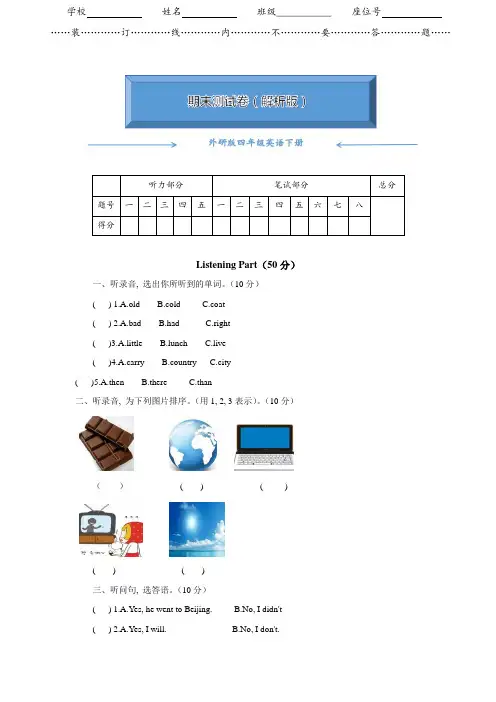
学校姓名班级___________ 座位号……装…………订…………线…………内…………不…………要…………答…………题……听力部分笔试部分总分题号一二三四五一二三四五六七八得分Listening Part(50分)一、听录音, 选出你所听到的单词。
(10分)( ) 1.A.old B.cold C.coat( ) 2.A.bad B.had C.right( )3.A.little B.lunch C.live( )4.A.carry B.country C.city( )5.A.then B.there C.than二、听录音, 为下列图片排序。
(用1, 2, 3表示)。
(10分)()( ) ( )( ) ( )三、听问句, 选答语。
(10分)( ) 1.A.Yes, he went to Beijing. B.No, I didn't( ) 2.A.Yes, I will. B.No, I don't.( ) 3.A.Yes, It was. B.No, I don't.( )4.A.Yes, It will. B.Yes, It can.( ) 5.A.She is my little sister. B.He's my little brother.四、听录音, 补全句子。
(10分)1.Yesterday Grandma _________ _________.2.They weren't _________then.They were_________.3.San Francisco is a _________city in America.4.This panda is _________, and that panda is ________.5.What happened _________ your _________ ?五、听录音, 排列顺序(10分)( ) It will be cold in Yinchuan.( ) Mount Tai is very famous.( ) This is Hyde park.( ) I like her bag.( ) This is my family.Writing Part(50分)一、看图写单词。
外研版(三起)-英语-四年级下册-【新课堂】Module1 Unit2教材同步讲解
【新课堂】Module1 Unit2教材同步讲解1.Listen and chant.听一听,说唱。
(教材第5页)课文英汉互译重难点精析一、she's的用法1.she's a nice teacher.她是一位好老师。
点拨:she's是she is的缩写形式,意为“她是”。
she's后可接名词,用于表示身份等。
例如:She's a doctor.她是一名医生。
She's my mother.她是我的妈妈。
知识拓展:she's后可接形容词,用于描述人物的特征、状态等。
例如:She's tall.她长得高。
She's happy.她很开心。
she's后可接数词,表示“年龄”。
例如:She's 11.她十一岁。
即学即用______Amy.A. She B.She's C.He's二、he's的用法2.he's very clever.他很聪明。
点拨:he's是he与is的缩写形式,意为“他是”。
例如:He's a driver.他是一名司机。
He's nice.他很好。
即学即用______very tall.A.He B.Is C.He's答案速查:1.B 2.C2.Listen and say.听一听,说一说。
(教材第5页)课文英汉互译naughty.朗读参考新词速记①aunt/a:nt/n.(名词)伯母;婶母;舅母;姨母短语:my aunt我的姑母例句:My aunt is young.我的姑母很年轻。
②uncle/'ʌŋkl/n.(名词)伯父;叔父;舅父;姑父短语:Uncle Tom汤姆叔叔例句:My uncle is a teacher.我的叔叔是一位教师。
③big/big/adj.(形容词)大的短语:a big city 一个大城市a big watermelon 一个大西瓜例句:Is this a big room?这是个大房间吗?反义词:small小的④cool/ku:l/adj.形容词)酷的;凉的例句:Your new bike is cool.你的新自行车真酷。
外研版小学四年级英语下学期知识点总结
四年级知识点总结Module 11.They are my friends. 因为they是人称复数他们,所以用are.2.This is Maomao. She’s very nice.This is Ms Smart. She is a nice teacher.This is Xiaoyong. He is a clever pupil.This is..... 介绍某人3.Can you answer the call? Can+动原4.This is my aunt. She is very nice./This is my uncle. He is very clever. This is my brother. He is cool./This is my sister. She is cute.This is my friend. He ‘s very naughty.This is ..... He’s/He’s.....Module 21.What’s this? 这是什么?(其答句要用It’s开头的句子)2.It’s a book about London. About 关于3.Is it your house?Yes, it is. No, it isn’t.一般疑问句用什么问用什么答4.Whose house is it? It’s the Queen’s house. Whose对谁的东西进行提问Queen’s house名词所有格,表示......的5.It’s close to the Queen’s house. Close to 靠近6.London Bridge is falling down. Be(am ,is, are)+v.ing 表示正在发生的事情。
现在进行时态。
Module 3.1.Sam can ride a bike. Amy can fly a kite. Can+ 动原ride a bike译为骑自行车。
外研版(三起)-英语-四年级下册-Module 2 Unit 1 London is a big city.教案
Module 2 Unit 1 London is a big city.教案一、教材分析本册教材共同分为11个模块,内含一个期末分析模块。
每个模块分两个单元。
一般,第一单元呈现要学习的语言内容,第二提供任务型练习,包括一首歌谣、歌曲或韵句。
歌谣和小诗的学习目的有三,一是培养学生的语感和节奏感,二是提高学生发音准确性,三是通过这些英语国家儿童所熟知的歌谣介绍一定的西方文化。
不常用单词不要求掌握。
希望学生结合语用和语词的基本语义,逐步获得最基本的运用英语的能力。
课文呈现了一些新的语法内容,但不要求讲解,更不要求学生掌握,只是要求初步运用这些语句。
教材注意选取了一些日常生活中学生熟悉、相对简单和容易理解的话题,学会使用形容词描述人的性格特征;学习一般将来时;一般过去式、学会提建议并参与讨论等。
本单元是整个模块教学的第一单元。
借助地图、图片认识英国的几个城市,练习使用big small beautiful等形容词介绍其他城市或者自己的家,自己的学校。
二、学情分析学情分析: 本课授课对象是四年级学生,他们活泼好动,有着丰富的想象力和好奇心,对游戏、歌曲等活动特别感兴趣。
也因为有一定的英语基础,他们的表现欲很强。
他们对外面的世界,特别是外国的模样充满兴趣。
因此我查找了生动形象的图片及视频,吸引学生的注意力。
营造愉悦、快乐的课堂氛围,充分调动学生参与活动的积极性,使学生在亲身体验中展开有效的学习,保持学习英语的欲望和兴趣,从而提高英语学习的效率。
本课讲述的是玲玲和艾米一起看书,这是一本有关英国伦敦的书。
在看书的过程中,玲玲向艾米询问书中的建筑,并对其中的建筑物进行描述,同时艾米也进行了相应的介绍。
学生通过本课的学习增强了跨文化交际意识,提高了跨文化交际能力。
三、教学目标1、语言技能听:全体学生能听懂:London is a big city. My house is very small, but it`s beautiful. It`s very old.说:全体学生能说:London is a big city . My house is very small, but it`s beautiful. It`s veryold.读:全体学生能认读:city, ship ,beautiful,whose ,close, old写:全体学生能拼写2-3个自选词语2、语言知识功能:描述一座城市、一处景物或一件物品。
最新外研版小学四年级英语下学期知识点总结
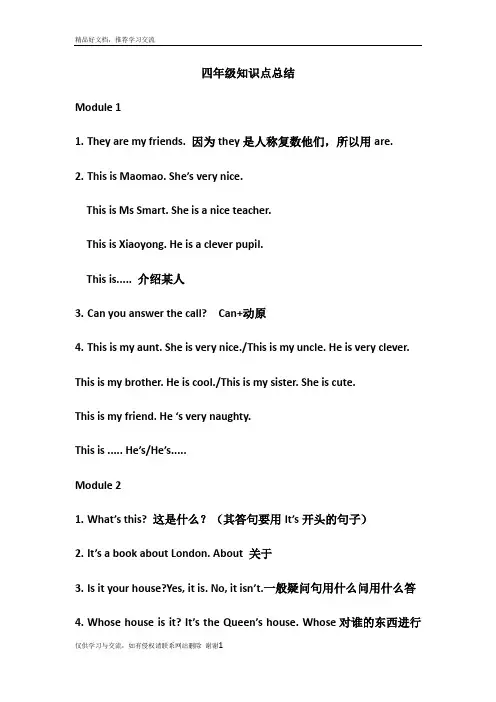
四年级知识点总结Module 11.They are my friends. 因为they是人称复数他们,所以用are.2.This is Maomao. She’s very nice.This is Ms Smart. She is a nice teacher.This is Xiaoyong. He is a clever pupil.This is..... 介绍某人3.Can you answer the call? Can+动原4.This is my aunt. She is very nice./This is my uncle. He is very clever. This is my brother. He is cool./This is my sister. She is cute.This is my friend. He ‘s very naughty.This is ..... He’s/He’s.....Module 21.What’s this? 这是什么?(其答句要用It’s开头的句子)2.It’s a book about London. About 关于3.Is it your house?Yes, it is. No, it isn’t.一般疑问句用什么问用什么答4.Whose house is it? It’s the Queen’s house. Whose对谁的东西进行提问Queen’s house名词所有格,表示......的5.It’s close to the Queen’s house. Close to 靠近6.London Bridge is falling down. Be(am ,is, are)+v.ing 表示正在发生的事情。
现在进行时态。
Module 3.1.Sam can ride a bike. Amy can fly a kite. Can+ 动原ride a bike译为骑自行车。
Module1Unit2He'scool.(教学设计)外研版(三起)英语四年级下册

教学设计:外研版英语四年级下册 Module 1 Unit 2 He's cool.一、教学目标1. 知识目标(1)能够听懂、会说、会读本课的生词和重点句子。
(2)能够运用所学知识介绍人物的特点。
2. 能力目标(1)能够熟练运用一般现在时描述人的性格和外貌特点。
(2)能够通过小组合作,完成角色扮演活动。
3. 情感目标培养学生的合作意识,提高学生对英语学习的兴趣。
二、教学内容本课主要讲述了一群学生在介绍自己的朋友,并描述了他们的性格和外貌特点。
重点句子为:“He’s cool.”和“She’s friendly.”,生词有:cool, friendly, kind, quiet, tall, short, fat, thin等。
三、教学重点与难点1. 重点:能够听懂、会说、会读本课的生词和重点句子。
2. 难点:一般现在时的运用,以及如何描述人的性格和外貌特点。
四、教具与学具准备1. 教具:PPT、录音机、磁带。
2. 学具:课本、练习册、单词卡片。
五、教学过程1. 导入:通过歌曲“Hello, hello, who are you?”引导学生唱歌曲,激发学生的学习兴趣。
2. Presentation:教师通过PPT展示本课的生词和重点句子,让学生跟读并模仿。
3. Practice:学生分组进行角色扮演,模拟对话场景,练习本课的生词和句子。
4. Production:学生分组,每组选择一个角色,用本课所学知识介绍角色的人物特点。
六、板书设计板书设计如下:Module 1 Unit 2 He's cool.生词:cool, friendly, kind, quiet, tall, short, fat, thin 重点句子:He's cool. She's friendly.七、作业设计1. 抄写本课生词和重点句子,每个词写5遍。
2. 用本课所学知识,写一篇关于自己朋友的文章。
四年级下英语教学设计-Module1Unit2He’scool-外研版(三起)
四年级下英语教学设计Module 1 Unit 2 He’s cool 外研版(三起)教学内容:本节课为四年级下学期英语课程,教学内容选自外研版(三起)教材,Module 1 Unit 2 "He’s cool"。
本单元围绕人物描述,学习如何用英语表达人物的外貌特征和性格特点。
主要词汇包括:cool, funny, clever, cute, friendly等。
语法点为形容词的使用,用于描述人物特征。
教学目标:1. 学生能够理解并正确使用本单元的形容词词汇,如cool, funny, clever, cute, friendly等。
2. 学生能够运用所学词汇和句型,对人物进行简单的描述。
3. 培养学生的英语听说能力,提高其英语交际能力。
4. 增强学生对英语学习的兴趣,培养其合作学习的意识。
教学难点:1. 形容词的正确使用和发音。
2. 人物描述的句型结构和语法规则。
3. 学生对形容词词汇的理解和记忆。
教具学具准备:1. 教材。
2. 多媒体设备,用于播放课件和视频。
3. 形容词词汇卡片。
4. 人物图片,用于描述练习。
5. 黑板和粉笔。
教学过程:1. 导入:通过展示一些名人或动画人物的图片,引导学生用中文描述这些人物的特点,引入本节课的主题。
2. 新课呈现:通过课件展示本单元的形容词词汇,引导学生学习词汇的发音和用法。
然后,通过示例句型,展示如何用这些形容词描述人物。
3. 练习:学生分组进行练习,每组选择一张人物图片,用所学形容词和句型进行描述。
教师巡回指导,纠正发音和语法错误。
4. 小组展示:每组选派一名代表,向全班展示他们的小组练习成果。
其他学生认真听,并给予评价。
6. 作业布置:布置相关的作业,巩固本节课的学习内容。
板书设计:1. Module 1 Unit 2 He’s cool2. 主要形容词词汇:cool, funny, clever, cute, friendly等。
外研版(三起)-英语-四年级下册-【新课堂】Module2 Unit2 教材同步讲解
【新课堂】Module2 Unit2教材同步讲解(教材11~13页)1.Listen,point and say.听一听,指一指,说一说。
(教材第11页)课文英汉互译新词速记①home/həum/n.(名词)家短语:my home我的家例句:That is his home.那是他的家。
同义词:family家,家庭②old/əu1d/adj.(形容词)年长的,古老的,破旧的短语:an old man老人old age老年old society旧社会例句:The book is very old.这本书很古老。
反义词:young年轻的new新的③famous/'feiməs/adj.(形容词)著名的,出名的短语:be famous for因……而闻名例句:China is famous for the Great Wall.中国因长城而闻名。
即学即用根据汉语提示完成句子1.His ______(家)is near.2.He is a ______(著名的)writer.3.My grandpa is ______(年老的).答案速查:1.home 2.famous 3.old重难点解析old的用法It's old.它很古老。
点拨:old作形容词,意为“老的,年老的,古老的”,其反义词为young(年轻的)。
例如:He is old. His son is young.他很老。
他的儿子很年轻。
old还可指“旧的”,其反义词为new(新的)。
例如:My shirt is old. Her shirt is new.我的衬衫旧。
她的衬衫新。
即学即用Her grandma is old, but she is______.A. new B.old C.young答案速查:C2.Listen and say.听一听,说一说。
(教材第11页)课文英汉互译very famous.Lingling: And it's very beautiful too.玲玲:它也很漂亮。
2021年外研版四年级下册Module 9 Unit 1练习题及答案
Module 9 Unit 1 Did he live in New York?一、单项选择。
( ) 1. It's a postcard ________ my friend.A. inB. fromC. at( ) 2. Do your parents live ________ New York?A. inB. onC. at( ) 3. We ________ here by train yesterday.A. comeB. cameC. comes( ) 4. Did you ________ to Hong Kong last year?A. goB. wentC. goes( ) 5. They want ________ Beijing .A. visitB. visitedC. to visit二、根据图片提示,从方框中选择正确的答语。
( ) 1 . Did he visit the Great Wall ?( ) 2 . Did Daming travel by plane?( ) 3 . Does he live in New York?( ) 4 . Did they play football yesterday?( ) 5 . What did they do last week?三、用正确的介词填空。
1. We live ________ Changsha.2. Welcome ________ our school.3. It's a postcard ________ my friend.4. Tom travelled ________ train last year.5. My parents are ________ holiday in Sanya.四、根据所给图片判断句子或对话的对(√)错(×)。
() 1. I came here by plane.() 2. —Did he travel by train —No, he didn’t. He travelled by bus.() 3. —Did Fangfang visit Beijing?—Yes, she did.() 4. Welcome to England!参考答案一、1. B 2. A 3. B 4. A 5. C二、1. B 2. E 3. A 4. C 5 . D三、1. in 2. to 3. from 4. by 5. on四、1.√ 2.× 3.√ 4.×Module 9 Unit 2 Did you have a nice holiday?一、根据汉语提示完成句子。
外语教学与研究出版社四年级英语下册英语课程说明书
外语教学与研究出版社四年级英语下册《课程说明书》班级:教师:学校:时间:外语教学与研究出版社四年级英语下册《课程说明书》课程名称:小学英语课程类型:基础型课程教材名称:外语教学与研究出版社四年级(下册)课时:29课时任课教师:课程目标:1、对英语有好奇心,喜欢听他人说英语2、能根据教师的简单指令做游戏、做动作、做事情(如涂颜色、连线)3、能做简单的角色扮演4、能唱简单的英文歌曲,说简单的英语歌谣5、能在图片的帮助下听懂和读懂简单的小故事6、能交流简单的个人信息,表达简单的情感和感觉7、能正确书写字母和单词8、对英语学习中接触的外国文化习俗感兴趣课程内容:课程实施:1、教师教学要求(1)教学方面:结合本校四年级学生学习的特点,在教学中要求教师采用“任务型”为主的教学途径,充分利用教学资源,采用听、做、说、唱、玩、演的方式,鼓励学生积极参与,大胆表达,侧重提高小学生对语言的感受和初步用英语进行听、说、唱、演的能力。
(2)作业方面:课后作业的目的是为了复习巩固已学内容,可分口头、书面两种。
作业量要保证中等学生用15分钟左右可以完成,尝试分层设置作业。
书面作业做到全批全改,批改做到及时和规范。
错的地方要求学生及时订正。
批改时应统一使用激励机制,可用贴画、ABC 不同等级。
当面批评要做好批改记录和讲评工作。
2、学生学习要求教学过程中应要求学生以独学、对学、群学的学习方式为主,通过思考、调查、讨论、交流和合作等途径,学习和使用英语,完成教师布置的学习任务。
3、课外活动要求结合四年级学生语言水平和年龄特点开展课外活动,举办朗诵、唱歌、讲故事、演讲等活动。
鼓励和帮助学生成立课外英语兴趣小组,保护学生的好奇心,培养他们的自主性和创新意识。
课程评价:1、评价指标:(1)提前预习的情况。
看学生凭借已有的知识和经验,在自学阶段的学习理解情况。
(2)课堂学习状态。
看学生在课堂学习过程中,是否积极主动,情绪是否饱满,思维是否活跃。