
人教版八年级英语下册单元知识点总结
1 八年级(下)英语知识讲解(人教)
每单元均有重要的字、词的辨析及重要语句的分析与用法指导;有课文中的难重点分析与讲解;有针对性的训练及同步检测题,并且附有详细的解答。目录
1 Unit 1 Will people have robots?
2 Unit 2 What should I do?
3 Unit3 What were you doing when the UFO arrived?
4 Unit 4 He said I was hard-working.
5 Unit 5 If you go to the party, you‘ll have a great time!
6 Review of units 1-3
7 Review of units 4-5
8 八年级下学期期中复习(一)
9 改错小练
10 八年级下学期期中复习(二)
11 八年级期中考试模拟题
12 Unit 6 How long have you been collecting shells?
13 Unit 7 Would you mind turning down the music?
14 Unit 8 Why don‘t you get her a scarf?
15 Unit 9 Have you ever been to an amusement park?
16 Unit 10 It‘s a nice day, isn‘t it?
17 介词复习
18 Review of units 6-8
19 Review of units 9-10
20 八年级第二学期期末复习题
21 八年级第二学期期末模拟试题
22 How do you study for a test
23 Unit2 I used to be afraid of the dark
Unit 1
Will people have robots?
II. Grammar:
·一般将来时
·there will be ·few,a few,little,a little,much,many
语法小结:
一、一般将来时
1.用be doing表示将来:主要意义是表示按计划、安排即将发生的动作,常用于位置转移的动词。 2 如:go,come,leave,arrive等,也可用于其他动作动词。
We are having fish for dinner.
We are moving to a different hotel the day after tomorrow.
这种用法通常带有表示将来的时间状语,如果不带时间状语,则根据上下文可表示最近即将发生的动作。
A: Where are you going? B: I am going for a walk. Are you coming with me?
A: Yes,I am just coming. Wait for me.
2.用be going to do表示将来:主要意义,一是表示―意图‖,即打算在最近的将来或将来进行某事。
Are you going to post that letter?
How long is he going to stay here?
I am going to book a ticket.
另一意义是表示―预见‖,即现在已有迹象表明将要发生或即将发生某种情况。
It‘s going to rain.
George is putting on weight; he is going to be quite fat.
3. 用will/ shall do表示将来:
主要意义,一是表示预见。
You will feel better after taking this medicine.
Do you think it will rain?
二是表示意图.
I will not lend the book to you.
Take it easy,I will not do it any longer.
基本结构:
She will come to have class tomorrow.
Will she come to have class tomorrow?
She won‘t come to have class tomorrow.
What will she do tomorrow?
二、There be结构
1. there be 结构中的be是可以运用各种时态的。
There is going to be a meeting tonight. 今晚有个会议。
There was a knock at the door. 有人敲门。
There has been a girl waiting for you. 有个女孩一直在等你。
There will be rain soon. 不久天就要下雨了。
2. 动词be单复数形式要跟there be之后的真正的主语一致。并且要根据就近一致原则来变换be的单复数形式。
如There is a book on the desk. 课桌上有一本书。
How many people are there in the city? 这个城市里有多少人口?
There is a pen and two books on the desk. 课桌上有一个钢笔和两本书。
There are two books and a pen on the desk. 课桌上有两本书和一个钢笔。
There are some students and a teacher in the classroom.教室里有一些学生和一位老师。 3 There is a teacher and some students in the classroom. 教室里有一位老师和一些学生。
3. 在there be引起的句子结构中,用来修饰主语的不定式主动形式和被动形式均可。
There is no time to lose (=to be lost). 时间紧迫。
There is nothing to see (=to be seen). 看不见有什么。
There is nothing to do. (=to be done) 无事可做。
4、There is no doing.
(口语)不可能…….
There is no telling when he will be back. 无法知道他什么时候回来。
There is no knowing what he is doing. 无法知道他在做什么。
三、课文难句解析
1. Will people use money in 100years? 一百年后人们还会使用钱币吗?
1) money 金钱;货币
eg. What's the money? 价钱是多少?
paper money 纸币;钞票
2) in 100 years 在100年之后
―in+一段时间‖常用在将来时态中
eg. I'll come in an hour. 我一小时后来。
I'll see you again in three days. 三天后我再见你。
2. There will be less leisure time.空闲时间会更少。
1) less 形容词:较少的(是little的比较级),修饰不可数名词,其最高级是least;反义词是more。
eg. Jane's less beautiful than Mary. 简不如玛丽漂亮。
Five is less than six. 5比6少。
2) leisure time 空闲时间
eg.What do you do in your leisure time? 你空闲时间做些什么?
3. I think there will be more pollution. 我认为将会有更多的污染产生。
1) think后跟的是宾语从句,且宾语从句是there be句型的一般将来时,结构为―there will
be+物+其他成分‖。
eg. I think it will rain tomorrow. 我认为明天会下雨。
I think there will be fewer trees. 我认为将来树木会更少。
2) pollution表示―污染‖,用作不可数名词。
例如:They did a lot to stop water pollution.他们采取大量措施制止水污染。
4. I don't agree. 我不同意。
agree在本句中作动词,I don't agree.是一句交际用语,表示―不赞成某人或某人的观点‖,如果表赞成,则为I agree。
1) 表示―同意某人意见‖时用agree with sb,该短语不能用于被动语态。
eg. Did you agree with him? 你同意他的意见吗?
I don't agree with what she said. 我不同意她所说的。
2) 表示―同意(某计划、办法、建议、条件)‖时,用agree to(to在此用作介词,其后接名词、代词或者相当于名词的成分),该短语可以用于被动语态。 4 eg.I agree to your idea. 我同意你的想法。
My plan was agreed to by all of them. 他们所有的人都同意我的计划。
3) 表示―就……取得一致意见‖用agree on(或upon),指―两者或两者以上的商定,达成协议‖。
eg.They both agreed on the date for the meeting.他们双方都同意开会的日期。
4) agree后还可以接不定式,不接动名词,表示―同意做某事‖。
eg.They agreed to leave tomorrow afternoon.他们同意明天下午动身。
5. What do you think Sally will be in five years? 你认为萨莉5年之后将会是什么样子?
人教版八年级英语下册第八单元重点知识点梳理

人教版八年级英语下册第八单元重点知识点梳理
Unit 8
一、重点短语
1.go out to sea出海
2.grow up长大
3.put…down放下;记下
4.at least至少
5.hurry up赶快;急忙(做某事)
6.on the island在岛上
7.bring back带回
8.cut down trees砍倒树
9.on the sand在沙滩上
10.not long after that不久之后
11.a piece of land一块陆地
12.come to realize逐渐意识到
13.ever since自从
14.the importance of………的重要性
15.one another彼此;相互
16.do some research做一些研究
17.science fiction科学小说(或影片等)
18.at the end of the day在一天结束的时候
19.belong to属于
20.trust one another相互信任
二、重点句型
1.—Have you read Little Women yet?你读过《小妇人》吗?
—Yes,I have./No,I haven't.是的,我读过。/不,我没有。
2.—Has Tina read Treasure Island yet?蒂娜读过《金银岛》这本书吗?
—Yes,she has.She thinks it's fantastic.是的,她读过。她觉得它很棒。 3.Would you like something to drink?你要来点喝的吗?
4.I heard you lost your key.我听说你丢钥匙了。
5.She came to realize how much she actually missed all of them.她开始意识到,事实上她是多么想念他们所有的人。
人教版八年级英语下册Unit-1--Unit-3-单元知识点归纳
人教版八年级英语下册Unit-1--Unit-3-单元知识点归纳
free【动词】使……解脱,得到自由He could not free his arm.
free from
21. run out用完,用尽 When his water run out, he knew that he would have to do
something to save his own life.
物sth. tun out. 某物用尽了。 人sb. run out of物sth..人用尽了某物。He run out of all
his money last night.
22. risk sth to do sth. 冒着...的风险去做某事 take a risk=take risks 冒险
risk doing ...=take the risk of doing ...
23. the importance of (doing) sth.(做)某事的重要性 We students should know the
importance of (learning) English.
importance n. 重要(性), important adj.重要的,unimportant adj.
24. decision 【名词】决定;抉择; make a decision to do sth.
decide
25. be in the control of …掌管,管理 The headmaster is in the control of this new school.
be out of control无法控制,无法管理 be under control被控制住,在控制之中
26. 【复习】mind意为 介意 , Would you mind my opening the window?
最全面人教版八年级下册英语第一单元知识点归纳总结
Unit 1 What's the matter?
一、词汇与短语
◆ 重点单词
A部分
1.matter n. 问题;事情 2.sore adj. 疼痛的;酸痛的
3.stomachache n. 胃痛;腹痛 4.foot n. 脚;足
5.neck n. 颈;脖子 6.stomach n. 胃;腹部
7.throat n. 咽喉;喉咙 8.hurt v. (使)疼痛;受伤
9.fever n. 发烧 10.passenger n. 乘客;旅客
11.lie v. 躺;平躺 12.break n. 间歇;休息
13.rest v. & n. 放松;休息 14.onto prep. 向;朝
15.X-ray n. X射线;X光 16.trouble n. 问题;苦恼
17.toothache n. 牙痛 18.hit n. (用手或器具)击;打
19.headache n. 头痛 20.herself pron. (she的反身代词)她自己
21.off adv. & prep. 离开(某处);不工作;从……去掉
B部分
1.bandage n. 绷带 v. 用绷带包扎 2.press v. 压;挤;按
3.sick adj. 生病的;有病的 4.knee n. 膝;膝盖
5.breathe v. 呼吸 6.knife n. 刀
7.sunburned adj. 晒伤的 8.blood n. 血
9.ourselves pron. (we反身代词)我们自己 10.mean v. 意思是;打算
11.climber n. 登山者;攀登者 12.importance n. 重要性;重要
13.risk n.&v. 危险;风险;冒险 14.decision n. 决定;抉择
15.accident n.(交通)事故;意外遭遇 16.control v.&n. 限制;约束;管理
人教版Go for it!八年级下册英语各单元知识点总结
人教版Go for it!八年级下册英语各单元知识点总结
Unit 1 What’s the matter?
重点:1、态动词should & shouldn’t 的用法;2、have + 疾病;3. 反身代词的用法。
难点:能询问并表述身体的种.种不适以及对他人身体的种.种不适给予适当的建议。
知识点:
What’s the matter? 怎么了? What’s the matter with you? = What’s the trouble with you? = What’s wrong with you? 你怎么了?
have a cold = catch a cold 感冒 have a stomachache 胃痛 have a
sore + 部位 „„痛 lie down 躺下
take one’s temperature 量体温 have a fever 发烧 have a cough 咳嗽 take breaks 休息
get an X-ray 拍X光片 away from 远离
on the side of the road 在马路边 shout for help 大声呼救 get off 下车
to one’s surprise 出乎某人意料 thanks to 多亏;由于 in time 及时
right away 马上,立即
get into 陷入
get into trouble 陷入困境 have a toothache 牙痛 put one’s head
down 低头 have a nosebleed 流鼻血
put a bandage on sth. 用绷带包扎 get hit on the head 砸到头(注意v. + on the + 身体部位的表达方达) be interested in 对„„感兴趣
There were many times when „ (when 引导的定语从句)
人教版八年级英语下册知识点总结
人教版八年级英语下册知识点总结
Unit1What’sthematter
【重点单词】
matter[mt]v.重要,要紧,有关系
What’sthematter怎么了?出什么事了?
sore[s:(r)]adj.疼痛的,酸痛的
haveacold感冒
stomach['stmk]n.胃,腹部
stomachache['stmkek]n.胃痛,腹痛
haveastomachache胃痛
foot(复数feet)[fu:t]n.脚
neck[nek]n.颈,脖子
throat[θrt]n.喉咙
fever['fi:v]n.发烧,发热
lie[la]v.躺,平躺
liedown躺下
rest[rest]n.剩余部分,其余;放松,休息
cough[kf]n.&v.咳嗽
X-ray['eksre]n.X光,X射线
toothache[tu:θek]n.牙痛
takeone'stemperature量体温
headache[hedek]n.头痛
haveafever发烧
break[brek]n.&v.休息,暂停;打破
takebreaks(takeabreak)休息
hurt[h:t]v.伤害,损害,使受伤
passenger['psnd]n.乘客,旅客
off[f]adv.prep.离开(某处);从…去掉
getoff下车
toone'ssurprise使…惊讶,出乎…意料
onto[nt]prep.向,朝
trouble[trbl]n.麻烦,烦扰,问题
hit[hit]n.&v.碰撞,打,打击
rightaway立即,马上
getinto陷入,参与 herself[h:self]pron.她自己,她本身(she的反身代词)
bandage['bndd]n.&v.绷带;用绷带包扎
sick[sk]adj.患病的,不适的
knee[ni:]n.膝盖
nosebleed[nzbli:d]n.鼻出血
breathe[bri:e]v.呼吸
人教版八年级下册英语第九单元知识点归纳总结
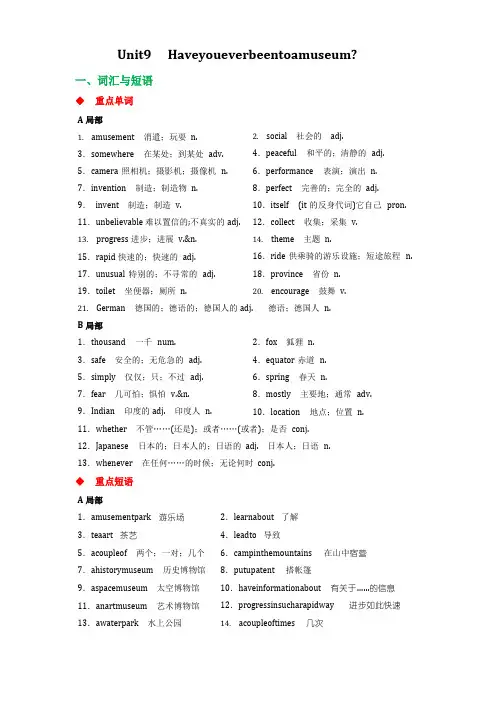
Unit9 Haveyoueverbeentoamuseum?
一、词汇与短语
◆ 重点单词
A 局部
1. amusement 消遣;玩耍 n.
3.somewhere 在某处;到某处 adv.
5.camera 照相机;摄影机;摄像机 n.
7.invention 制造;制造物 n.
9. invent 制造;制造 v.
2. social 社会的 adj.
4.peaceful 和平的;清静的 adj.
6.performance 表演;演出 n.
8.perfect 完善的;完全的 adj.
10.itself (it 的反身代词)它自己 pron.
11.unbelievable 难以置信的;不真实的 adj. 12.collect 收集;采集 v.
13. progress 进步;进展 v.&n.
15.rapid 快速的;快速的 adj.
17.unusual 特别的;不寻常的 adj.
19.toilet 坐便器;厕所 n. 14. theme 主题 n.
16.ride 供乘骑的游乐设施;短途旅程 n.
18.province 省份 n.
20. encourage 鼓舞 v.
21. German 德国的;德语的;德国人的 adj. 德语;德国人 n.
B 局部
1.thousand 一千 num.
3.safe 安全的;无危急的 adj.
5.simply 仅仅;只;不过 adj.
7.fear 几可怕;惧怕 v.&n.
9.Indian 印度的 adj. 印度人 n. 2.fox 狐狸 n.
4.equator 赤道 n.
6.spring 春天 n.
8.mostly 主要地;通常 adv.
10.location 地点;位置 n.
11.whether 不管……(还是);或者……(或者);是否 conj.
12.Japanese 日本的;日本人的;日语的 adj. 日本人;日语 n.
人教版八年级英语下册第九单元知识点汇总总结
人教版八年级英语下册第九单元知识点汇总总结
01、重点短语
1、 encourage sb. to do sth 鼓励某人做某事
2、 a couple of 两个,一对,几个
3、go to different places 去某个不同的地方
4、take the subway乘坐地铁
5、 lead to导致,促成
6、 learn about 了解到
7、put up a tent搭起帐篷
8、 in such a rapid way以如此迅速的方式
9、ways to improve…提高改善...的方法
10、a couple of times 几次
11、 hear of 听说,了解
12、 take a holiday度假
13、three quarters of 四分之三
14、an English-speaking country一个讲英语的国家
15、 will be able to 将能够
16、 have problems doing sth 做某事有困难
17、during the daytime在白天
18、one great thing about…关于...好的一面是
19、all year round 全年
20、on the one hand ,on the other hand一方面,另一方面
21、whether …or不管…还是…
02、重点句子
Grammar Focus 句子
1 Have you ever been to a science museum?
新人教版英语八年级下册 6单元重要知识总结
新人教版英语八年级下册 6单元重要知识总结
这份文档总结了新人教版英语八年级下册第6单元的重要知识点。
单词与短语
1. intelligent - 聪明的intelligent - 聪明的intelligent - 聪明的
2. dolphin - 海豚dolphin - 海豚dolphin - 海豚
3. carrier - 营养者;运输工具carrier - 营养者;运输工具carrier - 营养者;运输工具
4. species - 物种species - 物种species - 物种
5. oxygen - 氧气oxygen - 氧气oxygen - 氧气
6. environment - 环境environment - 环境environment - 环境
7. capture - 捕获capture - 捕获capture - 捕获
8. release - 释放release - 释放release - 释放
9. protect - 保护protect - 保护protect - 保护
10. electronic - 电子的electronic - 电子的electronic - 电子的
重要句型
1. ___. - 海豚是非常聪明的生物。Dolphins are very intelligent
creatures. - 海豚是非常聪明的生物。Dolphins are very intelligent
creatures. - 海豚是非常聪明的生物。
2. ___. - 这些海豚承载着重要的信息。These dolphins are
carriers of important information. - 这些海豚承载着重要的信息。These dolphins are carriers of important information. - 这些海豚承载着重要的信息。
人教版八年级英语下册全册知识点考点整理
八年级英语下册全册各单元知识点考点整理
Unit 1 what's the matter?
一、重点短语
1.too much太多
2.lie down躺下
3.get an X-ray做个X光检查
4.take one’s temperature量体温
5.put some medicine on......在....上敷药
6.have a fever发烧
7.take breaks/take a break休息
8.without thinking twice没多想
9.get off下车
10.take sb to the hospital送某人去医院
11.wait for等待
12.to one’s surprise使.......惊讶的
13.thanks to多亏于;由于
14.in time及时
15.think about考虑
16.have a heart problem患有心脏病
17.get into the trouble遇到麻烦
18.do the right thing做正确的事情事情
19.fall down摔倒
20.put......on sth把...放在某物上
21.get hit/sunburned摔伤/烧伤
22.be interested in对.....感兴趣
23.be used to习惯于....
24.take risks/take a risk挑战
25.lose one’s life失去生命
26.because of因为
27.run out of用完 28.cut off切除
29.get out of从...出来
30.make a decision/decisions做决定
31.be in control of掌管;管理
32.give up放弃
主要句型
1.It’s+形容词+for sb.+to do sth.做某事对某人来说是…的。
人教版英语八年级下册Unit8英语知识点总结
人教版英语八年级下册Unit8英语知识点总结
Unit 8 English Knowledge Summary
1.Island: on the island。an island。
An island is a piece of land surrounded by water。We use "on
the island" XXX" is used to refer to a specific island.
2.Full of: full of something。filled with something。
Full of" is often followed by a noun。which together form a
post-XXX。"Full of" is XXX "filled with." For example。"the
basket full of apples," "the cup full of water." "Full of" can also be
used with the verb "be" to form the XXX。"Be full of" is
equivalent to "be filled with." For example。"The classroom is full
of students" is the same as "The classroom is filled with students."
"The box is full of apples" is the same as "The box is filled with
apples."
3.Already and yet。 Already" is often used in the affirmative sentence of the
present perfect tense。and is placed after "have/has" and before