
科普版-英语-五下-5B Lesson6 Revision教案(第2课时)
5B Lesson6 Revision教案
第二课时
教学内容:Read and act 的后4段
A big carrot .
教学目标:
1、复习单词:house 、sleep 、out、face 、food 、carrot 、share 、better .
2、复习由Let 引导的祈使句。
3、学习词组:Much better, not well = ill .
Wash my face . have no food = have not any food , go out to play .
句子How are you doing = How are you ?
You are welcome = That’s OK
4、读一读,演一演,本课是以“一个胡萝卜”为题的小故事,要求能理解课文大意,能回答与课文内容相关的问题,并能根据图片及关键词进行复述并能表演。
教学重点:复习Let 引导的祈使句。
复习有关词组。
教学难点:根据图片复述并表演课文。
教具:单词卡片,教学图片,录音机,多媒体。
教学过程:
Step 1 热身
A:sing a song .
B:自由对话:What are you doing ? I’m sleeping.
Let’s play games. OK .
Step 2 复习检查.
A:复习上一课时所学的8个生词,其中house , sleep , out , face , food 这5个单词由教师说中文学生写英文。
而carrot, share ,better 这三个单词由教师说英文学生写出中文。
B:复习对话:学生两人一组朗读上一课时所学的Read and act, 然后进行复述,最后两人一组进行表演。
Step 3 导入新课:
A:学习词组和句子:板书:wash my face , have no food , not well , much better , go out to play , How are you doing ? you are wellcome.
教师领读几遍并让学生译成中文,教师可适当讲解并让学生试着造句。
B:复习Let 引导的祈使句。
采用教师说英文,学生说中文的方法。
教师说:“Let ‘s eat the carrot togeth er .” 学生说:“咱们一起吃胡萝卜吧!”教师接着说:“Let’s share the carrot with Mr Horse”.学生回答:“咱们和马先生一起分享胡萝卜吧!”等。
C:导入Read and act 的后四段采用讲故事的方法导入:今天我继续给大家讲一个“胡萝卜”的小故事,上一课我们说到小兔和小猪要和绵羊一起吃胡萝卜,那么,他们究竟吃了没有。
请听录音(两遍)。
老师接着讲,噢,绵羊又说马生病了,他也没有食物,然后他们一起看马,并与马同吃了胡萝卜。
通过这个故事,要引导学生,从小养成“关心他人,助人为乐”的好习惯。
D:电脑操作,通过多媒体出示幻灯片,并且让绵羊做出洗脸的动作,当小兔问它“你饿吗?”绵羊说:“Yes,but I have no food .” 以同样的方法出示第6、7、8张幻灯片。
根据绵羊提意,要与生病的马一起分享这个胡萝卜,最后他们吃完后高兴地出去玩。
E:按顺序把幻灯片再逐一放一遍,并逐句跟说,使学生对全文有一个整体的印象。
F:打开课文,听录音(两遍),然后老师逐句读,让学生跟说并译成中文。
Step 4 操练巩固
首先,教师领读,然后让全班同学逐段齐读,再抽查个别学生读。
最后请同学们自读课文,回答相关的问题。
①What is Miss Sheep doing ?
②Does Missi Sheep have food ?
③Who is not well ?
④Do they want to share the carrot with Mr Horse .
⑤How is Mr Horse doing ?
⑥Is Mr Horse much better now ?
⑦Do they want to go out to play together ?
B:⑴教师出示图片,并写出关键词,然后一段一段地进行操练。
⑵教师放录音,学生逐句跟读。
⑶让学生齐读,同桌互相读,个人读。
⑷找学生分角色含有表演意味地读。
⑸根据所给的关键词复述,第一段完成以后,再进行下一段,直到四段全部结束后,再把四段连起来复述,复述的顺序是先个人再集体再个人的方式进行。
Step 5Homework
把Read and act 分成两部分,前四幅图为第一部分,后四幅图为第二部分,第一部分两人一组,第二部分四人一组,让他们课后自由结合,进行练习。
下一节课找学生进行表演。
板书:
Lessons Six A big carrot
Wash my face have no food
Not well much better
go out to play
How are you doing ?You are welcome .
课后反思:
①本节课着重复习了由Let引导的祈使句,在这个教学过程中,只强调了老师说英语让学生说汉语这个环节,即忽视了让学生说英语这个环节,在整个教学过程中,应尽量给学生提供多说英语的机会。
②前面复习时间不易过长,应给学生留较长的时间读课文,然后独立完成根据课文回答的问题。
应引导他们在英语学习过程中更大限度发挥自主学习的能力。
五年级(下)英语公开课-Lesson 6 Revision Lesson 1 词汇小练习 科普版课件

精编优质课PPT五年级(下)英语公开课 -Lesso n 6 Revision Lesson 1 词汇小练习 科普版获奖课件推荐下载
词汇小练习
Fill in the blanks.
精编优质课PPT五年级(下)英语公开课 -Lesso n 6 Revision Lesson 1 词汇小练习 科普版获奖课件推荐下载
ห้องสมุดไป่ตู้
on under beside near in
_____ the teddy bear is a bag. There is a desk _____ the window. There are some books and a pencil box _______ the desk.
精编优质课PPT五年级(下)英语公开课 -Lesso n 6 Revision Lesson 1 词汇小练习 科普版获奖课件推荐下载
4. The ________(路灯)was on when I ________(穿 过)the street.
5. The ________(清洁工)thinks his ________(工 作)is very ____________(有趣的).
精编优质课PPT五年级(下)英语公开课 -Lesso n 6 Revision Lesson 1 词汇小练习 科普版获奖课件推荐下载
词汇小练习
Let’s have a look at what we’ve learnt.
③ key words speak afternoon put must street light cousin answer blackboard pupil forty paper dirty live Ms. farm easy interesting kind hospital thirty
五年级下册科普版英语2课

五年级下册科普版英语2课Five Years of Science: Exploring the World in Fifth GradeIntroduction:In the exciting world of science, fifth graders embark on a journey to deepen their understanding of the natural phenomena that shape our world. The fifth-grade science curriculum offers students a comprehensive overview of various scientific topics, enabling them to develop a strong foundation in scientific principles and critical thinking. This article will explore the various areas of study covered in the second lesson of the fifth-grade science curriculum, as outlined in the Science Popularization English Version textbook.Lesson 2: The Water CycleThe second lesson in the fifth-grade science curriculum delves into the fascinating topic of the water cycle. Throughout this lesson, students will learn about the continuous movement of water on Earth, transitioning between the atmosphere, land, and bodies of water. The water cycle is a fundamental process in maintaining the delicate balance of our planet's ecosystems. By understanding this concept, students can gain a deeper appreciation for the vital role water plays in their everyday lives.Exploring the Water Cycle:1. Evaporation: The lesson begins by introducing the process of evaporation, where water changes from a liquid to a gas state due to heatenergy from the sun. Through evaporation, water molecules rise into the atmosphere, forming water vapor.2. Condensation: Students then learn about condensation, which occurs when water vapor cools and transforms back into liquid water. This process is responsible for the formation of clouds in the sky.3. Precipitation: The lesson continues with a discussion on precipitation, where condensed water droplets combine and fall from the atmosphere back to the Earth's surface. Precipitation takes various forms, including rain, snow, hail, and sleet.4. Collection: The final stage of the water cycle is collection, where surface runoff and groundwater flow into bodies of water such as rivers, lakes, and oceans. This replenishes the Earth's water sources, enabling the cycle to continue.Importance of the Water Cycle:Understanding the water cycle is crucial as it explains how water moves and distributes itself across the Earth. It highlights the interconnections between different natural systems, such as weather patterns, plant growth, and the availability of freshwater. The knowledge gained in this lesson equips students to comprehend the significance of water conservation and the impact of human activities on the water cycle.Practical Applications:The water cycle has practical implications in our daily lives. Students can apply their understanding of evaporation and condensation to explain phenomena such as foggy windows, the formation of rainbows, or theoccurrence of dew on grass. By recognizing the water cycle's influence, students are encouraged to observe their surroundings with a scientific lens, fostering critical thinking skills.Conclusion:As students delve into the second lesson of the fifth-grade science curriculum, they unlock the mysteries of the water cycle. The knowledge gained not only broadens their understanding of the natural world but also nurtures their scientific curiosity. By exploring the water cycle, fifth graders develop skills that will serve as building blocks for future scientific endeavors. Let us embrace the wonder of science and continue to explore the myriad of possibilities that await us.。
三年级下册英语教案Unit 6 Revision 第二课时_科普版(三起)-最新教学文档

Unit 6 Revision 第二课时Teaching topic: Say and reciteTeaching material analysis:(教材分析)1)Review the new words:hungry little open, door, who, grandma, wait, we ,him ,hut.2)Retell the story about this text.Goal request:(教学目的)Review the new words: hungry ,little, open, door, who, grandma, wait, we ,him ,hut.Key difficulty:(重点难点)Master the new words: hungry little wait we himwho hut grandmaTeaching times:(教学时间)1Teaching methods : (教学方法)three doubts three searchesTeaching aid study:(教学工具)cards, tapeTeaching process:(教学过程)Step 1设疑自探(5 minutes)1、复习上节学过的单词……Today we go on learning Unit Six.2、Please look at say and recite.T: Can you read them? What’s the meaning of them?Ss: Sorry, we don’t know.T: Now please talk about them in four, OK?Ss: OKStep 2解疑合探(15 minutes)1、 Choose someone to read them. If there is something wrong, the teacher should correct it. Then let the Ss read after the teacher, make sure all of the students can read them fluently.2、Choose someone to translate it .3、Practice in pairs.4、Say and recite.Step 3质疑再探(15 minutes)About this Unit, what else do you want to ask? Step 4运用拓展(5 minutes)选择。
牛津苏教版-英语-五下-(牛津苏教版)5B Unit 6 A PE lesson教案(第五课时)
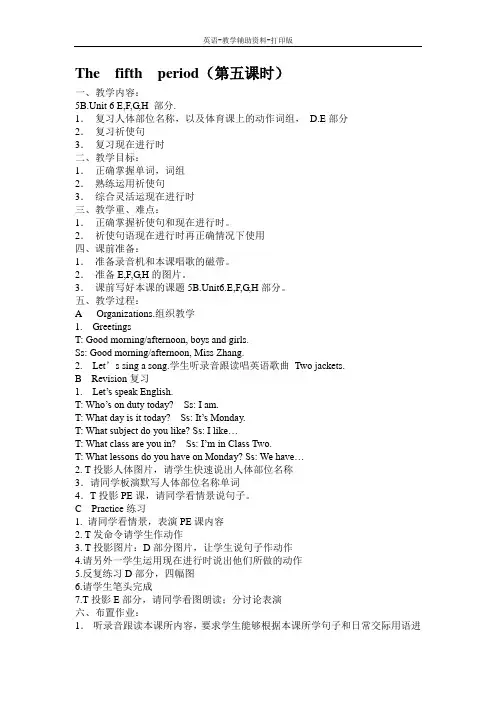
The fifth period(第五课时)一、教学内容:5B.Unit 6 E,F,G,H 部分.1.复习人体部位名称,以及体育课上的动作词组,D.E部分2.复习祈使句3.复习现在进行时二、教学目标:1.正确掌握单词,词组2.熟练运用祈使句3.综合灵活运现在进行时三、教学重、难点:1.正确掌握祈使句和现在进行时。
2.祈使句语现在进行时再正确情况下使用四、课前准备:1.准备录音机和本课唱歌的磁带。
2.准备E,F,G,H的图片。
3.课前写好本课的课题5B.Unit6.E,F,G,H部分。
五、教学过程:A Organizations.组织教学1. GreetingsT: Good morning/afternoon, boys and girls.Ss: Good morning/afternoon, Miss Zhang.2. Let’s sing a song.学生听录音跟读唱英语歌曲Two jackets.B Revision复习1. Let’s speak English.T: Who’s on duty toda y? Ss: I am.T: What day is it today? Ss: It’s Monday.T: What subject do you like? Ss: I like…T: What class are you in? Ss: I’m in Class Two.T: What lessons do you have on Monday? Ss: We have…2. T投影人体图片,请学生快速说出人体部位名称3.请同学板演默写人体部位名称单词4.T投影PE课,请同学看情景说句子。
C Practice练习1. 请同学看情景,表演PE课内容2. T发命令请学生作动作3. T投影图片:D部分图片,让学生说句子作动作4.请另外一学生运用现在进行时说出他们所做的动作5.反复练习D部分,四幅图6.请学生笔头完成7.T投影E部分,请同学看图朗读;分讨论表演六、布置作业:1.听录音跟读本课所内容,要求学生能够根据本课所学句子和日常交际用语进行自编会话,同桌表演。
四年级下册英语教案-Lesson6Revision科普版(三起)
四年级下册英语教案Lesson 6 Revision 科普版(三起)教学内容本课为科普版四年级下册英语第6课的教学内容,主题为“ Revision”,旨在通过复习前面所学知识,巩固和加深学生对英语知识的理解和运用。
教学内容涵盖词汇、语法、阅读和写作四个方面,包括对前五个课时所学单词、短语、句型的回顾,以及对阅读和写作技巧的复习。
教学目标1. 让学生通过复习,巩固和加深对前五个课时所学英语知识的理解和运用。
2. 培养学生的英语阅读和写作能力,提高学生的英语综合运用能力。
3. 培养学生的合作意识和自主学习能力,提高学生的学习兴趣。
教学难点1. 对前五个课时所学英语知识的理解和运用。
2. 英语阅读和写作技巧的掌握。
3. 学生的合作意识和自主学习能力的培养。
教具学具准备1. 教师用书、学生用书。
2. 课件、投影仪。
3. 学生自备学习用品。
教学过程1. 导入:教师通过提问、游戏等方式,引导学生回顾前五个课时所学知识,激发学生的学习兴趣。
2. 复习:教师带领学生复习前五个课时所学单词、短语、句型,巩固学生的英语基础知识。
3. 练习:教师设计各种练习题,让学生通过练习,加深对英语知识的理解和运用。
4. 阅读和写作:教师选取适当的阅读材料,让学生通过阅读,提高阅读理解能力;同时,教师设计写作任务,让学生通过写作,提高写作能力。
板书设计1. Lesson 6 Revision2. 内容:单词、短语、句型、阅读和写作技巧作业设计1. 完成课后练习题。
2. 阅读一篇英语短文,并回答相关问题。
3. 写一篇英语短文,描述自己在学校的一天。
课后反思通过本节课的教学,我发现学生在复习过程中,对一些基础知识掌握不够牢固,需要在今后的教学中,加强对这些知识点的讲解和练习。
同时,我也发现学生在阅读和写作方面,还存在一定的困难,需要在今后的教学中,加强对这些技巧的培养。
总的来说,本节课的教学效果较好,学生能够积极参与,学习兴趣较高。
科普版-英语-五年级下册--5B Lesson 6 Revision创新作业(三)
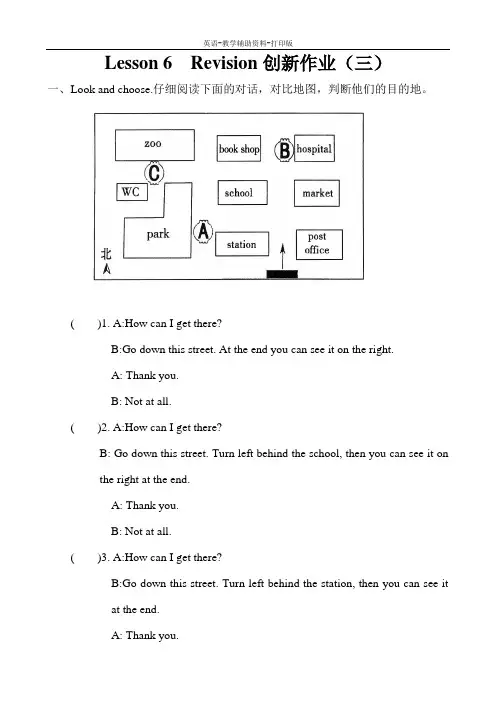
Lesson 6 Revision创新作业(三)一、Look and choose.仔细阅读下面的对话,对比地图,判断他们的目的地。
( )1. A:How can I get there?B:Go down this street. At the end you can see it on the right.A: Thank you.B: Not at all.( )2. A:How can I get there?B: Go down this street. Turn left behind the school, then you can see it onthe right at the end.A: Thank you.B: Not at all.( )3. A:How can I get there?B:Go down this street. Turn left behind the station, then you can see itat the end.A: Thank you.B: Not at all.二、Read, judge and choose.阅读理解。
Mr Black teaches us English this year. He is a tall man. He likes wearing a white shirt and black trousers. He speaks English very well. We like his lessons very much.His home is near the school. Sometimes Mr Black walks to his home. He has two little sons. They look the same. They often wear the same clothes. He plays with them. Mr Black calls the two boys Da Mao and Xiao Mao.(一)请你根据短文内容,判断正(T)误(F)。
科普版五年级下册英语全册教学课件
Let’s talk
(L- Lulu, M-Mingming) M: Excuse me. Is there a library near here? L: Yes, there is M: Are there any English storybooks in the library? L: Yes, there are M: How can I get there? L: Go down this street. Turn left at the end. You can see it on the right. M: Thank you L:You’ re welcome
科学普及出版社 五年级 | 下册
What do you do? I am a postman. Where do you work? I work in a post office.
Let’s sing
科学普及出版社 五年级 | 下册
Match and say
What do you do?
Where do you work?
Let’s talk
科学普及出版社 五年级 | 下册
Let’s talk
科学普及出版社 五年级 | 下册
Let’s learn
What do you do?
Where do you work?
科学普及出版社 五年级 | 下册
I am a worker. I work in a factory.
A
A
B
B
B
科学普及出版社 五年级 | 下册
Listen and say
科学普及出版社 五年级 | 下册
Why are you …? I can’t … Don’t worry. Where do you live? Do you know …?
四年级下册英语教案Lesson 6 Revision 第二课时_科普版(三起)
Lesson6 Revision 第二课时唐宋或更早之前,针对“经学”“律学”“算学”和“书学”各科目,其相应传授者称为“博士”,这与当今“博士”含义已经相去甚远。
而对那些特别讲授“武事”或讲解“经籍”者,又称“讲师”。
“教授”和“助教”均原为学官称谓。
前者始于宋,乃“宗学”“律学”“医学”“武学”等科目的讲授者;而后者则于西晋武帝时代即已设立了,主要协助国子、博士培养生徒。
“助教”在古代不仅要作入流的学问,其教书育人的职责也十分明晰。
唐代国子学、太学等所设之“助教”一席,也是当朝打眼的学官。
至明清两代,只设国子监(国子学)一科的“助教”,其身价不谓显赫,也称得上朝廷要员。
至此,无论是“博士”“讲师”,还是“教授”“助教”,其今日教师应具有的基本概念都具有了。
Teaching material analysic: (教材分析)我国古代的读书人,从上学之日起,就日诵不辍,一般在几年内就能识记几千个汉字,熟记几百篇文章,写出的诗文也是字斟句酌,琅琅上口,成为满腹经纶的文人。
为什么在现代化教学的今天,我们念了十几年书的高中毕业生甚至大学生,竟提起作文就头疼,写不出像样的文章呢?吕叔湘先生早在1978年就尖锐地提出:“中小学语文教学效果差,中学语文毕业生语文水平低,……十几年上课总时数是9160课时,语文是2749课时,恰好是30%,十年的时间,二千七百多课时,用来学本国语文,却是大多数不过关,岂非咄咄怪事!”寻根究底,其主要原因就是腹中无物。
特别是写议论文,初中水平以上的学生都知道议论文的“三要素”是论点、论据、论证,也通晓议论文的基本结构:提出问题――分析问题――解决问题,但真正动起笔来就犯难了。
知道“是这样”,就是讲不出“为什么”。
根本原因还是无“米”下“锅”。
于是便翻开作文集锦之类的书大段抄起来,抄人家的名言警句,抄人家的事例,不参考作文书就很难写出像样的文章。
所以,词汇贫乏、内容空洞、千篇一律便成了中学生作文的通病。
三年级下册英语教案Unit6Revision第二课时_科普版(三起)
三年级下册英语教案Unit6Revision第二课时_科普版(三起)Unit 6 Revision 第二课时死记硬背是一种传统的教学方式,在我国有悠久的历史。
但随着素质教育的开展,死记硬背被作为一种僵化的、阻碍学生能力发展的教学方式,渐渐为人们所摒弃;而另一方面,老师们又为提高学生的语文素养煞费苦心。
其实,只要应用得当,“死记硬背”与提高学生素质并不矛盾。
相反,它恰是提高学生语文水平的重要前提和基础。
Teaching topic: Say and recite课本、报刊杂志中的成语、名言警句等俯首皆是,但学生写作文运用到文章中的甚少,即使运用也很难做到恰如其分。
为什么?还是没有彻底“记死”的缘故。
要解决这个问题,方法很简单,每天花3-5分钟左右的时间记一条成语、一则名言警句即可。
可以写在后黑板的“积累专栏”上每日一换,可以在每天课前的3分钟让学生轮流讲解,也可让学生个人搜集,每天往笔记本上抄写,教师定期检查等等。
这样,一年就可记300多条成语、300多则名言警句,日积月累,终究会成为一笔不小的财富。
这些成语典故“贮藏”在学生脑中,自然会出口成章,写作时便会随心所欲地“提取”出来,使文章增色添辉。
Teaching material analysis:(教材分析)宋以后,京师所设小学馆和武学堂中的教师称谓皆称之为“教谕”。
至元明清之县学一律循之不变。
明朝入选翰林院的进士之师称“教习”。
到清末,学堂兴起,各科教师仍沿用“教习”一称。
其实“教谕”在明清时还有学官一意,即主管县一级的教育生员。
而相应府和州掌管教育生员者则谓“教授”和“学正”。
“教授”“学正”和“教谕”的副手一律称“训导”。
于民间,特别是汉代以后,对于在“校”或“学”中传授经学者也称为“经师”。
在一些特定的讲学场合,比如书院、皇室,也称教师为“院长、西席、讲席”等。
1)Review the new words:hungry little open,door,who,grandma,wait,we ,him ,hut.2)Retell the story about this text.Goal request:(教学目的)Review the new words: hungry ,little,open,door,who,grandma,wait,we ,him ,hut.Key difficulty:(重点难点)Master the new words: hungry little wait we himwho hut grandmaTeaching times:(教学时间)1Teaching methods : (教学方法)three doubts three searchesTeaching aid study:(教学工具)cards,tapeTeaching process:(教学过程)Step 1设疑自探(5 minutes)1、复习上节学过的单词……Today we go on learning Unit Six.2、Please look at say and recite.T: Can you read them? What’s the meaning of them?Ss: Sorry,we don’t know.T: Now please talk about them in four,OK?Ss: OKStep 2解疑合探(15 minutes)1、Choose someone to read them. If there is something wrong,the teacher should correct it. Then let the Ss read after the teacher,make sure all of the students can read them fluently.2、Choose someone to translate it .3、Practice in pairs.4、Say and recite.Step 3质疑再探(15 minutes)About this Unit,what else do you want to ask? Step 4运用拓展(5 minutes)选择。