
人教版高一英语必修一unit4 课文翻译和知识点详解
Unit 4 Earthquake
A night the earth didn’t sleep
Strange things were happening in the countryside in northeast Hebei. For three days the water in the village wells rose and fell, rose and fell. Farmers noticed that the well walls had deep cracks (n. 裂缝)in them. A smelly gas came out of the cracks. In the farm-yards, the chickens and even the pigs were too nervous to(太。
而不能)eat. Mice(mouse的复数)ran out of the fields looking for places to hide. Fish jumped out of bowls and ponds. At about 3:00 am on July 28, 1976, people saw bright lights in the sky. The sound of planes could be heard outside Tangshan even when no planes were in the sky. In the city, the water pipes in some buildings cracked and burst. But the one million people of the city, who thought little of these events, went to bed as usual(像往常一样)that night.
At 3:42 am everything began to shake. It seemed as if the world was at an end! Eleven kilometers directly below the city the greatest earthquakes of the 20th century had began. It was felt in Beijing, which is more than 2 hundred
kilometers away. One - third of the nation felt it. A huge crack that was eight kilometers long and thirty meters wide cut across houses, roads and canals. Steam burst from holes in the ground. Hard hills of rock became rivers of dirt. In fifteen terrible seconds a large city lay in ruins. The suffering of the people was extreme. Two-thirds of them died or were injured during the earthquake. Thousands of families were killed and many children were left without parents. The number of people who were killed or seriously injured reached more than 400,000.
But how could the survivors believe it was natural? Everywhere they looked nearly everything was destroyed. All of the city’s hospitals, 75% of its factories and buildings and 90% of its homes were gone. Bricks covered the ground like red autumn leaves. No wind, however, could blow them away. Two dams fell and most of the bridges also fell or were not safe for traveling. The railway tracks were now useless piece of steel. Tens of thousands of cows would never give milk again. Half a million pigs and millions of chickens were dead. Sand now filled the wells instead of(代替,取代) water. People were shocked. Then,
later that afternoon, another big quake shook Tangshan. Some of the rescue workers and doctors were trapped under the ruins. More buildings fell down. Water, food, and electricity were hard to get. People began to wonder how long the disaster would last(宾语从句).
All hope was not lost. Soon after the quakes, the army sent 150,000 soldiers to Tangshan to help rescue workers. Hundreds of thousands of people were helped.The army organized teams to dig out those who were trapped to bury the dead. To the north of the city, most of the 10,000 miners were rescued from the coal mines there. Workers built shelters for survivors whose homes had been destroyed. Fresh water was taken to the city by train, truck and plane. Slowly, the city began to breathe again.
词汇:
1.飓风hurricane 龙卷风tornado
台风typhoon 干旱drought
2.警报alarm 潮湿的humid 湿气humidity 现象phenomenon
3.摇;震动shake 爆炸burst 废墟ruin
损害injure
4.破坏destroy 无用的useless 使震惊shock 地震quake/earthquake
5.救援rescue 灾难disaster
短语:
1.雷电交加thunder and lightning 温室效应weather forcast
2.全球变暖global warming 立刻,马上right away
3.平静下来calm down 爆发burst out
4.突然burst into 废墟in ruins
5.挖掘dug out 分发,发出give out
6.为。
做准备prepare for 代替;不是instead of
7.完结,结束at an end 大量的a great number of
8.对。
感到震惊be shocked at .... 躲避: take shelter from
9.垮掉: break down 涌入: crowd in
10.吹倒: blow down。
高一英语必修一Unit4知识点归纳.ppt
=All of them burst into laughter/tears/songs.
burst out +v-ing :suddenly begin doing sth
扩展: burst into leaf burs into flower
长出叶子 开花
n. a burst of ...一阵... a burst of laughter /thunder /applause(欢呼)
by the end of in the end ★at the end of “在…尽头;在…末” ★by the end of “到/截止……末”;主句一般用完成 时 ★in the end 意思“最后、终于”= at last/ finally 1. Wash your hands ___a_t_t_h_e_e_n_d__o_f__ the experiment.
2. To tell you the truth, I __t_h_in_k__p_o_o_rl_y_o_f_ Tom, who is very lazy and never knows what to do .
5. It seemed as if the world was at an end.
演示课件
“too…to…”结构之前带有only,but,never,not,时, 是强调肯定的表示法,译作“非常……”“十分…” “实在……””真是太……”等
I am only too happy to teach you. 我非常高兴教你们。
He is but too glad to do so 他非常喜欢这样做
1. The city _l_a_y_/_w_a_s_i_n_r_u_i_n_s (成为废墟)after
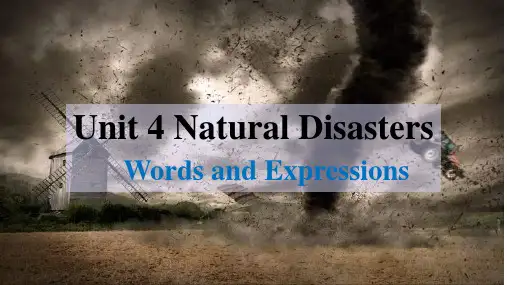
Unit+4+Natural+Disasters+词汇课件高一上学期英语人教版(2019)必修第一册
break 指有形的或无形的东西被“打破,弄碎”
Ⅰ.用damage、ruin、destroy、harm、hurt的适当形式填空
ruins
(1) There are many ancient temples which have fallen into _______.
trap sb. into (doing) sth. 诱使某人(做)某事
• set a trap for
给……设圈套
fall into a trap
落入圈套/陷阱
When travelling, they were trapped in the mountain, waiting to be rescued.
深深打动
vi.&vt.
(使)破裂
n.裂纹;裂缝
ruin
[ˈruːɪn]
n.&vt.
破坏;毁坏
Verbs describing Disasters
trap
[træp]
vt.使陷入险
境;
使陷入圈套
n.险境;
陷阱
suffer
[ˈsʌfə]
vt.遭受;蒙受
vi.(因疾病、
痛苦、悲伤等)
受苦
strike
crash
火山喷发
typhoon
台风
hurricane
飓风
disaster [dɪˈzɑːstə(r)]
n.灾难;灾害;彻底失败的人或物
【C】&【U】
三音节词
➢ an air disaster 一场空难
➢ The whole thing is a total disaster.
高中英语必修一unit4课文

高中英语必修一unit4课文教学目标:1、让学生掌握与“灾难”相关的词汇和表达方式。
2、了解地震的基本成因和应对方法。
3、培养学生的阅读能力和分析能力。
4、培养学生的灾难意识和自我保护意识。
教学内容:5、词汇:掌握与“灾难”相关的词汇,如earthquake,disaster,flood,fire,tsunami等。
6、阅读:阅读一篇关于地震成因和应对方法的文章。
7、听力:听一段与地震相关的音频,了解地震的基本知识。
8、写作:根据所学知识,写一篇关于地震的短文。
教学步骤:Step 1: Warm-up(5 minutes)9、与学生进行简单的问候和交流,了解他们的兴趣和爱好。
10、通过展示一些与“灾难”相关的图片,引导学生谈论他们所了解的灾难类型和影响。
11、引入本单元的主题:“灾难”。
Step 2: Vocabulary (10 minutes)12、教师出示一些与“灾难”相关的词汇,如earthquake,disaster,flood,fire,tsunami等,并让学生掌握这些词汇的发音和意思。
13、教师将这些词汇放入句子中,让学生进行翻译和运用。
Step 3: Reading (20 minutes)14、教师让学生快速阅读一篇关于地震成因和应对方法的文章,并回答以下问题:•What is the cause of earthquakes?•What should we do to prepare for an earthquake?•What should we do after an earthquake?15、教师引导学生深入分析文章内容,掌握文章的主旨和细节信息。
16、教师出示一些与文章内容相关的词汇和表达方式,让学生进行记忆和应用。
Step 4: Listening (10 minutes)17、教师播放一段与地震相关的音频,让学生了解地震的基本知识。
18、教师让学生回答以下问题:•What is the difference between an earthquake and a tremor?•What should you do during an earthquake?•What should you do after an earthquake?19、教师引导学生总结音频中的重点内容,加深学生对地震知识的理解。
Unit+4+Natural+Disasters+词汇课件高一上学期英语人教版(2019)必修第一册
estimated at $6 million.
3.
destroy vt.摧毁;毁灭;消灭;破坏
➢ destroy one's confidence/ hope/ faith
摧毁某人的信心/希望/信仰
➢ destruction n.[U] 摧毁;毁灭;破坏
destructive adj. 造成破坏的;毁灭性的
no hope of recovery.
Ⅱ.一句多译:每天熬夜一定会对你的健康造成很大的影
响。
(4) Staying up late every day is certain to
affect your health greatly
_________________________.(affect)
trapped men.
[衔接写作] 补全句子
Rescue teams are using thermal imaging to locate
③ ______________
survivors of the earthquake.
救援队伍正利用热成像确定地震幸存者的位置。
2.
damage n.损失;损害 vt.损害;破坏
➢ cause/do damage to 对……造成损害;损害……
➢ damage one’s health 损害某人的健康
[巩固内化] 单句语法填空
①Several vehicles were damaged
________(damage) in the crash.
to
②The earthquake caused damage ______
come to/go to sb’s rescue=rescue sb 救援某人
(完整版)高中英语人教版必修一课文内容电子版Unit4
Unit 4 A NIGHT THE EARTH DIDN’T SLEEPStrange things were happening in the countryside of northeast Hebei. For three days the water in the village wells rose and fell. Farmers noticed that the well walls had deep cracks in them. A smelly gas came out of the fields looking for places to hide. Fish jumped out of their bowls and ponds. At about 3:00 am on July 28, 1976, some people saw bright lights in the sky. The sound of planes could be heard outside the city of Tangshan even when no planes were in the sky. In the city, the water pipes in some buildings cracked and burst. But the one million people of the city, who thought little of these events, were asleep as usual that night.At 3:42 am everything began to shake. It seemed as if the world was at an end! Eleven kilometres directly below the city one of the greatest earthquakes of the 20th century had begun. It was felt in Beijing, which is more than two hundred kilometres away. One-third of the nation felt it. A huge crack that was eight kilometres long and thirty metres wide cut across houses, roads and canals. Steam burst from holes in the ground. Hard hills of rock became rivers of dirt. In fifteen terrible seconds a large city lay in ruins. The sufferings of the people was extreme. Two-thirds of them died or were injured during the earthquake. The number of people who were killed or seriously injured reached more than 400,000.But how could the survivors believe it was natural? Everywhere they looked nearly everything was destroyed. All of the city’s hospital, 75%of its factories and buildings and 90%of its homes were gone. Bricks covered the ground like red autumn leaves. No wind, however, could blow them away. Two dams fell and most of the bridges also fell or were not safe for travelling. The railway tracks were now useless pieces of steel. Tens of thousands of cows would never give milk again. Half a million pigs and millions of chickens were dead. Sand now filled the wells instead of water. People were shocked. Then, later that afternoon, another big quake which was almost as strong as the first one shook Tangshan. Water, food, and electricity were hard to get. People began to wonder how long the disaster would last.All hope was not lost. Soon after the quakes, the army sent 150,000 soldiers to Tangshan to help the rescue workers. Hundreds of thousands of people were helped. The army organized teams to dig out those who were trapped and to bury the dead. To the north of the city, most of the 10,000 miners were rescued from the coal mines there. Workers built shelters for survivors whose homes had been destroyed. Fresh water was taken to the city by train, truck and plane. Slowly, the city began to breathe again.。
高一英语必修一Unit4重点英语词汇和句子
高一英语必修一Unit4重点英语词汇和句子Unit 4 EarthquakesWord usage1. shake 1)v. (shook, shaken)to (cause to) move up and down or from side to side with quick short movements. 2) n. [C usually sing.] an act of shakingThe house shook when the earthquake started.Shake the bottle before taking the medicine.He came forward and shook me by the hand. =He came forward and shook hands with me.He was shaking with anger.She answered “no” with a shake of the head.2. rise 1) vi. (rose, risen) to move from a lower to a higher level or position; go up 2) n. [C (in)] an increase in quantity, price, demand etc.The sun has not yet risen.The population of the city has risen to five million.He rose and left the room.There will be a rise in unemployment next year.There’s been a sharp rise in the cost of living.2. pond n. an area of still water smaller than a lake, especially one that has been artificially madeSome cattle were drinking at the pond.There are some fish living in the pond.When an earthquake is coming, fish will jump out of ponds.3. burst 1) v. to (cause to ) break open or break apart suddenly and violently, usually as a result of pressure from within and often cause the contents to become widely scattered.2) n. an act of result of bursting; (of) a sudden short period of great activity, loud noise, strong feeling; outbreakThe balloon burst.After ten days of rain the river burst its banks.A burst of hand-clapping followed the ending of the song.4. canal n. an artificial stretch of water dug in the ground to allow ships or boats to travel alongit, or to bring water to or remove water from an areaCoal used to be sent here by canal.Canals have been built to irrigate the desert.The Panama Canal joins two oceans.5. steam n. [U] 1) water in the state gas produced by boiling2) power or effort produced by steam under pressure, and used for making things work or moveWho invented the steam engine?Steam was used to be the power of a train.There is steam bursting from that hole.6. ruin 1. n. a) [U] the cause or state of destruction and decayb) [C] a building that has been badly damaged or destroyed2. vt. a) to spoil or completely destroy a person or thingb) to cause someone to loss all their moneyThe temple has fallen into ruin.We visited the ruins of the temple.The heavy rain ruined our holiday.The hurricane ruined all the houses here.The flood ruined the crops.If I lose my lawsuit(官司), the cost will ruin me.7. injure vt. to cause physical harm to (a person or animal), especially in an accident; hurt seriously; to damageI hope I didn't injure her feelings.His back was injured.Two people were killed and seven were injured.His reputation will be badly injured by the vicious rumour.8. destroy vt. to damage sth so severely that it can not be repaired; put an end to the existence of; ruinA fire destroyed the house.What he said destroyed our last hope.All hopes of peaceful settlement were destroyed by his speech.9. brick n. [C,U] 1) a hard piece of baked clay used for building2) sth. in the shape of a brickThey used yellow bricks to build the house.The tower is made of bricks.Bricks covered the ground like red autumn leaves.10. useless adj. not of any useThis knife is so blunt. It’s useless.I realized it was useless to reason with him.I was useless at maths. = My maths is very poor.11. shock 1) n. a) [C, U] a violent force from sth such as explosion, a crash or a hard blowb) [C, U] the feeling you get after sth unexpected and usually very unpleasant has suddenly happened, or you have received an unexpected piece of newsc) the poor medical condition of someone who has an accident and whose heart and lungs are not working properly2) v. to make someone feel very upset, angry, or unpleasantEarthquake shocks are often felt in Japan.The news of his death was a shock to us.The traffic accident sent him into a state of shock.They were shocked by her rudeness.We were shocked by his sudden death.12. rescue v. to save someone or sth from harm or dangerHe rescued three children from the burning building.The life boat was sent out to rescue the sailors from the sinking ship.The boy was rescued after hours at sea.13. disaster n. [C,U] a sudden event causes great loss or harmWe were all shocked by the disaster.The earthquake is one of the worst natural disasters the country has ever suffered. People began to wonder how long the disaster would last.14. organize v. to plan and arrange an event; to arrange things in a sensible orderWe'll organize an oral English contest.The story is very well organized.They organized the truckers into a union.15. shelter 1) n. a) [U] protection, especially from bad weather or danger b) a building that protects you from weather or danger.2) vt. to protect someone or sth from bad weather or danger;vi. to stay in a place in order to be protected from bad weather or dangerThe umbrella is a poor shelter from heavy rain.Their immediate need is for food, clothing and shelter.The wall sheltered us from the wind.She was accused of sheltering a murderer.She wad sheltered by the USA.In the rain people were sheltering in the doorways of shops.16. fresh adj. 1) new and different (only before a noun ); 2) recently picked, caught, produced and therefore in good condition (used of food); 3) clean, cool and pleasant They buy fresh meat.This kind of fish lives in fresh water.She is fresh from university.She is quite fresh to office work.17. percent n. parts for each 100The bank has increased its interest rate by one percent.Over ninety percent of the islanders here are illiterate.He spends a large percent of his income on food and drink.18. speech n. 1) [C] a formal talk to a group of listeners2) [U] the ability to speak or the act of speaking3) [U] way of speakingThe chairman made an opening speech.She is researching speech development in children.We express our thoughts by speech.By your speech I can tell you're from Hong Kong.19. judge 1) vi. & vt. to decide who or what is the winner in a competition2) [vt. + that] to form or give an opinion about someone or sth after careful thoughtjudging fr om, judging by…3) n. a public official who has the power to decide questions brought before a court of law; a person who has the knowledge and experience to give an opinion about the value of sth You can't judge a book by its cover.He is going to judge the first race.We must judge whether he is guilty.The prisoner was taken before the judge.He was one of the judges at the horse race.20. honour 1) n. a) [U] great respect and admirationb) [sing] sth that brings great respect and pride2) v. to show respect to sb. or to praise sb. publiclyWe fight for the honor of our country.He is an honor to our school.Children should be taught to show honor to their elders.He honors his teachers.20. prepare 1) vt. to make sth. ready for a future event or action2) vi. to get ready to do sth.They prepared themselves for the worst.When we arrived home, mother had already prepared dinner for us.I was preparing for bed when I heard a knock at the door.Useful expressions1. right awayat once ; in no time; immediatelyI will return the book right away.I am getting in touch with him right away.We are about to start right away.2. end1) at an endfinish; overIt seems that the world was at en end.2) bring… to an end =put an end to…I wonder how I can bring the dispute to an end.=I wonder how I can put an end to the dispute.3) come to an endThe meeting came to an end at midnight.4) at the end of…At the end of the road there is a shop.5) by the end of…How many English words have you learned by the end of last term?6) in the end =at last; finallyHe will be a scientist in the end.3. dig out1) to get sth out of a place, using a spade or your hands2) to find sth you have not seen for a long time, or that is not easy to find Let’s dig out the roots.Why did you dig out all those old magazines?We must dig the truth out of him.1. a (good \ great \ large) number of+ n.(pl.)many; a large quantity of; a lot ofA good number of students are not interested in modern art.I’ve seen the film a number of times.The Great Wall attracts a great number of foreign tourists every day.the number of…The number of private colleges has increased.= Private colleges have increased in number.5.give out1) to give sth to a number of different people, especially to give information to people2) to produce light, heat, a sound, a gas, smell etcYou have no right to give my telephone number out.Students were giving out leaflets(传单)to everyone on the street.The teacher gave out the examination papers.The radiator (散热器) is giving out a lot of heat.与give有关的常用短语还有:give away 送掉,捐赠give in 让步,屈服give off 发出(气味、光、热、声音等),此时相当于give outgive up放弃give back 归还6.thousands of基数词+s,并不表示确切的具体数字,可以单独使用,也可以先接介词of再接复数名词。
高一英语必修一Unit4知识点 PPT
2. A _s_m_e_l_ly_ gas came _o_u_t _o_f other. 他乐于助人。 I am too eager to have a world trip. 我很想去环球旅行
10. hurt 指肉体上,也可指精神上的
伤害.也可指“疼痛,痛苦”.
injure 指由于意外或事故而受伤.
wound 指外伤,如枪伤,刀伤,剑伤,尤
2. To tell you the truth, I __t_h_in_k__p_o_o_rl_y_o_f_ Tom, who is very lazy and never knows what to do .
5. It seemed as if the world was at an end.
health→ wealth →
3. burst vi.vt. (burst---burst---burst)
使某物爆炸,胀破,爆破, 破裂
burst in/into a door/ room /building 突然进入门/房间
/大楼
burst into sth. = burst out doing 突然…起来
by the end of in the end ★at the end of “在…尽头;在…末” ★by the end of “到/截止……末”;主句一般用完成 时 ★in the end 意思“最后、终于”= at last/ finally 1. Wash your hands ___a_t_t_h_e_e_n_d__o_f__ the experiment.
高一英语必修一unit4知识点总结四
高一英语必修一unit4知识点总结四高中英语必修四unit4知识点2It 作形式宾语用来替代作宾语的`从句、动词不定式、动名词,而把真正作宾语的从句、动词不定式、动名词置于句尾。
It 作形式宾语的常见句型:1. verb+ it+ adj./noun (for/of) to do/clause (verb=think, believe,suppose, consider, feel, make, keep…)例 I think it hard for you to do the task on your own./I think it hard that you'll do the task on your own.2. verb+it+adj./noun (one's) doing(adj.=useless/worth/worthwhile)(noun=no use/no good/worth one's while/a wasteof time/money/energy/words) (verb=think, believe, suppose, consider, feel,make, keep…)例 I'll make it worth your while telling me about his secret.3.verb+it+important/unimportant/necessary/unnecessary/ natural/essential that … (should)…verb+it+ofmuch/great/no/little importancetha t…(should)…(verb=think, believe, suppose, consider, feel, make, keep…)例 I think it important that you (should) attendthe conference.4. verb + it+ as+ noun/adj.+ clause (verb=accept, regard, take, see,view)例 The lecturer takes it as encouraging when so many students attendhis lecture.5. v. +it + prep. + that…owe it to sb. that…把…归功于…leave it to sb that…把…留给某人去做take it for granted that …想当然keep it in mind that…例 Don't bother to arrange anything. Just leave it to me to sort out.6. It用在不能直接跟宾语从句的动词后面,尤其是表示好恶的动词后,enjoy,like, love, dislike, resent, hate, don't mind, be fond of, feel like, see to 宾语从句紧跟it之后例 I hate it you can swim so well and I can't.7. It用在不能直接跟宾语从句的介词后面,宾语从句紧跟it之后(except that例外)例 I'm for it that you will follow their advice.高一英语必修一unit4知识点总结 (菁选2篇)(扩展4)——英语高一必修1知识点总结5篇英语高一必修1知识点总结1重点单词major local represent curious introduceapproach stranger express action generalavoid misunderstand similar agreement *punish intend means universal culturalapologize behave bow flight defencedormitory canteen dash fortable distanceprefer touch custom false hugfunction international powerful greet fistyawn threaten respectful association gesture英语高一必修1知识点总结2重点句子1. Whichever and whatever you like, there is a theme park for you!2. With all these attractions, no wonder tourism is increasing wherever there is a Disneyland.3. To enter a world of fantasy about ancient England, e to Camelot Park!4. Futuroscope is not only for inpiduals, but is also the perfect mix of fun and learning for class outings.5. If driving, Futuroscope is within easy reach of the freeway.6. Visit the candy shop to try the same kind of candy that American southerners made 150years ago, or take a ride on the only steam engine train still working in the …7. After that, joined some drivers and went to the bottom of the ocean to see the strange blind creatures that have never seen sunlight.Visitors can get close to parts of the world they have never experienced, going to the bottom of the ocean, flying through the jungle or visiting the edges of the solar system。
Unit 4-高一英语同步精品讲义(人教必修第一册)(学生版)
1. come along 跟随;到达;进步;赶快 2. work out 锻炼;计算出;解决 3. set an example 树立榜样 4. fall apart 破裂;破碎;崩溃 5. lose heart 丧失信心;泄气 6. give up 放弃;投降 7. make sense 有道理;合乎情理;表述清楚 8. pretend to do sth.假装做某事 9. even if/though 即使;虽然 10. make a difference 有作用或影响 11. rather than 而不是 12. cut... out 停止做(或使用、食用);剪下 13. now and then 有时;偶尔 14. compare...with/to...与……比较
7. injurevt.使受伤;损害→injuryn.伤害;损伤→injuredadj.受伤的;有伤的 8. strengthn.力量;体力→strengthenv.加强→strongadj.强壮的;坚强的 9. failuren.失败;失败的人(或事物)→failv.失败 10. competevi.竞争;对抗→competitionn.竞争;比赛→competitiveadj.竞争的;有竞争力的→competitorn.竞争者 11. positiveadj.积极的;正面的;乐观的;肯定的→positivelyadv.乐观地;肯定地;积极地 12. jogvi.慢跑 n.慢跑→joggingn.慢跑锻炼→joggern.慢跑锻炼者 13. stressn.压力;紧张;重音 vt.强调;重读;使焦虑不安 vi.焦虑不安→stressfuladj.压力重的;紧张的→stressedadj. 焦虑不安的
3 经典句型
1. Losing two important players(损失两员大将)was a big challenge, but Lang Ping did not lose heart.(动名词 作主语) 2. Jordan’s skills were impressive, but the mental strength that he showed made him unique(使他与众不同). (make+宾语+宾补) 3. In the final seconds of a game, Jordan always seemed to find a way(似乎找到一个方法) to win.(seem to do) 4. They need some volunteers, don’t they(不是吗)?(反意疑问句) 5. A soccer player should not pretend to fall down even if it helps his/her team(即使有助于他/她的球队). (even if)
【知识学习】高一英语必修一Unit 4 reading知识点讲解(1)
高一英语必修一Unit 4 reading知识点讲解(1)时间:_XX年_10月11星期日制作人:北大附中河南分校王萍LearningAims:1.knowledgeAims:①Enablethestudentstograsptheu sagesofsuchimportantnewwordsandexpression_r_rsassha ke,injure,destroy,skock,rescue,rightaway,agreatnumb erof,giveout,etc.②GettheSstomatertheusageofthepatterns:ItseemedthattheworldwasatendAllhopewasnotlost2.AbilityAims:ToimproveSs’abilityofreading Learningdifficultpoints:1LettheSslearntheusageofthewords“shake”2EnabletheSstomastertheusageofthepattern“all----isnot---”andunderstandsomedifficultAndlongsentence.教学过程:StepⅠ.Leading-in1.GreetSsasusual2.Enjoythe3-minute’stalkshowandgivethecommentonit. FreetopicThencommontitStepⅡ.Preparation:(3-5分钟)1.Readthewarming-uploudlyandfindthewordstheycan’tread2.Readtheparagraphloudlyandtrytofindthedifficultpoi ntswarming-up Imagineyourhomebeginstoshakeandyoumustleaveitrighta way知识点:1.Itisalwayscalmbeforeastorm.before走进高考:1Itwon’tbelong_______hereturns.AsinceBbeforecafterDwhen2Hewastoldthatitwouldbeatlastthreemoremonthhs_____hecouldrecoverandreturntowork.AwhenBbeforecsinceDthat3ThefieldresearchwilltakejoanandPaulaboutfivemonths ;itwillbealongtime______wemeetthemagain.AafterBbeforecsinceDwhen2Lookcarefullyatthetwophots. 复习look的有关短语补充Lookupto尊敬,尊重Lookthrough浏览,仔细查看Lookover快速地翻阅Lookon旁观连接高考1“Goodbye,then,”shesaid,withouteven____fromherbook. AlookingdownBlookingupclookingawayDlookingon2Ihave_____allmypapersbutIstillcan’tfindmynotes. AlookedthroughBlookedforclookedafterDlookedout3Desribletoyourpartnerwhatmighthappentotheobjectsin thephotos.复习imagine的用法imagine+n./pronimaginesb.tobeshake:causetomovetoandfrorightaway:atonce;innotime;immediatelyrightnow:atthisverymomentmakeupyourmind___________.I’llreturnthebook___________.复习shake的用法。