
人教版八年级英语下册Unit 3 Could you please clean your room
八年级英语下册 Unit 3 Could you please clean your room

2. You can ______ the book, but you can only
______ it for a week.
A. lend; borrow
B. lend; keep
C. borrow; lend
D. borrow; keep
3. She stopped talking ______ her mother came
A: _Y_e_s_, _su_r_e_._______
3. Q: Could you please fold your clothes? (Sorry/ do my homework)
A: Sorry, I can’t. I have to do my homework. ____________________________________ 4. Q: Could I please use your pen? (Sorry/ need it
take out the rubbish do the dishes fold the clothes sweep the floor get a ride work on
7. 帮助解决…… 8. 随时 9. 扔掉 10. 遛狗 11. 频繁;反复 12. 走开
help out (with…) any minute throw down take the dog for a walk all the time walk away
take care of a waste of time provide sth. for sb. (don’t) mind (doing sth.)
23. 结果 24. 照看;照顾 25. 生病 26. 同意
as a result look after fall ill agree with
八年级英语下册 Unit 3 Could you please clean your room?教案
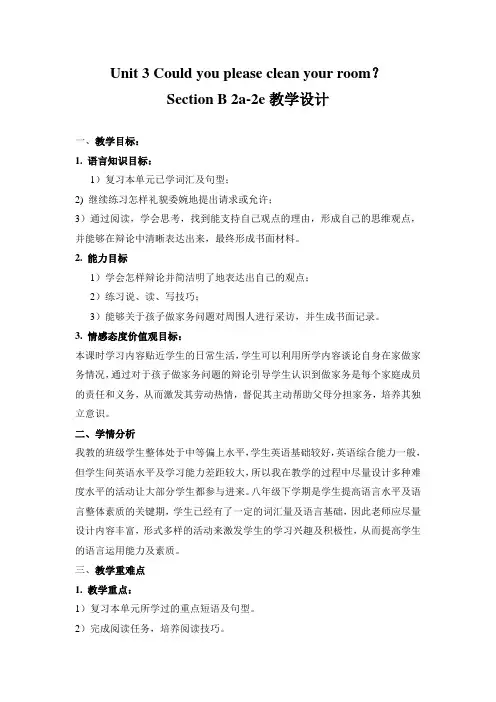
Unit 3 Could you please clean your room?Section B 2a-2e教学设计一、教学目标:1. 语言知识目标:1)复习本单元已学词汇及句型;2) 继续练习怎样礼貌委婉地提出请求或允许;3)通过阅读,学会思考,找到能支持自己观点的理由,形成自己的思维观点,并能够在辩论中清晰表达出来,最终形成书面材料。
2. 能力目标1)学会怎样辩论并简洁明了地表达出自己的观点;2)练习说、读、写技巧;3)能够关于孩子做家务问题对周围人进行采访,并生成书面记录。
3. 情感态度价值观目标:本课时学习内容贴近学生的日常生活,学生可以利用所学内容谈论自身在家做家务情况,通过对于孩子做家务问题的辩论引导学生认识到做家务是每个家庭成员的责任和义务,从而激发其劳动热情,督促其主动帮助父母分担家务,培养其独立意识。
二、学情分析我教的班级学生整体处于中等偏上水平,学生英语基础较好,英语综合能力一般,但学生间英语水平及学习能力差距较大,所以我在教学的过程中尽量设计多种难度水平的活动让大部分学生都参与进来。
八年级下学期是学生提高语言水平及语言整体素质的关键期,学生已经有了一定的词汇量及语言基础,因此老师应尽量设计内容丰富,形式多样的活动来激发学生的学习兴趣及积极性,从而提高学生的语言运用能力及素质。
三、教学重难点1. 教学重点:1)复习本单元所学过的重点短语及句型。
2)完成阅读任务,培养阅读技巧。
3)能够清晰表达自己对做家务一事的看法。
2. 教学难点:1)能够采访周围人对孩子做家务一事的看法,并做书面记录。
2)能够思考并得到找到能支持自己观点的理由,并形成书面材料。
3)通过完成阅读任务提高自己的阅读能力。
四、教学过程I. Warming-up and lead-in1. Greet students as usual and tell students that there is a group competition in which the winner group can get the gift.2.Interview some of the students about whether they do housework at home and what they often do.3. Show the chatting records of parents group about kids doing chores at home to lead in the topic of this class—whether children should do chores at home or not.II. Pre-readingAsk the following two questions:1.What can you know from the chatting records of your parents?2.Do you think kids should do chores at home?III. While-reading1.Students read the two letters quickly to find out which one agrees and which one disagrees and give the reasons.2.Introduce the reading skill “Skimming”—looking quickly through a piece of writing to find the main idea without reading every word. It is still a good idea to read the first sentence in each paragraph quickly.3.Students read the examples already given in 2c and guess the meanings of “pros” and “cons”. Ask students to do a group work-- according to Mr. Smith and Ms. Miller, what are the pros and cons about kids doing chores?4.Students read the letters again and fill in the blanks to review the reasons given by Mr. Smith and Ms. Miller.IV. Post-reading.1. Be a good debater. Ask the students choose one side freely and have a debate onwhether children should do chores at home.2. Ask students to prepare for the debate and give some tips to them. Students can use the information they get before class. Students write down their ideas during their preparation.3. Introduce the rules of debate and the debate begins. Students from the positive side and the negative side can stand up and give ideas. The teacher concludes the debate in the end.V. Emotional sublimationShow some pictures of parents who work hard and remind students of the great contributions parents make to our family. Encourage students to be a good helper at home and try their best to do chores. Give the winner group some housework cards to encourage them to do chores at home.VI. HomeworkWrite a passage to express your ideas about kids doing chores at home.五、板书设计Unit 3 Section B 2a-2ekids doing chores at homeMs. Miller VS. Mr. Smithnegative side positive side。
人教版八年级下英语Unit3Could you please clean_your_room课件_ppt
Peter’s father His father’s reasons says… Yes no I have to do some work Yes no You have to clean your room. Yes no I need to eat breakfast. Yes no You have a basketball game.
√ √
√ √
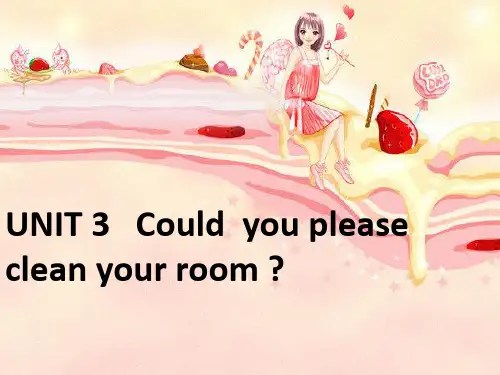
2b Listen again. Why does Peter’s father say “no”? Draw lines to the reasons in the chart below. Peter wants to… go out for dinner. go to the movies. stay out late. get a ride. Peter’s father His father’s reasons says… Yes no I have to do some work Yes no You have to clean your room. Yes no I need to eat breakfast. Yes no You have a basketball game.
Could 的其他几种用法:
1.Could 作为can的过去式,表示过去的能力。 2.表示惊讶,怀疑,不相信等态度,主要用 于否定句或者疑问句,此时could 与can无时 间上的区别,但语气比can缓和,情绪要弱。 3.表示可能性,只对将来,现在后者过去某 种可能的推测 4,用于虚拟语气。
We Love our parents.
情态动词:Can, May , Could 的用法
1.共同点:三者均可表示请求,允许。意思为: ”………………可以吗?” 2.不同点: CAN表示请求或允许,多用于口语中, 意为“可以、能”等。 如:Can I help you ? May表示“许可、准许、请求许可”, 此时与 can 同义,可以互换使用 如:May I use your ruler ? Sure ,/Certianly . /Yes , please. No, you mustn’t /No , you can’t . 注意:否定回答不能说成No, you may not .
八年级英语下册 Unit 3 Could you please clean your room(第4课时)教学设计 (新版)人教新目标版
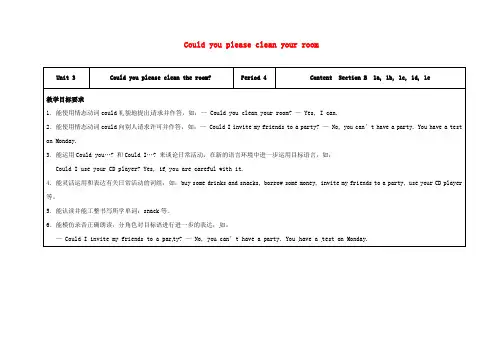
Now, let’s check the answers.
核对1a任务的答案,答案不唯一。学生进行自我评价
(电子书可随机做出评价)
7
学习并强化刚刚学过的短语。
Let’s learn these words.
(buy some drinks and snacks, borrow some money, invite my friends to a party, go to the store, use your CD player…)
创设情景,引入话题。
You are going to have a party. Ask you r partner for help. Talk about these things and make a conversation.
(go to the store, buy drinks and sn acks, do the dishes, clean the living room, take out the rubbish)
6
理解并辨认父母和孩子通常会做什么事情,完成1a。
Look at 1a. First, read the activities together.
What do teenagers ask their parents’ permission for? What do parents ask their teenagers to do? Writeparentsorteenagersnext to each phrase.
小结
时间
3 m
18
本活动的检查评价;归纳、反馈、强化本节课的学习
目标。
八年级英语下册 Unit 3《Could you please clean your room》第1课时教案 (新版)人教新目标版
《Unit3 Could you please clean your room》课题U3 课型N总课时主备人授课日期审核人主讲人教学目标:一知识目标:1.学习谈论家务2.提出请求;申请许可3.能够口头或书面描述日常活动二过程与方法课前讨论为任务一的完成做了铺垫。
接着,通过听,了解句型,并初步掌握如何表达谈论家务,提出请求及申请许可。
最后,学生又通过阅读进一步巩固本单元所学的句型,并通过迁移进行仿写,最后以自主写作为最终目标。
情感目标:三培养学生热爱劳动,帮助他人的传统美德。
教学重点难点:1. "Could " for polite requests2. "Could" for permission.3. "Make" versus "do"教学流程及教学内容个案补充1. Warming upEnjoy ourselves. Watch cartoon Cinderela. 看动画片段《灰姑娘》导如入本课话题和新词汇“chores”美丽善良的鬼姑娘因继母的嫉妒,每天得做所有的家务。
2. learn new words and phrasesLook! What is she / he dong? 看图学习动词词组do chores, do the dishes,make the bed, take out the trash, fold the clothes, do the laundry, cleanthe living room.Ask a student to pretend Jack who was hurt, and tell him to ask for helpsfrom his classmates in the front. The rest of the class try to give himdifferent answers.E.g. --- Maria, could you please move the chair for me?---Sure, I'd love to.---Annie, could you please help me take English notes?---Sorry, I can't. I have to go to t he teacher's officefirst. I can help you later.3. Guessing game. What is she doing ?4. Pair work. ,Do you do these things at home? Write “Y” for “yes” and “N” for “no”.5. Listening . 1b ,6. PairworkLook at the picture, Ask your partner to do the chores that you see. Present some conversations to the class.E.g. Tom: Could I have an ice cream?Father/Mother: …Tom: Could I take the small plane there?Father/Mother: …7. Interview Who is the most able at home?1) What chores do you do at home? How often do you do the chores? Work in four,2) Then one student make a report to the class. “In my group…. Does the dishes every day,…We think … is the most able one in our group.”3) 颁奖。
(完整版)八年级英语下册Unit3Couldyoupleasecleanyourroom教案
1.Could you please take out therubbish?
.Sure./Sorry,I can’t.I have to finish homework first.
2.Could I use your computer?
Sorry. I'm going to work on it now.
B:Yes,sure./All right. /No problem./Certainly.
Sorry,I can't.I have to do...
Sorry,I can't.I am doing...
Step 5 Listening2a&2b
Peter asks his father if he can do four things. What does his father say? Check (√) “yes” or “no”. Listen again.Draw lines to the reasons.
Step 3 Listening
1bListen.Whowill do these chores?Check (√) Peter’smother or Peter.
Chores
Pe ter’s mother
Peter
do the dishes
sweep the floor
take out the rubbish
stay out late.
YesNo
I need to eat breakfast.
get a ride.
YesNo
You have a basketball game.
Step 6Practice
英语人教新版八年级下册《Unit3Couldyoupleasecleanyourroom》含答案
人教新版八年级下册《Unit 3 Could you please clean your room》2021年同步练习卷(Section B(2a-2e))Ⅰ.根据句意及汉语提示写出所缺的单词1. Rick has too much________(精神压力) and he doesn't know how to deal with it.2. Please give me a________(公正的) result.3. Bob and Jim have been good friends ________(自从)they joined the same tennis team.4. It's too expensive and________(而且) the color doesn't suit you.5. People should do something to protect our________(环境).Ⅱ.根据句意及首字母提示补全单词6. More and more people have realized that we shouldn't________ (浪费) food.7. Chinese parents try their best________(提供)a good environment for their children.8. The value(价值) of life doesn't d________ on who you are, but what you do.9. Mr. White lives next to me, so we are n________.10. The bottle on the table d________ onto the ground and it broke into pieces.Ⅲ.用所给单词的适当形式填空11. I think everyone should do their part in________(keep) the environment clean.12. Yesterday Mr. Brown didn't go to the meeting because of his________(ill).13. Uncle Chen________(repair) more than five bicycles since last Friday.14. Mrs. Green is a good teacher. She is known for her________(fair). She treats every student equally(平等地).15. The boss was satisfied with the________(develop) of the company.Ⅳ.根据汉语意思完成句子16. 青少年不能总是依靠父母.Teenagers can't________ their parents all the time.17. 青少年应该学习如何照顾自己.Teenagers should learn how to________of themselves.18. 你越努力,你就会越幸运.________you work,________you will be.19. 你没有必要和他们生气。
八年级下册人教版英语Unit3_Could_you_please_clean_your_room课件
2. have to有人称、数、时态的变化, 而must只有一种形式。但must 可 用于间接引语中表示过去的必要 或义务。
He had to look after his sister yesterday.
3. 在否定结构中: don’t have to 表示 “不必”, mustn’t 表示“禁止”。 You don’t have to tell him about it. 你不一定要把此事
√
room
1c Pairwork
A: Could you please sweep the floor? B: Yes, sure. / I’m sorry, but I’m
reading the newspaper.
2a Listening and check “yes” or “no”.
have to和must
1. 两词都是 “必须”的意思, have to 表示客观的需要, must 表示 说话人主观上的看法, 既主观 上的必要。
My brother was very ill, so I had to call the doctor in the middle of the night. 我弟弟病得很厉害,我只得半夜里 把医生请来。(客观上需要做这件事) He said that they must work hard. 他说他们必须努力工作。 (主观上要做这件事)
cooking. I _c_a_n_ come later. 2. - _M__u_st_ we clean the windows today?
- No, you _n_e_e_d_n_’_t. You __c_a_nclean them tomorrow.
3. - _M__a_y I watch TV this evening, mum? - No, you _m_u__st_n_’_t. Work _m__u_s_t come first.
Unit 3 Could you please clean your room教学反思
人教版初中英语八年级下册
Unit 3 Could you please clean your room?教学反思在本堂课的教学中,充分利用了多媒体的优势,在情境中教学,逐步引导
学生去感悟,理解教学内容,从而大大降低了教学的难度。
在本节课上,我教学设计合理,容量大,重难点突出。
由幻灯片作为引入,激发学生的学习兴趣,调动学生学习的积极性,根据学生的学习特点和认知规律,课堂教学的各环节是由易到难的渐进过程,教学模式以活动为中心,面向
全体学生,强调学生的参与和实践,通过在活动中学习,强化了语言实践的过程,提高了学生的听说表达能力,培养了学生的创新精神和合作精神。
在英语的教学中适当运用图片导入及对话训练可使学生在玩中学,变无意
注意为有意注意,使学生在实实在在地进行语言信息交流,避免了枯燥的死记
硬背,激发了学生的学习兴趣,也增强了学生学好英语的信心和决心,使良好
的英语学习心理素质在游戏之中逐渐培养起来。
新课程标准从某种意义上说对老师提出了更高的要求,作为英语老师,我
们要及时转换自己的角色和观念,做一名出色的“课堂主持人”,组织好每一
项课堂活动,把表演的机会给学生,让学生成为真正的“主角”,让学生时刻
处在体验、实践、参与、合作与交流的活动中,使他们的语言技能、语言知识、情感态度、学习策略和文化意识等素养得到整体发展。
在英语听、说、读写四个环节上,均有所体现,遵循了听说领先,读写跟
上的教学原则。
在听说教学上落实得还可以,但是在写的训练上也流于形式,
没有充足的时间给学生进行练习。
从课堂教学氛围来看,还算浓厚,学生课堂较大胆,积极参与课堂活动。
体现了学生学习的主体作用。
人教版八年级下英语Unit 3 Could you please cleanyourroom知识总结
unit 3 Could you please clean your room?话题相关:Could you please+动词原形?表示请求的句子,意为“请你......好吗”,其否定形式是Could you please+not+动词原形?句中could 表示请求,不表示过去,只表示委婉的语气短语do the dishes 洗餐具take out取出;拿出take out the rubbish倒垃圾fold the clothes 叠衣服sweep the floor 扫地make the bed 铺床work on 从事;创作clean the living room 打扫起居室go out 出去stay out 待在外面;不在家help out 帮助做完某事in front of 在......前面come over 过来;顺便来访hang out 闲逛do chores 做家务at least 至少throw down 扔下all the time 频繁;反复in surprise 吃惊地;惊讶地as soon as 一.......就a waste of time 浪费时间spend...on... 在......上花费(时间或金钱)in order to 为了,目的是depend on 依靠;信赖;取决于,由......决定keep it clean and tidy 保持它干净、整洁get into 进入take care of 照顾;处理as a result 结果provide sth. for sb.=provide sb. with sth. 为某人提供某物a developed country 一个发达国家a developing country 一个发展中国家a life of independence 独立的生活an independent country 一个独立自主的国家have no idea “不知道”=don't knowtake care of “照顾;处理”=look after=care for take good care of “好好照顾......”=look after.....well as a result 结果;因此as a result of 由于.......;作为......结果句型和固定结构finish doing sth. 做完某事neither+连系动词be/助动词/情态动词+主语. .....也不hate to do sth. 厌恶做某事let sb. do sth. 让某人做某事spend...doing sth. 花费......做某事provide sth. for sb. 向某人提供某物learn to do sth. 学会做某事learn how to do sth. 学会怎样做某事do one's part in (doing) 尽自己的职责做某事as.....as... 与.......一样not as/so...as... 不如......borrow sth. from sb. “向某人借某物”hate sb./sth. 讨厌某人/某物hate to do sth./doing sth. 厌恶做某事enjoy doing sth 喜欢做某事buy sb.sth.=buy sth. for sb. "给某人买某物invite sb. to +地点名词“邀请某人到某地”invite sb. to do sth. “邀请某人做某事”make sb. do sth. 让/使某人做某事help with sth. =help (to) do sth.帮忙做某事There is no need for sb. to do sth.“对于某人来说,没有必要做某事”解释minute n.分钟;片刻(1)any minute now “随时;马上;在任何时刻”,表示事情有可能在极短的时间内发生或眼下就要发生。