
牛津英语4B unit6 Music Period 1
沪教牛津版小学英语四年级下册单词
英
中
全
Unit 5 - 01
sport
体育运动
footbal cl lub
足球
俱乐部;兴趣小组
join
参加;加入
tell
告诉
about
关于
basketball 篮球
volleyball 排球
us
我们
table tennis 乒乓球运动
英
中
全
Unit 5 - 02
play football play basketball play volleyball
07
have a party 举办
聚会
Unit 12 - 01
ugly 丑的;丑陋的 duckling 小鸭 duck 鸭子 river 河;江 baby 宝宝;婴儿 later 后来;以后 quack (鸭叫声)嘎嘎 back 背;背部 away 去别处;朝另一个方向 swan 天鹅
Unit 12 - 02
壹
play football 踢足 球
贰
play volleyball 打 排球
叁
play basketball 打 篮球
Unit 6 wonderful 使0人1愉悦的;绝妙的
violin 小提琴
guitar 吉他 whose 谁的 piano 钢琴
city 城市 bag 袋子 gold 金子 all 全部;所有
oy r
或者;还是
watermelo 西瓜
n grape
葡萄
fox
狐狸
round
圆的
purple
紫色的
wait
等待;等候
minute
一会儿;分钟
牛津上海版(三起)英语四年级下册_Module_2_Unit_6_Music_练习卷
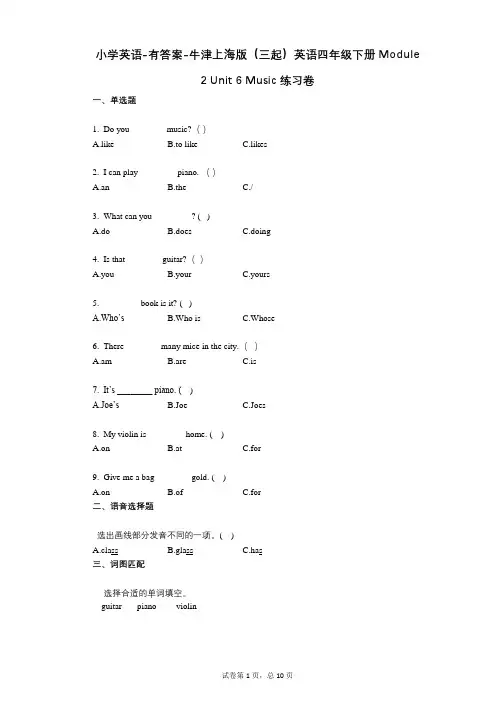
小学英语-有答案-牛津上海版(三起)英语四年级下册 Module2 Unit 6 Music 练习卷一、单选题1. Do you ________music?()A.likeB.to likeC.likes2. I can play ________ piano. ()A.anB.theC./3. What can you ________ ? ( )A.doB.doesC.doing4. Is that ________guitar?()A.youB.yourC.yours5. ________ book is it? ( )A.Who’sB.Who isC.Whose6. There ________many mice in the city.()A.amB.areC.is7. It’s ________ piano. ( )A.Joe’sB.JoeC.Joes8. My violin is ________ home. ( )A.onB.atC.for9. Give me a bag________ gold. ( )A.onB.ofC.for二、语音选择题选出画线部分发音不同的一项。
( )A.classB.glassC.has三、词图匹配选择合适的单词填空。
guitar piano violin(1)________(2)________(3)________四、按要求填空填空题1. child的复数形式是________.2. I can play the________3. I have many ________(朋友).五、连词成句连词成句。
(1)violin it is whose________?(2)can play I piano the________.六、填内容补全对话/短文根据题意,补全对话。
1. —Whose guitar is it? —________ .(它是乔的)2. —Is that your violin? —________.(作否定回答)七、找出错误部分并改正改错题。
沪教版四年级英语下册(上海牛津4B)知识点总结
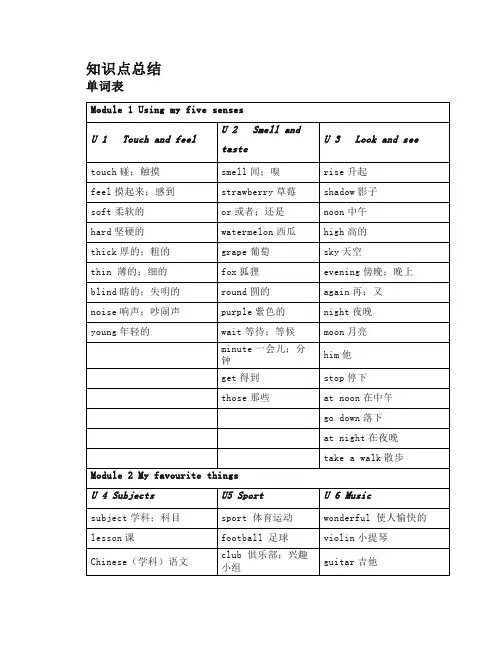
知识点总结单词表语法复习1. 量词的用法There is a glass of watermelonjuice.There are three glass es of strawberry juice.2. 选择疑问句和一般疑问句的区别(1) 一般疑问句Is thekite red and blue?(这风筝是蓝红色的吗?)一般疑问句的回答必须Yes或No开头 Yes, it is./No, it isn’t.(2) 选择疑问句Is thekite red or blue?(这风筝是蓝色还是红色?)选择疑问句的回答必须是二选一:It’s red.或It’s blue.3. 关于like后面接不同的名词和动词like apples / like green ones (可数名词复数)like the apple / like the green one (可数名词单数)likejelly(不可数名词)like dancing=like todance (动词)would like todance(would like to do=want to do)be like me/her/hisfather…(解释为像,作介词)4. 感叹句What nice grapes!(复数)What a nice girl!(单数)5. whose对所有格提问Whose bag is this?-----It’s peter’s.(this/that回答用it’s)Whose knives are those?-----They are hisknives. (these/those回答用they’re)6.so和too解释为如此、太时后面跟形容词It’s so thick. /He is so puzzled.It’s too noisy.7. How+助动词+主语+动词The pineapple is rough. (划线提问)Howdoes the pineapple feel?This cherry is sweet. (划线提问)How does this cherry taste?8.祈使句和can句型永远用动词原形,即使有now,也不能是进行时祈使句Let’s make a card now.Kitty, don’t put your book on the floor.(否定句在动词前加d on’t)can句型 Can Lucy read the book now?(容易犯的错误:看见Lucy一个人就用三单reads,或看见now用进行时)9. There be就近原则,后面所接词必须看清是否是可数名词从而确定be 动词There is a cat and two dogs. (离得近的是单数)There are two dogs and a cat. (离得近的是复数)There is some paper. (不可数)There are some paper rabbits. (前面有修饰的名词复数)There are some sheep. (单复数相同)There is some string. (不可数)There is a lot of apple juice. (前面有修饰的不可数)10. both和all 放在be动词之后,do动词之前We are bothtall.(be动词之后)They are allblind.(be动词之后)We both runfast.(do动词之前)The brothers all touch the elephant. (do动词之前)11. one of the 复数,谓语三单One of the boy s is Tom.say s one of the brother s12. 一般时和进行时的区别进行时:当句子里有标志性的词如now,look,listen,it’s…几点(祈使句和can句型除外),或是某个有上下情景的句子表示这个动作现在正在发生,结构be+doingListen, birds are singing.Where’s Sam? He is playing football outside.一般时:当句子里有标志性的词如every morning, on Moday, at weedends, always, usually, often,sometimes,n ever, at…几点等,表示陈述某个事实。
牛津译林版高中英语模块6 Unit 1《Period Six Project》课件1

setting: in the palace
theme:
the important papers
What does the King really mean by saying “the important papers〞?
Detailed reading (2)
The important papers
1. Who do you think is the main character in the play?
2. What does the King actually want? 3. In what style of comedy is this play?
theme lines plot stage directions
director
actors / actress vivid performances
costumes props
exaggerated expressions…
setting
Fast reading (1)
The invisible bench
theme:
Fast reading (2)
The important papers
characters: The King, the Queen, Servant
setting: in the palace
theme:
the important papers
Fast reading (2)
The important papers
Why? 4. Why are the others unable to
牛津小学英语4B全册教案Unit6Let’sgobytaxi教案
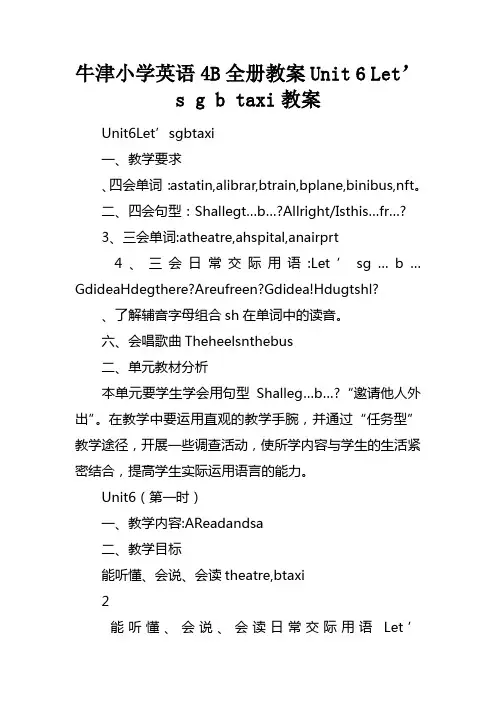
牛津小学英语4B全册教案Unit 6 Let’s g b taxi教案Unit6Let’sgbtaxi一、教学要求、四会单词:astatin,alibrar,btrain,bplane,binibus,nft。
二、四会句型:Shallegt…b…?Allright/Isthis…fr…?3、三会单词:atheatre,ahspital,anairprt4、三会日常交际用语:Let’sg…b…GdideaHdegthere?Areufreen?Gdidea!Hdugtshl?、了解辅音字母组合sh在单词中的读音。
六、会唱歌曲Theheelsnthebus二、单元教材分析本单元要学生学会用句型Shalleg…b…?“邀请他人外出”。
在教学中要运用直观的教学手腕,并通过“任务型”教学途径,开展一些调查活动,使所学内容与学生的生活紧密结合,提高学生实际运用语言的能力。
Unit6(第一时)一、教学内容:AReadandsa二、教学目标能听懂、会说、会读theatre,btaxi2能听懂、会说、会读日常交际用语Let’sgbtaxiHdegthere?Shallegt…b…?Isthis…fr…?及其回答并取得运用所学语言进行交际的能力。
要求读音正确,语调自然。
3能正确流畅地朗诵并演出文。
三、教学重点能正确明白得运用Let’sgbtaxiHdegthere?Shallegt…b…?Isthis…fr…?及其回答。
四、教学难点熟练运用本所学的交际用语。
五、教学预备、教具预备:1)扮演司机、乘务员等所需的道具。
2)景点图片。
3)关于本时的多媒体。
二、板书预备:写好题和日期。
六、教学进程AFreetalandtivatinSingasng:Gtshl2FreetalT:hattiedesNangtshl?Ss:AtsevenfiftT:Nangestshlatsevenfifthattiedugtshl?S1:IgtshlatsevenfrtT;Hdugtshl?Bbusrbbie?S1:BbusT:Hdugtshl,S2?S2:IgtshlbarT:Nasandanserinpairs:Hdugtshl?学生两人一组练习后,检查几组,了解反馈情形。
最新外研版英语四年级下册《module 6 music》unit1教案.doc
(外研版)四年级英语下册教案Module6Module 6 Music 单元分析本模块由Unit 1 This girl is good.和Unit 2 Lingling is better than Daming.两部分组成,它的目的是向我们介绍进行评价和比较,同时讲解了一些与音乐相关的背景知识,例如:‘Pop music’中的‘pop’是‘popular’的缩写,意思是‘流行的’;‘Chinese music’在这里指的是‘Chinese traditional music’,演奏这类音乐常用的乐器有二胡、古筝等;‘classical music’比较严肃而正统;‘jazz music’是爵士乐,发源于美国南部,节奏感强,含有大量即兴成分。
Unit 1 Tthis girl is good.Teaching aims: This girl is good.This boy is better than the girls.This picture is bad.This picture is worse.Teaching Importance and difficulties:Teaching tools:RecorderTeaching steps:step1: Warm up1)Sing a song2)This unit introduces some of the irregular comparatives. Write the following adjectives at random on the board:big small good bad fat thin 3)Get individual students to call out one of the adjectives and you say the comparative form.4)Ask the students what is different about'good'and 'bad'compared to the other adjectives in the list ( they don't add '-er'to make thecompatative).Explain that these aare adjectives that haveirregular(meaating 'not the usual')comparatives.5)Now get the students to work in pairs and continue to do the activity. They must take turns to say the adjective.Step 2 : Learning and practising1)Tell the students to close their books. Say that they are going to listen to the tape and tell you which comparatives they hear.2)Play the passage once and let the students listen.They should hear both'better'and 'worse'.3)Point and sayTell the students to try and bring the following magazine pictures to class:a holiday place,a car,a house,a stereo,a room. If they can't find magazine pictures,they can draw these places and objects. In the next lesson, invite two studenta to the front and get them to hold up their pictures of houses.The students have to say which one is better and which one is worse. Now have another pair come to the front. They should hold up their pictures of cars and the rest of the class says which one is better and which one is worse.Step 3 : Homework。
Unit-6I-like-music-that-I-can-dance-toPeriod-1人教新目
My favorite sport is basketball. =I like
best.
I like basketball better than football.
=I
basketball
football.
Do you like music? What kind of music do you know?
Listen to the following music, and guess what kind of music it is.
Pop music
流行音乐
jazz music. 爵士音乐
classical music 古典音乐
Michael Learns To Rock
rock music 摇滚音乐
bands. What about you? A: I prefer music that makes me happy.
Sample dialogue 2: A: What kind of music do you like? B: I like music that is really cool. What
Music that I Music that has Music that I can dance to great lyrics can sing along
withTony√来自√Betty√
√
Groupwork :Oral Practice (1c)
Sample dialogue 1: A: What kind of music do you like? B: I like music that is played by famous
1a Look at the picture and circle the sentences you agree with.Then write your own sentence.
【牛津上海版(深圳用)】 四年级英语下册 Module 2 Unit 6 单元检测(含答案)
【优选-基础卷】四年级下册英语单元检测-Module 2 Unit 6 Music 沪教牛津版(深圳用)满分:100分一、单选题(共10题;共20分)1.— Is this your violin,Mike?— ___________________________A.Yes,he is.B.Yes,it is.C.No,he isn't.2.— Does your brother like ________________ basketball?— No,he doesn't.A.play B.playing C.doing3.— ___________________________— Yes,he does.A.Does Joe like PE?B.Do you like Art?C.Is it your football? 4.— What can Lily play?— ___________________________A.I can play the guitar.B.I can sing and dance.C.She can play the piano.5.The man ______ magic music.A.play B.playing C.plays6.选出不同类的单词()A.violin B.guitar C.music7.选出不同类的单词()A.play B.look C.bag8.I like playing _____ guitar.A.a B.the C./9.Daming can play______ football.A./B.the C.a10.What can you _______?A.play B.playing C.plays二、音标题(共1题;共6分)11.判断下列各组单词画线部分的发音。
(1)five like driver(2)thick time thin(3)miss class glass(4)piano go do三、选词填空(共1题;共6分)12.(1)— violin is it?— It is violin.(2)— this your piano,Kate?— Yes,it is.(3)— your cousin like football?— No,he doesn't.(4)What would you like to play?(5)I would like to “Good boy".四、判断题(共5题;共10分)13.Tom doesn't like playing the violin.14.My mom likes dancing very much.15.Many boys like playing the drum.16.My dad likes playing the guitar very much.17.Kitty likes pop music. She likes singing pop songs.五、匹配题(共1题;共8分)18.给下列句子选择相应的图片A. B. C. D.(1)—Whose book is it?—It's Sam's.(2)It's Joe's guitar.(3)I can play the violin.(4)There are two mice in the house.六、情景交际(共1题;共4分)19.读—读,选出正确答案。
牛津英语4B Unit 6 Let’s go by taxi课件英语课件PPT
32.你能做到的,比想像的更多。 69.没有年少轻狂,只有胜者为王。 84.成功人的性格:勇敢正直;挑战生活;态度温和;宽厚待人;乐于助人;礼貌谦和;低调做人;自强自立。 96.长在我们大脑左右的耳朵,往往左右我们的大脑。 50.学会忘记痛苦,为阳光记忆腾出空间。 35.如果你能成功地选择劳动,并把自己的全部精神灌注到它里面去,那么幸福本身就会找到你。 89.在人生的道路上,谁都会遇到困难和挫折,就看你能不能战胜它。战胜了,你就是英雄,就是生活的强者。 一个优秀的人,始终坚信明天肯定会比今天更美好。
Make a dialogue:
1、你上学要迟到了,本来准备走着去,只 好……
2、你的同学忽然生病了,本来准备乘公共汽车 去医院,但他撑不住了,于是……
3、你和你同学约好一起去图书馆,本来准备 骑车准备走着去, 但奶奶累了,只好……
Homework
83.人都有以第一印象定好坏的习惯,认为一个人好时,就会爱屋及乌;认为一个人不好时,就会全盘否认。 85.与积极的人在一起,可以让我们心情高昂。 44.你现在活的越欢,将来命运越会给你拉清单。 89.对于攀登者来说,失掉往昔的足迹并不可惜,迷失了继续前时的方向却很危险。 39.时间好比一位妙手成春的良医,它能帮助我们医治流血的心灵。时间犹如一个万能的慰藉者,它能开导我们忘记人生的伤痛。时间有如一位循循善诱的智者,他能引导求学者构筑知识的大厦 。时间好比一位点屏成蝇的画家,他会帮助勤奋者描绘辉煌的明天。
Unit 6 Let’s go by taxi
Taxi
Xin’an Primary School Liu Yingjuan
牛津小学英语4B Unit6 Let’s go by taxi(A部分)第一课时教学设计
牛津小学英语4B Unit6 Let’s go by taxi(A部分)第一课时教学设计教学目标1.知识与技能目标(1)学生能熟练掌握单词theatre。
(2)学生能熟练掌握词组by taxi, by train, by plane, by bike, by bus, by car, 并能初步感知on foot。
(3)学生能熟练掌握句型How do we go there?/ Shall we go there by…?/ Is this …for …?及其应答Yes, it is./ No, i t isn‟t.2.情感、策略与文化目标(1)通过学习,学生能邀请别人外出,并能根据实际情况与同伴商量外出的交通方式,从而培养学生运用英语初步交流的能力。
(2)通过学习,培养学生与人交往的合作精神;通过在不同的地点情况下运用不同的交通方式,培养学生的生活能力。
教学重、难点1. 单词theatre的读音。
2. 学生能熟练运用句型并选择合适的交通工具邀请外出。
教学过程Step 1 : Warm up1.师生互致问候T: Boys and girls, shall we begin our class ?Ss: OK!T: Please look at here, this is my Chinese name? So you can call me Miss Wang.T:OK! Class begins. Good morning , boys and girls .Ss: Good morning , Miss Wang .T: Sit down, please.T: Today, I‟m very happy to be here with you.May I know your names? What‟s your name? Can you tell me ? Do you have an English name ?(I‟m sorry. Let me give you one. How about Happy? Do you like it as your English name ? I hope you be happy every day.) Nice to meet you ! How are you?2.巩固旧知,递进教学T: Now, I know some of you. Do you want to know my English name? Please read and remember Miss Wang‟s information within the time. T: Now, let me test your memory.My English name is ______ .I live in _______.I go to school by ______ .I like ____ .T: Do you like reading?Ss: Yes.T: Now, let‟s read together.go to the supermarket / go to Changshu / go to the cinema / go to thepark / go to Beijing / go to the zooT: Look, supermaeket, cinema, park and zoo, they are common nouns. Changshu and Beijing, they are proper nouns.Please with your magic eyes, and look carefully.Now, can you read it?go to 后跟普通名词,_____加the. (要)go to 后跟专有名词,_____加the. (不)Step 2 : Presentation and practice1、邀约出游(1) Invite you.T: Look! The places are beautiful. I want to go . Let me invite you .T: Let‟s go to the supermarket/cinema?S: OK./All right./ …We also can say : Shall we go to … ?T: Shall we go to the zoo/park ?S: OK./All right./ …T: Shall we go to Changshu / Beijing ?S: OK./All right./ …(2) Invite me.T: I know, there are some nice places in Yangzhou. This is He Yuan.This is Slender West Lake. This is Ge garden. … They are beautiful.T: But, today I‟m new here. Can you invite me to go anywhere?S: Shall we go to … ?T: OK./All right./ …S: Shall we go to … ?T: Great. But how?S: By … .S: Shall we go to … ?T: Great. How do we go there ?S: By … .(3) Invite your partner.T: Now, can you invite your partner?Please invite in two.2、语篇教学A.Pre-reading.T: The places are beautiful. David and Nancy are free now. They want to go ,too.T: L et‟s watch a flash and answer the question.Where? Where do they want to go?T: Now, can you tell us ? Choose A, B or C?S: C.T: Yes. Listen.新授:theatreT: Please look at my mouth . theatre. This is my ear. ♓☯ ♓☯theatre. Look at this word. ♦☯ ♦☯ theatre.B. While-reading.Task1. Watch and answer(1) T:Yes. They want to go to the theatre. And let‟s watch it again.(P1)Answer: How do they go there?(2) T: How do they go there?S: By bus.T: Yes. You are right. And how do they talk? Let‟s go and have a look .a. T: Do you know how does David give suggtions? Can you say?Let‟s listen. Please read.b.T: If you are Nancy, what will you say? Nancy, l et‟s go to the theatre.S: …T: Please read “there”. What does it mean?S: “the theatre”.c. T: Next, how does David give suggtions?d. T: Nancy says…(3)T: They want to go to the theatre by bus. Look at this sign, are they in the bus?S: No, they are in the taxi.T: This is the taxi driver. How do they talk?跟读(P4)Task2. Think and read.(1)T: Now , how do they go to the theatre?S: By taxi .T: Yes, they don‟t go to the theatre by bus. At last, they go there by taxi. Why?T: Please open your English books and turn turn to Page44.Please read and find out the reasons.T: Please read the sentences loudly.S: Excuse me , is this bus for the theatre? No, it isn‟t.(2)T: Let‟s go and have a look. How do they talk ?T: Please pay attention to “for”.①“for”has the similar pronounciation as “four”.②It means the direction in which something or someonegoes to ] in the direction of; towards.T: The bus driver says,….T: If I‟m the bus driver, who wants to ask me ?S:Excuse me , is this bus for the theatre?T:No, it isn‟t.T: Now, who wants to be the bus driver? Let‟s ask together.Ss:Excuse me , is this bus for the theatre?S1:No, it isn‟t.T: The bus isn‟t for the theatre, so they go there bu taxi.(3)T: Please read the dialogues again, can you find out the otherreasons?S: They are late.T: Let‟s learn to say.T: Because they‟re late, they go by taxi.(4)T: David and Nancy want to go to the theatre by bus. But this busisn‟t for the theatre. And they‟re late. So they go there by taxi.(5)(6)T: Now, I‟ll give you a good idea.When you go out, please choose the suitable vehicle.C. Post-reading.(1) T: Please listen carefully and imitate the pronoucation.(2) T: Let‟s read and fill in the blanks.(3) T: Now, please read the dialogues by yourselves.If you have finished, please read in two.At last, please read by choosing your favourite roles.(4) T: Please look at your blackboard. Let‟s retell the dialogues.This is David . This is Nancy. Let‟s say together. The first,David says… .Next, … . How to ask the bus driver? The busdriver answers, … . Next, Nancy says… . Now they are in thetaxi . How do they talk ? The taxi driver says … . (一一出示)(5) T: It‟s show time.There are some rules for you. If you speak loudly , you will getone star. If you be confident , you will get two stars. If you actwell , you will get three stars. Please work in four . Let‟s start.T: Now, it‟s your turn. (给予相应的头饰)T: You should say: Thank you.T: How many stars do you want to get ?Step 3 : ConsolidationT: You did a good job. Let‟s do something fun. There‟s a storybook for you.Look , this is Sam. This is Bobby . This is their master, Nancy. May Day is coming .Nancy wants to take Sam and Bobby go out to travel. They‟re making a plan.T: But this isn‟t a complete story.T: Now, take out your storybooks. Please discuss in three and make dialogues.T: Now, please complete the title and then act.T: After class, maybe you can make many stories.Step 4 : HomeworkT: Today …s homework. Please try to remember your homework.1.Listen and repeat the dialogue.(听并跟读课文对话。