
新版八年级英语下册第三单元知识点归纳
1 新版八年级英语下册第三单元知识点归纳
Unit3 Could you please clean your room?
一、Peter ,could you please take out the rubbish? 彼得,你能把垃圾倒了吗?
----sure,mom.
Could you please do sth ?请你(做)......好吗? 用于提出请求,希望得到对方的肯定回答,说话的语气比较客气委婉。
Could 不是can的过去式,是委婉、礼貌的说法。回答用can.
【常用答语】肯定回答:Sure./ Of course./ Certainly./No problem. 否定回答: Sorry , I
can’t
2、take out 取出(v+ adv)
【注】: 跟代词做宾语,代词放中间;跟名词做宾语,可放在中间,也可放在后边
take 有关的短语:
take out 带出去,取出
Please take out a piece of paper.请拿出一张纸。
Please take it out.请把它拿出来。
take ...out “把……带出去”
My father is taking me out to go for a drive.我爸爸要带我出去开车。
(1)take off 脱下;(飞机)起飞
----Please take off your coat(外套), It’s warm here.
---The plane took off at 9:00 am.
【短语】take out the trash/rubbish 倒垃圾 take away 拿走,取走
take back 收回 take place 发生 take off 脱下; 起飞
(2)take …to …把...带到... (3)take sb. for a walk 带某人去散步 take a walk 散步
(4)take exercise 运动,锻炼(5)take one’s time 不用急,慢慢来
(6)take a bus(ship/train)乘坐公共汽车(7)take turns 轮流,替换
(8)It takes sb. some time to do sth. 做某事花费某人多长时间
3. Can you do the dishes.?那你可以洗盘子吗?
do the dishes 洗碗
【结构1】do the +名词: do the dishes/ laundry 洗餐具/衣服
【结构2】do the +动词-ing do the cleaning 打扫卫生
【结构3】do one’s + 名词 do one’s housework/ homework 做家务/家庭作业
【结构4】do some +动词-ing do some reading/ shopping 读写书/购物
4.could you please help out with a few things?
help out动词短语,表示在某人繁忙或 遇到困难时“给予帮助”。
help和out之间还可以加入具体的“人”。
e.g. He helped me out with my task.他帮我完成了任务。
They helped (us) out with the clean-up.他们帮助我们做大扫除。
5.Because Mom will back from shopping any minute now .因为妈妈马上回来购物。
6.any minute now 一种常见的口语表达法,相当于“随时;马上;在任何时刻”的意思,
e.g. Don’t worry, he will come here any minute now.别担心, 他会马上来这儿。
7.Could I at least finish watching this show? 至少让我看完这个节目可以吗?
1】Could I do sth? 我可以做......吗? 2 用于表达请求,语气比较委婉。 Could I go out with my classmate this weekend?
2】at least 至少,多指数量或程度上的最低限度。(反) at most 至多
3】finish v 结束;完成 finish doing sth 做完某事
eg— Can you finish reading these books before 10 o'clock? — Yes, I can.
5、I think two hours of TV is enough for you! 我觉得你看两个小时的电视已经足够了。
1】two hours of TV 表示时间、距离、金额、度量等词语作主语时,通常被视作整体,谓语动词用单数形式。
How time is flies! Three years is really a short time.时光飞逝!三年真的是短暂的时光。
【解析1】enough 足够的,充分的(在句中作定语或表语)
I don’t have enough money with me.我没有足够的钱。
【解析2】足够;充分(放在形容词;副词后)
The river is deep enough for swimming. 这条河够深,可以游泳。
【记】 Mr. Smith has enough money ,but he isn’t kind enough to help others.史米斯先生有足够的钱,但他不够好心帮助别人
【注意】enough 修饰名词时,置于名词前;修饰形容词时,置于形容词之后。
6、Could you take out the rubbish,fold the clothes and do the dishes?
你能把垃圾倒了。把衣服叠好,再把碗洗了吗?
【解析】take out 拿出;取出
take 的用法:
Please take some books to the classroom.请带一些书到教室去。
Take this medicine three times a day.这药一天服三次。
They usually take the bus to work.他们通常乘公共汽车去上班。
It takes me two hours to do my homework every day.我每天花两个小时做作业。
短语 take a rest 休息 take care of 照顾 take off 脱下;起飞 take up 占据
take down 拿下 take one’s time 不急;慢慢来 take one’s temperature 量体温
7. The minute I sat down in front of the TV, my mom came over .
我刚坐在电视机前面,我妈妈就过来了。
【解析1】the minute = as soon as “一...... 就......”
Please write to me the minute you get there.
【解析2】 in front of指在物体外部的前面
There is a bike in front of the classroom.教室前面有一辆自行车。
指在物体内部的前面
Our teacher is standing in the front of the classroom 我们的老师正站在教室的前面
【记】 The driver sat _in the front of_ the car. The policeman stood ___in front of_ the car.
【注意】有the无the区别大:
at table 吃饭;进餐 in hospital 住院
at the tabel 在桌边 in the hospital 在医院(不一定看病)
【解析3】come over 过来
【拓展】 come 短语:
come across(偶然)发现 come back 回来 come up with想出
come true实现 come down下来 come from=be from来自,出生于
come in/into进入,进来 come on赶快,加油 come along走吧,过来,快点 3 come and go来来去去 come up上来 come out出来,(花)开,(照片)冲洗出来
7. You watch TV all the time and never help out around the house! 你总是看电视,从不帮忙做家务!
all the time = always 一直;总是
8. I’m just as tired as you are! 我和你一样累! 【解析】as...as ... 和......一样......
9. For one week , she did not do any housework and neither did I. 一周的时间,她不做任何家务,我也不做。
【解析】neither +助动词/系动词/情态动词 +主语 “某人(主语) 也不”
⑴ neither两者都不
neither …nor… 既不…也不…,连接两个词做主语,谓语动词由后一个主语确定
Neither Tom nor Jim is a student
⑵ 表达“…也不……” 则用 “Neither /Nor + be / V助 / V情 + 主”
—The first one wasn’t bad. — Neither was the second. 第一个并不坏。-第二个也不是。
10. The next day , my mom came home from work to find the house clean and tidy.
第二天,妈妈下班回到家后发现房间很干净、整洁。
【解析】find +宾语+宾语补足语
【注】find → found →found v寻找
(1) find sb. doing sth 发现某人做某事
(2) find it + adj. + to do sth 发现做某事很……
◆find it difficult/ hard to do sth 发现做某事很困难 She found _it__ hard to finish the work
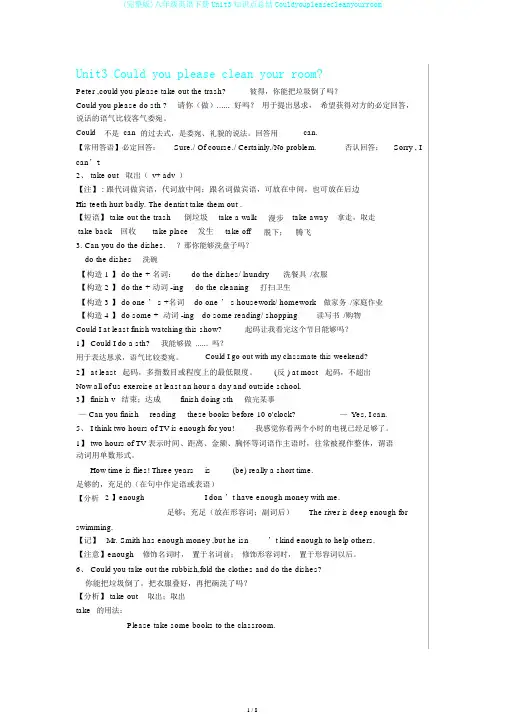
(完整版)八年级英语下册Unit3知识点总结Couldyoupleasecleanyourroom
(完整版)八年级英语下册Unit3知识点总结Couldyoupleasecleanyourroom 1 / 8
Unit3 Could you please clean your room?
Peter ,could you please take out the trash? 彼得,你能把垃圾倒了吗?
Could you please do sth ? 请你(做)...... 好吗? 用于提出恳求, 希望获得对方的必定回答, 说话的语气比较客气委宛。
Could
不是
can
的过去式,是委宛、礼貌的说法。回答用
can. 【常用答语】必定回答: Sure./ Of course./ Certainly./No problem. 否认回答: Sorry , I
can’t
2、 take out 取出( v+ adv )
【注】 : 跟代词做宾语,代词放中间;跟名词做宾语,可放在中间,也可放在后边
His teeth hurt badly. The dentist take them out .
【短语】 take out the trash 倒垃圾 take a walk
take back 回收 take place 发生 take off
3. Can you do the dishes. ?那你能够洗盘子吗?
do the dishes 洗碗
漫步
脱下;
take away
腾飞
拿走,取走
【构造 1 】 do the + 名词: do the dishes/ laundry 洗餐具 /衣服
【构造 2 】 do the + 动词 -ing do the cleaning 打扫卫生
【构造 3 】 do one ’ s +名词 do one ’ s housework/ homework 做家务 /家庭作业
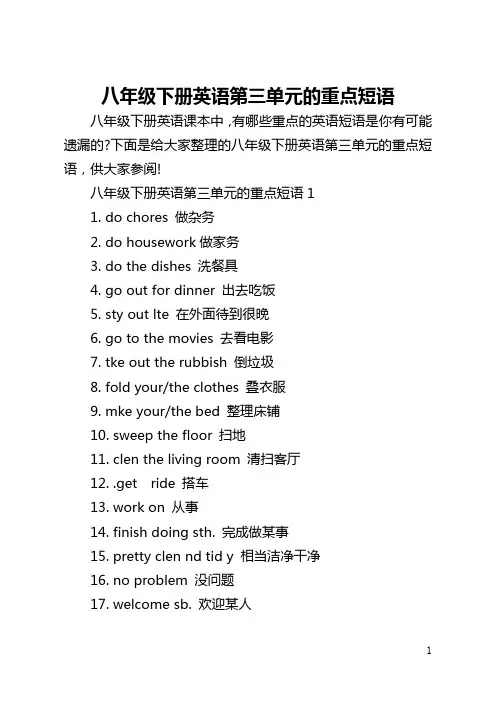
八年级下册英语第三单元的重点短语
1 八年级下册英语第三单元的重点短语
八年级下册英语课本中,有哪些重点的英语短语是你有可能遗漏的?下面是给大家整理的八年级下册英语第三单元的重点短语,供大家参阅!
八年级下册英语第三单元的重点短语1
1. do chores 做杂务
2. do housework做家务
3. do the dishes 洗餐具
4. go out for dinner 出去吃饭
5. sty out lte 在外面待到很晚
6. go to the movies 去看电影
7. tke out the rubbish 倒垃圾
8. fold your/the clothes 叠衣服
9. mke your/the bed 整理床铺
10. sweep the floor 扫地
11. clen the living room 清扫客厅
12. .get ride 搭车
13. work on 从事
14. finish doing sth. 完成做某事
15. pretty clen nd tid y 相当洁净干净
16. no problem 没问题
17. welcome sb. 欢迎某人 1 18. tke sb. for wlk 带某人去散步 c
19. ome home from school/ work放学/下班回家
20. throw down 扔下
八年级下册英语第三单元的重点短语2
1. sit down 坐下
2. two hours of TV两个小时的电视
3. ny minute 随时
4. few things 几件事
5. see this mess看到这样不干净
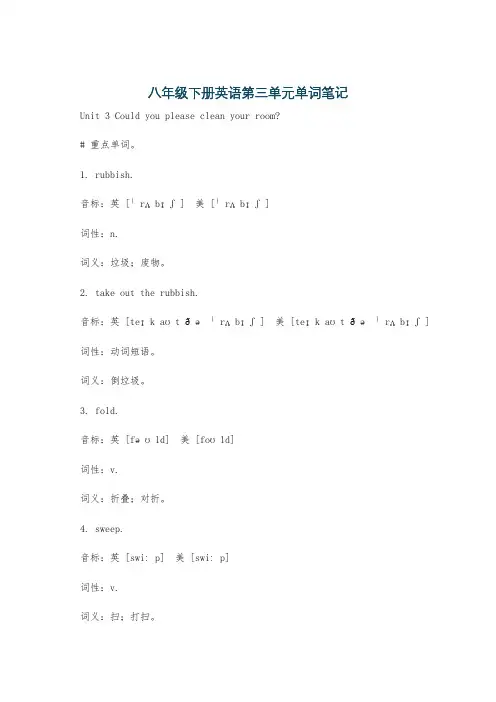
八年级下册英语第三单元单词笔记
八年级下册英语第三单元单词笔记
Unit 3 Could you please clean your room?
# 重点单词。
1. rubbish.
音标:英 [ˈrʌbɪʃ] 美 [ˈrʌbɪʃ]
词性:n.
词义:垃圾;废物。
2. take out the rubbish.
音标:英 [teɪk aʊt ðə ˈrʌbɪʃ] 美 [teɪk aʊt ðə ˈrʌbɪʃ]
词性:动词短语。
词义:倒垃圾。
3. fold.
音标:英 [fəʊld] 美 [foʊld]
词性:v.
词义:折叠;对折。
4. sweep.
音标:英 [swiːp] 美 [swiːp]
词性:v.
词义:扫;打扫。 5. floor.
音标:英 [flɔː(r)] 美 [flɔːr]
词性:n.
词义:地板。
6. mess.
音标:英 [mes] 美 [mes]
词性:n.
词义:杂乱;不整洁。
7. throw.
音标:英 [θrəʊ] 美 [θroʊ]
词性:v.
词义:扔;掷。
8. neither.
音标:英 [ˈnaɪðə(r)] 美 [ˈniːðər]
词性:adv. (与nor连用)也不;两者都不。
词性:pron. 两者都不。
词性:adj. 两者都不的。
9. shirt.
音标:英 [ʃɜːt] 美 [ʃɜːrt]
词性:n. 词义:衬衫。
10. pass.
音标:英 [pɑːs] 美 [pæs]
词性:v.
词义:给;递;走过;通过。
11. borrow.
音标:英 [ˈbɒrəʊ] 美 [ˈbɑːroʊ]
词性:v.
词义:借(入);借用。
12. lend.
音标:英 [lend] 美 [lend]
词性:v.
词义:借给(某人);借出。
13. finger.
音标:英 [ˈfɪŋɡə(r)] 美 [ˈfɪŋɡər]
词性:n.
词义:手指。
14. hate.
go for it 人教版八年级英语下册第三单元八下 U3词汇+句型 习题
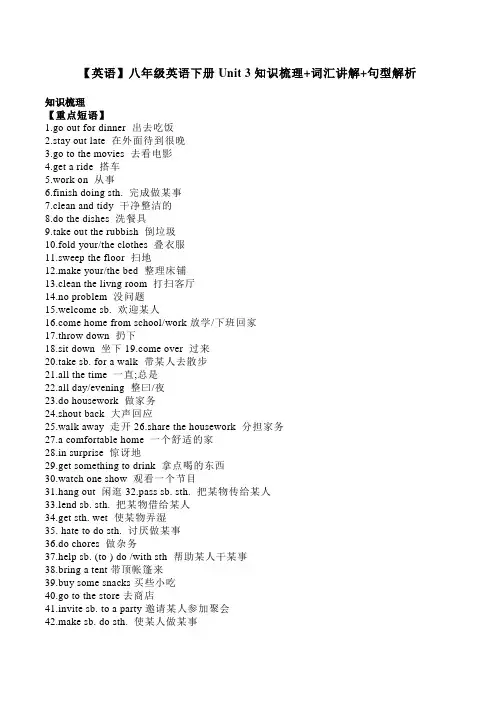
【英语】八年级英语下册Unit 3知识梳理+词汇讲解+句型解析
知识梳理
【重点短语】
1.go out for dinner 出去吃饭
2.stay out late 在外面待到很晚
3.go to the movies 去看电影
4.get a ride 搭车
5.work on 从事
6.finish doing sth. 完成做某事
7.clean and tidy 干净整洁的
8.do the dishes 洗餐具
9.take out the rubbish 倒垃圾
10.fold your/the clothes 叠衣服
11.sweep the floor 扫地
12.make your/the bed 整理床铺
13.clean the livng room 打扫客厅
14.no problem 没问题
15.welcome sb. 欢迎某人
e home from school/work放学/下班回家
17.throw down 扔下
18.sit down 坐下e over 过来
20.take sb. for a walk 带某人去散步
21.all the time 一直;总是
22.all day/evening 整曰/夜
23.do housework 做家务
24.shout back 大声回应
25.walk away 走开26.share the housework 分担家务
27.a comfortable home 一个舒适的家
28.in surprise 惊讶地
29.get something to drink 拿点喝的东西
30.watch one show 观看一个节目
31.hang out 闲逛32.pass sb. sth. 把某物传给某人
33.lend sb. sth. 把某物借给某人
34.get sth. wet 使某物弄湿
35. hate to do sth. 讨厌做某事
八下第三单元知识点英语
八下第三单元知识点英语
Here are some key points for the third unit of Grade 8
English, written in an informal and conversational style:
First up, let's talk about past tense verbs. When
you're telling a story or recalling an event, it's
important to use past tense verbs to describe what happened.
For example, "I went to the park yesterday and saw a
beautiful butterfly." Simple, right? Just make sure you
don't mix up past tense with present tense.
Now, let's dive into some useful phrases for describing
daily routines. You can talk about what you usually do in
the morning with phrases like "I usually wake up at 7 am
and have breakfast." Or if you're describing your evening
routine, you could say, "After dinner, I like to read a
book before bed." These phrases are great for building your
speaking and writing skills.
人教版八年级英语下册unit3知识点总结

人教版八年级英语下册unit3知识点总结
全文共6篇示例,供读者参考
篇1
Unit 3 - What an Interesting World
Hi everyone! I'm going to tell you all about the cool things I
learned in Unit 3 of my English textbook. Get ready, because
there's a lot!
First up, we covered some really useful vocabulary about the
world around us. Words like "environment", "pollute", "protect"
and "conservation". It's so important to take care of our planet
and not pollute the air, water and land with rubbish and
chemicals. Conservation means protecting animals, plants and
natural resources. I try my best to recycle, save energy and water
at home.
Then we learned how to describe locations using
prepositions like "near", "opposite", "behind" and "between". For
example, my school is near the park and opposite the
supermarket. The library is between the bank and the post office.
八年级下册英语第三单元知识点笔记
八年级下册英语第三单元知识点笔记
全文共6篇示例,供读者参考
篇1
Unit 3 Study Guide
Grammar
Passive Voice
The passive voice is really important in this unit. It's used
when the object of an active sentence becomes the subject. Like:
Active: My mom baked the cake.
Passive: The cake was baked by my mom.
You use "be" + past participle to make the passive. The past
participle is like "baked", "cleaned", "jumped" etc. Sometimes
you can leave out the "by..." part if it's obvious or you don't want
to mention who did it.
There are a few reasons to use the passive:
If you don't know who did the action
If it's obvious who did it If you want to emphasize the object, not the subject
Modals of Deduction
These aremodals like "must, can't, might, may, could" that
you use when you are making a deduction or guess about
人教版英语八年级下册Unit3知识点总结
Unit 3 Could you please clean your room?
【重点短语】
1. wash/do the dishes 洗餐具 2.take out the trash 倒垃圾 3.fold clothes折衣服
4.sweep the floor 扫地 5.make the bed 整理床铺 6.clean the living room 打扫客厅
7.throw down 丢下 8.in front of 在......的前面 9.all day 整天
10.share housework分摊家务 11.do chores 做家务 12.help sb. with sth.帮助某人做某事
13.have to 不得不 14.go to the movies 去看电影 15.lend me some money 借给我一些钱
16.no problem没问题 17.invite...to...邀请...去... 18.enough stress足够的压力
19.a waste of 浪费...... 20.spend...on /spend ...doing sth.花费....... 19.in order to 为了
20.get good grades 取得好成绩 21.provide sth. for sb.=provide sb. with sth. 为某人提供某物
22.mind doing介意做....... 23.depend on取决于,依赖 24.develop children’s independence发展孩子们的独立性 25.take care of =look after照顾 26.do one’s part尽自己的一份力
八年级下册英语第三单元知识点
八年级下册英语第三单元知识点
八年级下册的英语第三单元是我们学习英语之旅中的重要一站。在这个单元里,我们将学习一些重要的语法和词汇知识,以及提高我们的听说读写能力。下面,我们来一起回顾一下这个单元的知识点。
一、名词的复数形式
在英语中,名词的复数形式是非常重要的。通常,我们可以通过在名词后面加上“-s”来表示复数形式,如books、cats等。但是也有一些特殊情况,如以“-s”、“-sh”、“-ch”、“-x”或“-o”结尾的名词,复数形式是在名词后面加上“-es”,如boxes、watches、bushes、foxes和tomatoes等。
二、动词的一般现在时和一般过去时
在第三单元里,我们学习了动词的一般现在时和一般过去时的用法。一般现在时用来表示经常性的动作或现在的状态,我们可以在动词原形后面加上“-s”或“-es”来构成一般现在时,如plays、goes等。一般过去时用来表示过去发生的事情,我们可以在动词原形后面加上“-ed”或变化其结尾的字母形式来构成一般过去时,如played、went等。
三、形容词的比较级和最高级
形容词的比较级和最高级是用来比较不同事物之间的属性或状态的。通常,我们可以在形容词原形后面加上“-er”来构成比较级,如bigger、happier等。而构成最高级,我们可以在形容词原形后面加上“-est”,如biggest、happiest等。但是也有一些特殊形式,如good、bad和far等,它们的比较级和最高级分别是better、worse和farther/further。
四、名词所有格
名词所有格表示某物属于某人或某事物的所有关系。通常,我们可以在名词后面加上“-’s”来表示名词所有格,如John’s book。如果名词是以“-s”结尾的复数形式,我们只需要在名词后面加上一个撇号“’”来表示名词所有格,如the students’ books。
五、句子的倒装结构
八年级下册英语第三单元知识归纳
八年级下册英语第三单元知识归纳
In the third unit of the eighth grade English textbook, we will focus on the topic of
"Healthy Living". This unit covers a variety of important aspects related to maintaining a
healthy lifestyle, including exercise, diet, and mental well-being. By the end of this unit,
students will have a better understanding of how to make healthy choices in their daily
lives.
One key aspect of healthy living is regular exercise. Exercise is essential for
maintaining physical fitness and overall health. It helps to strengthen muscles, improve
cardiovascular health, and boost mood and mental well-being. In this unit, students will
learn about different types of exercises, such as cardio, strength training, and flexibility
exercises. They will also explore the benefits of each type of exercise and how to