
英语语法术语的英文名称
选择疑问句 alternative 反义疑问句 disjunctive 感叹疑问句 exclamatory question
存在句 existential sentence
肯定句 positive sentence
基本句型 basic sentence pattern
否定句 negative sentence
对全部高中资料试卷电气设备,在安装过程中以及安装结束后进行高中资料试卷调整试验;通电检查所有设备高中资料电试力卷保相护互装作置用调与试相技互术关,系电,力根保通据护过生高管产中线工资敷艺料设高试技中卷术资0配料不置试仅技卷可术要以是求解指,决机对吊组电顶在气层进设配行备置继进不电行规保空范护载高高与中中带资资负料料荷试试下卷卷高问总中题体资,配料而置试且时卷可,调保需控障要试各在验类最;管大对路限设习度备题内进到来行位确调。保整在机使管组其路高在敷中正设资常过料工程试况中卷下,安与要全过加,度强并工看且作护尽下关可都于能可管地以路缩正高小常中故工资障作料高;试中对卷资于连料继接试电管卷保口破护处坏进理范行高围整中,核资或对料者定试对值卷某,弯些审扁异核度常与固高校定中对盒资图位料纸置试.,卷保编工护写况层复进防杂行腐设自跨备动接与处地装理线置,弯高尤曲中其半资要径料避标试免高卷错等调误,试高要方中求案资技,料术编试5交写卷、底重保电。要护气管设装设线备置备4敷高动调、设中作试电技资,高气术料并中课3中试且资件、包卷拒料中管含试绝试调路线验动卷试敷槽方作技设、案,术技管以来术架及避等系免多统不项启必方动要式方高,案中为;资解对料决整试高套卷中启突语动然文过停电程机气中。课高因件中此中资,管料电壁试力薄卷高、电中接气资口设料不备试严进卷等行保问调护题试装,工置合作调理并试利且技用进术管行,线过要敷关求设运电技行力术高保。中护线资装缆料置敷试做设卷到原技准则术确:指灵在导活分。。线对对盒于于处调差,试动当过保不程护同中装电高置压中高回资中路料资交试料叉卷试时技卷,术调应问试采题技用,术金作是属为指隔调发板试电进人机行员一隔,变开需压处要器理在组;事在同前发一掌生线握内槽图部内纸故,资障强料时电、,回设需路备要须制进同造行时厂外切家部断出电习具源题高高电中中源资资,料料线试试缆卷卷敷试切设验除完报从毕告而,与采要相用进关高行技中检术资查资料和料试检,卷测并主处且要理了保。解护现装场置设。备高中资料试卷布置情况与有关高中资料试卷电气系统接线等情况,然后根据规范与规程规定,制定设备调试高中资料试卷方案。
原因状语从句 adverbial clause of cause
结果状语从句 adverbial clause of result
目的状语从句 adverbial clause of purpose
条件状语从句 adverbial clause of condition
真实条件状语从句 adverbial clause of real condition
同位语从句 appositive clause
时间状语从句 adverbial clause of
time
地点状语从句 adverbial clause of place
方式状语从句 adverbial clause of
manner
让步状语从句 adverbial clause of concession
形式 form
单数形式 singular form
复数形式 plural form
限定动词 finite verb form
非限定动词 non-finite verb form
原形 base form
对全部高中资料试卷电气设备,在安装过程中以及安装结束后进行高中资料试卷调整试验;通电检查所有设备高中资料电试力卷保相护互装作置用调与试相技互术关,系电,力根保通据护过生高管产中线工资敷艺料设高试技中卷术资0配料不置试仅技卷可术要以是求解指,决机对吊组电顶在气层进设配行备置继进不电行规保空范护载高高与中中带资资负料料荷试试下卷卷高问总中题体资,配料而置试且时卷可,调保需控障要试各在验类最;管大对路限设习度备题内进到来行位确调。保整在机使管组其路高在敷中正设资常过料工程试况中卷下,安与要全过加,度强并工看且作护尽下关可都于能可管地以路缩正高小常中故工资障作料高;试中对卷资于连料继接试电管卷保口破护处坏进理范行高围整中,核资或对料者定试对值卷某,弯些审扁异核度常与固高校定中对盒资图位料纸置试.,卷保编工护写况层复进防杂行腐设自跨备动接与处地装理线置,弯高尤曲中其半资要径料避标试免高卷错等调误,试高要方中求案资技,料术编试5交写卷、底重保电。要护气管设装设线备置备4敷高动调、设中作试电技资,高气术料并中课3中试且资件、包卷拒料中管含试绝试调路线验动卷试敷槽方作技设、案,术技管以来术架及避等系免多统不项启必方动要式方高,案中为;资解对料决整试高套卷中启突语动然文过停电程机气中。课高因件中此中资,管料电壁试力薄卷高、电中接气资口设料不备试严进卷等行保问调护题试装,工置合作调理并试利且技用进术管行,线过要敷关求设运电技行力术高保。中护线资装缆料置敷试做设卷到原技准则术确:指灵在导活分。。线对对盒于于处调差,试动当过保不程护同中装电高置压中高回资中路料资交试料叉卷试时技卷,术调应问试采题技用,术金作是属为指隔调发板试电进人机行员一隔,变开需压处要器理在组;事在同前发一掌生线握内槽图部内纸故,资障强料时电、,回设需路备要须制进同造行时厂外切家部断出电习具源题高高电中中源资资,料料线试试缆卷卷敷试切设验除完报从毕告而,与采要相用进关高行技中检术资查资料和料试检,卷测并主处且要理了保。解护现装场置设。备高中资料试卷布置情况与有关高中资料试卷电气系统接线等情况,然后根据规范与规程规定,制定设备调试高中资料试卷方案。
英语语法术语的英文名称
名词性从句:Noun Clauses. 语法 grammar 词法 morphology 层次 rank 从句 clause 词类 part of speech 实词 notional word 单纯词 simple word 复合词 compound 名词 noun 普通名词 common noun 不可数名词 uncountable noun 具体名词 concrete noun 集体名词 collective noun 介词 preposition 动词 verb 及物动词 transitive verb 系动词 link verb 情态动词 modal verb 不规则动词 irregular verb 限定动词 finite verb 使役动词 causative verb 动态动词 event verb 感叹词 exclamation 副词 adverb 程度副词 adverb of degree 地点副词 adverb of place 连接性副词 conjunct 关系副词 relative adverb 人称代词 personal pronoun 反身代词 reflexive pronoun 指示代词 demonstrative pronoun 关系代词 relative pronoun 物主代词 possessive pronoun
从句 clause
从属句 subordinate clause
并列句 coordinate clause
名词从句 nominal clause
定语从句 attributive clause
状语从句 adverbial clause
宾语从句 object clause
主语从句 subject clause
pronoun 形容词性物主代词 adjectival possessive pronoun
冠词 article
定冠词 definite article
不定冠词 indefinite article
数词 numeral
基数词 cardinal numeral
序数词 ordinal numeral
分数词 fractional numeral
句法 syntax 结构 structure 句子 sentence 词组 phrase 单词 word 虚词 structural word 派生词 derivative 词性 part of speech 专有名词 proper noun 可数名词 countable noun 抽象名词 abstract noun 物质名词 material noun 个体名词 individual noun 连词 conjunction 主动词 main verb 不及物动词 intransitive verb 助动词 auxiliary verb 规则动词 regular verb 短语动词 phrasal verb 非限定动词 infinite verb 感官动词 verb of senses 静态动词 state verb 形容词 adjective 方式副词 adverb of manner 时间副词 adverb of time 修饰性副词 adjunct 疑问副词 interrogative adverb 代词 pronoun 物主代词 possessive pronoun 相互代词 reciprocal pronoun 疑问代词 interrogative pronoun 不定代词 indefinite pronoun 名词性物主代词 nominal possessive
对全部高中资料试卷电气设备,在安装过程中以及安装结束后进行高中资料试卷调整试验;通电检查所有设备高中资料电试力卷保相护互装作置用调与试相技互术关,系电,力根保通据护过生高管产中线工资敷艺料设高试技中卷术资配0料不置试仅技卷可术要以是求解指,决机对吊组电顶在气层进设配行备置继进不电行规保空范护载高高与中中带资资负料料荷试试下卷卷高问总中题体资,配料而置试且时卷可,调保需控障要试各在验类最;管大对路限设习度备题内进到来行位确调。保整在机使管组其路高在敷中正设资常过料工程试况中卷下,安与要全过加,度强并工看且作护尽下关可都于能可管地以路缩正高小常中故工资障作料高;试中对卷资于连料继接试电管卷保口破护处坏进理范行高围整中,核资或对料者定试对值卷某,弯些审扁异核度常与固高校定中对盒资图位料纸置试,.卷保编工护写况层复进防杂行腐设自跨备动接与处地装理线置,弯高尤曲中其半资要径料避标试免高卷错等调误,试高要方中求案资技,料术编试交写5、卷底重电保。要气护管设设装线备备置敷4高、调动设中电试作技资气高,术料课中并中3试、件资且包卷管中料拒含试路调试绝线验敷试卷动槽方设技作、案技术,管以术来架及避等系免多统不项启必方动要式方高,案中为;资解对料决整试高套卷中启突语动然文过停电程机气中。课高因件中此中资,管料电壁试力薄卷高、电中接气资口设料不备试严进卷等行保问调护题试装,工置合作调理并试利且技用进术管行,线过要敷关求设运电技行力术高保。中护线资装缆料置敷试做设卷到原技准则术确:指灵在导活分。。线对对盒于于处调差,试动当过保不程护同中装电高置压中高回资中路料资交试料叉卷试时技卷,术调应问试采题技用,术金作是属为指隔调发板试电进人机行员一隔,变开需压处要器理在组;事在同前发一掌生线握内槽图部内纸故,资障强料时电、,回设需路备要须制进同造行时厂外切家部断出电习具源题高高电中中源资资,料料线试试缆卷卷敷试切设验除完报从毕告而,与采要相用进关高行技中检术资查资料和料试检,卷测并主处且要理了保。解护现装场置设。备高中资料试卷布置情况与有关高中资料试卷电气系统接线等情况,然后根据规范与规程规定,制定设备调试高中资料试卷方案。
英语语法术语解释

英语语法术语解释及物动词后面必须跟宾语意义才完整的实义动词,字典里词后标有vt.不及物动词后面不能直接跟有动作的对象(即宾语)。
若要跟宾语,必须先在其后添加上某个介词,如to,of ,at后方可跟上宾语。
及物动词可直接跟宾语。
字典里词后标有vi.系动词亦称连系动词, 不能独立存在,后面必须跟表语一起构成复合谓语,表示主语的身份、类别、特征、状态等。
常见类型归纳:be动词(am,is,are),感官动词(feel,look,smell,sound,taste,seem),“变得”词(get,become,turn,grow),“保持”(keep,stay)。
助动词协助主要动词构成谓语的词,用来构成时态和语态。
助动词具有语法意义,没有词汇意义,不可单独作谓语,没有对应的汉译,例如:He doesn't like English. 他不喜欢英语。
(does是助动词,无词义;like是主要动词,有词义)最常用的助动词有:be, have, has, do, does, shall, did, will,should, would等,助动词可构成疑问句和否定句,构成否定句时与否定副词not连用情态动词本身有一定的词义,表示语气的单词。
情态动词用在行为动词前,表示说话人对这一动作或状态的看法或主观设想。
主要有:can(could), may (might), must, need, ought to, dare (dared), shall(should), will (would) must not.动词过去式表示过去某个时间里发生的动作或状态,有规测或不规则的变化。
非谓语动词是指在句子中不是谓语的动词,主要包括不定式、动名词和分词(现在分词和过去分词),分词是具有动词及形容词二者特征的词,分为现在分词和过去分词两种,是一种非谓语动词形式过去分词 1. 及物动词的过去分词作表语,与句子的主语是被动关系,表示主语的状态,不但表示被动,还强调已完成了。
柯林斯英语词典语法术语表
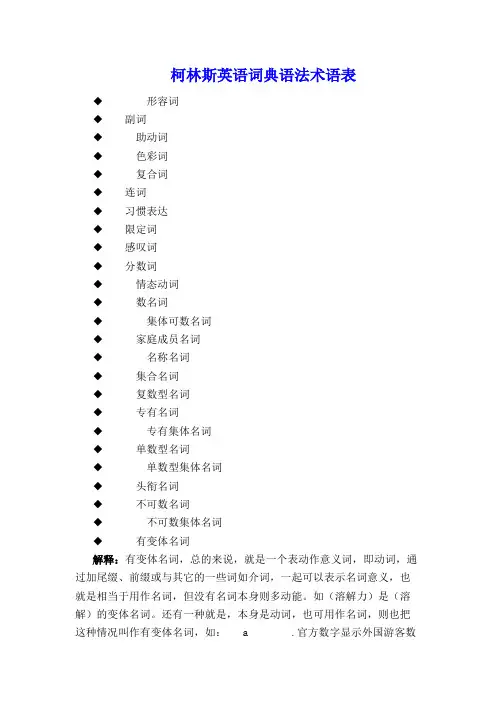
柯林斯英语词典语法术语表◆形容词◆副词◆助动词◆色彩词◆复合词◆连词◆习惯表达◆限定词◆感叹词◆分数词◆情态动词◆数名词◆集体可数名词◆家庭成员名词◆名称名词◆集合名词◆复数型名词◆专有名词◆专有集体名词◆单数型名词◆单数型集体名词◆头衔名词◆不可数名词◆不可数集体名词◆有变体名词解释:有变体名词,总的来说,就是一个表动作意义词,即动词,通过加尾缀、前缀或与其它的一些词如介词,一起可以表示名词意义,也就是相当于用作名词,但没有名词本身则多动能。
如(溶解力)是(溶解)的变体名词。
还有一种就是,本身是动词,也可用作名词,则也把这种情况叫作有变体名词,如: a .官方数字显示外国游客数量骤降。
中的这时就是(这个是动词)的有变体名词。
简单的说,就是动词可用作名词,或加前后缀变成名词,则这些动词就有有变体名词。
◆有变体集体名词◆称呼名词◆否定词◆数词◆序数词◆动词词组◆习语◆前置限定词◆前缀◆介词◆代词◆强调代词◆不定代词◆否定不定代词◆否定代词◆复数型代词◆所有格代词◆相互代词◆反身代词◆强调反身代词◆关系代词◆单数型代词◆数量词◆否定数量词◆复数型数量词◆疑问词◆表音词◆不与物动词◆连系动词◆被动与物动词◆相互动词◆被动相互动词◆与物动词◆被动与物动词◆与物动词/不与物动词。
(全)英语语法术语中英对照

定冠词 definite article 不定冠词 indefinite article
数词 Numeral
基数词 cardinal numeral 序数词 ordinal numeral 分数词 fractional numeral 形式 form 单数形式 singular form 复数形式 plural form 原形 base form
句法关系
句法 Syntactic relationship
并列 coordinate 从属 subordination
修饰 modification 前置修饰 pre-modification 后置修饰 post-modification 限制 restriction 双重限制 double-restriction 非限制 non-restriction
从句 Clause
从属句 subordinate clause 并列句 coordinate clause 名词从句 nominal clause 定语从句 attributive clause 状语从句 adverbial clause 宾语从句 object clause 主语从句 subject clause 同位语从句 appositive clause 真实条件状语从句 adverbial clause of real condition 非真实条件状语从句 adverbial clause of unreal condition
其实,the words that are used to describe a person or thing 指的就是形容词, 形容词的英文说法是 “adjective”. 有鉴于此, 现在把英文语法的专有名词说法,整理如下,同 学花个几分钟的时间把他们记起来,下次再想问 外教语法问题时,就不用那么麻烦啰!
高中英语疑难探究语法术语:“可变名词”和“时序副词”素材
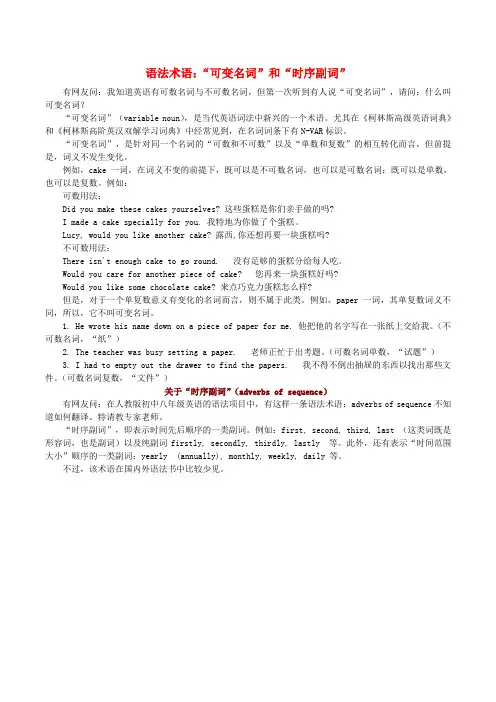
语法术语:“可变名词”和“时序副词”有网友问:我知道英语有可数名词与不可数名词,但第一次听到有人说“可变名词”,请问:什么叫可变名词?“可变名词”(variable noun),是当代英语词法中新兴的一个术语。
尤其在《柯林斯高级英语词典》和《柯林斯高阶英汉双解学习词典》中经常见到,在名词词条下有N-VAR标识。
“可变名词”,是针对同一个名词的“可数和不可数”以及“单数和复数”的相互转化而言,但前提是,词义不发生变化。
例如,cake 一词,在词义不变的前提下,既可以是不可数名词,也可以是可数名词;既可以是单数,也可以是复数。
例如:可数用法:Did you make these cakes yourselves? 这些蛋糕是你们亲手做的吗?I made a cake specially for you. 我特地为你做了个蛋糕。
Lucy, would you like another cake? 露西,你还想再要一块蛋糕吗?不可数用法:There isn't enough cake to go round. 没有足够的蛋糕分给每人吃。
Would you care for another piece of cake? 您再来一块蛋糕好吗?Would you like some chocolate cake? 来点巧克力蛋糕怎么样?但是,对于一个单复数意义有变化的名词而言,则不属于此类。
例如,paper 一词,其单复数词义不同,所以,它不叫可变名词。
1. He wrote his name down on a piece of paper for me. 他把他的名字写在一张纸上交给我。
(不可数名词,“纸”)2. The teacher was busy setting a paper. 老师正忙于出考题。
(可数名词单数,“试题”)3. I had to empty out the drawer to find the papers. 我不得不倒出抽屉的东西以找出那些文件。
英语语法专业术语
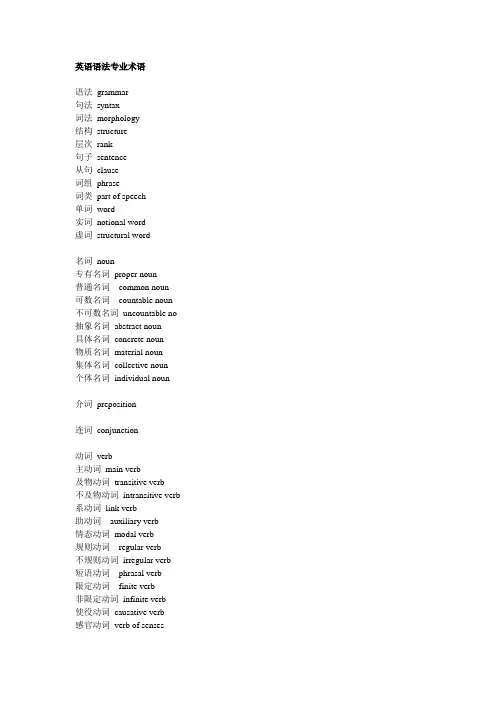
英语语法专业术语语法grammar句法syntax词法morphology结构structure层次rank句子sentence从句clause词组phrase词类part of speech单词word实词notional word虚词structural word名词noun专有名词proper noun普通名词common noun可数名词countable noun 不可数名词uncountable no 抽象名词abstract noun具体名词concrete noun物质名词material noun集体名词collective noun个体名词individual noun介词preposition连词conjunction动词verb主动词main verb及物动词transitive verb不及物动词intransitive verb 系动词link verb助动词auxiliary verb情态动词modal verb规则动词regular verb不规则动词irregular verb 短语动词phrasal verb限定动词finite verb非限定动词infinite verb使役动词causative verb感官动词verb of senses动态动词event verb静态动词state verb感叹词exclamation形容词adjective副词adverb方式副词adverb of manner程度副词adverb of degree时间副词adverb of time地点副词adverb of place修饰性副词adjunct连接性副词conjunct疑问副词interrogative adverb关系副词relative adverb代词pronoun人称代词personal pronoun物主代词possessive pronoun反身代词reflexive pronoun相互代词reciprocal pronoun指示代词demonstrative pronoun疑问代词interrogative pronoun关系代词relative pronoun不定代词indefinite物主代词possessive pronoun名词性物主代词nominal possessive形容词性物主代词adjectival possessive pronoun冠词article定冠词definite article不定冠词indefinite article数词numeral基数词cardinal numeral序数词ordinal numeral分数词fractional numeral形式form单数形式singular form复数形式plural form限定动词finite verb form非限定动词non-finite verb form原形base form从句clause从属句subordinate clause并列句coordinate clause名词从句nominal clause定语从句attributive clause状语从句adverbial clause宾语从句object clause主语从句subject clause同位语从句appositive clause时间状语从句adverbial clause of time地点状语从句adverbial clause of place方式状语从句adverbial clause of manner让步状语从句adverbial clause of concession原因状语从句adverbial clause of cause结果状语从句adverbial clause of result目的状语从句adverbial clause of purpose条件状语从句adverbial clause of condition真实条件状语从句adverbial clause of real condition非真实条件状语从句adverbial clause of unreal condition 含蓄条件句adverbial clause of implied condition错综条件句adverbial clause of mixed condition句子sentence简单句simple sentence并列句compound sentence复合句complex sentence并列复合句compound complex sentence陈述句declarative sentence疑问句interrogative sentence一般疑问句general question特殊疑问句special question选择疑问句alternative question附加疑问句tag question反义疑问句disjunctive question修辞疑问句rhetorical question感叹疑问句exclamatory question存在句existential sentence肯定句positive sentence否定句negative sentence祈使句imperative sentence省略句elliptical sentence感叹句exclamatory sentence基本句型basic sentence pattern句子成分members of sentences 主语subject谓语predicate宾语object双宾语dual object直接宾语direct object间接宾语indirect object复合宾语complex object同源宾语cognate object补语complement主补subject complement宾补object complement表语predicative定语attribute同位语appositive状语adverbial句法关系syntactic relationship 并列coordinate从属subordination修饰modification前置修饰pre-modification后置修饰post-modification限制restriction双重限制double-restriction非限制non-restriction数number单数形式singular form复数形式plural form规则形式regular form不规则形式irregular form格case普通格common case所有格possessive case主格nominative case宾格objective case性gender阳性masculine阴性feminine通性common中性neuter人称person第一人称first person第二人称second person第三人称third person时态tense过去将来时past future tense过去将来进行时past future continuous tense过去将来完成时past future perfect tense一般现在时present simple tense一般过去时past simple tense一般将来时future simple tense现在完成时past perfect tense过去完成时present perfect tense将来完成时future perfect tense现在进行时present continuous tense过去进行时past continuous tense将来进行时future continuous tense过去将来进行时past future continuous tense现在完成进行时present perfect continuous tense 过去完成进行时past perfect continuous tense语态voice主动语态active voice被动语态passive voice语气mood陈述语气indicative mood祈使语气imperative mood虚拟语气subjunctive mood否定negation否定范围scope of negation全部否定full negation局部否定partial negation转移否定shift of negation语序order自然语序natural order倒装语序inversion全部倒装full inversion部分倒装partial inversion直接引语direct speech间接引语indirect speech自由直接引语free direct speech自由间接引语free indirect speech一致agreement主谓一致subject-predicate agreement 语法一致grammatical agreement概念一致notional agreement就近原则principle of proximity强调emphasis重复repetition语音pronunciation语调tone升调rising tone降调falling tone降升调falling-rising tone文体style正式文体formal非正式文体informal口语spoken/oral English套语formulistic expression英国英语British English美国英语American English用法usage感情色彩emotional coloring褒义commendatory贬义derogatory幽默humorous讽刺sarcastic挖苦ironic动名词gerund连字号hyphen祈使语气imperative mood祈使句imperative sentences独立成分indefinite case主句indicative mood物质名词material nouns句子的成分members of the sentence 情态动词modal verbs语气mood词法morphology否定疑问句negative interrogative sentence动词的非限定形式non-finite forms of the verb非限制性定语从句non-restrictive attributive clauses 括号brackets名词的分类classification of nouns从句(分句)clauses同源宾语cognate object集体名词collective nouns冒号colon逗号comma普通格common case普通名词common nouns比较级comparative degree复合宾语complex Object复合句complex sentences并列复合句compound complex sentences表性状的复合谓语compound nominal predicate复合谓语compound predicate并列句compound sentences表行为的复合谓语compound verbal predicate合成词compound words合成compounding ( composition )错综时间条件句conditional sentences of mixed time 连词conjunction连接副词conjunctive adverbs连接代词conjunctive pronouns转化conversion并列连词co-coordinating conjunctions可数名词countable nouns破折号dash陈述句declarative sentences定冠词definite article比较的级别degrees of comparison指示代词demonstrative pronouns派生(词缀法)derivation ( affixation )描绘性定语descriptive attributes呼语direct address直接宾语direct object直接引语direct speech反意问句disjunctive questions省略ellipsis省略句elliptical sentences感叹号exclamation mark感叹句exclamatory sentences动词的限定形式finite forms of the verb虚词form words分数词fractional numerals完全倒装full inversion将来进行时future continuous一般将来时future indefinite将来完成时future perfect将来完成进行时future perfect continuous独立结构absolute constructions物主代词的绝对形式absolute forms of possessive pronouns 抽象名词abstract nouns主动语态active voice方式状语从句adverbial clauses of manner地点状语从句adverbial clauses of place目的状语从句adverbial clauses of purpose时间状语从句adverbial clauses of time程度副词adverbs of degree频度副词adverbs of frequency方式副词adverbs of manner地点副词adverbs of place时间副词adverbs of time选择问句alternative questions句子分析analysis of sentences省略号apostrophe同谓语appositive同位语从句appositive clauses助动词auxiliary verbs插入语parenthesis部分倒装partial inversion分词短语participial phrases分词participle小品词particle词类parts of speech过去式past forms过去分词past participle句号period ( full stop )人称person人称代词personal pronouns成语动词phrasal verbs谓语predicate表语predicative表语从句predicative clauses前缀prefix(es)介词短语prepositional phrases现在式present forms现在分词present participle动词的主要形式principal forms of verbs专有名词proper nouns标点符号punctuation问号question mark引号quotation mark相互代词reciprocal pronouns不定代词indefinite Pronouns关系副词relative adverbs关系代词relative pronouns限制性定语从句restrictive attributive clauses 自身代词self pronouns分号semicolon真实条件句sentences of real condition虚拟条件句sentences of unreal condition时态的呼应sequence of tenses特殊问句special questions虚拟语气subjunctive mood后缀suffix(es)最高级superlative degree句法syntax句型的转换transformation of sentences双部句two-member sentences不可数名词uncountable nouns动词短语verbal phrases名词化的动词verbal noun构词法word building。
英语语法中的专业术语的翻译

感叹词 interjection 缩写 int.
代词pronoun 缩写pron.
名词 noun 缩写n.
☆普通名词 common noun (集体名词 collective noun/个体名词 individual noun
物质名词 material noun/ 抽象名词 abstract noun ) ☆专有名词 proper noun
☆可数名词 countable noun 不可数名词 uncountable noun
关联词 connective
从句 clause
从属句 subordinate clause
并列句 coordinate clause
☆名词从句 nominal clause
主语从句 subject clause
宾语从句 objective clause
表语从句 predicative clause
同位语从句 oppositive clause
定冠词 definite article 不定冠词 indefinite article
☆数词 numeral 缩写num.
基数词 cardinal numeral 序数词 ordinal numeral
连词 conjunction 缩写 conj.
☆并列连词 coordinating conjunction 从属连词 subordinating conjunction
☆定语从句 attributive clause
教资高中英语学科知识与能力 语法专业术语
教资高中英语学科知识与能力语法专业术语(一)词类part of speech实词notional word ['nəuʃənəl]虚词structural word/ form word (e.g. article preposition conjunction interjection) 派生词derivative [di'rivətiv, də'rivətiv]复合词compound ['kɔmpaund,kɔm'paund]词性part of speech名词noun专有名词proper noun普通名词common noun可数名词countable noun不可数名词uncountable noun单数形式singular form复数形式plural form ['pluərəl, 'plurəl]抽象名词abstract noun [æb'strækt,'æbstrækt]具体名词concrete noun ['kɔnkri:t]物质名词material noun集体名词collective noun个体名词individual noun动词verb主动词main verb及物动词transitive verb ['trænsitiv, 'trænsətiv]不及物动词intransitive verb [in'trænsitiv, in'trænsətiv]系动词link verb助动词auxiliary verb [ɔ:g'ziljəri]情态动词modal verb规则动词regular verb不规则动词irregular verb短语动词phrasal verb ['freizl, 'freizəl]限定动词finite verb ['fainait]非限定动词infinite verb ['infinit, 'infənit]使役动词causative verb ['kɔ:zətiv]感官动词verb of senses动态动词event verb静态动词state verb形容词adjective比较等级degrees of comparison☆原级positive degree☆比较级comparative degree☆最高级superlative degree副词adverb方式副词adverb of manner程度副词adverb of degree时间副词adverb of time地点副词adverb of place修饰性副词adjunct连接性副词conjunct疑问副词interrogative adverb [.intə'rɔgətiv]关系副词relative adverb代词pronoun ['prəunaun]人称代词personal pronoun物主代词possessive pronoun [pə'zesiv]反身代词reflexive pronoun [ri'fleksiv]相互代词reciprocal pronoun [ri'siprəkəl]指示代词demonstrative pronoun [di'mɔnstrətiv]疑问代词interrogative pronoun [.intə'rɔgətiv]关系代词relative pronoun不定代词indefinite pronoun [in'definit, in'defənit]名词性物主代词nominal possessive pronoun形容词性物主代词adjectival possessive pronoun [.ædʒik'taivəl]冠词article定冠词definite article ['definit, 'defənit]不定冠词indefinite article介词preposition [prepə'ziʃən]连词conjunction [kən'dʒʌŋkʃən]感叹词exclamation [.eksklə'meiʃən]数词numeral ['nju:mərəl]基数词cardinal numeral ['kɑ:dinl, 'kɑ:dnəl]序数词ordinal numeral ['ɔ:dinəl, 'ɔ:dnəl]分数词fractional numeral ['frækʃənəl]限定动词finite verb form ['fainait]非限定动词non-finite verb form [nʌn'finit]原形base form数number单数形式singular form复数形式plural form规则形式regular form不规则形式irregular form格case普通格common case所有格possessive case主格nominative case宾格objective case [əb'dʒektiv]性gender ['dʒendə]阳性masculine ['mæskjulin, 'mæskjəlin]阴性feminine ['feminin, 'femənin]通性common中性neuter ['nju:tə]人称person第一人称first person 第二人称second person 第三人称third person(二)句子句子成分members of sentences主语subject谓语predicate ['predikeit,'predikit]宾语object双宾语dual object ['dju:əl]直接宾语direct object间接宾语indirect object复合宾语complex object同源宾语cognate object ['kɔg.neit]补语complement ['kɔmplimənt, 'kɔmplə.ment,'kɔmpləmənt]主补subject complement宾补object complement表语predicative ['pridi.kətiv, 'predi.keitiv]定语attribute [ə'tribju:t,'ætribju:t, ə'tribjut,'ætrə.bju:t]同位语appositive [ə'pɔzitiv]状语adverbial [əd'və:biəl]从句clause从属句subordinate clause [sə'bɔ:dineit, sə'bɔ:dn.eit,sə'bɔ:dnit]并列句coordinate clause [kəu'ɔ:dneit,kəu'ɔ:dnit, kəu'ɔ:dəneit]名词从句nominal clause ['nɔminəl, 'nɔmənəl]定语从句attributive clause [ə'tribjutiv, ə'tribjətiv]状语从句adverbial clause [əd'və:biəl]宾语从句object clause主语从句subject clause同位语从句appositive clause [ə'pɔzitiv]时间状语从句adverbial clause of time地点状语从句adverbial clause of place方式状语从句adverbial clause of manner让步状语从句adverbial clause of concession [kən'seʃən]原因状语从句adverbial clause of cause结果状语从句adverbial clause of result目的状语从句adverbial clause of purpose条件状语从句adverbial clause of condition真实条件状语从句adverbial clause of real condition非真实条件状语从句adverbial clause of unreal condition含蓄条件句adverbial clause of implied condition错综条件句adverbial clause of mixed condition简单句simple sentence并列句compound sentence复合句complex sentence并列复合句compound complex sentence陈述句declarative sentence [di'klærətiv]疑问句interrogative sentence [.intə'rɔgətiv]一般疑问句general question特殊疑问句special question选择疑问句alternative question [ɔ:l'tə:nətiv]附加疑问句tag question反义疑问句disjunctive question [dis'dʒʌŋktiv]修辞疑问句rhetorical question [ri'tɔrikəl]感叹疑问句exclamatory question [iks'klæmə.təri, ik'sklæmə.təuri]存在句existential sentence [.egzis'tenʃəl]肯定句positive sentence基本句型basic sentence pattern否定句negative sentence祈使句imperative sentence [im'perətiv]省略句elliptical sentence [i'liptikəl]感叹句exclamatory sentence [iks'klæmə.təri, ik'sklæmə.təuri]句法关系syntactic relationship [sin'tæktik]并列coordinate [kəu'ɔ:dneit,kəu'ɔ:dnit, kəu'ɔ:dəneit]从属subordination [səb.ɔ:di'neiʃən, səb.ɔ:dən'eiʃən]修饰modification [.mɔdifi'keiʃən, .mɔdəfə'keiʃən]前置修饰pre-modification [.mɔdifi'keiʃən, .mɔdəfə'keiʃən]后置修饰post-modification [.mɔdifi'keiʃən, .mɔdəfə'keiʃən] 限制restriction [ri'strikʃən]双重限制double-restriction非限制non-restriction时态tense过去将来时past future tense过去将来进行时past future continuous tense过去将来完成时past future perfect tense一般现在时present simple tense一般过去时past simple tense一般将来时future simple tense现在完成时past perfect tense过去完成时present perfect tense将来完成时future perfect tense现在进行时present continuous tense过去进行时past continuous tense将来进行时future continuous tense过去将来进行时past future continuous tense现在完成进行时present perfect continuous tense过去完成进行时past perfect continuous tense语态voice主动语态active voice 被动语态passive voice语气mood陈述语气indicative mood [in'dikətiv] 祈使语气imperative mood [im'perətiv]虚拟语气subjunctive mood [səb'dʒʌŋktiv]否定negation [ni'geiʃən]否定范围scope of negation [skəup] 全部否定full negation局部否定partial negation ['pɑ:ʃəl] 转移否定shift of negation语序order自然语序natural order 倒装语序inversion [in'və:ʃən]全部倒装full inversion 部分倒装partial inversion直接引语direct speech 间接引语indirect speech自由直接引语free direct speech 自由间接引语free indirect speech一致agreement主谓一致subject-predicate agreement ['predikeit,'predikit]语法一致grammatical agreement [grə'mætikəl]概念一致notional agreement ['nəuʃənəl]就近原则principle of proximity [prɔk'simiti, prɔk'siməti]强调emphasis ['emfəsis] /emphasize ['emfəsaiz, 'emfə.saiz]重复repetition [.repi'tiʃən]语音pronunciation 语调tone 升调rising tone 降调falling tone 降升调falling-rising tone 文体style 正式文体formal非正式文体informal用法usage感情色彩emotional coloring ['kʌləriŋ]褒义commendatory [kə'mendətəri, kə'mendə.təuri] 贬义derogatory [di'rɔgətəri, di'rɔgə.təuri] 幽默humorous ['hju:mərəs] 讽刺sarcastic [sɑ:'kæstik]挖苦ironic [ai'rɔnik] 语法grammar句法syntax ['sintæks] 词法morphology [mɔ:'fɔlədʒi]结构structure 层次rank 句子sentence 从句clause 词组phrase 插入语parenthesis。
英语中常见的语法术语
英语中常见的语法术语Common Grammar Terms in English.English, as a rich and diverse language, is known for its intricate grammar rules and terminologies. These terms help us understand and communicate more effectively. Here, we will explore some of the commonly used grammar terms in English.1. Noun: A noun is a word that names a person, place, thing, or idea. For example, "cat," "book," "Paris," and "happiness" are all nouns.2. Verb: Verbs express actions or states of being. They are often the most important part of a sentence, expressing what is happening or what the subject of the sentence is doing. For instance, "run," "sing," "is," and "exists" are verbs.3. Adjective: Adjectives describe or modify nouns,indicating their qualities, size, age, shape, color, or origin. For instance, in the sentence "She has a beautiful red dress," "beautiful" and "red" are adjectives modifying the noun "dress."4. Adverb: Adverbs modify verbs, adjectives, or other adverbs, telling how, when, where, or to what degree something happens. For instance, in the sentence "She sings beautifully," "beautifully" is an adverb modifying the verb "sings."5. Pronoun: Pronouns replace nouns to avoid repetition. They can refer to people, places, things, or ideas. For example, "he," "she," "they," "it," "which," and "whom" are pronouns.6. Preposition: Prepositions show the relationship between a noun or pronoun and another word in a sentence. They indicate direction, position, time, or manner. For instance, in the sentence "The cat is sitting on the mat," "on" is a preposition.7. Conjunction: Conjunctions are words that connect words, phrases, or clauses together. They can be coordinating (e.g., "and," "but," "or") or subordinating (e.g., "because," "although," "until").8. Interjection: Interjections are words that express strong feelings or emotions, such as surprise, joy, anger, or pain. They are usually placed at the beginning of a sentence and can stand alone. For example, "Wow!" or "Oh no!" are interjections.9. Sentence: A sentence is a complete thought that expresses a statement, question, command, or exclamation. It begins with a capital letter and ends with a period, question mark, or exclamation mark.10. Clause: A clause is a group of words that containsa subject and a verb and can stand alone as a complete thought. Independent clauses can form complete sentences, while dependent clauses cannot and need to be connected to an independent clause to form a complete sentence.11. Tense: Tense refers to the time when an action or state of being occurs. There are three basic tenses in English: present, past, and future. Each tense has its own forms and uses.12. Voice: Voice refers to whether the subject of a verb is performing the action (active voice) or receiving the action (passive voice). For example, in the sentence "The cat chased the mouse," the active voice is used, while in the sentence "The mouse was chased by the cat," the passive voice is used.13. Syntax: Syntax refers to the rules and patternsthat govern how words are combined to form sentences. It involves the arrangement of words, phrases, and clauses to create grammatically correct and meaningful sentences.These are just some of the basic grammar terms in English. Mastering these terms and understanding their functions in sentences is essential for effective communication and writing. With practice and exposure, onecan become more proficient in using these terms correctly and fluently.。
英语语法中的专业术语的翻译
☆自身代词 self-pronoun(反身)
☆相互代词 reciprocal / pronoun eg: each other
☆指示代词 demonstrative / pronoun:this ,that
☆疑问代词 interrogative /pronoun:who ,when ,where
☆关系代词 relative pronoun:that ,when ,how,why
The Translation of Professional Terms in English Grammar
实词 notional word noun pronoun verb adjective adverb
numeral 虚词 form word article preposition conjunction
interjection
名词 noun /
/ 缩写n.
☆普通名词 common noun(类名词 class noun/ 集体名词 collective noun/ 物质名词 material noun/ 抽象名词 abstract noun )
☆专有名词 r noun
☆可数名词 countable noun
☆现在分词 present participle ☆ 时态 tense
句子成分 members of the sentence
☆主语 subject / ☆谓语 predicate / 谓语动词 predicate verb
☆表语 predicative / ☆宾语 objective ☆定语 attribute ☆状语 adverbial ☆同位语 apposition ☆句子的独立成分 independent elements of the sentence ☆插入语 parenthetical statement
英语语法基础术语概述(中英对照)
英语语法基础术语概述(中英对照)英语语法基础术语概述(中英对照)
在研究英语语法方面,理解常用的基础术语是很重要的。
本文将对一些基本术语进行简要概述,旨在帮助读者更好地掌握英语语法。
名词/Noun
名词是指人、事物、地方或抽象概念,如“人”、“桌子”、“加油站”、“爱情”等等。
动词/Verb
动词描述动作或状态。
动作动词包括“跑”、“跳”、“走”等,状态动词包括“是”、“有”、“喜欢”等。
形容词/Adjective
形容词用于描述名词或代词,如“美丽的”、“晴朗的”、“重要的”。
副词/Adverb
副词用于描述动词、形容词、其他副词和整个句子的意义,如“快速地”、“非常”、“可能”等。
代词/Pronoun
代词用于替代名词,以避免重复,如“他”、“她”、“它”等。
冠词/Article
冠词用于限定名词,并指明其在句子中的身份,包括“a/an”和“the”。
介词/Preposition
介词用于表达位置、方向、时间、方式和目的,如“在”、“到”、“在...之前”、“以...的方式”等。
连词/Conjunction
连词用于连接句子或句子的不同部分,包括“and”,“but”,“or”等。
感叹词/Interjection
感叹词用于表达情感、愤怒或惊讶,并不与其他部分相关,如“哦”、“嗨”等。
以上就是英语语法基础术语的简要概述。
希望本文能对您的英
语语法学习有所帮助。