
人教版英语八年级下册第三单元知识点
Unit 3 Could you please clean your room?
一 重点短语
1. go out for dinner 出去吃饭 2.stay out late 在外面待到很晚
2. go to the movies 去看电影 4.get a ride 搭车
5. work on 从事 6.finish doing sth. 完成做某事
6. clean and tidy 干净整洁 8.do the dishes 洗餐具
9.take out the rubbish 倒垃圾 10.fold your/the clothes 叠衣服
11.sweep the floor 扫地 12.make your/the bed 整理床铺
13.clean the living room 打扫客厅 14.no problem 没问题
15.welcome sb. 欢迎某人 e home from school/ work放学/下班回家
17.throw down 扔下 18.sit down 坐下
e over 过来 20.take sb. for a walk 带某人去散步
21.all the time 一直;总是 22.all day/night 整日/夜
23.do housework 做家务 24.shout back 大声回应
25.walk away 走开 26.share the housework 分担家务27.a comfortable home 一个舒适的家 28.in surprise 惊讶地
29.get something to drink 拿点喝的东西 30.watch one show 观看一个节目
31.hang out 闲逛 32.pass sb. sth. 把某物传给某人33.lend sb. sth. 把某物借给某人 34.get sth. wet 使某物弄湿
35.hate to do sth. 讨厌做某事 36.do chores 做杂务
37.help sb. (to ) do /with sth 38.帮助某人干某事
39.bring a tent带顶帐篷来 40.buy some snacks买些小吃
41.go to the store去商店 42.invite sb. to a party邀请某人参加聚会
43.make sb. do sth. 使某人做某事 44.enough stress足够的压力45.waste of time浪费时间 46.in order to为了
47.get good grades取得好成绩 48.mind doing sth. 介意做某事
49.depend on依赖;依靠 50.develop children’s
independence发展孩子的独立性
51.look after/take care of 照顾;照看 52.do one’ s part in (doing ) sth.做某人分内的事
二 语法讲解
1. “Could you please do sth.?”的答语以下两种情况:
接受请求时 可以用Yes, sure./Sure./Of course./Certainly./No
problem./My pleasure./It’s my pleasure./With pleasure.等来回答
拒绝请求时 可以用Sorry./Sorry, I can’t.等来回答,还可以用I have to
do sth.来解释原因
其否定句是:“Could you please not do sth.?”
2. 有关“家务劳动”有关的短语:
take out the rubbish/trash倒垃圾; fold one’s clothes叠衣服;
sweep the floor扫地 ; clean the room打扫房间 ;
make one’s /the bed铺床 ; do the dishes/wash the dishes洗餐具
3. throw down扔下 ; throw at扔向,掷向; throw away扔掉,丢弃
4. the minute 表示“一....就....”,相当于as soon as.(引导时间状语从句)
e.g.: The minute I sat down in front of the TV, my mother came over.
我一坐在电视机前,我妈妈就走过来。
5. 常见time的短语:
all the time一直,总是; at times 不时,有时; in time及时; on time按时; for the first time第一次; in no time立刻,马上; at any time随时; at the same同时; have a good/great/wonderful time玩的愉快 ;
by the time到...的时候
6. as ….as 表示“和…..一样”,之间要用形容词或副词的原级。
否定结构是not as/so…as, 表示“不如…….,比不上…..” e.g.: I’m just as tired as you are. 我只是和你一样累。
I’m not so tired as you are. 我没有你累。
7. so, neither 引导的倒装句
结构 用法
so+助动词/be动词/情态动词+主语 当前面叙述的肯定事实也适用于后者时
neither+助动词/be动词/情态动词+主语 当前面叙述的否定事实也适用于后者时
e.g.:--I like playing ping-pong.---So do I.
--I don’t like playing ping-pong. --Neither do I.
8. in surprise 惊讶地 e.g.: “What happened?”She asked in surprise.
9. 宾语从句要用陈述句语序。
e.g.: I don’t know what should I do.
10. in order to “目的是,为了”,后跟动词原形。
in order to do sth. 表示“为了做某事”,
否定结构是in order not to do sth. “为了不做某事”。
so that, in order that 表示“目的是,为了”,用来引导目的状语从句,可以转换为含to, in order to的句子。
e.g.: He gets up very early in order not to be late for school.
He gets up so early that he will not be late for school.
He gets up early in order that he will not be late for school.
11. provide sb. with sth.=provide sth. for sb.表示“给某人提供某物”。
12. “动词+on”的短语:depend on/upon 依赖,依靠,取决于…., 由….决定
get on 上车 ; turn on 打开 ; come on 快点,加油 ; put on 穿上,上演 ;
call on 号召; pass on 传递 ; concentrate on 专心,集中精力
13. since 作连词,意味“因为,既然”,此时引导原因状语从句,表示因果时语气没有because强烈。
(介词),自…以来,自从 I have never kept in touch with her since 2018.
(副词),从那以后,此后 I saw him in June, but we haven’t met since.
(连词),既然,因为,自…以来 He has been in the army since he left school.
14. take care of 表示“照顾”,和look after, care for 是同义表达;表示“好好照顾某人”要用take good care of sb. =look after sb.well.
e.g.: You should take good care of your parents.
15. ①as a result 意为“结果,因此”
eg.: He did not prepare well, as a result, he failed in the public speaking
contest.
②fall 的短语小结:fall asleep 睡着,入睡 ;fall ill 生病 ; fall
behind 落后;fall off 跌落,从…跌下来 ; fall down 跌倒,摔倒 ;fall in
love with…爱上….
e.g.: He felt in love with her at the first sight.
16. 用could提出要求和征求许可
① 用could提出要求
常见的结构是Could you( please)…? 译为“你能……吗?”或“请你….好吗?”如果同意就用OK.或No problem.等来回答。如果不同意就用Sorry,
I can’t.等来回答,并以委婉的方式来解释原因。
② 用could 征求许可
常见的结构是Could I….?可翻译为“我能/可以…..吗?”此时回答不用could, 习惯上肯定回答用may, can等;否定回答用can’t 或mustn’t(语
17.both, either, neither, all, none 区别
both 译为“两者都”,用于两者之间,可以和and搭配,both…and…表示“…..和…...都”
neither 是both的完全否定形式,表示“两个都不”。可以和nor搭配,neither…nor…表示“……和…...都不”
either 表示“两个人或物中的一个”。可以和or搭配,neither…or…表示“或者…或者….;要么….要么…..”
人教版初中八年级教学下册--英语Unit3知识总结点总结
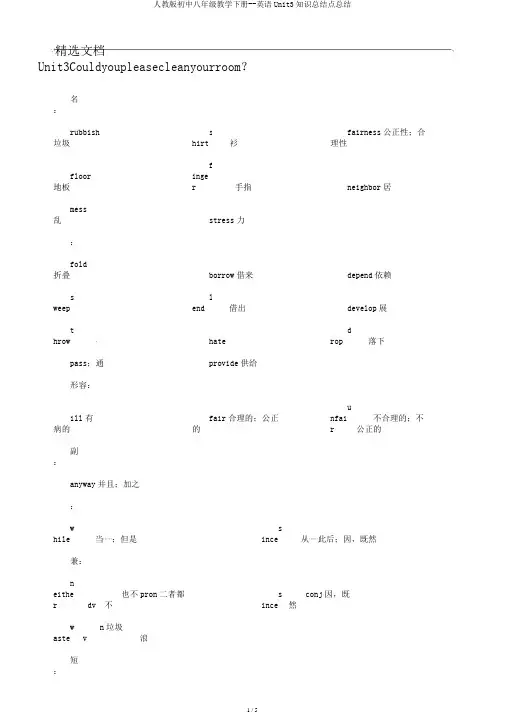
人教版初中八年级教学下册--英语Unit3知识总结点总结 1 / 5 精选文档
Unit3Couldyoupleasecleanyourroom?
名:
rubbish垃圾 shirt 衫 fairness公正性;合理性
floor地板 finger 手指 neighbor居
mess乱 stress力
:
fold折叠 borrow借来 depend依赖
sweep 打 lend 借出 develop展
throw 扔 hate drop 落下
pass;通 provide供给
形容:
ill有病的 fair合理的;公正的 unfair 不合理的;不公正的
副:
anyway并且;加之
:
while 当⋯⋯;但是 since 从⋯⋯此后;因,既然
兼:
neither adv 也不pron二者都不 since conj因,既然
waste n垃圾v 浪
短: 人教版初中八年级教学下册--英语Unit3知识总结点总结
2 / 5 takeouttherubbish 倒垃圾 dependon依赖
allthetime 向来;繁 takecareof照
assoonas一⋯⋯就⋯⋯ sweepthefloor地
inorderto了
知点:
1、rubbish 垃圾;物 不可以数名 =garbage=trash
2、floor地板;楼
thefirstfloor 第一 thesecondfloor第二
the+序数 +floor第几
3、atleast 起码
atmost 至多
.人教版初中八年级教学下册--英语Unit3知识总结点总结 3 / 5 精选文档
人教版八年级英语下册第三单元重点短语句子作文

Unit 3 Could you please clean your room?
一、 重点短语
1.go out for dinner 出去吃晚饭
2. stay out late/until nine 呆到很晚
3. go to the movies 去看电影
4. get a ride 搭车
give me a ride to town车送我到镇上
5.work on 从事
6. finish doing sth. 完成做某事
7. clean and tid y 干净整洁
8. do the dishes=wash the dishes洗餐具
9. take out the rubbish 倒垃圾
10. fold your/the clothes 叠衣服
11. sweep the floor 扫地
12. make your/the bed 整理床铺
13.clean the livng room 打扫客厅
14. no problem 没问题
15. welcome sb. 欢迎某人
16. come home from school/ work
放学/下班回家
be/ come back from shopping购物回来
help out with a few things帮助做些事情
any minute/ second/ moment now随时;马上
pretty clean and tidy相当干净而整洁
17.be angry with sb.对某人生气
be angry at sth.因某事而生气
solve the problem解决问题
throw down my bag 扔下我的书包
18. sit down 坐下
the minute/ as soon as / the moment
一……就……
come over 过来
20 take sb. for a walk 带某人去散步
(完整版)新人教版八年级英语下册第三单元知识点.docx
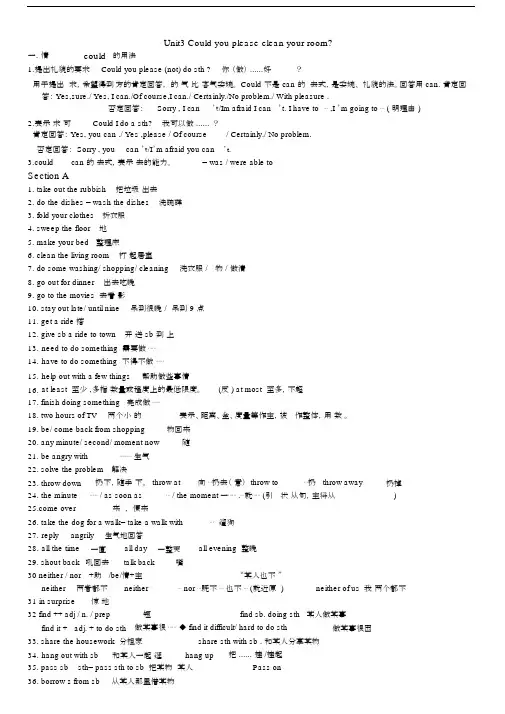
Unit3 Could you please clean your room? 一.情 could 的用法
1.提出礼貌的要求 Could you please (not) do sth ? 你 (做) ......好 ?
用于提出 求,希望得到 方的肯定回答, 的 气 比 客气委婉。 Could 不是 can 的 去式,是委婉、 礼貌的法。回答用 can. 肯定回答: Yes,sure./ Yes, I can./Of course,I can./ Certainly./No problem./ With pleasure . 否定回答: Sorry , I can ’t/Im afraid I can ’t. I have to ⋯ ,I ’m going to ⋯ ( 明理由 )
2.表示 求 可 Could I do a sth? 我可以做 ...... ? 肯定回答: Yes, you can ./ Yes ,please / Of course / Certainly./ No problem.
否定回答: Sorry , you can ’t/I’m afraid you can ’t.
3.could can 的 去式,表示 去的能力。 = was / were able to
Section A 1. take out the rubbish 把垃圾 出去
2. do the dishes = wash the dishes 洗碗碟
3. fold your clothes 折衣服
4. sweep the floor 地 5. make your bed 整理床
6. clean the living room 打 起居室 7. do some washing/ shopping/ cleaning 洗衣服 / 物 / 做清
人教版八年级下册英语unit-3知识点汇总
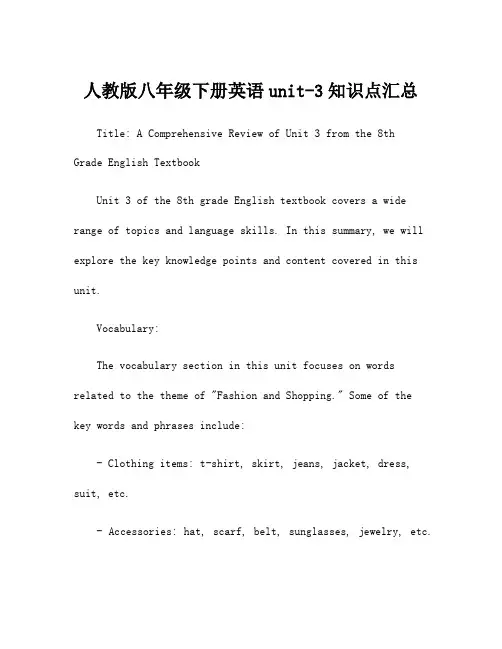
人教版八年级下册英语unit-3知识点汇总
Title: A Comprehensive Review of Unit 3 from the 8th
Grade English Textbook
Unit 3 of the 8th grade English textbook covers a wide
range of topics and language skills. In this summary, we will
explore the key knowledge points and content covered in this
unit.
Vocabulary:
The vocabulary section in this unit focuses on words
related to the theme of "Fashion and Shopping." Some of the
key words and phrases include:
- Clothing items: t-shirt, skirt, jeans, jacket, dress,
suit, etc.
- Accessories: hat, scarf, belt, sunglasses, jewelry, etc. - Adjectives to describe clothing: stylish, casual,
formal, comfortable, expensive, cheap, etc.
- Verbs related to shopping: try on, buy, sell, return,
exchange, etc.
- Useful expressions: "How much is it?", "It fits me
well.", "I'd like to try this on.", etc.
人教版八下英语unit3 知识点

人教版八下英语unit3 知识点
Unit 3 in the 8th grade English textbook of People's
Education Press covers a variety of topics, including hobbies,
sports, and leisure activities. In this unit, students will learn new
vocabulary, common expressions, grammar rules, and cultural
information related to these topics. Let's explore some key
points in Unit 3.
Firstly, students will learn about different hobbies and
interests. They will be introduced to vocabulary related to
hobbies such as painting, playing musical instruments,
gardening, cooking, and more. Through exercises and activities,
students will be able to practice using these new words and
expressions in context.
Secondly, students will learn about sports and leisure
activities. They will study vocabulary related to sports such as
basketball, football, swimming, and cycling. Students will also
八年级(下)英语Unit3知识点,重点短语及句型
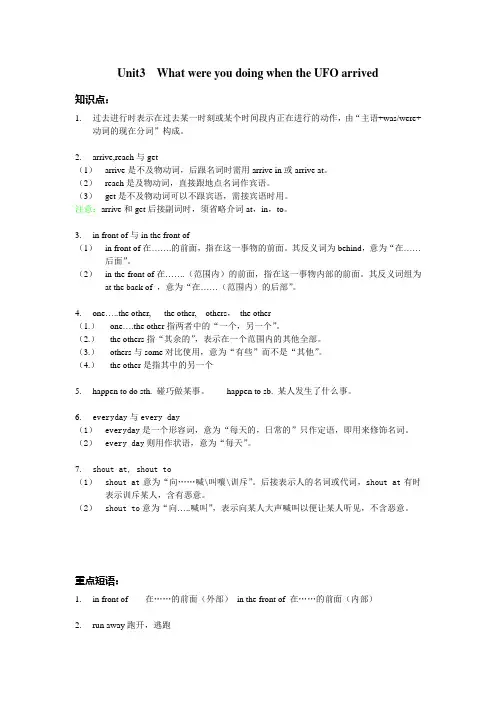
Unit3 What were you doing when the UFO arrived
知识点:
1. 过去进行时表示在过去某一时刻或某个时间段内正在进行的动作,由“主语+was/were+动词的现在分词”构成。
2. arrive,reach与get
(1) arrive是不及物动词,后跟名词时需用arrive in或arrive at。
(2) reach是及物动词,直接跟地点名词作宾语。
(3) get是不及物动词可以不跟宾语,需接宾语时用。
注意:arrive和get后接副词时,须省略介词at,in,to。
3. in front of与in the front of
(1) in front of在…….的前面,指在这一事物的前面。其反义词为behind,意为“在……后面”。
(2) in the front of在…….(范围内)的前面,指在这一事物内部的前面。其反义词组为at the back of ,意为“在……(范围内)的后部”。
4. one…..the other, the other, others, the other
(1.) one….the other指两者中的“一个,另一个”。
(2.) the others指“其余的”,表示在一个范围内的其他全部。
(3.) others与some对比使用,意为“有些”而不是“其他”。
(4.) the other是指其中的另一个
5. happen to do sth. 碰巧做某事。 happen to sb. 某人发生了什么事。
6. everyday与every day
(1) everyday是一个形容词,意为“每天的,日常的”只作定语,即用来修饰名词。
(2) every day则用作状语,意为“每天”。
7. shout at, shout to
(1) shout at意为“向„„喊\叫嚷\训斥”。后接表示人的名词或代词,shout at有时表示训斥某人,含有恶意。
最新人教版八年级英语下册第三单元知识点汇总
最新人教版八年级英语下册第三单元知识点汇总
Unit 3: Could You Please Clean Your Room?
Peter。could you please take out the trash。This phrase is
used to make a request in a polite and indirect way。"Could" is not
the past tense of "can," but a more courteous way of making a
request。The response to this type of n should be "can" or
"cannot."
Could I at least finish watching this show。"At least" is used
to indicate the minimum quantity or degree of something。It is
often used in contrast to "at most," which indicates the maximum
amount。
Can you do the dishes。This is a request to wash the dishes。"Do the" is a structure used with nouns。such as "do the dishes" or
"do the laundry." It can also be used with verbs in the "-ing" form。such as "do the cleaning." Could you please take out the rubbish。fold the clothes。and
do the dishes。(改写并修正格式错误)
人教版初二英语下册第三单元知识点总结
人教版初二英语下册第三单元知识点总结
In the third unit of the People's Education Press's Grade 8 English textbook,
students are introduced to a variety of new knowledge and skills in the English
language. The unit primarily focuses on the theme of 'Travel', and covers topics
such as travel plans, transportation, directions, and making suggestions.
Throughout the unit, students are encouraged to practice their listening, speaking,
reading, and writing skills in English, while also learning about different
cultures and customs related to travel.
One of the key knowledge points in this unit is learning how to make travel
plans. Students are taught how to discuss and plan a trip, including choosing a
destination, deciding on transportation, and making accommodation arrangements.
This not only helps students improve their English language skills, but also
人教版八年级下册unit3单元知识点
It takes me two hours to do my homework every day.
【拓展】take 构成的短语:
take a walk 去散步 take a rest 休息 take care of 照顾 take off 脱下;起飞
take up 占据 take down 拿下 take one’s time 不急;慢慢来
take one’s temperature 量体温
6. The minute I sat down in front of the TV, my mom came over .
我刚坐在电视机前面,我妈妈就过来了。
【解析1】the minute = as soon as “一...... 就......”
Please write to me the minute you get there.
【解析2】 in front of
指在物体外部的前面
There is a bike in front of the classroom.
【辨析】
指在物体内部的前面
Our teacher is standing in the front of the classroom
【记】 The driver sat ________________ the car.
The policeman stood ___________ the car.
( ) At last the taxi stopped ______ a tall building ,and we all got off.
A. in front B. in the front C. in front of D. in the front of
人教版八年级英语下册unit3知识点总结
人教版八年级英语下册unit3知识点总结
全文共6篇示例,供读者参考
篇1
Unit 3 - What an Interesting World
Hi everyone! I'm going to tell you all about the cool things I
learned in Unit 3 of my English textbook. Get ready, because
there's a lot!
First up, we covered some really useful vocabulary about the
world around us. Words like "environment", "pollute", "protect"
and "conservation". It's so important to take care of our planet
and not pollute the air, water and land with rubbish and
chemicals. Conservation means protecting animals, plants and
natural resources. I try my best to recycle, save energy and water
at home.
Then we learned how to describe locations using
prepositions like "near", "opposite", "behind" and "between". For
example, my school is near the park and opposite the
supermarket. The library is between the bank and the post office.