
外研版英语(新标准)七年级上册Module 5 My school day模块知识点归纳总结
1
Module 5 My school day
I love history.
必背单词
1.half (n.)一半→halves (pl.)
2.difficult (adj.)困难的,难懂的→difficulty (n.)困难
3.interesting (adj.)有趣的→interested (adj.)感到有趣的(主语为人)
4.past (prep.)晚于,过(几点)
5.o'clock (adv.)……点钟
6.to (prep.)(距整点时间)差……
2
7.art (n.)美术;艺术
8.geography (n.)地理
9.history (n.)历史
10.maths (n.)数学
11.PE (n.)体育;体育课
12.lesson (n.)(一节)课
13.then (adv.)接着,然后
14.like (v.)喜欢;喜悦
15.love (v.)爱,热爱 (n.)喜爱;关爱
16.subject (n.)科目
17.because (conj.)因为
18.talk (v.)谈论,说话
19.begin (v.)开始
20.when (adv.)什么时候,何时
必背短语
21.on Monday在星期一
3
22.five to nine八点五十五
23.have maths上数学课
24.talk with...和……交谈
25.be good at擅长
必背句子
26.At twenty past ten we have IT.
在十点二十分,我们上信息技术课。
27.Do you like maths, Tony?
你喜欢数学吗,托尼?
28.I like the lessons on Monday afternoon: English and art.
我喜欢周一下午的课:英语和美术。
29.It's my favourite subject because it's very interesting.
它是我最喜欢的学科,因为它很有趣。
4
We start work at nine o'clock.
必背单词
1.start (v.)开始→begin(同义词)
2.watch (v.)看,观看→watches(第三人称单数形式)
3.do (v.)做;干→does(第三人称单数形式)
4.sleep (n.)睡觉 (v.)睡觉→sleepy (adj.)困乏的
5.weekday (n.)工作日
6.house (n.)房子;住宅
7.work (n.)学习;工作(v.)学习;工作
5
8.break (n.)课间休息
9.evening (n.)晚上
10.homework (n.)家庭作业
11.bed (n.)床
必背短语
12.go to school上学
13.on weekdays在工作日
14.have breakfast吃早餐
15.have lunch吃午餐
16.go home
回家
17.have dinner
吃饭;吃晚餐
6
必背句子
18.I get up at half past seven in the morning.
我早上七点半起床。
19.My school is next to my house.
学校在我家旁边。
20.We start work at nine o'clock.
我们九点开始上课。
21.In the evening, I watch TV and have dinner with my family.
晚上,我和我的家人一起看电视,吃晚饭。
7
Language in use
必背单词
1.busy (adj.)忙的,繁忙的→free (反义词)空闲的
2.wash (v.)洗,洗涤→washes(第三人称单数形式)
3.park (n.)公园
4.face (n.)脸
5.minute (n.)分钟
8
必背短语
6.do exercise 做运动
7.go swimming去游泳
必背句子
8.In the UK, children have five lessons in the day and finish school at half
past three in the afternoon. 在英国,孩子们白天有五节课,并且在
下午三点半放学。
9.They also do homework like you!
他们像你一样也做作业!
9
景德镇市第一中学七年级英语上册 Module 5 My school day模块同步作文指导课件新版

休息时间到啦
同学们,下课休息十分钟。现在是休息时间 休息一下眼睛,
看看远处,要保护好眼睛哦~站起来动一动 对身体不好哦~
结束语
同学们,你们要相信梦想是价值的源泉,相信成 功的信念比成功本身更重要,相信人生有挫折没 有失败,相信生命的质量来自决不妥协的信念,
考试加油!奥利给~
Unit 1 My name's Gina.
美文欣赏
It's Sunday today.I'm going to cook a wonderful dinner for my family.What will I cook ?Well , my mother would like some dumplings , vegetable salad and icecream.My father would like beef and potato rice.He wants to drink coffee , too.I would like a small bowl of mutton and carrot noodles.What about my cat ?Well , he likes fish and soup.So I'll cook the food for them.
常用表达 1.This is my school day. 2.I get up at half past seven in the morning , and then have breakfast. 3.We start work at nine o'clock. 4.We have three lessons in the morning. 5.At eleven o'clock , we have a break in the playground and I talk to my friends. 6.We have lunch in the dining hall at half past twelve. 7.In the evening , I watch TV and have dinner with my family. 8.I do my homework and go to bed at ten o'clock.
外研版七年级上册重点短语及句子
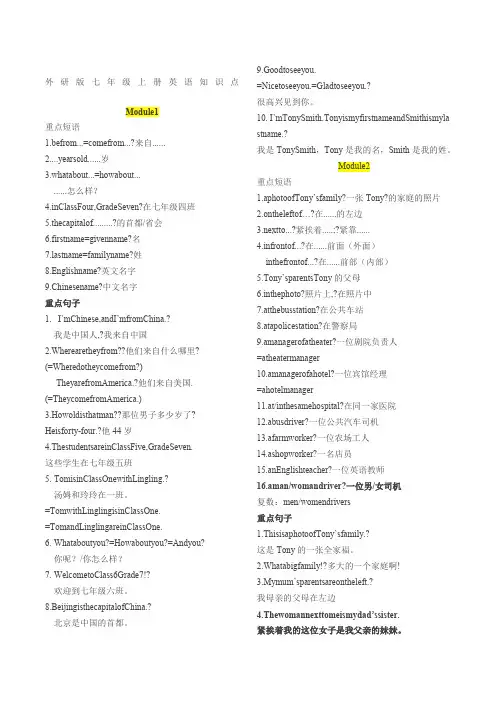
外研版七年级上册英语知识点Module1重点短语1.befrom...=comefrom...?来自......2....yearsold......岁3.whatabout...=howabout.........怎么样?4.inClassFour,GradeSeven?在七年级四班5.thecapitalof.........?的首都/省会6.firstname=givenname?名stname=familyname?姓8.Englishname?英文名字9.Chinesename?中文名字重点句子1.I’mChinese,andI’mfromChina.?我是中国人,?我来自中国2.Wherearetheyfrom??他们来自什么哪里?(=Wheredotheycomefrom?)TheyarefromAmerica.?他们来自美国.(=TheycomefromAmerica.)3.Howoldisthatman??那位男子多少岁了?Heisforty-four.?他44岁4.ThestudentsareinClassFive,GradeSeven.这些学生在七年级五班5.TomisinClassOnewithLingling.?汤姆和玲玲在一班。
=TomwithLinglingisinClassOne.=TomandLinglingareinClassOne.6.Whataboutyou?=Howaboutyou?=Andyou?你呢?/你怎么样?7.WelcometoClass6Grade7!?欢迎到七年级六班。
8.BeijingisthecapitalofChina.?北京是中国的首都。
9.Goodtoseeyou.=Nicetoseeyou.=Gladtoseeyou.?很高兴见到你。
10.I’mTonySmith.TonyismyfirstnameandSmithismyla stname.?我是TonySmith,Tony是我的名,Smith是我的姓。
外研版七上英语 Module 5 My school day 模块提升写作作文课

get up起床
wash one's hands and face洗手和洗脸
词 have breakfast/lunch/dinner吃早餐/午餐/晚餐 汇 go to school去上学
have...lessons/classes上……课 have a break休息一会儿
go home回家 go to bed上床睡觉
to school on weekdays, but not on SaturdaBiblioteka and Sunday. This
is my school day.
教材原句 Then we go home at half past three.(教材P28)
②In the morning, I get up at six o'clock. ③Then I wash my hands and face. ②At half past six, I have breakfast. After breakfast, I go to school. ②I start work at ten to eight. There are four lessons in the morning. ④I'm good at maths and English. At nine thirty, I go to the playground and play games with my classmates. In the afternoon, I have two lessons.
Module 5 My school day
模块提升
初中英语 七年级上册 WY
如何写学校生活的相关文章
本模块以"学校的作息时间表"为话题,介绍了学生的学校生 活。"学校生活"是学生们非常熟悉的话题,书面表达通常会让学 生谈论他们一天的学校生活。在写作时注意时间安排的合理性。
最新外研版七年级英语上册各单元知识点汇总(全册)
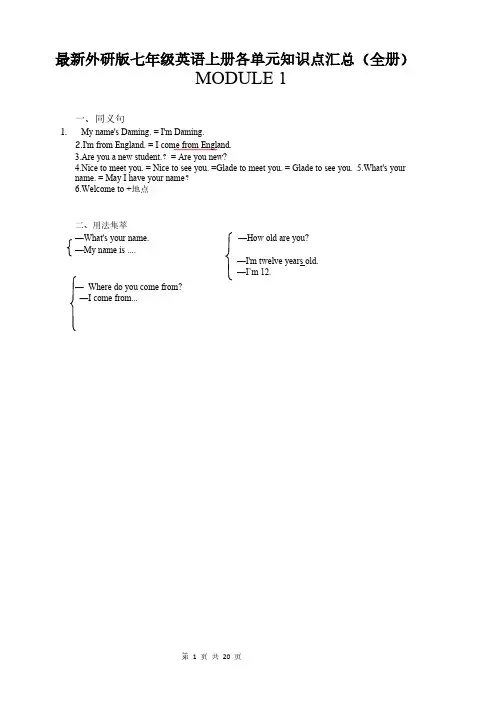
最新外研版七年级英语上册各单元知识点汇总(全册)MODULE 1一、同义句1.My name's Daming. = I'm Daming.2.I'm from England. = I come from England.3.Are you a new student.?= Are you new?4.Nice to meet you. = Nice to see you. =Glade to meet you. = Glade to see you.5.What's your name. = May I have your name ?6.Welcome to +地点二、用法集萃—What's your name.—How old are you?—My name is ....— Where do you come from?—I come from...—I'm twelve years old.—I’m 12.—Where are you from?—What class are you in?—I'm from...—I'm in Class One, Grade One.—What about ...?—What about doing ...?=How about doing ...?With 和 andJim and Lily go to the bank.(and 表并列)Jim with Lily goes to the bank.(with 是介词,和...一起,动词的形式 要与 with 前面的主语一致)三 语法专项。
Be 动词用法口诀我用 am 你用 are,is 跟着他,她,它. 单数名词用 is ,复数名词全用 are. 变疑问,往前提,句末问号莫丢弃。
变否定,更容易,be 后 not 莫忘记。
否定疑问任你变,句首大写莫迟疑。
外研版英语七年级上册模块知识点归纳
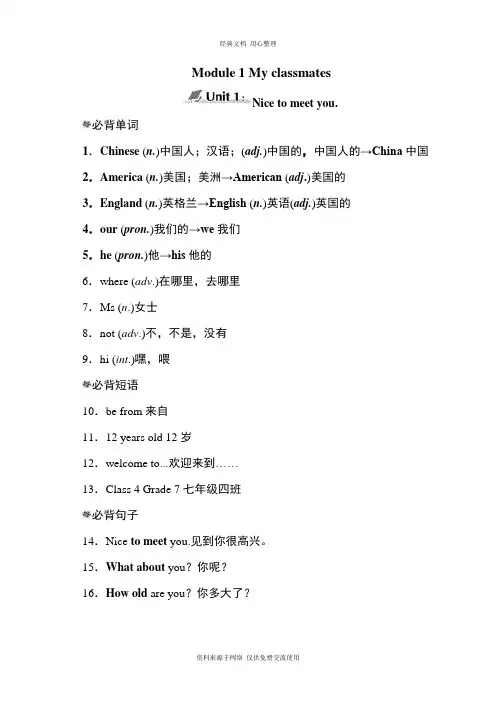
Module 1 My classmatesNice to meet you.必背单词1.Chinese (n.)中国人;汉语;(adj.)中国的,中国人的→China中国2.America (n.)美国;美洲→American (adj.)美国的3.England (n.)英格兰→English (n.)英语(adj.)英国的4.our (pron.)我们的→we我们5.he (pron.)他→his他的6.where (adv.)在哪里,去哪里7.Ms (n.)女士8.not (adv.)不,不是,没有9.hi (int.)嘿,喂必背短语10.be from来自11.12 years old 12岁12.welcome to...欢迎来到……13.Class 4 Grade 7七年级四班必背句子14.Nice to meet you.见到你很高兴。
15.What about you?你呢?16.How old are you?你多大了?I'm Wang Lingling andI'm thirteen years old.必背单词1.everyone (pron.)大家;每人→作主语时,谓语动词用第三人称单数2.but (conj.)但是,然而→表转折关系3.big (adj.)大的→small(反义词)小的4.city (n.)城市→cities (pl.)5.all (pron.)每个,全体→both(用于两者)都6.first (adj.)第一(位)的;首先的(adv.)先;首先7.last (adj.)最后的;最末的(adv.)最后,最末必背短语8.first name名字9.last name姓10.in my class在我的班里11.a very big city一座很大的城市必背句子12.I'm twelve years old.我十二岁了。
13.Beijing is the capital of China.北京是中国的首都。
2019秋外研版七年级英语上册课件:Module 5 My school day Unit 3
二、单项填空。
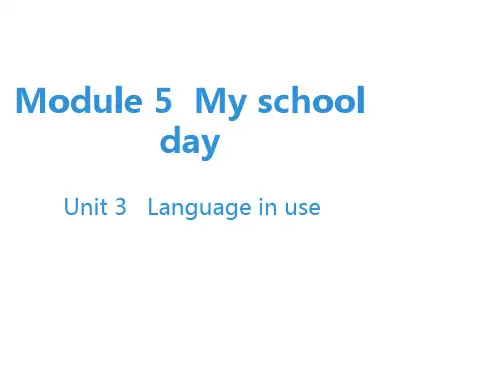
(D )1. We have ____ English class ____ Monday morning.
A.Aan; in B. a; on C. a; in D. an; on ( )2. We have geography ____ two o’clock in
the afternoon.
There are four lessons in the morning. The morning classes are over at eleven fifty,and he has lunch ten minutes later.
The afternoon classes begin at one thirty. There are two lessons in the afternoon. They are over at three ten. Tom stays at school for another hour to play games with his classmates,and he gets home at about four thirty.
The place Tom is staying inBeij1in. g_____________
now
leave home
The thing Tom does at 7:15(at)122. :_0_0___________
The time when Tom has
3. _____________
4. I _d_o_n_’_t_h_a_v_e_____. 5. We d_o_n__’t_r_e_a_d______(not read)in the library.
最新外研版七年级英语上册词组归纳(1)
外研版七年级上册英语短语归纳Starter Module1 和Module2的重点词汇1.good morning 早上好2.good afternoon 下午好3。
work in pairs 两人一组练习 4.thank you 谢谢5。
see you 再见,回头见 6.stand up 起立,站起来7。
sit down 坐下,请坐Starter Module1 和Module2的重点句子1.What’s your name,please? 请问你叫什么名字?2.Can you spell it, please? 你能把它拼写出来吗?3.How are you? 你好吗?4.This is my friend,Tony。
这位是我的朋友,托尼。
5.Nice to meet you. 很高兴认识你。
6.It’s time to go now。
该走了;现在是时候走了。
7.See you tomorrow。
明天见。
8.Open your book. 打开你的书。
9.Close your book。
合上你的书。
10.Put up your hand。
举起你的手。
11.Are you a new student here? 你是一个新学生吗?12.What class are you in? 你在哪个班?13.I let it go again。
我把它放生了。
14.What’s your telephone number?你的电话号码是多少?15.How old are you? 你多大(几岁)了?Starter Module3和Module4的重点词汇1.in English 用英语,用英语说2.write on 在。
..上写3.write it on 把它写在。
.。
上4.of course 当然,当然可以5.in spring 在春天6。
after school 放学后7.good idea 好主意,好想法8。
外研版七年级英语上册Module 5 My school day Unit 2 We start work at nine o’clock.教案
Module 5 My School DayUnit 2 We start work at nine o’clock.一、学习目标:1. 重点单词:2. 重点短语:go to school,get up, have breakfast, have lunch, go home, have dinner, go to bed, go to sleep3.重点句子:1) I love history.2) It’s twelve o’clock .3) We have Chinese at eight o’clock.4) We don’t have maths.5) —Do you like maths?—Yes, I do.6) In the evening, I watch TV and have dinner with my family.7) I get up at half past seven in the morning and have breakfast.8) I drink Cola or water.9) We start work at nin e o’clock.二、重点及难点:1.时间的表达方式。
2.用在时间前的介词(at , in , on)的用法。
3.一般现在时的陈述句形式(主语为I, they, we, you)。
4.And 连接的两个简单句。
三、教学设计:Unit 2 We start work at nine o’clock.ⅠTeaching modelReading and writing .ⅡTeaching methodInteractive approachⅢTeaching aims1. To get information from a description of a school day .2. To be able to put pictures in order according to the reading material .3. To write about one’s school day .4. To learn to join simple sentences with and .ⅣTeaching ObjectivesKey vocabulary: week, house, start, work, break, evening, watch, homework, bed, sleepKey phrase: go to school,get up, have breakfast, have lunch, go home, have dinner, go to bed, go to sleepKey structures: This is my school day . I get up at …Lessons start at …We have a break and talk to our friends.ⅤTeaching aidsRecorder , OHP , videoⅥTeaching StepsStep 1 Warming-up1. Review the text of Unit 1 .2. Show some pictures, ask the students to look at the pictures , then talk something about the pictures.3. Introduce the new words .4. Read the new words .Step 2 Read the passage and match the times with the pictures in Activity 1.1. Read through the passage and order it individually.2. Check with a partner .3. Call back the answers from the whole class .Keys: 1. e 2. f 3. d 4. a 5. b 6. cStep 3 Match the times with the pictures in Activity 1 .1. Read out the times and have the students repeat them after you .2. Ask them to match the times and the pictures individually.3. Check with a partner .4. Call back the answers from th e whole class .Keys: 7:30 e 10:00 c 11:00 d 12:30 a 3:30 b 9:00 fStep 4 Check (√) the true sentences.1. Read the passage again.2. Ask the students to choose the correct answers .1) I get up / start work at half past seven.2) We have a break / have lunch at half past twelve.3) I go home / watch TV in the evening.4) I do my homework / see my friends in the evening.5) I go home / go to sleep at ten o’clock.3. Ask the students to check with a partner.4. Play the recording again .Check the answers:Keys:1. get up2. have lunch3. watch TV4. do my homework5. go to sleepStep 5 Do exercises:I’m Alex Greenall. I (1)_______ at half past seven (2)________ the morning. I go to school at (3)________ and lessons (4)________ at nine o’clock. We have (5)________ lessons in the morning. I (6)_________ at eleven o’clock. I don’t like (7)________. We have lunch at (8)__________. Lessons start in the afternoon at (9)__________ . We have (10)_______ lessons in the afternoon . We (11)_________ at half past three. I go to bed at (12)________ o’clock.Keys: 1.get up 2.in 3. half past eight 4. start 5. four 6. have a break 7. football 8. half past twelve 9. half past one 10. two 11. go home 12. ten Step 6 Writing and speaking.A. Talk about your school day .1. Read through the phrases and have the students repeat them .2. Ask them to talk about their school days .B. Look at these sentences .I get up at seven o’clock . I go to school at eight o’clock .I get up at seven o’clock, and then go to school at eight o’clock .C. Now join these sentences with and then .1) In the morning, we get up. We go to school.2) In th e afternoon, we have lessons. We play football in the playground.3) In the evening, I have dinner. I do my homework.4) In the evening, I do my homework. I go to bed.D. Call back the answers from the whole class .Keys:1. In the morning, we get up, and then go to school.2. In the afternoon, we have lessons, and then we play football in the playground.3. In the evening, I have dinner, and then do my homework.4. In the evening, I do my homework, and then go to bed .Step 7 Grammar一般现在时:表示现阶段经常发生的动作或存在的状态。
广东省佛山市七级英语上册 Module 5 My school day Unit 3 Language in use课件1 (新版)外研版
in表示“在某一段时间”,如某年、某 月、某个季节,如:in 1998(在1998年) in March(在三月),in summer(在夏 天)。另外,在某一些固定短语中要 用in,如:in the morning, in the evening, in the day, in the middle of th
• 学习目标: • 1. 复习M5单词、词组及句型 • 2. 学习总结行为动词的一般现在 时主语为第一,第二人称的情况。
4
We have Chinese at eight o’clock. We don’t have maths. Do you like maths? Yes, I do. In the evening, I watch TV and have dinner with my family.
22
Complete the sentences with at, in or on. 1. We go to school _____ in the morning. 2. We don’t go to school _____ on Sunday. 3. We don’t have a science lesson _____Wednesday. on 4. I get up _____ at seven o’clock. 5. We go home _____ in the afternoon. 6. We have dinner _____ at half past six.
11
例如: 12:05—— five past twelve 9:50——ten to ten 8:40——twenty to nine 如果分钟是15,一般用a quarter 来代替 fifteen; 如果分钟是30, 一般用half来代 替thirty。例如: 9:15——a quarter past nine 11:30——half past eleven 2:45——a quarter to three
外研版英语七年级上册期末知识点复习课件
isn’t _____y_e_a.r(sEnglish) 4. Tomairse15 _____ oldc.ome from 65..WWeh_a_t _abstouudte_n_t_s_.gW_o_ine_g_____s_ho_p_p_i_n_gBeijing.
5. 国家 China America Japan 语言/人 Chinese American Japanese
国家 England France Germany
语言/人 English French German
6. It’s + adj. +to do It’s nice to meet you. It’s + n. +to do It’s time to have lunch.
Yes, there is / are
No, there isn’t / aren’t
5. everyone + v.单 6. some 肯定句
any 否定/疑问句 以下句型some不变any
What/ How about some…?
Would you like some…?
Can/ Could you …?
7. 介词总结:in on at
1998 / January (年份,月份)
in
spring (四季) the morning (早下晚)
Dalian (+大地点)
Friday (星期)
on
Friday morning (某日上下午) October 7th (具体日期)