
人教版八年级下册英语教案unit1
人教版八年级下册英语教案unit1就英语教学过程而言,英语教案要充分体现开放性和动态生成性,从而赋予课堂教学以灵活性和多元性品格;下面是小编为大家精心整理的人教版八年级下册英语教案unit1,仅供参考。
人教版八年级下册英语教案unit1范文课题:Unit One Whats the matter? Period 1 Section A (1a-2d)一、Teaching date:二:学情及教学内容分析:主要讨论的话题是询问某人的健康状况以及遇到麻烦的表达方法。
本单元涉及到大量的表示人体部分的单词以及关于身体某部位不舒服的短语。
此外,本单元还涉及到党当人身体不适时,医生、朋友或亲人提出的意见的表达法。
本单元共有阅读类文章两篇,文章的主体时态都为一般过去时。
主要句型为.Whats the matter with?What should I/ you/ he/ she/they do? I/ you/ he/ she/they should do?I have a headache/stomachache/toothache. Does she/he/ have a fever/cold/toothache?总的来说,本单元的相关语法知识并不难。
教学目标:三:教学目标:1. 语言知识目标:1) 能掌握以下单词以及短语:matter, sore, have a cold, foot,neck, stomach, throat, fever, lie, lie down, rest, cough, toothache, headache, break, hurt, enough water, take breaks away from, all weekend, take ones temperature, in the same way, go to a doctor, see a dentist,2) 能熟悉以下句型:Whats the matter with?What should I/ you/ he/ she/they do?I/ you/ he/ she/they should do2. 情感态度价值观目标:教会学生关心他人,培养同学间团结、友善的精神。
四:教学重难点掌握相关的单词和词组,并能够灵活运用会使用以下句型:Whats the matter with?What should I/ you/ he/ she/they do?I/ you/ he/ she/they should do五:教学流程:Step1 Greet the whole class as usual.T: Whats the date today?/ What day is it today?/ Hows the weather?/ How was your weekend?/What do you usually do on weekends?/ Do you like exercising?/ How often do you exercise?/ Thats great! To do exercise can keep us healthy, but if we dont pay attention to our health, there will be something wrong with our body. Now , look at these people.Learn some new words.Step2 引入一般过去时,对上学期所学知识进行复习。
Step3 Learn 1a on page 1. Look at the picture. Write the correct letter.arm, back, ear, eye, footStep4 1b Listen and look at the picture, then number the names on page 1.Nancy Sarah DavidStep5 Practice the conversations.Whats the matter with? She talked too much yesterday.知识点归纳:当某人心情沮丧,闷闷不乐,身体不舒服或是遇到麻烦事时,可以用下列问句:Whats the matter? Whats wrong with sb/sth?某人/某物怎么了?(sb:哪儿不舒服/出什么事了/为何不高兴?sth:某物出了毛病或故障)可以用下列问句:Whats the matter with you?/ Whats the trouble with you?/ Whats your trouble?/ Whats wrong with you? /Is there anything wrong with you?Step 6 Listen and number the pictures on page 2.Step 7 Listen again and then match.1. fever a. lie down and rest2. stomachache b.drink some hot tea with honey3.cough and sore throat c. see a dentist知识点归纳:You should drink some hot tea with honey.(1) with 做介词,意为有,带有表示某物带有或具有某种特征。
介词短语with honey做hot tea 的后置定语。
例:a tall girl with long curly hair.(2)with还有和某人某物在一起,表示伴随。
例:I like to talk with my friends.with还有用表示使用某种工具、手段等例:Cut it with a knife/wirte with a pen/with the help of或with ones helpwith还有关于对于表示关系和适应范围例:be angry with Step 8 Role-play the conversation.先带领学生学习书中对话部分所出现的语法知识,新的词组以及新的句型。
并要求学生熟读本部分课文。
对话中主要词组:take breaks away from, all weekend, take ones temperature, in the same way, go to a doctor, see a dentist, get an X-ray, cut oneself.六:设计意图及反思八年级英语试题单项填空(20分)从每小题A、B、C、D中选出能填入句中空白处的最佳选项。
21. Its interesting, but ________ difficult for me.A.littleB. a littleC. a fewD. few22. Everyone ______ here last Monday.A.wereB.isC. areD. was23. Did Julie study _______ exams?A.toB. forC. haveD. at24. It was a _________ day yesterday.A.rainB. rainingC. rainyD. to rain25. There are also many fast food restaurants in _________ parts of our city.A.otherB. othersC. anotherD. the others26. You neednt _________ your English. I will help you.A.worryB.worriedC.worry aboutD.worried about27. _________ does you mother go to the supermarket?By bus.A.WhereB. WhenC. HowD.What28. Its time ___________class.A.for haveB. haveC. to haveD. to having29. He helped his mother clean the rooms and then ________ his homework yesterday afternoon.A. doB.doingC. doesD. did30. Is that ________ interesting book?Yes, but it is ___________ difficult.A.an, a littleB. a, a bitC.a, a littleD. an, little31. When did you see the film?__________.A.Two hours ago.B.In an hourC.Two hoursD. In two hours ago32. How about _________ the supermarket?A.to go toB.goingC.to goD. going to33. Id like ________ TV, but my father enjoys _________ newspapers.A.watching, readingB. seeing, seeC.to see, seeD. to watch, reading34. His __________ says its 7:00 pm.A.beltB. walletC. watchD.ring35. I think the TV show is interesting. Do you ________ me?A. likeB. agreeC. agree toD. agree with36. I love Sports News. What about you?__________.A.I did, tooB.I do, eitherC.I do, tooD. I love to37. Welcome to Beijing!__________.A. Not at allB.Thats all rightC.GoodbyeD. Thank you38. Ninas home is ___________ from here, so she doesnthave to take the bus.A.five minutes walkB. twenty-kilometerC.two hours by busD.two hours39. He is very tired. He doesnt want to do ___________.A.somethingB.nothingC.everythingD.anything40. I found it _______ to work out this math problem in one minute.A.easyB.easilyC.quicklyD. hardly人教版八年级下册英语教案unit1。
人教版八年级下册Unit1 反身代词 初中八年级下册英语教案教学设计课后反思
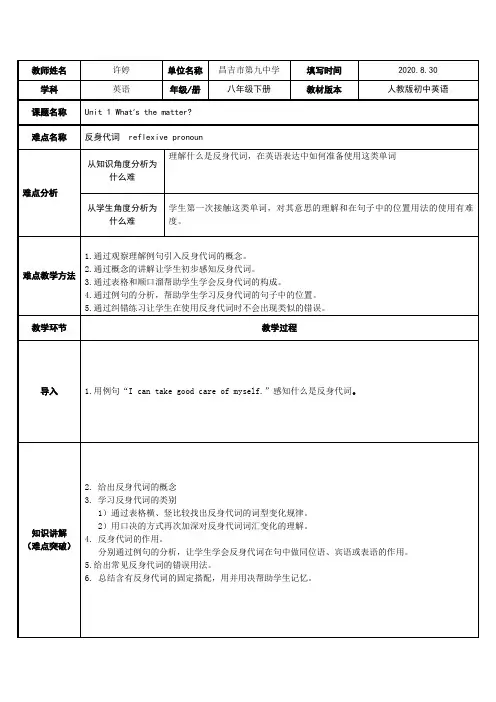
教学过程
导入
1.用例句“I can take good care of myself.”感知什么是反身代词。
知识讲解
(难点突破)
2.给出反身代词的概念
3.学习反身代词的类别
1)通过表格横、竖比较找出反身代词的词型变化规律。
2)用口决的方式再次加深对反身代词词汇变化的理解。
4.反身代词的作用。
从学生角度分析为什么难
学生第一次接触这类单词,对其意思的理解和在句子中的位置用法的使用有难度。
难点教学方法
1.通过观察理解例句引入反身代词的概念。
2.通过概念的讲解让学生初步感知反身代词。
3.通过表格和顺口溜帮助学生学会反身代词的构成。
4.通过例句的分析,帮助学生学习反身代词的句子中的位置。
5.通过纠错练习让学生在使用反身代词时不会出现类似的错误。
教师姓名
许婷
单位名称
昌吉市第九中学
填写时间
2020.8.30
学科
英语
年级/册
Hale Waihona Puke 八年级下册教材版本人教版初中英语
课题名称
Unit 1 What’s the matter?
难点名称
反身代词 reflexive pronoun
难点分析
从知识角度分析为什么难
理解什么是反身代词,在英语表达中如何准备使用这类单词
分别通过例句的分析,让学生学会反身代词在句中做同位语、宾语或表语的作用。
5.给出常见反身代词的错误用法。
6. 总结含有反身代词的固定搭配,用并用决帮助学生记忆。
课堂练习
(难点巩固)
结合课本出常出现的反身的词组,进行填词练习
小结
总结今天课堂上学习的反身代词的构成和基本用法,鼓励学生多去练习反琢磨其用法,以达到学以至用的目的。
人教新目标八年级英语下册教案Unit1Whatsthemat教案
Unit1 What’s the matter?复习课教学设计一、设计背景初中英语升学考试所涉及的知识面广,因而复习时需要扎扎实实打好基础,对课本的复习可以说是以“地毯式”搜捕的方式进行的。
教师要在有限的时间内完成如此大容量的复习任务,就必须要想方设法提高复习效率,让学生的复习取得事半功倍的效果。
我在复习中采用“知识递进式”复习法,用话题带动词句的使用,注重知识的综合运用。
二、设计理念本课是以“problems and advice”为话题的复习课,课堂上把主动权交给学生,以听说训练为主线,通过看、听、说、写等一系列教学活动,让学生运用所学知识来完成单词拼写、即时翻译短语、小组合作翻译句子,定时背诵语篇。
使学生获得最基本的英语听、说、读、写能力,并在教学中充分激发学生强烈的学习愿望。
在注重学生知识能力发展的同时,注重提高学生的人格修养,学会关心别人,帮助别人,达到培养学生互助的德育教育的目的。
三、教学目标设计用具体、明确、可操作的行为语言,描述本课的知识、技能、能力、方法、情感、态度、价值观等方面的教学目标。
Objectives: By the end of the session, most students will be better able to acquire the required information. This will be achieved by: 1.Knowledge Objectives:1)Be able to master the pronunciation, meaning and spellingof the names of diseases: fever, sore throat, sore back; stomachache, headache, toothache, cold, cough; 2) Be able tolearn the e某pressions of giving advice: lie down and rest, drink hot tea with honey, see a dentist, take this medicine;3) Be able to talk about health problems by using “What’s the matter? I have a?” and give advice by using “Youshould?You shouldn’t?” 2. Ability Objectives:1) Be able to talk about one’s health problems and give advice fluently; 2) Be able to role play doctor and patient; 3. Moral Objectives:1) Improve the cooperative spirit through pair work and role playing 2) Care more about yourself and your family members’ health. 四、教学重点难点设计由于本节课的话题是谈论健康,根据教学大纲的要求,学生需掌握有关疾病的单词,并能针对疾病提出合理的建议。
人教版英语八年级下册 Unit1 教案(英文版)

Unit1 What’s the matter?1. KnowledgeWords: have, cold, back, arm, ear, eye, foot, hand, head, leg, mouth, neck, nose, tooth, fever, rest, should, headache, ago, so, illness, thirsty, early, problem, way, traditional, believe, weak, angry, medicine, western, everybody, get, few, stay, important, moment, late, until, yesterday, hearPhrases: have a cold, be stressed out, a few, at the momentStructures: Have for talking about health problems.Modal: should / shouldn’t2. SkillsTalk about your health.Give advice.3. Learning StrategiesUsing what you know.Inferring content.II. BackgroundIII. Teaching Time: Six PeriodsPeriod OneTeaching Aims:1. Learn and master the following words and phrases: matter, have, cold, have a cold, stomachache, sore, back, arm, ear, foot, hand, head, leg, mouth, neck, nose, stomach, tooth, throat2. Develop the students’ listening ability.3. Be able to talk about health.4. Sentence PatternsWhat’s the matter? I have a sore throat.Teaching Difficult PointThe sentence patterns.Teaching MethodsListening practice to train the students’ listening ability.PairwrokTeaching AidsSome pictures.A tape recorder.Teaching ProceduresStep I Greetings.Step II. 1aTeach the students to study the new words by showing some pictures.eye, nose, mouth, ear, tooth, face, head, neck, back, stomach, arm, hand, leg, footAsk a student to read the list of thirteen names of body parts.Then let the students look at the picture and write the correct letter for each part of the body.Check the answers.Answers:k arm c back g ear i eye m foot a hand l head b leg f mouth e tooth d neck j nose h stomach Step III 1bShow some illnesses.e.g. I have a cold. I have a stomachache. Let several students say some illnesses.Ask a student to read the names. Nancy, Sarah, David, Ben, JudyThen play the recording the first time. Students only listen. Play the recording a second time. Students number the names. Cheek the answersAnswers:Nancy = 3 Sarah = 1 David = 2 Ben = 5 Judy = 4Step IV 1cAsk two students to read the conversation.A: What’s the matter?B: I have a sore throat.Then let the students make conversations in pairs.After some minutes, ask several pairs to say their conversations.Explain the language points.1. What’s the matter? 你怎么啦?这句话在口语中很常见,当别人遇到什么麻烦,或身体不舒服,你就可以问What’s the matter?意思是你怎么啦?/ 你遇到什么麻烦啦?/ 你哪儿不舒服?还可以在句末用介词with表示对象。
(完整)人教版八年级下册英语教案unit1.docx
人教版八年级下册英语教案unit1: Unit One What ’ s the matter? Period 1 Section A (1a-2d)一、 Teaching date:二:学情及教学内容分析:主要的是某人的健康状况以及遇到麻的表达方法。
本元涉及到大量的表示人体部分的以及关于身体某部位不舒服的短。
此外,本元涉及到党当人身体不适,医生、朋友或人提出的意的表达法。
本元共有文章两篇,文章的主体都一般去。
主要句型 .What ’s the matter with ⋯?”“What should I/ you/ he/ she/they⋯do? ” “ I/ you/ he/ she/they should do ⋯ ? ” “ I have aheadache/stomachache/toothache.”“Does she/he/have afever/cold/toothache⋯ ?” 的来,本元的相关法知并不。
教学目 :三:教学目:1.言知目:1) 能掌握以下以及短:matter, sore, have a cold, foot,n eck,stomach, throat, fever, lie, lie down, rest, cough, toothache, headache, break,hurt, enough water, take breaks away from, all weekend, takeone’ s temperature, in the same way, go to a doctor, see a dentist,2) 能熟悉以下句型:What ’s the matter with⋯?”“What should I/ you/ he/ she/they⋯do?”“I/ you/ he/ she/they should do⋯”2.情感度价目:教会学生关心他人,培养同学、友善的精神。
八年级英语下册教案人教版核心素养unit 1英文版
八年级英语下册教案人教版核心素养unit 1英文版全文共3篇示例,供读者参考篇1Unit 1: My future jobPart 1: Teaching Objectives1. Knowledge and skills goals:- Students can understand and use vocabulary related to future jobs.- Students can talk about their dreams and aspirations.- Students can describe their future job and career aspirations.2. Process goals:- Students can participate in group discussions and share their ideas.- Students can practice listening, speaking, reading and writing skills.3. Emotion and values goals:- Students can develop a positive attitude towards planning for their future.- Students can appreciate the importance of setting goals and working towards achieving them.Part 2: Teaching Content1. Vocabulary: job titles (teacher, doctor, engineer, etc.), job responsibilities (teaching, healing, designing, etc.), job requirements (skills, education, experience, etc.).2. Grammar: Future tense (will/won't + base form of the verb).3. Speaking and Listening: discussing future goals and aspirations, describing future job aspirations.4. Reading and Writing: reading and writing about future job aspirations.Part 3: Teaching Procedures1. Warm-up: (10 minutes)- Show pictures of different job titles and ask students to guess the job titles.- Play a guessing game where students describe a job without using the job title and others have to guess the job.- Discuss the importance of setting goals and working towards achieving them.2. Presentation: (20 minutes)- Introduce vocabulary related to future jobs using flashcards or pictures.- Present and practice the future tense with examples.- Show a video or audio clip of people talking about their future career aspirations.3. Practice: (30 minutes)- Divide students into pairs or small groups to discuss their dreams and future job aspirations.- Have students write a short paragraph describing their future job aspirations.- Conduct a role play activity where students act out a job interview scenario.4. Production: (20 minutes)- Ask students to present their future job descriptions to the class.- Have students write a short essay about their dream job, including job title, responsibilities, requirements, and reasons for choosing that job.5. Review: (10 minutes)- Review vocabulary and grammar covered in the lesson.- Summarize key points and discuss the importance of setting goals for the future.Part 4: Assessment- Assessment can be done through written assignments, oral presentations, and class participation.- Encourage students to reflect on their learning and set goals for improving their English skills in the future.篇2Unit 1: Our worldLesson 1: We need to protect our worldObjectives:1. Students will be able to understand the importance of protecting our environment.2. Students will be able to discuss different ways to protect our world.3. Students will be able to use target vocabulary related to the environment.Warm-up: To start the lesson, the teacher can show pictures of environmental issues such as pollution, deforestation, and climate change. Students can discuss in pairs or small groups what they see in the pictures and why it is important to protect our world.Presentation: The teacher can introduce key vocabulary words related to the environment such as pollution, recycling, conservation, and sustainable. Students can repeat after the teacher to practice pronunciation.Practice: Students can work in pairs to discuss different ways to protect our environment. They can also brainstorm ideas on how they can make a difference in their daily lives to help the environment.Production: In groups, students can create a poster or a presentation about a specific environmental issue and how theycan make a positive impact in solving it. They can present their work to the class and engage in a discussion about each group's topic.Homework: Students can write a short paragraph about what they can do to protect our world. They can also research and find information about a specific environmental issue and write a summary of their findings.Assessment: The teacher can assess students based on their participation in class discussions, their creativity and teamwork during the group project, and the quality of their homework assignment.Overall, this lesson aims to raise awareness about the importance of protecting our environment and empower students to take action to make a difference in the world. By fostering a sense of responsibility and empathy towards the planet, students will be better equipped to contribute to a more sustainable and eco-friendly future.篇3Unit 1 Get ready for the futureTeaching Goals:1. Enable students to understand and use the target language in real-life situations2. Develop students' listening, speaking, reading, and writing skills3. Encourage students to think about their future plans and goalsTeaching Procedures:Part 1: Warm-up (10 minutes)- Start the lesson by asking students about their future plans and goals. This can be done in a whole-class discussion or in small groups.- Have students share their aspirations, such as what they want to be when they grow up or where they want to visit in the future.- Encourage students to think about why these goals are important to them and how they plan to achieve them.Part 2: Listening and Speaking (20 minutes)- Play a video or audio clip of people talking about their future plans and goals. Ask students to listen carefully and take notes.- After playing the clip, have students work in pairs or small groups to discuss what they heard and share their notes.- Encourage students to ask each other questions about their future plans and offer advice or support.Part 3: Reading (20 minutes)- Distribute a reading passage about different career options and their requirements. Have students read the passage silently and underline any unfamiliar vocabulary.- Divide students into pairs and have them discuss the different career options mentioned in the passage. Ask them to talk about the skills and qualifications needed for each career.- The teacher can then lead a whole-class discussion on the importance of education and training in achieving future goals.Part 4: Writing (20 minutes)- Ask students to write a short paragraph about their future plans and goals. They can include information about their desired career, education, hobbies, and aspirations.- Encourage students to use the target language learned in class and to be as descriptive as possible.- Once students have finished writing, have them share their paragraphs with a partner or with the whole class.Part 5: Assessment and Extension (10 minutes)- To assess students' understanding of the lesson material, give them a short quiz on the target language and key concepts covered in class.- For extension activities, ask students to research a specific career or field of interest and present their findings to the class.- Provide feedback on students' work and encourage them to continue thinking about their future plans and how they can achieve success.Homework:Assign students to write a reflection on their future goals and the steps they will take to achieve them. Encourage them to be specific and realistic in their planning.Overall, this lesson aims to inspire students to think about their future with optimism and determination. By developing their language skills and critical thinking abilities, students will bebetter prepared to face the challenges and opportunities that lie ahead.。
八年级英语下册教案人教版核心素养unit 1英文版

八年级英语下册教案人教版核心素养unit 1英文版English: In Unit 1 of the eighth grade English textbook, students will be focusing on developing their core literacy skills through the theme of "Wonderful Plants". The unit covers various aspects of plants, such as their structures, functions, and importance to human life and the environment. Students will engage in activities that encourage critical thinking, communication, collaboration, and creativity. They will also have opportunities to improve their reading, writing, listening, and speaking skills through a variety of tasks and exercises. By the end of the unit, students will have a deeper understanding of the role that plants play in the world and the importance of preserving and protecting them for future generations.中文翻译: 在八年级英语教科书的第一单元中,学生将专注于通过“奇妙的植物”主题发展其核心素养技能。
新人教版八年级英语下册Unit1(2)教案
新人教版八年级英语下册Unit1(2)教案目标本教案旨在培养学生的英语听说能力,并帮助他们掌握单词和短语的用法。
教学内容1. 单词与短语:include, camp, method, review, experience, journey, abroad, equipment2. 句型:Have you ever been to a summer camp? / What's your favorite activity at the camp? / Why do you want to go abroad?3. 听力和口语练教学步骤1. 引入- 利用图片、视频或故事引起学生对夏令营和国外旅行的兴趣。
- 引导学生回答问题:"Have you ever been to a summer camp?Did you enjoy it? Why or why not?"2. 研究单词与短语- 呈现单词和短语的图片,教授其发音和意义。
- 练单词和短语的听说、读写能力。
3. 研究句型- 教授句型及其正确的使用方式。
- 鼓励学生在小组中互相练对话,运用所学句型。
4. 听力练- 播放相关录音,要求学生听取关键信息并回答问题。
- 练学生的听力理解能力,培养他们从听力材料中获取信息的能力。
5. 口语练- 分组活动,让学生根据所学单词与短语进行问答练。
- 鼓励学生充分发挥想象力,用所学句型描述自己参加夏令营或国外旅行的经历。
6. 归纳与总结- 回顾所学内容,对新单词、句型进行总结。
- 解答学生可能存在的问题,澄清他们的疑惑。
7. 作业布置- 要求学生用所学内容写一篇关于夏令营或国外旅行的短文。
- 布置其他口语或听力练任务。
教学评估1. 通过学生的口语表达和听力回答,评估他们对所学内容的掌握情况。
2. 批改学生的作业,评估他们的写作能力和对所学内容的理解。
拓展活动1. 与其他班级或学校开展英语交流活动,分享各自的夏令营或国外旅行经历。
人教版八年级下册英语Unit1(第一单元)优秀教案
Unit 1 What's the matter?第一课时Section A (1a2d)【教学目标】1.重点单词:matter,back,sore,throat,stomachache,foot,neck,stomach,fever,lie,rest,cough,Xray,toothache,headache2 重点短语:have a sore throat,have a stomachache,have a cold,lie down,take one's temperature,have a fever,go to a doctor3 重点句式:—What's the matter?—She talked too much yesterday and didn't drink enough water.She has a very sore throat now.You should drink some hot tea with honey.It doesn't sound like you have a fever.You need to take breaks away from the computer.I think I sat in the same way for too long without moving.If your head and neck still hurt tomorrow,then go to a doctor.【学习重点】1 重点短语和句型2 询问对方身体状况的句型及答语【学习难点】询问对方身体状况的句型及答语【自主学习】一、预习课本P12新单词并背诵,完成下面的汉译英。
1 问题____________ 2.背部____________3 疼痛的____________ 4.嗓子____________5 胃痛____________ 6.脚____________7 脖子____________ 8.胃____________9 发烧____________ 10.平躺____________11 休息____________ 12.咳嗽____________13 X光____________ 14.牙疼____________15 头疼____________二、认真预习1a2d找出下列短语和句型。
人教版英语八年级下册Unit 1 写作教学案
八年级下册Unit 1 What’s the matter?写作教学案话题:健康与急救(教师使用)【写作目标】能根据别人的健康问题提建议,并能描述怎样对待健康问题。
【阅读积累】一、词汇积累:写出下列单词和短语(课前任务)1、习惯于2、坚持做某事3、放松4、感冒5、同意做某事6、放弃7、决定做某事 8、保持健康9、均衡的饮食 10、拥有好习惯11、对……有益 12、做运动13、越来越强壮 14、多吃蔬菜15、对……有害参考答案:1.be used to… 2.k eep doing 3.relax 4.have a cold 5.agree to do 6.give up 7. decide to do 8.keep healthy 9.balanced diet 10.have a good habit 11.be good for 12.do sports 13.stronger and stronger 14.eat more vegetable 15.be bad for二、句型积累:根据汉语意思完成英语句子,每空一词。
(课前任务)1、你怎么啦?What is ________ ________ ________ you ?2、我发烧了。
I have a ________ .3、我认为你该按时上学。
I think you ________ go to school on time .4、别放弃。
Don’t ________ ________.5、我习惯冒险。
I ________ ________ ________ taking risks.6、他割伤了自己所以放些药在上面。
He ____________ ____________ so he put some ____________ on it .7、他得重感冒,让他多喝水、躺下、休息。
He has a ____________ ____________ , let him ____________ more water, ____________ down and ____________ .8、每天我做运动时,我感到很高兴。
人教版八年级英语下册Unit1单元整体教学设计
3.任务型教学法:设计各种任务,如填空、选择、连线等,让学生在完成任务的过程中,巩固所学知识,提高语言运用能力。
4.自主学习与合作学习:鼓励学生课前预习、课后复习,培养自主学习的能力;同时,通过小组合作完成任务,培养学生的团队协作精神。
3.学习动机:学生已经意识到英语在日常生活和国际交往中的重要性,他们渴望通过学习英语了解外部世界。在本单元的教学中,教师应充分利用学生的这一动机,引导他们主动参与课堂活动,提高英语水平。
4.学习策略:经过一段时间的学习,学生已经掌握了一定的学习方法和策略。在本单元的教学中,教师应关注学生学习策略的运用,引导他们通过自主学习、合作学习和探究学习,提高学习效果。
人教版八年级英语下册Unit1单元整体教学设计
一、教学目标
(一)知识与技能
在本单元的教学中,学生将通过学习与旅游相关的英语表达,掌握以下知识与技能:
1.了解并掌握本单元的生词和短语,如:amazing, exciting, adventure, guidebook, itinerary等,并能正确运用到日常交流中。
6.课后延伸,拓展视野:鼓励学生利用课后时间,通过网络、书籍等渠道,了解世界各地的旅游文化,拓宽知识视野。
7.形成性评价,关注过程:采用课堂观察、作业批改、学生自评和互评等多种评价方式,关注学生的学习过程,及时给予反馈,促进学生的全面发展。
四、教学内容与过程
(一)导入新课
1.教师通过展示一幅世界地图,引发学生对旅游话题的兴趣,询问他们:“Have you ever been to any interesting places?”,让学生分享自己的旅游经历。