
Unit1 Making friends
2.would like“想要”相当want ,比want 语气更加委婉、客气 would 常与主语缩写成'd. would like 的常见用法: ** would like sth.想要某物 ** would like to do sth. 想要做某事 ** would like sb. to do sth. 想要某人做某事 例题: I'd like _____(play) basketball with you . 3.read+书籍、报纸 “阅读” 及物动词(直接)+宾语 look 强调看的动作 “看” 不及物动词+介词+宾语 see 强调看的结果 “看见” 及物动词(直接)+宾语 watch+电视、节目、比赛等 带有欣赏的看 及物动词(直接)+宾语 4.多个形容词修饰头发排列顺序:先长短,后曲直,最后颜色 5.lots of=a lot of +复数可数名词 做主语,谓语用复数=many +不可数名词
eg: I have a few grey hairs.
9.close to 靠近、接近 10. every day “每天”副词短语作方式状语,可放在句首或者句末。 11. go to school 去上学 school 前不加冠词
12 . by school bus 是by 引导的介词短语做方式状语,表示“乘坐....” by +表交通工具/水陆空的名词 ,表示“乘坐...”
D.women's
8.I'm
Germany from_______(German) B there any _____in your school?
9.---Are
---Yes, there are.
A.Germen
B. Germans
C.German
10.--______our school ,my dear friends .Let me show you around. B
B.to practise speaking C.practise speaking
Grammer
Exercise
1.--How many _____are there in the box? --Nine. A.apple B.a apple C.an apple D.apples 2.--______do you speak English so well? --Becsuse I practise it with my partner every day . A.Why B.When C.Who 3.---Excuse me ,is this ____egg? ---No ,it's ____cake. A.an;a B.a;a C.a;an D.an;an
--Thank you . A.Welcoming to B. Welcome to C.Welcome 11. The students from Xinjiang enjoy staying in our school because everyone is ______to them. A A. friendly B.gently C.happily D.politely D 12. Are you good _____sports ?I think running is good _____you. A.at;at B.for ;to C. for ;at D.at ;for B 13.Everyone in my family _____TV. A.like watching B.likes watching C.likes watches D.like to watch 14.I like science because it's interesting.(对划线部分提问) Why do _______ ______you like science? 15.My favorite subject is Maths .(改为同义句) like best I _______Maths _______.
eg: I like swimming but today I don't like to swim. like .....(the)best 最喜欢.....
14.because 连词,放句首时后面加逗号
because 不能与so 连用。
***<注> 英语中,有“因为”不能有“所以”,有“虽然”不能有“但是”
be good to
对....好
18.want to do sth. 想要做某事
want sth. 想要某物
want sb .to do sth. 想要某人做某事 19.make friends with sb . 与某人交朋友 20.all over the world = around the worls 全世界
Listening
need 实义动词, 意为“需要” + to do sth. need 情态动词, + do sth. 例题: Lisa is a little poor at Chinese. I think she needs ___it every day. A.practise to speak
15.friendly 友好的
be friendly to 对....友好
所有
16.all 代词 三者或三者以上 both…and 两者都
17.be good at doing sth. =do well in sth. 擅长做某事 be good with 善于使用某物/ 接人表示善于待人
A. make friends C.make friend with
B.make friends to D.make friends with
7.I
D don't think looking after children is just ______work.
A.woman
B.woman's
C.women
***表示年纪时也可以直接使用句型”主语+am/is/are +数词“
eg: She is 11 years old .= She is eleven. 7.tall 反义词 short thin 反义词fat
LOREM IPSUM DOLOR
8.have 意为:“有” 可根据语境引申为“留着,长着” hair 不可数名词,没有单复数的变化,作主语时,谓语动词用单数 eg: My hair is long . hair 也可以作可数名词,意为”(一根)头发“
A. by B. at C.on D.in
4.----What do you think of your English teacher?
C -----I love her.She is really ______. She always has a smile on her face.
2.welcome to + 名词 表示”欢迎来到...“ eg: Welcome to my school. welcome + 地点副词 eg: Welcome here.欢迎来到这里。 3.about:关于。介词,接人称代词时人称代词必须用宾格。所以这里用了I的宾 格 me.
4. be from = come from 来自 5.Germany是专有名词,意为”德国“,首字母必须大写。此时不用冠词修饰。 German 表示”德语“时,是不可数名词,表示”德国人“时,是可数名词,有复数 形式Germans 6. years old表示”……岁“要放在大于1的基数词前,如果基数词为1 ,要用year old.
Exercise:
Welcome ______my to 1.______ home.
B 2.Wherecome from B.is; from C.does; comes from D.do ; come from
A 3 .Her mother goes to work _____bus every morning .
More practice
习题:1.同义句转换,每空一词 I'm not busy now. I ____ _____ now. 2.--I'm in Class 3. --I'm in Class3,too. We're in______class. A.the same B. same C.a same 3.I decide ______the classroom first. A.cleaning up B. cleans up C.clean up D.to clean up 4. I hope Mary _____friends with me . A.to make B.make C. making D. can make 5._____you a happy New Year, boys and girls! I ____you can have fun. A.Hope;wish B.Hope;hope C.Wish;wish D.Wish;hope
6.hope与wish区别
(1)hope to do sth.希望做某事(希望比较大) hope 可以与 so或 not连用 eg: I hope so.我希望如此 I hope not.我希望不是 hope that+从句 (所需时态) (2)wish to do sth.希望做某事(希望比较小) wish+双宾语 表示祝愿 eg: I will you success. 祝你成功。 wish sb.to do sth. 希望某人做某事 eg: I wish you to go with me. wish that+从句 (虚拟语气) eg: I wish that I knew the answer.
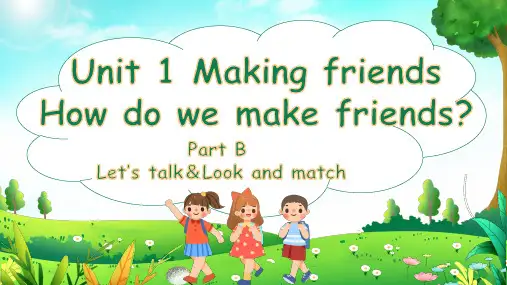
Unit1 Making friends Part B 人教PEP版(2024)英语三年级上册
A.I’m Sarah.
B. Thanks.
( )3. 新同学问你的名字,你会说:_______
A.Chen Jie
B. Nice to meet you, too.
Words: share, thanks Sentences: It’s OK.
We can share. Thank you. How can we be a good friend?
Acting(表演)
Thank you, Chen Jie.
Nice to meet you.
_______.
A. Thank you. B. Nice to meet you too. C. It’s OK.
_______.
Oh no.
A. Thank you. B. Nice to meet you too. C. It’s OK.
3. What does she say?(说) She is out of paint.
If you were Chen Jie’s friend, what will you do?
如果你是陈洁的朋友,你会怎么做?
I will help.
没关系 It’s OK,Chen Jie. We can share.
you.
Oh no!
It’s OK, Chen Jie. We can share.
Hey, Sarah! We can share.
Thanks, Sarah.
Thank you, Chen Jie.
Oh no!
It’s O__K, Chen Jie. We can share.
Hey, Sarah! We can _sh_a_r_e_.
人教PEP英语(2024)三年级上册Unit 1 Making friends 单元知识考点梳理
例句 ①I can share my apples. 我可以分享我的苹果。
透 ②We can share food. 我们可以分享食物。
析 ③I can say the names of body parts. 我能说出身体部位
的名字。
④John can make friends at school. 约翰可以在学校交朋
透 ②Hi! My name is Sarah Miller. 嗨!我叫萨拉·米勒。
析 拓展 用英文表达中国人的名字时,按照汉语拼音的形式
写,姓和名的第一个字母都要大写,而且姓和名要隔开一个
字母的空格,如:
姓(单姓)+名(单字)→Zhao Hai 赵海
姓(单姓)+名(两个字)→Wang Xiaoyu 王晓宇
解析 “Hello! / Hi! ”是打招呼用语,尤其是熟人之间打招
呼通常都用“Hello! / Hi! ”,意为“你好! /嗨! ”。“I’m +姓
名.”和“My name is +姓名.”常用于介绍自己的名字。其中
I’m是 I am 的缩略形式,意为“我是”。
返回目录
句 型
例句 ①Hello! I’m Chen Jie. 你好! 我是陈杰。
复数 eyes 例句 Look into my eyes. 看着我的眼睛。
返回目录
词 汇 巧 记
例句 Point to your mouth. 指向你的嘴。
例句 Wave your arm. 挥挥你的胳膊。
返回目录
课 文
Let's talk
翻 译
Mike: Hello! I’m Mike
Black.
④Mum is nice to my friends. 妈妈对我的朋友们很好。
Unit 1 Making friends 复习知识总结练习 人教版三年级上册英语
Unit 1 Making friends知识归纳语音:字母Aa、Bb、Cc、Dd的字母读音以及在单词中的发音。
四会单词:eye眼睛ear耳朵hand手arm手臂mouth嘴;嘴巴nice令人愉快的;友好的smile微笑;笑listen听;倾听help帮助share分享三会单词:can可以say说;讲meet见面;遇见hi嗨hello你好friend朋友good好的常考短语:an eye一直眼睛an ear一只耳朵shake hands握手point to指向;指着必会句型:1.打招呼用语:Hi./Hello.—Hello! I’m Mike Black. 你好!我是麦克布莱克。
—Hi! My name is Wu Binbin. 嗨!我叫吴斌斌。
2.自我介绍的句型: I’m +姓名。
/My name is +姓名。
—I’m Mike Black.我是麦克布莱克。
—My name is Mike Black.我是麦克布莱克。
3.询问对方姓名的句型及答语:—What’s your name?—I’m/My name is +姓名.—What’s your name? 你叫什么名字?—I’m/My name is Mike Black。
我叫麦克布莱克。
4. 初次见面的问候语及答语:—Nice to meet you. 很高兴见到你。
—Nice to meet you, too. 我也很高兴见到你。
5.表示感谢地句型:Thanks./Thank you.—We can share.我们可以分享。
—Thanks./Thank you.谢谢你。
核心语法:1.打招呼用语:Hi./Hello.2.初次见面的问候语及答语:—Nice to meet you.—Nice to meet you, too.3.询问对方姓名及介绍自己姓名的句型:—What’s your name?—I’m/My name is+姓名。
Unit1 Making friends(知识清单)三年级英语上册(人教PEP版2024秋)学生版

【知识清单】Unit1Making friends(人教PEP版)(学生版)一、字母字母A的读音是/eɪ/,发作/æ/,字母B的读音是/bi:/,发作/b/,字母C的读音是/si:/,发作/k/,字母D的读音是/di:/,发作/d/。
二、词汇1.nice令人愉快的;友好的2.ear耳朵3.hand手4.eye眼睛5.mouth嘴6.arm胳膊7.can可以8.share分享9.smile微笑;笑10.listen听;倾听11.help帮助12.say说;讲13.and和;与14.goodbye再见15.toy玩具16.friend朋友17.good好的三、重点句型1.—Hello!I'm Mike Black.你好!我是迈克·布莱克。
—Hi!My name is Wu Binbin.嗨!我叫吴斌斌。
hello和hi都表示“喂;你好”,是人们打招呼的常用语。
该用语使用时间不限,上午、下午、晚上都可以用,使用场合一般较为随意。
答语仍用hello或hi。
2.Hello!I'm Mike Black.你好!我是迈克·布莱克。
【句型】“I'm+姓名.”意为“我是……”用来向对方介绍自己。
其中I'm=工am,I'm是I am的缩写形式,后面直接接名字,3.Oh no!噢,不!本句用于表达惊愕,其中oh意为“哦;啊;哎呀”,表示恐惧、惊讶疑虑等;no意为“不”,表示否定意义,用于加强语气,反义词为yes。
四、知识拓展知识点01:打招呼用语Hello和Hi1.Hello和Hi都表示“你好”,一天中不同时间段都适用,常用于口语之中,是家人、朋友或熟人之间打招呼时常用的问候语,可以单独使用,也可以在后面加上称呼(注意称呼前需加逗号);2.Hello也可以用来引起某人的注意,或用于打电话时,相当于汉语里的“喂”;Hello比Hi更正式,回答也用Hello或Hi。
Unit 1Making friends PartB(课件)人教PEP(2024)英语三年级上册

PEP 三年级上册
Warm-up
A B C song
Aa-Bb-Cc-Dd-Ee-Ff-Gg, Hh-Ii-Jj-Kk-Ll-Mm-Nn, Oo-Pp-Qq, Rr-Ss-Tt, Uu-Vv-Ww-Xx-Yy-Zz, Xx-Yy-Zz, now you see, I can say my ABCs.我微笑。Fra bibliotek我倾听。
我帮忙。
我分享。
Listen and chant
Am I a good friend? Yes, I am! I listen and say “Hi!”. I smile too. Am I a good friend? Yes, I am! I help and share. I play fair too.
Unit 1 Making friends
PEP 三年级上册
New words
可以 We can share.
分享 I share my apples with Sarah.
倾听 I listen with care.
帮助 I help my friends.
说 I say“Hello!”
Look and match
We can share. Nice to meet you. Oh no!
我们可以分享。 见到你很高兴。 噢,不!
Thank you.
谢谢你。
Nice to meet you
It's OK.
too.
没关系。
见到你(我)也很高兴。
Play roles
Oh no!
We can share.
课文英汉对译
Unit 1 Making friends 知识点归纳

Unit 1 Making Friends 知识点归纳Chapter One Making friends Reading1. What do you know about…… 关于……,你知道多少?2. Friends often write to each other about their hobbies. Can you match the hobbies in the box with the picture below?write to sb. about sth. 就某事写信给某人in the box 在方框里match……with 把……和……匹配each other= one another彼此,互相3. Write down your hobbies. 写下你的爱好。
write down写下write to sb. 写信给某人4. Anna’s blog. sb’s 某人的Her parents’ names. 以s结尾时,只加’即可。
5. tell sb sth. 告诉某人某事tell a lie/ story 说谎/ 讲故事speak to sb. 对某人说话speak English 说英语talk to/ with sb 与某人交谈(to :单向;with:双向)listening to music reading books playing basketball(playing the piano)6. Welcome to my blog. welcome to sp. 欢迎来到某地7. I’m from Germany. 我来自德国。
be from= come from 来自Germany 德国German adj. 德国的n.德语;德国人(two Germans)German cars are very good. She was born in Germany.The Germans speak English very well.8. I’m 11 years old. 我十一岁。
Unit 1 Making friends Part A教案 人教PEP版英语三年级上册
Unit 1 Making friends 教案第一课时(A. Let’s talk & Listen, sing and role -play)1.能听、说、认读单词hello, hi, name, nice, meet, you 等;能运用句Look and say (Pair -work)教师带学生认识其他课本人物,并仿照他们的口吻进行自我介绍,然后同桌结对进行自我介绍练习。
T: Look, can you read these names? S1: Chen Jie ...T: OK. Follow me, Chen Jie...T: If you are Chen Jie, how will you introduce yourself? You can use the sentences “Hi/Hello! I’m/My name’s ... Nice to meet you ...” Now, practice with your partner.S1: Hi! I’m/My name’s ... Nice to meet you ... S2: Hi! I’m/My name’s ... Nice to meet you ...T: Are they good? How many stars can they get? Two or three? Why? S1: Two. No actions but fluent ...Step 3 Consolidation&Extension在学习课文对话的基础上,让学生唱be friends 的歌曲,进一步分析如何be friends 。
Sing and role -play 1. Enjoy a songT: Boys and girls, Do you know how to make friends now? Now let’s enjoy a song. And then tell me how to make friends?2.Let’s think (How to make friends?)(Group work ) T: From the song, we can get some tips to make friends. First, ________ Then, ________Unit 1 Making friendsA. How do we greet friends?Let’s talk&Sing and role-playHi, I’m...Hello, my name’s...Nice to meet you! Nice to meet you too.Unit 1 Making friends教案第二课时(A. Let’s learn & Listen and do)2. Listen and do.Play the recording again. Show the listening material. Ask students to read after the recording and act it out in pairs.和图片连线并跟读,锻炼学生听和说的能力。
(PEP)小学三年级英语上册《Unit 1 Making friends》大单元整体教学设计
新人教版(PEP)小学三年级英语上册《Unit 1 Making friends》——大单元整体教学设计一、内容分析与整合(一)教学内容分析《Making Friends》作为人教版英语三年级上册的起始单元,其重要性不言而喻。
这一单元不仅承载着引导学生踏入英语学习新阶段的使命,更肩负着培养他们基本社交技能的重任,尤其是如何与人建立和维护友谊这一核心议题。
在Part A部分,“How do we greet friends?”通过生动有趣的课堂活动,学生们将被带入一个充满互动的学习环境。
他们将学习如何用简单的英语问候语来开启一段对话,如“Hello, I'm ...”和“Nice to meet you.”,这些基本的交际用语将成为他们英语社交的敲门砖。
结合身体部位词汇的学习,如ear, hand, eye, mouth, arm等,学生们将在实践中掌握与这些词汇相关的动作指令,使英语学习与实际生活紧密相连。
Phonics教学的引入,让学生们在轻松愉快的氛围中掌握字母A a-D d的发音,为日后的词汇学习和阅读打下坚实的基础。
进入Part B,“How can we be a good friend?”则更深层次地探讨了友谊的真谛。
通过一系列角色扮演和情境模拟,学生们将学会如何通过具体的行动,如微笑(smile)、倾听(listen)、帮助(help)、分享(share)等,来表达友好和建立深厚的友情。
阅读材料《I am a good friend!》以其温馨的故事情节,帮助学生深刻理解友谊的重要性,激发他们成为更好朋友的愿望。
Part C作为可选内容,鼓励学生发挥创意,制作一张关于“如何交朋友”的思维导图。
这一活动不仅促进了学生对本单元知识的系统回顾和总结,还极大地提升了他们的综合运用能力和创新思维。
而扩展阅读材料“My new friend Zoom”则是对友谊主题的进一步延伸。
学生们将通过这篇简单现在时叙述的文章,学习到如何用英语描述自己的新朋友和与之相关的经历,从而在语言实践中加深对友谊价值的理解和感受。
PEP人教版英语三年级上册《Unit1 Making friends 》知识清单
PEP人教版小学英语三年级上册知识清单+练习Unit 1 Making friends一、词句汇总1.重点单词nice 令人愉快的;友好的ear 耳朵hand手eye眼睛mouth嘴巴arm胳膊can可以share 分享smile微笑listen听;倾听help帮助say说;讲and和;与goodbye再见toy玩具friend朋友good好的2.重点人物Sarah Chen Jie Mike Wu Binbin Zoom Zip 3.重点字母4.重点句式二、知识点总结1.英文句子首字母要大写,姓氏和名字的首字母要大写。
如My name is Chen Jie.中My 的M要大写。
Chen Jie的C和J要大写。
2.缩写:I am=I’m;let us=let’s3.初次见面打招呼用Nice to meet you!回应时句末加too,表示“也”。
4.介绍自己的姓名结构:①I am/I’m+姓名②My name is+姓名。
5.重点句型:I+动词。
如:I smile.6.Oh no!表示失望、惊讶或不知所措,通常用于意外事件或出乎意料的情况7.It’s OK.“没关系”,表示安慰。
8.Hey用于引起注意,也可用来问好。
三、单元练习一、默写本单元所学四个字母的大小写。
二、图文连线。
A.armB.earC.handD.mouthE.eyes三、选出不同类的单词。
( ) 1. A. I B. you C. can ( ) 2. A. we B. share C. help ( ) 3. A. Mike B. hello C. hi( ) 4. A. listen B. say C. good ( ) 5. A. Sarah B. smile C. Chen Jie 四、单项选择。
( ) 1. Hello! _______ Mike Black.A. IB. amC. I’m( ) 2. —Nice to meet you.—________.A. Nice to meet you, too.B.Nice to meet you.C. Goodbye! ( ) 3. —Oh, no!—________.A. Hello!B. It’s OK!C. Thank you. ( ) 4. —We can share.—________.A. I smileB. Oh, no!C. Thank you. ( ) 5. We share _______ .A. foodB. earC. mouth五、选择正确的中文意思,将序号填入括号内。
七年级上册Unit 1 Making friends
be good at be good for be good to
擅长 对....有好处
对....好
Jenny is good at dancing. Vegetables are good for us. Our teachers are very good to us.
Ex. 1)English is my favourite subject,and I am good it.
I want an apple.
want +动词不定式 想要做某事
I want to go there.
want sb. to do sth. 想要某人做某事
He wants me to go.
2.be good at意为“擅长....”,后接名词、代词或动名词,同义词组为do well in。 表示“不擅长....”或“在某方面做得不好”,用be bad/poor at.../do badly in.../be weak in...。 辨析be good at,be good for与be good to
修饰可数名词复数
many cars many people
much
修饰不可数名词
much water much time
a lot of/ 修饰可数名词复数和不可数名词 lots of
a lot of cars/water
want 及物动词,意为“想要”,常见句型结构有:
want +名词
想要.....
German blog grammar sound complete
hobby country age dream everyone
Germany mountain elder friendly engineer