
2014年深圳新版牛津英语八年级下册Unit 2 body language 词汇讲解
2014年深圳新版牛津英语八年级下册Unit 2 body language 词汇讲解
第一课时
1. language n. 语言
Students are expected to master a second language. 学生们要掌握一门外语。
【搭配】 natural language 自然语言 body language 肢体语言
2. communication n. 交流;交际
Most important of all, computers create wide communication around the world.
【同根词】communicate v. = share or exchange information with them 沟通;联系;交流
We only communicate by e-mail.
【搭配】communicate with somebody 和……沟通;和……联系
My natural mother has never communicated with me.
communicate to somebody = let somebody know about information, a feeling, or an idea.
They successfully communicate their knowledge to others.
3. accept v. 接受
I don’t think they would accept that view.
【辨析】receive, accept, take的区别:
receive, accept, take这三个词都有“接受”的意思。receive只表示被动地接受
If you receive a request like this, you can’t fail to obey it!
accept总表示主动而且高兴地接受
She has received his present, but she will not accept it.
take所表示的接受包含着有人赠给的意思
Did you take his advice?
Is there nobody to take my instructions?
4. meaning n. 意思,意义
I became more aware of the symbols and their meanings.
【同根词】mean v. 意味着
The red signal means you can shoot.
5. bored adj. 无聊的,无趣的,烦人的
The children quickly got bored with staying indoors.
【同根词】boring adj. 令人厌烦的 The film is so boring.
bore v. 使某人感到厌烦
All his stories bore me.
【搭配】bore to death(tear)/bore sb. to death(tear) 令人极度厌烦
The politician’s speech bored the crowd to death.
用于bored to结构
There is so much noise and she is bored to death.
be bored with 对……感到厌烦
I’m bored with so many boring things.
【辨析】bore, bored, boring的区别
bore主要有两种意思,一种是我们所熟悉的“使人厌烦、厌倦”;另外一种是“钻洞、挖孔”。在这里要讨论的意思是前者。bore是及物动词,bored是它的过去式和过去分词形式,boring是它的现在分词形式,bored是过去分词,它修饰的主语是人,boring修饰的主语是事物。例如:
His class bores me badly, and I can’t stand it!
= I am bored by his class, and I can’t stand it!
= His class is boring, and I can’t stand it!
6. appearance n. 外貌,外观;出现
The appearance of the old house completely changed.
【同根词】appear v. 出现
Gradually a smile appeared on her face.
disappear v. 消失
You disappear from my life.
disappearance n. 消失
Her sudden disappearance was very worrying.
【搭配】judge sb. by one’s appearance 以貌取人
It is unfair to judge him by his appearance.
7. impression n. 印象;感觉
What is your impression of Shanghai?
【同根词】impress v. 使……有印象 I was very impressed by his story.
impressive adj. 给人印象深刻的
His speech was impressive.
【搭配】make a good impression 留下好的印象
He made a good impression on his friend.
第二课时
1. hold v. 拿住,握住;保留
Debbie is holding her head up.
【同根词】hold n. 握住;保留;控制
He released his hold on the camera.
【搭配】grab hold of / catch hold of / get hold of = close your hand tightly around something
A doctor and a nurse caught hold of his arms.
Mother took hold of the barking dogs by their collars.
2. remind v. = make sb. remember something 提醒,使想起
Please remind me to post the letter tomorrow.
【同根词】reminder n. 提醒物,提示
His note is a reminder of tomorrow’s meeting to me.
【搭配】remind sb. of sth. 让人想起……,提醒某人某事
Remind him of the meeting tomorrow.
remind sb to do sth. 提醒某人做某事
Please remind him to take his medicine tomorrow.
remind sb. that + 从句 提醒某人某事,使某人想起某事
He reminded me that I ought to do it at once.
3.cross v. 使相交;交错而行;横渡
It’s very dangerous for children to cross the busy street.
【同根词】cross n. 十字架;十字形
She wore a small silver cross on a chain round her neck.
【辨析】cross, across, through的区别:
(1)首先是词性的区别:across为介词,而cross为动词。
(动词为“穿过,横穿”,名词为“十字,十字路口”) (2)当然across必须与through区别开来。across为“横穿”,与“道路”交叉形成“十字”。而through为在立体空间中的“穿过”。例如:
go through the forest 穿过森林 go across the street 穿过大街
(3)through表示“贯通、直穿、透过、穿过”的意思,即从一头(边)贯穿到另一头(边)。
The river runs through our city.
(4)across表示“横穿、横过、横渡、横跨”
I swam across the Changjiang River 20 years ago..
4. take place = happen
这两个词都可以用作动词,表示“发生”。需要注意的是,这两个词都不可以使用被动语态的结构。
Great changes have taken place in my hometown.
Several serious accidents have happened in this area.
5. shake v. 摇头;握手
As soon as he got inside, the dog shook himself.
He shook his hands to warm them up.
【搭配】shake hands 握手
Shake hands as you say goodbye and thank the interviewer for spending time with you.
shake one’s head 摇头
In many countries, shaking one’s head means “no”, and nodding means “yes”.
重点句型
1. What’s the matter? 怎么了?
= What’s up? / What’s wrong with you? / What happened?
2. It’s the way ……这是……的方式。
It’s the way you communicate.
I don’t like the way you spoken to me just now.(此句型属于定语从句,当先行词表示方式(the way),从句不缺成分时,用that/in which来引导定语从句,或是省略引导词。)
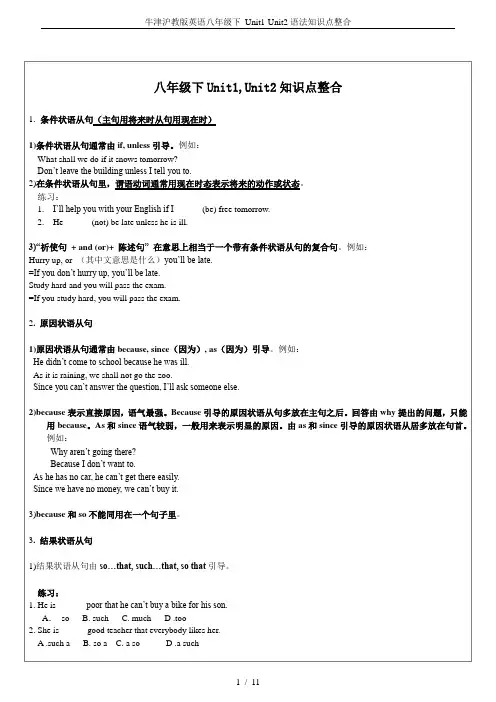
牛津沪教版英语八年级下 Unit1-Unit2语法知识点整合
1 / 11
八年级下Unit1,Unit2知识点整合
1. 条件状语从句(主句用将来时从句用现在时)
1)条件状语从句通常由if, unless引导。例如:
What shall we do if it snows tomorrow?
Don’t leave the building unless I tell you to.
2)在条件状语从句里,谓语动词通常用现在时态表示将来的动作或状态。
练习:
1. I’ll help you with your English if I ______(be) free tomorrow.
2. He ______(not) be late unless he is ill.
3)“祈使句 + and (or)+ 陈述句” 在意思上相当于一个带有条件状语从句的复合句。例如:
Hurry up, or (其中文意思是什么)you’ll be late.
=If you don’t hurry up, you’ll be late.
Study hard and you will pass the exam.
=If you study hard, you will pass the exam.
2. 原因状语从句
1)原因状语从句通常由because, since(因为), as(因为)引导。例如:
He didn’t come to school because he was ill.
As it is raining, we shall not go the zoo.
Since you can’t answer the question, I’ll ask someone else.
2)because表示直接原因,语气最强。Because引导的原因状语从句多放在主句之后。回答由why提出的问题,只能用because。As和since语气较弱,一般用来表示明显的原因。由as和since引导的原因状语从居多放在句首。例如:
英语沪教版八年级下册电子书单词
沪教版
Unit1
新版深圳牛津版英语八年级下册
必记单词
voyage n航.行
American adj美.洲的
continent .陆
discovery .现
rise .得更加成功(或者重要、强大等)
develop v增.强,加强
relation .系,交往
trade n贸.易 v.以物换物,互相交换
foreign ad外j.国的
Africa .洲
nowhere adv.无处,哪里都不
silk .织物,丝绸
besides pre .....之..外 (还)
development n发.展,壮大
pioneer n先.锋,先驱
people n民.族,种族 wealth n财.富
spread v传.播
短语归纳
1.open up开辟
2.trade route贸s易路线
3.set of发
4.go on a tr去ip旅行
5.set up建立,设立
6.set sa起il航
7.At that tim在e那时
8. (be) known a被s称为
9.As well a也s,还
10.too...to.太.....而..不能......
11.Grow up 长大
12.pay attention 注to意
13.Hand in上交
14.look fo寻r找
15.Around the worl界各地
16.such as例如
17.At the end o在f....末..端
18.quantities f量的
19.Not ...unt直il到....才.......
20.Because of因为,由于
pare...with.把....与.....对..比 22.between ...and在.....和.....之..间
用法集萃
1.how to do sth如.何做某事
2.order sb. to do 命sth令.某人做某事
3.It seems that似..乎.......
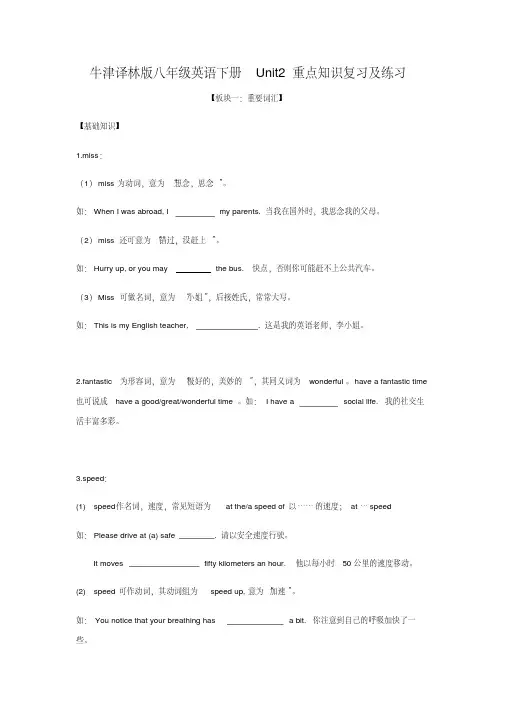
牛津译林版八年级英语下册Unit2重点知识复习及练习(20200707215651)
牛津译林版八年级英语下册Unit2重点知识复习及练习
【板块一:重要词汇】
【基础知识】
1.miss:(1)miss为动词,意为“想念,思念”。
如:When I was abroad, I my parents. 当我在国外时,我思念我的父母。
(2)miss 还可意为“错过,没赶上”。
如:Hurry up, or you may the bus. 快点,否则你可能赶不上公共汽车。
(3)Miss 可做名词,意为“小姐”,后接姓氏,常常大写。
如:This is my English teacher, . 这是我的英语老师,李小姐。
2.fantastic 为形容词,意为“极好的,美妙的”,其同义词为wonderful。have a fantastic time 也可说成have a good/great/wonderful time。如:I have a social life. 我的社交生活丰富多彩。
3.speed:
(1)speed作名词,速度,常见短语为at the/a speed of 以……的速度;at…speed。
如:Please drive at (a) safe . 请以安全速度行驶。It moves fifty kilometers an hour. 他以每小时50公里的速度移动。
(2)speed 可作动词,其动词组为speed up, 意为“加速”。
如:You notice that your breathing has a bit. 你注意到自己的呼吸加快了一些。
4.through作介词,自始至终,从头到尾;穿过,通过。如:The river runs our village. 这条河穿过我们的村子。
辨析across和through
两者均可表示“横过,穿过”,前者across表示从某物的表面“横过”,而后者则指在里面或在空间范围内“穿过”。
如:I draw a line the page. 我在那一页上面画了一条线。He walked the forest alone. 他独自一人穿过森林。
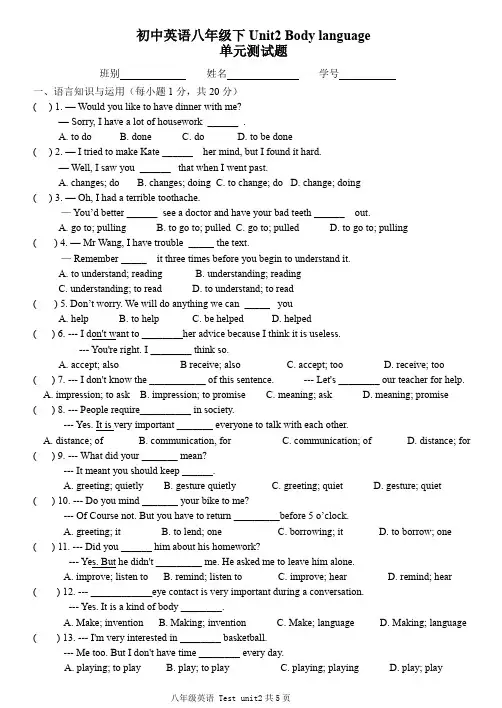
初二八年级下Unit2广州沪教牛津版课后练习题
八年级英语 Test unit2共5页初中英语八年级下Unit2 Body language 单元测试题 班别 姓名 学号 一、语言知识与运用(每小题1分,共20分) ( ) 1. — Would you like to have dinner with me? — Sorry, I have a lot of housework ______ . A. to do B. done C. do D. to be done ( ) 2. — I tried to make Kate ______ her mind, but I found it hard. — Well, I saw you ______ that when I went past. A. changes; do B. changes; doing C. to change; do D. change; doing ( ) 3. — Oh, I had a terrible toothache. — You’d better ______ see a doctor and have your bad teeth ______ out. A. go to; pulling B. to go to; pulled C. go to; pulled D. to go to; pulling ( ) 4. — Mr Wang, I have trouble _____ the text. — Remember _____ it three times before you begin to understand it. A. to understand; reading B. understanding; reading C. understanding; to read D. to understand; to read ( ) 5. Don’t worry. We will do anything we can _____ you A. help B. to help C. be helped D. helped ( ) 6. --- I don't want to ________her advice because I think it is useless. --- You're right. I ________ think so. A. accept; also B receive; also C. accept; too D. receive; too ( ) 7. --- I don't know the ___________ of this sentence.--- Let's ________ our teacher for help. A. impression; to ask B. impression; to promise C. meaning; ask D. meaning; promise ( ) 8. --- People require__________ in society. --- Yes. It is very important _______ everyone to talk with each other. A. distance; of B. communication, for C. communication; of D. distance; for ( ) 9. --- What did your _______ mean? --- It meant you should keep ______. A. greeting; quietly B. gesture quietly C. greeting; quiet D. gesture; quiet ( ) 10. --- Do you mind _______ your bike to me? --- Of Course not. But you have to return _________before 5 o’clock. A. greeting; it B. to lend; one C. borrowing; it D. to borrow; one ( ) 11. --- Did you ______ him about his homework? --- Yes. But he didn't _________ me. He asked me to leave him alone. A. improve; listen to B. remind; listen to C. improve; hear D. remind; hear ( ) 12. --- ____________eye contact is very important during a conversation. --- Yes. It is a kind of body ________. A. Make; invention B. Making; invention C. Make; language D. Making; language ( ) 13. --- I'm very interested in ________ basketball. --- Me too. But I don't have time ________ every day. A. playing; to play B. play; to play C. playing; playing D. play; play 八年级英语 Test unit2共5页( ) 14. -- Can you tell me how to make a good impression ___others?21 --- Smile often. That is the ___to success. A. on; model B. in, key C. on; key D. in; model ( ) 15. --- What’s the _________with you?---I _______in the exam. A. matter failed B. question; failed C. matter, sighed D. question; sighed ( ) 16. --- Great changes have ________ in my hometown. --- Yes. Look! There ______many beautiful parks and building now. A. taken place; were B. taken off; were C. taken place; are D. taken off; are ( ) 17. --- May I leave a(n) ______ to Mr Smith? ---Yes, you _____. What do you want to tell him?21 A. information, must B. message; can C. message; must D. information; can ( ) 18. --- Her words always make people _______welcome --- She is good at _______. A. sound; communicate B. feel; communicating C. sound; communicating D. feel; communicate ( ) 19. --- I am very ____ with my job now. What should I do? ---Why don't you _____ for a few months?2 1 A. boring; rest B. bored; to rest C. boring; to rest D. bored; rest ( ) 20. --- What should I do if I __________ with you? --- You should _______your head. A. will agree; nod B. agree; nod C. will agree; lose D. agree; lose 二、完形填空。(每小题1分,共10分) Little children use a lot of silent signals to communicate, but we've got ways to read their body language. Like many parents of children, you might find it is hard to__21__ your children's signals. Even though children can know around 200 words by their second birthday, they are only able to __22__50 of these words in daily life. This means you have to __23__ your children's body language much of the time to know how they're __24__ or what they're wanting. While no one expects you to be a mind __25__, you can pay attention to your children's body language to learn how to __26__ in some cases. It is difficult to believe that one little arm cross can have more than 67 kinds of meanings. But for children, it's __27__ to be a signal that they’re feeling uneasy. For example, your children might not be able to __28__, "I don't want this unfamiliar (不熟悉的) horse near me," but they can __29__ themselves from it by folding their arms to __30__ a protective barrier (保护屏障)21 Learn more about your children's body language so that you can communicate with them more easily. ( ) 21. A. continue B. imagine C. understand D. produce ( ) 22. A. carry B. take C. make D. use ( ) 23. A. depend on B. hold on C. keep on D. put on ( ) 24. A. watching B. looking C. feeling D. tasting ( ) 25. A. driver B. reader C. actor D. adviser ( ) 26. A. find B. show C. respond D. answer ( ) 27. A. false B. wrong C. important D. likely ( ) 28. A. ask B. say C. talk D. tell
牛津英语八年级下册知识点梳理汇总
八年级下册知识点
Unit1
一.【精选词汇】
㈠重点短语
1.thechangestoSunshineTown阳光镇的变化→thechangesto……的变化(p8)
〈知识链接〉changen.变化,常用复数changes。e.g.Greatchangeshavetakenplacesince1995.
2.inthesouthernpartoftown→inthesouthernpartof…在…的南部→south→southern
〈知识链接〉east东部→eastern东部的,west→western,north→northern
3.inthepast在过去→atpresent现在→inthefuture未来;将来,注意这些短语中的介词和冠词。
4.turntheplaceintoapark→turn…into…把…变成…
〈知识链接〉①Heatturnswaterintovapor.热使水变成蒸气。②TurnthissentenceintoEnglish.
5.playcardsandChinesechess打牌、下象棋,e.g.It’spleasanttoplaycardsandChinesechess.
6.waterpollution水污染→airpollution空气污染,noisepollution噪音污染(p9)
〈知识链接〉Waterpollutionwasaproblembefore.
edtodumpitswasteintowater→usedtodosth过去常做某事,注意否定式、疑问式的形式
〈知识链接〉⑴usedtodosth→否定式usednottodosth或didn’tusetodosth→疑问式Didsbusetodosth或Usedsbtodosth⑵Therebe和usedto合用的形式为Thereusedtobe。
沪教牛津版英语八年级下册课本翻译

上教社牛津版八年级英语(下册)课文与翻译Unitl Helping
those in need
Voluntary work
Three teenagers offered to do some voluntary work during the school holidays. They wrote the
following reports.
I did some voluntary work in a children's hospital. The children there all suffer from serious illness.
Wc organized a painting competition for them.
I met a girl called Cindy. She wanted to paint a picture of the park near her home. I went there and took
some photos of it. Cindy used them for her painting.
Betty
There are many children without parents. I met some of these children with my mother. We taught
them to tell stories. This helps them express their feelings. One child said," My friends don't understand
my pain'1.
Wc spent some time with a girl called Vivien. Her parents died in a car accident, and she is unhappy
and very lonely. She needs friendship. My mother and I will continue to visit Vivien.
广东省深圳市龙华新区大浪实验学校八年级英语下册Unit2主题阅读牛津深圳版
Unit2主题阅读
Ⅰ.短文填空
We are always using body language in our daily 1 (communicate). When
we talk 2 each other, we may use body language. For example, in the USA,
people
point to 3 (they)heads when they think someone 4 (be)clever. 5 , human
beings are not the only ones who use body language. Animals also use body language
and facial 6 (express) to tell each other how they feel and what they think.
7 a dog is happy, its ears will stand up and its ears will wide open. When it
is angry, it will look straight at you. If an elephant spreads its ears, it means
“Watch out!” To show friendship, elephants will touch each other with their
trunks(鼻子). Dolphins live in groups and like to show each other their
8
(feeling). An 9 (anger) dolphin will sometimes slap its tail on the water. A happy
牛津深圳版八年级下册 unit 1词汇 讲解+练习 (答案不全)
1 8B Unit1 Helping those in need
Key words and Phrases:
1. raise v. 筹集;提升;增加
raise = keep 有“饲养,抚养”的意思
常见搭配:
raise one’s voice 提高嗓门 raise a family 养家糊口 raise money 筹款;
raise price 提高价格; raise one’s spirits 打起精神
raise children(抚养孩子)
辨析:raise, rise(rise--rose--risen)的区别
(1) 这两个词都有“提高,上升,增加”的意思,但其用法不同。
raise是及物动词,其主语通常是人;而rise是不及物动词,其主语通常是物。例如:
The sun rises and bathes the earth. 太阳升起,普照大地。
(2) raise和rise用于同一事物时含义不同。例如:
The price of TV sets has been raised recently. 最近电视机提价了。(政府或厂家主动行动)
The price of TV sets has risen recently. 最近电视机提价了。(市场调节)
2. permission n. = agreement 准许;批准
Write a letter to the head teacher to ask permission to raise money.
给校长写一封信请求允许筹钱。
同根词:permit v. = allow 许可,准许;默许
常用短语:permit/allow sb. to do sth.
The guards permitted me to bring my camera and tape recorder.
[精]人教版八年级英语下册Unit 2知识梳理+词汇讲解+句型解析
人教版丨八年级英语下册Unit 2知识梳理+词汇讲解+句型解析
知识梳理
【重点单词】
cheer [tʃiə] v. 欢呼
volunteer [ˌvɔlənˈtiə] n. & v. 志愿者;义务做
put off 推迟
sign [saɪn] n. 标记,符号,标牌
notice [ˈnəʊtɪs] n. & v. 通知,公告;注意到
lonely ['ləʊnlɪ] adj. 孤独的,寂寞的
several [ˈsevrəl] prep. 几个,数个,一些
strong [strɒŋ] adj. 强壮的,强烈的
feeling [ˈfi:lɪŋ] n. 感觉,感触
satisfaction [ˌsætɪs\'fækʃn] n. 满足,满意
joy [dʒɔɪ] n. 高兴,愉快
owner [ˈəʊnə(r)] n. 所有者,物主 journey ['dʒɜ:nɪ] n. (尤指长途)旅行,行程
raise [reɪz] v. 抬起,举起,筹集,征集
alone [əˈləun] adv. 独自地,孤独地
repair [riˈpɛə] v. 修理,修补
fix [fiks] v. 修理,安装
fix up 修理,修补
give away 赠送,捐赠
take after (外貌或行为)像
broken ['brəʊkən] adj. 破损的,残缺的
wheel [wi:l] n. & v. 轮子,车轮;旋转
letter [ˈletə] n. 信件,字母
Miss [mɪs] n. 小姐
disabled [disˈeibəld] adj. 有残疾的,丧失能力的
blind [blaɪnd] adj. 盲的,盲目的,失明的
deaf [def] adj. 聋的
imagine [ɪˈmædʒɪn] v. 想象,设想 difficulty ['dɪfɪkəltɪ] n. 困难
open [ˈəʊpən] v. 打开
Unit2作文范文牛津深圳版(广州沈阳通用)八年级英语下册
八下Unit2作文范文
U21
【书面表达】
假设你的印度网友Mary下个月要到你们学校交流学习。请根据下面的内容提示,用英语写一篇短文告诉她关于肢体语言的注意事项。
内容包括:
1. 中国人见面通常微笑,握手;
2. 在中国,点头表示同意,摇头表示不同意;
3. 眼神交流很重要;但与长辈交流时,不要长时间看着对方的眼睛;
4. 你的其他建议(至少一点)
作文要求:
1. 不能照抄原文;不得在作文中出现学校的真实名称和学生的真实姓名。
2. 语句连贯,词数80个左右。作文的开头和结尾已给出,不计入词数。
3. 内容必须包括所有要点,但不要逐条翻译。
参考词汇:(dis)agree with sb. (不)赞同某人
Body Language in China
We often use body language in our daily life. I’d like to tell you something about it in China.
When we meet each other, we often smile and shake hands. What’s more, when we agree
with each other, we will nod our heads. However, when we have different opinions, we will shake
our heads instead. Eye contact is a very important part of body language. But to be polite, don’t
look at the older people’s eyes for a long time. To make a good impression on others, you should
smile at others when talking with them.