
The translator's invisibility Venuti 译者的隐形
The translator’s invisibilityA history of translationLawrence VenutiChapter one InvisibilityI“Invisibility” is the term I will use to describe the translator’s situation and activity in contemporary Anglo-American culture. A translated text, whether prose or poetry, fiction or nonfiction, is judged acceptable by most publishers, reviewers, and readers when it reads fluently, when the absence of any linguistic or stylistics peculiarities makes it seem transparent, giving the appearance that it reflects the foreign writer’s personality or intention or te essential meaning of the foreign text-the appearance, in other words, that the translation is not the translation, but the “original”.The illusion of transparency is an effect of fluent discourse, of the translator’s effort to insure easy readability by adhering to current usage, maintaining continuous syntax, fixing a precise meaning. What is so remarkable here is that this illusory effect conceals the numerous conditions under which the translation is made, starting with the translator’s crucial intervention in the foreign text. The more fluent the translation, the more invisible the translator, and presumably, the more visible the writer or meaning of the foreign text.P4.A fluent translation is written in English that is current (“modern”) instead of archaic, that is widely used instead of specialized (“jargonization”), and that is standard instead of colloquial (“slangy”). Foreign words (pidgin) are avoided, as are Britishism in American translations and Americanisms in British translations. Fluency also depends on syntax that is not so “faithful”to the foreign text as to be “not quirt idiomatic”, that unfolds continuously ans easily (not “doughy”) to insure semantic “precision”with some rhythmic definition, a sense of closure (not a “dullthud’). A fluent translation is immediately recognizable and intelligible, familiarized, domesticated, not disconcertingly, foreign, capable of giving the reader unobstructed access to great thoughts, to what is present in the original. Under the regime of fluent translating, the translator works to make his or her work invisible, producing illusory effect of transparency that simultaneously masks its status as an illusion: the translated text seems natural, i.e., not translated.The translator’s invisibility is also partly determined by the individualistic conception of authorship that continues to prevail in Anglo-American culture. According to this conception, the author freely expresses his thought and feelings in writing, which is thus viewed as an original and transparent self-representation, unmediated by trans individual determinants (linguistic, cultural, social) that might complicate authorial originalityIIP17Translation is a process by which the chain of signifiers that constitutes the source-language text is replaced by a chain of signifiers in the target language which the translator provides on the strength of an interpretation.P19.The German theologian and philosopher Friedrich Schleiermacher. In an 1813 lecture on the different methods of translation, Schleiermacher argued that “there are only two. Either the translator leaves the author in peace, as much as possible, and moves the reader towards him; or he leaves the reader in peace, as much as possible, and moves the author towards him” (Lefevere 1977: 74). Admitting that translation can never be completely adequate to the foreign text, Schleiermacher allowed the translator to choose between a domesticating method, an ethnocentric reduction of the foreign text target-language cultural values, bring the author back home, and a foreignizing method, an ethnodeviant pressure on those values to register the linguistic and cultural difference of the foreign text, sending the reader abroad.I want to suggest that insofar as foreignizing translation seeks to restrain the ethnocentric violence of translation, it is highly desirable today, a strategic culture intervention in the current state of the world affairs, pitched against the hegemonic English-language nations and the unequal cultural exchanges in which they engage their global others. Foreinizing translation in English can be a form of resistance against ethnocentrism and racism, cultural narcissism and imperialism, in the interests of democratic geopolitical relations.Consider Nida’s concept of “dynamic”or “functional equivalence”in translation, formulated first in 1964, but restated and developed in numerous books and articles over the past thirty years. “A translation of dynamic equivalence aims at complete naturalness od expression,” states Nida, “and tries to relate the receptor to modes of behavior relevant within the context of his own culture” (Nida 1964: 159). The phrase “naturalness of expression” signals the importance of a fluent strategy to this theory of translation, and in Nida’s work it is obvious that fluency involves domestication. For Nida, accuracy in translation depends on generating an equivalent effect in the target-language culture: “the receptor of a translation should comprehend the translated text to such an extent that they can understand how the original receptors must have understood the original text”(ibid. 36). The dynamically equivalent translation is “interlingual communication”which overcomes the linguistic and cultural differences that impede it (ibid. 11).。
The translator27s invisibility Venuti 译者的隐形

The translator’s invisibilityA history of translationLawrence VenutiChapter one InvisibilityI“Invisibility” is the term I will use to describe the translator’s situation and activity in contemporary Anglo-American culture. A translated text, whether prose or poetry, fiction or nonfiction, is judged acceptable by most publishers, reviewers, and readers when it reads fluently, when the absence of any linguistic or stylistics peculiarities makes it seem transparent, giving the appearance that it reflects the foreign writer’s personality or intention or te essential meaning of the foreign text-the appearance, in other words, that the translation is not the translation, but the “original”.The illusion of transparency is an effect of fluent discourse, of the translator’s effort to insure easy readability by adhering to current usage, maintaining continuous syntax, fixing a precise meaning. What is so remarkable here is that this illusory effect conceals the numerous conditions under which the translation is made, starting with the translator’s crucial intervention in the foreign text. The more fluent the translation, the more invisible the translator, and presumably, the more visible the writer or meaning of the foreign text.P4.A fluent translation is written in English that is current (“modern”) instead of archaic, that is widely used instead of specialized (“jargonization”), and that is standard insteadof colloquial (“slangy”). Foreign words (pidgin) are avoided, as are Britishism in American translations and Americanisms in British translations. Fluency also depends on syntax that is not so “faithful”to the foreign text as to be “not quirt idiomatic”, that unfolds continuously ans easily (not “doughy”) to insure semantic “precision” with some rhythmic definition, a sense of closure (not a “dullthud’). A fluent translation is immediately recognizable and intelligible, familiarized, domesticated, not disconcertingly, foreign, capable of giving the reader unobstructed access to great thoughts, to what is present in the original. Under the regime of fluent translating, the translator works to make his or her work invisible, producing illusory effect of transparency that simultaneously masks its status as an illusion: the translated text seems natural, i.e., not translated.The translator’s invisibility is also partly determined by the individualistic conception of authorship that continues to prevail in Anglo-American culture. According to this conception, the author freely expresses his thought and feelings in writing, which is thus viewed as an original and transparent self-representation, unmediated by trans individual determinants (linguistic, cultural, social) that might complicate authorial originalityIIP17Translation is a process by which the chain of signifiers that constitutes the source-language text is replaced by a chain of signifiers in the target language which the translator provides on the strength of an interpretation.P19.The German theologian and philosopher Friedrich Schleiermacher. In an 1813 lecture on the different methods of translation, Schleiermacher argued that “there are only two. Either the translator leaves the author in peace, as much as possible, and moves the reader towards him; or he leaves the reader in peace, as much as possible, and moves the author towards him”(Lefevere 1977: 74). Admitting that translation can never be completely adequate to the foreign text, Schleiermacher allowed the translator to choose between a domesticating method, an ethnocentric reduction of the foreign text target-language cultural values, bring the author back home, and a foreignizing method, an ethnodeviant pressure on those values to register the linguistic and cultural difference of the foreign text, sending the reader abroad.I want to suggest that insofar as foreignizing translation seeks to restrain the ethnocentric violence of translation, it is highly desirable today, a strategic culture intervention in the current state of the world affairs, pitched against the hegemonic English-language nations and the unequal cultural exchanges in which they engage their global others. Foreinizing translation in English can be a form of resistance against ethnocentrism and racism, cultural narcissism and imperialism, in the interests of democratic geopolitical relations.Consider Nida’s concept of “dynamic” or “functional equivalence” in translation, formulated first in 1964, but restated and developed in numerous books and articles over the past thirty years. “A translation of dynamic equivalence aims at completenaturalness od expression,” states Nida, “and tries to relate the receptor to modes of behavior relevant within the context of his own culture”(Nida 1964: 159). The phrase “naturalness of expression” signals the importance of a fluent strategy to this theory of translation, and in Nida’s work it is obvious that fluency involves domestication.For Nida, accuracy in translation depends on generating an equivalent effect in the target-language culture: “the receptor of a translation should comprehend the translated text to such an extent that they can understand how the original receptors must have understood the original text”(ibid. 36). The dynamically equivalent translation is “interlingual communication” which overcomes the linguistic and cultural differences that impede it (ibid. 11).如有侵权请联系告知删除,感谢你们的配合!。
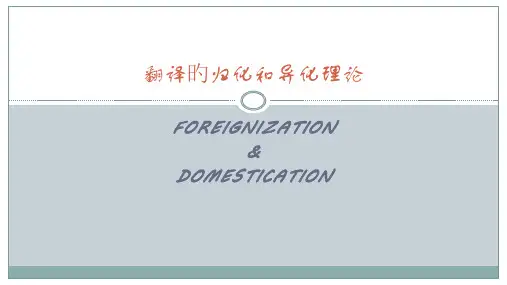
翻译的归化和异化理论
例如: 1.Love me, love my dog. 爱屋及乌。 2.a lion in the way 拦路虎 3.lick one’s boots 拍马屁 4.Diamond cuts diamond 棋逢对手 5.A flash in a pan 昙花一现 6.Have one foot in the grave 风烛残年 7.To grow like mushrooms 雨后春笋 8.One boy is a boy,two boys half a boy,three boys nobody.一种和尚
Differences
However, this does not mean the two pairs are just one. There are some differences between them. When a translator resorts to either literal translating method or free translating method, he puts his attention mainly to the linguistic factors of the source text and tries his utmost to keep the original meaning in the target text.
Domestication refers to the target-culture-oriented translation in which unusual expressions to the target culture are exploited and turned into some familiar ones so as to make the translated text intelligible and easy for the target readers.
Venuti_汇总
反常式翻译
译者的隐身 异化翻译
对抗式翻译
翻译之耻
通顺翻译
症候式阅读
少数化翻译 语言剩余
存异伦理 因地制宜伦理
Key concepts
• the 'invisibility' of the translator • 'Foreignizing' vs. 'Domesticating' • 'call for action'
reflects the foreign writer’s personality or intention or the essential
meaning of the foreign text-the appearance, in othter words, that the
translation is not in fact a translation, but the ‘original’.
(外国文本的种族中心让位于[英美]译入语的文化价值观)
异入语
>
原语
Domestication vs. Foreignization
• Domestication: a term used by Venuti to describe the translation strategy in which a transparent, fluent style is adopted in order to minimize the strangeness of the foreign text for TL readers.
(Venti 1995:1)
译入语文化中的不同读者层解读翻译文本的方 式。译文读起来流畅,使人们觉得这不是翻译, 而是‘原文’时,出版商、评论家和读者认为 这样的翻译作品(不论是散文还是诗歌,小说 还是其他类型的题材)才是可以接受的。
浅析韦努蒂的翻译思想
浅析韦努蒂的翻译思想浅析韦努蒂的翻译思想摘要:通过对西方翻译理论和译本的研究,韦努蒂批判在西方翻译界占主导地位的归化翻译,指出英美文化中通顺流畅的归化策略导致译者“隐形”,并主张异化的翻译策略以阻挡英美文化的霸权。
该篇论文主要分析韦努蒂的核心思想,批判地分析异化翻译的积极意义和局限性,从而更好地指导翻译实践。
关键词:译者的隐形归化异化局限性美裔意大利学者劳伦斯.韦努蒂是解构主义的代表人物之一,他秉承该流派的思想,追求文化的多样性,主张“存异”而非“求同”,反对传统以译入语为倾向的归化翻译策略,提倡译者“显形”和异化的翻译策略以抵御英美文化的霸权主义。
一、译者的“隐形”韦努蒂在其专著 Translator's Invisibility: A History of Translation 中提出“隐形”这个术语,用来描述译者在当代英美翻译界的状况。
在传统翻译中,对于外国文学的翻译一直以归化为主导,认为好的译文应该通顺流畅,读起来不像译文而且译者在翻译过程应力求“透明”让人没感觉到其存在。
这也就是韦努蒂所指的“不可见性”即译者应处于“隐形”的状态。
这主要原因在于:首先,译者本身倾向于译成“流畅”的英语。
译者以译入语文化为归宿,努力地使译文语言地道,符合译入语的语言习惯,从而提高可读性。
其次,译入语读者阅读翻译文本的方式。
不论是散文、诗歌、小说还是其他类型的题材,多数人所接受的译文是读起来流畅,没有任何语言或风格的独特之处,看上去译文已经反映了作者的实质意义,译文似乎不是译文而是原作。
这种流畅透明的翻译似乎符合忠实的准则,传达了原文的精神实质,但忽略了原文与译文,作者和译者的相互关系。
传统的翻译观认为译文是原著的派生,只有作者才能对文本拥有绝对的解释权,译者处于次要地位,译文从属于原文。
译者的任务是使译文通顺流畅,不得对译文干预,译者应尽可能地保持译文透明,减少翻译的痕迹,恪守忠实原文的准则。
因此,译者就会本着以译入语的语言特征和价值观念来同化外来语言。
劳伦斯·韦努蒂
一.劳伦斯·韦努蒂的基本信息及其主张:劳伦斯·韦努蒂 Lawrence Venuti(1953年—)学者,大学英语教授,专职翻译家,美籍意大利人,生于费城南部(此区域居住者多为意大利裔),七十年代早期在天普大学攻读英语文学,1980年获哥伦比亚大学博士学位。
主要著作:主编论文集《对翻译的重新思考:语篇、主体性与意识形态》(RethinkingTranslation: Discourse, Subjectivity,Ideology),(1992)、《译者的隐身一部翻译史》(Translator's Invisibility: A History ofTranslation)(1995)《不光彩的翻译》(The Scandals of Translation: Towards anEthics of Difference)(1998).韦努蒂把解构主义的翻译思想付诸实施,提出了反对译文通顺的翻译策略。
其目的是:在思想意识上反对殖民主义的翻译观和英美民族中心主义和帝国主义文化价值观;在翻译原则和方法上,提创“存异”而不是“求同”。
通过对英美翻译历史的研究,他得出英美文化中译者和译作实际上处于“隐形”状态。
造成译者隐形的原因是由于归化翻译是英美翻译界的主流翻译方法所致。
鉴于归化翻译是英美翻译作品是主流翻译方法,而译者在这些翻译作品中都是“隐形人”。
Venuti主张“异化”翻译,号召译者采取抵抗翻译策略,以显示自己在翻译中的存在。
Venuti的异化翻译法归因于19世纪德国哲学家Schleiermacher的翻译论说:the translator leaves the author in peace, as much as possible, and moves the reader towards him. “译者尽量不惊动原作者,让读者向他靠近。
”VENUTI异化翻译理论中存在的问题:由于Venuti过分关注政治对翻译方法的影响,其所提倡的异化翻译理论忽视了文学翻译的主要目的,没有考虑到接受者的需求。
《傲慢与偏见》两个中译本中反讽语的翻译
傲慢与偏见》两个中译本中反讽语的翻译《傲慢与偏见》在中国有着很高的知名度,七十年来已经有三十三个译本,之中又以王科一和孙致礼的译本最为出众。
因此就以这二人的译本为例,探讨他们在处理反讽语句其中所采用的归化与异化策略对翻译反讽语句的作用,为今后翻译具有反讽色彩的文学作品提供一定的帮助。
一、引言为何几个世纪以来,简?奥斯汀的小说那么受人追捧,很大的原因就是她风趣又幽默的语言常常令人忍俊不禁,即使是再琐碎的小事和再不过平凡的人,她也能描绘地栩栩如生。
她的小说中充满了讽刺,其中又以反讽这一修辞手法最为突出。
众所周知,《傲慢与偏见》既是她的成名之作,也是反讽艺术的典范。
小说描写了乡绅班纳特五个待字闺中的千金,主角是二女儿伊丽莎白。
她在舞会上认识了达西,但是见他为人傲慢,一直对他心生排斥。
几经波折后,伊丽莎白消除了对这西的偏见,达西也放下傲慢,这对有情人终成眷属。
在这部小说中,奥斯丁一反当时社会上流行的矫揉造作的写作方法,而是用幽默的语言、锋利的笔触以及其独特的反讽手法为我们塑造出一个又一个经典的人物形象,18世纪末到19 世纪初的英国人的日常生活和人生百态引人入胜。
在作者的巧妙运用之下反讽贯穿整个小说,使得小说有着经久不衰的魅力。
所以,能否精准地翻译其中带有反讽意味的语句,对于读者在阅读这本小说时是否能正确地体会作者的意思来说非常重要。
在中国,简?奥斯汀小说的翻译始于七十多年前。
1935 年,杨斌第一个翻译了《傲慢与偏见》,并且大多数人都认为这个译本非常通顺且忠实。
在这之后,有越来越多的学者开始翻译这个本小说。
迄今为止,已经有33个版本了,其中又以王科一(2010)和孙致礼(2012)的版本最为出名最受认可。
接下来就以这两人的译本为例,从归化与异化视角来探讨在翻译带有反讽意味的语句时所应采用的翻译策略。
二、反讽;归化与异化在进一步讨论前,有必要对相关概念先做简要介绍。
(一)反讽究竟何为“反讽”呢?在中国古代汉语中,“风”是“讽” 的假借,有“用委婉的语言暗示、劝告、指责”的意思。
翻译的归化和异化理论
Foreignization is a source-culture-oriented translation which strives to preserve the foreign flavor as much as possible in order to transfer the source language and culture into the target one.
定义Definition
归化(domestication)是指在翻译中采用透明、流畅的风格,最 大限度地淡化原文的陌生感的翻译策略。它应尽可能的使源语文本 所反映的世界接近目的语文化读者的世界,从而达到源语文化与目 的语文化之间的“文化对等”。
归化法是以目的语文化为归宿的翻译方法, 是基于人类文化和语言 的个性而发展。要求译者向译语读者靠拢,采取译语读者习惯的译 语表达方式,来传达原文的内容;
例子
① 异化可以在语音层上出现。例如: ballet译作“芭蕾舞” cigar译作“雪茄” laser过去译成“莱塞”,现译作“镭射”、“激光” 目前大街小巷都风行的“卡拉 OK”等。
② 异化可以在词语层出现。例如: “crocodile tears”译作“鳄鱼的眼泪” “an olive branch”译作“橄榄枝” “sour grapes”译作“酸葡萄” “the cold war”译作“冷战ove my dog. 爱屋及乌。 2.a lion in the way 拦路虎 3.lick one’s boots 拍马屁 4.Diamond cuts diamond 棋逢对手 5.A flash in a pan 昙花一现 6.Have one foot in the grave 风烛残年 7.To grow like mushrooms 雨后春笋 8.One boy is a boy,two boys half a boy,three boys nobody.一个和尚
汉语英译中文化因素的处理——以《红楼梦》为例
- 226-校园英语 / 翻译探究汉语英译中文化因素的处理——以《红楼梦》为例郑州澍青医学高等专科学校外语教研室/李卫丽【摘要】中西文化存在着很大的差异,给汉英翻译工作带来了难题。
一般来说,处理翻译文本中的文化因素可以分成两种对立的意见,即所谓异化和归化。
本文以《红楼梦》的两个流传较广的译本,即杨宪益夫妇和霍克斯的译本为例,来探讨汉英翻译中文化因素的处理。
【关键词】《红楼梦》 归化 异化 文化因素【Abstract 】There are considerable differences between Chinese culture and Western culture. These bring difficulties to Chinese-English translation. In general, the process of cultural factors in the translated text can be divided into two opposing views, the so-called foreignization and domestication. In this paper, the author takes the two wide-spread translation of Hongloumeng, namely Yang Hsien-yi ’s version and Hawkes ’ version, as examples, to discuss the deal with cultural factors during Chinese-English Translation.【Key words 】Hongloumeng; foreignization; domestication; cultural factors在信息全球化大语境的影响下,信息的传播和大众传媒的崛起使得翻译成为信息传播的工具,在国际交往中起着越来越重要的作用。
归化异化例子 good novel
落汤鸡 拦路虎 爱屋及乌 胆小如鼠 对牛弹琴 鸡皮疙瘩 亚洲四小龙
a drawn rat a lion in the way love me,love my dog as timid as rabbit for the birds goose flesh four Asian Tigers
语言是文化的载体,语言的文化内涵涉及到一 个民族的政治、经济、社会、历史、风俗、 习惯等各方面,是一个民族知识、经验、信仰、 价值、宗教、时空等观念的总和。而汉语和 英语在文化内涵上的差异就十分显著。归化 法的翻译将源语与目的语之间语言上和文化 上的彼此差异降到最低,用目的语读者熟悉的 语言和文化表达源语的语言和文化,使译文更 透明、通顺、易懂,为两种语言更有效的交流 扫除了语言和文化上的障碍。
5. 冷子兴笑道:“亏你是进士出身,原来不通! 古人有云:‘百足之虫,死而不僵。’……” (《红楼梦》) 6. 他必审问我,我给他个‘徐庶进曹营———一 语不发’。(《骆驼祥子》) 7.看见了人马的忙乱,听见了复杂刺耳的声音,闻 见了干臭的味道,踏上了细软污浊的灰土,祥子想 趴下去吻一吻那个灰臭的地,可爱的地,生长洋钱 的地! (《骆驼祥子》) 8.时已薪水不继,余佯为雇骡以安心,实则囊饼徒 步,且食且行。(《浮生六记》)
Foreignization, on the other hand, means taking the reader over to the foreign culture, making him or her see the cultural and linguistic differences. Foreignizing translation signifies the difference of the foreign text, yet only by disrupting the cultural codes that prevail in the target language.
《舌尖上的中国》英译中归化和异化翻译策略运用[权威资料]
《舌尖上的中国》英译中归化和异化翻译策略运用【摘要】为更好地向英语受众介绍中国饮食文化,纪录片《舌尖上的中国》的英译综合采用了归化、异化以及归化与异化相结合的翻译策略。
文章对该纪录片中的菜肴名称、制备过程和所涉民俗文化的英译过程中这三种翻译策略的运用情况进行了统计分析,发现译者围绕实现最佳译文效果这一中心,因地制宜地灵活采用了这三种翻译策略,此外,与此前同类纪录片相比,该纪录片英译过程中异化策略的运用比例有明显提高,反映了近年来中国文化自信的提升。
【关键词】《舌尖上的中国》;归化与异化;纪录片翻译归化与异化是翻译时普遍使用的两种翻译策略,由美国著名翻译理论学家劳伦斯・韦努蒂提出。
“归化”指在翻译时尽量向目的语的读者靠拢,采取目的语习惯的表达方式翻译原文;而“异化”则是翻译时向源语作者靠拢,尽量在保留源语的表达方式后进行翻译。
归化与异化是对立统一的,译者在翻译时通常会综合运用归化法与异化法。
随着中国的发展壮大与全球化趋势的进一步增强,世界对中国的关注与日俱增。
以中华饮食为代表的中国文化成了外国人了解中国的一个重要窗口。
在此背景下,纪录片《舌尖上的中国》(以下简称《舌尖》)自2012年5月首播以来,引起了国内外人士的广泛关注与热烈讨论。
《舌尖》主要介绍了中国各地的美食生态,从多个侧面展示了中华民族博大精深的饮食文化。
《舌尖》的字幕翻译作为中国纪录片外宣的典范,受到了海外观众较好的评价。
本文以《舌尖》中英文脚本为语料,对《舌尖》脚本中译英过程中归化和异化翻译策略的运用情况进行统计和分析,并归纳总结在翻译具有鲜明中国文化色彩的中文纪录片时,如何在归化和异化这两种翻译策略中间取得最佳平衡,以实现译文的忠实、通顺,并通过影视这一特殊载体,实现翻译目的,为类似纪录片的英译提供指导和参考,服务国家的“文化走出去”战略。
一、归化与异化策略在《舌尖》英译中的应用(一)归化策略的应用“影视翻译的瞬间性、通俗性以及观众多层次等诸多特点决定了影视翻译必须以译语观众为中心”(李颜,2005:82),即中文纪录片翻译工作者在翻译时应充分考虑译语观众的欣赏角度与接受程度,向目的语靠拢。