
第三人称单数形式最新版
五、不定代词someone, somebody, nobody, everything, something等及指示代词this, that作主语时,是第三人称单数。
①Everyone is here. 大家到齐了。
②There is something wrong with the watch. 这块手表有毛病。
③This is a pen. 这是一支钢笔。
④That is an eraser. 那是一块橡皮擦。
六、当数字或字母作主语时,看作第三人称单数。
1.把下列动词变为第三人称单数形式。
clean—go-- have-- do-- play-- fly— see— teach-- watch-- study-- ask-- answer-- swim-- catch- write-- eat-- make-- draw-- learn-- phone-- write-- like-- sing-- pick--2.选出正确的答案.1. She (like / likes) to play football.2. He (like / likes) drinking milk.3. I (like / likes) to watch TV.4. We (like / likes) to play badminton.5. They (like / likes) to sing songs.6. She (read / reads) books every day.7. He (play / plays) computer games every day.8. It (listen / listens) to the radio every day.9. Linda (draw / draws) pictures every day.10. Jane and Linda (play / plays) football every day.练习一、将括号里动词的适当形式填入横线上。
1.He often ________(have) dinner at home.2.We _______(not watch) TV on Monday.3.Nick _______(not go) to the zoo on Sunday.4.______ they ________(like) the World Cup?5.What _______they often _______(do) on Saturdays?6._______ your parents _______(read) newspapers every day?7.The girl _______(teach) us English on Sundays.8.She and I ________(take) a walk together every evening.9.There ________(be) some water in the bottle.10.Mike _______(like) cooking.11.They _______(have) the same hobby.12.My aunt _______(look) after her baby carefully.13.You always _______(do) your homework well.14.I _______(be) ill. I’m staying in bed.15.She _______(go) to school from Monday to Friday.16.Liu Tao _______(do) not like PE.17.The child often _______(watch) TV in the evening.18.Su Hai and Su Yang _______(have) eight lessons this term.19. He________ TV every evening. (watch)20.John ________ like his father. (look)I ________ in the corridors. (walk)l He _________ in the corridors. (run)l She ___________ her face once a day. (wash)l They ____________ their teeth once a day. (brush)l You ___________ up your clothes once a day. (hang)l We ____________ our home work once a day. (finish)l He ____________ rubbish in the classroom. (throw)l She _____________ rubbish on the floor. (throw)l I _____________ rubbish in the bin. (throw)l They ___________ the table once a day. (set)l Peter never _________ in the corridors. (run)l Mary usually _________ the table. (set)l Pat and Ken _________ the plants in the morning. (water)l The boy __________ his hair once a day. (comb)l Miss Cheng _________ TV at home. (watch)l My sister __________ his schoolbag once a day. (pack)l My mother _________ dinner for me. (cook)l My parents _________ the house at Chinese New Year. (clean)l My teachers _________ us some gifts. (give)l My friends _________ the table with me. (set)练习二、选择正确的单词填到括号里。
1. What does Candy __________ (wants,want) to be ?2. You __________ (should,shouldn’t) be quiet in the library.3. He shouldn’t ___________ (throw,throws) rubbish on the floor.4. Peter ___________ (help,helps) his mother at home.5. She never _________ (run,runs) in the corridors.6. We should __________ (walks,walk) in the corridors.7. He _________ (don’t,doesn’t) get up early.8. How often __________ (do,does) your father go to bed?练习三、将下列句子改成第三人称He的句型(看例句)例句:I brush my teeth once a day.---- 改:He brushes his teeth once a day.1.I comb my hair twice a day.2.They go to school at six in the morning.3.You wash your face and put on your clothes.4.When do you get up?5.How often do you hang up your clothes?练习四1. He __________(watch) TV every day.2. He _________(go) to school on his bike.3. Dad _________(wash) the dishes for us every day.4. My uncle _________(not go) fishing at the weekends.5. My brother _______(not like) playing football.6. The twin brother _________(enjoy) going to the concert.7. One of the students often __(do) his homework after 10 p.m. It is wrong.8. Lucy often ________(chat) with Millie.9. Tom usually ______(have) a fast breakfast in the morning so he ____(feel) hungry early.10. -_______ he ________ (go) bed early?---Yes, he _______.11. The sunshine ________(bring) us warmth(温暖).12. Sam usually _________(fly) kites with his father in May.13. Sometimes the little boy_________(cross) the road himself.14. Nick _______(miss) a turn because he is late.15. Sandy _______(study) harder than before.16. My parents often _______(let) me choose what to do.17. -________ Amy _________(close) the window? -No, she ________.18. The little girl often ________(cry).19. _______ she _______(help) you ________(do) some cleaning on Sunday?20. He often ___(do) some ____(shop) or ___(listen) to music with his family.练习六句型转换1. I go to school by bus. (用He做主语)2. Kim plays baseball very well. (变一般疑问句)3. She plays sports every day. (变否定句)4. David doesn’t like French. (变肯定句)5.They like watches. (变否定句)6.Alan doesn’t watch TV on school nights. (变肯定句)7. We have time to do it. (变否定句)8.John has a car. (对划线部分提问)9. Do you have a pencil? (把主语改成she)10.Sonia Hall likes hamburgers .(划线部分提问)练习七、填空,根据括号内的单词写出其正确的形式。
动词第三人称单数词尾变化形式及读音
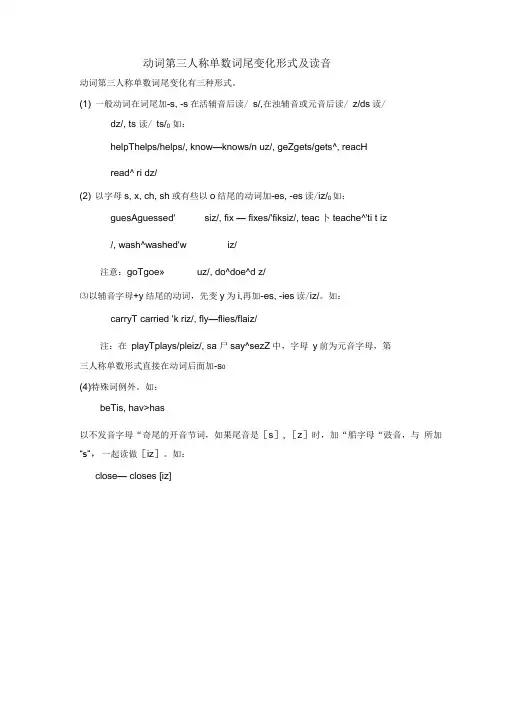
动词第三人称单数词尾变化形式及读音动词第三人称单数词尾变化有三种形式。
(1) 一般动词在词尾加-s, -s在活辅音后读/ s/,在浊辅音或元音后读/ z/ds读/dz/, ts 读/ ts/0如:helpThelps/helps/, know—knows/n uz/, geZgets/gets^, reacHread^ ri dz/(2) 以字母s, x, ch, sh或有些以o结尾的动词加-es, -es读/iz/0如:guesAguessed' siz/, fix — fixes/'fiksiz/, teac卜teache^'ti t iz/, wash^washed'w iz/注意:goTgoe»uz/, do^doe^d z/⑶以辅音字母+y结尾的动词,先变y为i,再加-es, -ies读/iz/。
如:carryT carried 'k riz/, fly—flies/flaiz/注:在playTplays/pleiz/, sa尸say^sezZ中,字母y前为元音字母,第三人称单数形式直接在动词后面加-s0(4)特殊词例外。
如:beTis, hav>has以不发音字母“奇尾的开音节词,如果尾音是[s], [z]时,加“船字母“豉音,与所加“s”,一起读做[iz]。
如:close— closes [iz]规则动词和不规则动词的过去式变化如下:一般情况下,动词词尾加-ed ,如:work — worked piay— played want--wanted act--acted以不发音的-e结尾动词,动词词尾加-d,如:live--lived move--moved decide--decided decline-declined hope--hoped judge— judged raise--raised wipe--wiped以辅音字母+ y结尾的动词,把-y变为-i再加-ed ,如:study--studied try--tried copy--copied justify--justified cry--criedcarry--carried embody--embodied empty--emptied以一个辅音字母结尾的重读闭音节动词,双写词尾辅音字母,再加-ed ,如:stop--stopped beg--begged fret--fretted drag--dragged drop— dropped plan--planned dot--dotted drip--dripped注:不规则动词的过去式变化规律性不强,须多加记忆。
第三人称单数主语的六种形式

第三人称单数主语的六种形式大家都知道,在一般现在时中,当主语是第三人称单数时,谓语动词要用第三人称单数形式,即常在动词原形后加-s或-es.但有些同学们对于哪些主语是第三人称单数还不十分清楚,现归纳总结如下:一、人称代词he, she, it是第三人称单数.如:He likes watching TV. 他喜欢看电视.She has lunch at twelve. 她十二点吃午餐.It looks like a cat. 它看起来像只猫.二、单个人名、地名或称呼作主语;是第三人称单数.如:①Han Mei looks like her mother. 韩梅看起来像她的母亲.②Beijing is in China. 北京在中国.③Uncle Wang often makes cakes. 王叔叔经常做蛋糕.三、单数可数名词或"this / that / the+单数可数名词"作主语时,是第三人称单数.如:①A horse is a useful animal. 马是有用的动物.②This book is yours. 这本书是你的.③That car is red. 那辆小汽车是红色的.④The cat is Lucy's. 这只猫是露茜的.四、不定代词someone, somebody, nobody, everything, something等及指示代词this, that作主语时,是第三人称单数.如:①Everyone is here. 大家到齐了.②There is something wrong with the watch. 这块手表有毛病.③This is a pen. 这是一支钢笔.④That is an eraser. 那是一块橡皮擦.五、不可数名词作主语时为第三人称单数.如:①The milk is in the glass. 牛奶在玻璃杯里.②The bread is very small. 那面包很小.六、当数字或字母作主语时,看作第三人称单数.如:①"6" is a lucky number. "6"是个吉利数字.②"I" is a letter. "I"是个字母.。
第三人称单数形式

是英语中的一种语法,也称“”或“单三”,用于一般现在时的句子,当动词在第三人称后时:首先,咱们要搞清楚、、各是什么。
就是“”和“”。
是“”和“”。
第三人称单数是“”、“”和“”,复数则是“”、“”和“”。
在一般现在时中,当主语是第三人称单数时,动词要用第三人称单数形式,即常在动词原形后加-s或-es。
下面我们归纳一下第三人称单数的用法:一、人称代词he,she,it是。
如:HelikeswatchingTV.他喜欢看电视。
Shehaslunchattwelve.她十二点吃午餐。
Itlookslikeacat.它看起来像只猫。
二、单个人名、地名或称呼作;是第三人称单数。
如:①HanMeilookslikehermother.韩梅看起来像她的母亲。
②BeijingisinChina.北京在中国。
③UncleWangoftenmakescakes.王叔叔经常做蛋糕。
三、单数可数名词或"this/that/the+单数可数名词"作主语时,是第三人称单数。
如:①Ahorseisausefulanimal.马是有用的动物。
②Thisbookisyours.这本书是你的。
③Thatcarisred.那辆小汽车是红色的。
④ThecatisLucy's.这只猫是露茜的。
四、不定代词someone,somebody,nobody,everything,something等及指示代词this,that作主语时,是第三人称单数。
如:①Everyoneishere.大家到齐了。
②Thereissomethingwrongwiththewatch.这块手表有毛病。
③Thisisapen.这是一支钢笔。
④Thatisaneraser.那是一块橡皮擦。
五、不可数名词作主语时为第三人称单数。
如:①Themilkisintheglass.牛奶在玻璃杯里。
②Thebreadisverysmall.那面包很小。
第三人称单数形式

五、不定代词someone, somebody, nobody, everything, something等及指示代词this, that作主语时,是第三人称单数。
①Everyone is here. 大家到齐了。
②There is something wrong with the watch. 这块手表有毛病。
③This is a pen. 这是一支钢笔。
④That is an eraser. 那是一块橡皮擦。
六、当数字或字母作主语时,看作第三人称单数。
1.把下列动词变为第三人称单数形式。
clean—go-- have-- do-- play-- fly— see— teach-- watch-- study-- ask-- answer-- swim-- catch- write-- eat-- make-- draw-- learn-- phone-- write-- like-- sing-- pick--2.选出正确的答案.1. She (like / likes) to play football.2. He (like / likes) drinking milk.3. I (like / likes) to watch TV.4. We (like / likes) to play badminton.5. They (like / likes) to sing songs.6. She (read / reads) books every day.7. He (play / plays) computer games every day.8. It (listen / listens) to the radio every day.9. Linda (draw / draws) pictures every day.10. Jane and Linda (play / plays) football every day.练习一、将括号里动词的适当形式填入横线上。
第三人称单数形式

二. 哪些主语 是第三人称单 数
1.人称代词he, she, it是第三人称 单数. 1).He likes watching TV. 他喜欢看电视. 2).She has lunch at twelve. 他十二点吃午餐. 3). It looks like a cat. 它看起来象只猫.
2. 单个人名.地名或称呼作主语时, 是第三人称单数形式.如: 1).Han Mei looks like her mother.韩梅看起来像她的母亲. 2).Beijing is in China. 北京在中 国. 3). Uncle Wang often makes cakes.王叔叔经常做蛋糕.
is
5. The tiger____ is (be) a dangerous animal. 6. Shanghai_______ (be) is a modern city. knows 7. Everybody_____ (know) Jay Chou. is (be) my 8. This_____ new pen pal.
语法新课堂
何谓第三人称单数形 式来自一.第三人称单数 形式的词尾变化.
在一般现在时中, 当主 语是第三人称单数形 式时,行为动词用第三 人称单数形式,即加-s 或 –es. 具体方法如 下:
1.一般情况下,直接加 -s.如: work---works play---plays rain---rains see---sees
4.someone, somebody, nobody, everything, something等不定代词及指示 代词this, that作主语时,是第 三人称单数.如: 1).Everyone is here.大家到齐 了. 2)This is a pen.这是一支钢笔. 3).That is an eraser.那是一
第三人称单数

最新版整理ppt
5
do my homework drink coffee go to bed watch TV
have lunch get up
buy food fly study come back home
does my homework drinks coffee goes to bed watches TV
6. She is going to write a letter. ___A_l_e_tt_e_r_i_s_g_o_in_g__to__b_e_w__ri_t_te_n_ by her.
最新版整理ppt
29
1. If city noises __A__ from increasing,people ____ shout
3. Mr Turner gave me a birthday present. __I _w_a_s_g_i_v_e_n_____a birthday present by Mr Turner.
5. You may hand in your homework tomorrow. __Y_o_u_r__h_o_m_e_w_o_r_k__m_a_y__b_e_h_a_n_d_e_d_i_n_ by you tomorrow.
最新版整理ppt
8
6.How _____it feel? A.does B.do C.are D.is 7.Mike______not like his bike. A.do B.is C.does D.are 8.He ______apples. A.likes B.like C.does D.are 9.He_______with his nose. A.smelling B.smells C.smell D.is smell 10.Lucy_______with her hands. A.touch B.touching C.touches D.touchs
第三人称单数形式
第三人称单数形式第三人称单数是英语中的一种语法,也称“三单”或“单三”,用于一般现在时的句子,当动词在第三人称后时:情况方法示例一般情况+s let-lets;get-gets以s、x、ch、sh和o结尾+es pass-passes;fix-fixes;watch-watches;teach-teaches wash-washes;go-goes;do-does以辅音字母+y结尾变y为i +es study—--studies 以元音字母+y结尾直接+s play-----plays特殊情况不规则have—--has be—--is首先,咱们要搞清楚第一、第二、第三人称各是什么。
第一人称就是“我”和“我们”。
第二人称是“你”和“你们”。
第三人称单数是“他”、“她”和“它”,复数则是“他们”、“她们”和“它们”。
在一般现在时中,当主语是第三人称单数时,谓语动词要用第三人称单数形式,即常在动词原形后加-s或-es。
下面我们归纳一下第三人称单数的用法:一、人称代词he, she, it是第三人称单数。
如:He likes watching TV. 他喜欢看电视。
She has lunch at twelve. 她十二点吃午餐。
It looks like a cat. 它看起来像只猫。
二、单个人名、地名或称呼作主语;是第三人称单数。
如:①Han Mei looks like her mother. 韩梅看起来像她的母亲。
②Beijing is in China. 北京在中国。
③Uncle Wang often makes cakes. 王叔叔经常做蛋糕。
三、单数可数名词或"this/that/the+单数可数名词"作主语时,是第三人称单数。
如:①A horse is a useful animal. 马是有用的动物。
②This book is yours. 这本书是你的。
③That car is red. 那辆小汽车是红色的。
动词第三人称单数词尾变化形式及读音
动词第三人称单数词尾变化形式及读音动词第三人称单数词尾变化有三种形式。
(1)一般动词在词尾加-s,-s在清辅音后读/s/,在浊辅音或元音后读/z/ds读/dz/,ts读/ts/。
如:help→helps/helps/,know→knows/n☜uz/,get→gets/gets/,read→reads/ri dz /(2)以字母s,x,ch,sh或有些以o结尾的动词加-es,-es读/iz/。
如:guess→guesses/'♑✌siz/,fix→fixes/'fiksiz/,teach→teaches/'ti t☞iz/,wash→washes/'w ☞iz/注意:go→goes/♑☜uz/,do→does/d✈z/(3)以辅音字母+y结尾的动词,先变y为i,再加-es,-ies读/iz/。
如:carry→carries/'k✌riz/,fly→flies/flaiz/注:在play→plays/pleiz/,say→says/sez/中,字母y前为元音字母,第三人称单数形式直接在动词后面加-s。
(4)特殊词例外。
如:be→is,have→has以不发音字母“e”结尾的开音节词,如果尾音是[s],[z]时,加“s”后字母“e”发音,与所加“s” ,一起读做[iz]。
如:close-closes [iz]规则动词和不规则动词的过去式变化如下:一般情况下,动词词尾加-ed ,如:work—worked piay—played want--wanted act--acted以不发音的-e 结尾动词,动词词尾加-d,如:live--lived move--moved decide--decided decline--declined hope--hoped judge—judged raise--raised wipe--wiped以辅音字母+ y结尾的动词,把-y变为-i 再加-ed,如:study--studied try--tried copy--copied justify--justified cry--criedcarry--carried embody--embodied empty--emptied以一个辅音字母结尾的重读闭音节动词,双写词尾辅音字母,再加-ed,如:stop--stopped beg--begged fret--fretted drag--dragged drop—dropped plan--planned dot--dotted drip--dripped注:不规则动词的过去式变化规律性不强,须多加记忆。
第三人称单数be动词
第三人称单数be动词
摘要:
1.概述第三人称单数be 动词的用法
2.第三人称单数be 动词的形式变化
3.第三人称单数be 动词的例句
正文:
第三人称单数be 动词是英语语法中的一个重要概念,它用于表示某人或某物的存在或状态。
在英语中,be 动词有很多种形式,其中第三人称单数形式是最常用的。
第三人称单数be 动词的形式变化如下:
- 一般现在时:is
- 一般过去时:was
- 一般将来时:will be
- 现在进行时:is being
- 过去进行时:was being
- 将来进行时:will be being
下面是第三人称单数be 动词的一些例句:
- 一般现在时:He is a student.(他是一名学生。
)
- 一般过去时:She was a teacher.(她曾经是一名教师。
)
- 一般将来时:They will be parents.(他们将来会成为父母。
)
- 现在进行时:He is being operated on.(他正在接受手术。
)
- 过去进行时:She was being interviewed.(她正在接受采访。
)
- 将来进行时:We will be traveling in Europe.(我们将要去欧洲旅行。
)
总之,第三人称单数be 动词在英语中扮演着至关重要的角色,它是构建句子的基础。
单词第三人称单数形式变化规则
单词第三人称单数形式变化规则
英语中,动词的第三人称单数形式与其他形式有所不同。
以下是第三人称单数形式变化的规则:
1. 如果动词以辅音字母加y结尾,将y变为i,再加上-es。
例如:study(学习)的第三人称单数形式为studies(学习)。
2. 如果动词以“s, x, ch, sh”结尾,加上-es。
例如:pass (通过)的第三人称单数形式为passes(通过)。
3. 如果动词以元音字母加y结尾,直接加上-s。
例如:play(玩)的第三人称单数形式为plays(玩)。
4. 如果动词以辅音字母加o结尾,加上-es。
例如:go(去)的第三人称单数形式为goes(去)。
5. 对于大多数动词,直接加上-s。
例如:walk(走)的第三人
称单数形式为walks(走)。
需要注意的是,有些动词的第三人称单数形式会有不规则变化,例如:be(是)的第三人称单数形式为is(是),have(有)的第三人称单数形式为has(有)。
掌握这些规则和不规则变化,可以帮助我们更好地理解英语语法,提高英语写作和口语表达的能力。
- 1 -。