
(完整版)中国民俗-二十四节气英文介绍
段落翻译
B-中国民俗-二十四节气-渊源-4
中文:
二十四节气(the Twenty-four Solar Terms)是中国古人的独特发明,它可以表示天文、季节、气候与农业生产的关系。
二十四节气的确立和中国的农业生产息息相关。
农业发展初期,由于农业生产在很大程度上受到季节变化的影响,人们开始探索自然的规律。
在这个过程中,能表示季节和气候变化的二十四节气得以形成,人们用它来指导播种和收获等农事活动。
时至今日,二十四节气仍然是用以指导农业生产不可或缺的重要工具。
语言要点:
establishment; be closely associated with; at the initial stage of; be highly subject to; come into being; to date; function as; indispensable
译文:
The Twenty-four Solar Terms show the relationship between the universe, seasons, climate and agriculture, which is a unique creation by Chinese ancestors. Its establishment was closely associated with Chinese agricultural production. At the initial stage of agricultural development, people began to explore rules of nature since agricultural production was highly subject to seasonal changes. Thus, the Twenty-four Solar Terms that can indicate the changes of seasons and climate came into being, and they were used to guide sowing, harvesting and other agricultural activities. To date, it has functioned as an indispensable tool to guide the agricultural production in China.。
中国24节气英语

中国24节气英语中国的24节气是根据太阳在黄道上的位置和地球的自转、公转等因素而定的,反映了气候、物候等方面的变化。
以下是中国24节气的英文翻译:立春 (Lì Chūn) - Beginning of Spring雨水 (Yǔ Shuǐ) - Rain Water惊蛰 (Jīng Zhé) - Waking of Insects春分 (Chūn Fēn) - Spring Equinox清明 (Qīng Míng) - Clear and Bright谷雨 (Gǔ Yǔ) - Grain Rain立夏 (Lì Xià) - Beginning of Summer小满 (Xiǎo Mǎn) - Grain Buds芒种 (Máng Zhòng) - Grain in Ear夏至 (Xià Zhì) - Summer Solstice小暑 (Xiǎo Shǔ) - Minor Heat大暑 (Dà Shǔ) - Major Heat立秋 (Lì Qiū) - Beginning of Autumn处暑 (Chǔ Shǔ) - End of Heat白露 (Bái Lù) - White Dew秋分 (Qiū Fēn) - Autumn Equinox寒露 (Hán Lù) - Cold Dew霜降 (Shuāng Jiàng) - Descent of Frost立冬 (Lì Dōng) - Beginning of Winter小雪 (Xiǎo Xuě) - Minor Snow大雪 (Dà Xuě) - Major Snow冬至 (Dōng Zhì) - Winter Solstice小寒 (Xiǎo Hán) - Minor Cold大寒 (Dà Hán) - Major Cold这些节气对应了中国传统文化中的各种习俗、节庆和农事活动,是中国古老而精深的气象学体系的一部分。
24节气中英简介
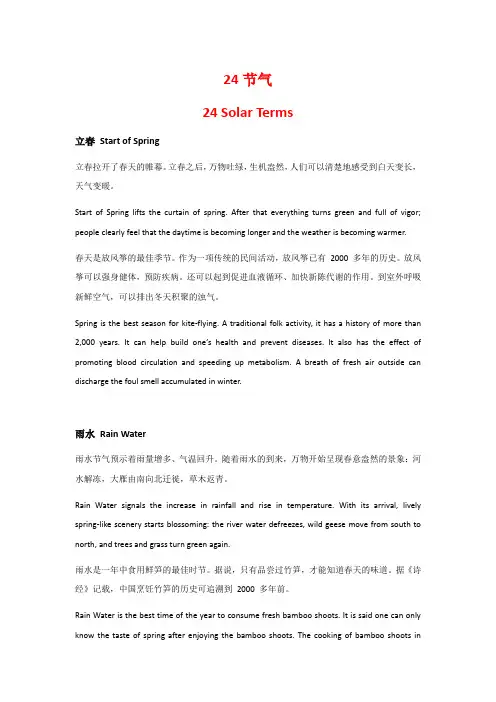
24节气24 Solar Terms立春Start of Spring立春拉开了春天的帷幕。
立春之后,万物吐绿,生机盎然,人们可以清楚地感受到白天变长,天气变暖。
Start of Spring lifts the curtain of spring. After that everything turns green and full of vigor; people clearly feel that the daytime is becoming longer and the weather is becoming warmer.春天是放风筝的最佳季节。
作为一项传统的民间活动,放风筝已有2000 多年的历史。
放风筝可以强身健体,预防疾病。
还可以起到促进血液循环、加快新陈代谢的作用。
到室外呼吸新鲜空气,可以排出冬天积聚的浊气。
Spring is the best season for kite-flying. A traditional folk activity, it has a history of more than 2,000 years. It can help build one’s health and prevent diseases. It also has the effect of promoting blood circulation and speeding up metabolism. A breath of fresh air outside can discharge the foul smell accumulated in winter.雨水Rain Water雨水节气预示着雨量增多、气温回升。
随着雨水的到来,万物开始呈现春意盎然的景象:河水解冻,大雁由南向北迁徙,草木返青。
Rain Water signals the increase in rainfall and rise in temperature. With its arrival, lively spring-like scenery starts blossoming: the river water defreezes, wild geese move from south to north, and trees and grass turn green again.雨水是一年中食用鲜笋的最佳时节。
给外国人介绍中国节气的作文英语

给外国人介绍中国节气的作文英语English: China has a rich tradition of celebrating the 24 solar terms, which are based on the sun's position in the sky. These solar terms mark the changing of seasons and have been an integral part of Chinese culture for thousands of years. Each solar term is associated with specific activities, foods, and customs that highlight the characteristics of that particular time of year. For example, the Spring Equinox is a time for planting crops and making offerings to ancestors, while the Winter Solstice is a time for eating dumplings and staying warm. The 24 solar terms not only reflect the agricultural cycle but also serve as a guide for daily life, emphasizing the importance of harmony with nature. Many Chinese people still follow these traditions today, participating in rituals and ceremonies to honor the changing seasons and ensure good luck for the coming year.Translated content: 中国有庆祝24节气的悠久传统,这些节气是根据太阳在天空中的位置而来。
24节气英语介绍 世界非物质遗产

24节气英语介绍世界非物质遗产以下是一篇关于24节气的英语介绍。
文章将逐步回答题目中的要求。
[24节气英语介绍世界非物质遗产]IntroductionChina, an ancient civilization with a rich cultural heritage, is home to various intangible cultural heritages, including the 24 solar terms, which are known as "二十四节气" (èrshísìjiéqì) in Chinese. As a significant part of Chinese traditional culture, the 24 solar terms have been recognized as a remarkable non-material cultural heritage both in China and around the world. In this article, we will explore the origins, significance, and traditions associated with these 24 solar terms.Origins and SignificanceThe origins of the 24 solar terms can be traced back to ancient China, where people observed and studied the changes in nature throughout the year. By observing the sun's position and its effects on the climate, agriculture, and animal behavior, the ancientChinese divided the year into 24 distinct solar terms. Each solar term lasts about 15 days and represents a specific astronomical event or natural phenomenon. These solar terms act as a practical and effective guide for agricultural activities, as well as serving as a cultural marker in Chinese society.The 24 Solar TermsThe 24 solar terms are divided into four seasons: Spring, Summer, Autumn, and Winter. Each season consists of six solar terms. Let's take a closer look at each of these solar terms along with the corresponding dates and their meanings.Spring Solar Terms1.立春(Lìchūn) - February 3-5: Lichun marks the beginning of spring when the weather gradually warms up, and activities such as plowing and sowing begin.2.雨水(Yǔshuǐ) - February 18-20: Yushui indicates the arrival of rain, which nourishes the soil and promotes the growth of plants.3.惊蛰(Jīngzhé) - March 5-7: Jingzhe refers to the waking of hibernating animals as the temperature continues to rise.4.春分(Chūnfēn) - March 20-22: Chunfen represents the vernal equinox when the length of day and night is equal. It symbolizes balance and harmony in nature.5.清明(Qīngmíng) - April 4-6: Qingming marks the time for people to pay respects to their ancestors, clean tombstones, and enjoy nature's beauty during the Tomb-Sweeping Day.6.谷雨(Gǔyǔ) - April 20-22: Guyu signifies the arrival of rainwater, nurturing crops and preparing for the farming season.Summer Solar Terms7.立夏(Lìxià) - May 5-7: Lixia marks the beginning of summer when the temperature rises and farming activities such as planting rice and corn start.8.小满(Xiǎomǎn) - May 20-22: Xiaoman represents the time when crops start to mature but are not yet fully ripened.9.芒种(Mángzhòng) - June 5-7: Mangzhong denotes the start of the wheat-ripening season when the crops are in full growth. 10.夏至(Xiàzhì) - June 21-22: Xiazi refers to the summer solstice, the longest day of the year. It signifies the peak of summer and the beginning of hot weather.11.小暑(Xiǎoshǔ) - July 6-8: Xiaoshu indicates that summer is in fullswing, with high temperatures and sultry weather.12.大暑(Dàshǔ) - July 22-24: Dashu represents the hottest period of the summer, and it signifies the time when crops need extra care due to scorching weather.Autumn Solar Terms13.立秋(Lìqiū) - August 7-9: Liqiu marks the beginning of autumn when the temperature starts to drop, and farmers prepare for the harvest.14.处暑(Chǔshǔ) - August 22-24: Chushu indicates that summer heat gradually dissipates, and cool autumn weather is on its way.15.白露(Báilù) - September 7-9: Bailu refers to the appearance of dew in the morning, signifying the further arrival of autumn.16.秋分(Qiūfēn) - September 22-24: Qiufen represents the autumn equinox when the length of day and night is equal once again. It serves as a reminder of the impermanence of life and the transience of seasons.17.寒露(Hánlù) - October 7-9: Hanlu signifies the arrival of colder weather with more frequent occurrences of dew, indicating that winter is approaching.18.霜降(Shuāngjiàng) - October 22-24: Shuangjiang symbolizesthe arrival of frost, marking the season when farmers start harvesting crops and preparing for winter.Winter Solar Terms19.立冬(Lìdōng) - November 7-9: Lidong represents the beginning of winter, as the temperature significantly drops, and hibernating animals start preparing for the cold.20.小雪(Xiǎoxuě) - November 22-24: Xiaoxue indicates the possibility of light snowfall, hinting at the nearing of winter.21.大雪(Dàxuě) - December 7-9: Daxue refers to heavy snowfall, suggesting the arrival of the coldest period of the year.22.冬至(Dōngzhì) - December 21-23: Dongzhi, the winter solstice, represents the shortest day and the longest night of the year. It holds great significance as it marks the turning point towards longer days and shorter nights.23.小寒(Xiǎohán) - January 5-7: Xiaohan indicates that winter is at its coldest, and people need to take extra caution to keep warm.24.大寒(Dàhán) - January 20-21: Dahan represents the coldest period of winter, signifying the imminent arrival of spring.Traditions and CelebrationsTraditional customs and celebrations are associated with each of the 24 solar terms. For example, during Qingming, people visit the graves of their ancestors, offer food and burn incense, and engage in outings to enjoy the beautiful spring scenery. During the winter solstice (Dongzhi), families gather together to make and eat "tangyuan," glutinous rice balls, symbolizing reunion and good fortune.Recognition as World Intangible Cultural HeritageIn 2016, the 24 solar terms were inscribed on the Representative List of the Intangible Cultural Heritage of Humanity by UNESCO. This recognition enhances global awareness of the importance of the 24 solar terms, not only as a unique Chinese cultural heritage but also as a valuable human heritage that promotes sustainable living in harmony with nature.ConclusionThe 24 solar terms of China carry profound cultural, agricultural, and astronomical implications, making them a remarkablenon-material cultural heritage. Each solar term represents a natural phenomenon within a specific season and guides important activities in agriculture and daily life. This cultural tradition has been celebrated for centuries and continues to be protected, preserved, and celebrated as a vital part of China's cultural heritage and the world's shared heritage.。
中国二十四节气英语介绍中国传统文化作文

中国二十四节气英语介绍中国传统文化作文The Traditional Chinese Twenty-Four Solar Terms: A Glimpse into the Rich Cultural HeritageThe ancient Chinese calendar, with its intricate system of twenty-four solar terms, offers a unique window into the profound cultural traditions of China. These solar terms, rooted in the rhythms of nature and the celestial movements, have been integral to the lives of the Chinese people for centuries, shaping their agricultural practices, festivals, and even their philosophical perspectives.At the heart of the twenty-four solar terms lies a deep understanding of the cyclical nature of the seasons and the delicate balance between Heaven and Earth. Each solar term, marked by the sun's passage through the zodiac, represents a distinct phase in the natural world, from the awakening of spring to the slumbering of winter. These transitions are not merely observed, but celebrated with reverence and rituals, reflecting the Chinese belief in the harmonious coexistence of humanity and the natural environment.One of the most prominent solar terms is the Vernal Equinox, known as Chunfen in Chinese. This event, marking the arrival of spring, iscelebrated with the Qingming Festival, a time for honoring one's ancestors and tending to their graves. The act of sweeping the tombs and leaving offerings not only pays respect to the departed but also symbolizes the renewal of life and the cyclical nature of existence.The Summer Solstice, or Xiazhi, is another significant solar term that holds deep cultural significance. During this time, the Chinese people engage in the Dragon Boat Festival, a vibrant celebration that commemorates the life and death of the poet Qu Yuan. The races of colorful dragon boats, the consumption of zongzi (glutinous rice dumplings), and the throwing of realgar wine into the water all hold profound symbolic meanings, connecting the people to their ancestral traditions and the rhythms of the natural world.As the year progresses, the solar terms continue to shape the cultural fabric of China. The Autumnal Equinox, or Qiufen, marks the arrival of the harvest season, a time of thanksgiving and reflection. Families gather to enjoy the Mid-Autumn Festival, savoring the delicate mooncakes and admiring the full moon, which is seen as a symbol of unity and harmony.The Winter Solstice, or Dongzhi, is celebrated as a time of renewal and the return of the sun. Families come together to prepare and enjoy the traditional dish of tangyuan, glutinous rice balls, whichsymbolize togetherness and the reunion of loved ones.Beyond the festivals and rituals, the twenty-four solar terms have also influenced the Chinese philosophy and approach to life. The concept of yin and yang, the delicate balance between opposing forces, is deeply intertwined with the cyclical nature of the solar terms. The understanding that change is constant, and that harmony is achieved through the embrace of both light and dark, has shaped the Chinese worldview and its approach to living in harmony with the natural world.Furthermore, the solar terms have also played a crucial role in the development of traditional Chinese medicine. The timing of certain treatments and the use of specific herbs are closely tied to the rhythms of the solar terms, reflecting the belief that the human body is intimately connected to the natural cycles of the earth.In conclusion, the twenty-four solar terms of the Chinese calendar are not merely a means of marking time but a profound expression of the country's rich cultural heritage. These intricate seasonal markers have shaped the festivals, rituals, philosophy, and even the medical practices of the Chinese people, serving as a testament to their deep reverence for the natural world and their desire to live in harmony with its rhythms. As the world increasingly grapples with the challenges of modernity, the wisdom embodied in the twenty-four solar terms offers a valuable perspective on the importance of maintaining a balanced and sustainable relationship with the environment.。
向外国留学生介绍二十四节气英语作文
向外国留学生介绍二十四节气英语作文全文共3篇示例,供读者参考篇1Introduction:The twenty-four solar terms, also known as the twenty-four seasons, have been an important part of Chinese culture and tradition for thousands of years. Each solar term is a special time that marks changes in climate, agriculture, and other natural phenomena. In this essay, I will introduce the twenty-four solar terms to foreign students studying in China.What are the twenty-four solar terms?The twenty-four solar terms are divided into four groups of six terms each. Each group represents the changes in seasons and weather over a period of six months. The twenty-four solar terms are based on the positions of the sun in relation to the earth and are used to guide agricultural activities, daily life, and health practices.The twenty-four solar terms are as follows:Spring Equinox (Chun Fen)Pure Brightness (Qing Ming) Grain Rain (Gu Yu) Beginning of Summer (Li Xia) Grain Full (Xiao Man)Grain in Ear (Mang Zhong) Summer Solstice (Xia Zhi) Slight Heat (Xiao Shu)Great Heat (Da Shu) Beginning of Autumn (Li Qiu) End of Heat (Chu Shu)White Dew (Bai Lu) Autumnal Equinox (Qiu Fen) Cold Dew (Han Lu)Frost's Descent (Shuang Jiang) Winter Solstice (Dong Zhi) Slight Cold (Xiao Han)Great Cold (Da Han)Beginning of Spring (Li Chun)Rain Water (Yu Shui)Awakening of Insects (Jing Zhe)Spring Equinox (Chun Fen)Clear and Bright (Qing Ming)Grain Rain (Gu Yu)How are the twenty-four solar terms celebrated?Each of the twenty-four solar terms is celebrated with various traditions, customs, and festivals. For example, the Spring Equinox (Chun Fen) marks the beginning of spring and is usually celebrated with outdoor activities such as picnics, kite flying, and planting trees. Grain Rain (Gu Yu) is a time for planting crops such as rice and wheat, while the Summer Solstice (Xia Zhi) is celebrated with festivals, feasts, and bonfires.Why are the twenty-four solar terms important?The twenty-four solar terms are important in Chinese culture because they reflect the harmony between humans and nature. By following the changes in the seasons and weather, people can better understand the world around them and live in harmony with nature. The twenty-four solar terms also play a crucial role inagriculture, helping farmers plan their planting, harvesting, and other farming activities.Conclusion:In conclusion, the twenty-four solar terms are an essential part of Chinese culture and tradition. By understanding the significance of each solar term, foreign students can gain a deeper appreciation for Chinese culture and the importance of living in harmony with nature. I hope this introduction to the twenty-four solar terms has been informative and inspiring for foreign students studying in China.篇2Introducing the Twenty-Four Solar Terms to International StudentsAs a traditional Chinese cultural practice dating back thousands of years, the Twenty-Four Solar Terms serve as a calendar system that divides the year into twenty-four equal segments based on the sun's position in the sky. Each solar term corresponds to a specific astronomical event or natural phenomenon, marking the changes in the climate and guiding agricultural activities. These solar terms are not only animportant part of the Chinese agricultural calendar but also an integral part of Chinese culture and daily life.The twenty-four solar terms are divided into twelve major solar terms and twelve minor solar terms. The major solar terms include Spring Begins, Spring Equinox, Pure Brightness, Summer Begins, Summer Solstice, Slight Heat, Great Heat, Autumn Begins, Autumn Equinox, Frost Descends, Winter Begins, and Winter Solstice. The minor solar terms are used to further divide the major solar terms into more specific time periods.The solar terms are closely related to various aspects of Chinese culture, such as food, festivals, and traditional Chinese medicine. For example, the Solar Term "Spring Begins" marks the beginning of spring and is associated with the Qingming Festival, a traditional Chinese festival where people pay tribute to their ancestors by visiting their graves. "Slight Heat" is the solar term that indicates the onset of summer and is known for the custom of eating mung bean soup to cool off in the hot weather.In addition to their cultural significance, the twenty-four solar terms are also deeply connected to the natural environment and the changing seasons. By paying attention to the solar terms, people can better understand and adapt to the changes in the weather, helping them to plan their agriculturalactivities and daily routines accordingly. For example, farmers rely on the solar terms to determine the best time to plant crops, harvest crops, or engage in other agricultural practices.Overall, the Twenty-Four Solar Terms are an important part of Chinese cultural heritage that reflects the wisdom and knowledge of ancient Chinese civilization. By learning about the solar terms, international students can gain a deeper understanding of Chinese culture and traditions and develop a greater appreciation for the interconnectedness of nature and human life.篇3Introduction to the 24 Solar Terms for Foreign StudentsIn China, there is a traditional way of dividing the year into 24 periods, known as the 24 solar terms. These terms are based on the position of the sun and have been used for thousands of years to guide agricultural activities, health practices, and everyday life. The 24 solar terms are a unique cultural treasure that reflects the wisdom of the ancient Chinese people and their deep connection with nature.The 24 solar terms are divided into four seasons, each consisting of six terms. The terms are based on the changes inthe sun’s position and are closely related to the climate, natural phenomena, and farming activities of each period. For example, the first term of the year is called "Lichun" or the Beginning of Spring, marking the start of the spring season when plants begin to grow and the earth wakes up from winter slumber. The second term is called "Yushui" or Rain Water, signaling the arrival of the rainy season that helps to nourish the crops.As the seasons change, so do the activities and traditions associated with each solar term. For example, the term "Qingming" or Pure Brightness in early April is a time for families to visit the graves of their ancestors and pay respects. During the Mid-Autumn Festival in the term "Chushu" or the End of Heat, people gather to admire the full moon and enjoy mooncakes together.The 24 solar terms are not only a calendar system but also a way to understand the natural world and live in harmony with it. By observing the changes in the seasons and following the advice of the solar terms, people can better plan their activities, take care of their health, and appreciate the beauty of nature.For students studying in China, learning about the 24 solar terms can provide a valuable insight into Chinese culture and traditions. By understanding the significance of each term andthe customs associated with it, foreign students can deepen their appreciation for Chinese heritage and develop a deeper connection with the local community.In conclusion, the 24 solar terms are a rich and ancient tradition that reflects the wisdom of the Chinese people and their deep connection with nature. By learning about these terms, foreign students can gain a deeper understanding of Chinese culture and tradition, as well as a greater appreciation for the beauty and complexity of the natural world. Let's cherish the 24 solar terms and continue to pass down this valuable tradition for generations to come.。
二十四节气_中英讲解
beginning of autumn.
"Autumn" is refers to the
heat to cool to, means the
立秋,是第13个 节气,每年8月7、
beginning of autumn. In the beginning of autumn,
8或9日立秋。意
buttonwood will start
agricultural production in China
二十四节气概述
节气可作两个意思理解: 一. 二十四气中的一类。从小寒起,太阳黄经每增加30°,
为另一个节气。计有小寒、立春、惊蛰、清明、立夏、芒种、 小暑、立秋、白露、寒露、立冬、大雪。称十二节气。
二. 二十四气的泛称。
分类
反映寒來暑往四季 变化
Slight heat
小暑节气,为夏季第五个 节气。小暑前后,我省大 部分地方雷暴天气增多, 雷暴是一种剧烈的天气现 象,常与短时大风、暴雨 相伴出现,有时还有冰雹, 容易造成灾害,亦须注意 预防。
Great Heat
. Is the hottest period, the highest temperature, fastest growing, most parts of the most frequent drought, waterlogging, wind and rush in the harvest busy planting, drought waterlogging drainage control stage and field management task is very heavy.
一年中第四个节气。 这时昼夜平分,从每 年3月20日(或21日) 开始至4月4日(或5 日)结束。” 天文学 上规定,春分为春季 开始。此时,中国大 部分地区的越冬 作物 进入春 季生长 阶段。
介绍二十四节气英文
竭诚为您提供优质文档/双击可除介绍二十四节气英文篇一:中国民俗-二十四节气英文介绍段落翻译b-中国民俗-二十四节气-渊源-4中文:二十四节气(theTwenty-foursolarTerms)是中国古人的独特发明,它可以表示天文、季节、气候与农业生产的关系。
二十四节气的确立和中国的农业生产息息相关。
农业发展初期,由于农业生产在很大程度上受到季节变化的影响,人们开始探索自然的规律。
在这个过程中,能表示季节和气候变化的二十四节气得以形成,人们用它来指导播种和收获等农事活动。
时至今日,二十四节气仍然是用以指导农业生产不可或缺的重要工具。
语言要点:establishment;becloselyassociatedwith;attheinitials tageof;behighlysubjectto;comeintobeing;todate;funct ionas;indispensable译文:TheTwenty-foursolarTermsshowtherelationshipbetweent heuniverse,seasons,climateandagriculture,whichisaun iquecreationbychineseancestors.Itsestablishmentwasc loselyassociatedwithchineseagriculturalproduction.A ttheinitialstageofagriculturaldevelopment,peoplebeg antoexplorerulesofnaturesinceagriculturalproduction washighlysubjecttoseasonalchanges.Thus,theTwenty-fo ursolarTermsthatcanindicatethechangesofseasonsandcl imatecameintobeing,andtheywereusedtoguidesowing,har vestingandotheragriculturalactivities.Todate,ithasf unctionedasanindispensabletooltoguidetheagricultura lproductioninchina.篇二:二十四节气的英文表达立春thebeginningofspring(1stsolarterm)雨水Rainwater(2ndsolarterm)惊蛰thewakingofInsects(3rdsolarterm)春分thespringequinox(4thsolarterm)清明purebrightness(5thsolarterm)谷雨grainRain(6thsolarterm)立夏thebeginningofsummer(7thsolarterm)小满grainFull(8thsolarterm)芒种graininear(9thsolarterm)夏至thesummersolstice(10thsolarterm)小暑slightheat(11thsolarterm)大暑greatheat(12thsolarterm)立秋thebeginningofAutumn(13thsolarterm)处暑theLimitofheat(14thsolarterm)白露whiteDew(15thsolarterm)秋分theAutumnalequinox(16thsolarterm)寒露coldDew(17thsolarterm)霜降Frost′sdescent(18thsolarterm)立冬thebeginningofwinter(19thsolarterm)小雪slightsnow(20thsolarterm)大雪greatsnow(21stsolarterm)冬至thewintersolstice(22ndsolarterm)小寒slightcold(23rdsolarterm)大寒greatcold(24thsolarterm)篇三:24节气英语词汇二十四节气二十四节气The24solarTerms 立春springbegins.雨水Therains.惊蛰Insectsawaken.春分Vernalequinox清明clearandbright.谷雨grainrain.立夏summerbegins.小满grainbuds.芒种graininear.夏至summersolstice.小暑slightheat.大暑greatheat.立秋Autumnbegins.处暑stoppingtheheat.白露whitedews.秋分Autumnequinox.寒露colddews.霜降hoar-frostfalls.立冬winterbegins.小雪Lightsnow.大雪heavysnow.冬至wintersolstice.小寒slightcold.大寒greatcold城市的常见英语词汇centreofpopulation城市city城capital首都metropolis大都市centre市中心(美作:center) shoppingcentre商业区municipality市政当局municipal市的,市政的district区residentialarea居民区,住宅区urban市区的suburb近郊区outskirts郊区slums贫民窟,贫民区shantytown贫民区village村hamlet小村hole,dump狭小破旧的住房locality所在地chinesequarter唐人街extension范围,扩展house房子building楼房skyscraper摩天楼flat居住单元,套房shop,store商店departmentstores百货公司bazaar,bazaar市场market市场,集市junkshop旧货店newsstand报摊commodityexchange商品交易所stockexchange股票交易所townhall市政厅Lawcourt法院church教堂cathedral大教堂chapel小礼拜堂cemetery墓地,公墓grave,tomb坟,墓school学校university大学library图书馆theatre剧院(美作:theater) museum博物馆zoologicalgarden动物园fairground,funfair游乐园stadium体育场generalpostoffice邮局station车站artmuseum美术馆artgallery画廊botanicalgarden植物园monument纪念碑publictelephone公共电话publiclavatory公共厕所nationalhighway国道trafficlight交通灯barracks兵营标点符号和运算符号.period句号,comma逗号:colon冒号;semicolon分号!exclamation惊叹号?questionmark问号 ̄hyphen连字符apostrophe省略号;所有格符号—dash破折号??singlequotationmarks单引号“”doublequotationmarks双引号()parentheses圆括号[]squarebrackets方括号《》Frenchquotes法文引号;书名号...ellipsis省略号¨tandemcolon双点号"ditto同上‖parallel双线号/virgule斜线号&ampersand=and~swungdash代字号section;division分节号→arrow箭号;参见号+plus加号;正号-minus减号;负号±plusorminus正负号×ismultipliedby乘号÷isdividedby除号=isequalto等于号≠isnotequalto不等于号≡isequivalentto全等于号≌isequaltoorapproximatelyequalto等于或约等于号≈isapproximatelyequalto约等于号<islessthan小于号>ismorethan大于号≮isnotlessthan不小于号≯isnotmorethan不大于号≤islessthanorequalto小于或等于号≥ismorethanorequalto大于或等于号%percent百分之…‰permill千分之…∞infinity无限大号∝variesas与…成比例√(square)root平方根∵since;because因为∴hence所以∷equals,as(proportion)等于,成比例∠angle角?semicircle半圆?circle圆○circumference圆周πpi圆周率△triangle三角形?perpendicularto垂直于∪unionof并,合集∩intersectionof交,通集∫theintegralof…的积分∑(sigma)summationof总和°degree度′minute分″second秒#number…号℃celsiussystem摄氏度@at单价。
英文版二十四节气
Grain in Beard
Jun . 5 , 6 or 7
during this period ,the wheat has been ripe , peasants should bring in the wheat as soon as possible ,after finishing the harvest of wheat ,they have to sow the rice . Yangtze River region in China will enter the rainy season .
二十四节气歌
春雨惊春清谷天, 夏满芒夏暑相连, 秋处露秋寒霜降, 冬雪雪冬小大寒。
上半年是六廿一, 下半年来八廿三,
每月两节日期定, 最多不差一二天。
(立)春 (立)夏 (立)秋 (立)冬 雨(水) 惊(蛰) (小)满 芒(种) 处(署) (白)露 (小)雪 (大)雪 春(分) 夏(至) 秋(分) 冬(至) 清(明) 谷(雨)天, (小)暑 (大)暑相连, 寒(露) 霜降, 小(寒) 大寒。
Grain Rain
Apr . 19 , 20 , or 21
Grain Rain ranks the 6th of all solar terms , it take places on Apr . 19 , 20 ,
or 21,during this period , the rainfall is increasing more and the cereal crops grow fast .
he Beginning of Spring is the first f twenty-four solar terms . it usually ns on February 3-5 every year , and ans spring is coming up , from this n , the days get longer and the her gets warmer. In addition , from ay to summer, we usually call this d the spring. besides , it's also an rtant traditional festival in china --half of the beginning of the new . so the beginning of spring is also wn as playing chun, there exists the lar custom of weaving Spring Cattle ating spring rolls and cakes on that o it has another saying of biting
24节气英文介绍短文
24节气英文介绍短文英文回答:What are the 24 Solar Terms?The 24 Solar Terms (節氣/jiéqì) are a traditional Chinese calendar system that divides the year into 24 equal parts. Each solar term marks a specific astronomical event or change in the natural world, such as the winter solstice or the beginning of spring.The 24 Solar Terms have been used for centuries in China to guide agricultural activities, festivals, and other aspects of daily life. They are based on the observation of the sun's position in the sky and the length of daylight.The 24 Solar Terms are listed below in order, withtheir English and Chinese names:Lichun (立春) Beginning of Spring. Yushui (雨水) Rain Water.Jingzhe (驚蟄) Waking of Insects. Chunfen (春分) Spring Equinox.Qingming (清明) Clear and Bright. Guyu (穀雨) Grain Rain.Lixia (立夏) Beginning of Summer. Xiaoman (小滿) Grain Filling.Mangzhong (芒種) Grain in Ear.Xiazhi (夏至) Summer Solstice.Xiaoshu (小暑) Minor Heat.Dashu (大暑) Major Heat.Liqiu (立秋) Beginning of Autumn.Chushu (處暑) End of Heat.Bailu (白露) White Dew.Qiufen (秋分) Autumn Equinox.Hanlu (寒露) Cold Dew.Shuangjiang (霜降) Descent of Frost. Lidong (立冬) Beginning of Winter. Xiaoxue (小雪) Minor Snow.Daxue (大雪) Major Snow.Dongzhi (冬至) Winter Solstice.Xiaohan (小寒) Minor Cold.Dahan (大寒) Major Cold.中文回答:什么是24节气?24节气是中国的传统历法系统,将一年划分为24个相等的部分。