
欧盟英文介绍
– elected by the peoples of the Member States
• Council of the European Union
– representing the governments of the Member States
• European Commission
European Commissioners (27)
• A college of equals
– broad participation in collective debate – Commission votes only when there’s no consensus
• are all required to swear
– “to be completely independent in the performance of their duties – “neither seek nor take instructions from any government or from any other body
European Commission
• • • • • • • • administers EU competition policies administers Common Agricultural Policy administers structural funds plays role in environmental policy plays role in R&D strategies and programs regulates workplace health and safety draws up EU budget represents EU and member states
• Former president Santer claimed that the Commission would “do less and better”
– Commission did do less, but not better
• conflict with European Parliament
– driving force, agenda setter, and executive body
European Commission
• Commission proposes EU legislation • Commission oversees and monitors implementation of EU policy
– balance of power among institutions – new institutions
• EU institutions dense and complex
– a triangle of institutions plus the court
Triangle of institutions
– transposition of EU law into national statute
• Commission is
– the guardian of the treaties – to agitate for the future of European integration
European Commission’s duties
– Parliament threatened to refuse discharge to the 1996 annual budget – entire commission resigned collectively
Council of the EU
• Co-decides with the European Parliament
– trade and economic matters – justice and home affairs – foreign and security policy
• composed of ministers empowered by member states’ government • where member states express preferences
Council of the EU
• Different councils in practice
– foreign ministers (General Affairs Council) – economics and finance ministers – agriculture ministers – multiplicity of different councils – 90 council meetings per year on average
European Commissioners (27)
• Appointed by member states for 5-year term • President nominated by the European Council • President and entire commission approved by the European Parliament • President assigns each commissioner a portfolio of precise tasks
Council of the EU
• • • • Complex decision rules: unanimity simple majority qualified majority voting (232/321)
European Union
Institutions and functions
EU institutions
• EU in stant evolution
– exercise some sovereignty – the treaties that have created it
• EU institutions in constant evolution
欧盟详细情况介绍

欧盟详细情况介绍一、欧盟简介欧洲联盟(简称欧盟,European Union -- EU)是由欧洲共同体(European communities) 发展而来的,是一个集政治实体和经济实体于一身、在世界上具有重要影响的区域一体化组织。
1991年12月,欧洲共同体马斯特里赫特首脑会议通过《欧洲联盟条约》,通称《马斯特里赫特条约》(简称《马约》)。
1993年11月1日,《马约》正式生效,欧盟正式诞生。
欧盟现有25个成员国和4.56亿人口(2004年1月),总部设在比利时首都布鲁塞尔。
25个国家分别是奥地利、比利时、塞普路斯、捷克、丹麦、爱沙尼亚、芬兰、法国、德国、希腊、匈牙利、意大利、爱尔兰、拉脱维亚、立陶宛、卢森堡、马耳他、荷兰、波兰、葡萄牙斯洛伐克、斯洛文尼亚、西班牙、瑞典、英国等再加2007年1月1日加入的保加利亚和罗马尼亚总共是27个国家。
主要五个成员国:英国、德国、法国、意大利、西班牙二、五个主要欧盟成员国:英国、德国、法国、意大利、西班牙1、英国:大不列颠及北爱尔兰联合王国(The United Kingdom of Great Britain and Northern Ireland)A\首都:伦敦(London),B\风俗:●在英国购物,最忌讳的是砍价。
英国人热爱体育,现代形式的体育运动几乎全是英国人的发明,如拳击、橄榄球、曲棍球和网球●在英国女士优先是人人皆知的行为准则●伦敦的酒吧英国街头巷尾到处都有酒吧,喝啤酒已成为伦敦人的传统习惯之一。
有的酒吧已有100多年的历史。
英国的酒吧一般装修得古色古香,有雕花的门窗、磨花的大玻璃窗面和铮亮的吧台。
酒吧已成为伦敦的一种文化●饮食英国菜比较简单,制作方式只有两种:放入烤箱烤,或者放入锅里煮。
做菜是什么调味品都不放,吃的时候在以个人爱好放些盐、胡椒或芥末、辣酱油之类。
英国的特色菜有烤牛排,炸鱼,炸马铃薯●英国的机动车都是靠左行使,和我国相反,因此无论是驾车还是行走都应注意;●英国的时间:“GMT”中文叫“格林威治时间”,它是英国的标准时间也是世界各地的参考标准。
介绍欧盟英文作文范文
介绍欧盟英文作文范文The European Union is a political and economic union of 27 member countries located primarily in Europe. It was established in the aftermath of World War II to promote peace, stability, and cooperation among European nations.The EU has its own currency, the euro, which is used by 19 of its member states. It also has its own parliament,the European Parliament, where representatives from each member country come together to make decisions on a wide range of issues.One of the main goals of the EU is to create a single market where goods, services, and people can move freely across borders. This has helped to boost trade and economic growth within the member countries.In addition to promoting economic cooperation, the EU also works to protect the environment, promote human rights, and address global challenges such as climate change andterrorism.Despite its many achievements, the EU has faced criticism from some quarters for being too bureaucratic and distant from ordinary citizens. There have also been concerns about the impact of immigration and the rise of nationalist movements in some member countries.Overall, the European Union remains an important and influential player on the global stage, working to promote peace, prosperity, and cooperation among its member states.。
欧盟ppt课件
• 中国是欧元区重要的货物贸易伙伴。19972005年间,欧元区12国与中国货物贸易额 逐年增加,尤其在进口方面。
9
欧盟和中国贸易发展对中国的影响
1.欧盟片面地视中国为国营贸易国家个非市场经济国家,对中国 制定多项歧视性贸易政策,造成双边贸易摩擦和其他贸易矛 盾。
2012年9月6日,欧盟宣布对中国光伏产品发起反倾销 立案调查,该调查涉及金额超过200亿美元,是迄今为止 欧盟对中国发起的最大规模贸易诉讼。9月11日商务部派 出副部长级的代表团前往欧盟及法国、德国就此案进行紧 急磋商,光伏产业性命攸关。(请观看视频)
欧洲联盟(英文:European Union;法文:Union
européenne),简称欧盟 (EU),总部设在比利时首都
布鲁塞尔
1
欧盟的盟旗是蓝色底上的十二星旗,普 遍说法是因为欧盟一开始只有12个国家, 代表了欧盟的开端。实际上这个十二星 旗代表的是圣母玛利亚的十二星冠,寓 意圣母玛利亚将永远保佑欧洲联盟。
2.反倾销已经成为影响中国对欧正常出口的最严重的为题之一。
具体为三个方面的倒退: ① 一是拒不接受中国有关公司就承诺提高出口价格与欧盟协商; ② 二是对被涉及到的中国有关公司按统一税率征税; ③ 三是一次方倾销,打击一大片,殃及所有的中国外贸企业。
3.歧视性数量限制和配额等阻碍了我国对欧贸易的发展。 (欧盟对来自中国的一大部分商品实施进口管制,设有数量限制、配额和
• 2009年12月1日,《里斯本条约》生效,设置新的欧洲理
事会主席、欧盟外交及安全政策高级代表。条约加入了
《基本权利宪章》以保障人权,使欧洲议会和各成员国议
欧盟发展历程以及影响

欧盟简介●英文名称:European Union(EU)●总部设在比利时首都布鲁塞尔,是由欧洲共同体(European Community,又称欧洲共同市场)发展而来的●会徽:1988年1月开始使用,会徽的底呈蓝色,上面12颗星围成圆圈,象征着欧共体12个成员国,袁泉中间为各个成员国国名●欧盟的盟歌:贝多芬第九交响曲中的《欢乐颂》●欧盟的铭言:“多元一体”●欧洲日:每年5月9日●主要经历了三个阶段:荷卢比三国经济联盟、欧洲共同体、欧盟●1992年12月,欧洲共同体马斯特里赫特首脑会议通过《欧洲联盟条约》,通称《马斯特里赫特条约》(简称《马约》)。
1993年11月1日,《马约》正式生效,欧盟正式诞生。
欧盟成立的背景和原因背景:两次世界大战给欧洲造成了一场空前的浩劫,几千万人在战火中丧生,各国人民受尽了战乱之苦。
第二次世界大战结束之后,欧洲面临两个强悍的近邻:西边是强大的美国,东边是崛起的前苏联。
美、俄的迅速强大对西欧构成了巨大威胁。
而欧洲已经脆弱到没有美国的援助便难以复苏的境地。
在这种新的国际秩序下,欧洲一批具有远见卓识的政治家认为,欧洲唯有联合才能避免重燃战火,才能在国际舞台上独立地发挥作用。
在让·莫奈看来,当时的西欧只有两种选择:不在联合中自强,就得甘心情愿当二流国家。
为此,让·莫奈提出:“为了适应世界新形势,西欧必须联合起来”,并建议组织一个“民主的、有效的机构”促进西欧各国团结,相互补充,改变西欧国家经济极度虚弱的局面。
不久,他又进一步提出在西欧“建立国际贸易、货币、安全联盟”和一系列具体设想,以应付急剧变化的世界形势。
西欧国家痛定思痛,在让·莫奈的“西欧联合”思想影响下,当时一些明智的、有远见的政治家越来越意识到西欧联合自强的重大战略意义。
原因:第一,欧洲认识到自身所处的不利地位。
战后的欧洲不再是世界舞台的主角,其位置被美国与苏联代替。
与这两个超级大国相比,欧洲是一个在军事上、政治上、经济上分割的小国集合。
一、欧盟、北美、亚太简介
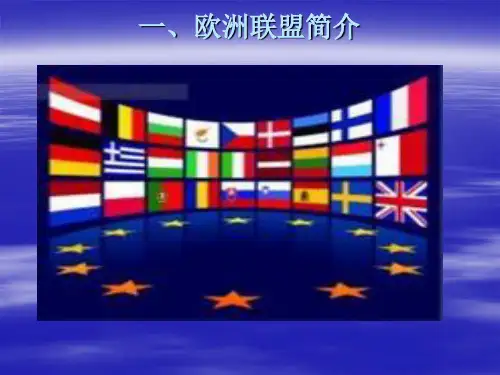
欧洲联盟(英文名称:European Union;法文 名称:Union européenne),简称欧盟(EU), 总部设在比利时首都布鲁塞尔,是由欧洲共同 体 (European Community,又称欧洲共同市 场)发展而来的,主要经历了三个阶段:荷卢 比三国经济联盟、欧洲共同体、欧盟。其实是 一个集政治实体和经济实体于一身、在世界上 具有重要影响的区域一体化组织。1991年12月, 欧洲共同体马斯特里赫特首脑会议通过《欧洲 联盟条约》 ,通称《马斯特里赫特条约》 (简称《马约》)。1993年11月1日,《马约》 正式生效,欧盟正式诞生。
发展历程
起步 关于建立北美自由贸易区的设想,最早出现 在1979年美国国会关于贸易协定的法案提议 中,1980年美国前总统里根在其总统竞选的 有关纲领中再次提出。但由于种种原因,该 设想一直未受到很大重视,直到1985年才开 始起步。
美加自由贸易区的建立 1985年3月,加拿大总理马尔罗尼在与美国总统里 根会晤时,首次正式提出美、加两国加强经济合作、 实行自由贸易的主张。由于两国经济发展水平及文 化、生活习俗相近,交通运输便利,经济上的互相 依赖程度很高,所以自1986年5月开始经过一年多 的协商与谈判于1987年10月达成了协议,次年1月2 日,双方正式签署了《美加自由贸易协定》。经美 国国会和加拿大联邦议会批准,该协定于1989年1 月生效。
1991年12月11日,欧共体马斯特里赫特首脑会 议通过了建立“欧洲经济货币联盟”和“欧洲 政治联盟”的《欧洲联盟条约》(通称马斯特 里赫特条约,简称“马约”)。1992年2月1日, 各国外长正式签署马约。经欧共体各成员国批 准,马约于1993 年11月1日正式生效,欧共体 开始向欧洲联盟过渡。1993年11月1日“马约” 正式生效,欧共体更名为欧盟。这标志着欧共 体从经济实体向经济政治实体过渡。1995年, 奥地利、瑞典和芬兰加入,使欧盟成员国扩大 到15个。欧盟成立后,经济快速发展,1995年 至2000年间经济增速达3%,人均国内生产总 值由1997年的1.9万美元上升到1999年的2.06 万美元。欧盟的经济总量从1993年的约6.7万 亿美元增长到2002年的近10万亿美元。
欧盟英文介绍【精品】

CORE
?
?
CONFIRMATION OF CORE-DOMAIN MODEL
How does it work?
• There are five EU institutions, each playing a specific role:
– European Parliament (one of two legislative bodies in the EU; elected by the peoples of the Member States) – Council of the European Union (EU’s highest Legislative Body; has legislative initiative; is made up of representatives appointed by member states according to a population-based allotment) – European Commission (EU’s executive body; one commissioner per country appointed by each government) – Court of Justice (ensures compliance with the EU laws) – Court of Auditors (manages the EU budget)
• Phases of growth
– Initially, the European Economic Community (EEC) consisted of just six countries: Belgium, Germany, France, Italy, Luxembourg and the Netherlands (1958) – European Communities (EC) (1967) – Denmark, Ireland and the United Kingdom joined in 1973 – Greece in 1981 – Spain and Portugal in 1986 – European Union (EU) (after 1992) (Maastricht Treaty) – Austria, Finland and Sweden in 1995 – Largest enlargement took place with 10 new countries joining May 9, 2004
欧盟介绍作文英语版
欧盟介绍作文英语版Title: Introduction to the European Union。
Introduction:The European Union (EU) is an economic and political union comprising 27 member states, located primarily in Europe. It traces its origins to the European Coal and Steel Community (ECSC) and the European Economic Community (EEC), formed by six countries in the 1950s. Over the decades, the EU has evolved into a unique entity, playing a significant role in global affairs. This essay aims to provide a comprehensive overview of the European Union, covering its history, institutions, policies, and significance in the contemporary world.History:The roots of the European Union can be traced back to the aftermath of World War II, when European leaders soughtto prevent future conflicts through economic integration. In 1951, the Treaty of Paris established the European Coal and Steel Community, which aimed to unify the coal andsteel industries of its member states. This initiative was followed by the signing of the Treaty of Rome in 1957, which created the European Economic Community and the European Atomic Energy Community. These treaties laid the foundation for what would eventually become the European Union.Institutions:The European Union operates through a complex system of institutions, each with its specific roles and responsibilities. The European Commission, based in Brussels, serves as the executive branch of the EU, responsible for proposing legislation and implementing EU policies. The European Parliament, consisting of directly elected representatives from each member state, acts as the legislative body, debating and voting on proposed laws. The European Council, composed of the heads of state or government of the member states, sets the EU's overallpolitical direction and priorities. Additionally, the Court of Justice of the European Union ensures the uniform interpretation and application of EU law.Policies:The European Union has developed a wide range of policies aimed at promoting economic prosperity, social cohesion, and environmental sustainability. The Common Agricultural Policy (CAP) aims to support farmers and ensure food security across the EU. The Single Market seeks to remove barriers to trade and investment, fostering economic growth and competitiveness. The EU also has policies addressing issues such as climate change, energy security, and migration, reflecting its commitment to tackling global challenges collectively.Significance:The European Union plays a crucial role in shaping the global political and economic landscape. As the world's largest single market, the EU is a major economic power,accounting for a significant share of global GDP and trade. Its common currency, the euro, is used by 19 of its member states, further enhancing its economic influence. Moreover, the EU's commitment to multilateralism and international cooperation has made it a key player in efforts to address global issues such as climate change, terrorism, and nuclear proliferation.Challenges:Despite its achievements, the European Union faces numerous challenges that threaten its unity and effectiveness. Brexit, the withdrawal of the United Kingdom from the EU, has raised questions about the bloc's future and strained relations with one of its largest members. Additionally, the EU grapples with internal divisions over issues such as migration, economic governance, and the rule of law, highlighting the complexities of governing a diverse union of sovereign states.Conclusion:In conclusion, the European Union stands as a remarkable example of regional integration and cooperation. From its humble beginnings as a coal and steel community to its current status as a global actor, the EU has achieved significant progress in promoting peace, prosperity, and solidarity among its member states. However, the challenges it faces underscore the need for continued reform and adaptation to ensure its relevance and effectiveness in the ever-changing world order. As such, the European Union remains a fascinating subject of study and debate for scholars, policymakers, and citizens alike.。
英文介绍欧盟
英文介绍欧盟The European Union (EU) is a political and economic union of 27 European countries that are located primarilyin Europe. It was established after World War II with the aim of fostering economic cooperation and preventinganother devastating conflict in Europe. The EU has its origins in the European Coal and Steel Community and the European Economic Community, which were established in the 1950s. Over the years, the EU has evolved into a unique political entity with its own institutions, laws, and currency.One of the key objectives of the EU is to promote peace, stability, and prosperity in Europe. By fostering economic cooperation among its member states, the EU has helped to create a single market where goods, services, capital, and people can move freely. This has led to increased trade and investment among member states, as well as the creation of millions of jobs. In addition, the EU has played a crucial role in promoting democracy, human rights, and the rule oflaw in Europe.The EU has its own institutions, including the European Commission, the European Parliament, the Council of the European Union, and the European Court of Justice. These institutions work together to make decisions on a wide range of issues, such as trade, agriculture, immigration, and the environment. The EU also has its own currency, the euro, which is used by 19 of its member states. The EU's common policies and regulations help to ensure a level playing field for businesses and consumers across Europe.In order to join the EU, a country must meet certain criteria known as the "Copenhagen criteria." These criteria include having a stable democracy, a functioning market economy, and the ability to adopt and implement EU laws and regulations. Once a country meets these criteria, it must negotiate a membership agreement with the EU and undergo a process of accession, which can take several years. Currently, several countries in Europe, such as Albania, North Macedonia, and Serbia, are in the process of seeking EU membership.The EU faces a number of challenges, including Brexit, the rise of populist and nationalist movements in some member states, and the ongoing refugee crisis. Brexit, the UK's decision to leave the EU, has raised questions about the future of the EU and its ability to maintain unity and solidarity among its member states. Populist andnationalist movements in countries such as Hungary, Poland, and Italy have challenged the EU's values of democracy, human rights, and the rule of law. The refugee crisis, which has seen millions of people fleeing conflict and persecution in the Middle East and Africa, has strained the EU's ability to manage migration and asylum policies.Despite these challenges, the EU remains a unique and powerful force for peace, stability, and prosperity in Europe. By working together, its member states can address common challenges and achieve common goals that would be impossible to achieve on their own. The EU's commitment to democracy, human rights, and the rule of law sets it apart as a beacon of hope and progress in an increasingly uncertain world.。
欧盟历史英文介绍【精品】
Prof. Dr. Dr. h.c Wichard Woyke
1
Which Europe?
• in post-war Europe the idea of Pan-Europa •
• • • •
(Coudenhove-Kalergi 1922/23) was heatedly discussed even the British were in favour of European Unity Churchill: United States of Europe (Zurich 1946) Congress of Europe (The Hague 1948) Unionists vs. Federalists Result: Council of Europe (1949)
2
3
4
5
European integration is closely obliged to the names Jean Monnet & Robert Schuman
Jean Monnet (1888 - 1979) • responsible for the French economic modernisation (Monnet Plan) • author of the Schuman Plan and by this „architect‟ of European Unity • assuming that integration does not follow grand logics but functional necessities • peace and prosperity only in a federal Europe
欧盟(European_Union)英文介绍
Malta Netherlands Poland Portugal Romania Slovakia Slovenia Spain Sweden
Flag
There are 12 golden stars on the flag, which is the symble of the virgin Mary. Obviously, the blue is stand for the sky. The purpose of such designing is for establishing an unified European, and enhancing people's impression of the European Union.
The history of EU
1950* — French Foreign Minister Robert Schuman proposes integrating the coal and steel industries of Western Europe.
Countries
Austria Belgium Bulgaria Croatia Cyprus Czech Republic Denmark Estonia Finland United Kingdom
France Germany Greece Hungary Ireland Italy Latvia Lithuania Luxembourg
Geography
Most of the European Union is on the European continent. The EU covers less than half of the territory of Europe, significant parts of the continent especially in the East (e.g. European Russia, Ukraine, Belarus) and smaller parts in the North and Center are not part of the EU. The member states of the EU have land borders with 19 other nations. The EU's member states cover an area of 4,423,147 square kilometres