
用发展的眼光看中国(英文)
See China in the Light of Her DevelopmentSpeech at the University of CambridgeWen JiabaoPremier of the State Council of the People's Republic of China2 February 2009Vice Chancellor Alison Richard, Ladies and Gentlemen,It gives me great pleasure to come to Cambridge, a world-renowned university that I have long wanted to visit. Cambridge has produced many great scientists and thinkers Isaac Newton, Charles Darwin and Francis Bacon, to name but a few, and made important contribution to the progress of human civilization. This year marks the 800th anniversary of the university. Please accept my warm congratulations.This is my fourth visit to your country. Despite the great distance between China and Britain, the friendly exchanges between our peoples have been on the rise. The successful resolution of the question of Hong Kong and fruitful cooperation between our two countries in areas such as economy, trade, culture, education, science and technology have cemented the foundation of our comprehensive strategic partnership. Here, I wish to pay high tribute to all those who have been working tirelessly to promote friendly ties between our two countries.The title of my speech today is "See China in the Light of Her Development".My beloved motherland is a country both old and young.She is old, because she is a big Oriental country with a civilization stretching back several thousand years. With diligence and wisdom, the Chinese nation created a splendid civilization and made significant contributions to the progress of humanity.She is young, because the People's Republic is just 60 years old, and the country began reform and opening-up only 30 years ago. The Chinese people established the New China after unremitting struggles and ultimately found a development path suited to China's national conditions through painstaking efforts. This is the path of socialism with Chinese characteristics. Following this path, our ancient civilization has been rejuvenated.The key element of China's reform and opening-up is to free people's mind and the most fundamental and significant component is institutional innovation. Through economic reform, we have built a socialist market economy, where the market plays a primary role in allocating resources under government macro-regulation. We have carried out political reform, promoted democracy and improved the legal system. People are the masters of the country. We run thecountry according to law and endeavor to build a socialist country under the rule of law.The essence of China's reform and opening-up is to put people first and meet their ever growing material and cultural needs through releasing and developing productive forces. It aims to give everyone equal opportunities for all-round development. It aims to protect the democratic rights of the people and promote stability, harmony and prosperity across the land. And it aims to safeguard the dignity and freedom of everyone so that he or she may pursue happiness with ingenuity and hard work.Over the past three decades, more than 200 million Chinese have been lifted out of poverty, the average life expectancy has increased by 5 years, and the 83 million people with disabilities in China have received special care from the government and the society. All this points to the tremendous efforts China has made to protect human rights. We have introduced free nine-year compulsory education throughout the country, established the cooperative medical system in the rural areas and improved the social safety net. The age-old dream of the Chinese nation is being turned into reality a dream to see the young educated, the sick treated and the old cared for.I want to quote from a Tang Dynasty poem to describe what is happening in China, "From shore to shore it is wide at high tide, and before fair wind a sail is lifting." The Chinese people are working hard to modernize their country. This is a great practice in a large developing country both ancient and new. The Chinese people, with destiny in their own hands, are full of confidence in their future.My beloved motherland is a country that stood numerous vicissitudes but never gave up.Earlier in my career, I worked in northwest China for many years. There, in the boundless desert, grows a rare variety of tree called euphrates poplar. Rooted over 50 meters down the ground, they thrive in hostile environments, defying droughts, sandstorms and salinization. They are known as the "hero tree", because a euphrates poplar can live for a thousand years. Even after it dies, it stands upright for a thousand years, and even after it falls, it stays intact for another thousand years. I like euphrates poplar because they symbolize the resilience of the Chinese nation.Over the millennia, the Chinese nation has weathered numerous disasters, both natural and man-made, surmounted all kinds of difficulties and challenges, and made her way to where she proudly stands today. The long sufferings have only made her a nation of fortitude and perseverance. The experience of the Chinese nation attests to a truth: what a nation loses in times of disaster will be made up for by her progress.I am reminded of the experience that I had in Wenchuan, Sichuan Province after the devastating earthquake there last May. That earthquake shocked the whole world. It flattened Beichuan Middle School and claimed many young lives. But only 10 days after the earthquake, when I went there for the second time, I had before my eyes new classrooms built on debris by local villagers with planks. Once again, the campus echoed with the sound of students reading aloud. I wrote down 4 Chinese characters on the blackboard, meaning "A country will emerge stronger from adversities."I have been to Wenchuan seven times since the earthquake and witnessed countless touching scenes like this. I am deeply moved by the unyielding spirit of my people. This great national spirit is the source of strength which has enabled the Chinese nation to emerge from all the hardships stronger than before.With hard work over the past half century and more, China has achieved great progress. Its total economic output is now one of the largest in the world. However, we remain a developing country and we are keenly aware of the big gap that we have with the developed countries. There has been no fundamental change in our basic national condition: a big population, weak economic foundation and uneven development. China's per capita GDP ranks behind 100 countries in the world and is only about 1/18 that of Britain. Those of you who have been to China as tourists must have seen the modern cities, but our rural areas are still quite backward.To basically achieve modernization by the middle of this century, we must accomplish three major tasks: first, achieve industrialization, which Europe has long completed, while keeping abreast of the latest trends of the scientific and technological revolution; second, promote economic growth while ensuring social equity and justice; and third, pursue sustainable development at home while accepting our share of international responsibilities. The journey ahead will be long and arduous, but no amount of difficulty will stop the Chinese people from marching forward. Through persistent efforts, we will reach our goal.My beloved motherland is a country that values her traditions while opening her arms to the outside world.The traditional Chinese culture is rich, extensive and profound. Harmony, the supreme value cherished in ancient China, lies at the heart of the Chinese culture. The Book of History, an ancient classic in China for example, advocates amity among people and friendly exchanges among nations.The Chinese cultural tradition values peace as the most precious. This has nurtured the broad mind of the Chinese nation. The Chinese nation is generous and tolerant, just as Mother Earth cares for all living things. She is in constant pursuit of justice, just as the eternal movement of the Universe.In the 15th century, the famous Chinese navigator Zheng He led seven maritime expeditions to the Western Seas and reached over 30countries. He took with him Chinese tea, silk and porcelain and helped local people fight pirates as he sailed along. He was truly a messenger of love and friendship.The argument that a big power is bound to seek hegemony does not apply to China. Seeking hegemony goes against China's cultural tradition as well as the will of the Chinese people. China's development harms no one and threatens no one. We shall be a peace-loving country, a country that is eager to learn from and cooperate with others. We are committed to building a harmonious world.Different countries and nations need to respect, tolerate and learn from each other's culture. Today, 300 million Chinese are learning English and over one million of our young people are studying abroad. The cultures and arts of various parts of the world are featured daily on China's television, radio and print media. Had we not learned from others through exchanges and enriched ourselves by drawing on others' experience, we would not have enjoyed today's prosperity and progress.In the 21st century, economic globalization and the information network have linked us all together. Different cultures live together and influence each other. No culture can flourish in isolation. How much a country or a nation contributes to the culture of humanity is increasingly determined by her ability to absorb foreign cultures and renew herself. That is why China will remain open and receptive, value her own traditions while drawing on others' successful experience, and achieve economic prosperity and social progress in a civilized and harmonious way.Ladies and Gentlemen,I stress the importance of seeing China in the light of her development, because the world is changing and China is changing. China is no longer the closed and backward society it was 100 years ago, or the poor and ossified society 30 years ago. Thanks to reform and opening-up, China has taken on a new look. What the Beijing Olympic Games showcased is a colorful China, both ancient and modern. I therefore encourage you to visit China more often and see more places there. This way, you will better understand what the Chinese people are thinking and doing, and what they are interested in. Y ou will get to know the true China, a country constantly developing and changing. Y ou will also better appreciate how China has been tackling the ongoing global financial crisis.This unprecedented financial crisis has inflicted a severe impact on both China and Britain as well as other European countries. The crisis has not yet hit the bottom, and it is hard to predict what further damage it may cause. To work together and tide over the difficulties has become our top priority.I believe that closer cooperation is needed to meet the global crisis, and the level of cooperation hinges upon the level of mutual trust. The Chinese Government maintains that countries should: first and foremost, run their own affairs well and refrain from shifting troubles onto others; second, carry out cooperation with full sincerity and avoid pursuing one's own interests at the expense of others; and third, address both the symptoms and the root cause of the problem. A palliative approach will not work. We should not treat only the head when the head aches, and the foot when the foot hurts. As I reiterated at the World Economic Forum Annual Meeting in Davos, necessary reform of the international monetary and financial systems should be carried out to establish a new international financial order that is fair, equitable, inclusive and well-managed. We should create an institutional environment conducive to global economic growth.Let me talk briefly about how China has been responding to the crisis.The fallout of the financial crisis on China's real economy is becoming more evident. Since the third quarter of last year, our exports have declined sharply, economic growth has slowed down, and the pressure on employment has been rising. In the face of the grim situation, we have acted decisively. We have made timely adjustment to the direction of our macroeconomic policy, promptly introduced ten measures to expand domestic demand, and formulated a series of related policies. Together, they make up a systematic and comprehensive package plan aimed at promoting steady and relatively fast economic growth. Its main contents are:First, substantially increase government spending to boost domestic demand. The Chinese Government has announced a two-year investment program that will generate, through fiscal spending, a total investment of RMB 4 trillion nationwide, equivalent to 16% of China's GDP in 2007. The money will mainly go into government-subsidized housing, projects related to the well-being of rural residents, the construction of railway and other infrastructural projects, social development programs, environmental protection and post-earthquake recovery and reconstruction. The Chinese Government has introduced a massive tax-cut program, which will reduce the tax burdens on businesses and individuals by about RMB 500 billion each year. We have also cut interest rates by a large margin, increased liquidity in the banking system and adopted a range of financial measures.Second, implement a large-scale industrial restructuring and rejuvenation program. We are pushing forward industrial restructuring and upgrading across the board and formulating plans for the restructuring and revitalization of ten key industries, including automobiles and iron and steel. We will take economic and technological measures to boost energy conservation and reduce emissions, and promote merger and reorganization of enterprises to raise the level of industry concentration and the efficiency of resource allocation. We encourage and support the extensive application of new technologies, techniques, equipment and materials and the development of marketable products by enterprises.Third, make energetic efforts for progress and innovation in science and technology. Science and technology are of fundamental importance in overcoming the financial crisis. A major crisis is usually followed by a revolution in science and technology, and no economic recovery is possible without technological innovation. We are stepping up the implementation of the National Program for Medium- and Long-Term Scientific and Technological Development, with special emphasis on 16 major projects including core electronic devices, development and use of nuclear energy and advanced numerically controlled machine tools. We will strive to make breakthroughs in a host of core technologies and key generic technologies to support sustainable economic growth at a higher level. We will promote the development of high-tech industrial clusters and cultivate new economic growth areas. All in all, we will rely on major breakthroughs in science and technology to foster new social demand and bring about a new round of economic boom.Fourth, significantly raise the level of social security. We will continue to increase basic pension for enterprise retirees and upgrade the standard of unemployment insurance and workers' compensation. We will raise the level of basic cost of living allowances in both urban and rural areas and welfare allowances for those rural residents without family support. We are advancingthe reform of the medical and health system and working to put in place a nationwide basic medical and health system covering both urban and rural areas within three years and achieve the goal of everyone having access to basic medical and health service. We give priority to education and are now working on the Guidelines of the National Program for Medium- and Long-Term Educational Reform and Development. We are following a more active employment policy with special emphasis on helping college graduates and migrant workers find jobs. We are endeavoring to create more jobs and lessen the impact of the financial crisis on employment. The aforementioned measures will help us boost domestic demand, readjust and reinvigorate industries, enhance the support of science and technology and strengthen social security all at the same tim e. They will stimulate consumption through increased investment, drive economic growth while improving people's livelihood and creating more jobs, and see us through current difficulties while also improving the long-term prospect of the Chinese economy. They will not only benefit China's development, but also bring enormous business opportunities to other countries, Britain included.This once-in-a-century financial crisis is truly thought-provoking. It reminds us of the need to have serious reflections on the existing economic systems and theories.For many years in the past, China practiced a highly centralized planned economy and regarded planning as being absolute. This hampered the development of productivity. The ongoing financial crisis has made it clear to us, however, that the market is not a cure-all, either. A totally laissez-faire approach will inevitably lead to economic disorder and unfair social distribution, and will eventually take its toll. A credible market-oriented reform should never set the market against government macro-regulation. The invisible hand of the market and the visible hand of government and social supervision should both act, and act vigorously. Only in this way can resources be distributed according to market rules and distributed in a reasonable, coordinated, balanced and sustainable manner.The international financial crisis once again shows how dangerous a market economy without regulation can be. Since the 1990s, some profit-driven financial institutions in economies lacking effective regulation have raised massive capital with a leverage of dozens of times. While they reaped huge profits, the world was exposed to enormous risks. This fully demonstrates that a totally unregulated market economy cannot work. We must strike a balance between financial innovation and regulation, between the financial sector and real economy, and between savings and consumption.To effectively meet the crisis, we must fully recognize the role of morality. Nothing is greater than morality. It shines even more brightly than the sun. True economic theories will never come into conflict with the highest moral and ethical standards. Instead, they should stand for justice and integrity, and contribute in an equal way to the well-being of all people, including the most vulnerable ones. Adam Smith, known as the father of modern economics, held the view in The Theory of Moral Sentiments that if the fruits of a society's economic development cannot be shared by all, it is morally unsound and risky, as it is bound to jeopardize social stability. The loss of morality is an underlying cause for the current crisis. Some people have sacrificed principle and sought profits at the expense of public interests. They have crossed the moral baseline. We shouldcall on all enterprises to take up their social responsibilities. Within the body of every businessman should flow the blood of morality.Ladies and Gentlemen,Britain is the last leg of my European trip. I have gained a deeper understanding of Europe through this visit. China-EU cooperation is now standing at a new historical starting point and I am all the more confident about the China-EU comprehensive strategic partnership. There are no outstanding issues left over from history or conflict of fundamental interests between the two sides. What we have is a solid foundation and a bright future for cooperation. As the first industrialized country, Britain has accumulated rich experience in economic development and environmental protection. We hope to learn from your experience and strengthen exchanges and cooperation with you.The future belongs to the younger generation. It is incumbent职责所在的upon you to build an even more splendid future of China-Britain relations. Here and now, I cannot but mention Dr. Joseph Needham, a Cambridge alumnus男毕业生who made important contribution to cultural exchanges between China and Britain. With his monumental masterpiece, Science and Civilization in China, he built a bridge between the two great civilizations of East and West. To honor tradition and innovation is the outstanding character of Cambridge. I hope more of you will turn your eyes to China, see my country in the light of her development, and act as ambassadors of China-Britain friendship. I believe that as long as you, the young people of China and Britain learn from each other and strive for progress hand in hand, you will add a brilliant new chapter to the annals of our relations.Thank you!。
20个建筑行业标志释义

20个建筑行业标志释义1德高置业的标识是由数条向上的箭头组成抽象的大厦图案,即表明了德高置业的行业属性,又寓意了德高人团结一致,齐头并进,共创企业辉煌。
标识下方的方形是“德”字的开头字母“D”的变形,又寓意天圆地方,也象征着一栋栋高楼大厦拔地而起。
标识主色彩采用红色,代表热情、奔放、有活力。
象征快乐与好运的红色增加了企业形象的亲和力。
同红色也代表着吉祥、富贵之意,寓意企业红红火火的发展。
标识字体为设计字体,具备独一无二的企业识别性。
为今后品牌的推广奠定了良好的基础。
2客户名称│Name:金钥匙装饰项目类别│Classification:企业标志设计行业类别│Trade:建筑业标志释义:标志整体图形是一把钥匙的形象,其中方体图形代表房子,与公司英文名称组合构成一把钥匙,寓意金钥匙装饰能开启全新家居生活,从而点明了金钥匙装饰的行业属性。
标志中的方体图形恰似房子的俯瞰图,象征着金钥匙装饰高瞻远瞩,以宏观的、综合的、发展的眼光看待人类生活空间的角度和态度。
方体图形也象征城市之窗,人类生活空间之窗,寓意金钥匙装饰能为城市生活,家居生活开启一片新天地。
标志整体钥匙的形象由公司名称的英文和方体组成,简约时尚,代表金钥匙装饰团结有力,紧密协作的团队实力,颜色为金黄色,与公司名称相符同时也代表金钥匙装饰舒适,典雅,美观,实用的装饰风格。
3深港建筑集团企业标志由“深港”的汉语拼音首字母“SG”变形而成,体现了“深港建筑集团”形象的唯一性与关联性。
由“SG”组合成一座挺拔的立体建筑物形象,使“深港建筑集团”的行业特征显而易见;同时又表达了深港建筑集团不断进取、不断发展,打造建筑业强势品牌的信心。
中国古代宇宙观有“天圆地方”之说,方型代表大地。
标志取用方型底就是代表“深港建筑集团”扎根大地、建设家园,努力成为中国最好的建筑承包商的信心和目标。
蓝色代表了理性、稳建、深邃与博大,蓝色作为“深港建筑集团”的主色,表达了深港建筑集团“和谐创新,科学管理,优质高效,筑造精品”的企业文化特征。
用发展的眼光看中国原文

By Wen Jiabao, Premier of the State Council of the People's Republic of ChinaThe title of my speech today is "See China in the Light of Her Development".My beloved motherland is a country both old and young.She is old, because she is a big Oriental country with a civilization stretching back several thousand years. With diligence and wisdom, the Chinese nation created a splendid civilization and made significant contributions to the progress of humanity.She is young, because the People's Republic is just 60 years old, and the country began reform and opening-up only 30 years ago. The Chinese people established the New China after unremitting struggles and ultimately found a development path suited to China's national conditions through painstaking efforts. This is the path of socialism with Chinese characteristics. Following this path, our ancient civilization has been rejuvenated.My beloved motherland is a country that stood numerous vicissitudes but never gave up.Over the millennia, the Chinese nation has weathered numerous disasters, both natural and man-made, surmounted all kinds of difficulties and challenges, and made her way to where she proudly stands today. The long sufferings have only made her a nation offortitude and perseverance. The experience of the Chinese nation attests to a truth: what a nation loses in times of disaster will be made up for by her progress.My beloved motherland is a country that values her traditions while opening her arms to the outside world.The traditional Chinese culture is rich, extensive and profound. Harmony, the supreme value cherished in ancient China, lies at the heart of the Chinese culture. The Book of History, an ancient classic in China for example, advocates amity among people and friendly exchanges among nations.Ladies and Gentlemen,I stress the importance of seeing China in the light of her development, because the world is changing and China is changing. China is no longer the closed and backward society it was 100 years ago, or the poor and ossified society 30 years ago. Thanks to reform and opening-up, China has taken on a new look. What the Beijing Olympic Games showcased is a colorful China, both ancient and modern. I therefore encourage you to visit China more often and see more places there. This way, you will better understand what the Chinese people are thinking and doing, and what they are interested in. You will get to know the true China, a country constantly developing and changing. You will also better appreciatehow China has been tackling the ongoing global financial crisis. Thank you!。
中式英语的表现形式和例句分析

中式英语的表现形式和例句分析一、什么是中式英语中式英语是指中国人在英语学习,日常交际和写作中因受汉语思维和文化的影响,硬套汉语规则和习惯,在英语交际中出现的不合规范英语或不合英语文化习惯的畸形英语。
从上述定义中我们不难看出,中式英语是具有中国特征的英语,是不能被以英语为母语者所接受的。
中式英语是规范英语在中国的误用,是中国英语学习者在使用英语时,受汉语思维和文化影响拼造出的与正规英语语言规则和文化习惯相悖的英语。
这是中国人在学习英语的过程中必然出现的一种语言现象。
二、中式英语的例子中国人长期在汉语环境中学习英语,缺乏真实的英语语言环境,又深受汉语思维、文化背景、表达方式的影响,常直接套用汉语规则和表达习惯。
下面就从几个方面探讨中式英语的表现形式。
(一)语音方面汉语和英语发音规则差异很大。
例如,汉语拼音中没有/θ/这个音,很多学生就借用与之相近的/s/来发/θ/的音。
比如,think和thank you,这是两个最容易出现的中国式发音的典型错误。
(二)词汇方面1.词汇误用英语中的一些词有与之相近的汉语意思,但适用于不同的情况和语境中,常犯的错误是只记住了单词的中文意思,没有考虑单词的具体使用方法和语境,只是机械地对应英汉翻译,因此导致了出现中式英语现象。
例1:I am watching a book.例2:Tomorrow I will look a movie.例1和例2中“watch”和“look”都有看的意思,但他们使用的语境各不相同,规范的英语应该是“reading a book”和“watch a movie”。
与这类错误相似的还有“speak,say,talk”的误用,如“Can you sayChinese?”。
2.词汇冗余汉语表达中经常会使用同义词或近义词来强调所说内容和语气,而英语则尽量避免重复,强调简洁明了。
常犯的错误是按照汉语思维逐字翻译,从而出现中式英语。
例1:His body is healthy.例2:My name is called Peter.例1和例2的两个句子作为中国人来看,不难理解,因为这两句话的表达与汉语思维完全一致,但是作为英语人士来看的话,两个句子都犯了累赘的错误,与英文的表达习惯不相符。
100本最棒的幼儿绘本推荐
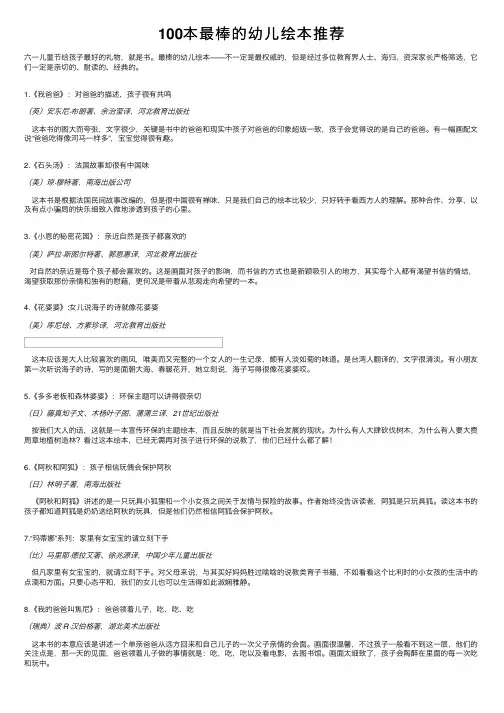
100本最棒的幼⼉绘本推荐六⼀⼉童节给孩⼦最好的礼物,就是书。
最棒的幼⼉绘本——不⼀定是最权威的,但是经过多位教育界⼈⼠、海归、资深家长严格筛选,它们⼀定是亲切的、耐读的、经典的。
1.《我爸爸》:对爸爸的描述,孩⼦很有共鸣(英)安东尼·布朗著、余治莹译,河北教育出版社这本书的图⼤⽽夸张,⽂字很少,关键是书中的爸爸和现实中孩⼦对爸爸的印象超级⼀致,孩⼦会觉得说的是⾃⼰的爸爸。
有⼀幅画配⽂说“爸爸吃得像河马⼀样多”,宝宝觉得很有趣。
2.《⽯头汤》:法国故事却很有中国味(美〕琼·穆特著,南海出版公司这本书是根据法国民间故事改编的,但是很中国很有禅味,只是我们⾃⼰的绘本⽐较少,只好转⼿看西⽅⼈的理解。
那种合作、分享,以及有点⼩骗局的快乐细致⼊微地渗透到孩⼦的⼼⾥。
3.《⼩恩的秘密花园》:亲近⾃然是孩⼦都喜欢的(美)萨拉·斯图尔特著、郭恩惠译,河北教育出版社对⾃然的亲近是每个孩⼦都会喜欢的。
这是画⾯对孩⼦的影响,⽽书信的⽅式也是新颖吸引⼈的地⽅,其实每个⼈都有渴望书信的情结,渴望获取那份亲情和独有的慰藉,更何况是带着从悲观⾛向希望的⼀本。
4.《花婆婆》:⼥⼉说海⼦的诗就像花婆婆(美)库尼绘、⽅素珍译,河北教育出版社这本应该是⼤⼈⽐较喜欢的画风,唯美⽽⼜完整的⼀个⼥⼈的⼀⽣记录,颇有⼈淡如菊的味道。
是台湾⼈翻译的,⽂字很清淡。
有⼩朋友第⼀次听说海⼦的诗,写的是⾯朝⼤海、春暖花开,她⽴刻说,海⼦写得很像花婆婆哎。
5.《多多⽼板和森林婆婆》:环保主题可以讲得很亲切(⽇)藤真知⼦⽂、⽊杨叶⼦图、蒲蒲兰译,21世纪出版社按我们⼤⼈的话,这就是⼀本宣传环保的主题绘本,⽽且反映的就是当下社会发展的现状。
为什么有⼈⼤肆砍伐树⽊,为什么有⼈要⼤费周章地植树造林?看过这本绘本,已经⽆需再对孩⼦进⾏环保的说教了,他们已经什么都了解!6.《阿秋和阿狐》:孩⼦相信玩偶会保护阿秋(⽇)林明⼦著,南海出版社《阿秋和阿狐》讲述的是⼀只玩具⼩狐狸和⼀个⼩⼥孩之间关于友情与探险的故事。
产业结构演变与三次产业发展的关联度

数 据 来 源 :《中 国 统 计 年 鉴 .2009》。
2010 年第 3 期 总第 193 期
专业眼光看经济 经济眼光看中国
37
产业经济 INDUS TRIAL ECONOMY
图二 我国就业人数比例
同为止。 2.第 二 产 业 从表1数 据 可 以 看 出:1978年 我 国 第 二 产 业 占国
2002年后, 加入WTO对我国 经济 的 推 动 作 用 开 始显现,净出口大幅增加,同时国家进一步加强重化 工 业 的 发 展 , 因 此 到 2008 年 这 一 比 重 又 恢 复 到 48.6%。
从表2数据可知, 第二产业占总就业人数比重的 变化趋势基本与其占国内生产总值的比重变化趋势 相同,这也从另一方面反映了只有产业的发展才能创 造足够的就业机会。
46.2
16.5
45.8
15.1
45.9
14.4
45.1
13.7
44.8`
12.8
46.0
13.4
46.2
12.2
47.7
11.3
48.7
11.1
48.5
11.3
48.6
第三产业 23.9 21.6 21.6 22.0 21.8 22.4 24.8 28.7 29.1 29.6 30.5 32.1 31.6 33.7 34.8 33.7 33.6 32.9 32.8 34.2 36.2 37.7 39.0 40.5 41.5 41.2 40.4 40.1 40.0 40.4 40.1
3.第 三 产 业 从1978年 开 始 ,第 三 产 业 占 国 内 生 产 总 值 的 比 重 一直稳步增加到2002年的41.5%,这符 合 工 业 化 初期 到中期的特征。 但2003~2008年这一比重却一直徘徊 在40%~41%的水平, 这一现象可以从我国采取的经 济政策得到说明。 此阶段为 克 服1997年 东南 亚 金 融 危机的影响实施较多扩张性的经济政策,其中很多方 面都侧重第二产业的投资。 例如:1998年我国推出了 福利性住房改革, 极大推动了我国房地产市场的发
用发展的眼光看中国
用发展的眼光看中国使用发展的眼光来看中国,我们将会看到一个跨越了几十年的巨大进步。
这个国家不仅仅是在经济领域得到了显著的发展,还在其他领域,如科技、文化、环境和社会方面进行了积极的变革。
现如今的中国是一个不断进化、追求更好未来的国家。
首先让我们来看看中国的经济发展。
中国在过去的40多年中,在经济领域的发展一直是领先于世界的,并迅速成为了世界上最大的制造业中心。
中国逐渐从一个人口众多、贫困落后的国家转变为一个拥有庞大经济体量的国家。
自1978年中国领导人改革开放以来,中国的国内生产总值已经增长了超过18倍,这进一步加快了中国的现代化进程。
现在,中国的经济体量已经是全球第二大的,仅次于美国。
此外,中国还在可持续和绿色经济方面做出了积极努力,中央政府在去年提出了“绿色发展”的战略,以推进可持续发展。
除了经济领域,中国的科技也在发展。
中国的互联网、移动支付、电子商务和人工智能等领域已经成为了世界的领导者。
中国人民也是世界上使用移动支付最多的国家。
此外,中国的高速铁路系统是世界上最先进的,而且还在不断扩展和完善。
中国的太空探索也是一个令人瞩目的领域,中国已经成功地进行了数次太空行动,包括中国的长征五号火箭发射,和2019年成功登陆月球的嫦娥四号任务。
在文化方面,中国也在走向全球,中国艺术品、食品、电视剧等也在国际上得到了更广泛的认可和欣赏。
中国的电影产业也正在经历着一次前所未有的增长,越来越多的中国电影作品不仅仅在本国票房或中国的周边国家,而且越来越多地被全球票房所接受,如《流浪地球》和《唐人街探案》等电影。
同时,中国的文化传统也得到了新的尊重和重视,例如中国的春节,已经成为全球范围内的一个值得庆祝的重大节日。
社会方面的变革同样令人注目。
中国在减少贫困人口方面取得了巨大的成就,目前已经有九千万人摆脱贫困。
中国也在不断加强其社会安全网络,包括社会医疗保险计划和退休金制度。
此外,中国在反腐倡廉方面也有了显著的进展,努力改进公共服务、积极推动教育和文化等各个方面,以建立更加公开透明、公正公平的社会。
用发展的眼光看中国
“《用发展的眼光看中国》━━温家宝总理在剑桥大学的演讲”有感时光飞逝,转眼已经过去近三年了,但再看到这篇演讲稿,仍旧能想起温家宝总理充满激情的声音和在剑桥800年讲坛上的翩翩风度。
今天我就简单谈一谈自己对温总理这篇演讲的一些见解。
当时中国威胁论在世界上被别有用心的人炒得很盛,所以温总理这篇演讲既是对这种错误言论的回应,也是把中国今天开放的面貌展现在欧洲和世界。
开篇总理以“剑桥举世闻名,培养出牛顿、达尔文、培根等许多杰出的科学家、思想家,为人类文明进步作出了重要贡献。
今年是剑桥建校800周年,我谨致以热烈祝贺!”表示了我国人民对英国的友好态度。
总理从三方面论证自己的观点:我深深爱着的祖国——古老而又年轻;我深深爱着的祖国——历经磨难而又自强不息;我深深爱着的祖国——珍视传统而又开放兼容。
结构严谨、条理清晰、层层深入。
不仅仅说明了中国在发展、社会在进步,也表达了自己对伟大祖国的无限热爱与对祖国未来发展的坚定信心。
我对其中的几句话感慨很深:“中华民族的历史证明了一个真理:一个民族在灾难中失去的,必将从民族的进步中得到补偿。
”这句话我自从看见便牢记在了心里。
历史也确实如此,只要没有被灾难亡国灭种,那么灾难过后,为了重建家园、为了更加强大,全民族都会前赴后继不懈地努力。
最终失去多少都会在民族的进步中得以体现。
“我为我们中华民族这种愈挫愈奋的精神深深感动。
这种伟大的精神,正是我们的民族饱经忧患而愈益坚强、生生不息的力量源泉。
”汶川地震过后,举国同悲,同时我们也看到了在汶川的废墟中奔走指挥的总理,在悲痛过后坚定地重建家园的老百姓,在灾后的汶川撑起一道钢铁长城的人民子弟兵。
这样的精神正是《礼记》中所说既能像大地承载万物一样,宽厚包容;又能像苍天刚健运行一样,彰显正义的民族精神,它是民族兴旺发达的不竭动力。
时值金融危机席卷全球之际,中国在应对金融危机中显得进退自如、张弛有度。
因此,温总理特意提到了中国应对金融危机的方法,这正体现了大国的姿态。
2020年教师资格证《幼儿综合素质》真题及答案解析
2020年教师资格证《幼儿综合素质》真题及答案注意事项:1.考试时间为120分钟,满分为150分。
2.请按规定在答题卡上填涂、作答。
在试卷上作答无效,不予评分。
1.李老师与大班幼儿面对面,自由的坐在塑胶地上。
李老师对幼儿说,请你们想一个办法到老师面前来。
乐乐想到了前滚翻,动作不怎么标准,滚到了一边。
对此,李老师恰当的说法是()A.动作不标准,重新做一遍。
B.乐乐的想法真奇妙,要注意安全。
C.这样不好,会踢到旁边的小朋友。
D.乐乐真勇敢,大家要向他学习。
233网校答案:B乐乐的想法真奇妙,要注意安全。
考查教师教育行为。
2.自由活动时,幼儿三五成群的在沙坑里玩耍,只有杰杰孤零零的站在旁边,一动不动。
对此,老师恰当的做法是()A.询问杰杰不与大家玩的原因。
B.只关注其他孩子,不理会杰杰。
C.告诉杰杰可以自己一个人玩。
D.要求杰杰过去与大家一起玩。
233网校答案:A询问杰杰不与大家玩的原因。
老师行为符合面向全体的幼儿理念。
3.下列对实施素质教育的理解不正确的是()A.更加重视学生的全面发展。
B.针对基础教育提出。
C.更加重视德育工作。
D.针对提高国民素质提出。
233网校答案:B针对基础教育提出。
素质教育是针对应试教育提出的。
4.幼儿园里有的孩子活泼,有的孩子沉默,有的喜欢画画,有的喜欢唱歌。
关于导致个体差异的原因不正确的是()A.家庭教育和幼儿园教育决定了幼儿发展个体差异。
B.遗传素质的差异性对人的发展有一定的影响。
C.个体通过能动的活动选择建构自我发展。
D.环境的给定性与主体选择性相互作用。
233网校答案:A家庭教育和幼儿园教育决定了幼儿发展的个体差异。
人的主观能动性对人的身心发展起决定性作用。
5.中华人民共和国教育法第10条规定:国家根据各少数民族的特点和需要,帮助各少数民族地区发展教育事业。
国家扶持边远贫困地区发展教育事业。
接下来这条规定所体现的教育法的基本原则是()A.公益性。
B.方向性。
C.强制性。
新人教版高中英语选择性必修二Unit2 Bridging Cultures单元分析
Unit 2 BRIDGING CULTURES单元分析单元主题:人与社会单元内容分析本单元主题语境是人与社会,围绕“文化沟通与交流(Bridging cultures)”这一主题展开。
内容涵盖中国学生国外留学的经历、巴基斯坦孔子学院的情况、不同家长对出国留学利与弊的观点等。
作为青年人主体的学生既要学习世界各国的优秀文化,汲取精华,博采众长,又要积极推动中华文化走向世界,增强中华文化的国际影响力,在对外文化交流中,既要认同民族文化,坚定文化自信,又要尊重文化的多样性,学会包容其他民族文化,求同存异,和睦相处,在文化沟通和交流中肩负起文化传播和沟通的使命。
以下为教材各部分教学内容的简要分析及教学活动的实施建议:1.Opening Page 主题图展示的是国外大学课堂的场景,画面上的主体人群是不同肤色的国外青年。
出国留学是青年学生接触外国文化的一种常见方式,在海外求学的同时,留学生沟通中外文化,构架起中国与世界的桥梁,本单元的阅读语篇便是从留学生的视角切入文化沟通和交流这一主题的。
开篇页的引言“I am not the same,having seen the moon shine on the ot her side of the world.”可译为:当在世界的另一端看到月光闪耀的时候,我就不一样了。
这句话阐述了一个人在接触另一种全新的文化后的心理触动,以及自己在深入体验这一文化后产生的深刻变化,用简练又深刻的语言阐释了文化沟通与交流对个人的意义。
它能让人们开阔视野,增长见识,理解不同文化之间的差异,接受新的观念和价值观的挑战,在文化交融中学会用新的眼光看待自己的文化,更全面地理解人性和世界,从而形成更为完整的人生观和世界观。
2.Reading and Thinking 阅读语篇是一篇刊登在伦敦一所大学校报上的文章,讲述了中国商科留学生谢蕾国外的留学生活。
文章有两条线索,一条线索介绍了谢蕾初到国外时在生活和学业上遇到的种种困难和挑战,并逐渐适应新环境的经历,以及伴随这些经历所产生的一系列情感体验的变化,具体表现为:离开祖国和家人朋友飞往陌生国度时的兴奋、紧张与迷茫,与寄宿家庭相处过程中获得的安慰,听到导师提出学术要求时的困惑,在学业上取得进步后的惊喜,作报告成功后重获的信心,以及逐渐适应新生活后内心的轻松自在。
部编版必修四《8.1 文化的民族性与多样性》教案、导学案、课后练习
第八课学习借鉴外来文化的有益成果《第一框文化的民族性与多样性》教案【教学目标】(1)了解民族文化的地位、作用。
(2)理解民族文化的核心和灵魂是价值观。
(3)理解文化多样性的地位、意义和要求。
【核心素养】政治认同:认同中国特色社会主义文化,建设社会主义文化强国。
科学精神:科学把握文化多样性的地位、意义和要求。
公共参与:正确吸收和借鉴外来文化有益成果,推动中国特色社会主义文化建设。
【教学重点】:了解民族文化的地位、作用。
【教学难点】:理解文化多样性的地位、意义和要求。
【教学过程】(一)引入新课世界文化多姿多彩。
各具特色的文化,构成世界文化的多样性。
在经济全球化进程中,如何正确认识文化的民族性和多样性?如何推动不同民族文化的交流交融?正确理解这些问题,有助于我们正确吸收和借鉴外来文化有益成果,推动中国特色社会主义文化建设。
本节课我们学习文化的民族性与多样性。
(二)讲授新课文化的民族性与多样性(板书)一.文化具有民族性(板书)阅读与思考风格迥异的建筑艺术杰作遍布世界各地,展现出多姿多彩的文化特色。
不同的建筑艺术、舞蹈艺术、体育运动项目、语言文字等,承载着不同的文化内涵。
请举一两个例子加以说明。
学生回答:略。
教师总结:中国武术作为中华民族传统文化的一个有机组成部分和独特表现形式,与中国的古典哲学、政治伦理、军事思想、文化艺术、医学理论、社会习俗等相互联系、相互作用,共同组成了绚丽多姿的中国文化。
它的指导思想是中国传统的“天人合一”的哲学思想。
武术练功是把人作为一个整体来训练的,讲究“内练精气神,外练筋骨皮”“内外合一,形神兼备”。
而且,要把人放到自然中去,把人的运动同周围的环境密切联系起来。
武术练功要求按不同的季节、时辰、时令等,根据自然界和人体机能的变化,采用不同的方法,来达到练习的目的。
由于中国武术蕴含着深刻的哲学思想,具有修身养性的功效,因此,它在世界上有着广泛影响。
教师:民族文化的地位是什么?学生:民族文化是一个民族区别于其他民族的独特标识。