
ACCA考试科目内容完整介绍从F1到F7
ACCA考试科目内容完整介绍从F1到F7
本文由高顿ACCA整理发布,转载请注明出处
Foundations of Accounting in Business
To introduce knowledge and understanding of the business and its environment and the influence this has on how organisations are structured and on the role of the accounting and other key business functions in contributing to the efficient, effective and ethical management and development of an organisation and its people and systems.
(F2/FMA)Foundations of Management Accounting
To develop knowledge and understanding of providing basic management information in an organisation to support management in planning and decision- making.
(F3/FFA)Foundations of Financial Accounting
To develop knowledge and understanding of the underlying principles and concepts relating to financial accounting and technical proficiency in the use of double-entry accounting techniques including the preparation of basic financial statements.
(F4)Corporate and Business Law
To develop knowledge and skills in the understanding of the general legal framework, and of specific legal areas relating to business, recognizing the need to seek further specialist leg advice where necessary.
(F5)Performance Management
To develop knowledge and skills in the application of management accounting techniques to quantitative and qualitative information for planning, decision-making, performance evaluation, and control
(F6)Taxation (UK)
To develop knowledge and skills relating to the tax system as applicable to individuals, single companies, and groups of companies.
(F7)Financial Reporting (INT)
To develop knowledge and skills in understanding and applying accounting standards and the theoretical framework in the preparation of financial statements of entities, including groups and how to analyse and interpret those financial statements.
(F8)Audit and Assurance (INT)
To develop knowledge and understanding of the process of carrying out the assurance engagement and its application in the context of the professional regulatory framework.
(F9)Financial Management
To develop the knowledge and skills expected of a finance manager, in relation to investment, financing, and dividend policy decisions.
(P1)Governance, Risk and Ethics
To apply relevant knowledge, skills and exercise professional judgment in carrying out the role of the accountant relating to governance, internal control, compliance and the management of risk within an organisation, in the context of an overall ethical framework.
(P2)Corporate Reporting (INT)
To apply knowledge, skills and exercise professional judgement in the application and evaluation of financial reporting principles and practices in a range of business contexts and situations.
(P3)Business Analysis
To apply relevant knowledge, skills, and exercise professional judgement in assessing strategic position, determining strategic choice, and implementing strategic action through beneficial business process and structural change; coordinating knowledge systems and information technology and by effectively managing processes projects, and people within financial and other resource constraints.
(P4)Advanced Financial Management
To apply relevant knowledge, skills and exercise professional judgement as expected of a senior financial executive or advisor, in taking or recommending decisions relating to the financial management of an organisation.
(P5)Advanced Performance Management
To apply relevant knowledge, skills and exercise professional judgement in selecting and applying strategic management accounting techniques in different business contexts and to contribute to the evaluation of the performance of an organisation and its strategic development.
(P7)Advanced Audit and Assurance (INT)
To analyse, evaluate and conclude on the assurance engagement and other audit and assurance issues in the context of best practice and current developments.
更多ACCA资讯请关注高顿ACCA官网:。
acca的简介
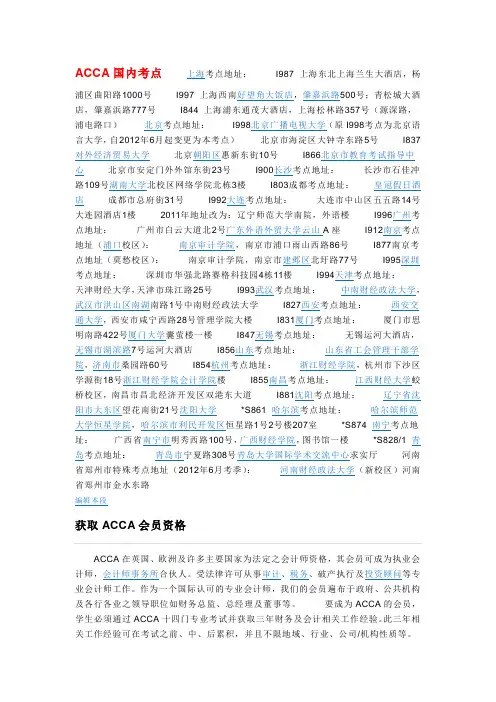
ACCA国内考点上海考点地址:I987 上海东北上海兰生大酒店,杨浦区曲阳路1000号I997 上海西南好望角大饭店,肇嘉浜路500号;青松城大酒店,肇嘉浜路777号I844 上海浦东通茂大酒店,上海松林路357号(源深路,浦电路口)北京考点地址:I998北京广播电视大学(原I998考点为北京语言大学,自2012年6月起变更为本考点)北京市海淀区大钟寺东路5号I837对外经济贸易大学北京朝阳区惠新东街10号I866北京市教育考试指导中心北京市安定门外外馆东街23号I900长沙考点地址:长沙市石佳冲路109号湖南大学北校区网络学院北栋3楼I803成都考点地址:皇冠假日酒店成都市总府街31号I992大连考点地址:大连市中山区五五路14号大连园酒店1楼2011年地址改为:辽宁师范大学南院,外语楼I996广州考点地址:广州市白云大道北2号广东外语外贸大学云山A座I912南京考点地址(浦口校区):南京审计学院,南京市浦口雨山西路86号I877南京考点地址(莫愁校区):南京审计学院,南京市建邺区北圩路77号I995深圳考点地址:深圳市华强北路赛格科技园4栋11楼I994天津考点地址:天津财经大学,天津市珠江路25号I993武汉考点地址:中南财经政法大学,武汉市洪山区南湖南路1号中南财经政法大学I827西安考点地址:西安交通大学,西安市咸宁西路28号管理学院大楼I831厦门考点地址:厦门市思明南路422号厦门大学囊萤楼一楼I847无锡考点地址:无锡运河大酒店,无锡市湖滨路7号运河大酒店I856山东考点地址:山东省工会管理干部学院,济南市桑园路60号I854杭州考点地址:浙江财经学院,杭州市下沙区学源街18号浙江财经学院会计学院楼I855南昌考点地址:江西财经大学蛟桥校区,南昌市昌北经济开发区双港东大道I881沈阳考点地址:辽宁省沈阳市大东区望花南街21号沈阳大学*S861 哈尔滨考点地址:哈尔滨师范大学恒星学院,哈尔滨市利民开发区恒星路1号2号楼207室*S874 南宁考点地址:广西省南宁市明秀西路100号,广西财经学院,图书馆一楼*S828/1 青岛考点地址:青岛市宁夏路308号青岛大学国际学术交流中心求实厅河南省郑州市特殊考点地址(2012年6月考季):河南财经政法大学(新校区)河南省郑州市金水东路编辑本段获取ACCA会员资格ACCA在英国、欧洲及许多主要国家为法定之会计师资格,其会员可成为执业会计师,会计师事务所合伙人。
2019年ACCA考试科目及内容

2019年ACCA考试科目及内容第一部分为基础阶段,主要分为知识课程和技能课程两个部分。
知识课程主要涉及财务会计和管理会计方面的核心知识,也为接下去实行技能阶段的详细学习搭建了一个平台。
知识课程的三个科目同时也是FIA方式注册学员所学习的FAB、FMA、FFA三个科目。
技能课程共有六门课程,广泛的涵盖了一名会计师所涉及的知识领域及必须掌握的技能。
具体课程为:第二部分为专业阶段,主要分为核心课程和选修(四选二)课程。
该阶段的课程相当于硕士阶段的课程难度,是对第一部分课程的引申和发展。
该阶段课程引入了作为未来的高级会计师所必须的更高级的职业技能和知识技能。
选修课程为从事高级管理咨询或顾问职业的学员,设计了解决更高级和更复杂的问题的技能。
具体课程为:所有学生必须完成三门核心课程。
ACCA科目内容介绍(中文版)基础阶段:知识课程F1会计师与企业F1《会计师与企业》是P1《公司治理,风险管理与职业道德》和P3《商务分析》的基础。
涵盖:企业组织,公司管理,会计和报告体系,内部财务控制,人力资源管理,会计职业道德您将会学到:企业是如何运作的,会计师和审计师在企业中的作用,如何使用科学的人力资源管理方式,如何使企业和财务的各个环节的处理符合职业道德和价值观。
F2管理会计F2《管理会计》是F5《业绩管理》和P5《高级业绩管理》的基础。
涵盖:管理会计,管理信息,成本会计,预算和标准成本,业绩衡量,短期决策方法。
您将会学到:如何使学员能够处理基本的成本信息,并能向管理层提供能用作预算和决策的信息。
F3财务会计F3《财务会计》是F7《财务报告》和P2《公司报告》的基础。
涵盖:财务会计,财务信息,复式记账法,会计系统,试算平衡表,业务交易,会计事项的记录以及合并报表基础知识。
您将会学到:如何利用财务会计相关的原则和概念,使用复式记账法,编制基本的财务报表。
基础阶段:技能课程F4公司法与商法F4《公司法》与F7《财务报告》、F8《审计与认证业务》、P1《公司治理,风险管理与职业道德》、P2《公司报告》都有着一定的联系。
ACCA-F7-知识点总结

ACCA考试F7知识点辅导I. The accounting problemBefore IAS37 provisions were recognized on the basis of prudence,little guidance was given on when a provision should be recognized and how it should be measured. This gave rise to inconsistencies,and also allowed profits to be manipulated.Some problems are noted below:(a) Provisions could be recognized on the basis of management intentions,rather than on any obligation to be entity;(b) Several items could be combined into one large provision. There were known as ‘big bath’ provisions;(c) A provision could be created for one purpose and then used for another;(d) Poor disclosure made it difficult to assess the effect of provisions on reported profits. In particular,provisions could be created when profits were high and released when profits were low in order to smooth profits.(1) DefinitionsIAS 37 views a provision as a liability.A provision is a liability of uncertainty timing or amount;A liability is an obligation of an enterprise to transfer economic benefits as a result of past transactions or events.Provision must be based on obligations,not management intentions.(2) Under IAS37, a provision should be recognized:a. When an enterprise has a present obligation;b. It is probable that a transfer of economic benefits will be required to settle it;c. A reliable estimate can be made of its amount; if a reasonable estimate cannot be made,then the nature of the provision and the uncertainties relating to the amount and timing of the cash flows should be disclosed.A provision is made for something which will probably happen. It should be recognizedwhen it is probable that a transfer of economic events will take place and when its amount can be estimated reliably.(3) Contingent liabilitiesDefinitionThe Standard defines a contingent liability as:(a) A possible obligation that arises from past events and whose existence will be confirmed only by the occurrence or non-occurrence of one or more uncertain future events not wholly within the control of the enterprise; or(b) A present obligation that arises from past events but is not recognized because:(i) It is not probable that an outflow of resources embodying economic benefits will be required to settle the obligation; or(ii) The amount of the obligation cannot be measured with sufficient reliability.As a rule of thumb,probable means more than 50% likely. If an obligation is probable,it is not a contingent liability – instead,a provision is needed.Treatment of contingent liabilitiesContingent liabilities should not be recognized in financial statements but they should be disclosed. The required disclosures are:(a) A brief description of the nature of the contingent liability;(b) An estimate of its financial effect;(c) An indication of the uncertainties that exist;(d) The possibility of any reimbursement;(4) Contingent assetsDefinitionA possible asset that arises from the past events whose existence will be confirmed by the occurrence of one or more uncertain future events not wholly within the enterprise’s control.A contingent asset must not be recognized. Only when the realization of the relatedeconomic benefits is virtually certain should recognition take place. At that point,the asset is no longer a contingent asset.Disclosure:contingent assetsContingent assets must only be disclosed in the notes if they are probable. In that case a brief description of the contingent asset should be provided along with an estimate of its likely financial effect.II. Specific application1. Future operating lossesIn the past,provisions were recognized for future operating losses on the grounds of prudence. However these should not be provided for the following reasons.①They relate to future events;②There is no obligation to a third party. The loss-making business could be closed and the losses avoided.2. Onerous contractsAn onerous contract is a contract in which the unavoidable costs of meeting the contract exceed the economic benefits expected to be received under it.A common example of an onerous contract is a lease on a surplus factory. The leaseholder is legally obliged to carry on paying the rent on the factory,but they will not get any benefit from using the factory.The least net cost of an onerous contract should be recognized as a provision. The least net cost is the lower of the cost of fulfilling the contract or of terminating it and suffering any penalty payments.Some assets may have been bought specifically for the onerous contract. These should be reviewed for impairment before any separate provision is made for the contract itself.1DemoDroopers has recently bought all of the trade,assets and liabilities of Dolittle,an unincorporatd business. As part of the take-over all of the combined business’s activities have been relocated at Droopers main site. As a result Dolittle’s premises are now empty and surplus to requirements.However,just before the acquisition Dolittle had signed a three year lease for their premises at $6000 per calendar month. At 31 December 2003 this lease ad 32 months left to run and the landlord had refused to terminate the lease. A sub-tenant had taken over part of the premises for the rest of the lease at a rent of $2500 per calendar month.Required(a) Should Droopers recognized a provision for an onerous contract in respect of this lease?(b) Show how this information will be presented in the financial statements for 2003 and 2004. Ignore the time value of money.Solution:Droopers has a legal obligation to pay a further $192000 to the landlord,as a result of a lease signed before the year end. Therefore an onerous contract exists and must be provided for.There is also an amount recoverable form the sub-tenant of $80000(32×2500). This will be shown separately in the balance sheet as an asset.The $192000 payable and the $80000 recoverable can be netted off in the income statement.income statements20032004$$provision for onerous lease contract(net)112000 Dr.net rental payable on lease (72-30)-42000 Drrelease of provision42000 Cr112000 Dr.balance sheetsreceivalbesamounts recoverable from sub-tenants80000 Dr.50000 Drliabilitiesamounts payable on onerous contracts192000 Cr120000 Cr3. RestructuringA restructuring is a programme that is planned and controlled by management and has a material effect on:①The scope of a business undertaken by the reporting entity in terms of the products or services it provides; or②The manner in which a business undertaken by the reporting entity is conducted;Restructuring includes terminating a line of business,closure of business locations,changes in management structure,and refocusing a business’s operations.Restructuring provisions have always been quite common,and have often been misused. IAS37 restricts the recognition of restructuring provisions to situations where an entity has a constructive obligation to restructure.A constructive obligation will only arise if:①There is a detailed formal plan for restructuring. This must identify the businesses,locations and employees affected; and②Those affected have a valid expectation that the restructuring will be carried out. This can be by starting to implement the plan or by announcing it to those affected.The constructive obligation must exist at the year-end.(Any obligation arising after the year end may require disclosure under IAS10)A board decision alone will not create a constructive obligation unless:①The plan is already being implemented. For example,assets are being sold,redundancy negotiations have begun; or②The plan has been announced to those affected by it. The plan must have a strict timeframe without unreasonable delays; or③The Board itself contains representatives of employees or other groups affected by the decision.(This is common in mainland Europe.)An announcement to sell an operation will not create a constructive obligation. An obligation will only arise when a purchaser is found and there is a binding sale agreement.A restructuring provision should only include the direct costs of restructuring. These must be both:(a) Necessarily entailed by the restructuring; and(b) Not associated with the ongoing activities of the entity;The following costs must not be provided for because they relate to future events:(a) Retaining or relocating staff;(b) Marketing;(c) Investment in new systems and distribution networks;(d) Future operating losses (unless arising from an onerous contract)(e) Profits on disposal of assets.cca f7真题对于acca f7的考试的重要性我相信各位acca考生都心知肚明了,首先我们先看一下acca f7科目的考试内容ACCA F7科目介绍:F7《财务报告》是F3《财务会计》的后续课程或说是升级课程。
acca各科考试大纲
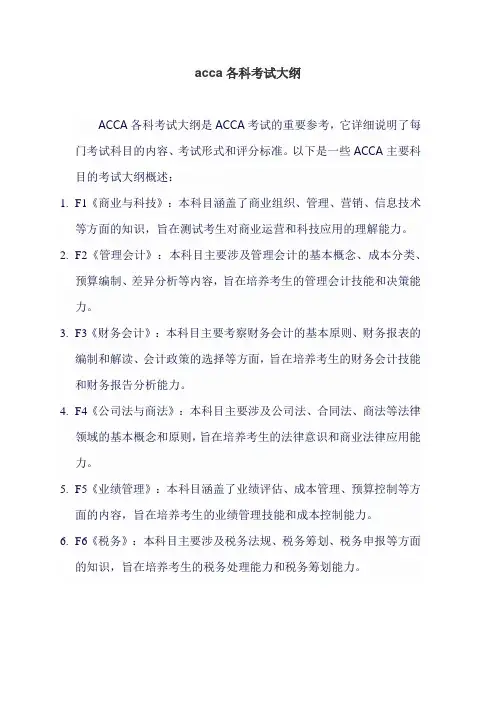
acca各科考试大纲ACCA各科考试大纲是ACCA考试的重要参考,它详细说明了每门考试科目的内容、考试形式和评分标准。
以下是一些ACCA主要科目的考试大纲概述:1.F1《商业与科技》:本科目涵盖了商业组织、管理、营销、信息技术等方面的知识,旨在测试考生对商业运营和科技应用的理解能力。
2.F2《管理会计》:本科目主要涉及管理会计的基本概念、成本分类、预算编制、差异分析等内容,旨在培养考生的管理会计技能和决策能力。
3.F3《财务会计》:本科目主要考察财务会计的基本原则、财务报表的编制和解读、会计政策的选择等方面,旨在培养考生的财务会计技能和财务报告分析能力。
4.F4《公司法与商法》:本科目主要涉及公司法、合同法、商法等法律领域的基本概念和原则,旨在培养考生的法律意识和商业法律应用能力。
5.F5《业绩管理》:本科目涵盖了业绩评估、成本管理、预算控制等方面的内容,旨在培养考生的业绩管理技能和成本控制能力。
6.F6《税务》:本科目主要涉及税务法规、税务筹划、税务申报等方面的知识,旨在培养考生的税务处理能力和税务筹划能力。
7.F7《财务报告》:本科目是F3的延伸,更深入地探讨了财务报告的编制和分析,包括合并报表、财务分析等内容,旨在培养考生的高级财务报告技能和分析能力。
8.F8《审计与认证业务》:本科目主要涉及审计程序、内部控制评估、风险管理等方面的知识,旨在培养考生的审计技能和风险管理能力。
9.F9《财务管理》:本科目涵盖了投资决策、融资决策、资本结构管理等方面的内容,旨在培养考生的财务管理技能和资本运作能力。
10.P级科目(P1-P7):这些科目是ACCA的高级阶段课程,涵盖了更专业、更深入的领域,如高级业绩管理(P1/P3)、高级财务管理(P2)、高级税务(P6)、高级审计与鉴证(P7)等。
这些科目旨在培养考生在专业领域的高级技能和知识应用能力。
ICAEW和ACCA的比较
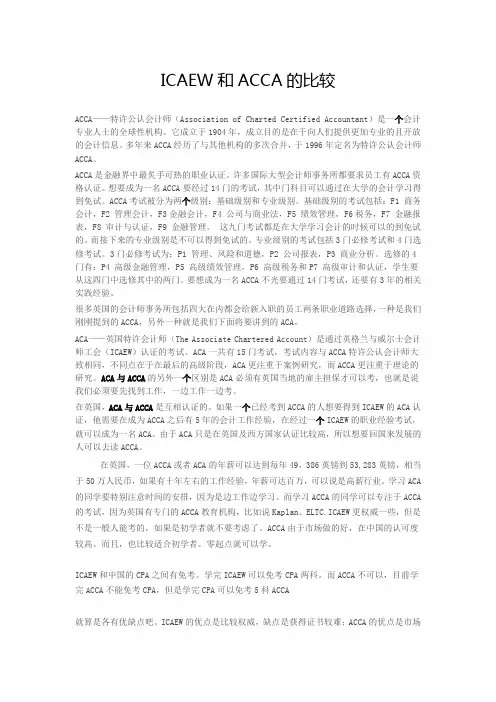
ICAEW和ACCA的比较ACCA——特许公认会计师(Association of Charted Certified Accountant)是一个会计专业人士的全球性机构。
它成立于1904年,成立目的是在于向人们提供更加专业的且开放的会计信息。
多年来ACCA经历了与其他机构的多次合并,于1996年定名为特许公认会计师ACCA。
ACCA是金融界中最炙手可热的职业认证。
许多国际大型会计师事务所都要求员工有ACCA资格认证。
想要成为一名ACCA要经过14门的考试,其中门科目可以通过在大学的会计学习得到免试。
ACCA考试被分为两个级别:基础级别和专业级别。
基础级别的考试包括:F1 商务会计,F2 管理会计,F3金融会计,F4 公司与商业法,F5 绩效管理,F6税务,F7 金融报表,F8 审计与认证,F9 金融管理。
这九门考试都是在大学学习会计的时候可以的到免试的。
而接下来的专业级别是不可以得到免试的。
专业级别的考试包括3门必修考试和4门选修考试。
3门必修考试为:P1 管理、风险和道德,P2 公司报表,P3 商业分析。
选修的4门有:P4 高级金融管理,P5 高级绩效管理,P6 高级税务和P7 高级审计和认证,学生要从这四门中选修其中的两门。
要想成为一名ACCA不光要通过14门考试,还要有3年的相关实践经验。
很多英国的会计师事务所包括四大在内都会给新入职的员工两条职业道路选择,一种是我们刚刚提到的ACCA,另外一种就是我们下面将要讲到的ACA。
ACA——英国特许会计师(The Associate Chartered Account)是通过英格兰与威尔士会计师工会(ICAEW)认证的考试。
ACA一共有15门考试,考试内容与ACCA特许公认会计师大致相同,不同点在于在最后的高级阶段,ACA更注重于案例研究,而ACCA更注重于理论的研究。
ACA与ACCA的另外一个区别是ACA必须有英国当地的雇主担保才可以考,也就是说我们必须要先找到工作,一边工作一边考。
acca考试制度

The global body for professional accountants
ACCA Qualification 注册与考试报名指引2012
The global body for professional accountants
注册时间指引.
The global body for professional accountants
您将在此页面填写所需添加的学历或资格证明。
您可在此输入学校或学院名称, 在下拉菜单中选择国家以 及毕业时间。 注:如您在输入学校全称后,如Jinan University,未能 在下表中找到相应的院校,请尝试输入关键字,如Jinan, 点击“Find”,再次进行搜寻。
凡符合搜寻条件的学校或学院将显示在此, 您可点选 所需选择的学校或学院。
如果遗忘密码, 系统将向您提问一条安全 性问题,通过答案来核实您的身份。 系统 将在此区域收集您的问题和答案。 如果不填写,将无法自行申请密码!
此处为验证码,验证码能有效地防止来自外 部的恶意攻击。完整填写后,请点击“Next”
The global body for professional accountants
点击“Next”,进入“exam status”页面,相关免考 评估信息将显示于“exam status”页面。 如所提交申请资料并未达到申请ACCA资格最低要求, 并且您未能提供其他学历和资格证明,系统将建议 您修改申请为FIA。
The global body for professional accountants
此页为上一页面的延续
请在此选择“ACCA Qualification”, 在下拉菜单中选择您的居住国,点击 “Apply Now”
ACCA考前复习指南:F7重要知识点、考点总结.doc
ACCA考前复习指南:F7重要知识点.考点总结改革之后的F7考试,考查范围更加全面。
同学们在备考的时候,需要对每个准则基本内容进行准备。
考官一般围绕recognition , measurement和presentation等方面考查。
而选择题部分,考前可以结合三套真题的选择题和练习册的选择题梳理知识点。
试卷分析SectionA备考要点■仔细读题■理解准则基础■排除法,举反例■计算题排除干扰自己算SectionB备考要点■计算ratio ,分类别(profitability/liquidity/gearing/i n vest or)■关注题目角色,以谁的角度写report■又寸比ratio :纟吉合题目要求,VS past year/competitors/industry benchmark■特殊关注点:从无到有,变化迅速,人无我有,人有我优■ 思考:financing sources, overtrading cashflow, risk going concernsConsolidation FS 重要知识点FV of considerationShare exchangeDeferred cashLoan noteContingent considerationFV Adjustment of net asset Depreciatio nFurther value in crease after acquisitionGoodwillImpairment of GoodwillMid・year acquisitiontime apportionIntra-group tradingSale &COSURP considering who is seller (S or P)Intra-group balancereceivables & payablesCIT & GITIntra-group loanInvestment & liabilityFinance cost & Investment incomeNCIFull methods(FV methods) VS proportionate methodsAssociateIntra-trading A&P: URP * P%Impairment of AssociateSingle entity重要知识点IAS16 PPEInitial Cost measurementDepreciationRevaluati on・ watch out DT from revaluationDisposalIFRS9 Financial instrumentFinance asset-FVTPL/FVTOCI/Amortizatio n-Watch out Issue cost・Debt instrument & Equity instrument Finance liability-Loan note■Convertible loan noteIFRS15 Revenue5 steps to recognize revenueConstruction contractService-Deferred revenueAgency sale-sales & repurchase-sales & return-sales & leasebackFactor receivablesIAS 2 Inventory adjustmentopening inventory+ purchase -closing inventory= cost of saleIAS 17 leaseFinance lease-NCL/CL & finance cost-Asset: CV & depreciationoperating lease・annual lease payment(time apportion)TaxCurrent taxDeferred tax-watch out DT from revaluationIAS 37Provision & contingent liabilityIAS 33 EPSEPS 计算:full market issue bonus issue & right issueCashflowInvestment, operating f financing局部计算选择题高频考点梳理Framework选择题文字题为主Qualitative characteristics 理解应用Recognition结合田可准则考察会计处理是否正确Measurement结合任何准则考察会计处理是否正确Historical cost, replacement cost, current cost Conceptual frameworkIAS 16 PPEInitial measurement costCapital expenditure VS revenue expenditure Depreciatio nRevaluationIAS 36 ImpairmentIndicators-carrying value > recoverable amount-external or internal indicatorCalculati on・Lower of carrying value-FV -cost to sell, Value in useCGU・order to impairment-1st specific damaged Asset■2nd Goodwill-3rd other asset (pro rata allocation)IAS 38 Intangible assetRecog nition-Research & development (capitalized criteria) Amortizati on-Finite life■Infinitive life : impairment reviewIFRS 5 NCA - Held for sale & discontinued operations Recognition Criteria 分类为IFRS5 的条件Measureme nt-Lower of:l.FV-cost to sell2.CV■No depreciation being held for saleIAS 23 Borrowing costConditions to be met for capitalizationInterest expenseIAS 20 Government GrantRevenue VS capital grantDeferred income / deducted from value of assetIAS 40 investment propertyFV to p/lIAS 2 InventoryValued at lower of 1: NRV=selling price - cost to sell2:Costopening inventory + purchase -closing inventory二cost of saleIAS 41 AgricultureScopeMeasurement: FVIFRS 15 (IAS 18/IAS11) revenue文字题-Revenue确认时点及金额■结合sales & repurchase z sales &lease back zFactor receivables/agency sales/sales & return 等特殊事项处理。
一文看懂ACCA各科目内容、特点、题型、分值、通过率、难度、彼此关系·····
ACCA考试共有15个考试科目,其中AB(F1)、MA(F2)、FA(F3)、LW(F4)、PM(F5)、TX(F6)、FR(F7)、AA(F8)、FM(F9)为F阶段课程,共9个科目,SBL、SBR、AFM(P4)、APM(P5)、ATX(P6)、AAA(P7)为P阶段课程,共6个科目。
ACCA课程中,F阶段科目全部为必修课,P阶段科目中SBL、SBR为必修课,其他为选修课(4选2参加考试),ACCA考试一共考过13科即可变成ACCA准会员。
考试之前一定要对ACCA有全面的了解,知己知彼方能百战不殆。
AB (F1)1英文名:Accountant in Business2中文名:会计师与企业3课程内容:主要是帮助无任何商业背景知识的学员初步建立人力资源、企业组织、商业环境及相互之间影响关系的相关知识内容。
内容涵盖:企业组织,公司管理,会计和报告体系,内部财务控制,人力资源管理,会计职业道徳。
4科目联系:AB(F1)是SBL课程中《公司治理,风险管理与职业道德》和《商务分析》的基础。
5考试时间:2小时(机考)6考试分值:A部分一一30道单选题(每题2分,共计60分)一一16道单选题(每题1分,共计16分)B部分一一情景为基础的6道多任务题(由单选、多选、判断题构成,每题4分,共计24分)7课程难度:☆☆8时间花费:☆☆☆2019年全球平均通过率:82.50%MA (F2)1英文名:Management Accounting2中文名:管理会计3课程内容:主要向学员介绍了管理会计体系的主要元素以及管理会计如何发挥支持企业决策, 制定企业决策的作用。
内容涵盖:管理会计,管理信息,成本会计,预算和标准成本,业绩衡量,短期决策方法。
4科目联系:MA(F2)《管理会计》是PM(F5)《业绩管理》和APM(P5)《高级业绩管理》的基础。
5考试时间:2小时(机考)6考试分值:A部分一一35道单选题(每题2分,共计70分)B部分一一3道多任务题(由计算、简单、论述题构成,每题10分,共计30分)7课程难度:☆☆8时间花费:☆☆☆2019年全球平均通过率:65.00%FA (F3)1英文名:Financial Accounting2中文名:财务会计3课程内容:主要向学员介绍了财务会计准则、相关会计科目账户建立以及准确财务信息的提供。
ACCA必考知识点
ACCA必考知识点ACCA(Association of Chartered Certified Accountants)作为国际性的注册会计师组织,其考试内容相当广泛,涵盖了会计、财务、税务、审计等多个领域。
以下是ACCA考试中的一些重要知识点:1.国际财务报告准则(IFRS):考生需熟悉IFRS的核心概念和准则,并了解各项财务报表的编制要求和披露要求。
2.管理会计:包括预算编制、成本管理、绩效管理等。
考生需了解不同类型的成本、成本计算方法、成本-体量利润分析、预算编制和分析、投资决策等相关内容。
3.财务管理:主要包括资本预算决策、财务风险管理、资金成本、资本结构和资本市场等内容。
考生需熟悉投资决策方法、财务风险评估与管理、资本结构理论和成本等概念。
4.税务:考生需了解税法和税务规定,包括个人所得税、公司所得税、增值税等。
此外,还需要了解跨国公司税务筹划和税务合规等内容。
5.审计与审计规范:考生需了解审计的目的和范围,以及审计的程序和方法。
还需要了解国际审计准则和内部控制的相关知识。
6.商法和公司法:考生需了解与商业活动相关的法律和法规,包括合同法、公司法、劳动法等。
7.伦理与专业行为准则:ACCA强调会计师的道德素养和道德风险管理。
考生需了解职业道德原则、职业观念和反洗钱法规。
8.商业伦理与社会责任:考生需要了解商业伦理的核心原则和企业社会责任的要求。
9.资本市场:考生需要了解股票市场、债券市场和货币市场的基本知识,包括证券发行、股票投资组合管理等。
10.管理信息系统:考生需要了解信息系统的开发、实施和管理,以及信息安全和数据分析等内容。
此外,ACCA考试还有一些与个人发展和交流有关的知识,如沟通技巧、领导力和团队合作等。
考生可以根据自己的实际情况和所报考的科目选择相应的重点知识点进行学习和准备。
总结起来,ACCA考试的知识点涉及面相当广泛,需要考生全面的了解和掌握。
准备ACCA考试需要进行系统的学习和复习,掌握基本概念和重要原理,同时也要注重实践能力的培养和应用能力的提升。
ACCA
新手导航:ACCA报考指南及常见相关问题汇总2009年6月ACCA各科考试通过率教材真题下载:[ACCA]—2009年6月考题及答案超级汇总版[ACCA]ACCA历年全球统考考题汇总[ACCA]—历年试题下载汇总(P1—P7,F1—F9)[ACCA]—新旧大纲历年试题下载汇总(P1—P7,F1—F9)ACCA教材下载—F1_chapter1-3(word版)ACCA教材下载—F5_word版[ACCA]—2009年F4模拟试题课件及讲义:[ACCA]—2009年12月份各科讲义下载汇总F4—公司法和商法—讲义下载09年12月f4讲义09.6 F9讲义及练习[ACCA考试]《F1 会计师与企业Accountant in Business (AB)》讲座课件下载[ACCA考试]《F2 管理会计Management Accounting(MA)》讲座课件下载[ACCA考试]《F3 财务会计Financial Accounting (FA)》讲座课件下载[ACCA考试]《F7 财务报告Financial Reporting (FR)》讲座课件下载[ACCA考试]《F8 审计与认证服务Audit and Assurance Services(AAS)》讲座课件下载备考辅导:F5复习资料F9复习资料整理分享2009年11月考官文章汇总资料2009年10月考官文章汇总资料2009年12月ACCA考试tips大全!ACCA字典会计科目中英对照经验分享:[经验分享]ACCA看书有诀窍[经验分享]中国ACCA第一人:吴卫军[经验分享]我的ACCA考试经验、教训以及建议[经验分享]F7,F9 的攻略(ACCA考试总结)[经验分享]ACCA考试高手的经验[经验分享]ACCA考试技巧与学习方法[经验分享]ACCA工作经验-work Experience[经验分享]—ACCA考试试题的特点及做题技巧分析[经验分享]—ACCA考试技巧与学习方法![经验分享]—ACCA三遍循环法[经验分享]—ACCA考试实战攻略(1)[经验分享]—ACCA考试实战攻略(2)[ACCA考试]《F3 财务会计 Financial Accounting (FA)》讲座课件下载ACCA F6 真题[ACCA]ACCA各Paper考官一览表[ACCA考试]《F1 会计师与企业 Accountant in Business (AB)》讲座课件下载[ACCA考试]2007年12月开始执行的新大纲的模拟试题[ACCA]ACCA历年全球统考考题汇总[ACCA]教材相关问题汇总[转贴]我是这样考过ACCA的(word版)[转贴]ACCA考试经验及P1.2-P2.2攻略(完整下载版)[转帖]ACCA看书有诀窍[转帖]中国ACCA第一人:吴卫军[转帖]我的ACCA考试经验、教训以及建议[ACCA考试]《F8 审计与认证服务 Audit and Assurance Services(AAS)》讲座课件下载[ACCA考试]《F2 管理会计 Management Accounting(MA)》讲座课件下载[ACCA考试]《F7 财务报告 Financial Reporting (FR)》讲座课件下载[ACCA]ACCA 考试报考指南ACCA 考试介绍特许公认会计师公会(The Association of Chartered Certified Accountants,简称ACCA) 成立于1904年,是目前全球最大的国际会计师组织。