
四年级英语外研版下册知识点总结
外研版四年级英语下册知识点总结Module 1重点单词: nice 好的友善的 a bit 有一点 shy 害羞的 clever 聪明的 aunt 姨姑naughty 淘气的 little 小的年幼的 cute 可爱的 uncle 叔舅短语1、my friends 我的朋友们2、a bit shy 一点儿害羞的 2、a nice teacher 一位友好的老师4、a clever pupil 一个聪明的小学生5、a very naughty bird 一只非常淘气的鸟儿6 my big brother我的大兄弟(哥哥) 7、my little sister我的小妹妹重点句型:1. She is a nice teacher. 她是一位友善的老师。
2. Parrot is very naughty . 鹦鹉非常淘气。
3. Xiaoyong is a very clever boy. 小勇是一个非常聪明的男孩。
4. This is my mother. She is very nice.这是我妈妈,她很好。
Module 2重点单词: about 关于 beautiful 美丽的 long 长的 many 很多 old 古老的 famous 著名的短语1、一本关于伦敦的书 a book about London2、来自…(是…人)be from…3、英国的首都 the capital of England4、白金汉宫 Buckingham Palace5、女王的房子 the Queen’s house6、泰晤士河 the River Thames7、在河上 on the river 8、大本钟 Big Ben 9、海德公园 Hyde Park 10、塔桥 Tower Bridge重点句型:1. This is a book about London. 这是一本关于伦敦的书。
2. London is a big city. 伦敦是个大城市。
3.Whose house is it? 这是谁的房子?it’s the Queen’s house这是女王的房子4. A: Is it your house? 那是你的房子吗? B: No, it’s the Queen’s house. 不,那是女王的房子。
5. This is Hyde Park. It’s very beautiful. 这是海德公园,它非常漂亮。
Module 3重点单词: robot 机器人 everything 所有事情 one day (总)有一天housework 家务 learn 学习 our 我们的短语: will + 动词(原形)表示“将来做...”1、do everything 做所有事2、talk 说 walk 走路3、do the housework 做家务4、help children learn帮助孩子们学习5、do our homework 做我们的作业6、next week 下周7、a holiday 一个假期 8、go swimming 去游泳 9、play with my friends和我的朋友玩10、go to the park 去公园 11、do my homework 做我的作业 12、visit my grandma 拜访我的奶奶13、help my mother 帮助我妈妈(做家务) 14、read my books 看我的书重点句型:1. One day,robots will do everything.总有一天,机器人会做一切事情。
2. A: Will they do the housework? 他们会做家务吗?B: Yes, they will.是的,它们会.\No,they won’t.不,它们不会。
3. On Monday I’ll go swimming. 我星期一去游泳。
Module 4重点单词:take 带,拿走 picnic 野餐 great 太好了 why 为什么 because 因为 so所以短语: Will you...? → Yes, I will. / No, I won’t.Will it...? → Yes, it will. / No, it won’t.1、Monday 星期一 Tuesday 星期二 Wednesday 星期三 Thursday 星期四Friday 星期五 Saturday 星期六 Sunday 星期日2、on Saturday 在星期六3、have a picnic 举行、进行野餐4、take your kite / ball带上你的风筝 /球5、The Weather Tomorrow 明天的天气(情况)9、be windy 刮风的 10、be hot 炎热的 11、be cold 寒冷的12、be sunny 晴朗的 13、rain 下雨 14、snow 下雪重点句型:1. A: Will you take your kite tomorrow? 明天你带着你的风筝吗?B: Yes, I will.\ No, I won’t. 是的,我会。
\不,我不会。
(注意情连)2. On Saturday we’re going to have a picnic. 星期六我们要去野餐。
3. A: Why not? 为什么不呢? B:Because tomorrow is Friday .因为明天是周五。
4. A: What will Shanshan do on Monday? 姗姗星期一要干什么?B: On Monday she’ll play with her friend,5. A:Will it be windy in Beijing? 北京会有风吗?B:Yes, it will.是的,会.\No, it won’t.不,不会。
Module 5重点单词: old 年长的 young 年轻的 strong 强壮的 clean干净的 dirty 脏的短语:1、过去式:发生在过去的事情用过去常和 then(那时)或yesterday(昨天)一起用2、be动词过去式:① was ( is/am的过去式)→我(I)、他(he、she、it)、一人 + was②were ( are的过去式)→你(们)(You)他们(they)我们(we) + were③否定式: wasn't weren't3、反义词then(那时)——now(现在) old(老的)——young(年轻的) long(长的)——short(短的)big(大的)——small(小的)good(好的)——bad(差的) tall(高的)——short(矮的)fat(胖的)——thin(瘦的) clean(干净的)——dirty(脏的)4、that little girl那个小女孩5、so short如此矮6、so cute如此可爱重点句型:1.I was two then. 我那时候2岁。
2.Who is that little girl?那个小女孩是谁?3.They were young then. 他们那时候很年轻。
4.It wasn’t clean then.It is clean now。
它之前很不干净,它现在很干净Module 6重点单词: Very well 非常好 yesterday昨天 lesson 一节课短语:1、重点句型:Were you...? → Yes, I was. / No, I wasn’t.Was it...? → Yes, it was. / No, it wasn’t.2.yesterday 昨天3.play in the sun 在阳光下玩耍4.at home 在家5. Chinese Lesson 语文课a very small village 一个非常小的乡村重点句型:1. Were you at home yesterday? 你昨天在家吗?2.Was it sunny in London yesterday? 伦敦昨天是晴天吗?Yes,it was. / No it wasn’t.3.Was it a big city then? 它过去是个大城市吗?4.It was a very small village then.它过去是个小村庄。
Module 7重点单词:have(过去式had) 度过,有 phone(过去式phoned)打电话 cook (过去式cooked)煮东西wash (过去式 washed)洗东西 do (过去式 did)做play(过去式played) 玩 watch(过去式watched)看listen (过去式listened)听 talk(过去式 talked )说短语:动词的过去式规则动词:+ ed / d 不规则:没有规律,要背诵1. help Mum (过去式:helped)帮助妈妈2. phone grandma (过去式phoned )给奶奶打电话3. wash clothes (过去式:washed )洗衣服4. cook fish (过去式:cooked ) 做鱼5. cook noodles 煮面6.listen to music (过去式:listened ) 听音乐7.walk in the park (过去式:walked )在公园里散步8.talk with some friends (过去式:talked ) 和一些朋友聊天9. play on the computer (过去式:played ) 玩电脑10. watch TV (过去式:watched ) 看电视 11.What about.....? ...怎么样?重点句型:1. I cooked noodles yesterday.我昨天煮面条了。
2. He played on the computer and watched TV. 他玩电脑和看电视。
3. I phoned grandma yesterday.我昨天给奶奶打电话了。
Module 8重点单词:beautifully 优美地,动听地 game游戏,比赛 have a good time过得愉快短语:动词过去式(不规则)原形过去式sing(唱歌)—— sang have(度过)—— had go (去)—— wentsee (看见)—— saw eat (吃)—— ate drink (喝)——dranktake (拍摄)—— took make (制作)—— made1. have a picnic (过去式:had) 进行野餐2. go there (过去式:went) 去那儿3. see some bird (过去式:saw) 看见一些小鸟4. sing beautiful (过去式:sang) 唱歌动听5. eat some food (过去式:ate) 吃一些食物6. drink some drinks(过去式:drank) 喝一些饮料7. dance (过去式:danced) 跳舞 8. play game (过去式:played) 玩游戏9. have a busy day (过去式:had) 度过愉快的一天10. take some pictures (过去式:took)拍一些照片重点句型:1. They sang beautifully. 它们唱得很动听。
小学英语四年级下册课本知识点(外研版三年级起点)

小学英语四年级下册课本知识点(外研版三年级起点)Module 1一、句型与语法1、形容词(1)修饰名词,如She is a nice teacher.(2)单独使用,如She is nice.(3)形容词前可加表示程度的词修饰,如very、so、a bit“有点”,She is a bit shy.“她有点害羞。
”二、单词及短语1、短语:answer the call“接电话”、my big brother“我的哥哥”、my little sister“我的妹妹”Module 2一、句型及语法1、one用作代词,代指上文提到的同类事物,如This panda is short, but that one is tall.(that one=that panda)2、提问物品的主人whose“谁的”,如It’s the Queen’s house. Whose house is it? whose后面紧跟提问的名词3、【复习】名词所有格,It’s the Queen’s house.4、【复习】连词,两个句子如果连在一起使用,中间必须加连词,如This panda is short, but that one is tall.二、单词及短语1、close to“离…很近”,如My house is close to the Queen’s house.2、house、home、family(1)house“房子”,如My house is big and beautiful.(2)family“家庭、家人”,如There are three people in my family.(3)home“家”,由house和family共同构成,如Welcome to my home.3、短语:a book about London“一本关于伦敦的书”Module 3一、句型及语法1、一般将来时(will+动词原形)(1)主语+will+动词原形+其他,预测将会发生的事情,如Robots will do everything.(2)动词形式:will+动词原形,will是助动词,没有人称、数的变化(3)标志词:tomorrow“明天”、one day“将来的某一天”、next week“下周”【复习】be going to+动词原形也表示将来时,但侧重表示计划打算将要做某事注意不要讲will与be going to连用,千万不要出现will be going to的形式2、【复习】情态动词can“能、会”二、单词及短语1、help sb do sth“帮助某人做某事”,如They will help children learn.2、our“我们的”,we的物主代词,my的复数3、短语:do the housework“干家务活”、do the homework“做家庭作业”、on+星期、【复习】ride a bike“骑自行车”、fly a kite“放风筝”、make cakes“做蛋糕”、go swimming“去游泳”、go to the park“去公园”、visit my grandma “看望我的奶奶”、play with my friends“与我的朋友一起玩”、read books for me“为我读书”Module 4一、交际用语1、Great!“太棒了!”二、句型及语法1、一般将来时(will+动词原形)(1)一般疑问句:will提前,如I will fly. →Will you fly? Yes, I will. No, I won’t.(won’t=will not)2、提问原因why“为什么”,如Why will you take your ball tomorrow?(1)回答:Because we are going to have a picnic tomorrow.(2)Why not?“为什么不呢”,Why won’t you do sth?=Why not do sth?eg:Why won’t you take your ball tomorrow? = Why not take your ball tomorrow?3、连词because“因为”、so“所以”,注意英语中because和so不能连用eg:Because we are going to have a picnic tomorrow, I will take my kite.We are going to have a picnic tomorrow, so I will take my kite.【复习】so“如此、这么”,如It is so hot today.4、询问天气What will be the weather?“天气怎么样?”,回答It will be+形容词,如It will be sunny.注意:will后要求加动词原形,am/is/are的原形是be,如It is sunny today. →It will be sunny tomorrow.三、单词及短语1、take“带着、拿着”,如take your kite“带着你的风筝”【复习】take“拍摄”,如take pictures“拍照”2、名词变形容词:sun-sunny、cloud-cloudy、wind-windy3、短语:have a picnic“去野餐”、【复习】in+地点,如in HaikouModule 5一、句型及语法1be动词)(1)主语+be动词过去式+其他,表示过去的情况,如I was two then.“我那时两岁”←I am ten now.“我现在十岁。
外研版小学四年级英语下学期知识点总结

一、单词和词组:1. 数字:eleven, twelve, thirteen, fourteen, fifteen, sixteen, seventeen, eighteen, nineteen, twenty, thirty, forty, fifty, sixty, seventy, eighty, ninety, one hundred2. 日期:the first, the second, the third, the fourth, the fifth, the sixth, the seventh, the eighth, the ninth, the tenth, the eleventh, the twelfth, the thirteenth, the fourteenth, the fifteenth, the sixteenth, the seventeenth, the eighteenth, the nineteenth, the twentieth3. 表示时间的词汇:o'clock, half past, quarter past, quarter to4. 表示天气的词汇:sunny, cloudy, rainy, snowy, windy5. 表示季节的词汇:spring, summer, autumn, winter6. 表示衣物和颜色的词汇:coat, T-shirt, dress, hat, shoes, socks, blue, red, green, yellow, black, white, pink, orange7. 表示活动的词汇:swim, play basketball, play football, play tennis, fly kites, have a picnic8. 表示假期的词汇:Spring Festival, Lantern Festival, Qingming Festival, Labor Day, Dragon Boat Festival, Mid-Autumn Festival, National Day9. 形容词:big, small, tall, short, long, short, thin, fat, heavy, light, strong, weak, fast, slow, happy, sad, angry, hungry, thirsty, excited, scared, tired10. 情态动词:can, can't, could, couldn't, may, may not,will, won't, shall, shall not, must, must not二、基本句型和语法:1. 一般疑问句:Is it...? Are you...? Do you like...? Does he have...?2. 肯定回答:Yes, it is. Yes, I am. Yes, I do. Yes, he does.3. 否定回答:No, it isn't. No, I'm not. No, I don't. No, he doesn't.4.一般现在时的肯定句:主语+动词原形+其他5. 一般现在时的否定句:主语 + 动词原形 + not + 其他6. 一般现在时的一般疑问句:Do/Does + 主语 + 动词原形 + 其他?7. 一般现在时的特殊疑问句:Wh- + do/does + 主语 + 动词原形 + 其他?8. there is/there are 句型:There is + 单数名词 + 其他;There are + 复数名词 + 其他9. can/can't 句型:主语 + can/can't + 动词原形 + 其他10. could/couldn't 句型:主语 + could/couldn't + 动词原形 +其他11. can/could 提示:Can you...? Could you...? Yes, I can. Yes, I could.12. may/may not 句型:主语 + may/may not + 动词原形 + 其他13. will/won't 句型:主语 + will/won't + 动词原形 + 其他14. shall/shall not 句型:主语 + shall/shall not + 动词原形+ 其他15. must/must not 句型:主语 + must/must not + 动词原形 + 其他三、课文内容:1. Unit 1: How Do You Go There?(交通工具的使用方式)2. Unit 2: How Was Your Day Yesterday?(过去一天的活动)3. Unit 3: What's Your Hobby?(运动和爱好)4. Unit 4: What's the Day Today?(日期和天气)5. Unit 5: What Season Do You Like?(季节和天气)6. Unit 6: What Are You Wearing?(衣物和颜色)7. Unit 7: Can You Swim?(运动技能)8. Unit 8: What Did You Do in the Holidays?(假期活动)9. Unit 9: Whose Is It?(物品所有者)10. Unit 10: What Can You Do?(能力和兴趣)四、日常对话和口语表达:1. 问候:Hello! Hi! Good morning! Good afternoon! Good evening! Nice to meet you!2. 自我介绍:My name is... I am... years old. I am from...3. 询问他人的姓名和年龄:What's your name? How old are you?4. 询问他人的住所:Where do you live?5. 询问他人的过去活动:What did you do yesterday? Did you...?6. 询问他人的兴趣爱好:What's your hobby? Do you like...?7. 询问日期和天气:What's the day today? What's the weather like today?8. 询问季节和喜好:What season do you like?9. 询问衣物的颜色和穿着:What color is it? What are you wearing?10. 询问他人的能力:Can you...?以上就是外研版小学四年级英语下学期知识点的总结。
外研版小学四年级英语下学期知识点总结
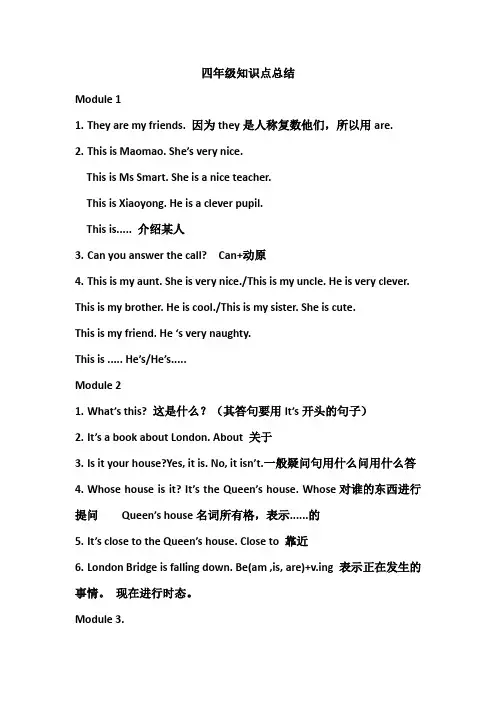
四年级知识点总结Module 11.They are my friends. 因为they是人称复数他们,所以用are.2.This is Maomao. She’s very nice.This is Ms Smart. She is a nice teacher.This is Xiaoyong. He is a clever pupil.This is..... 介绍某人3.Can you answer the call? Can+动原4.This is my aunt. She is very nice./This is my uncle. He is very clever. This is my brother. He is cool./This is my sister. She is cute.This is my friend. He ‘s very naughty.This is ..... He’s/He’s.....Module 21.What’s this? 这是什么?(其答句要用It’s开头的句子)2.It’s a book about London. About 关于3.Is it your house?Yes, it is. No, it isn’t.一般疑问句用什么问用什么答4.Whose house is it? It’s the Queen’s house. Whose对谁的东西进行提问Queen’s house名词所有格,表示......的5.It’s close to the Queen’s house. Close to 靠近6.London Bridge is falling down. Be(am ,is, are)+v.ing 表示正在发生的事情。
现在进行时态。
Module 3.1.Sam can ride a bike. Amy can fly a kite. Can+ 动原ride a bike译为骑自行车。
四年级英语下册知识点总结(外研社 全册)
四年级英语下册知识点总结(外研社全册)四年级英语下册知识点总结四年级英语下册是外研社出版的一套教材,本教材囊括了四年级下学期的重要英语知识点。
本文将对这些知识点进行总结,以帮助学生加深对这些知识的理解和掌握。
一、单词学习1. 数字和时间:在四年级下册中,学生将学习如何表达数字和时间。
他们将学会用英语表达1到100的数字,以及学会问候并报时。
2. 家庭成员:学生将学习如何用英语表达家人的关系,比如爸爸、妈妈、姐姐、弟弟等。
3. 学校设施:学生将学习一些常见的学校设施的英文词汇,比如教室、图书馆、操场等。
4. 日常生活用品:学生将学会一些日常生活用品的英文名称,比如床、桌子、椅子等。
二、句型构造1. 询问与回答:学生将学会询问和回答简单的问题,比如“你叫什么名字?”“你几岁了?”等。
2. 表达喜好和能力:学生将学会用英语表示自己的喜好和能力,比如“I like swimming.”(我喜欢游泳)和“I can play the piano.”(我会弹钢琴)等。
3. 表达日常活动:学生将学会用英文表达一些日常活动,比如“我每天上学。
”(I go to school every day)和“我通常和朋友一起玩。
”(I usually play with my friends)等。
4. 情态动词的用法:学生将学习情态动词can和must的用法,例如can用于表示能力和许可,而must用于表示义务和必须。
三、语法知识1. 现在进行时:学生将学会现在进行时的构成和用法,例如“I am swimming.”(我正在游泳)和“She is eating dinner.”(她正在吃晚饭)等。
2. 一般过去时:学生将学习一般过去时的构成和用法,例如“I played soccer yesterday.”(我昨天踢足球)和“He watched a movie last night.”(他昨晚看电影)等。
3. 形容词的比较级和最高级:学生将学会形容词的比较级和最高级的构成和用法,例如“taller”(更高的)和“the tallest”(最高的)。
四年级英语外研版下册知识点总结

四年级英语外研版下册知识点总结外研版四年级英语下册知识点总结Module 1重点单词:nice好的友善的a bit有一点shy害羞的clever 聪明的aunt姨姑naughty淘气的little小的年幼的cute可爱的uncle叔舅短语1、my friends我的朋友们2、a bit shy一点儿害羞的2、a nice teacher一位友好的老师4、a clever pupil一个聪明的小学生5、a very naughty bird一只非常淘气的鸟儿6 my big brother我的大兄弟(哥哥)7、my little sister我的小妹妹重点句型:1. She is a nice teacher.她是一位友善的老师。
2. Parrot is very naughty .鹦鹉非常淘气。
3. Xiaoyong is a very clever boy.小勇是一个非常聪明的男孩。
4. This is my mother. She is very nice.这是我妈妈,她很好。
Module 2重点单词:about关于beautiful艳丽的long长的many良多old陈腐的famous有名的短语1、一本关于伦敦的书abookaboutLondon2、来自…(是…人)befrom…3、英国的都城thecapitalofEngland4、白金汉宫Buckingham Palace5、女王的屋子the Queen’s house6、泰晤士河the River Thames7、在河上on the river8、大本钟Big Ben9、海德公园Hyde Park 10、塔桥Tower Bridge重点句型:1. This is a book about London.这是一本关于伦敦的书。
2. London is a big city.伦敦是个大城市。
3.Whose house is it?这是谁的屋子?it’s the Queen’s house这是女王的屋子4. A: Is it your house?那是你的房子吗?B:No, it’s the Queen’s house.不,那是女王的房子。
(完整版)外研版四年级英语下册知识点总结

外研版四年级英语下册知识点总结1、She’s a nice teacher.(她是一位好老师。
)2、These are my friends.(这些是我的朋友们。
)3、Parrot is a very naughty bird !(鹦鹉是一只很淘气的鸟。
)4、This is my big brother。
He’s cool.(这是我的哥哥,他很酷。
)5、Are you naughty?(你淘气吗?)Yes,I am. / No, I am not.6、London is the capital of England.(伦敦是英国的首都。
)7、What is this?(这是什么?)8、I am from London。
(我来自伦敦。
)9、It is a book about London。
(它是一本关于伦敦的书。
)10、It is very big and very beautiful。
(它又大又美丽。
)11、This is the River Thames.(这是泰晤士河。
)It’s long and wide.12、Is it tall?(它高吗?)Yes,it is / No,it is not。
13、The desk is very old。
(这张书桌很破旧。
)14、We are going to have a picnic On Saturday。
(在星期六我们将要去野餐。
)15、Will you take your kite tomorrow?(明天你会带着你的风筝吗?)Yes,I will。
/ No,I won’t。
16、Why not?(为什么不?)17、On Monday I’ll go swimming。
(在星期一我将要去游泳。
)18、Robots will do everything。
(机器人将要做所有事情。
)19、Will it be windy in Beijing?(北京的天气将会有风吗?)20、Amy’s taller than Lingling.(艾米比玲玲高。
外研版(三年级起点)版小学四年级下册英语知识点讲解归纳
外研版(三年级起点)版小学四年级下册英语知识点讲解归纳本文档旨在归纳和讲解外研版(三年级起点)版小学四年级下册的英语知识点。
以下是该教材的主要内容和重点。
请注意,本文档不会对具体细节进行摘要和总结,而是提供简要的概述。
一、Unit 1: My School- 词汇: 学校设施、研究用品、科目名称- 句型: What's in the...? It's a/an...- 语法: 形容词的基本用法二、Unit 2: My Family- 词汇: 家庭成员、家居物品、情感词汇- 句型: Whose...is this/that? It's...三、Unit 3: My Friends- 词汇: 描述外貌特征、性格特点、兴趣爱好- 句型: What does he/she look like? He/She is...四、Unit 4: My Day- 词汇: 时间词、日常活动、地点名称- 句型: What do you do...? I...- 语法: 简单现在时的用法五、Unit 5: My Home- 词汇: 家庭活动、房间名称、家具物品- 句型: Do you like...? Yes, I do/No, I don't.六、Unit 6: My Town- 词汇: 地点名称、城市景点、交通工具- 句型: How do you go to...? I go by...- 语法: 方位介词的基本用法七、Unit 7: Nature- 词汇: 自然界事物、季节、天气- 句型: What's the weather like...? It's...- 语法: 一般疑问句的基本用法八、Unit 8: Fun Time- 词汇: 运动项目、游戏名称、娱乐活动- 句型: Can you...? Yes, I can/No, I can't.以上是外研版(三年级起点)版小学四年级下册的英语知识点讲解的简要归纳。
外研版三起英语四年级下册语法知识点总结全
外研版三起英语四年级下册语法知识点总结全本文档总结了外研版三起英语四年级下册的语法知识点,旨在帮助学生系统地研究和掌握这些知识。
1. Present Simple Tense(一般现在时)- 表示经常性的动作或惯- 基本句型:主语 + 动词原形(第三人称单数加s)- 示例:I play football every day. (我每天踢足球。
)2. Present Continuous Tense(现在进行时)- 表示正在进行的动作- 基本句型:主语 + am/is/are + 动词-ing 形式- 示例:She is reading a book. (她正在读书。
)3. Past Simple Tense(一般过去时)- 表示过去发生的动作或状态- 基本句型:主语 + 动词过去式- 示例:We watched a movie last night. (我们昨晚看了一场电影。
)4. Future Simple Tense(一般将来时)- 表示将来发生的动作或状态- 基本句型:主语 + will + 动词原形- 示例:I will visit my grandparents tomorrow. (我明天会去看望我的祖父母。
)5. Imperative Sentences(祈使句)- 表示命令、请求、建议等- 基本句型:动词原形 + 其他- 示例:Be quiet. (安静点。
)6. Question Sentences(疑问句)- 表示询问的句子- 基本句型:特殊疑问词/助动词 + 主语 + 其他?- 示例:What are you doing? (你在做什么?)7. Tag Questions(反意疑问句)- 在陈述句后面加上相反的疑问句- 示例:You are a student, aren't you? (你是学生,对吧?)8. Adjectives(形容词)- 用于描述名词的特征或品质- 示例:He is a tall boy. (他是个高个子男孩。
外研版小学四年级英语下学期知识点总结
学习英语是一项长期的过程,需要对各个知识点进行综合总结和巩固。
下面是外研版小学四年级英语下学期的知识点总结,总结的内容包括:词汇、语法、对话及句型、听力和阅读。
一、词汇1.数字四年级下学期会学习到1000以内的数字。
2.日期和时间会学习到月份、星期和时间的表达方式。
3.季节和天气学习到四个季节和常见的天气词汇。
4.动物和植物学习各种动物和植物的名称,以及相关的形容词。
5.食物和饮品学习各种食物和饮品的名称,以及如何表达喜欢和不喜欢。
6.身体部位学习人体各个部分的名称,如头、手、脚等。
7.家庭成员学习家庭成员的称呼,如爸爸、妈妈、哥哥、姐姐等。
8.学科和学习用品学习各种学科和学习用品的名称。
二、语法1.数字的表达学习如何表达数字,包括基数词和序数词。
2.一般现在时学习一般现在时的基本用法,并学会构造肯定句、否定句和疑问句。
3.介词的使用学习几个常用的介词并能正确运用在句子中。
4.物主代词学习如何用物主代词表达物品的所有关系。
5.反意疑问句学习如何使用反意疑问句来加强陈述句的语气。
三、对话及句型1.问候和交流学习如何用英语进行问候和交流,如"Hello, how are you?"。
2.请求和询问学习如何用礼貌的方式请求和询问,如"Can I have a pen, please?"。
3.表达喜好和不喜好学习如何表达自己的喜好和不喜好,如"I like swimming, but Idon't like running"。
4.描述事物学习如何用英语描述事物的外表、颜色、大小等特点。
5.提供帮助和回答问题学习如何提供帮助和回答问题,如"Do you need any help?"。
四、听力1.听懂简单的对话通过听力练习,培养听懂简单对话的能力,如问候、介绍自己、询问个人信息等。
2.听懂简单的指示和指导词通过听力练习,培养听懂简单指示和指导词的能力,如Go straight、Turn left等。
完整版)四年级英语外研版下册知识点总结
完整版)四年级英语外研版下册知识点总结重点单词:happy快乐的sad悲伤的angry生气的tired疲倦的hungry饥饿的thirsty口渴的excited兴奋的短语1、感到快乐feel happy2、感到疲倦feel tired3、感到饥饿feel hungry4、感到口渴feel thirsty5、感到兴奋feel excited6、感到生气feel angry7、感到悲伤feel sad重点句型:1.I feel happy today.我今天感到快乐。
2.She feels tired after running.她跑步后感到疲倦。
3.He feels hungry.他感到饥饿。
4.I am thirsty.我口渴了。
5.She is excited about her birthday party.她对自己的生日派对感到兴奋。
6.He is angry with his friend.他对他的朋友生气了。
7.She is sad because she lost her toy.她因为丢失了她的玩具而感到悲伤。
One day。
robots will be able to do everything。
including talking and walking。
They will even be able to do the housework and help children learn。
Our homework will be done by robots too。
Next week。
we might even have a holiday because robots will be doing everything for us.On Saturday。
the weather will be great for a ic。
Will you take your kite or ball。