
人教新目标九年级全册英语课件:unit1 Section B-1
九年级英语全册Unit1单元同步作文指导SectionB3a_3b人教版

单元同步作文指导& Section B(3a~3b)
【单元写作目标】
本单元的话题主要是谈论学习英语的方法以及在语言学习中遇到的困难 等,要求学生能正确使用by doing sth.结构,并运用已掌握的学习方法,有针对 性地给语言学习困难者提供合理建议。常见话题:How to learn English/Chinese well;How to be a good learner;How to improve our study effectively…
5.每个人天生具有学习的能力。 Everyone is_b_o_r_n____w_i_t_h_____ thea_b_i_l_i_t_y____to learn. 6.调查表明,成功的学习者有着一些共同的好习惯。
Research_s_h_o_w_s___ that_s_u_c_c_e_s_s_f_u_l__le_a_r_n_e_r_s__ have some goodh_a_b_i_t_s___ _i_n______co_m_m_o_n____. 7.据我所知,通过学习英语歌曲来提高英语是非常有用的。 As far as I know,it's veryh_e_l_p_f_u_l__ _t_o______im_p_r_o_v_e___ English blye_a_r_n_i_n_g__ English songs.
like to read more English classics because they like them.Six
percent hope that they can learn more foreign culture, such as
人教版英语九年级全册Unit1sectionB教学设计

(二)过程与方法
在本章节的学习过程中,教师将采用以下方法引导学生学习:
1.情境教学法:通过设定真实的语境,让学生在情境中感知、体验目标语言,提高学生的语言运用能力。
2.任务型教学法:设计各种任务,引导学生积极参与课堂活动,培养学生的合作意识和解决问题的能力。
b.新课内容呈现:采用任务型教学法,设计各种任务,引导学生积极参与,学习目标语言。
c.练习环节:设计不同难度的练习,让学生在梯度训练中逐步提高,巩固所学知识。
d.课堂小结:教师引导学生总结本节课所学内容,强调重难点,帮助学生梳理知识结构。
e.课后作业:布置与课堂内容相关的作业,巩固学生的知识,提高学生的自主学习能力。
2.学生在小组内分享自己的观点,运用目标语言进行讨论。
3.每个小组选一名代表进行汇报,展示小组讨论成果。
4.教师给予评价和反馈,强调学生在讨论中使用目标语言的重要性。
(四)课堂练习(500字)
1.教师设计以下练习题,巩固学生对本节课知识点的掌握:
a.填空题:使用一般过去时和一般现在时填空。
b.改错题:纠正句子中的时态和情态动词错误。
难点:如何引导学生正确运用时态进行表达,以及如何运用情态动词进行推测性描述。
2.重点:提高学生的阅读理解能力,使学生能够把握课文的主旨大意,理解人物情感和故事情节。
难点:如何帮助学生从课文中提取关键信息,并进行有效的信息整合和推理。
(二)教学设想
1.针对重难点,采用以下教学策略:
a.利用多媒体教学手段,如图片、视频等,创设情境,让学生在实际语境中感知和运用目标时态。
6.家庭作业:请家长协助学生完成一项关于家庭成员过去和现在习惯变化的调查。学生需用英文记录调查结果,并在课堂上与同学分享。
Unit 14第4课时 (Section B 1a-1e)(教学课件)九年级英语全一册(人教新目标)

Post-listening
1e Prepare a speech for your graduation. Use the questions to help you. Present your speech to your group. How to write a speech? Let’s watch a video!
Post-listening
1e Prepare a speech for your graduation. Use the questions to help you. Present your speech to your group.
Beginning Thanks Ending
How have you changed since you started junior high school? Who has helped you most? What advice have your parents given you? What will you do after you graduate? What are you looking forward to?
04
Post-listening
Post-listening
Fill in the blank according to the listening material.
Today is the (1)_s_t_u_d_e_n_t_s_(student) last class . Bob thinks Mrs. Chen’s classes have been great and Mrs. Chen is glad (2)_to__h_e_a_r__(hear) that. Mrs. Chen thinks the future (3) _w__il_l_b_e__e_x_c_i_ti_n_g_(exciting). The students talk about what they want to do in the future. Bob hopes(4)_to__p_a_s_s__(pass) the exam to get into senior high school. Shirley wants (5) _t_o__g_e_t_ (get) into a music school. Ken is good at science and he (6)_w_o_n__(win) a prize for it last year. So he wants to be (7)a__n__astronaut. Anna is going to improve English(8)_s_o__th__a_t_ she can teach kids English in the future. Mrs. Chen believes in all of them. To celebrate the (9)_e_n_d___(末尾)of junior high , they are having a party. They ask Mrs. Chen to come, and she is happy to accept the(10)_i_n_v_i_t_a_ti_o_n___(invite).
英语人教版九年级全册Unit 1 Section 1a -2d. 学练优九英上Unit 1 Section A 第一课时

现在完成时 (Present Perfect)
定义:表示过去发生的某一动作对现在 造成的影响或产生的结果;或这一动作 开始于过去,持续到现在,并有可能继 续持续下去。
现在完成时的构成:
1. 肯定句:have (has)+过去分词 注意:该句式中的have或has是助动词, has用于第三人称单数,其它人称一律用 have。
by + v.ing 常常表示手段、方式或方法,可以 用来回答how引导的特殊疑问句。
-- How do you learn English? -- I learn English by watching
English movies.
√ 1a Check ( ) the ways you study for an English test.
e.g. ---Have you ever been to Beijing? --- Yes, I have. / No, I haven’t.
注式。
e.g. I’ve been to New York once before. 我曾经到过纽约。
____________________________
1b Listen. How do these students study for a test?
Write letters from 1a above.
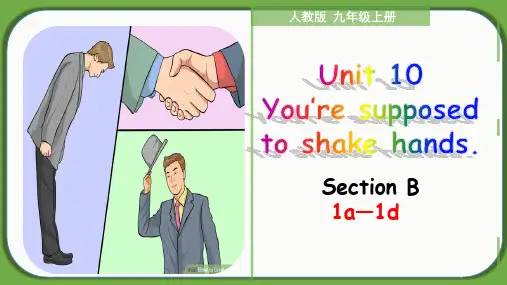
Unit 10 Section B(1a-1d)九年级全册英语教学课件(人教版)
In Japan
You're (not) supposed to...
point at anyone with your chopsticks
start eating first if there are older people at the table
返回
What should we notice in a Western meal?
Chinese Table Manners
It’s rude to stick the chopsticks into the bowl. We’re not supposed to talk aloud at the table.
In China, it’s impolite to
use your chopsticks to hit an empty bow.
• make noise while eating 吃饭时发出声音
• stick the chopsticks into the food 把筷子插在食物里
• point at someone with the chopsticks 用筷子指着某人
• eat while walking down the street 在路上边走边吃
Section B 1a—1d
Let's enjoy a video.
How much do you know about table manners around the world? There are many table manners around the world. But different countries have different customs.
Unit3SectionB(1a-1e)课件人教版九年级英语全册

Section B (1a-1e)
Words Review
fascinating adj. 迷人的;极有吸引 力的
inexpensive adj. 不昂贵的 uncrowded adj. 不拥挤的;人少的 convenient adj. 便利的;方便的
F. uncrowded
Talk about the places in our city using the words above.
A: The Fine Arts Museum is really interesting.
B: Yes, and it’s beautiful, too.
Look at the picture and look through the conversations, then answer the questions .
e.g.Internet makes it convenient for us to get in touch with each other.
互联网使得我们相互联系便利了。
convenience是convenient的名词形式,既可作可数名词,意 为“便利的设施”,也可作不可数名词,意为“方便,便 利”。 ►The house has all the modern convenience.
Summary
What have we learnt today? Some adjectives : fascinating, inexpensive,
uncrowded, convenient … …
How to ask for information politely
【人教新目标】九年级英语:全册一课一练(含答案) Section B (1a—2b)
Unit 6 When was it invented?Section B (la—2b)1.根据句意及所给汉语提示,写出句中所缺单词。
1.The teacher asks us to learn from these(英雄).2.Would you like to eat(酥脆的)food?3.There were many(顾客)in the mall that day.4.This apple is so(酸的)that 1 ca n't stand it.6. The teacher(分开)-the class into small groups to discuss the problem.II.根据汉语意思完成英语句子,每空一词。
You can't people what they think.2.她误把盐放进茶里了。
She pul salt into her tea.3.如果你坚持工作,最终你会成功的。
If you keep working, you will succeed.4.他的爷爷在农村生活了很长一段时间。
His grandfather lived in the countryside.5.同时,我还在学习钢琴。
6.史密斯先生执教多年,他的学生都非常钦佩他。
Mr. Smith has taught for many years, and all hi s studentshim.m.根据各题后括号内的要求完成下列各题,每空一词(含缩略形式)。
1.The telephone was invented in 1876.(改为一般疑问句)The kite was made by Tom.(改为否定句)The kite by Tom.2.There were over 100 people in the mall at ihal lime.(改为同义句)There were 100 people in the mall at that time.the first basketball game played?Answers:I . 1. heroes 2. crispy 3. customers 4. sour 5. Canadian 6. divided 7. baskets1. stop; from saying 2. by mistake 3. in the end 4. for a long time 5. At the same time 6. look up toII. 1. Was; invented 2. wasn't made 3. more than 4. When was。
人教版英语九年级全一册-Unit 1 Section A Grammar Focus(教案)
Unit 1 How can we become goodlearners?Section A Grammar Focus-Section B 1e一、教学目标1. 学习掌握下列词汇及短语:repeat, note, physics, chemistry, pronounce, increase, speed, partner, take notes, make mistakes, get…right2. 掌握重点句型:(1) —How do you learn English?—I learn by studying with a group.(2) —Do you learn English by reading aloud?—Yes, I do. It helps my pronunciation.(3) —How can I read faster?—You can read faster by reading word groups.(4) —How can I improve my pronunciation?—One way is by listening to tapes.(5) —I don’t have a partner to practice English with?— Maybe you should join an English club.3. 能用英语表达在英语学习上的问题和解决方法。
4. 能从听力材料中听懂有关于英语学习方面的挑战和获取解决办法。
5. 通过引导学生总结自己和了解同伴的学习方法,帮助学生相互交流和借鉴彼此的学习方法。
同时引导学生谈论学习中的困难及解决的办法,提高学习英语的信心。
二、教学重点及难点重点:1. 掌握本单元出现的词汇、短语及目标语言。
2. 用how引导的特殊疑问句来询问方式、方法。
难点:1. 准确理解和运用how用于提问方式的特殊疑问句。
人教版九年级英语下册第一单元Unit 1 Section A (1a-2d)教学课件
__d____ __b____
3. ____ What about listening to tapes?
______
4. __√__ What about reading aloud to practice pronunciation? ___c___
5. __√__ Have you ever studied with a group?
— I study by working with a group. ② It’s too hard to understand spoken English. ③ The more you read, the faster you’ll be.
新课导入
思 考思 考 What do you usually do when you study English?
新课讲解 2a Listen and check ( √ ) the questions you hear.
Questions
1. __√__ Do you learn English by watching videos? 2. __√__ Do you ever practice conversations with friends?
listening to tapes. reading the textbooks. watching English movies. asking the teacher for help. working with friends.
by doing sth. 通过做某事
此处by作介词,意为“通过”,表示方式或方法
Useful expressions: ask sb. for help, read aloud, what about, spoken English, word by word, be patient
英语人教版九年级全册unit1 section A 1a-2c
pronunciation v.发音
1. How do you… for…? by +doing
---How do you study for a test? ---I study by making word cards.
I study by…
doing exercises doing some reciting going over the exercises
and notebooks
taking part in extra classes after school
get a tutoຫໍສະໝຸດ (家庭教师)joining an English club
Reading: reading aloud to practice pronunciation
reading English magazines and newspaper
Writing: keeping English diaries
doing lots of exercises
movies. 我通过看英文电影学英语。
How do they study for an English test?
She learns English by ______ to tapes.
They learn English by ____ the textbook aloud.
They learn English by ____ with friends.
Help me!