
沪教版牛津英语六年级下册6B期中知识点总结
Module 1 City Life Unit 1 Great cities in Asia 【知识点梳理】 1.方位词:east / west / north / south / north-east / north-west / south-east / south-west 用法:a. 两地不相邻: e.g. A is north B. (= to the south of) b. 两地接壤: e.g. A is on the north of B. c. 所属关系,A包含B, B属于A: e.g. B is in the north of A. 2. by + 交通工具 表示“乘……交通工具”, 用how进行提问 e.g. by bus / ferry / train / ship / underground… by plane = by air, by ship = by sea 3. How far…多远(询问距离的远近,路程的长短) e.g. Hoe far is it from your home to school? 从你家到学校有多远? 4. How long…多长,多久(询问时间的长短,提问一段时间) e.g. How long does it take to travel from Shanghai to Beijing by train? 坐火车从上海到北京要花多长时间? 5. It takes (sb.) some time to do sth. 做某事需要花费(某人)多少时间 e.g. It takes me five hours to make this modal plane. 做这个模型飞机花了我5个小时。 6. like / love / enjoy doing sth. 喜欢做某事 e.g. The people in Bangkok like / love / enjoy eating spicy food. 曼谷人喜欢吃辛辣食物。 6. 词组句型 at an exhibition about great cities in Asia 在一个关于亚洲大城市的展览会上 Which city…? 哪个城市…? the capital of… …的首都 from…to…从…到… in the past 在过去 travel to other places 去别的地方 more than = over 超过,多于 visit the Great wall 参观长城 tall buildings 高楼大厦 huge department stores大型的百货商店 famous hotels著名的宾馆 quiz cards测试卡 at these beautiful beaches 在这些美丽的沙滩上
Module 1 City Life Unit 2 At the Airport 【知识点梳理】 1. have/has been to 去过,到过 (表示现在已经回来) have/has been in 住在 = have lived / stayed in have/has gone to 去,到… (表示现在还没有回来) e.g. We have already been to Changfeng Park. I have lived in Shanghai for thirteen years. Where is Henry? He has gone to Japan. He will come back next week. 2. already 已经(多用于肯定句,放于动词前) yet 迄今,还(多用于疑问句和否定句,放于句末) just 刚刚 (用法和位置和already相同) e.g. I have already been to Lily’s home. Have you been to Lily’s home yet? No, I haven’t been to her home yet. 3. plan to do 计划做…… e.g. Tom is planning to visit Rome this Spring Festival. 汤姆正计划今年春节到罗马旅行。 4. leave for 出发去……动身去…… leave A 离开A地 e.g. He will leave Shanghai. leave for B 出发去B地 e.g. He will leave for Tokyo. leave A for B 离开A地去B地 e.g. He will leave Shanghai for Tokyo. 5. arrive + in 大地方 (如国家、城市等范围较大的地方) e.g.arrive in China arrive + at 小地方 (如车站、学校等小范围的地方) e.g. arrive at the airport 【近义】 get to, reach到达 6. have to do…不得不做… (否定don’t have to do) e.g. I have to say it again. 我不得不再说一遍。 7. enough space 足够的空间 space“空间”,不可数名词 enough 修饰名词时前置,修饰形容词副词时后置 e.g. enough money, good enough 8. live / stay …for…在…住/待…(时间) for +一段时间,多与现在完成时连用表示动作从过去延续到现在的一段时间,并用how long提问。 e.g. We have learned English for six years. 我们学习英语已经六年了。 9. have / has got “有、拥有” 否定形式haven’t/ hasn’t got…疑问形式Have/ Has…got…? 10. too many + 可数名词复数 “太多的…” too much + 不可数名词“太多的…” 11. plenty of “许多,大量”,后面可跟不可数名词或可数名词复数 12. 重要词组句型 this Sunday live in Los Angeles one and a half hours at eleven thirty in the morning look at this sign over there buy sb. sth. =buy sth. for sb. departure time / arrival time write down one’s address What time…?
Module 1 City Life Unit 3 Dragon Boat Festival 【知识点梳理】 1. know something about the Dragon Boat Festival了解一些关于端午节的知识 know about 知道/了解关于……的事情 know认识 2. His job was to give advice to the king. 他的工作是给国王出谋划策。 ⑴ be +to do, 不定式做表语,表示主语和表语在概念上是等同的。 e.g. His plan is to clean the room. 他的任务是打扫房间。 My wish is to be a doctor. 我的愿望是称为一名医生。 ⑵ give sth. to sb. = give sb. sth. 给某人某物 ⑶ advice “劝告, 忠告”, 不可数名词 a piece of advice 一条建议 some advice 一些建议 give advice to sb. 想某人提出建议 take sb’s advice 采纳某人的建议 3. listen to 在本文中指 “听从, 听信” e.g. She never listens to me. 她从不听我的话。 4. in danger 在危险中 danger n. 危险 dangerous adj. 危险的 5. would like to do想要做……= want to do 6. ---Would you like some…? 表示“你想要……吗?”,用于询问对方的意见。 ---Yes, please. (肯定回答) / No, thanks. (否定回答) 7. later adv. 后来,以后 late adj. 晚的,迟的 e.g. I'll tell you later. 我以后再告诉你。 He was late for school. 他上学迟到了。 8. a salty rice dumpling with / without meat 一只(没)有肉的咸粽子 with 表示“有”,without表示“没有” with还有“和……”、“用”等意思 e.g. I write the report with my pen. 我用我的新钢笔写报告。 She lives with her son.她和儿子住在一起。 9. I like salty rice dumplings, but I don’t like sweet ones. 我喜欢咸粽子,但我不喜欢甜粽子。 ⑴ one 用来指代一个人或事物,而ones用来指代一些人或事物。 ⑵ but但是,表示意思的转折。 10. would rather do 宁愿做…… would rather not do 宁愿不做…… e.g. He would rather stay at home at weekends. 他宁愿周末呆在家。 11. the fifth day of the fifth lunar month 农历五月初五 在英语中,用序数词表达农历的第几个月和第几天。 12. 重要词组句型 the story of the festival be born two hundred years ago jump into a river the fifth day of the fifth lunar month of that year on that day eat rice dumplings and have dragon boat races to remember him
Module 1 City Life Unit 4 Staying Healthy 【知识点梳理】 1. like / love / enjoy doing 喜欢做…… e.g. Many children like/love/enjoy eating fried food. 许多小孩喜欢吃油炸
新沪教牛津版六年级下册小学英语 Module 3 单元知识点小结
Module Things we do一、核心词汇1. 名词bell铃铛neck脖子gatekeeper 门卫sign标识middle中间;中部;中心path小路;小径can金属罐rubber橡皮vase花瓶pen holder 笔筒envelope 信封rubbish bin 垃圾桶truck卡车piece碎片;碎块cloth布;布料2. 动词praise赞扬;称赞worry担心follow跟随;跟着reuse重新利用3. 形容词special特别的lost迷路的;迷失的plastic塑料制的;塑料的4. 副词ago以前5. 情态动词may可能;可以6. 短语praise … for …因……而表扬……in the middle 在中间look out小心;当心no smoking禁止吸烟no swimming禁止游泳get lost 迷路some time 一段时间on the way在路上throw away 扔掉二、拓展词汇must 必须should 应该seat 座位三、核心句型1. We can help you. 我们能帮助你。
解读:这是介绍某人能做某事的句型。
举一反三: She can dress herself. 她会自己穿衣服。
2. I saw her half an hour ago. 半小时之前我看到她了。
解读:这是一般过去时的句子,一般过去时用来介绍过去某一时间发生的动作或存在的状态。
举一反三: I went for a walk yesterday. 我昨天去散步了。
3. I’m going to ask the gatekeeper.我要去问门卫。
解读:这是一般将来时的句子,一般将来时用来介绍将来某一时间发生的动作或存在的状态。
举一反三: He’s going to run. 他要去跑步。
4. — Excuse me. Where’s the underground station?打扰一下,地铁站在哪里?— It’s over there. 在那边。
沪教牛津版六年级英语下(Unit8 基础知识梳理)
精锐教育学科教师辅导讲义年级:六年级辅导科目:英语课时数:3课题Unit8基础知识梳理教学目的1.使学生能够基本掌握Unit8中的基础词汇词组并且能够进行一些词汇变形练习;2.帮助学生梳理重点句型和语言点。
教学内容Step1: Greetings & Free talkHow are you today? Is there somethinginteresting or important this week?What have you learned in your school? (询问学校课程进度)Step2: Lead in—学海拾贝Early birds catch the worms.勤能补拙。
Step3: Words and expressions.Ⅰ. Words.1. display n.展示;陈列e. g. On New Year's Eve, the display of fireworks was really beautiful. 除夕之夜的焰火确实很漂亮。
There will be a clothing display next Sunday.下周日将有一个服装展示。
【记忆链接】on display正在展览中(=on show):e. g. The work was on display.这个作品正在展出。
2. gentle adj.温和的e. g. She is a gentle and kind girl.她是一个温柔和蔼的女孩。
“May I help you?" she said with a gentle voice. “有什么可帮助的吗?”她用温和的声音说道。
3. hold v.抓住;拿住;抱住e. g. The girl is holding her father’s hand.那个女孩正抓住她父亲的手。
Julie held the cat in her arms.朱莉把小猫搂在怀里。
沪教版牛津英语六年级下册 Unit6 第一课时 教学课件
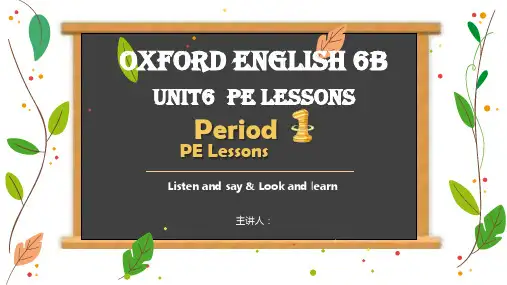
Activities in PE lessons
2 We run long races and short races.The races are exciting.We all
want to win.
3 We do the long jump and the high jump.Jill is good at the high
jump.Joe is good at the long jump.
Part 2
4 Sometimes we play ball games.I like playing football,volleyball
and basketball.
5
My friends and I like playing sport.We have a lot of fun together!
What is Peter talking about?
What is Peter talking about?
Read and divide into 3 parts
(划分课文为3部分)
1
We My
fhraievBneedtgswiaonnnPdiEnI llgeiks(es开oPnE头sl)eastssocnhsoovel reyvemryucwhe. ek.
like (doing) 喜欢做 ……
be good at (doing) 擅长做……
Part 3
Read and answer (Underline划线)
Part 1
1 How many PE lessons do they have every week? 2 Who likes PE lessons very much?
六年级下册英语-单词表(素材)-沪教牛津版(深圳用)
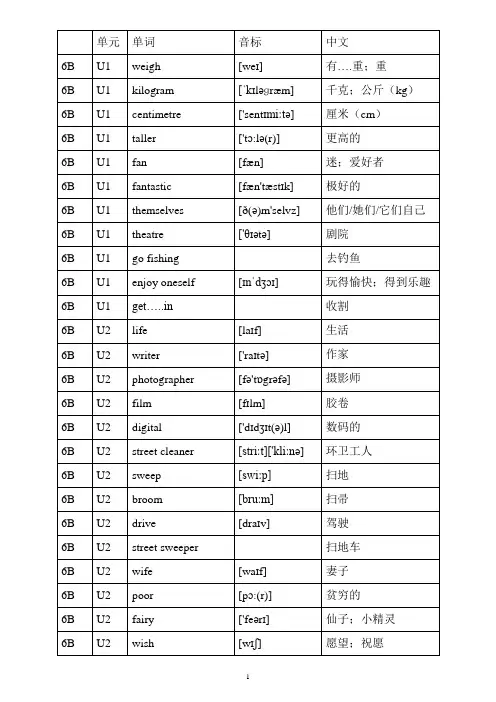
赞扬;陈赞
6B
U7
praise…..for
因……而表扬….
6B
U8
sign
[saɪn]
标识
6B
U8
middle
['mɪd(ə)l]
中间;中部;中心
6B
U8
special
['speʃ(ə)l]
特别的
6B
U8
path
[pɑːθ]
小路;小径
Hale Waihona Puke 6BU8may[meɪ]
可能;可以
6B
U8
lost
[lɒst]
['plæstɪk]
塑料制的;塑料的
6B
U9
rubbish bin
['rʌbɪʃ][bɪn]
垃圾桶
6B
U9
truck
[trʌk]
卡车
6B
U9
piece
[piːs]
碎片;碎块
6B
U9
cloth
[klɒθ]
布;布料
6B
U9
throw away
[θrəʊ]
扔掉
6B
U10
fairy tale
['feərɪ] [teɪl]
6B
U8
on the way
在路上
6B
U9
reuse
[riː'juːz]
重新使用
6B
U9
can
[kæn]
金属罐
6B
U9
rubber
['rʌbə]
橡皮
6B
U9
vase
[vɑːz]
沪教牛津版六年级英语下册期中期末试题及答案
沪教⽜津版六年级英语下册期中期末试题及答案沪教⽜津版六年级英语下册期中期末试题及答案满分:100分时间:60分钟得分:听⼒部分⼀、听录⾳,选出你所听到的单词。
(10分)()1. A. fan B. fun C. run()2. A. weigh B. theatre C. exercise()3. A. are B. artist C. park()4. A. happy B. unhappy C. many()5. A. brush B. bus C. black⼆、听录⾳,选答语。
(10分)()1. A. 150 centimetres tall.B. Yes, I am. C. No, he isn’t.()2. A. At six. B. No, I don’t. C. Go to the park.()3. A. No, he doesn’t. B. Because he thinks it’s interesting.C. In class.()4. A. Yes, I do. B. No, I don’t. C. The white one.()5. A. An egg. B. This Saturday. C. To the lake.三、听录⾳,给下列图⽚排序。
(10分)()()()()()四、听录⾳,完成短⽂。
(10分)I have a dream school. We will have a 1.every month. We will also have a garden and there are many 2.in the garden. Students will not carry any 3. to school. Sometimes we can study online at 4. . We will have a 5.time.笔试部分五、选出不同类的单词。
沪教牛津版六年级英语下(Unit3 基础知识梳理)
精锐教育学科教师辅导讲义人们总是要一起吃顿团圆饭来纪念中秋节。
【知识拓展】celebration n.庆祝会,典礼e. g. birthday celebrations生日庆祝会a day of celebration庆祝日5. born v. 出生;出世e. g. She was born in 1980.她生于1980年。
The Trades Union movement was born in the early years of the century. 工会运动创始于本世纪初。
【知识拓展】be born, give birth to的区别(1) be born意为“出生”,但其主语通常只能是表示被生下的人或动物。
e. g. She was born in 1968.她生于1968年。
She was born in a very musical family.她生在音乐之家。
(2)give birth to意为“生产,生下”。
其宾语通常是表示幼畜或婴儿的词,其主语只能是表示雌性的词。
e. g. She gave birth to five children.她生了五个小孩。
6. ago adv.以前e. g. -Have you been to Beijing before? 你去过北京吗?-Yes, I went there six years ago. 去过,六年前去的。
7. country n.(1)(复数countries)国家e. g. China and Japan are Asian countries.中国和日本是亚洲国家。
【百科小贴士】世界七大洲中,除南极洲外,都有国家分布,各大洲的国家分布是不均衡的,非洲的国家最多。
面积最大的国家是俄罗斯,面积最小的国家是梵蒂冈,总面积只有0.44平方公里。
(2)乡下,农村e. g. -Where did you go yesterday, Mary? 玛丽,你昨天去哪儿了?-We went for a picnic in the country. 我们去乡下野餐了。
牛津沪教版六年级英语上6BModule 1 Unit 1语法及拓展
四、课堂练习
Ⅰ Choose the best answer.
介词 in, on, to 的用法?
三、新课讲解
1. Miss Guo and her students are at an exhibition about great cities in Asia. 郭老师和她的学生们出 席了一场关于亚洲大城市的展览会。
at an exhibition 意为“出席展览会;在展览会现场”。 great cities 指的是“大城市”。
牛津沪教版六年级英语上 6BModule 1 Unit 1 语法及拓展
学 科 英语 课题名称
6B M1 Unit1 Great cities in Asia.语法及拓展
Unit1 Great cities in Asia 语法及拓展
一、课前回顾
单词默写:
名词 noun
1.
亚洲
2.
日本
3.
东京
4.
泰国
5. How far is it from Shanghai to Beijing? 北京距离上海有多远? How far … 意为“距离(多远)”,用 How far 引导的特殊疑问句来询问距离的远近。 不定代词 it 在这里指代“距离” 介词结构 from … to … 表示“从……到……”
6. ----How long does it take to travel from Shanghai to Beijing by train? 乘火车从上海到北京要多久? ---- It takes about ten hours. 大约 10 小时。 How long 表示“多久”,用于对一段时间的提问。 这里 take 意为“花费”。it 在这里是形式主语,真正的主语是后面的动词不定式 to do sth. It takes sb. some time to do sth. 表示做某事花费某人多少时间
沪教牛津六年级英语下册全册单元测试卷+期中期末试卷及答案(2020春)
Module Changes and differences得分:满分: 100分 时间: 60分钟分钟听力部分一、听录音,选出你所听到的单词。
(10分)( )1. A. make B. take C. lake( )2. A. mine B. nine C. nice( )3. A. pain B. main C. paint( )4. A. light B. night C. right( )5. A. white B. right C. light二、听录音,选答语。
(10分)( )1. A. 47 kilograms. B. Yes, I’m tall. C. 150 centimetres.( )2. A. 40 kilograms. B. Yes, I am. C. 152 centimetres.( )3. A. OK, Miss Gao. B. No, I don’t. C. A blue box.( )4. A. Here are you. B. Thank you. C. No, I don’t.( )5. A. A farmer. B. In a school. C. He is tall.三、听录音,给下列图片排序。
(10分)( ) ( ) ( )( ) ( )四、听录音,完成短文。
(10分)In the future, schools will be different. They will be under the sea, on high 1. andeven in 2. . Robots will 3. us find books in the library. They will also do otherthings in schools. We will use 4. in all our lessons. They will help us 5. dinosaurs and other interesting things.笔试部分五、根据括号内所给汉语提示,完成句子。
沪教牛津版六年级英语下(Unit1 语法点梳理以及能力训练)
精锐教育学科教师辅导讲义在过去;从前长城多于;超过喜欢做某事3.课文背诵检查。
4.课后作业检查分析。
5.上次课错题回顾。
(帮助学生整理上次课错题)Step4: Grammar1.乘坐交通工具的表达(1)可以用by的介词词组来表达,但步行一定要用on foot表示。
e. g. I go to school by bus/by underground.我乘公共汽车/地铁上学。
He goes to school on foot.他步行上学。
(2)乘飞机可以用by plane也可以用by air;乘船可以用by ship /boat,也可以用by sea(但不能用by lake或by river)。
(3)如指具体某一辆车或船可以用on或in的介词词组来表示。
e. g.He often goes to Beijing on the train.他通常乘这班火车去北京。
She goes to work in her car.她开她的汽车上班。
【友情提示】这种用法需要有定冠词或物主代词,且空间较小的如汽车通常用in,其他空间较大的交通工具一般用on。
2. How long与How far的用法(1) How long用于询问时间上的“多久”。
e. g.How long have you stayed here? 你待在这儿有多长时间了?We have stayed here for one week.我们已经待在这儿有一周了。
(2) How far用于询问距离上的“多远”。
e. g.How far is it from the school to the theatre? 从学校到电影院有多远?Step 5:Exercise. (综合能力训练)PartⅡVocabulary and Grammar (35分)I . Choose the most proper answer. : (15 分)( ) 1. It is very expensive to a plane to Britain, but it's cheaper to go there .A. take, by shipsB. take, by shipC. by, take shipsD. by, take ship() 2. Russia is China.A. in the north ofB. the north ofC. on the north ofD. to the north of() 3. There are visitors on Nanjing Road every day.A. thousand ofB. more than 3 thousandsC. thousands ofD. more than 3 thousands of( ) 4. It is train ride from Shanghai to Suzhou.A. two-hour'sB. two hourC. two hour'sD. two hours'() 5. All the passengers must the airport two hours before the departure time.1.There are some books in my bag. (改为否定句)There books in my bag.2.John's mother does exercises every morning. (改为一般疑问句)John's mother ________ exercises every morning?3.It takes me an hour to get to the school by bus. (划线提问)does it take you to get to the school by bus?4.It's about 3,500 kilometres from Garden City to Singapore. (划线提问)is it from Garden City to Singapore?5.Beijing is a beautiful city. (改为感叹句)beautiful city Beijing is!【keys】I. 1. B 2. C 3. C 4.D 5. B 6. B 7. A 8. A9. C 10. A 11. C 12. C 13. C 14. D 15. AⅡ.1. C 2. E 3. F 4. A 5. DⅢ. 1. interesting 2. children 3. teachers 4. swimming 5. touristsⅣ. 1. aren't any 2. Does, do 3. How long 4. How far 5. What aPartⅢReading and Writing (40分)I. Reading comprehension. (15分)(A)Jimmy lived in the country, and he loved playing in a very shallow(浅的)river near his house, but then his father got a job in a big city, and he moved there with his family.Their new house had a garden, but the garden was very small. Jimmy wasn't very happy."Is there a river near here?" he asked his mother on the first morning.His mother answered, "No, there isn't, but there's a beautiful park near here, Jimmy, and there's a pool in it. We'll go there this afternoon." Then Jimmy was happy.After lunch, Jimmy and his mother went to the park, Jimmy wanted to walk near the pool, but there was a sign in front of it. His mother read it to him: "'WARNING!' This pool is dangerous(危险的). 367 people have fallen into it. "J immy looked into the pool carefully. Then he said, "I can't see them."True or false:( )1. Jimmy's father worked in a big city.( )2. After breakfast, Jimmy and his mother went to the park.( )3. The garden was very small.( )4. There's a pool in the country.( )5. 367 people have fallen into the pool.(B)Visitors to London often eat in restaurants. The owners and workers in them are all from other countries. The visitors say in these restaurants they don't feel they are in England. Most of English people eat at home as much as they can. Sometimes they themselves will think they are in another country when they are in restaurants. When an Englishman goes out of a restaurant, he may find that he doesn't understand why everything is written in French and Italian.Most of English people think it is better to eat at home, because it is cheaper. They don't want to spend much money onfood and they like cooking at home. They like fast food. But for Christmas, they will spend two or three weeks to get ready for it, because they want to have good food.Choose the best answer:()1. Visitors to London often eat in restaurants because .A. they don't like the food at homeB. their homes are not in LondonC. it's cheaperD. restaurants are beautiful places( )2. When English people eat in restaurants,they sometimes think .A. they are in another countryB. they are in the countryC. they are themselvesD. they love their country()3. Some of English people don't know .A.why everything comes from French and ItalianB.why people write everything in French and ItalianC.everything in restaurantsD.everyone in restaurants()4. English people eat at home because .A. it is fastB. the food is expensive at homeC. it is sometimes very cheapD. the food is very cheap at home( )5. English people will spend much time for Christmas.A. In order to get more foodB. In order to have much foodC. In order to get good foodD. In order to have enough food(C)It was a Saturday morning in May. When Mrs. Edwards opened her curtains (窗帘) and looked out, she smiled and said, "It's going to be a beautiful day. f She woke(唤醒) her small son up at eight-thirty and said to him, "Get up, Teddy. We're going to the zoo today. Wash your hands and face, brush your teeth and eat your breakfast quickly. We're going to New York by train, vTeddy was six years old. He was very happy now, because he liked going to the zoo very much, and he also liked going by train. He said, "I dreamed about the zoo last night, Mommy." His mother was in a hurry, but she stopped and smiled at her small son. "You did, Teddy?" she said. "And what did you do in the zoo in your dream?"Teddy laughed and answered, "You know, Mommy! You were there in my dream too. "Answer the questions:1. What did Mrs. Edwards say when she looked out of the window?2. Why was Teddy happy?3. What did Teddy dream about?4. What did Mrs. Edwards ask Teddy?5. What did Teddy answer?Ⅱ. Choose the words and expressions and complete the passage. (6分)。
六年级下册英语课件-Module 2 Unit 6 Lessons∣沪教牛津版(三起)(共30张)
Brain storming
上海教育出版社 六年级 | 下册
上海教育出版社 六年级 | 下册
Ask and answer
For swimming lesson, what do you need? For swimming lesson, what should you do?
上海教育出版社 六年级 | 下册
上海教育出版社 六年级 | 下册
We do the long jump and the high jump. Jill is good at the high jump. Joe is good at the long jump.
上海教育出版社 六年级 | 下册
Sometimes we play ball games. I like playing football, volley and basketball. My friends and I like playing sport. We have a lot of fun together!
We have two PE lessons at school every week. My friends and I like PE lessons very much. We run long races and short races. The races are exciting. We all want to win.
Look and learn
上海教育出版社 六年级 | 下册
high jump
上海教育出版社 六年级 | 下册
long jump
上海教育出版社 六年级 | 下册
long race
上海教育出版社 六年级 | 下册
short race