
上海牛津版英语五年级下册Module2Unit1M2U1同步讲义教案
5.量词用法 可数名词
不可数名词
可数和不可数名词
many
much, little, a little
a lot of=lots of, some, any
批注:本单元学习了 a lot of 的用法,要提醒学生它既可以修饰不可数名词,也可以修饰可数名词。
(建议 5-10 分钟)
( ) 1.Have you _______ water? I’m too thirsty.
5
6
A. either
B. too
C. never
( )6. Peter didn’t _____his breakfast this morning.
A. have,
B. had
C. has
( )7. The hamburgers ______ unhealthy. Would you like _______ rice?
4. either/too I like English. My sister likes English, too. I don’t like English. My sister doesn’t like English, either.
批注:让学生自己比较两个句子,从而得出结论:either 用于否定句,too 用于肯定句
( ) 4. Do you like ____ films or ____ TV?
A. see watch,
B seeing, watching
C. looking, watching
( ) 5. My mother doesn’t like dancing, I don’t like dancing ___________.
学员编号: 学员姓名:YYY
授课类型 星级
教学目标
年 级: 辅导科目:英语
课 时 数: 学科教师: XX
M2U1(牛津 5B)基础知识梳理
★★★
1、 使学生能够基本掌握牛津英语五年级下册 unit1 中的基础词汇及重要句型; 2、 进一步复习一般过去时 3、 掌握量词用法
T 同步-U1 基础知识梳理
A. sound, some B. sounds, some
C. sound, any
4
( (
(
(
)8. The silkworms can make _____ silk for people.
A. much
B. many
C. a lot
)9. It was quiet. Ben _____ in the sofa and ______ TV.
key words: pork, beef, tomato, potato, cabbage, bean, sound, healthy, favourite
key phrases and sentences: 1. What did you have for breakfast? 2. That doesn’t sound healthy. 3. …is/are my favourite food. 4. either/too 5.量词用法:a lot of, many, much Step 2. 错题回顾
巧记单词:可以把两个 o 看成两个西红柿。 4. potato 土豆
I like potatoes very much. 批注:参看 tomato
5. carrot 萝卜
2
Rabbits like carrots best. 批注:carrot=car+rot 区分 parrot 鹦鹉。parrot 五年级以前已经学过,把 p 换成 c 就可以记住 carrot 了。让学生自 己造句:兔子最喜欢萝卜。还可以拓展 like…best 与 favourite 替换。Rabbits’ favourite food are carrots.
8. favourite 最喜欢的 Dolls are my favourite toys. 批注:重点单词,提醒学生拼写。常和 like…best 替换。如例句可换成 I like dolls best.
9. sound 听起来 That doesn’t sound healthy. 批注: 后面跟形容词
2.beef 牛肉
We should have some beef every day. It is healthy. 批注:提醒学生是不可数名词。
拓展:常见的肉类都是不可数名词:pork, meat, chicken, fish 等 3. tomato 西红柿
Tomatoes are my favourite vegetables. 批注:注意 tomato 的复数是加 es, 小学学习的还有 potato 也是加 es. 其他都是加 s 比如 photos.要提醒学生注意
(建议 2-5 分钟)
批注:通过第一幅图片,询问学生早上吃的什么,从而导入过去时。第二幅图片由学生自己观察讲解,让他们了解健 康饮食的常识,进而引入本节课主题,也可以培养他们的良好生活习惯。
(建议 20-25 分钟) 想学得更多就必须先扫开单词障碍!
1
一、词k for lunch yesterday. 批注:pork=p+or+k 这样方便学生记忆。提醒学生是不可数名词。
已经学习过了,要提醒学生 have 的过去式是 had。加了 did 后,had 要变回原形。答语是:I had…
2. That doesn’t sound healthy. 那听起来不健康。 批注:用于评价饮食的用语。
批注:重点句型。常会和 like…best 替换。可以让学生自己多说几个句子进行操练。
6. cabbage 白菜,卷心菜
Cabbages are good for our health. 批注:cabbage=cab(出租车)+bag(包)+e 构成
7. bean 豆子
Tom had some beans this morning. 批注:复数形式 beans.
8. healthy 健康的 I wasn’t hungry this morning. So I didn’t have breakfast. 批注:重点单词。反义词 unhealthy, un 是否定前缀。名词 health
二、重要句型 Important Sentences structures
3
1. What did you have for breakfast?(lunch, dinner) 早饭你吃了什么? 批注:用来询问早饭,午饭,晚饭吃了什么东西。这是一般过去时在本单元的运用的重要句型。一般过去时上一单元
A. a lot of
B. some
C. many
( ) 2. Peter
to school at seven o’clock yesterday.
A. goes
B. went
C. go
( ) 3. I don’t like
. I like rice.
A. potato
B. potatos
C. potatoes
A. sat, watch
B. sat, watched
C. sits, watch
) 10. His sister _____lunch at school from Monday to Friday.
A. have
B. has
C. is having
Keys: 1-5 BBCBA 6-10 AAABB
score:____________ (xx 小题,共 xx 分)
(建议 2-5 分钟) 放电影回顾式学习法
批注:第一步采用放电影学习法,让学生自己回忆在本模块学到了哪些知识点;如果学生回答的是一些凌乱且琐碎的 知识点,这个时候老师可以让学生翻看前面的知识点进行总结。第二步是错题再次回顾总结,在“斩妖除魔”环节,学 生做了 10 道题目,需要再次让学生总结出现错误的原因及下次如何避免。 Step 1. 思考回忆所学知识点,并将所学知识点列在下面
牛津上海版(试用本)五年级下册英语Module 1 Unit 2 Watch it grow!_The third period教学设计

Procedures
Contents
Methods
Purpose
Pre-task preparation
Listen and enjoy
Look and say
Show the pictures for“Listen and enjoy”.and have the students say the rhyme together.Then ask them to answer some questions to review the words and patterns that they have learnt previously.
Display the pictures of an egg, a caterpillar, a cocoon and a butterfly on the blackboard in a random order.Ask the students to put them in the right order according to the life stages of a butterfly.Then invite several students to describe the life stages.
能力要求:学会正确表述事物的变化。
情感态度:通过学习,培养学生之间相互交流的能力,同时让学生积极主动地运用所学的语言,表达动物和昆虫的变化成长过程。
【教学重难点】
1.Using the simple past tense to talk about pimple present tense to talk about present states.
2.Have the students look at the pictures in“Look and read”on P.10and listen to the recording.Then ask questions about each picture.
牛津上海版五年级下册M1U2教案
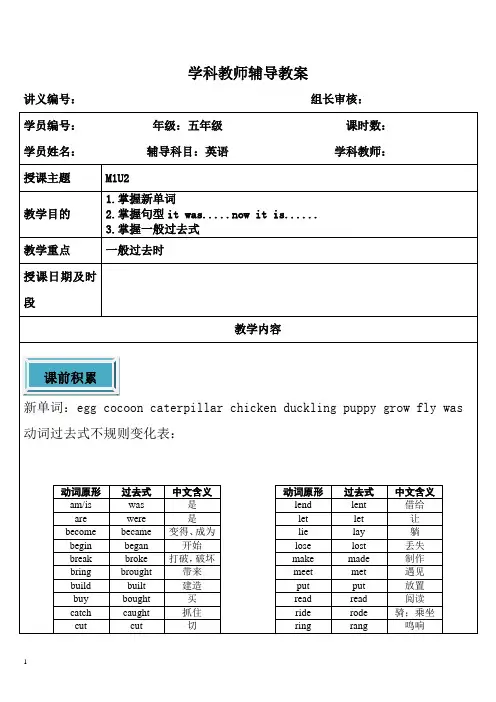
说话
give
gave
给
spend
spent
花费
go
went
去
stand
stood
站立
have/has
had
有
swim
swam
游泳
hear
heard
听见
take
took
拿,取
hide
hid
躲藏
teach
taught
教
hit
hit
打
tell
told
告诉
hold
held
举行;握着
think
thought
3 Theycocoons Now theybutterflies.
A were...are B was...are C was...am
4 ---you a student? ---Yes,I.
A Was...were B Were...was C Were...were
5 A butterflyeggs on the leaf.
6 Thereany silk in the box.
7 Our friendsome black tadpoles.
8 My moths are small.are big.
1.抄写新单词,每个4遍并家默
2.熟读M1U2课文并打卡
3.默写动词不规则变化表第一列
4.配套试卷一份
一般现在时:表示经常性、习惯性的动作,表示现在的状态、特征和真理,常与sometimes,often,usually,every day等时间状语连用。
举例:It was a white egg.(过去时态)----Now it is a green caterpillar.(现在时态)
五年级下册M2U1She learnt English.

Module2 Unit1 She learnt English.教案【教学目标】知识目标:1)会读会写单词learnt/these/dancer/ study/hard/taught。
2)掌握动词不规则变化,以及be 动词的过去式was, were 的用法。
3)操练句型Did you / he / she + verb` .?Yes, I / he / she did ;No, I / he / she didn't.能力目标:能用英语来询问过去所发生的事情及他人过去和现在的状态。
情感目标:1)乐于开口,积极参与课堂活动,并与他人合作学习。
2)有兴趣谈论自己家人的过去并与现在作比较。
【教学重难点】能听懂Did your grandma learn English?这类句型,并能口头运用He is learning English now.说明自己想要表达的过去和现在的状态。
用英语描述过去和现在的变化。
【教学方法】小组合作法、讲授法、情境教学法、游戏教学法【教学工具】PPT 、单词卡、图片【教学课时】第一课时【教学过程】Step 1. Warming up (热身活动)(5分钟)Good morning,Boys and girls。
问一个女生是否喜欢跳舞1. T: Do you like dancing?S: Yes, I do. /No, I don't.(如她喜欢跳舞,请她上台跳舞,然后说:)T: Look! She is dancing.(接着视频展示舞蹈家杨丽萍的孔雀舞,然后对同学们说:)T: Do you know Yang Liping?She is a famous dancer.(教授dancer 这个单词,并分别讲解dance,dancing,dancer,让学生区分和理解这三个单词。
)2. T: Do you like learning English?S: Yes, I do. And we are learning English now.(教授learn这个单词,让学生学会运用learn Chinese, learn Japanese)3. T: We are learning English now, but did your mother learn English?S: Yes, she did / No, she didn't.(如果学生肯定回答,教师通过重复句子,引出learn 的过去式learnt)4. T: Did your father learn English?S: Yes, he did / No, he didn't.(如果学生肯定回答,可以重复句子:He learnt English.)T: Did he learn any foreign languages?S: Yes, he did / No, he didn't.(解释foreign languages的意思,并教读发音,特别注意学生的口型。
牛津上海版五年级下册M2U2教案
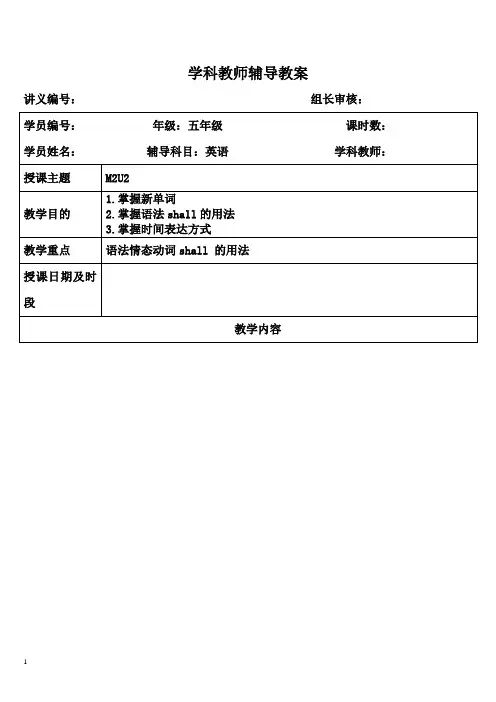
听见
take
took
拿,取
hide
hid
躲藏
teach
taught
教
hit
hit
打
tell
told
告诉
hold
held
举行;握着
think
thought
思考,想
hurt
hurt
伤害,疼
understand
understood
理解
keep
kept
保持
wear
wore
穿
know
knew
知道
win
8 The snow white is asleep.(否定句,意思不变)
6、阅读填空
I cfind my toy car. Wis it? Is it bthe door? Is it ithe cupboard? Is it uyour bed? Oh! It’s bthe cupboard.
1.抄写新单词,每个4遍并家默
Seat n.座位 sit v.坐
2.学习look and say 部分
Shall aux.应该 相当于should
Shall 是一个情态动词,表示“将要、要不要、应该”等意思,语气比较委婉,用于疑问句中表示请求给予指示、征求对方意见、主动提供帮助等时,常用句型“shall i/we.....”意思是“....好吗?要不要.....?”这种问句没有固定的肯定句或否定回答模式,可根据实际情况表明对待意见的态度。
Buy sth for sb.=buy sb sth给某人买某物
three tickets for Snow White 三张白雪公主的电影票
新牛津上海版深圳五年级下册unit 2《our new home》第一课时优秀教案(重点资料).doc

Module2 Period1 教案一、教学目标:1、知识目标:(1)掌握四会单词:why, because, study, dining room, all day.(2)能用特殊疑问句Why do you like…?询问别人喜欢某物的原因,并能用Because…句型说明喜欢的原因。
2、技能目标:(1) 学生能够熟练记忆本节课的重点单词。
(2) 学生能够在真是的情景中运用本课重点句型Why do you like…? Because…3、情感目标:培养学生热爱生活,发现生活中美的品质。
能真实表达自己的喜好。
二、教学重难点掌握四会单词:why, because, study, dining room, all day.句型Where’s …? It’s … Where are …? They’re…的运用三、教学过程:Step 1: Review:T: Hello, boys and girls. Before our class, let’s sing a song <Table and chait>了解部分房间的名称,和与房间有关物品的名称,同时活跃课堂气氛。
Step 2:New words:听录音,学习单词living room. 解释live---living----living room 举例句We are watching TV in the living room.学会看图选出哪副图片属于客厅的。
Which one is in the living room.The sofa is in the living room.学习单词study 解释它的名词和动词词性。
举例说明I can read books in the study.I study in the classroom.学习dining room 解释dinner—dining—dining room. We have breakfast in the dining room. Step 3:Gassing game.出示房屋的的四个房间,living room, bedroom, study, dining room. 学生先抢答他们的名称,然后用图片遮挡图片,然后学生猜带有问号的图片Step 4 : Let’s learn.Read the story and answer the questions.. 1.Why does Sally like the living room?2.Why does Dad like the study?3.Why do Peter and Paul like the garden?学生阅读对话找出答案:Because it’s so big.Because he can read and write there.wBecause the can play in the garden all day.2学生找出答案做练习Fill in the blacks. 巩固课文内容。
沪教牛津版英语五年级下册Module 1 Unit 2课件ppt

Module 1 Using my five senses
Unit 2 Use your ears
Let’s learn the imperatives sentence.
第二人称
祈使句
第一和第三人称
主语为第二人称 Switch off the motor. Follow the rules of the road. Don’t leave the light on.
4. 含let 的祈使句:Let somebody v/adv. Let’s be friends. Let me have a try, will you ? Let him in, please.
5. 不用动词开头的祈使句。 To pumps , every one of you ! To the airport , taxi! Down with the pens! No smoking ! No parking ! No spitting ! No litter! No admittance except on business!
★ Turn on the car radio ★Blow your horn
★ Speak to your passengers ★ Follow the rules of the road ★ Keep cool
★React when others drive badly ★Break the rules of the road ★Get angry
主语为第一,三人称 Let me see. Let her come here at eight o’clock. Let us help you tidy your room. Let’s have a break.
牛津上海版(试用本)五年级下册英语Module 1 Unit 2 Watch it grow!_The fourth period教学设计
2.Put the students into groups.Each group can choose and tell a story about the growth of an animal or an insect.Then ask the groups to write stories down and invite several groups to share them with the class.
4.Role-play the story in groups.Walk arபைடு நூலகம்und the classroom and help the students if necessary.
鼓励学生主动阅读文本,培养学生自主学习的能力。
学生通过角色的扮演,提高语言的表达能力。
Post-task activity
Unit 2 Watch it grow!
The fourth period
【教学目标】
认知内容:Using adjectives to describe some animals and insects.
能力要求:学会用所学的句型进行表述,培养学生的语言表达能力。
情感态度:通过语篇的阅读,增加学生语言的信息量,同时让学生积极主动地运用所学的语言,表达动物和昆虫的变化成长过程。
五年级英语下册 Module 1 Unit 2(2)课件 沪教牛津
主语为第一,三人称 Let me see. Let her come here at eight o’clock. Let us help you tidy your room. Let’s have a break.
1.祈使句的否定式: Don’t +动词原形 Don’t be nervous ! Don’t make any noise in the reading room.
4.The girl is __u_n_d_e_r_ the tree.
请同学们再从这幅图画里找句子.(运用今 天学过的方位介词)
•11、凡为教者必期于达到不须教。对人以诚信,人不欺我;对事以诚信,事无不成。 •12、首先是教师品格的陶冶,行为的教育,然后才是专门知识和技能的训练。 •13、在教师手里操着幼年人的命运,便操着民族和人类的命运。2022/1/152022/1/15January 15, 2022 •14、孩子在快乐的时候,他学习任何东西都比较容易。 •15、纪律是集体的面貌,集体的声音,集体的动作,集体的表情,集体的信念。 •16、一个人所受的教育超过了自己的智力,这样的人才有学问。 •17、好奇是儿童的原始本性,感知会使儿童心灵升华,为其为了探究事物藏下本源。2022年1月2022/1/152022/1/152022/1/151/15/2022 •18、人自身有一种力量,用许多方式按照本人意愿控制和影响这种力量,一旦他这样做,就会影响到对他的教育和对他发生作用的环境。 2022/1/152022/1/15
4. 含let 的祈使句:Let somebody v/adv. Let’s be friends. Let me have a try, will you ? Let him in, please.
最新上海版新牛津英语5B教案M2U1
5B Module 2 Unit1 Food and drinks 教学内容:教时安排:The first period教学内容:认知内容: Using the key words in context.能力要求:能用所学的单词正确表述各种不同的食物和饮料。
情感态度:能正确掌握食物类单词。
教学过程:The second period教学内容:认知内容: 1. Using the key words and phrases in context.2. Using the simple past tense to talk about past events.3. Using wh-questions to find out specific information.能力要求:学会用所学的句型表达一日三餐的饮食。
情感态度:通过学生之间相互交流,了解同学间一日三餐的饮食情况。
教学过程:The third period教学内容:认知内容: 1. Using the simple past tense to describe habitual actions.2. Using the simple present tense to describe present states.3. Using determiners to express indefinite quantities.能力要求: 学会正确表述健康的生活习惯。
情感态度:通过学习, 培养学生之间相互交流的能力,同时让学生养成健康的生活习惯。
教学过程:The fourth period教学内容:认知内容: 1. Using the simple present tense to describe present states.2. Using the simple past tense to describe habitual actions.能力要求:学会用所学的句型进行表述, 培养学生的语言表达能力。
牛津上海版小学五年级下册英语Module2-Unit1第五课时课件说课稿
5BM2U1 P5 说课稿各位老师大家下午好,今天我就5B Module2 Unit1的第五课时进行一下简单的说课。
首先M2U1的主题是Food and drinks。
本单元的教学目标如下以及本单元的教学设计在此就不一一赘述了。
本单元分为五个课时,单元课时项目和话题如下:第5课时的主题是Keeping healthy, staying fit这个话题,以美食节闭幕后,Miss Fang 和学生们交流最喜欢的食物为情境,通过介绍和对话较为熟练地运用本单元的核心词汇与核心句型,在创设的情境中通过各种练习类型,有机整合新旧知识,训练技能,达成语用,进一步感受健康生活所带来的不同好处,进一步体会健康生活对于人们的重要性。
这个情境比较贴合我校学生的实际生活,巩固了本单元的词汇和句型,结合文本要求单词熟练拼写,句型正确运用,朗读时语音正确流利。
因此制定了本课的教学目标,要求如下:1、进一步复习进一步学习辅音音素/əʊ/和/aʊ/在单词中的发音,在练习中区别音素,掌握一定的读音规则。
2、较为熟练地运用本单元的核心词汇与核心句型,如:meat, pork, beef, chicken, fish, fruit, vegetable, tomato, potato, carrot, cabbage, bean, rice, milk,had, eat, did, healthy, keep…away等;补充拓展学习lamb、steak、peas、porridge、pasta等内容。
3、能在互动、讲练与练习中提升单元核心的语用能力。
4、在巩固理解何为健康饮食以及了解一日三餐的健康饮食的重要性,进而感受到可以从更多方面定义健康生活。
在Part1 的环节设计中,首先通过听读儿歌复习导入,引用情境中的图片引入含有/əʊ/音素的单词。
朗读和复习本学期学过的八个双元音的音标。
对其中的一些内容进行问答互动。
通过朗读和选择练习,进行再巩固。