
牛津译林版小学英语六年级上册全册教案及课后反思
Unit 1 The king’s new clothesStory time本课是六年级上学期第一单元Story time部分对话题的语篇阅读教学。
阅读过程中,重在培养学生的阅读兴趣,教会学生简单的阅读策略。
在学习和实践的基础上,体现了以下特点:1.各班学生层次不一,学习能力较差的同学兴趣不高,甚至羞于参与课堂教学。
针对这一情况,可以发挥小组合作,同桌交流的形式,让所有的学生都能参与课堂活动,以便各有所获。
2.整堂课中,注意学生阅读方法和阅读习惯的培养。
在逐步理解故事的过程中,分别让学生采用快速读、默读、跟读、朗读方式进行学习。
而且在每一次的活动中,我都让学生带着一定的任务去读,具有一定的目的性,并规定用不同符号在文中画出答案,培养学生勾画、做批注的习惯。
3.对于高年级的学生而言,英语思维的发展重要性逐步凸显出来。
我们应该力图通过不同形式、不同层次的活动,跳出机械认读的学习方式,激活学生的思维,学生思维发展是一个长期训练的过程。
Grammar time & Fun time本课是六年级上学期第一单元(Grammar time &Fun time)环节的语法教学。
教学过程中,重在引导学生在小组内进行对比、分析、整理出一般过去时态的结构和动词过去式变化规则,并能够熟练进行语言练习。
纵观整节课的教学活动,总结出以下问题及经验:1.在小组活动中解决问题虽然降低了教学难度,但仍不能完全有效调动小组成员完成任务,个别组员存在“浑水摸鱼”的行为,因此小组活动前的任务分工很重要。
2.教学情景化是指课堂教学必须最大限度地引起学生的学习兴趣,为学生提供足够的机会用英语进行交流和活动,让学生感受到运用所学英语在课堂上进行交流后产生一种自豪感,心里产生愉悦感。
本节课中部分学生表演得相当出色,特别是得到老师的表扬时,这些学生的心情非常激动。
所以英语教学的课堂必须通过各种手段来提高学生的英语兴趣,要让小学生能够在四十分钟的时间内保持良好的学习状态,必须根据不同的教学内容创设各种情景,做到教学情景化。
Sound time, Culture time & Cartoon time通过本节课教学我发现:课堂游戏如果数量过多,很容易喧宾夺主,造成学生忽略对教学内容的巩固和接受,使原本以学习和提高英语能力为目的的英语课变成了游戏活动课。
所以,在教学实践中,教师选用的游戏要精,要富有创意。
即使是再有趣的活动,如果教师一成不变地长期使用,学生也会觉得索然无味,最初的活动兴趣就会不复存在。
因此,英语游戏教学想要使学生乐于接受,乐于参与,教师就应不断搜集游戏,并富有创造性地设计出新的游戏活动来激发学生的兴趣。
同时,我也发现小学生的天性是爱玩并且喜欢争强好胜,有些学生做起游戏来容易忘乎所以,即使在课堂上也会情不自禁地大呼小叫,走来窜去,使教师对课堂纪律难以控制。
因此,教师在组织学生游戏活动时,要充分发挥指导和调控作用,使学生做到动静有序,令行禁止。
首先,在游戏开始前教师要讲清楚游戏规则、评分标准和纪律要求;另外,教师也要积极参与游戏活动,及时发现并解决问题。
这样,在游戏过程中即使出现一些小插曲,教师也能有规可循,有则可守,较好地控制局面,培养学生的自律意识,从而使课堂达到活而不乱的教学效果。
Checkout time & Ticking time本节课是一节知识巩固课,同时要对学生之前所学的内容进行自我检测。
为了能上好自己的复习课,提高学生运用英语的能力与技巧,我有以下几点看法:一、在教学过程中教师要摆正自己的位置,明确学生才是学习的主角,教师应放手让学生主动回忆、巩固所学过的知识。
整个过程中教师只需起到引导和检查的作用,教师提出一个知识点后让学生快速地去回忆,这样一来教师就会感到很轻松,学生的积极性也就调动起来了。
二、教师要明确复习课的主要目标是:引导学生对所学知识进行查缺补漏,疏理归类,便于学生记忆和融会贯通,提高掌握和综合语言运用的能力。
针对六年级学生所具有的强烈的竞争和进取意识的年龄特点,教师要在英语课堂上适当创设情境,有意识地增添一些趣味性和竞争性的活动,激活英语课堂,增强学生的自信心。
三、在自我评价过程中,如何使学生建立学习英语的自信心是极其重要的。
自信心就像人的能力催化剂,将人的一切潜能都调动起来,将各部分的功能推动到最佳状态。
因此在评价过程中,教师要注意帮助学生端正评价态度,启发和鼓励学生树立自信心,排除不良思想和自卑感,并努力为他们创设一个拥有最佳心理状态的环境,学生心情愉快,愿意上英语课,就容易记住所学知识。
Unit 2 What a day!Story time1.在教案设计中注重课程的开发和利用,增强学生综合运用能力,使课堂与生活“链接”。
2.引导学生将语言知识联系到自己的生活中,让孩子们主动积极交流,尽量在课堂上开发学生的自主学习、合作交流、合作探究的能力,发展学习策略,培养创新能力。
3.从课前的教学设计到课中的教学过程,教者始终努力凸现学生的主体地位,赋予学生以广阔的学习空间,引导学生全身心地沉浸到教材意境中,真正做到学以致用,联系生活。
4.教师要学会指导学生通过多种形式进行朗读,帮助学生记忆单词和句型。
5.教师能灵活把握教材,做到详略处理得当。
正确处理教与学的关系,既充分发挥小学生活泼好动、乐于表现的天性,又能使他们在游戏竞争中学习知识。
Grammar time & Fun time板书是最常用的教学手段之一,好的板书是教学内容的浓缩。
随着多媒体教学手段的广泛运用,部分教师往往容易忽视板书的作用在讲授阶段,好的板书设计具有提纲挈领,突出重点,增强教学过程节奏感,集中学生注意力参达到审美教育的作用。
同时,也有助于学生记忆、理解相关内容,便于学生记录和课后复习。
本节课为了使学生很容易分析、整理一般过去时态的结构和突破动词过去式的规则与不规则变化这一难点,我抓住板书的直观性和突出性,将语言知识进行架构,降低知识难度,使学生易于理解与掌握。
因此,好的板书直接影响着讲授的效果。
Sound time, Song time & Cartoon time传统的语音教学是在教师领读之后,给学生讲解发音方法,讲舌位、齿位等,教师费力、费时.学生却云里雾里,使得本就枯燥的音标更加乏味了。
如果尝试把语音教学内容改编成歌曲、口诀,则是一种很好的辅导方法,因为歌曲、口诀能加深记忆,而且学生可以通过好的节奏和旋律把学到的知识和歌词一块儿记住。
童谣、儿歌读起来朗朗上口,文字简练,通俗易懂,易读,节奏感强,有韵味。
既能充分调动学生学习语音的兴趣积极性,也让学生在美的熏陶中获取了英语语感。
同时,教学过程中还可以采用辅助现代化的视听手段和各种多媒体——实物、图片、光盘、动画等直观教具,这些都能对培养学生学习语音的兴趣起到积极辅助作用。
总之,语音教学的好坏直接关系着英语教学的成败。
作为英语教师,要始终不断地提高自身教学素养,积极地进行教学研究,努力让学生训练出良好的语音语调,他们为进一步学习英语打下坚实的基础。
Checkout time & Ticking time众所周知,听是理解和吸收口头信息的手段。
听和读是输入,只有达到足够的输入量,才能保证学生具有较好的说和写的输出能力。
语言学家认为,说的能力和听的能力是密切相关、相辅相成的,人们只有听懂,才能说清,才能表情达意,从而充分发挥语言的交际作用。
听是说的基础,说是听的提高。
为了培养和提高学生听的能力,要尽力为学生创造“听力环境”,充分利用电教手段。
如每堂课上必须用录音机进行教学,让学生听原汁原味的英语,这样可大大增加纯正英语的输入量,帮助学生学到纯正、地道的语音语调,培养学生良好的语感。
还要充分利用PPT创设与教学内容相符的场景、图像,使学生能够结合生动的场景理解语言,增强学习的趣味性,以利于学生听说能力的培养。
通过长期的听力训练,实现学生对音的感知和识别、对具体材料的初步理解,使学生领会材料的意思并进行记忆,即认知—理解—记忆的过程。
Unit 3 Holiday fun!Story time本节课,在阅读教学过程中结合了任务教学法进行教学,学生在完成任务的过程中实现了对知识的构架,同时也培养了学生的自主学习能力。
进行任务教学首先要为学生创设真实语言情境,要培养学生在真实生活中运用语言的能力,就应让学生在教学活动中参与和完成真实的生活任务,因此教师设计任务时要提供给学生明确、真实的语言信息,使学生在一种自然真实或模拟真实的情景中体会和学习语言,这样就可以使学生直接感受语言的交际用途,把语言的学习和运用自然而有机地结合起来。
其次,结合本课的教学内容,培养学生在对话中的交际能力应是本课的教学重点,语言的交际功能是在一定的情境中体现出来的,教师设计活动,完成任务时,应尽力创设真实的语境,注意设计具有信息差的活动内容,让学生在具体的语境中体会语言的交际过程。
同时又因为六年级的学生喜欢新鲜事物,乐于接受挑战,如果教学过程中教师所设计的任务只是浅层次的交际活动,缺乏一定的创造性,则会影响学生自主学习能力的培养,甚至还会使学生丧失学习的动力。
因此,任务的设计应由浅人深,由表及里,注重培养学生的思维能力和创造能力。
总之,希望任务型教学能给英语课堂教学带来活力,强化学生的语言运用能力,注重发展学生的学习策略,促进学生创新精神和实践能力的提高。
Grammar time & Fun time本节课在整理语言结构过程中采用了小组合作的形式来进行,众所周之,英语教学的最终目的在于运用英语进行社会交流,这就意味着学习并非是封闭的纯个体行为,而应在群体合作、交流的氛围中进行。
小组合作学习是以合作互动小组活动为基本组织形式的教学活动,是目前世界上许多国家普遍采用的一种富有创意和实效的教学方法。
它以团体学习作为评价标准,共同达成教学目标。
为此,教师在教学过程中应设计多维互动、丰富多彩的合作活动,激发学生学习英语的浓厚兴趣,发掘学生积极求知、努力进取的潜能,提高学生的英语运用能力和接受继续教育的自学能力,培养学生的团结合作精神和合作的技能技巧,从而全面提高学生的英语素质,以达到“人人有所收获”的目的。
学生在活动中的合作互动是促使全体学生积极参与的关键;提高小组合作活动的质和量:是保证学生学习成效的核心;学生在合作互动过程中调控情感态度和学习策略,是形成积极的学习态度、提高语言运用能力的保证。
合作互动的学习方式,为学生提供了充裕的时间;互助学习开展的广阔空间,使学生在宽松、民主、和谐的气氛中积极主动参与学习,从而全面地提高了学生的英语素质,同时培养了学生的自主学习能力、团结协作和社会交往能力,从而较好地达到了小学英语救学的目标与要求,使得人人有所收获。
最新苏教牛津译林小学英语六年级上册《Unit 1 The king’s new cloths》公开课教学设计(3)

【课题】Unit 1 The king’s new clothes总第【6】课时【主备人】【教学内容】译林版小学六年级英语上册第一单元第14页Checkout time【教学目标】1. 复习与巩固前三课时所学单词、句型和日常用语。
2. 熟练掌握一般过去式相关语法知识,并能正确运用。
3. 加强语言输出的训练,促进综合语言运用能力的提升。
【教学重点】加强语言输出的训练,促进综合语言运用能力的提升。
【教学过程】1. Free talk:Daily report.2. Review:a. Act out Cartoon time.b. Finish some exercise about past tense3. Checkout timea. Read and writea) Read the words.b) Finish the story.c) Read and learn the new words.d) Fun reading.b. Circle and saya) Circle the correct words.b) Prepare your own story.c) Tell your story in groups.d) Choose the best story teller of the group and let him/her tell the story in class.4. Ticking time5. Homework:Finish the exercise book.选择正确答案。
(15分)( )1. Long long ago, there a boy called Ma Liang.A. wasB. wereC. isD. sre( )2. I ________ TV a moment ago.A. watchB. watchedC. lookedD.look( )3. Tom visited the farm _______ his family yesterday.A. withB. forC. inD.and( )4. I want to play _______ football but he wants to play _______ volleyball.A. /; theB. /; /C. the; /D. the; the( )5. Do you want ________?A. visit the forestB. visiting the forestC. to visiting the forestD. to visit the forest ( )6. Each student one picture.A. drawB. drawsC. drawingD. to drawing( )7. She usually _______ new clothes his doll.A. makes…withB. make…forC. makes…forD. make…with( )8. The lion always walks ______ the forest every day.A. onB. underC. throughD.( )9. Were there ________ people in the street?A. someB. anyC. muchD. a( )10. What ________ beautiful girl!A. / B an C. a D. the( )11. The shoes are very cool, but they me.A. are fittingB. fitC. don’t fitD.fitted( )12. like to wear a kilt.A. The ChineseB. The ScottishC. The AmericanD.The English( )13. The little boy the king, because he is too foolish.A. looked atB. pointed atC. laughed atD. shoutedat( )14. Yesterday Nancy was sick, her mother her carefully.A. looked afterB. looked atC. looked forD.looked out( )15. The witch(女巫) the prince the lion.A. turned …onB. talked…with…C. told…aboutD. turned…into三、词组翻译。
小学英语译林牛津版六年级上册《signs》教案3
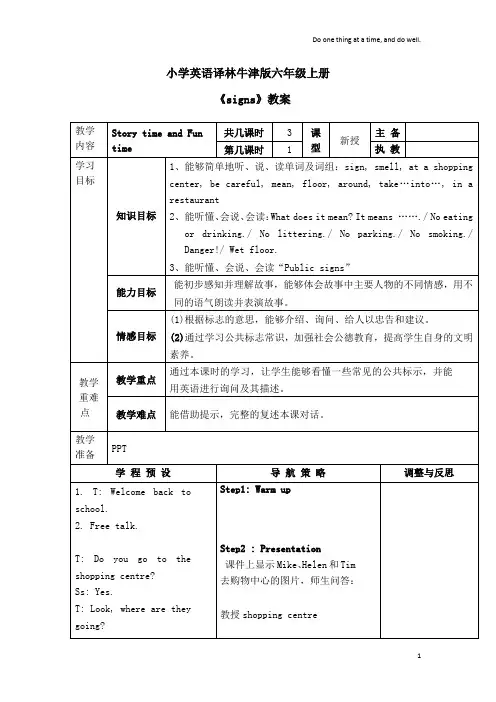
小学英语译林牛津版六年级上册《signs》教案教学内容Story time and Funtime共几课时 3 课型新授主备第几课时 1 执教学习目标知识目标1、能够简单地听、说、读单词及词组:sign, smell, at a shopping center, be careful, mean, floor, around, take…into…, in a restaurant2、能听懂、会说、会读:What does it mean? It means ……./ No eatingor drinking./ No littering./ No parking./ No smoking./ Danger!/ Wet floor.3、能听懂、会说、会读“Public signs”能力目标能初步感知并理解故事,能够体会故事中主要人物的不同情感,用不同的语气朗读并表演故事。
情感目标(1)根据标志的意思,能够介绍、询问、给人以忠告和建议。
(2)通过学习公共标志常识,加强社会公德教育,提高学生自身的文明素养。
教学重难点教学重点通过本课时的学习,让学生能够看懂一些常见的公共标示,并能用英语进行询问及其描述。
教学难点能借助提示,完整的复述本课对话。
教学准备PPT学程预设导航策略调整与反思1. T: Welcome back to school.2. Free talk.T: Do you go to the shopping centre?Ss: Yes.T: Look, where are they going? Step1: Warm upStep2 : Presentation课件上显示Mike、Helen和Tim 去购物中心的图片,师生问答:教授shopping centreS: They are going to the shopping centre.T: What can you see in theshopping center?S: ……T: They can see some public signsT: How many signs can they see in the text?T: How many signs can they see?S: Four.T: What are they?(课件上逐张显示No eating or drinking, No littering, No parking, No smoking,Danger, Wet floor 的图片,让学生选择)T: They can’t see these signs. What do they mean? What does this sign mean?(板书举行)S:学生用中文描述T:Yes, it means ‘No parking.’.(将学生分成四大组,每组讨论一副图片,分别讨论一个公共标志)(1) T: What does itmean?S: It means ‘Wet floor’.T: What does that mean?S: It means the floor is wet.(讨论这一副图片的学生做教授public signs1、Watch and answer.2、Choose and talk.3、课文中No parking!Danger!没有出现,教师先在此教授。
牛津译林版六年级英语上册Unit 3 Holiday fun 教学设计 1

Unit 3 Holiday fun 教学设计1Teaching contents教学内容:Story time & Think and writeTeaching aims and learning objectives教学目标:1 Students can listen, speak and read the new words : Bund , Shanghai Museum , caught , ate.2 Students can read and understand the meaning of the story.3 Students can retell the story.4 Students can talk about their holiday life.Focus of the lesson and predicted area of difficulty教学重难点:1 Students can read and understand the meaning of the story.2 Students can retell the story.3 Students can talk about their holiday life.Preparation教学准备:PPT , some photosTeaching procedures教学过程:Step 1 Free talk1T: Boys and girls , welcome back to school .It was National Day holiday last week .Did you have a good time for the National Day holiday?( Teach : National Day , holiday )How do you feel your holiday ?S: …2 T: I took some photos on National Day.Look at these photos and you will know where I went for the holiday.(Show the pictures: Xuanwu Lake, Hongshan Zoo , Wanda Cinema)3 T: Where did I go for the holiday? What did I do there? Guess! S :…4 T: What about you? Where did you go for the holiday? What did you do there ?S:…Step 2 Presentation1 T: Just now we talked about our National Day holiday.Mike and Liu Tao talked in the classroom.What did they talk about? Can you guess?2 Let’s watch the cartoon.What did they talk about?A: National Day holiday B: Planning for the weekend C: May Day holiday3 T: What did Liu Tao and Mike do for the National Day holiday?( Show “ Think and write “ )Please read the story by yourselves and try to fill in the blanks.( Teach : Bund , Shanghai Museum , catch—caught )4 T: Nancy wants to know how do Mike and Liu Tao spend their holiday .So she asks Su Yang some questions about th e two boy‘s holiday.Can you help Su Yang to answer the questions?( Show “ Ask and answer “ )Please read the story again and try to underline the answers.S:…5 Read the story in group .6 Try to retell the story .Mike and Liu Tao talked about their National Day holiday.Liu Tao went to ….andMike …Step 3 ConsolidationT: It was the first day after the National Day holiday. Mr Green asked the students to write a story about their holiday life . How do Mike and Liu Tao to write? Can you teach them? You could help one of them . Please write and read to him.Homework家庭作业1 Talk to your classmates about your National Day holiday.2 Write a story about your holiday life.。
牛津译林版六年级上册英语Unit 1教案
...
Teach the past tense of these words.
...
2Practice
(1)师生问答,操练规则动词过去式
T:(做弹钢琴的动作)
Ss:You played the piano.
...
(3)两人活动,操练规则动词的过去式(老师将规则动词的卡片一起呈现在黑板上,然后安排学生两人一组,一个选择一个动词并做相应动作,另一个用过去式给予描述)
1小组活动,描述儿时照片,操练be动词。(要求同学课前准备好照片,互相描述对方外貌,然后再用第三人称向他人介绍)
S:I/He/She was ...
S:You were ...
老师llS3 Reading and understanding
1听录音,排序图片
Show the four pictures of the text.Play the tape ,ask Ss
建议
Step1 Warm up
(1)Greetings
...
2 Look and say (Review the sentence”There be ...)
Show the pictures of the text and ask Ss to describe the the sentence“There be...”and the teacher can introduce the words“clever”and“foolish”.
Prepare some pictures about some actions and sports (如:shout,talk,walk,play,push,ump,skate,dance),ask Ss to read and do it.Then the teacher ask the students:”What did you do?”引出动词过去式。
牛津英语六年级上册6AU6教学设计及教学反思
6A Unit 6 Keep our city clean(Teaching Plan)Anding Primary School Wang YanLearning Aims:1. Be able to grasp the main ideas of the story, understand the story and try to retell it.2. Be able to read the following words and know their meanings in the story:keep, clean, make, dirty, smoke, air, messy, rubbish, dead, move, away, bin, plant, more.3.Be able to understand and try to use the following sentence structures in real life:What makes…dirty? What can … do to keep…clean?4.Try to be a good student to keep our city clean.Learning procedures:Activity One Warming up and leading inEnjoy some picturesT:Last National Day holiday, I went around our city. And I took some pictures. Let’s enjoy! T:I like our city because it is clean and beautiful! What does “clean” mean?T:The city is so clean and beautiful. We should …(Learn the title:Keep our city clean)Activity Two Presentation and practice1.Read and choose(P58)a T:We talked about my city. Miss Li and her students are talking about their city, too. Let’s read this part and choose the pictures of their city.(Work in groups, find the key words:smoke from cars &black smoke from factories air, rubbish the streets , the river )(Learn:smoke, rubbish, dead )b. try to say2. Read and write(P60)T:We know the city is dirty? What can we do to keep our city clean? Please read and write. (Work in groups, find the key words:take…to…, walk to …, move away from… put…in, plant more…)(Learn:move away from, plant more…)Activity Three Consolidation1.Read in rolesT:Well done, children. Now it’s time for you to read in roles.2.Retell the storyT:Now let’s retell the story together.3.Look and talkT:Now look at this room. Is it clean?T:It’s dirty and messy. What makes the room messy and dirty? Look at the clothes. Where are they?T:So the clothes make the sofa dirty. What can we do to keep the room clean?T:What else makes the room messy and dirty? Please talk in your groups.(Work in groups)4. Watch a videoT: Now let’s watch a video.T: What ideas would you like to share with others?Homework:1.Copy the new words.2. Listen and read the story.3. Make a poster about keeping the city clean in groups教学反思:一、备课的总体原则1.活动贯穿全课2.充分利用教材文本作为学习媒介。
牛津译林版-英语-六年级上册-牛津小学译林版6上Unit5 signs全单元教案
教学准备: 1、教学挂图;2、教学光盘; 3、录音带。
主备老师教学策略
二次备课
小学-英语-1上册-打印版
小学-英语-上册-打印版
Step 1. Warming up 1.Free talk. T-Ss: Where did you go last weekend? What did you do ? (互相问候,由老师所创设的情景引导学生回忆假期生活) Step 2. Presentation 1.T: Did you go to the shopping centre? Ss: Yes. T: Look, where did they go? (课件呈现 Mike、Helen 和 Tim 去购物中心的图片) S: They went to the shopping centre. (教授 shopping centre) T: What can they see in the shopping centre? S: …… T: They can see some public signs.(教授 public signs) 揭题:Unit5 Signs 2. Watch and answer. T: How many signs are they talking about? Let’s watch the cartoon and then you can answer. (Ss watch and answer) T: How many signs are they talking about? S: Four. 3. Listen and tick .(听课文录音,寻找标志)
单元 5 第 2 课时
1.知识目标:
(1)学生能听懂,会读,会说,会写日常用语 No eating or drinking, No littering, No parking, No smoking.
【新】牛津译林苏教版六年级英语上册Unit5Signs全单元教案.doc
【新】牛津译林苏教版六年级英语上册Unit5Signs全单元教案.doc教学内容: Unit 5 Signs Story time 单元 5 第 1 课时1.知识目标(1)能初步感知并理解故事,能够体会故事中主要人物的不同情感,用不同的语气朗读并表演故事。
(2)能够简单地听、说、读单词及词组:sign, smell, at a shopping centre, be careful, mean,floor, around, take…into…, in a restaurant(3)能听懂、会说、会读:What does it mean? It means ……./ No eating or drinking./ Nolittering./ No parking./ No smoking./ Danger!/ Wet floor.(4)能听懂、会说、会读“Signs”。
2.技能目标(1) 能借助提示,完整的复述本课对话(2) 通过本课时的学习,让学生能够看懂一些常见的公共标识,并能用英语进行询问极其描述。
3.情感目标(1)根据标志的意思,能够介绍、询问、给人以忠告和建议。
(2)通过学习公共标志常识,加强社会公德教育,提高学生自身的文明素养.教学重点和难点通过本课时的学习,让学生能够看懂一些常见的公共标示,并能用英语进行询问及其描述。
教学准备: 1、教学挂图;2、教学光盘; 3、录音带。
主备老师教学策略二次备课Step 1. Warming up1.Free talk.T-Ss: Where did you go last weekend? What did you do ?(互相问候,由老师所创设的情景引导学生回忆假期生活)Step 2. Presentation1.T: Did you go to the shopping centre?Ss: Yes.T: Look, where did they go?(课件呈现Mike、Helen和Tim去购物中心的图片)S: They went to the shopping centre.(教授shopping centre)T: What can they see in the shopping centre?S: ……T: They can see some public signs.(教授public signs)揭题:Unit5 Signs2. Watch and answer.T: How many signs are they talking about?Let’s watch the cartoon and then you can answer.(Ss watch and answer)T: How many signs are they talking about?S: Four.3. Listen and tick .(听课文录音,寻找标志)T: What are they?(课件上逐张显示No eating or drinking, No littering, No parking, No smoking,Danger, Wet floor的图片,让学生选择)4. 课文中No parking和Danger!没有出现,在此教授。
最新牛津译林版六年级英语上册Unit1 The king’s new clothes单元优秀教案
课时Period 2教学内容TeachingContentsGrammar time & Fun time教学目标Teaching Aims能正确、熟练地背诵或者复述Story time。
能初步运用本课所学的词汇和句型谈论自己对所学故事的看法。
能使学生认识到在生活中要敢于说真话,不虚伪。
能正确说出规则动词的过去式。
能正确使用英语表演。
1. 复习环节。
1)检查背诵Story time。
根据上节课的tip指导,要给予学生足够的信息支撑:板书线索、图片(最好使用Fun time里的图片)和主句型。
让学生自主选择、合作完成背诵或者复述。
2. Fun time1)出示图片(之前背诵、复述用过的)让学生观察。
Who are they?2) If you are …, what can you say? 鼓励学生根据图片,发挥想象力,自由发挥。
3)两人一组,补全对话,拓展对话内容,鼓励学生加上动作表情。
4)小组PK。
3. Grammar time1) Quick respond: 两人一组,一个人说动词原形,另一个人说动词过去式。
T: is/ S: was.T: are/ S: were.T: look/ S: looked.…S-S; S-Ss. 游戏同时,教师板书过去式于黑板。
2) Summary:一般在动词末尾加-ed,如:point-pointed,shout-shouted以不发音的e结尾加-d,如:like-liked live-lived过去式“-ed”的发音规则(1)动词词尾为“t,d”时,发/ id /音,want →wanted need →needed(2)动词词尾为清辅音时,发/ t / 音。
help →helped laugh →laughed look →lookedkiss →kissed wash →washed watch →watched(3)动词词尾为t,d以外之浊辅音或元音时,发/ d /音。
牛津译林版-英语-六年级上册-Unit 2 An Accident Lesson 5 Get It Right 教案设计
Unit2 An accidentLesson 5 Get It Right教学设计教学目标1.仿照范例,给插图写出简短的说明。
2.结合插图读懂小短文,理解短文大旁。
3.区别字母组合ea和字母i在单词中的不同发音。
4.模仿录音有节奏地朗读小诗,体会句子的节奏和语调。
教学重点1.能区别字母组合ea和字母i在单词中的基本发音。
2.阅读短文,模仿范例写句子。
教学难点根据插图提示理解短文的大意。
教学准备课件、音频(教师可以在平台直接调用或下载)。
教学过程Get Ready(1)呈现故事插图,教师用现在时态描述插图内容,让学生转述故事。
提醒学生注意其中动词时态的变化,复习常用动词过去式。
(2)让学生分成小组表演故事,其中要有人担任旁白角色。
Read and Write1. 阅读短文(1)引导学生看短文的插图,说一说插图中的主要人物是谁、他去了哪里、遇到了什么事。
(2)告诉学生接下来阅读这个小故事,看一看他们的理解是否正确。
(3)给学生时间独立阅读小故事。
(4)采用问答的方式,引导学生读一读、说一说小男孩上周末去了哪里、他和爸爸观看了什么。
(5)让学生说一说小男孩遇到的老人怎么了,以及他和爸爸是如何帮助老人的。
让学生看短文结尾,请学生说一说为什么小男孩最后没有赶上机器人展览却不感到遗憾。
(6)让学生读短文,根据短文内容写出所缺的单词。
(7)教师朗读短文,全班一起核对答案。
2. 看插图写语句(1)引导学生看插图,说一说插图的内容。
为了表述方便,可以给其中的主要人物起名字。
(2)可以采用问答的方式,教师提问,引导学生讲述插图的内容。
T:Where did they go? What did they play? What happened to Joe? How did his friends help him?(3)结合学生的回答,教师可以把主要的动词或词组写在黑板上。
(4)让学生看教材提示,根据插图写句子。
牛津译林版六上U1 Sound time, Culture time, 教案 (1)
《英语》(六年级上册)Unit 1 The king’s new clothesSound time, Culture time, Checkout time & Ticking time苏州市金阊实验小学张玲Teaching contents 教学内容Sound time, Culture time, Checkout time & Ticking timeTeaching aims and learning objectives 教学目标1. 能听懂、会读、会说at half past four, cowboy, Scottish, kilt。
2. 能听懂、会说并准确读音单词中的字母组合ar。
3. 能了解美国人、苏格兰人等不同国家人们的传统服饰。
4. 能运用一般过去时态编述故事。
Focus of the lesson and predicted area of difficulty 教学重点和难点教学重点:能运用一般过去时态编述故事。
教学难点:能正确运用动词的一般过去式。
Teaching procedures 教学过程Step 1 Free talk & ReviewT: What did you do yesterday? What did you do last weekend? What did you do this summer holiday?(学生们回答)T: We have learned The king’s new clothe s. What do you think of the king?S: He’s foolish/not honest/…T: What do you think of the two men?S: They’re bad/cheaters/They want money…T: What about the people?S: They want to be clever./They are not honest…T: What about the boy?S: He tells the truth./He’s honest./…T: Can you understand the story now?S: Yes!(Ticking time第一条)T: The king liked wearing new clothes. Do you like wearing new clothes?S: Yes/No.T: What clothes do you like wearing?S: I like wearing …(Game time: 学生们一起玩游戏)T: Say the clothes when you see the picture. When you see the king, clap your hands once.【设计意图:通过师生问答复习过去时态。