
七年级英语下Unit 1 My name's Gina
七年级英语下Unit 1 My name’s Gina 一、写出下列各词的英语形式。
我名字我的女孩它
你的他的她的什么男孩
二、完成下列对话,每空一词。
1. —Hello. your name?
—name’s Jenny.
——I’m Tony.
—— Nice to meet ,Tony.
2. —What’s his name?
—His name Tony.
—What’s her name?
—name’s Jenny.
3. —What’s your number, Bill?
— 278-2397, thanks.
— 278-2397, thanks.
4. —Excuse me, are you Gina?
—Yes, I .
—— Bob. Nice to meet you.
—— Nice to meet you, .
三、翻译下列词组。
1. 我的名字
2. 姓氏
3. 很高兴见到你。
4. 电话号码
5.身份证
四、回答问句。
1.What’s your name?
.
2. What’s your telephone number?
. 3. What’s your family name?
. 4. What’s five and two?
.
五、用正确的英文数字填空。
1. two+ two=
2. two-two=
3. nine ÷three=
4. one×nine=
5. three +four=
6. nine÷nine=
7. six + two=
8. eight-one=
9. two ×four=
10. eight÷four=
六、改错。
1. What’s you name?
2. His name is Jenny.
3. I name is Gina.
4. I’s Gina
5. Peter is his last name.
七、完成下列句子。
1. 我叫詹妮,你叫什么名字?
2. 她的名字叫玛丽。
3. 他的名字叫托尼。
4. 你的电话号码是什么?。
Unit 1 My name is Gina教案3
《My name is Gina》说课稿秦红梅一、说教材作为初中第一次所学的单元,内容相对较为简单。
主要是让学生做到能用英语介绍自己,以及相关句型。
这是一篇在新学期第一课让学生间互相了解、建立友谊、了解中西方文化的课程。
因此,我将这个单元的重点、难点归纳如下:重点:1,理解并掌握句型What’s your name? My name is…. Nice to meet you. What’s your telephone number?2,掌握英文姓名的读法而本单元的教学难点归为:对句型What’s your name? 及其回答方式的掌握。
另外,我把本单元的教学目标分为三个:知识目标、能力目标、情感目标知识目标:理解并掌握句型What’s your name?能力目标:能听懂课文中的对话,并在其基础上编写对话。
能扩展句型,由What’s your name?到What’s his name? What’s her name?情感目标:1、激发学生的学习热情,树立学生学习英语的自信心,培养他们观察和主动竞争的意识。
2、提供良好的学习氛围,让学生敢于开口,主动模仿,培养同学间合作交流的能力及广交朋友、和谐相处的品质。
二、说教法与学法针对这一阶段学生好胜、好奇、表现欲强的特点,经过四年的小学英语启蒙,他们对英语有了一定的认识,这一阶段主要培养的是学生的理解能力以及学生的听、说、读、写各方面的能力,在传授的基础上,培养学生对英语的兴趣以及学习英语的能力。
教法:根据“以教师为主导,学生为主体”的原则,综合学生的年龄特征,我准备这个单元采用任务型教学模式,在运用多媒体教学的基础上,穿插图片示意法。
用来让学生互相了解对方基本情况,会运用句型What’s your name? My name is… Nice to meet you!教给学生中英文姓名的区别,掌握英文姓名的读法。
我将在课堂上多创造机会让学生练习本单元内容,让课堂活起来,在第一堂课增进生生、师生间的友谊。
初一英语试题Unit 1 My name’s Gina单元测试题及答案解析含听力
Unit 1 My name’s Gina.听力词汇A) 听力。
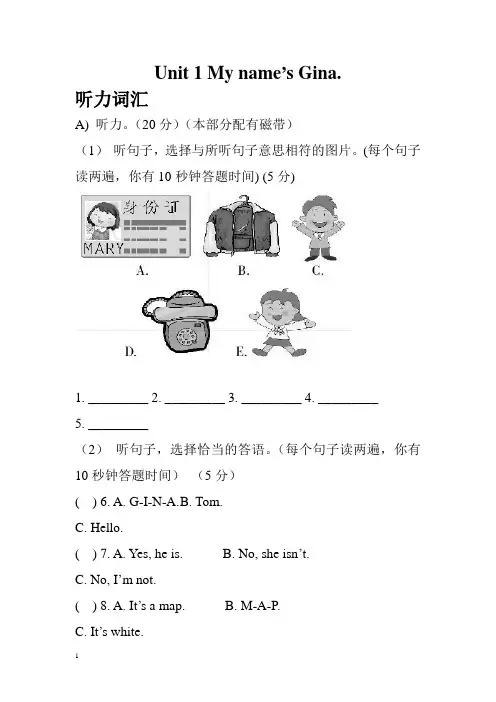
(20分)(本部分配有磁带)(1)听句子,选择与所听句子意思相符的图片。
(每个句子读两遍,你有10秒钟答题时间) (5分)1. _________2. _________3. _________4. _________5. _________(2)听句子,选择恰当的答语。
(每个句子读两遍,你有10秒钟答题时间)(5分)( ) 6. A. G-I-N-A. B. Tom.C. Hello.( ) 7. A. Yes, he is. B. No, she isn’t.C. No, I’m not.( ) 8. A. It’s a map. B. M-A-P.C. It’s white.( ) 9. A. I’m Jack. B. How are you?C. Nice to meet you, too.( ) 10. A. It’s Smith. B. It’s 361-8769.C. Fine, thank you.(3)听对话,将人名与电话号码配对。
(每组对话读两遍,你有15秒钟答题时间) (5分)( ) 11. A. 254-3665( ) 12. B. 315-4638( ) 13. C. 138-7207( ) 14. D. 269-9245( ) 15. E. 838-8921(4) 听短文,根据短文内容填空。
(短文读两遍,你有20秒钟答题时间) (5分)First name: (16) _________Last name: (17) _________Class: (18) _________Telephone number: (19) _________ID card number: (20) _________B) 词汇。
(10分)(1)根据句意及首字母或汉语提示,补全句子。
(5分)21. L__________________! This is his ID card.22. Please a__________________ the question, Tom.23. __________________ (喂)! What’s your name?24. The __________________ (男孩)is Jack Smith.25. That is his __________________ (时钟).(2)从II栏中找出与I栏词语相对应的图画。
最新人教七年级英语 Unit 1 My name's Gina.重点讲解

重点讲解1. What’s your name?★该句意为“你叫什么名字?”。
★句中的What’s是What is的缩写形式。
★句型“What’s your / his / her name?”用来询问对方或他人叫什么名字,其答语有三种形式,分别为“My / His / Her name is ...”;“I am / He is / She is ...”;直接回答名字。
如:—What’s his name?—His name is Alan. / He is Alan. / Alan.【运用】对下面句子中的划线部分提问。
Her name is Jenny. ____________________________________________2. first name & last namefirst name指“名字”,相当于given name;last name指“姓氏”,相当于family name。
姓和名在一起,称全名(full name)。
【拓展】★在英美人的姓名中,名在前,姓在后。
在中国人的姓名中,姓在前,名在后。
中国人的姓名翻译成英文时可以直接用汉语拼音表示,姓与名分开写,且姓与名的第一个字母都要大写。
如下面表格所示:★在较正式场合,英美人通常把Mr. (先生),Mrs. (太太),Ms. (女士),Miss (小姐)等与姓连用,表示尊敬或礼貌。
如:Mr. Smith,Miss Yang等。
【运用】完成下面的表格。
答案1. What’s her name? 2. (1) Cindy(2) Green (3) Lei (4) Wang。
《My name's Gina》SectionA PPT课件(第1课时)

知识回顾
1
Eric: Hello, what’s your name.? Alice: My name’s Alice. Eric: I’m Eric. Alice: Nice to meet you.
知识回顾
2
Tom: What’s his name? Grace: His name is Eric. Tom: And what’s her name? Grace: Her name's Alice.
新课学习
Grammar Focus
Is he Jack?
(一般疑问句)
Yes, he is.
(肯定回答)
No, he isn't.
(否定回答)
His name's Mary. (补充说明)
Are you Helen? Yes, I am. No, I'm not. I'm Gina.
新课学习
变一般疑问句 句子中含有be动词变一般疑问句时把be动词提前剩下的抄下来。写问号 注意:把am 变are 把I变you
(B )2. ---Hello! --- .
A. Good morning B. Hello C. Good D. Yes
(D)3. name is Bob.
is eleven years old.
A. He, His B. His, His C. He, He D. His, he
新课学习
1a.Write English words for the things in the picture. How many words do you know?
新课学习
3b 填空
A: Hi, ___w_h_a_t_'s__ your name? B: My ___n_a_m_e_'_s_ Gina. __A_r_e__ you Tom? A: _____N__o_ , I'm not. ___I_'m____ Bob. B: Hi, _B__o_b____. ___N__ic_e__ to meet you. A: Nice to ____m_e_e_t__ you, too.
七年级英语My-name’s-Gina课件
Thank you very much ! Welcome to Qiaotou MS
;论文网 论文网 ; 2019.1 ;
我作为你的妻子,必须跟着你一起回去." 李小克立刻明白过来,她对自己的决定并没有反对,反而是迁就."真是难为你了."抚着妻子的秀发,李小克很是欣慰.那人年纪小,细心程度令人感动,还有她表现出的对丈夫的忠诚,或者说,自己是她在那个世界上唯一的亲人了. 在出发前,鲶鱼村方 面向铁匠村发了电报,给予里固施科夫命令. 那位前村长不得不适应自己新的工作,********的督导村子生产军火的工作.整个村庄变成巨大的兵工厂,以前他又是村长又要监督生产.现在也好,他自诩工作变得轻松不少,好好的盯着军火生产没有它么多烦心事. 他收到了发给他的电报,摩尔 斯电码被翻译成一段话. "让我做好准备制造一门反坦克炮,就用摔坏的坦克的坦克炮制造.他们也太瞧得起我村的实力了."里固施科夫知道那是自己表现的机会,理论上只要它门炮完好无损,只要经过改造就是很好的反坦克炮了. 上次私自分了本该是部队的给养,一下子热闹的内务部的人. 里固施科夫自知捅了篓子,那番要好好表现,除了制造战防炮,在私下里他也在研究新的东西――大型火箭弹. 新的大规模杀伤性武器是在九月份研制完成的,等副师长亲自过来的时候,果断向他引荐一番. 那天,李小克随着运输破铜烂铁的马车车队前进,他和妻子都坐在马车上.一行人晃晃 悠悠的在沼泽中的道路上前行,几个小时后抵达铁匠村. 在简单的吃过饭后,李小克便亲自督导着拉着坦克炮的马车,亲自到了武器的总装厂. 所谓的武器总装车间,主要进行手榴弹的加工.因为有危险性,那里都是以一个个小房间为单位,房子是木质的,中间有夹层并加入泥土.如此一旦加 工过程中出现意外会发生爆炸,最后不会引发连锁反应.很幸运,铁匠村每天加工大量的手榴弹,尚未出现
七年级英语-Unit_1_My_name_is_Gina重难点讲解与练习docAqMMPn
Unit 1 My name is Gina学习重点1.介绍自己。
My name is…2.问候他人,询问他人姓名。
3.numbers 0-94.first name, last name难点学习What’s your name? My name is…What’s his name? His name is…What’s her name? Her name is…要点解析英语姓名的一般结构为:名+姓,即first name/given name+ last name/family name.first name/given name 为名,last name/family name为姓。
名字多为婴儿受洗礼时由牧师或父母亲朋所取。
姓则有多种来源。
介绍自己有两种方法。
1.My name is ….2.I’m ….eg. My name is Lucy Wang. 或I’m Lucy Wang.问候他人,询问他人姓名:美国人多说:Hi!,而英国人则爱说:Hello!问对方姓名:What’s your name?问第三人姓名:Wha t’s his name? What’s her name?Numbers 0-9要熟练说出自己的电话号码,就要学会数字0-9在做为电话号码时的读法。
1,从前向后,每四位停顿一下。
如6789-1253, 可读着six seven eight nine, one two five three. 2.其中数字0,可读为zero,也可读为字母o的音。
3.当两个相同的数字在一起时,读着double …,如,8733-5499可读着eight seven double three, five four double nine.回答他人询问时,人称一定要对应。
What’s your name? My name is…What’s his name? His name is…What’s her name? Her name is…Unit One My name’s Gina一.语音知识(10分)1) 选出每组字母含不同读音的选项。
My name’s Gina全英教案
different points Teaching procedures:
Step 1 Warming up
1. Sing ABC song 2。 Greeting (Say hello between the teacher and the Ss)
zero ~ nine, telephone, number, phone, first name, last name, friend, middle
school, China
What’s your/his/her telephone number? -It’s…
-What’s your first/last name?
different points
2)Learn to get some information by reading a short passage.
Teaching procedures: Step 1 Warming up Daily greetings to the students T: Good morning, everyone。 My name is Peter。 What's your name, please? S1: My name is Lily。 T: Hello, Lily. Nice to meet you! S1: Nice to meet you, too。 T: And what’s your name?
S1:Hello! I'm …What's your name?
S2: My name is…。Nice to meet you。
七年级英语课本翻译
七年级英语课文翻译Unit 1 My name's Gina.我叫吉娜。
Section A 1bA:What's your name? A: 你叫什么名字?B:Alan .B: 艾伦A:Hello,Alan.I'm Ms.Brown. A: 你好,艾伦。
我是布朗女士。
A:Good morning!I'm Cindy. A: 早上好!我是辛迪。
B:Hello,Cindy!I'm Dale. B: 你好,辛迪!我是戴尔。
A:Nice to meet you! A: 见到你很高兴。
A:Hi.My name's Gina. A: 你好,我的名字是吉娜。
B:I'm Jenny.Nice to meet you! B: 我是珍妮。
见到你很高兴。
A:Nice to meet you too. A: 见到你我也很高兴。
Section A 2dLinda:Good afternoon!My name's Linda.Are you Helen?琳达:下午好!我的名字是琳达。
你是海伦吗?Helen:Yes,I am.Nice to meet you,Linda.海伦:是的,我是。
见到你很高兴,琳达。
Linda:Nice to meet you,too.What's her name?琳达:见到你我也很高兴。
她的名字是什么?Helen:She's Jane.海伦:她是简。
Linda:Is he Jack?琳达:他是杰克吗?Helen:No,he isn't.His name's Mike.海伦:不,他不是。
他的名字是迈克。
Grammar Focus 语法重点What's your name? Alan./I'm Alan./My name's Alan.—你的名字是什么?—艾伦。
/ 我是艾伦。
/我的名字是艾伦。
Unit one My name is Gina
Unit one My name is Gina Unit one My name is Gina.鏁欐潗鍒嗘瀽銆€1锛庤瘽棰橈細Making new friends銆€2锛庡姛鑳界洰鏍囷細銆€1?2? 銆€3锛庢枃鍖栫洰鏍囷細1?銆€2瓧鐨勪笉鍚岋紝浜嗚В?銆€3娇瀛︾敓浜嗚В銆?銆€4柟鏂囧寲鐨勫ソ濂囧強鍏磋叮銆?銆€41锛夎瘝姹囷細clock, hello, hi, and, question, answer, look, first name, last name 2) be鐨勭敤娉?whatх墿涓讳唬璇峬y, your, his, herWhat鈥檚=What is I鈥檓=I am My name鈥檚=My name is3) ?銆€What鈥檚your name?銆€My name is Gina.銆€I鈥檓Gina. Nice to meet you.Period oneI.My mane is Gina.Н鏋佹€э紝涓嶄骇鐣忛毦鎯呯华锛屽敖閲忕畝鍗曠殑澶勭悊鏁欐潗銆? Language topic: What鈥檚your name?My name is Gina.Language strategies: Talk about the namesMain vocabulary: name is, meet, his, first name, last name, answer, boy , girl.II.: present tense to be, what questions, Possessive adj. my, your, his, her. 銆?III.:璇㈤棶濮撳悕鍙婃€庢牱鍥炵瓟.IV.?What鈥檚your first name?V. Teaching steps:Step 1:Greetings.Step 2: Words:Learn the new wordsA: first, listen to the recorder, the students read after the recorder.B: read the new words after the teacher.Step 3: 1a Write English words for the things in the picture. How many things do you know?Step 4: 1b Listen and number the conversations . three times.Step 5: 2a Listen to the four conversations and number the conversations (1--4) Step 6: 2b Listen and circle the names you hear. .Step 7: 3a. read the names. Write the first names and the last names.Step 8: Let鈥檚sum what we have learned this class.Words:Sentences:Something else:Step 9: HomeworkН鏋佹€у緢楂橈紝鍥犱负鏈夊緢Н?Period 2I.嚜宸辩殑鍚嶅瓧銆?Language topic: What鈥檚your name?My name is Gina.What鈥檚your first name?My first is ----.What鈥檚your last name?My last name is -----.Language strategies: Talk about the namesMain vocabulary: nine, number, phone, card, family name, first name.II.: present tense to be, what questions, Possessive adj. my, your, his, her. 銆?III.:璇㈤棶濮撳悕().IV.?What鈥檚your first name? V. Teaching steps:Step 1:Greetings.Step 2: Sing an English song:Step 3: Look at the picture. Find the last names and write the below.1. Karen _________.2. Peter __________3. David _________4. Jim ___________5. Maria _________Step 4: 3b Look at the ID card and answer the questions.Name: TanyaLast name: OlpezTelephone number535-2375What鈥檚her telephone number?What鈥檚her family name?What鈥檚her first name?Step 5: 3c Make an ID card for yourselfName: __________Last name: ______Telephone number________________PhotoStep 6: Let鈥檚sum what we have learned this class.Words:Sentences:Something else:Step 8: HomeworkID card.Period 3 Self check1. Give the full forms of the following. 鍐欏嚭涓嬮潰鐨勯潪缂╃暐褰㈠紡銆? 1锛塛hat鈥檚your name? ____________________________?2) His name鈥檚Jim. __________________.3) I鈥檓Jenny. ___________.銆€2.鎴愪笅鍒楀悇棰樸€?1锛塕ead the statement and circle T for 鈥渢rue鈥?or F for 鈥渇alse鈥?.(1) His first name is Clinton. T F(2) His last name is Clinton. T F(3) His telephone number is 985-6732. T F(4) Her e-mail is peterclinton@. T F(5) She is a girl. T F2) Fill in the blanks.?Example: She is a girl.(1) _____ first name is Rita.(2) Her _____ name is Hall.(3) Her fax number is _____.(4) Her _____ number is 786-4576.(5) Her e-mail is _____@.锛?) Answer the following questions in complete sentences. 鐢ㄥ畬鏁寸殑鍙ュ瓙鍥炵瓟涓嬮潰鐨勯棶棰樸€?锛?锛?What鈥檚his first name? _______________________________________. 锛?锛?What鈥檚his last name? _______________________________________. 锛?锛?What鈥檚his telephone number?_____________________________________.?Unit 2 Is this your pencil??(Teaching aims and demands)Excuse me but these they good those boat hill tree their much very much all right all right mum friend brother nice to meet child children welcome our come come in ohIs this your/my/his/her pencil-box? Yes,it is./No, it isn鈥檛.Here you are.Where鈥檚my鈥?What are these/those? They鈥檙e 鈥?etc.It鈥檚very good.Are these/those/they English books? Yes,they are./No,they aren鈥檛.They鈥檙e their books. That鈥檚all right. Thank you very much.These are my friends,Kate and her brother Jim鈥?Welcome to our home.Who am I? Do you know?What number is Jim鈥檚bus? Come in, please.:杩愮敤my, your,his,her,its?杩愮敤these,those鍜宼heyperiod 1Step 1 Revision1.ReviseIs everyone here today?Find out :who is present/absent.e flashcards to revise the new words in Unit 5. (girl, boy, man,woman,sister,father,mother,Mr,Mrs,etc.)3.Check homework.Step 2 PrsentationPick up a girl鈥檚pen and ask Excuse me.Is this your pen?Help her to answer Yes,it is. Say to the class This is her pen.Give the pen to her and say Here you are.Help the student to answer Thank you. Repeat with a boy, saying This is his pen.Repeat several times with different objects,including a bag,a pencil-box,a pencil,an eraser,a cup,etc.Get all the students to raise their pens.Point to a boy鈥檚pen and help the class say his pen. Then point to a girl鈥檚pen and say her pen. Repeat this several times at a quicker speed.Step 3 PracticeGet this chain drill going. In each case a student should pick up an object belongingto the person behind or beside him or her,and askA:Is this your book?B:Yes, it is.A:Here you are .B:Thank you. (Pick up an item from another student and ask C) Is that your eraser? C:Yes,it is.B:Here you are!(Give the eraser to the owner.)C.Thank you.(To D) Is this her鈥? Etc.Explain that it is polite to say Excuse me!to get someone鈥檚attention. Get them to repeat several times. Then repeat the chain drill adding Excuse me!Step 4 PresentationPick up a bag belonging to a girl, point to a boy and say Is that his bag?(No, it isn鈥檛.I think it鈥檚her bag.). Give extra emphasis to the word her.Pick up a pen that belongs to a boy,point to a girl, and ask Is this her pen?(No,it isn鈥檛.I think it鈥檚his pen).Put special emphasis on his. Repeat this several times with different students and different objects.Step 5 Look, listen and say.SB Page 26, Pictures 1, 2and 3, Speech Cassette Lesson 21. Say Open your books to page 26. Look and listen. Play the tape through once. Rewind and divide the class in two 锟紺A and B. Say Listen and repeat. Replay the tape, using the pause button. Students listen and repeat. Repeat changing roles. Notice the special emphasis on the word my in the last line. But where鈥檚my cup?Step 6 Pair practiceDivide the class into groups of three. Get them to practise the dialogues with Pictures 2 and 3. After they have practised once or twice, get them to repeat the dialogueusing other items and their own names.Step 7 ActingCall out four students, each with four different objects. Collect the objects from them, and have a similar dialogue. The teacher begins to say Excuse me. Is this your eraser? (Yes/No.)etc.Continue until the items are returned to the correct owners. Then call out five more students. Let one of them collect the objects and begin again.Step 8 Workbook.Sb Page 111, Wb Lesson 21. Exx. 2-3 should be done in class. Use the words in the box to substitute for the italicized words in the dialogue in Ex. 3.HomeworkFinish off the Workbook exercises. Write Exx. 1 and 2 in the exercise book.Note:When teaching new words, e.g. me,these,tree, meet,please,very,welcome,etc.remind the students of the spelling rules taught in the previous unit. From now on, the students have to learn more words. Help them deal with the English spelling.鏁欏悗涓€寰???,閫氳繃瀹炵墿.鎶曞奖浠?,寰堝ソ鐨勮В鍐充簡杩欎釜闅剧偣,鍙栧緱浜嗘暀濂界殑鏁堟灉.Period 2Step 1 Revision1. Ask a group to act out the dialogues from Page 26 with books. If desired, askanother group to act without books.2. Check hoework. Get some students to read and act Ex. 3 in Wb Lesson 21.Step 2 PresentationHold up a bag and ask What鈥檚this? It鈥?s a bag.Hold up two bags and say What are these ? They鈥檙e bags.Repeat with a pen/ pens, a book/ books,a box/boxes,etc.Now get the class to ask and answer both questions ---What鈥檚this ? What鈥檙e these?Make sure that they pronounce the plural forms correctly. Add /z/for banana, bag and pen,/s/for book and /iz/for box and bus. Also they should pronounce the ds in birds as one sound/dz/ not /d+z/.Step 3 PracticeChain drill . Call out several students to demonstrate.A:What are these ?(Holding up two pens. )B:They鈥檙e pens. What are these?(Holding up two books.)C:They鈥檙e books. What鈥檙e these? (Holding up two boxes. )etc.Organise a chain drill around the class in the same way.Step 4 PresentationDraw a banana on the Bb. Ask What鈥檚this? It鈥檚a banana.Draw two bananas and ask What are these? They鈥檙e bananas. Write one under the single banana and two under the two bananas.Repeat up to ten.Step 5. Read and say.SB Page 27, Part 1, Speech Cassette Lesson 22. Say Turn to Page 27, Part 1. Look at Picture 1. What鈥檚this? Help them to answer It鈥檚a banana.Ask How many can you see? One, two or three? (One.)Look at Picture 2. What are these? (They/They鈥檙e bananas.)Notice that the shortform for They are is They鈥檙e.Ask How many can you see, two, three or four?(Two.)Repeat with the other pictures.Then ask What can you see in Picture 2?Ss:Two bananas.Do the same for the other pictures in random order.Step 6 PresentationSB Page 27, Part 2. Books closed. Use flashcards or draw a quick sketch of a car on the Bb. Step away from it and using a pointer ask What鈥檚that? (It鈥檚a car.) Repeat with a bird, a cat, an egg and a cake. Teach a tree and a boat.Now draw a second car, and, pointing to it ask What are those? (They鈥檙e cars.) Repeat with birds, eggs, cakes, boats and trees.Be sure to stand back and point when you ask,so students aren鈥檛confused by these and those. Teach hills, boats and pictures in the same way. Get the students to read the dialogue in Part 2 in pairs.Step 7 Ask and answerSB Page 27, Part 2. Call out a student and ask What can you see in the picture? What are those? Point to the birds in the picture. They鈥檙e birds. Get him or her to ask you a similar question.Ask the students to work in pairs to ask and answer similar questions using the picture.Step 8 WorkbookSB Page 112, WB Lesson 22. Do Exx. 1-3Ex.1 contains the numbers from one to thirteen.Help the students to spell fourteen and fifteen.Tell them the numbers from thirteen to nineteen all end in teen. They are all formed by the number plus teen,except for thirteen and fifteen which are slightly different.HomeworkFinish off the Workbook exercises. Choose Exx. 2 or 3 for written homework.鏁欏悗涓€寰???,閫氳繃瀹炵墿.鎶曞奖浠?,寰堝ソ鐨勮В鍐充簡杩欎釜闅剧偣,鍙栧緱浜嗘暀濂界殑鏁堟灉.Period 3Step 1 Revision1 Revise What鈥檚this? /What are these?(They鈥檙e鈥? like this:Hold up a bag and ask What鈥檚this? (It鈥檚a bag.) Hold up two bags and ask What are these?(They鈥檙e bags.) Repeat. Help the class to answer.Repeat with pens, books,etc.Get the class to ask questions and give answers. Check for the use of plural forms.3. Revise What鈥檚that?/What are those?in a similar way.This time use pictures from magazines, pictures on the wall or Bb drawing to emphasize that that and those refer to items that are not near.Chain drill. Call out several students to demonstrate.A:What are these? (Holding up three pens.)B:They鈥檙e pens. What are those?(Pointing to trees outside.)C:They鈥檙e trees. What are these?etc. Then get the class to continue this chain drill.Step 2 Pronunciation praticeWrite these lists on the Bb one at a time and get the students to practise reading and pronouncing them correctly. Write the phonetic symbols if you think they will help the students.1./s/2./z/3./iz/desks birds/dz/ busesbooks trees boxescats/ts/ girls orangesbikes boysAfter writing each list,underline the endings and explain These words have theound. Do Ex. 2 in Wb Lesson 23.Step 3 PresentationTake out a bag with some oranges or pears in it. Hold it up and let several students feel the bag, Ask Are these apples? Some students will say Yes, they are.Others may say No,they鈥檙e not.Still others may say I think they鈥檙e鈥?Smile and say You don鈥檛know! Open the bag and say Look!These are (pears).Teach Are those鈥? For example , put a small picture with two cars in the corner of the room,and ask Are those Chinese/Japanese cars? The students try to guess. They may answer Yes,they are./ No, They鈥檙e not. Then bring the picture closer so that they can confirm that they are/are not Chinese/ Japanese cars.Step 4 Read and saySB Page 28, Part 1, Speech Cassette Lesson 23. Play the tape. Students listen, and then listen and repeat. Get two or three pairs to read aloud the dialogue. Then get the students to read in ter, get some students to read and act.Step 5 Look, listen and saySB Page 2, part 2,Speech Cassette Lesson 23. Let the students listen to the tape and then get them to practise the same way as in Step 4. Put the students in groups of three (A,Band C). Later ,call out several groups to read the dialogue and act in front of the class.Step 6 WorkbookSB Page 113, Wb Lesson 23. Do Exx.1-3 in pairs orally. Then check the answers withthe whole class. Wx. 4 is optional. Do this exercise if you think your students are ready. Point to the picture and draw the students鈥?attention to the difference between written English and Chinese, including the word order and the use of the verb to be.HomeworkFinish off the Workbook exercises. Revise the new language items in Lessons 21, 22 and 23. Do Ex.2 in the exercise book.鏁欏悗涓€寰???,閫氳繃瀹炵墿.鎶曞奖浠?,寰堝ソ鐨勮В鍐充簡杩欎釜闅剧偣,鍙栧緱浜嗘暀濂界殑鏁堟灉.Period 4Step 1 Revision1. Call the register. Get the students to talk about who is not at school today,etc.2. Revise the nubmers 1-28 and teach 29 and 30.3. Using flashcards, revise the plural words taught in this unit: hills,boats,birds,etc. Do Ex.2 in the Wb Lesson 23.4. Use the same cards to practise What are these? Are these鈥? And further away,What are those? Are those鈥?Step 2 Read, listen and saySB Page 29, Part 1,Speech Cassette Lesson 24(Phonic Reading Work). Follow the same steps as in Lesson 20. Step 2. (Please see Pages 148-167 of the TB.) As in Lesson20, use flashcards rather than going straight to the book.6.Get the students to read and say the above words from the Bb in random order. Then ask them to read aloud the words in SB Lesson 24, Part 1.7. Do Ex. 1 in Wb Lesson 24.Step 3. PresentationDraw a picture on the Bb. There should be six children- three boys and three girls. Point to the first boy and say This is Jim Green.Write Jim Green under the picture. Point to the first girl and say This is Kate Green. Write Kate Green under the picture. Say Kate is Jim鈥檚sister. Write Jim鈥檚sister under Kate. Point to Jim and say Jim is kate鈥檚brother. Repeat. Have students repeat brother several times. Now point to the next picture of a boy and say Who is this? He鈥檚Tom Read. Then, pointing to the girl Who is this? She is Ann Read. Write the names below the pictures. Point to Ann again and ask Who is she? Help a student to answer She鈥檚Tom鈥檚sister. Point to Tom and say This is Tom Read. Who is he? Help a student to answer He is Ann鈥檚brother.Write Ann鈥檚brother under Tom鈥檚picture.Repeat with Joy and David Smith.\When you are finished, say Jim is 12, Kate is 8, Ann is 12,Tom is 13, Joy is 7 and David is 12. They are all children. Write the word children on the Bb. Ask the students to guess what the word means. Explain if necessary and have the students repeat the word several times. Then draw a circle around all the pictures and say They are all children . They are all friends, too. Write the word friends on the Bb. Have the students guess the meaning and if necessary, explain. Step 4 PresentationCall out four students 锟紺two boys and two girls. Point to each one and give him or her a name. Say Kate, Jim, Ann and Tom. Ask them to leave the room and to come in two at a time, brother and sister together. When the first two come in say Hello,Jim .Hello,Kate. Welcome to our class! When the next two students come in say Look!There are your friends, Ann and Tom. Hello, Ann. Hello,Tom. Welcome to our class! Get the students to repeat Welcome to our class.Step 5 DrillStart a chain drill like this. Tell students to remember the name as you go around the rows pointing to each student in turn. Say 1-Jim, 2-Kate, 3-Ann,4-Tom,5-Joy,6-David, 7-Jim, etc.(Number the pictures on the Bb in the same way to help).Help S1 to say Hello, I鈥檓Jim.S2:Hello Jim.I鈥檓Kate.(Kate turns to Se and says. )Hello, I鈥?m Kate. This is my friend Jim.S3:Hello Kate. I鈥檓Ann. (Ann turns to S4.) hello, I鈥檓Ann. These are my friends Kate and Jim.S4:Hello, Ann. I鈥檓Tom. (Tom turns to S5.)Hello, I鈥檓Tom.These are my friends Jim,Kate and Ann.Continue in the way until you reach S6. Student 7 starts again. Hello, I鈥檓Jim. And so on.Step 6 Look, listen and saySB Page 29, Part 2, Speech Cassette Lesson 24,. Say Turn to Page 29. Play the dialogue for Picture 1. Students listen, and then listen and repeat. Explain that when people address a mother directly, they usually say Mum or Mom. Fathers are referred to as Dad. Get two or three pairs to read aloud the dialogue on Page 29. Then get the students to read in groups of three. Say Look at picture 2. Who is there? Do you know? Listen. Play the dialogue for Picture 2. Have students listen and repeat paying special attention to the pronunciation of the word room. Explain the meaning in Chinese. Get two or three pairs to read aloud the dialogue. Then get the students to read aloud the dialogue. Then get the students to read in groups of ter, get some groups to read the act.Step 7 Listen and answerSB Page 30, Part 3, Listening Cassette Lesson 24. Say Look at the picture on Page 30. What can you see? (Jim and Li Lei)Where are they? They are at the bus stop. Write at the bus stop on the Bb. Explain that Jim and Li Lei are at the bus stop. Jim wants to go home. Say Listen. What number is Jim鈥檚bus? Play the cassette twice, if necessary. The text of the tape is printed below. If you do not have the tape,read the following text aloud.Listening textJim:Is that my bus?Li Lei: What鈥檚number?Jim:I think it鈥檚25.Li Lei:No, that isn鈥檛your bus. Your bus is number 29.Jim:Look! Is that my bus?Li Lei: I think it is. Yes, It鈥檚a 29 bus.Jim:Good. Oh, where are my bags?Jim: Thanks.Goodbye!Li Lei:Goodbye!Then repeat the question What number is Jim鈥檚bus? (Answer:29)If time permits,play the tape again,and get the students to repeat. Half of them can be Jim, and the other half Li Lei.Step 8 Say and writeSB Page 30, Part 4. Books closed. Draw a boat on the Bb. Say This is a boat. Write the sentence on the Bb and then read it aloud. This is a boat.Have the students repeat.\Draw three boats. Say These are boats. Write the sentence on the Bb. Say These are boats.Hve the students repeat.Say Turn to Page 30. Point to Part 4. Explain the model to the students. Say Look at number 1. A box. This is鈥?Help a student to say a box. Say These are 鈥?Help a student to say boxes.T: Picture No.2. A computer. Row 2Row 2: This is a computer.These are computers.T:Picture No.3.An apple. Row 4.Row 4: This is an apple. These are apples, etc.After you have gone over all of the words , get students to write the answers in their books. When they have finished, ask the students to exchange books and to 鈥渕ark 鈥?each other鈥檚work. Remind them to pay special attention to boxes and buses, where an 鈥渆s鈥漨ust be added in the plural form.Step 9 Check point 6Revise the plural from of the noun. Refer to the notes on Page 182 of the SB. Do Wb Lesson 24, Ex. 3. Give a short dictation as in Lesson 20. Use some of the words, expressions and sentence patterns in this unit. Give the Ss a few nouns. Get them to make the nouns plural.Step 10 Workbook\Sb Page 114, Wb Lesson 24. Most of the exercises help revise the plural form of nouns. E.g Exx. 3 and 7.Ex.6 shows a way of learning new words by classifying them according to their meanings. Exx.9 and 10 are optional. Ex.9 provides students with reading practice. Ex.10 is a chant that helps the students to practise rhythm.HomeworkFinish off the Workbook exercises.鏁欏悗涓€寰???,閫氳繃瀹炵墿.鎶曞奖浠?,寰堝ソ鐨勮В鍐充簡杩欎釜闅剧偣,鍙栧緱浜嗘暀濂界殑鏁堟灉.。
《My name's Gina》课件
1. Tony F 2. Green L 3. Miller L 4. Mingming F 5. Gina F
6. Jack F 7. Smith L 8. Brown L 9. Zhang L 10. Mary F
如果我们想询问别人叫什么名字该 怎么说呢?可以用下面的句型:
1. Tony ______ twelve. His last name is ______. 2. Tony and Jim are ______ the same ______. Jane is ______ Class 2, too. 3. Tony and Jim ______ good ________. 4. Jim’s _________ is very good.
Listen again. Circle the name you hear.
Tony Bob
Tom Mike
Jenny Jim
Listen again. Circle the name you hear.
Tony Bob
Tom Mike
Jenny Jim
PAIRWORK
A: Hello! What’s your name? A: What’s his name?
二、以地点为姓
美国人很多是以居住地的地理位置或环境特点为 姓。如: Kent—肯特郡,Bedford—贝德福郡,
Bridge—桥, Brook—小河,Ford—浅滩, Cape—海角,Hill—山。另外,姓氏中以-gate, -bridge,-field,-wood等结尾的,也属此类。
美国人姓氏趣谈
---- ------- ---- ---------- -------- ---- -------Gina Green Jim Smith