
外研版英语六年级上册Module3Unit1Collecting_stamps_is_my_hobby
I love / like playing football.
Collecting stamps is my hobby.
收集邮票是我的业余爱好。
My hobby is collecting stamps. I like/love collecting stamps.
2. There is some juice in the cup. (1). 变一般疑问句,并作肯定回答。 Is there any juice in the cup? Yes, there is. ——————————————— (2).改为否定句 There isn’t any juice in the cup. ___________________________ (3). 划线部分提问 How much juice is there in the cup? ———————————————
These are some stamps from Canada.
3、Has Simon got any stamps from China?
Yes,he has.
4.Are these Chinese stamps from Simon’s letters? No, they are from Daming’s letters.
• 表达自己的爱好 • 常用句型: 动词-ing形式具有名词的特
征,可以放在句首作主语。
1.动词(短语)—ing形式 + is my hobby.
Playing football is my hobby. 2. My hobby is + 动词(短语)-ing形式.
My hobby is playing football.
1.There are five books in the room.
(1). 变一般疑问句,并作否定回答。 Are there five books in the room? No , there aren’t. ——————————————— (2).改为否定句 There aren’t five books in the room. ——————————————— (3).划线部分提问 How many books are there in the room? ———————————————
_____
I’v got lots of ______ books .
_____
I’v got lots of ______ cars .
_____
pens . I’v got lots of _______
3、Collect stamps is my hobby. _____ My hobby is _________ singing .
Do–you like riding your bicycle? Yes, I do. No, I don’t. _________________________________
A:Have you got any stamps from China ?
B: Yes, I have. / No, I haven’t.
2. There is some milk in the bottle. (1). 变一般疑问句,并作肯定回答。 Is there any milk in the bottle? Yes, there is. ——————————————— (2).改为否定句 There isn’t any milk in the bottle. ___________________________ (3). 划线部分提问 How much milk is there in the bottle? ———————————————
1.There are two computers in the classroom.
(1). 变一般疑问句,并作否定回答。 Are there two computers in the classroom? No , there aren’t. ——————————————— (2).改为否定句 There aren’t two computers in the classroom. ——————————————— (3).划线部分提问 How many computers are there in the classroom? ———————————————
对话
Listen to the tape, find out the answer to the question
What’s Simon’s hobby?
Collecting stamps is his hobby.
Listen again. Is there a letter for Daming?
• 1. I collect stamps. • (1). 改为一般疑问句,并作肯定和否定回答。 you collect stamps? Yes, I do. No, I don’t. • Do ________________________________ • (2). 变为否定句 I don’t collect stamps . • ________________________________ • 2. I like riding my bicycle. • (1).改为一般疑问句,并作肯定和否定回答。 • (2). 变为否定句 I don’t like riding my bicycle. • _________________________________
• another
自行车
另一个
collect
收集
collecting
stamp
邮票
stamps
lots of stamps
hobby
hobbies
业余爱好,嗜好
1、What’s Simon’s hobby?
Collecting stamps is his hobby.
2、Where are the stamps from?
1
Pair work (两人操练) 1、Do you collect stamps?
Yes, I do / No, I don’t.
_____ Do you collect ________ postcards ?
_____ Do you collect _________ books ?
2、 I’v got lots of stamps.
I have got = I’ve got
have got
has got (主语为第三人称单数时,用 “has got”) I have got lots of stamps. She(她) has got many stamps. He (他) has got lots of toys. It (它) has got a pair of eyes.
}
拥有
陈述句:主语+have got /has got +a/an/any +名词 e.g:
1、I
have got an apple.
lots of stamps .
2、You
have got 3、Daming has got
4、He
many stamps .
has got
a toy dog .
has got nine maps. have got famous people on them. 6. They _________
Talk about these stamps.
•These stamps are from China. •This one has got a picture of the Great Wall on it.
stamps from the US
stamps from the UK
Stamps from Canada famous people
2. Lingling has got some books. (1).变为一般疑问句,并作肯定和否定回答。 Has Lingling got any books? _______________________________ _______________________________ Yes, she has. No, she hasn’t . (2). 改为否定句。 Lingling hasn’t got any books. _______________________________
haven’t
1.I’ve got some toy dogs. (1). 改为一般疑问句,并作肯定回答。 Have you got any toy dogs? Yes, I have. _______________________________ (2). 变为否定句。 I have not got any toy dogs. _______________________________ 2. They have got famous people on them. (1). 改为一般疑问句,并作否定回答。 Have they got famous people on them? No, they haven’t. _____________________________ (2). 变为否定句。 They haven’t got famous people on them. ____________________________
This stamp is from China.= This stamp comes from China.
• • • • • • • • • be from 意为“来自”. 1. 用来说明人来自哪个国家或地区。 2. 也可用来说明物品的来源地 3. 主语+ be from + 地点 I am from the US. These apples are from Yantai. 4. be from = come from He comes from Beijing. Those books come from France.
外研版(三起)-英语-六年级上册-Module 3 Unit 1 Collecting stamps is my hobby一课一练 -答案
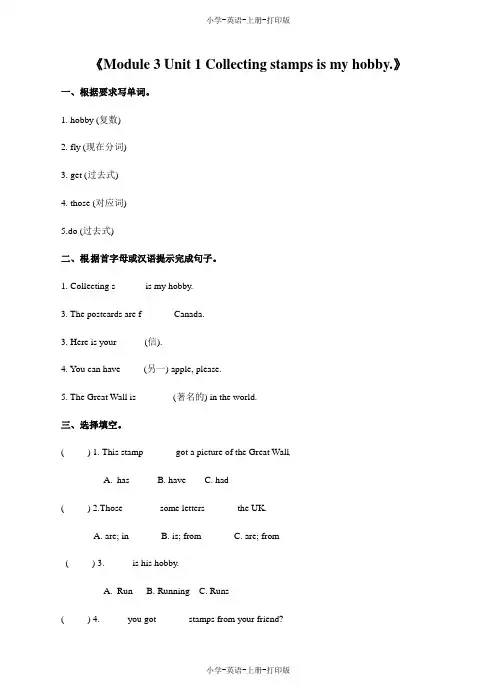
《Module 3 Unit 1 Collecting stamps is my hobby.》一、根据要求写单词。
1. hobby (复数)_______2. fly (现在分词)_______3. get (过去式)__________4. those (对应词)__________5.do (过去式)________二、根据首字母或汉语提示完成句子。
1. Collecting s______ is my hobby.3. The postcards are f ______ Canada.3. Here is your _____ (信).4. You can have ____ (另一) apple, please.5. The Great Wall is _______ (著名的) in the world.三、选择填空。
( ) 1. This stamp ______ got a picture of the Great WallA.hasB. haveC. had( ) 2.Those _______ some letters ______ the UK.A. are; inB. is; fromC. are; from( ) 3. _____ is his hobby.A.RunB. RunningC. Runs( ) 4. _____ you got ______ stamps from your friend?A.Have; someB. Has; anyC. Have , any( ) 5. We have _____ vegetables and fruit.A. a lotB. lot ofC. lots of四、连词成句。
1. gifts/ what/ you/ got/ have (?)__________________________2. can/ another/have/ Chinese/ you/ book(.)__________________________ 3. stamps/ Can ada/ of/ these/ are/ from(.)_____________________________4. is/ hobby/ collecting/ my/ sta mps (.)_____________________________5. there/ a/ letter/ is/ for/ me (?)_____________________________五、按要求完成句子。
六年级上英语 Module+3+Unit+1+Collecting+stamps+is+my+hobby外研社

Unit 1 Collecting stamps is my hobby.
What’s this?
It’s a stamp.
This one has got a picture of three pandas on it.
There are three pandas on the stamp.
2.Read the dialogue.
Homework.
1.Read the dialogue three times.(3 遍) 2.抄写书11页的第2部分1遍,并翻译成中文。
Module 3
Unit 2 I’ve got a hobby.
1.Look at the pictures and talk about their hobbies.
Gir2: I like riding my bicycle.
That’s my hobby.
Teacher: Have you got any photos of your bike?
Girl2: Yes.
These are some photos of my new bike.
She collects dolls. Collecting dolls is her hobby.
1.Listen and answer.
Q1:Does Simon collect stamps?
Yes,he does.
Q2:Has Simon got any stamps from China?
Yes,he has. Q3:Is there a letter for Daming?
Yes,there is.
painting
六年级英语上册 Module 3 Unit 1 Collecting stamps is my hobby教案 外研版(三起)
Unit 1 Collecting stamps is my hobby.【教学目标】:知识与技能:I’ve got lots of stamps.These are some stamps from Canada.This stamp is from China.过程与方法:自主式,互助式,启发式,任务型教学情感、态度和价值观:谈论和介绍个人的爱好。
【重点】:本模块的单词【难点】:动名词的用法,如:Collecting stamps【课时安排】:1课时【教学过程】:(一)导入:1)有节奏的颂唱上一单元的歌曲。
2)听写上一单元的单词。
3)通过谈论学生喜欢的东西渐人今天关于“hobby”的主题,例如:T: What’s your favoutite sport/games/food…?Ss:My favourite sport/games/food… is…T: Do you like…?Ss:Yes I do/No, I don’t. I like…(二)探究新知:对话之后,老师拿出一本集邮册给学生们看。
老师问学生:“What’s this?”然后回答…It s a stamp album.”引导学生通过实物理解“stamp”和“album”的意思。
老师一边向学生们展示集邮册里的邮票一边讲述:“I like stamps very much. I collect them. Look, this is a Chinese stamp. It’s very beautiful. Do you like these stamps? These stamps are from Canada. I like them very much. Collecting stamps is my hobby.”把学生的注意力引入课文。
向学生们说明:在今天即将学习的课文中,Darning和Simon 谈论起了Simon的一项兴趣爱好。
六年级英语上册 Module 3 Unit 1 Collecting stamps is my hobby教案 外研版

Unit 1 Collecting stamps is my hobby.【教学目标】:知识与技能:I’ve got lots of stamps.These are some stamps from Canada.This stamp is from China.过程与方法:自主式,互助式,启发式,任务型教学情感、态度和价值观:谈论和介绍个人的爱好。
【重点】:本模块的单词【难点】:动名词的用法,如:Collecting stamps【课时安排】:1课时【教学过程】:(一)导入:1)有节奏的颂唱上一单元的歌曲。
2)听写上一单元的单词。
3)通过谈论学生喜欢的东西渐人今天关于“hobby”的主题,例如:T: What’s your favoutite sport/games/food…?Ss:My favourite sport/games/food… is…T: Do you like…?Ss:Yes I do/No, I don’t. I like…(二)探究新知:对话之后,老师拿出一本集邮册给学生们看。
老师问学生:“What’s this?”然后回答…It s a stamp album.”引导学生通过实物理解“stamp”和“album”的意思。
老师一边向学生们展示集邮册里的邮票一边讲述:“I like stamps very much. I collect them. Look, this is a Chinese stamp. It’s very beautiful. Do you like these stamps? These stamps are from Canada. I like them very much. Collecting stamps is my hobby.”把学生的注意力引入课文。
向学生们说明:在今天即将学习的课文中,Darning和Simon 谈论起了Simon的一项兴趣爱好。
最新外研版小学六年级上册英语Module 3 Unit 1 Collecting stamps is my hobby.精品教案
Unit 1 Collecting stamps is my hobby.教学目标1.知识与技能(1)学生能听懂,会说,会用词汇: collect, stamp, hobby, have got.(2)学生能理解对话,并学会运用句型: …have/ has got ... This stamp is/ Thesestamps are from…(3)学生能够听懂、会说、会表演课文内容。
2.过程与方法在活动中教学,让学生在做中学,学中玩。
3.情感态度和价值观通过多种形式的教学活动,激发学生学英语的兴趣,培养学生善于思考的能力,引导他们积极参与谈论自己或他人的爱好。
教学重点(1)词汇: collect, stamp, hobby, have got.(2)句型: …have/ has got ... This stamp is/ These stamps are from…教学难点谈论自己和他人的爱好。
教学方法任务型教学法、情景教学法、交际法。
课前准备单词卡片,多媒体PPT。
课时安排1个课时教学过程一、Warming up and Revision1. Greetings. (师生间简单地打招呼。
)2. Free talk.看幻灯片第2页,看图并讨论这两个问题Do you know what these are? What arethey about?二、Presentation1. Let’s learn.看幻灯片第3.4.5页,学习词汇collect, stamp, hobby, have got.2. Look, listen and say.(1) Let’s watch.看图并讨论这个问题:Is this dog Daming’s toy?(2)看课文,听录音并朗读课文。
(3)听完课文后,男女生分角色朗读对话,老师重点强调it’s not a toy!3. Listen and read.(1) Watch and answer.看课文图片What are Daming and Simon doing?同学们思考讨论。
新外研版六年级英语上册Module 3 Unit 1 Collecting stamps is my hobb.ppt
Have you got any stamps from _E__n_g__la__n_d__?
Have you got any _b_o__o_k__s_ ? Have you got a _f_o_o__tb__a_l_l_?__
Yes, I do / No, I don’t. Do you collect _p_o_s_tc_a_r_d_s ?
Do you collect ts of stamps.
I’v got lots of _b_o_o_k_s_ . I’v got lots of _c_a_r_s__.
2.Have you got _an_y s_tam_p_s from China? 3.I _ha_ve_go_t some stamps from Canada. 4.These _ar_e stamps from China.
Bye-bye!
• 9、春去春又回,新桃换旧符。在那桃花盛开的地方,在这醉人芬芳的季节,愿你生活像春天一样阳光,心情像桃花一样美丽,日子像桃子一样甜蜜。 2020/6/112020/6/11Thursday, June 11, 2020
• 13、志不立,天下无可成之事。2020/6/112020/6/112020/6/112020/6/116/11/2020
• 14、Thank you very much for taking me with you on that splendid outing to London. It was the first time that I had seen the Tower or any of the other famous sights. If I'd gone alone, I couldn't have seen nearly as much, because I wouldn't have known my way about.
六年级上册英语教案Module3Unit1Collectingstampsismyhobby.外研社
六年级上册英语教案Module3Unit1Collectingstampsismyhobby Teaching aims:1.全体学生听、说、读、写、认生词:collect, stamp, hobby;2.全体学生理解“have got”的意思“有”;理解目标句型:Collecting stamps is my hobby; They have got famous people on them; Have you got any stamps from China? Yes, I have.3.中等生以上的学生能运用目标句型举行仿写或仿说句子。
Teaching processes:Step 1: GreetingsStep 2: A1T: Today we are going to learn Module 3 Unit 1. Collecting stamps is my hobby.(T teaches Ss to read “Collecting stamps is my hobby.”2-3 times.)T: Do you like toys? What toys have you got?(T asks 2- 3 Ss.)T: Listen and tell me: What toys has Simon got?(T plays the tape 1-2 times, then asks the questions. )T: Good. I am going to play the tape again, please listen and repeat the dialogues.(T plays the flash 1 -2 times. Ss listen and repeat. )T: I’m Daming, you’re Simon.( T and Ss read the dialogues in roles.)Step 3: PreparationT: I have got some kites. I like flying kites. Flying kites is my hobby.(T introduces hobby, and does the actions “ flying kites”.)T: What’s your hobby? 刚才我先容了自己的业余喜好。
外研版六年级英语上册Module 3Unit 1 Collecting stamps is my hobby
another Chinese stamp
another 另一个,又一个
/ ә יn∧ðә /
collect 收集 collect stamps 集邮
/ kə'lekt /
collect postcards
收集邮票是我的业余爱好。 Collecting stamps is my hobby.
外研版六年级英语上册
Module 3
Unit 1 Collecting stamps is my hobby
stamp邮票
/ stæ mp /
这张邮票来自中国。
This stamp is from China.
This is a stamp from Canada.
These are sore you from China﹖
Yes, I am. / No, I‘m not.
Is she student?
Yes, she is / No, she isn’t
Does he work in a bank﹖ Yes, he does. / No, he doesn't
Do you live in your school﹖Yes, I do. / No, I don't. Can you speak English﹖ Yes, I can. / No, I can't.
Is there a Chinatown in USA? Yes, there is / No, there isn’t
Have you got any stamps from China?
Yes, I have / No, I haven’t.
1、Do you collect stamps? Yes, I do / No, I don’t.
外研版三起六年级上册module 3《unit 1 collecting stamps is my hobby》优秀教案(重点资料).doc
Module 3Unit 1 Collecting stamps is my hobby.【教学目标】:知识与技能:I’ve got lots of stamps.These are some stamps from Canada.This stamp is from China.过程与方法:自主式,互助式,启发式,任务型教学情感、态度和价值观:谈论和介绍个人的爱好。
【重点】:本模块的单词【难点】:动名词的用法,如:Collecting stamps【课时安排】:1课时【教学过程】:(一)导入:1)有节奏的颂唱上一单元的歌曲。
2)听写上一单元的单词。
3)通过谈论学生喜欢的东西渐人今天关于“hobby”的主题,例如:T What’s your favoutite sport/games/food…?Ss:My favourite sport/games/food…is…T Do you like…?Ss:Yes I do/No, I don’t. I like…(二)探究新知:对话之后,老师拿出一本集邮册给学生们看。
老师问学生:“What’s this?”然后回答…It s a stamp album.”引导学生通过实物理解“stamp”和“album”的意思。
老师一边向学生们展示集邮册里的邮票一边讲述:“I like stamps very much.I collect them. Look, this is a Chinese stamp. It’s very beautiful. Do you like thesestamps? These stamps are from Canada. I like them very much. Collecting stamps is my hobby.”把学生的注意力引入课文。
向学生们说明:在今天即将学习的课文中,Darning和Simon谈论起了Simon的一项兴趣爱好。
外研版(三起)-英语-六年级上册-Module 3 Unit 1 Collecting stamps is my hobby 教案
Module 3 Unit 1Collecting stamps is my hobby. 教案教材分析:本课来自外研版(三起)小学英语第三模块一单元,主要通过学习Do you...与...have/has got...句型,动名词做主语等相关知识来谈论自己或他人的业余爱好。
对于学生有一定的难度。
学情分析:六年级的学生已有的一定的英语语言知识基础,能听懂一些简单的课堂指令,能根据指令完成相应的任务。
在语言知识方面,已经学习过Do you ...?引导的相关问句,接触过动词的”ing”形式,具备用英语简单描绘图片的能力,但尚未学习动名词做主语的相关知识。
教学目标:1、大部分学生能听、说、读并能正确使用单词:collect , stamp, hobby, women ,men ,doll ,bicycle 等。
2、全体学生能理解并掌握句型:I’ve got lots of stamps.This stamp is from China.Collecting stamps is my hobby.Do you collect stamps?Have you got any stamps from China?3、能掌握运用Do you...与...have/has got...句型。
4、全体学生能够运用已学语言谈论和表达自己的业余爱好。
教学重难点:重点:1、能听、说、读并能正确使用单词:collect, stamp, hobby, men , women .2、能掌握重点句型:I’ve got lots of stamps.This stamp is from China.Collecting stamps is my hobby.Do you collect stamps?Have you got any stamps from China?3、能够听懂并理解课文,能根据课文内容回答相关问题。
难点:1、能熟练运用重点句型,同时能掌握运用Do you...与...have/has got...句型。