
2019_2020学年新教材高中英语UNIT5MUSICSectionⅠListeningandSpeaking (1)
UNIT 5 MUSICSection ⅠListening and Speaking & Reading and Thinking—Comprehending听音填空/The Sound of Music// 音乐之声/ 《音乐之声》展现了奥地利山峦起伏、森林茂密的美丽自然风光,抒发了作者对故乡、对大自然、对音乐的无比热爱。
My day in the hills has come to an endI knowA star has come out to tell me1.It’s_time to goBut deep in the darkgreen shadowsAre voices that urge me to staySo I pause and I wait and I listenFor one more sound for one more lovely thing2.That_the_hills might say...The hills are alive with the sound of musicWith songs they have sung 3.for_a_thousand_yearsThe hills fill my heart with the sound of musicMy heart 4.wants_to_sing every song it hearsMy heart wants to beat like the wings of the birds that rise from the lake to the treesMy heart wants to sigh like the chime that flies from a church on a breeze To laugh like a brook 5.when_it_trips and falls over stones in its wayTo sing through the night like a lark who is learning to preyI go to the hills when my heart is lonelyI know I will hear what I’ve heard beforeMy heart will be blessed with the sound of music And I’ll sing once more我在山中的日子就要结束了我知道一颗星星出来告诉了我是时候离开了但在墨绿色阴影的深处传来了让我留下来的声音于是我停下来,等待着,聆听着为了再出现一个声音,为了再出现一件可爱的事情……群山也许在说群山是鲜活的伴着音乐之声伴着他们歌唱的歌曲已经过了千年群山填满了我的心伴着这音乐之声我的心也想歌唱把听到的每一首都唱出来我的心想要拍打跳动像鸟儿的翅膀一样从湖面飞到树枝我的心想要轻叹就像飞扬的钟声乘着微风从教堂吹来笑声像蜿蜒的小溪一路轻盈跳跃起伏自然地绕过石头整夜歌唱就像是云雀在学习捕食我走到群山中当我内心孤独时我知道我会听到我之前听过的声音我的心将被祝福伴着这音乐之声我将再一次歌唱[词海拾贝]1.chime [tʃaIm] n.钟声2.breeze [briːz] n.微风3.brook [brʊk] n.小溪;小河4.lark [laːk] n.云雀;百灵鸟5.bless [bles] vt.祝福重点单词写作词汇1.classical ['klæsIkl] adj.古典的;经典的2.soul [səʊl] n.灵魂;心灵3.virtual ['vɜːtʃʊəl] adj.很接近的;事实上;虚拟的4.opportunity [ɒpə'tjuːnəti] n.机会;时机5.studio ['stjuːdiəʊ] n.演播室;(音乐的)录音棚;工作室6.ordinary ['ɔːdnri] adj.普通的;平凡的7.prove [pruːv] vt.证明;展现8.award [ə'wɔːd] vt.授予n.奖品9.composer [kəm'pəʊzə(r)] n.作曲者;作曲家10.conductor [kən'dʌktə(r)] n.(乐队、合唱团等的)指挥;(公共汽车的)售票员11.stage [steIdʒ] n.(发展或进展的)时期;阶段;(多指剧场中的)舞台12.altogether [ɔːltə'ɡeðə(r)] adv.(用以强调)全部;总共13.thus [ðʌs] adv.如此;因此14.band [bænd] n.乐队;带子15.nowadays ['naʊədeIz] adv.现在;目前拓展词汇16.energy ['enədʒi] n.能源;能量;精力→energetic adj.精力旺盛的17.perform [pə'fɔː(r)m] vi.& vt.表演;履行;执行→performance n.表演;演技;表现→performer n.表演者;演员18.enable [I'neIbl] vt.使能够;使可能→able adj.有能力的19.original_ [ə'rIdʒənl] adj.原来的;独创的;原作的n.原件;原作→origin n.起源;由来;起因阅读词汇20.hiphop ['hIphɒp] n.嘻哈音乐;嘻哈文化21.composition [kɒmpə'zIʃn] n.成分;(音乐、艺术、诗歌的)作品22.phenomenon [fə'nɒmInən](pl.phenomena [Inə]) n.现象23.rap [ræp] n.快速敲击;说唱音乐vi.& vt.敲击;(说唱歌中的)念白重点短语1.fall_in_love_with 爱上2.remind_sb.of_ 使某人想起3.take_part_in 参加重点句型1.as 引导定语从句,意为“正如,正像”:As_one_virtual_choir_member_said(正如一位虚拟唱诗班成员所说), “Music helps me to...forget my problems.With music, I become someone else.”2.过去分词作状语:Moved_by_this_music(被这首音乐所感动), he said,“It was like seeing color for the first time.”ⅠFastreadingSkim the text (P52) and choose the best answer.1.What is mainly discussed in this passage?A.Eric Whitacre—the composer.B.The virtual choir.C.Influence of the virtual choir.D.Compositions of Eric Whitacre.答案:B2.Read the text and match the main idea of each part.Part 1(Para.1) A.The creator of virtual choir and his experience on music exploration.Part 2(Paras.2-3) B.The conclusion of the virtual choir.Part 3(Para.4) C.Background information about the virtual choir.答案:CABⅡCarefulreadingRead the text (P52) carefully and then choose the best answer.1.What is the attitude towards the virtual choir?A.Natural.B.Negative.C.Positive.D.Unknown.2.If you want to take part in a virtual choir, you need ________.A.a video camera and some instrumentsB.a band and some professional singersC.a video camera and an Internet connectionD.a master’s degree in musical composition3.Why does the virtual choir prove to be a good influence on the lives of many people?A.It helps to connect ordinary people together.B.It enables them to be part of the global community.C.It helps them to find those with the same interest.D.It enables them to forget their daily problems for a while.4.Please choose the correct order for the following events of Eric Whitacre.a.Studying music at the university of Nevada.b.Conducting the Virtual Youth Choir for UNICEF.c.Receiving a master’s degree in musical composition.d.His original composition became popular among choirs and singers.A.a-c-b-d B.a-c-d-bC.c-b-d-a D.c-d-b-a答案:1-DBⅢStudyreadingAnalyze the following difficult sentences in the text.1.Imagine having the opportunity to sing together with hundreds of other people while you are at home alone.该句为复合句。
Unit 5 Music (课件)高一英语(人教版2019必修第二册)

注意事项
1.过去分词作状语时,有时为了强调,前面可带有连词,如:when, while, if, though, as if, unless, until等,以使句意表达得更清楚。
Eg. Unless constantly repeated, the English words are easily forgotten. When asked why she came here, the girl kept silent.
5. 作让步状语 ,可转换为although, though或even if等引导的 状语从句。
观察下列句子,说出过去分词和现在分词作状语时的区别.
1.Seeing from the hill, you will find the city looks like a big garden. 从山上看,你会发现这座城市就像一个大花园。 (see与句子的主语you之间是逻辑上的主谓关系)
用法2.V-ed作表语,构成的系表结构与被动语态的区别:
V-ed作表语,强调主语的特点或状态,相当于形容词; 被动语态中,句子主语是动作的承受者,后面常跟by。
Eg:The library is now closed.(状态) 图书馆现在关闭了。 The cup was broken by my little sister yesterday.(动作) 昨天我妹妹把杯子打碎了。
The news sounded __e_x_c_it_i_n_g__(excite).
过去分词作表语多表示人自身的感受或事物自身的状态,常 译作“感到……的”;现在分词多表示事物具有的特性,常译 作“令人……的”。
2019-2020学年新教材高中英语unit5 music 单元重点知识回顾课件版本:人教版必修第二册

答案
9.They were completely 答案:absorbed
(absorb) in each other.
答案
10.We all breathed a sigh of 答案:relief
(relieve) when he left.
答案
Ⅳ.开放型任务 本单元我们学习了音乐方面的知识,音乐带给人很多美好的感受。同学 们可以组织一次英语 K 歌比赛,看看谁的英文歌唱的最好!并谈谈你对英文 歌曲的感觉。
3.He fell in love with Mozart's classical music when he sang for the university choir. (教材 P52)
当他在大学合唱团唱歌的时候,他就爱上了莫扎特的古典音乐。 4. Moved by this music, he said, “It was like seeing color for the first time.”(教材 P52) 惠塔克被这种音乐所感动,他说“那种(兴奋的)感觉就如同是第一次看到 色彩一样。”
(treat) of cancer.
答案
7.It was impossible to make 答案:assumptions
(assume) about people's reaction.
答案
8.She went to London with the aim 答案:of
finding a job.
9.assume vt. 以为;假设→assumption n. 假定;假设 assume sb./sth. to be 假定/假设……为…… It is assumed that ... 一般认为…… make an assumption 认为,假定 assume/assuming (that) ... 假设/假定……
新教材 人教版高中英语必修第二册 unit5 Music 精品教学课件(共231页)
发音提示
失去爆破 当一个爆破音后面紧接着有一个爆破音或破擦音、或鼻音、 或舌侧音时,前面一个音只按其发音部位形成阻碍,但不发生 爆破,这种现象称为“失去爆破”。 以下五种情况会出现失去爆破: 1.爆破音+爆破音 两个爆破音相连时,前一个失去爆破,后者则要完全爆破。 如:She sai(d) to herself.
Section Ⅱ Reading and Thinking
词汇认知
汉译英 1. virtual adj.很接近的;事实上的;虚拟的 2. opportunity n.机会;时机 3. onto prep.(朝)向 4. studio n.演播室;(音乐的)录音棚;工作室 5. ordinary adj.普通的;平凡的 6. prove vt.证明;展现 7. award vi.授予 n.奖品
语境领悟
(1)Only with all your time and energy can you do the job well.
只有用上你全部的时间和精力你才能把这项工作做好。 (2)She’s always full of energy. 她总是充满活力。
(3)Where do those kids get their energy from? 那些孩子哪来这么多精力?
学以致用 选词填空(energy/power/strength/force) (1)Not that I don’t want to help you,but that it’s beyond my power to do so. (2)She has always been encouraged to swim to build up the strength of her muscles.
(新课标)2019_2020学年高中英语Unit5MusicSectionⅠWarmingUpPre_reading
Unit 5 Music你听过美国乡村音乐吗?你知道美国乡村音乐的历史吗?下面是它的一些情况。
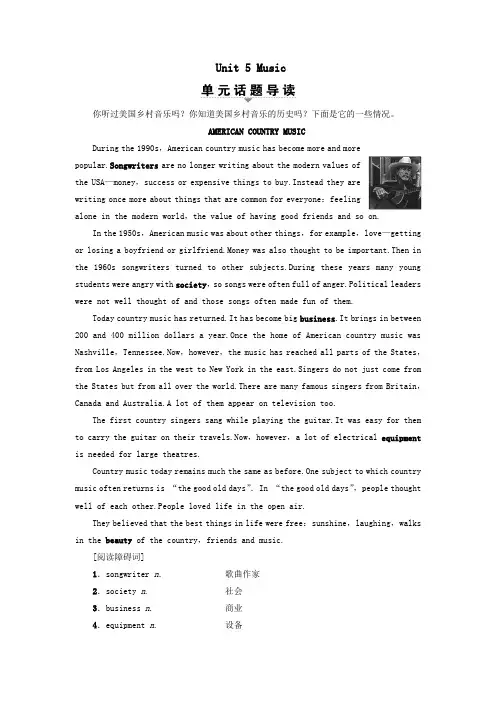
AMERICAN COUNTRY MUSICDuring the 1990s,American country music has become more and morepopular.Songwriters are no longer writing about the modern values ofthe USA—money,success or expensive things to buy.Instead they arewriting once more about things that are common for everyone:feelingalone in the modern world,the value of having good friends and so on.In the 1950s,American music was about other things,for example,love—getting or losing a boyfriend or girlfriend.Money was also thought to be important.Then in the 1960s songwriters turned to other subjects.During these years many young students were angry with society,so songs were often full of anger.Political leaders were not well thought of and those songs often made fun of them.Today country music has returned.It has become big business.It brings in between 200 and 400 million dollars a year.Once the home of American country music was Nashville,Tennessee.Now,however,the music has reached all parts of the States,from Los Angeles in the west to New York in the east.Singers do not just come from the States but from all over the world.There are many famous singers from Britain,Canada and Australia.A lot of them appear on television too.The first country singers sang while playing the guitar.It was easy for them to carry the guitar on their travels.Now,however,a lot of electrical equipment is needed for large theatres.Country music today remains much the same as before.One subject to which country music often returns is “the good old days”.In “the good old days”,people thought well of each other.People loved life in the open air.They believed that the best things in life were free:sunshine,laughing,walks in the beauty of the country,friends and music.[阅读障碍词]1.songwriter n.歌曲作家2.society n. 社会3.business n. 商业4.equipment n. 设备5.beauty n. 美[诱思导读]1.Do you like American country music? How much do you know about American country music?2.Why did the first country singers sing songs while playing the guitar?3.What was thought to be the best in the good old days?A.Holding a party at home.B.Walking with friends in the open air.C.Having a class in the building.D.Having a good sleep.[答案] 1.略。
高中英语人教版新课标课件 必修二 Unit 5 Music Section Ⅰ

Beatles. 音乐家一边演奏音乐,一边彼此打趣逗笑。这些玩笑和音乐大多都在模仿“甲
壳虫”乐队。
4.They put an advertisement in a newspaper
,but they
could only find one who was good enough. 他们在报纸上登了一则广告,想招摇滚乐手,但他们只招到一个满意的。
members of the band. Their exciting 8.
(perform) were copied by other
groups. “The Monkees” played their own instruments and wrote their own music.
Though it broke 9.
they
can earn some extra money for themselves or to play for their instruments. 有时他们可能在街上或地铁里为过路者演奏,这样他们可以为自己或自己要
买的乐器多挣一些钱。
3.The musicians were
was based loosely on the
【答案】 1.Soothing music. 2.Exciting music.
Section Ⅰ Warming Up & Reading-Preparing
根据提示写出下列单词
1.
adj.
民间的
2.
vt. 假装;假扮
3.
vt.&vi. 系上;附加;连接;缚上
4.
vt. (使)组成;形成;构成
理
提
基
素
2020年新人教版《Unit 5 Music》单元课件全套(优质课)
3.Why does the virtual choir prove to be a good influence on the lives of many people? A.It helps to connect ordinary people together. B.It enables them to be part of the global community. C.It helps them to find those with the same interest. D.It enables them to forget their daily problems for a while.
UNIT 5 MUSIC
UNIT 5 MUSIC
With songs they have sung 3._f_o_r_a__th_o_u_s_a_n_d__y_e_a_r_s The hills fill my heart with the sound of music My heart 4.__w_a_n_t_s_t_o_s_i_n_g______ every song it hears My heart wants to beat like the wings of the birds that rise from the lake to the trees My heart wants to sigh like the chime that flies from a church on a breeze
重点短语 1.__fa_l_l _in__l_o_v_e_w_i_t_h________ 2.__re_m__in__d_s_b_.__o_f_________ 3.__ta_k_e__p_a_r_t _in____________
2019_2020学年新教材高中英语Unit5MusicSectionⅡReadingandThinking课件新人教版必修第二册
5.Please choose the correct order for the following events of Eric
Whitacre. a.studying music at the university of Nevada b.conducting the Virtual Youth Choir for UNICEF c.receiving a master's degree in music composition d.his original composition became popular among choirs and
room on New Year's day.
易混辨析:energy, power, force, strength 辨析
energy主Βιβλιοθήκη 指人的精力、活力和物理学中的能量、能源
主要指政权、权力,还可泛指做某事的能力,也可指物
power
理学中的动力、功率
主要指为克服阻力使事物运动而实际上发出或施加的力
Ⅰ.核心单词(英汉互译) 1.classical adj. 古__典__的__;__经__典__的____ 2.soul n. __灵__魂__;__心__灵______ 3.virtual adj. 很___接__近__的__;__事__实__上__的__;__虚__拟__的___
4.o_p_p_o_r_tu__n_it_y__ n. 机会;时机 5.prove vt. ___证__明___________ 6.onto prep. ___(朝__)_向__________
►第一板块:核心单词诠释
1.energy n.能量;能源;精力 (1)save/use energy 节约/消耗能源 clean/new/renewable energy 清洁/新/可再生能源 (2)energetic adj. 精力充沛的;充满活力的
2019-2020年高中英语 Unit 5《Music》Warming up and Reading
2019-2020年高中英语 Unit 5《Music》Warming up and Reading教案新人教版必修2◆To learn to talk about kinds of music◆To learn to read about bands◆To study The Attributive Clause (in/ for/ with/ by+which/ whom)◆To learn to write an e-mailProceduresI. Warming upWarming up by describingGood morning, class. Today we are going to talk about an interesting topic --- music. As we know, music is a kind of art of making pleasing binations of sounds in rhythm, harmony and counterpoint. Music can produce a lively and happy atmosphere and bring people relaxation after hard work, which can reduce the tiredness. Listening to music also makes people feel happy and nice. How many do you know about music? Can you tell about different kinds of music? Now turn to page 33, look at the pictures, read the captions and listen to the different kinds of music. See if you can guess which music matches with which picture.Warming up by discussingHi, everyone. Do you like music? How much do you know about music? Can you tell about the different kinds of music? Please turn to page 33. Look at the pictures. Let’s listen to some music. Let’s see if you can guess which music matches with which picture.Classical music Country music Rock ‘n’ RollRap Orchestra Folk music Yes, you are right. I’m sure you will really enjoy yourselves after listening to all these beautiful music. What kind of music do you like better, Chinese or Western, classical or modern? Why? How does music make you feel? Why do you like to listen to music? Let’s discuss these questions in small groups. Try to share your opinions with one another.II. Pre-reading1.Thinking and sayingHave you heard about any of the famous bands in the world? List some if you can. For reference: I’ve heard about “The Beatles”, “Back Street Boys”, “The Eagles”, “West life” and “Pink Floyd”.2.Listening, talking and sharingLet’s listen to some pieces of music from different bands. Work in groups of four. Tell your group mates which band you like best. Why? Then the group leader is to stand up and share the group idea with the class.For reference: I am from Group 1. Our group likes “The Beatles” best. We like their style of performances. Listening to their performances, we will feel relaxed,Do you know anything about “The Monkees”?III. Reading1.Reading aloud to the recordingNow please listen and read aloud to the recording of the text T HE BAND THAT WASN’T. Pay attention to the pronunciation of each word and the pauses within each sentence.I will play the tape twice and you shall read aloud twice, too.2.Reading and underliningNext you are to read and underline all the useful expressions or collocations in the passage. Copy them to your notebook after class as homework.3.Reading to identify the topic sentence of each paragraphSkim the text and identify the topic sentence of each paragraph. You may find it either at the beginning, the middle or the end of the paragraph.1st paragraph: Many people want to be famous as singers or musicians.2nd paragraph: This is how most bands start.3rd paragraph: The Monkees started in a different way.4th paragraph: How the Monkees became popular and how they developed as a real band.3.Reading and transferring informationRead the text again to plete the tables, which list how people formed a band and how The Monkees was formed by the TV organizers and became a real band.How do people get to form a band?Members High school studentsReasons They like to write and play music.Places They practice their music in someone’s home.Forms They may play to passers-by in the street or subway.Results They can earn some extra money. They may also have a chance to dream of being famous.How was The Monkees formed and became a real band?The Monkees in 1968 (left to right): Micky Dolenz,Peter Tork, Mike Nesmith & Davy Jonesbeginning of the band It began as a TV show.They played jokes on each other as well as played music. style of theperformancefirst music and jokes Most of them were based loosely on the band called “TheBeatles”.development of the band They became more serious about their work and started toplay their own instruments and write their own songs likea real band. They produced their own records and startedtouring and playing their own music.changes of the band The band broke up in about 1970, but reunited in themid-1980s. They produced a new record in 1996, which wasa celebration of their time as a real band.4. Reading and understanding difficult sentencesAs you have read the text times, you can surely tell which sentences are difficult to understand. Now put your questions concerning the difficult points to me.IV. Closing downClosing down by doing exercisesTo end the lesson you are to do the prehending exercises No. 1, 2, 3 and 4. Closing down by having a discussionDo you think the TV organizers were right to call “The Monkees” a band when they did not sing or write their own songs? Why?For reference:I don’t think the TV organizers were right to call “The Monkees”a band when they did not sing or write their own songs because singing and writing its own songs was the basis of a band.Do you agree that the jokes were more important than the music for this band? Give a reason.For reference: Yes. I think it is the jokes that really attract more fans. No. I think the purpose of forming a band is getting people to enjoy the spirit of music. It’s more important than playing jokes just to make people laugh.Closing down by retelling the form of the band TheMonkees.I shall write some key words and expressions on the board. You are to retell theform of the band according to these words.Period 2: Learning about LanguageTeaching AimsTo help students learn about the Attributive Clause with a preposition in front. To help students discover and learn to use some useful words and expressions. To help students discover and learn to use some useful structures.ProceduresI. Warming upWarming up by discovering useful words and expressionsTurn to page 36 and do exercises 1, 2 and 3 first. Check your answers against your classmates’.II. Learning about grammar1.Reading and thinkingTurn to page 34 and read with me the text of THE BAND THAT WASN’t. As you read on, pay attention to The Attributive Clause (in/ for/ with/ by+which/ whom), that is, the attributive clauses with a preposition ahead of the relative pronoun shown in the sentences.2.Doing exercise 2 on page 37Turn to page 34. Look at the sentence in the text:However, after a year or so in which they became more serious about their work, “The Monkees” started to play and sing their own songs like a real band.Pay attention to the structure: preposition + relative pronoun. Usually only two relative pronouns --- which and whom--- can be used in the Attributive Clause, with a preposition put before the clause. That can’t be used. Look at the screen. Here are more examples on this kind of structure.Now go on to do Exercise 3 on page 37, that is, to sort out the sentences.III. Ready used materials for The Attributive Clause (in/ for/ with/ by+which/ whom)In formal styles we often put a preposition before the relative pronouns which and whom:•The rate at which a material heats up depends on its chemical position.•In the novel by Peters, on which the film is based, the main character is a teenager. •An actor with whom Gelson had previously worked contacted him about the role. •Her many friends, among whom I like to be considered, gave her encouragement. Notice that after a pr eposition you can’t use who in place of whom, and you can’t use that or zero relative pronoun either:•Is it right that politicians should make important decisions without consulting the public to whom they are accountable? (not --- the public to who they are accountable.)•The valley in which the town lies is heavily polluted. (not --- The valley in that the town...)•Arnold tried to gauge the speed at which they were traveling. (not --- the speed at they were traveling.)In informal English we usually put the preposition at the end in attributive clauses rather than at the beginning:•The office which Graham led the way to was filled with books.•Jim’s footballing ability, which he was noted for, had been encouraged by his parents.•The playground wasn’t u sed by those children who it was built for.In this case we prefer who rather than whom(although whom is used in formal contexts). In restrictive attributive clauses we can also use that or zero relative pronoun instead of who or which (e.g. ...the children (that) it was built for).If the verb in attributive clauses is a two-or-three-word verb (e.g. e across, fill in, go through, look after, look up to, put up with, take on) we don’t usually put the preposition at the beginning:•Your essay is one of those (which/that) I’ll go through tomorrow. (rather than...through which I’ll go tomorrow.)•She is one of the few people (who/that) I look up to. (not ... to whom I look up.)In formal written English, we often prefer to use of which rather than whose to talk about things:•A huge amount of oil was spilled, the effects of which are still being felt. (or...whose effects are still being felt.)•The end of the war, the anniversary of which is on the 16th of November, will be memorated in cities throughout the country. (or...whose anniversary is on...) Note that we can’t use of which in place of whose in the patterns described in Unit 71B:•Dorothy was able to switch between German, Polish and Russian, all of which she spoke fluently. (not..,all whose she spoke...)We can sometimes use that...of in place of of which. This is less formal than of which and whose, and is mainly used in spoken English:•The school that she is head of is closing down. (or The school of which she is head...)Whose can e after a preposition in attributive clauses. However, it is more natural to put the preposition at the end in less formal contexts and in spoken English: •We were grateful to Mr. Marks, in whose car we had traveled home. (or...whose car we had traveled home in.)•I now turn to Freud, from whose work the following quotation is taken. (or...whose work the following quotation is taken from.)IV. Closing down by doing exercises:Join the sentence halves using which or whom after an appropriate preposition. (A)a.I would never have finished the work.b.It was primarily written.c.We know nothing.d.They got a good view.e.He learned how to play chess.f.Dennis scored three goals in the final.g.She was born.h.It was discovered.1.They climbed up to the top of a large rock.2. I would like to thank my tutor.3. She has now moved back to the house on Long Island.4. The star is to be named after Patrick Jenks.S. This is the ball.6. He is now able to beat his father.7. The book is enjoyed by adults as well as children.8. There are still many things in our solar system.Are these correct or appropriate? If they are, put a√. If they are not, give a reason, correct them and give alternatives if you can. (A)I. It's a piece of jewelry across which I came in an antique shop. --- which I came across in an antique shop. (‘came across’ is a two-word verb.)2. The extra work which she took on was starting to affect her health.3. My mother, after whom I looked for over 20 years, died last year.4. The people whom I work with are all very friendly.5. Some of the criticisms with which they had to put up were very unfair.6. He had many friends with whom he had a regular correspondence.7. The woman to who he is engaged es from Poland.8. The forms which I had to fill in were very plicated.Rewrite these sentences so that they are more appropriate for formal written English. Use preposition + which or preposition + whose, as appropriate. (B)I. Tom Sims, whose car the weapons were found in, has been arrested. Torn Sims, in whose car the weapons were found, has been arrested.2. Tom Ham, whose novel the TV series is based on, will appear in the first episode.3. Dr Jackson owns the castle whose grounds the main road passes through.4. Tessa Parsons is now managing director of Simons, the pany that she was once a secretary in.5. Allowing the weapons to be sold is an action that the Government should be ashamed of.6. The dragonfly is an insect that we know very little of.Period 3: Using LanguageTeaching AimsTo read the story about Freddy and then enjoy and understand Beatles’ songs.To use the language by reading, listening, speaking and writing. ProceduresI. Warming up by listening and writingTurn to page 38 and read these exercises before listening to the tape. Then listen to the tape and finish them.II. Guided reading1.Reading and translatingRead more about FREDDY THE FROY and translate it into Chinese paragraph by paragraph.2.Reading and underliningNext you are to read and underline all the useful expressions or collocations in the passage. Copy them to your notebook after class as homework.3.Doing exercisesNow you are going to do exercise 6 on page 39 following the article. Suggested answers to exercise 6:This is a story about a band that became famous and did not like it.III. Guided writing1.Writing a letter for advicePlease turn to page 39 writing. Let’s read the instructions.You’d better do some brainstorming in small groups before writing your letters. You should follow the procedure for brainstorming and outlining introduced in Module 1 Unit 2.2.Reading Freddy’s replyLet’s read Freddy’s reply and answer the questions:--- How was Freddy’s band formed?--- What advice does Freddy give?3.Writing a note and a paragraphPlease turn to page 74. Now in pairs you are going to decide on the best way to tell a foreign friend about one kind of Chinese folk music. What do you think they need to know before they can enjoy it? Why do you like it? Who are your favorite singers? Discuss it with your partner and write notes to remind you of your most important ideas. Then write a paragraph telling your foreign friend about the type of Chinese folk music you have chosen. Use a dictionary and other reference books to help you. IV. Further applyingFinding informationGo to the library to read or get online to search in order to find more information on music and musicians. Take notes of your findings and report them to your group mates next Monday morning.V. Closing down by filling a formMake use of the text and others to fill in the form below.Closing down by describing a bandTo end this period, I am going to have two of you to describe to the class a band whom you appreciates. Who’d like to speak first?附:同步备课资料I. Different types of music:Folk musicIt has been passed down from one generation to another. At first it was never written down. People learned the songs from their families, relatives, neighbors and friends in the same village. These songs were about the country life, the seasons, animals and plants, and about love and sadness in people’s lives.Pop musicIt is a kind of modern music with a strong beat and not of lasting interest, especially just favored for a short time by younger people•Rock ’n’ RollIt is also called rock and roll, a kind of modern music with strong beat, played loudly on electrical instruments, in which the singer repeats the same few simple words.JazzJazz was born in the USA around 1890. It came from work songs sung by black people and had its roots in Africa. Jazz started developing in the 1920s in the southern states. Soon it was played by white musicians, too, and reached other parts of the USA.African musicIt plays an important part in people’s lives, especially for work, and at festivals and weddings, when people dance all night long.Indian musicIt’s not written down. There is a basic pattern of notes which the musician follows. But a lot of modern music is also written. India also produces films with music, and millions of records are sold every year.Music in the CaribbeanThe slaves who were brought from Africa developed their own kind of music. West Indians make musical instruments out of large oil cans. They hit different parts of the drum with hammers to produce different notes. This type of music has bee very famous in Britain and is very good music to dance to.II. Famous musicians:Joseph Haydn(1732-1809)was an Austrian poser and is known as “the father of the symphony”. Other posers had written symphonies before Haydn, but he changed the symphony into a long piece for a large orchestra.He was born in a village in Austria, the son of a peasant. He had a beautiful singingvoice. After studying music in Vienna, Haydn went to work at the court of a prince in eastern Austria, where he became director of music. Having worked there for 30 years, Haydn moved to London, where he was very successful.Wolfgang Amadeus Mozart (1756-1791)was a poser, possibly the greatest musical genius of all time. He only lived 35 years and he posed more than 600 pieces of music. Mozart was born in Salzburg, Austria. His father Leopold was a musician and orchestra conductor. Wolfgang had musical talent from a very early age. He learned to play the harpsichord in a concert for the Empress of Austria.By the time he was 14, Mozart had posed many pieces for the harpsichord, piano and violin, as well as for orchestras. While he was still a teenager, Mozart was already a big star and toured Europe giving concerts. Haydn met Mozart in 1781 and was very impressed with him. “He is the greatest poser the world has known,” he said. The two were friends until Mozart’s death in 1791.Ludwig van Beethoven (1770-1827)was born in Bonn, Germany. He showed musical talent when he was very young, and learned to play the violin and piano from his father, who was a singer. Mozart met Beethoven and was impressed by him. “He will give something wonderful to the world,” he said. Beethoven met Haydn in 1791, but was not impressed by the older man. After they had known each other for many years, Beethoven said, “He is a good poser, but he has taught me nothing.” However, it was Haydn who encouraged Beethoven to move to Vienna. Beethoven became very popular in the Austrian capital and stayed there for the rest of his life. As he grew older, he began to go deaf. He became pletely deaf during the last years of his life, but he continued posing.III. Musical instrument 乐器saxophone electrical equipment pianoguitar fluteV. What are the functions of music?•Make things more lively and interesting•Make things better for people to understand and enjoy•Express people’s feeling•Make people feel good•Help people forget their pain•Attract people’s attention•help people to remember things wellVI. The introduction of the band The MonkeesThe Monkees were a four-person band who appeared in an American television series of the same name, which ran on NBC from 1966 to 1968. The Monkees were formed in 1965 in Los Angeles, California and disbanded in 1970. At their peak they were one of the most popular musical acts of their time.Several reunions of the original lineup have taken place. The first reunion lasted from 1986 to 1989, and a second regrouping took place between 1996-1997. The Monkees last worked together for a brief period in xx.温馨提示:最好仔细阅读后才下载使用,万分感谢!。
2019-2020学年新教材高中英语unit5 music sectionⅠlisteningandspeaking课件版本:人教版必修第二册
4.________________ (什么音乐) do you like? 答案:What kind of music
答案
5.What makes it so ________________ (对你如此特别)? 答案:special to you
答案
6.I like to listen to it ________________ (当我锻炼时). 答案:when I exercise
Ⅱ.教材原句 1.Country music touches ________________ (我的内心). 答案:my heart
答案
2.When I listen to ________________ (嘻哈音乐), I just have to move. 答案:hip-hop
答案
3.This will help you make it ________________ (更容易理解). 答案:easier to understand
答案
(2)单句写作 他觉得好像自己在做一个美梦。 He ____________ that he was in a nice dream. 答案:felt like
答案
remind me of home/people I love 让我想起我 3 爱的家/人(教材 P51)
remind vt. 使记住;提醒;使(某人)想起 remind sb. of sth. 提醒某人某事;使某人想起 归纳 某事 拓展 remind sb. to do sth. 提醒某人做某事 remind sb. that/what/how ... 提醒某人……;使 某人想起……
答案:bagpipes
答案
新教材2023年高中英语 Unit 5 Music Section Ⅰ课件 新人教版必修第二册
Movies also created from the Hollywood used the country music as soundtracks and thus made them widely known. After the Second World War,various classes like gospel music(福音音乐)and other raw music have grown progressively. On top of that,they have been received well by the audience,and they also offer support which acts as a motivation④ to the artists.
15.__o_ri_g_in_a_l_____ adj. 原来的;独创的;原作的 n. 原件;原作
→___o_ri_g_in____ n. 起源 →___o_ri_g_in_a_t_e____ vi. 起源 →___o_ri_g_in_a_l_ly_____ adv. 原来;起初 16.__p_h_e_n_o_m_e_n_o_n___ (pl. phenomena)n. 现象
词海拾贝 ①accompany vt. 伴奏 ②introduce vt. 引进;介绍 ③entertainment n. 娱乐 ④motivation n. 动机
典句欣赏 Between 1930 and 1940 , radios became the popular source of entertainment,and different shows had been set up for the playing of the country songs which had grown famous all over the south from Chicago to California. 译文:从1930年到1940年,收音机成了娱乐的流行来源,各种各样 的节目被用来播放乡村歌曲,从芝加哥到加利福尼亚,乡村歌曲在整个 南部都很有名。 分 析 : Between 1930 and 1940 是 时 间 状 语 , radios became… 和 different shows had… 是并列句,which引导的是定语从句。