
Unit 2 How often do you exercise(第3课时) 教案1
Unit 2 How often do you exercise? Period 3(Grammar focus~3c ) 第三课时 语法课 Section A(Grammar focus~3c) Learning aims:
一、功能:Talk about how often you do things. 二、词汇及常用表达法:1. Learn to use “always, usually, often, sometimes, hardly ever, never” 2. Learn to express frequency times. 三、语法:1. Ask for activity frequencies using “how often” questions. 2. State the frequencies of the things you do using the adverbs of frequency and frequency time. Teaching steps: Step I Learning aims show: Show the students the learning aims of this period on the screen. Get the students to look through them quickly. Step II Lead-in. (Games) T: Boys and girls, would you like to play games? S: Yes, I’d like to. T: Very good! Let’s say the correct frequency adverb for each pie chart. You can stand up and say quickly.
100%
0%90%90%
≥
≥60%
≥5%<5%
(设计意图:扇形图形象、直观,可以直接引导学生回忆起所学的频度副词。另外,图片可以更好地吸引学生的注意力,让学生起立说出每幅图相对应的词汇有助于提高他们的兴趣,掀起学习的小高潮) T: Great! Now use the frequency adverbs to make up sentences according to the pictures and the charts. You can say the sentences without hands up. If your sentence is right, I’ll give your group one mark. Let’s see which group is the best.
T: Let’s play another game. Please choose your lucky number. Each lucky number has a question. Please answer it according to the picture and the times in it. You must answer them in sentences.
比一比,看谁用第一人称说周末活动又快又好?
100% ≥90%
比一比,看谁用第三人称说周末活动又快又好?
0% ≥5% ≤5% ≥5% 2
. (使用说明:在每一个数字中编辑一个超链接,链接到相应的图片。这样在点击每一个数字时,就会出现一个指定图片,图片上有问题及次数,学生根据图片及次数回答问题。另外,每一幅图片都要与上面的数字图片超链接,以便学生继续选择,继续练习。) Here are the pictures:
一天一次 一天三次 一周四次 一月五到六次 一月三或四次 每月八次 每天两次 每周三次 (设计意图:游戏的设计使比较松散的语法点穿成一体,有助于学生下一步的总结归纳;并且,游戏可以进一步增强学生的兴趣,提高他们学习的主观能动性。) Step III Summary Guide the students to recollect what they practiced in the above games. Use the following chart to help them to conclude. Let the students fill in the chart in their exercise book Get two individuals to write on the blackboard. T: Please fill in the chart using the words or the sentences we said just now.
asking for frequency(询问频度)
frequency times(频度次数)
frequency adverbs(频度副词) (设计意图:设计这个图表是为了帮助学生回顾刚才游戏中训练的内容,帮助他们在头脑中初步形成本课知识体系;另外,指导学生根据表格提示进行举例说明可以帮助他们巩固本节课所需的语言材料,为下一步的语法归纳与总结打下基础。) Check their answers after they finish. At the same time guide the students to conclude the frequency adverbs, the general way to express frequency times and the sentence pattern to ask for frequency. Write these contents on the blackboard.
always usually often sometimes hardly ever never How often+do/does sb. do sth.? once /twice/three times┄ 基数词+times/ + 单位时间
(设计意图:指导学生说出句式结构与一般的表达方法,可以锻炼学生的归纳与总结能力;板书设计调理、清晰,学生看了一目了然) Step III Discovering and concluding T: You’re very smart. Let’s go on concluding and find out more rules. Show the students some exercise of inquiry. Help them to find out the grammar rules. 1.how often 意为 “__________”,是用于提问表示________的特殊疑问词组。其答语应为表示________ 的副词或副词词组。句子的时态一般是_____________. After check the answers, show the students the following sentences. Get the students to read them in pairs. Then let them find the rules to use the auxiliary verbs—“do” and “does”. 2. 1) A: What do you do on weekends? B: I always exercise. A: How often do you exercise? B: I exercise every day. 2) A: What does she do on weekends? B: She sometimes helps with housework. A:Dose she go shopping? B: Yes, she goes shopping once a weekend. 实意动词的一般现在时变一般疑问句时应在句首加_______ 或___________. 该加哪一个应看主语, 当主语是 ____________人称、____________人称、______________复数及_____________ 名词时加do;当主语是____________ 人称单数及__________ 名词时加_____________. (设计意图: 通过游戏的系统训练与板书设计的指引与归纳,学生自然而然就能总结出how often的用法;实意动词的一般现在时是学生已经学过的内容,通过给出学生例子,引导他们自己发现归纳总结语法规律,在加深学生认识的同时,还训练了他们归纳与总结的能力) Step IV Drills 1. Get the students to complete the questions in 3a alone. Then match the questions with the answers. After they finish it, let the students check the answers with their partners. Next have pairs of students ask and answer. When they read, remind the other students to check the answers. (answers: 1. does 2. Do 3. do 4. Does 5. do 6. Do 1---c 2—f 3—e 4—a 5—b 6—c) 2. Pair-work Get the students to work in pairs to make up sentences according to 3b and write down the answers on their books. After they finish, have pairs of students read their conversations. Check their answers at the same time. 3. Show the teacher’s answers on the screen. Get the students to read it together.
英语教案人教版八年级英语上册Unit 2 How often do you exercise
Unit 2 How often do you exercise?Level: 8th gradeObjectives:To enable students to talk about frequency of activities using adverbs of frequency.To encourage students to ask and answer questions using frequency adverbs.To develop students' listening and speaking skills through pair and group work.To enhance students' vocabulary related to health and fitness.Materials:Textbook: New Target 8th grade English textbook, Unit 2.Handouts: Adverbs of frequency chart and questions for pair work.Pictures of different exercise routines and fitness equipment.Procedure:Warm-upa. Greet the students and ask them how they are doing.b. Ask students to recall the different types of exercise they know and share them with the class.c. Review the use of adverbs of frequency by asking students to identify the frequency adverbs used in their exercise routines.Presentationa. Introduce the topic of the lesson "How often do you exercise?" and show some pictures of different exercise routines and fitness equipment.b. Teach the adverbs of frequency through the handouts provided.c. Model the use of adverbs of frequency in sentences by using different exercise routines. Example: I always jog for 30 minutes every morning.Practicea. Divide the class into pairs and give them the questions handout. The questions should focus on their exercise routines. Example: How often do you exercise? What do you do to stay fit?b. Instruct the students to take turns asking and answering the questions using adverbs of frequency.c. Monitor the pairs and provide feedback where necessary.Productiona. Divide the class into groups of 4-5 students.b. Instruct the students to plan a fitness routine for a week and present it to the class using adverbs of frequency.c. Encourage the students to use as many adverbs of frequency as possible in their presentation.d. Allow the students to present their fitness plan to the class and give feedback.Conclusiona. Summarize the lesson by asking the students to recall the use of adverbs of frequency.b. Ask the students to share what they have learned in the lesson.c. Assign homework, which could be to write a paragraph about their own exercise routine using adverbs of frequency.Assessment:The teacher can assess the students' understanding of the lesson through their participation in the pair and group work. The students' use of adverbs of frequency and their ability to ask and answer questions will be evaluated. The homework assigned will also be assessed for the students' use of adverbs of frequency.。
人教版新目标版八年级英语上册-Unit-2-How-often-do-you-exercise教案

Unit 2 How often do you exercise?Section A 1 (1a-2d)一、教学目标:1. 语言知识目标:1) 能掌握以下单词: housework, hardly, ever, hardly ever, once, twice, Internet, program, full, swing, swing dance, maybe, least, at least能掌握以下句型:① —What does he do on weekends —He usually watches TV.② —How often do you watch TV —I watch TV every day.③ —Does he go shopping —No, he never go shopping.2) 能了解以下语法:频度副词及一般现在时简单谈论周末活动情况。
2. 情感态度价值观目标:通过本单元的学习,养成健康的饮食习惯,保证充足的睡眠时间,进行合理的运动锻炼,以保持健康的体魄。
培养学生的逻辑表述能力,激发学生的积极思维,并使学生互相了解,增进友谊,加强人际交往,以形成良好的人际关系。
二、教学重难点1. 教学重点:1) 对6个频度副词细微差异的理解及使用。
2) 弄清一般现在时在不同人称下动词形式及提问的变化。
2. 教学难点:1) 第三人称单数谓语动词在此核心句型中的运用。
2) 谈论课余时间的各项活动,以及初步认识和使用频率副词。
三、教学过程Ⅰ. Lead inTalk about your last weekend’s activities.Ⅱ. Presentation(1) 教师问:“What do you usually do on weekends ” (并且板书)让学生根据自己的实际回答I usually …… on weekends.(2) 教师出示动词卡片 watch TV,read books,exercise,swimplay football、go shopping、go to movies让学生回答。
Unit 2 How often do you exercise(讲义及答案)

Unit 2 How often do you exercise? (讲义) Words and expressionshousework/'haʊswɜː(r)k/ n. 家务劳动;家务事hardly /'hɑː(r)dli/ adv. 几乎不;几乎没有ever /'evə(r)/adv. 在任何时候;从来;曾经hardly ever 几乎从不once /wʌns/ adv. 一次;曾经twice /twaɪs/ adv. 两次;两倍 Internet/'ɪntə(r)net/n. (国际)互联网;因特网program /'prəʊɡræm/ n. (=programme) 节目full /fʊl/ adj. 忙的;满的;充满的swing /swɪŋ/n. 摆动;秋千v. (使) 摆动;摇摆swing dance 摇摆舞maybe /'meɪbi/ adv. 大概;或许;可能least /liːst/ adv. 最小;最少adj. & pron. 最小的;最少的at least 至少;不少于;起码junk /dʒʌŋk/n. 无用的东西;无价值的东西junk food 垃圾食品coffee /'kɒfi/ n. 咖啡health /helθ/n. 健康;人的身体(或精神)状态result /rɪ'zʌlt/ n. 结果;后果percent /pə(r)'sent/n. (= per cent) 百分之……online /ˌɒn'laɪn/ adj. & adv. 在线(的);联网(的) television /'telɪvɪʒn/ n. 电视节目;电视机although /ɔːl'ðəʊ/ conj. 虽然;尽管;即使through /θruː/ prep. 以;凭借;穿过mind /maɪnd/ n. 头脑;心智body /'bɒdi/ n. 身体such /sʌtʃ/ adj. & pron. 这样的;那样的;类似的such as 例如;像……这样together /tə'geðə(r)/adv. 在一起;共同die /daɪ/ v. 消失;灭亡;死亡writer /'raɪtə(r)/n. 作者;作家dentist /'dentɪst/ n. 牙科医生magazine /ˌmægə'ziːn/ n. 杂志;期刊however /haʊ'evə(r)/adv. 然而;不过than /ðæn/ prep. & conj.(用以引出比较的第二部分)比more than 多于almost /'ɔːlməʊst/ adv. 几乎;差不多none /nʌn/ pron. 没有一个;毫无less /les/ adv. 较少;较小adj. & pron. 较少的;更少的less than 少于point /pɔɪnt/ n. 得分;点Claire /kleə/克莱尔 (女名)Sue /suː/ 休 (女名)American Teenager /'tiːneɪdʒə(r)/《美国青少年》(文中为虚构的杂志名称)Role-playJack: Hi, Claire, are you free next week?Claire: Hmm…next week is quite full for me, Jack.Jack: Really? How come?Claire: I have dance and piano lessons.Jack: What kind of dance are you learning?Claire: Oh, swing dance. It’s fun! I have class once a week, every Monday. Jack: How often do you have piano lessons?Claire: Twice a week, on Wednesday and Friday.Jack: Well, how about Tuesday?Claire: Oh, I have to play tennis with my friends. But do you want to come? Jack: Sure!Grammar FocusWhat do you usually do on weekends?What do they do on weekends? What does she do on weekends? How often do you go to the movies?How often does he watch TV? Do you go shopping? I always exercise.They often help with housework. She sometimes goes shopping.I go to the movies maybe once a month.He hardly ever watches TV. No, I never go shopping.Complete the questions with do or does. Then match the questions and answers.1.How often he play soccer?2. you drink milk?3.How often they stay up late?4. Sue eat a healthy breakfast?5.How often you eat apples?6. your parents play sports? a.Yes. She usually does.b.Hardly ever. I don’t like them.c.He plays at least twice a week.d.No, they don’t. They’re too busy.e.Never. They always go to bed early.f.Yes, I do. Every day.ReadingRead the article and fill in the blanks.What do No. 5 High School Students Do in Their Free Time? Last month we asked our students about their free time activities. Our questions were about exercise, use of the Internet and watching TV. Here are the results.We found that only fifteen percent of our students exercise every day. Forty-five percent exercise four to six times a week. Twenty percent exercise only one to three times a week. And twenty percent do not exercise at all!We all know that many students often go online, but we were surprised that ninety percent of them use the Internet every day. The other ten percent use it at least three or four times a week. Most students use it for fun and not for homework.The answers to our questions about watching television were also interesting. Only two percent of the students watch TV one to three times a week. Thirteen percent watch TV four to six times a week. And eighty-five percent watch TV every day! Although many students like to watch sports, game shows are the most popular.It is good to relax by using the Internet or watching game shows, but we think the best way to relax is through exercise. It is healthy for the mind and the body. Exercise such as playing sports is fun, and you can spend time with your friends and family as you play together. And remember, “old habits die hard”. So start exercising before it’s too late! Exercise% every day% 1-3 times a week% 4-6 times a week% no exerciseUse the Internet% every day Watch TV% 1-3 times a week % every day% 3-4 times a week % 4-6 times a weekExercises一、根据句子意思及汉语提示填写单词 (每空一词)1. (虽然;尽管) she is young, she can speak English verywell.2.Everyone knows that a good eating habit is good for our(健康).3.We all know that Mo Yan is a famous (作家).4.In our class, ninetygirls.(百分之……) of the students are5.Sid is lazy, so he (几乎不) exercises.6.Let’s go (在一起;共同)!7.The meeting room is (充满的) of people.8.Please do n’t tell mom the (结果) of the test. I want togive her a surprise.9. (在线的) shopping is popular among young people.10.Her mom goes shopping (两次) a week.11.—Do you know when the sports meeting is?—I don’t know. Let’s ask the monitor. (或许) he knows.12.Be early next time. You (几乎) missed the bus.二、单项选择( )13. Helen was so excited at the news that she could say a word.A.everB. almostC. hardlyD. always( )14. —Ms. Lin is very popular among the students.—Yes. Her classes are lively (生动的) and interesting.A. sometimesB. alwaysC. hardlyD. never( )15. We play sports on school days. You know, we don’t have enough time.A. oftenB. usuallyC. hardlyD. ever( )16. —How often do you go shopping?—ever. I don’t like shopping at all.A. UsuallyB. NeverC. HardlyD. Always( )17. —How often does your sister surf the Internet?—About .A. three timeB. three timesC. every day three timeD. three times a day( )18. —How often do you drink milk?A. Less than oneB. One or two hoursC. For a long timeD. Once or twice a day( )19. I think twenty percent of the students Wang Fei’s new songs.A. likes listening toB. like to listenC. likes to listenD. like listening to( )20. he is very tired, he doesn’t stop working.A. SoB. ButC. AndD. Although ( )21. it rained hard, he still worked in the field.A. Although; andB. Although; /C. But; althoughD. Although; but三、根据提示完成句子22.我至少一周打扫一次房间。
人教版小学英语八年级上册Unit2 Section B(1a-1e)教学教案及教学反思
4. Read the new words and phrases.
引导学生头脑风暴列出健康食品,通过图片,学习与健康食物、垃圾食品相关的单词和短语,导入课本1a。
Step 3
Presentation
Unit 2 How often do you exercise?
SectionB(1a-1e)
want sb. to do,
be good for,
have good habits,
eat junk food,
eat healthily,
have a good living habit.
- How often do you drink milk?
人教版小学英语八年级上册Unit2 Section B(1a-1e)教学教案及教学反思
教学基本信息
学科
English
学段
初中
年级
八年级
单元
Unit 2
课题
How often do you exercise?
总课时数
6
课时
Section B
(1a-1e)
课型
听说课
授课时间
教学目标及教学重点、难点
教学目标:
引导学生用回答问题的方式谈论关于习惯的问题。
Step 2
Lead-in
(PPT 4-7)
1.Lead Ss tobrainstorm. List some kinds of healthy food.
2.Make Ss look at the pictures and learn the healthy food.
Unit 2 How often do you exercise (全单元课件及教案)
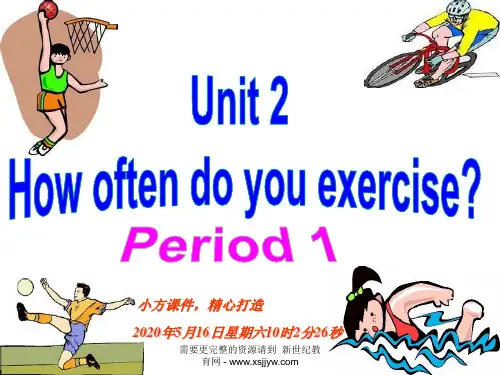
结对活动,练习周末活动
(Yes, I often go shopping.
需要更完整的资源请到 新世纪教 育网 -
1c
Practice the conversation in the picture above. Then make your own conversations about what you do on weekends.
-- I ….
需要更完整的资源请到 新世纪教 育网 -
四人一组进行操练, 频度副词任意用
A: What do you do on weekends? B: I often … 动词原形. C: What does he/she do on weekends? D: He/She often …(动词后加s) .
需要更完整的资源请到 新世纪教 育网 -
听对话,填写正确的活动,可重复
read watch TV help with housework go shopping watch TV go shopping
需要更完整的资源请到 新世纪教 育网 -
usually放实义动词watch之前
I never take a shower in the morning.
never放实义动词take之前
I am never late for school. never放be动词之后
weekend activities
--What do you do on weekends? --I (频度副词) … . How about you?
do homework
exercise
outdoor exercises indoor exercises
2021年秋八年级英语上册Unit2Howoftendoyouexercise教案新版人教新目标版
Unit 2 How often do you exercise?单元教材分析类别课程标准要求掌握的项目单元话题Talk about how often you do things.单元语法1.用how often引导的特殊疑问句来询问“动作的频率”;2.学习表示频率的副词always,usually,often,sometimes,hardly ever,never,every day,once aweek/month,twice a week/month,three times aweek/month等。
语言技能听1.训练学生快速、准确地获取所需信息的能力;2.训练学生根据所听信息完成填表、配对、选择等简单听力任务的能力。
说教会学生运用what和how often引导的特殊疑问句来询问别人所做的事情以及其频率。
读指导学生读懂有关某中学课外活动情况的调查结果的文章并完成文章后面的“饼型图”。
写指导学生利用课堂上所获取的知识来表达自己的日常作息及活动习惯。
学习策略培养学生主动用表示频率的副词谈论业余时间的活动的习惯和意识。
情感态度1.指导学生养成良好的活动和作息习惯,合理安排各项活动,如周末活动(学习、劳动、娱乐、锻炼等);2.培养学生良好的生活习惯,如饮食习惯、帮助父母干家务的习惯等。
文化意识1.了解不同的人物的活动安排的特点,培养自己健康的生活方式;2.学会更合理地安排自己的课外活动。
课时教学设计第一课时Section A (1a-2d)1.通过看图说话、师生问答、听录音、角色扮演等形式,掌握本课时的housework,Internet,program,full,swing这几个词汇和hardly,ever,hardly ever,once,twice 这几个频度副词和短语。
2.通过师生问答、角色扮演、调查采访、做游戏等形式,学会“How often…?”“Iusually…”等句子结构,并能用之谈论、描述自己或他人的业余活动,同其他人交流与业余活动有关的信息,谈论自己或他人进行某项活动的频率。
八年级英语教案Unit1Howoftendoyouexercise?第三课时教学设计
Unit 1 How often do you exercise? 第三课时教学设计单元名称unit 1 how often do you exercise?课时安排第三课时教学目标1.能够听懂并恰当的使用频率副词和短语描述基本饮食结构,谈论有关健康的话题。
2.学习完成任务所需要的语言:1) 词汇:junk food, milk, coffee, chip, cola, chocolate, drink, health, how many, interviewer2) 句子:how often do you drink milk?i drink milk every day.do you like it?no. but my mother says it's good for my health.3.完成课本第4页1a, 1b, 2a,2b,2c的教学任务。
教学环节突出内容教师活动学生活动复习回顾1. hello, boys and girls. nice to see you again. 同学们,大家好!很高兴我们又见面了。
last time we learned a survey from a magazine. do you remember in which school they did the survey?yes. you have a good memory. and what's the survey about?according to the survey, 75% of the students exercise three or four times a week. then you can say ...you are right.what about homework? who can remember?excellent!as for "watch tv", what is the result?very good.1. ss: green high school.ss: about students' activities.s1:most students exercise three or four times a week.s2: most students do homework every day and some students do homework three or four times a week. no students do homework once or twice a week.s3: most students watch tv every day and some students watch tv a few times a week.导入新课单词卡片1. by the way, how often do you watch tv?how many hours do you watch tv each time?how many hours do you sleep every night?well, i think it's not enough. class, how many hours should you sleep every night?i think so. if you want to keep healthy, you must sleep enough. do you think so?2. so what other things we should do if we want to keep healthy?3. and what is healthy food? yes!。
Unit2 How often do you exercise复习教案
Unit2 How often do you exercise?复习教案授课教师:授课日期:一.Teaching aims and demands1.Master the key words and phrases of unit2.2.Train students’writing ability.二.Teaching important and difficult pointsTranslation.三.Teaching methodsDiscussion method,discovery learning.四.Teaching aidsPapers.五.Teaching designsStep1 题组训练一单项选择。
1. ----_________ do your parents go to the movies?---- Twice a month.A. How many B How much C How often D How long2.Tom studies _______.He _______plays with his friends.A. hard; hardB. hardly; hardlyC. Hard;hardlyD. hardly; hard 3.Jane is ______ high school student in the United States.A.a 18-year-oldB.a 18-years-oldC.an 18-years-oldD.an 18 -year-old4..Eating ____ food is good for your ______. You ca n live _______.A.health, healthy, healthilyB.healthy, health, healthilyC.healthy, healthily, healthD.healthy, heal thy, healthily5.__________he is ill, __________ he goes to school.A. Although, butB. /, /C. Although, /D. But, although6.Is her lifestyle _______ yours or different?A. the sameB. the same asC. same asD. the same to7.The old man is well because he often__________.A. exercisesB. drinksC. sleepsD. play8.He must ________ his sister with her math.A. try helpB. trying to helpC. trys to helpD. try to help9. Eating fruit and vegetables can help you ______ more vit amins.A. gotB. gettingC. to getD. gets10. The woman is ______ fat because he eats ______ junk fo od.A. much too, too muchB. much too, much tooC. too much, too muchD. too much, much too11.He has ________ English friends. He knows ______ English.A.a little, a fewB.a little, a littleC.a few, a littleD.a few, a few12.Please drink some milk. It’s good ______ your health.A. toB. forC. atD. with13.-Mom,my uncle is coming for dinner this evening.-OK.Let’s give him______to eat.A.something differentB.different anythingC.anything differentD.different somethingStep2题组训练二完成句子。