
选修6 Unit 2 Poems 全单元教案
Unit 2 Poems Ⅰ. 单元教学目标Ⅱ. 目标语言Ⅲ. 教材分析与教材重组1. 教材分析本单元以Poems为话题,从学生初次接触诗歌,一直谈到诗歌创作的动机、有关诗歌的一些基本知识(包括诗歌的种类、风格)等。
旨在通过本单元的学习,使学生在初步了解和掌握诗歌这一文学形式的基本常识的基础上,进行简单的诗歌创作。
1.1 Warming Up部分要求学生回顾所学诗歌,启发学生以小组活动形式分析、列举人们进行诗歌创作的原因。
1.2 Pre-reading 部分首先要求学生说出自己最喜欢的中英文诗歌并阐明理由;然后通过快速阅读Reading部分内容填写列表,区分诗歌种类。
1.3 Reading部分是一篇介绍诗歌基础知识的文章。
文章从诗歌创作的动机、种类、特点及读者对象等方面简要介绍了五种不同风格、特色的诗歌。
1.4 Comprehending 部分根据阅读内容设置了三个习题。
第一个习题要求学生通过读文章、听录音感受诗歌特色,判断自己所喜欢的诗歌类型并说出理由;第二个习题就文章总体内容提出了五个问题,帮助学生进一步了解不同类型诗歌的不同特点;第三个习题通过十一个具体问题考查学生对文中某些细节内容的理解并要求分析诗歌创作者的情感、态度。
1.5 Learning about Language分words and expressions和structures两部分。
第一部分设置了两个练习:第1个练习要求从所学诗歌中找出与所给词汇压韵的词并添加其它韵词;第2个练习要求用所给词汇的正确形式填空。
第二部分通过四个小练习对所学诗歌中出现的两种结构形式进行训练。
1.6 Using Language共设置了三个任务:第一项任务通过一首小诗展开听力、口语、阅读训练,加深学生对诗歌韵律知识的理解;第二项任务通过Miss Jiang与学生谈论诗歌竞赛的一段录音学习,练习“意愿(intentions)”的表达。
第三项任务要求学生运用所学诗歌知识,根据所给提示进行模仿习作训练。
1.7 SUMMING UP部分对本单元所学知识进行归纳、总结、评估。
1.8 LEARNING TIP 部分介绍了一种通过阅读、写作和吟诵诗歌学习语言的方法。
2. 教材重组2.1 将课本Warming Up, Pre-reading, Reading, Comprehending和练习册READING TASK部分整合成一节“阅读课”。
2.2将课本Using Language中Writing, reading and discussing部分与练习册TALKING,SPEAKING TASK部分整合成一节“口语课”。
2.3将课本Writing部分与练习册WRITING TASK, PROJECT部分整合成一节“写作课”。
2.4将课本Using Language中Listening and discussing部分与练习册LISTENING, LISTENING TASK部分整合成一节“听力课”。
2.5将课本Learning about Language部分与练习册USING WORDS AND EXPRESSIONS,以及USING STRUCTURES部分整合成一节“语言知识课”。
3. 课型设计与课时分配1st Period Reading2nd Period Speaking3rd Period Writing4th Period Listening5th Period Language StudyⅣ. 分课时教案The First Period ReadingTeaching goals 教学目标1. Target language 目标语言a. 重点词汇和短语poem, recite, aspect, rhyme, rhythm, nursery rhyme, diamond, endless, branch, translation, transform, joy, anger, make up ofb. 重点句式Some poems tell a story or ... Others ... P10They delight small children because ... P102. Ability goals 能力目标Enable the students to know more about the poems, including the reason why people write poems and the simple types of poems.3. Learning ability goals 学能目标Enable the students to learn more about poems.Teaching important & difficult points 教学重难点The forms of poems.Teaching methods 教学方法Discussion.Teaching aids 教具准备A computer and a projector.Teaching procedures & ways 教学过程与方式Step Ⅰ RevisionTalk about poems or songs the students learned before. First, show the following to the students. (If possible, present them in audio-visual form.)夜雪已讶衾枕冷,复见窗户明。
夜深知雪重,时闻折竹声。
——李白有的人活着他已经死了;有的人死了他还活着。
有的人骑在人民头上:“呵,我多伟大!”Because I Could Not Stop for DeathBecause I could not stop for death,He kindly stopped for me;The carriage held but just ourselvesAnd Immortality.T: Who are the people in the pictures?S: Li Bai, Zang Kejia and Emily Dickinson.T: They are all famous poets in history. And they all wrote great poems. Do you know what poems are?S: Words and their sounds organized in a special way to express emotions.T: Poems are a kind of literature. Chinese has a long history of writing poems. People who write poems are poets. (Write down the word if necessary.) Do you know some poets in China or in other countries?S: In China, we have many famous poets in history. Such as Qu Yuan, Cao Zhi, Bai Juyi, Li Bai, Meng Haoran, Du Fu, Fan Zhongyan, Guo Moruo, Mao Zedong, and so on. In foreign countries, there are also many well-known poets, such as Yeats, Byron,Shelly in England; Tagore in India; Goethe in Germany; Emerson in America, etc. T: Do you still remember some of the poems or songs you learned before? Sample versions:S1: 山要找鸟儿玩,鸟儿拒绝他。
山要找风儿聊天,风儿溜走了。
只留下山愣愣的站在那里。
S2: 从天上掉下来哗啦啦吓跑路上行人也叫车儿躲藏云阿姨为何事伤心落泪到我家S3: Do-re-mi (Sound of Music)Let’s start at the very beginningA very good place to startWhen you read you begin withA-B-CWhen you sing you begin with do-re-miDo-re-miDo-re-miThe first three notes just happen to beDo-re-miDo-re-miDo-re-mi-fa-so-la-tiOh, let’s see if I can make it easierDoe, a deer, a female deerRay, a drop of golden sunMe, a name I call myselfFar, a long long way to runSew, a needle pulling threadLa, a note to follow sewTea, I drink with jam and breadThat will bring us back to do ... oh oh ohDoe, a deer, a female deerRay, a drop of golden sunMe, a name I call myselfFar, a long long way to runSew, a needle pulling threadLa, a note to follow sewTea, I drink with jam and breadThat will bring us back to doDoe, a deer, a female deerRay, a drop of golden sunMe, a name I call myselfFar, a long long way to runSew, a needle pulling threadLa, a note to follow sewTea, I drink with jam and breadThat will bring us back to doDo re mi fa so la ti do, so doS4: Happy and You Know ItIf you’re happy and you know it, clap your hands (clap clap)If you’re happy and you know it, clap your hands (clap clap)If you’re happy and you know it, then your face will surely show it If you’re happy and you know it, clap your hands. (clap clap)If you’re happy and you know it, stomp your feet (stomp stomp)If you’re happy and you know it, stomp your feet (stomp stomp)If you’re happy and you know it, then your face will surely show itIf you’re happy and you know it, stomp your feet. (stomp stomp)If you’re happy and you know it, shout “Hurray!” (hoo-ray!)If you’re happy and you know it, shout “Hurray!” (hoo-ray!)If you’re happy and you know it, then your face will surely show itIf you’re happy and you know it, shout “Hurray!” (hoo-ray!)If you’re happy and you know it, do all three (clap-clap, stomp-stomp, hoo-ray!)If you’re happy and you know it, do all three (clap-clap, stomp-stomp, hoo-ray!)If you’re happy and you know it, then your face will surely show itIf you’re happy and you know it, do all three. (clap-clap, stomp-stomp, hoo-ray!) Talk about why people write poems with the students.T: There are many reasons why people write poems. Some want to pass on some information, some tell a story, some express feeling of love, anger, joy, etc. We’ve learned a lot of poems before, especially in Chinese. But what are the reasons why people write poems? Work in groups and list some.Sample answers:People write poems: to express one’s hopes and intentions; to call up people to do something; to practice writing; to pour out one’s feelings; to show dissatisfaction or praise ...Step Ⅱ Lead-inTask 1: Talk about the kinds of poems.T: People in different countries make different kinds of poems. For example, in some western countries, there are epics, sonnets and so on; in Japan, there is haiku. Can you give examples of poems of different kinds both in Chinese and English you like best? Why?Sample answers:S1: A Chinese poem: 杜甫《春望》国破山河在,城春草木深,感时花溅泪,恨别鸟惊心。
高中英语人教版选修6教案-Unit_2_Poems_教学设计_教案
教学准备1. 教学目标Teaching goals:1. Help students know more about English poems.2. Unders tand fives kinds of poems in the unit.3. By lear ning the text, make students interested in writing poems by themselves.2. 教学重点/难点Teaching important points:Make students get across the text and improving their reading ability to English poems.Teaching difficult points:Find out and master the characteristics of different poems in the text.3. 教学用具4. 标签教学过程Teaching procedures:Step I Review1. Review the content of unit1 about art. Help students to associate new knowledge with old one.Time periodAD5th----15th The Middle Ages15th----16th The RenaissanceLate 19th----early 20th Impressionism20th ----today Modern art2. By recalling the content of art, lead in the topic of unit 2.Step II New wordsAsk students to look at Page 90 first and then read the first part of new words. Help students to understand the reading passage.Step III Lead-in1. Show an interesting and familiar song to lead new class. Ask students fill the blankets wi th words that they hear.2. Discuss the reasons why people write poems. Brainstorming discuss the reasons why people write poemsto tell a story to express feelingsto describe something to play with wordsto create images in the readers to express a point of viewto make others laugh to create a moodto encourage peopleExample: Lookin g up, I find the moon bright,Bowing, in homesickness I’m drownedStep IV ReadingTask1 Fast reading1. Qs: How many kinds of poems did the textmention?What are they?1.Nursery rhymes2.List poems 3 .Cinquain 4.Haiku 5.Tang poems2. Read and listen to the poems in the passage.Poetry is a great form of literature. There are different kinds of rules for poems, so the forms of poems are quite different from country to country. The passage i n Reading will tell us something about forms of English poems.3. Read the text on P 10 and find out information to complete the form.forms of poem characteristicsNursery rhymes strong rhythm and rhyme, a lot of repetition, easy to learn and to reciteList poems repeated phrases and some rhymeCinquain made up of five lines; convey a strongpicture in just a few word sHaiku made up of 17 syllables, giv e a clearpicture and create a special feeling in just a few words.Tang Poems have a free formTask2: pair workPeople write poems for different reasons. Next go over quickly the poems in the reading part. And then tick the correct Box/boxes for each question on P9As we know, poems are mostly w ritten to show people’s emotions.. In Chinese , we have 诗言志,诗言情,诗歌合为事而作.That is, peoplewrite poems for different reasons, and then we have different ki nd of poems.Task 3: Careful readingAnswer questions of each poem and understand these poems in details.Poem A: What is the baby’s father going to buy if the mirror gets broken?Poem C: What sports d o you think the speaker is writing about? Did his or her team win the game?Q: What’re Poems D & E about? Does the authors like the subjects?Poem H: Could you tell us the woman’s story in your own words?Q: Choose the words to show the woman’s feelingsloneliness joy love trust anger hate sorrowStep V: PracticeQs:Could you try to write some poems or just some lines for some reason.Let students appreciate some interesting poems and encourage them to write some simple poems by themselves. Show examples.课后习题Homework1.Choose two of the eight poems to recite.2.Translate an English poem into Chinese by yourself.。
高中英语选修6:Unit+2+Poems+教案7+
Unit 2 Poems教学目标Teaching aims1. To enable students to use unreal conditionals properly in real situations.2. To improve students integrated language ability, especially listening and speaking ability.3. To develop students’ability of autonomous learning language analysis, inquiry, and cooperation.4. To arouse students’interests and strengthen their confidence in English grammar learning.学情分析1. The analysis of teaching contentsSubjunctive mood is one of the important grammars in senior middle school and in the college entrance examination each topic will probably be involved. It is complicated in structure and usage , yet it is a key point in Senior high school English learning. Over the years it is the hotspot of college entrance examination. So mastering this grammar has the vital significance for the understanding and use of language.2. Analysis of the students:This lessen is designed to teach students how to use the three basic forms of the subjunctive mood .Because the students have learned thisgrammar in Junior, It is not so difficult to learn it. Yet the ways traditional grammar are taught are so dull and the forms are so unitary that it is not easy for the students to understand it effectively. Thus in this lessen in order to cultivate the students' interests in learning English I am going to use multimedia to collect information and guide the students to learn the grammar by practicing. In this class, the English levels of the students are different. The class activities are designed to accommodate all the students. Each student can participate in the activities.重点难点Important point1. Enable the students understand the concept of subjunctive mood and the situations of using unreal conditionals of the present, past and future.2. Make students understand and master different structures of unreal conditionals.Difficult point:Encourage students to make use of unreal conditionals to make up stories or dialogues to experience this new grammar phenomenon.4教学过程【导入】导入Step1. Introduction(3 minutes). Enjoy a video.(video content:Downton Abbey.)Teacher asks the questions:Q1:Have you find the sentence “If I were the only girl in the world, I were the only boy”Q2:Do you think this situation can happen?Of course not. Anyone of us can’t be the only girl or boy in the world. But we do hope. So every time we talk about events that can’t happen or are impossible, yet we wish they could happen or imagine they could happen. At this time we should use unreal conditional sentences or subjunctive mood. This is something we are going to talk about today.At this moment the teacher write the Subjunctive mood on the blackboard【导入】导入Step 2. Are the sentences real conditional or unreal conditional?(3 minutes)A. Ask students to read the four sentences and find which one is real conditional sentence and which one is unreal conditional sentence ?1) If you leave now, you will never regret it.2) If I were a bird , I could fly to the south in winter.3) If he comes, he will bring his violin.4) If we had time, we could play the game again.【讲授】讲授Step 3 Talk about the situations those are impossible now(10 minutes) 1.Teacher gives students three pictures and dialogues and enable them to find out the structures in unreal conditional now..Dialogue1A: Why don’t our grandchildren visit usmore often?B: They don’t have enough time. If theyhad more time, they would visit us more often.Dialogue2A: I wonder why Fred works so hard.B: I don’t know. He must like his job.A: If he didn’t like his job, he wouldn’t work so hard.Dialogue3A: Can Tom dance?B: No, he can’t, but he wishes he could.If he could dance, he would go dancingevery night.2..Conclusion:Teacher asks students to fill in the forms表示与现在事实相反的情况If从句S+ did/were, 主句S+ would/could/should/might +do【活动】练习PraticeExercise1: Rewrite the sentences.1)Tom is unhappy because he has too much homework. I wish Tom had less homework to do.Less homework, happyIf Tom had less homework, he would be happy.2)I am so busy that I can’t go to Jim’s party. I wish I could go to Jim’s party.Not busy, can goIf I were not so busy, I could go to Jim’s birthday party.省略If:Did Tom have less homework, he would be happy.Were I not so busy, I could go to Jim’s birthday party.Exercise2Show the four pictures to students and ask them to make a dialogue using the following sentences in pairs.If you were one of them, would/should/could/might you do the same thing?If I were one of them, I would not spit everywhere.Exercise3Play a gameAsk the students to play a game.in group of 4If I were a bird/fish/tree, I would/should/could/might…评论(0)活动5 【讲授】讲授Step 4. Talk about imaginary situation in the past.(10 minutes)1.Talk about some pictures and pay attention to the structure in unreal conditional situation in the past.1.If he had driven (drive) more carefully,he would not have had the car accident yesterday.2.If I had had(have)time last night,I would have gone(go) to see the film with you3..If I had learned(learn) how to swim, I would not have been_(be) trapped in this island.4.If I had gone (go) to Tom’s birthday party, I would have met (meet) her there.B Conclusion:Teacher asks students to fill in the forms表示与过去事实相反的情况If 从句S+ had done,主句S+ would/should/could/might have done 【活动】练习PracticeExercise1Rewrite the sentences.1.Mr. Black had an accident because he made a phone call while driving. If Mr. Black had not made a phone call, he would/might not have had an accident.2.John was so sleepy that he fell asleep while doing his home.If John had not been so sleepy, he would not have fallen asleep while doing homework.省略If:Had Mr. Black not made a phone call, he would not have had a car accident.Had John not been so sleepy, he would not have fallen asleep while doing his homework.Exercise 2:Group workProvide students four sentences in the film “Titanic “and ask them to rewrite the four sentences using unreal conditionals in group of four. Titanic was sailing on her voyage for America.1. Jack won his third-class ticket in a poker game and met a beautiful girl called Rose on board.2. Unfortunately, the ship struck an iceberg and it sank.3. Jack found a piece of wood and let Rose lie on it while he was in the cold water.4. At last, the rescue workers came and saved Rose.【讲授】讲授Step 5. Talk about imaginary situation in the future(10 minutes)1. Show some pictures and ask students to make a dialogue using the following sentences.What would you do if you had/should have/were to have a lot of money? If I had /should have /were to have a lot of money, I would…If I had/should have/were to have a lot of money, I would buy a car.If I had/should have/were to have a lot of money , I would travel around the world.If I had/should have/were to have a lot of money, I would help the people in need.2.Conclusion:Ask students to draw a conclusion:表示与将来事实相反的情况If +S+ did(were to /should do),S+ would/should/could/might +do .【练习】练习Exercise1Fill in the blanks.1).If I lived/were to live/should live (live) in the 22nd century, I would spend (spend) my vacation in a different way2). If I bought/were to buy/should buy (buy) a lot of books, I would give (give) them to the children who can’t go to school.3). If I met/were to meet/should meet (meet) Obama someday, I wouldshake (shake) hands with him.Exercise2Pair work:Talk about your wildest dreams in the future in group of four.. 【讲授】总结Step 6.Summary(2minutes)Complete the following blanks.Ask the students to fill in the blanksIf 引导的虚拟条件句表示与事实相反的条件。
选修6 Unit 2 Poems教案
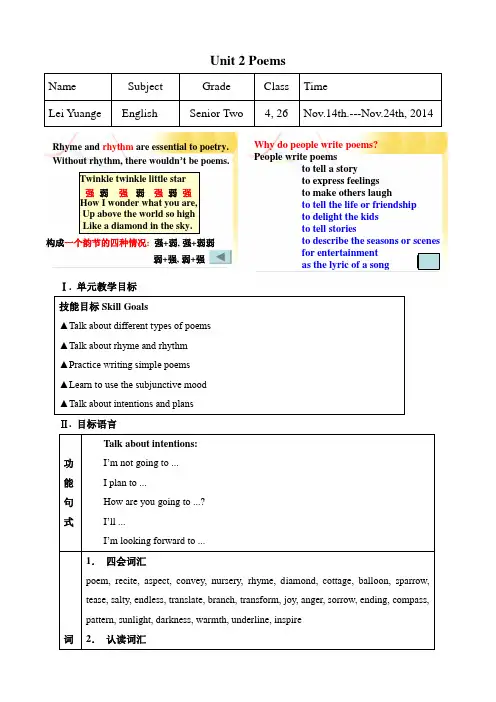
Unit 2 PoemsⅠ. 单元教学目标技能目标Skill Goals▲Talk about different types of poems ▲Talk about rhyme and rhythm Ⅱ. 目标语言 Rhyme and rhythm are essential to poetry. Without rhythm, there wouldn ’t be poems.Twinkle twinkle little starHow I wonder what you are,Up above the world so high Like a diamond in the sky.强弱强弱强弱强构成一个韵节的四种情况:强+弱, 强+弱弱弱+强, 弱+强Why do people write poems?People write poemsto tell a storyto express feelings to make others laughto tell the life or friendship to delight the kids to tell storiesto describe the seasons or scenes for entertainment as the lyric of a songⅢ. 教材分析与教材重组1. 教材分析本单元以Poems为话题,从学生初次接触诗歌,一直谈到诗歌创作的动机、有关诗歌的一些基本知识(包括诗歌的种类、风格)等。
旨在通过本单元的学习,使学生在初步了解和掌握诗歌这一文学形式的基本常识的基础上,进行简单的诗歌创作。
1.1 Warming Up部分要求学生回顾所学诗歌,启发学生以小组活动形式分析、列举人们进行诗歌创作的原因。
1.2 Pre-reading 部分首先要求学生说出自己最喜欢的中英文诗歌并阐明理由;然后通过快速阅读Reading部分内容填写列表,区分诗歌种类。
英语:unit 2《poems》教案-writing(新人教版选修6)
(四)On teaching procedures
Teaching steps
Teacher’s activity
Students’activity
Designing purpose
1. Lead-in
Show the students two Read the two poems and Get the students to poems try to discover the features. discover the features themselves so that it will be easier for them to write.
designed according to this subject. In this unit, different forms of poems are introduced. The students are
required to learn about the features of different forms of poems as well as try to write simple poems and appreciate beautiful literature works. Lessons arrangement Period 1: Warming up & Reading Period 2: Language Points Period 3: Word study &Using language Period 4: Listening Period 5: Grammar teaching Period 6: Writing 2.The function of this lessonin the unit
高中英语 Unit 2 Poems教案 新人教版选修6

Unit 2 Poems【美文阅读】THE WINDWho has seen the wind?Neither I nor you;But when the leaves hang trembling,The wind is passing through.Who has seen the wind?Neither you nor I;But when the trees bow down their heads,The wind is passing by.【诱思导学】1.Do you know about the author of the poem?________________________________________________________________________ 2.Who has seen the wind according to the poem?________________________________________________________________________ 【答案】 1.略 2.Nobody.Period ⅠPreviewing●教学目标本课时主要是通过学生对学案所给出的内容的学习,了解本课文中所出现的词汇,初步了解课文以及相关的背景知识,对下一堂课课文的全面理解起到一个铺垫作用。
●教学地位本单元话题是“诗歌”。
文中涉及诗歌的韵律、节奏,并介绍了几种不同内容和形式的简单诗歌。
本单元引导学生讨论这些内容,目的在于让他们了解诗歌的一些基本特征和写作方法,自己尝试写简单的诗歌,并学会欣赏这些优美的文学作品。
●新课导入建议可以通过给学生看地图,拼地形图卡片,看幻灯片等,尽可能多的直观地向学生介绍有关英国概况的知识,使学生对当代英国的经济与政治,城市与乡村等诸多方面有一个整体认识。
老师要尽量给学生自主学习的时间和空间,通过自学、自做、自悟、自助等方式,让学生体会和理解文章的内容,探讨英国的文化。
高中英语教学设计选修六unit2poems
高二学生已经对中国诗歌比较熟悉,那么从我国诗歌入手不仅可以让学生复习诗歌的相关知识为下一步英语诗歌的学习奠定基础,而且激发学生的学习兴趣和课堂主动参与性。
高二学生在经过高一学期学习策略的训练和培养后,基本掌握了略读、查读、归纳大意等阅读技巧,具有一定的阅读能力。但仍有一部分学生基础薄弱,学习积极性较差,那么在教学活动设计中注意层次性、激励性,注重以小组的形式鼓励学生参与到课堂活动中,培养关爱同学和集体主义精神。
参赛教学设计基本信息
作者姓名
董富华
性别
女
邮政编码
045200
通讯地址
山西省阳泉市第十四中学
所用教科书
书名
普通高中课程标准实验教科书英语
所教年级
高二
所教册次、
单元
高中英语选修六第二单元
设计主题
Unit2 Poems Reading
A Few Simple Forms of English Poems
1.整体设计思路、指导依据说明
3) Present some English poems and encourage the students to think aboutthe characteristicsof poems.
4)How to speak 诗歌、诗人、诗歌(总称)、韵, 压韵、节奏 in English.
从熟悉的中文诗歌入手容易激发学生学习兴趣,激活他们的思维;从英文转译到中文诗歌为下文的学习埋下伏笔,接着呈现英文诗歌引导学生中英对比,自主归纳诗歌的特点,顺势学习诗歌知识的英文表达方式,扩大词汇量,减轻阅读中的困难,增强信心。
5.教学过程设计
(中文为主 + 所教学科目标语言)
Step 1Warming up
英语:unit 2《Poems》教案-reading1(新人教版选修6)
Unite 2 PoemsPeriod 1 Warming up, Pre-reading, Reading (1)Teaching Goals:1. To arouse Ss’ interest in learning about English poems.2. To develop Ss’ ability of comparison.3. To arouse Ss’ interest in learning about different types of poems in the wo rld.4. To develop some basic reading skills.Teaching Procedures:Step 1 Leading-inPurpose: To activate Ss and arouse them to talk about their own little poems.The white sun sets behindmountains,The Yellow River flows into thesea.Go further up one flight of stairs,And you'll widen your view athousandli.——Wang ZhihuanShow the poem written by Wang Zhihuan and a photograph of the writer. Ask Ss to read the poem and. And see if they can remember any poems that they have learnt, either in Chinese or in English, and then ask them to recite one of them.Step 2: Warming UpPurpose: To lead Ss to the topic of this unit through a discussion.1. Pair workGet Ss to ask their partners the questions, and then ask them to present it before the class.(1) Which poem is written to tell a story?(2) Which poem is written to express feelings?(3) Which poem is written to make other laugh?…2. Group workGet Ss to talk about the world famous poets. The pictures below can be used for Ss to talk about, and Ss can also talk as much as they can.William Shakespeare George Gordon Byron Li Bai威廉·莎士比亚乔治·戈登·拜伦李白(1) William Shakespeare: English playwright and poet whose body of works is consideredthe greatest in English literature. His plays, many of which wereperformed at the Globe Theatre in London, include historical works,such as Richard II, comedies, including Much Ado about Nothing andAs You Like It, and tragedies, such as Hamlet, Othello, and KingLear. He also composed 154 sonnets. The earliest collected edition ofhis plays, the First Folio, contained 36 plays and was publishedposthumously (1623).(2) George Gordon Byron: British poet acclaimed as one of the leading figures of theRomantic Movement. The Byronic hero lonely, rebellious, andbrooding first appeared in Manfred (1817). Among his other works areChilde Harold (1812-1818), The Prisoner of Chilton (1816), and theepic satire Don Juan (1819-1824). Byron was notorious for his loveaffairs and unconventional lifestyle. He died while working to secureGreek independence from the Turks.(3) Li Bai: Chinese poet who spent much of his time wandering and composingromantic, wine-inspired verse.Conclusion: All these poets are well known to the whole world and do you know any poems written by them? Can you recite to all the class?Step 3. Pre-readingPurpose: To help Ss learn about the context of the Reading part.1. Group workAsk Ss to discuss the questions with their partners in groups of four.(1) Do you have a favorite poem in Chinese?(2) Why is it your favorite poem?(3) Do you have a favorite poem in English?(4) Why is it your favorite poem?For example:(1) My favorite poem in Chinese is: 去年今日此门中,人面桃花相映红。
人教版高中英语选修六:Unit2+Poems+教案4.doc
Unit 2 Poems教学目标1)知识和技能目标:让学生了解和掌握虚拟语气的基本语法规则,并能在具体的语言环境中灵活运用,解决相关高考试题,在日常交际中能够正确灵活的使用。
2)过程和方法:通过教师讲解和学生探究相结合;通过语法练习和语言实践活动相结合;通过任务型教学和情景式教学相结合,让学生构建语法功能知识,应用于实践中去发现和解决问题。
3)情感、态度和价值观目标:培养学生自主学习能力,增强学生合作意识,提高学生语言分析能力和自己对事物的正确认识,形成正确的人生观、价值观。
学情分析学生们在经过必修1-5的学习和累积中已经形成了基本的语法框架,这为学习虚拟语气中的非真实条件句打下了基础。
通过学生们对第二单元诗歌的阅读已经让他们对虚拟语气的使用情景有了一些了解,但是他们没有准确地掌握和熟练的运用。
希望本节课可以帮助他们突破汉语式的思维模式让其掌握虚拟语气中非真实条件句的基本用法。
重点难点教学重点:掌握虚拟语气非真实条件句的规则和基本原则。
教学难点:能够运用此语法项目去完成各种相关表达,并能在实际语言活动中灵活运用。
4教学过程【导入】导入Step1. Leading in the grammarStep One: Lead in. Let’s enjoy a song by Celine Dion——If I could. After listening to the song, ask students what the singer wanted to express.(Mother expressed love to her baby)Lead in: What mood did the singer use in this song?(Subjunctive mood)【活动】设置情景,发现规律Step Two: Approaching and presenting the grammarSupposing three different conditions of past, present and future, make some sentences1. Now we are having an English class, I find some of you are whispering secretly. If you paid attention to your studying, you would make great progress.2. Yesterday we had an English test. If you had been more careful, you would have got a high mark.3.The next day we will have a day off and go to climb the mountain. If I were to buy a pair of sport shoes, I could feel more comfortable while climbing.(通过设置情景,呈现不同时间的条件虚拟句,让学生注意发现语法规则,总结出与不同时间事实相反的虚拟条件句式特点。
人教版高二英语选修6Unit2Poems全单元教案
教案1 Unit2 PoemsWarming up and ReadingTeaching material: NSEFC Book 6 —— Unit 2Teaching Aims: To cultivate students’ interest of poetry and improve their reading skills. Teaching Important & Difficult PointsHow to help the students to grasp and remember the detailed information of the reading material. Teaching aids: a tape recorder, a projector, Slides and PicturesTeaching ProcedureStep 1 Warming up. Match the following information.Li Bai Song DynastyDu Fu Tang DynastyFan Zhongyan Tang DynastyMeng Haoran ModernGuo Moruo ModernMao Zedong Tang DynastyByron AmericaShelly EnglandEmerson EnglandTagore GermanyGoethe IndiaStep 2 Brainstorming1 Discuss the reasons why people write poems.2 Fast reading Scan the passage and answer the following questions.1). What is the main topic of the reading passage?2). What five kinds of poems does the reading passage talk about?Keys: 1) different forms of English poems2) nursery rhymes, list poems, cinquain, haiku, Tang poems.T: Now let’s read the following five poems and finish tasks.1 Listen to Poem A and pay attention to its rhyming lines and words.Read the poem by yourself again and answer the following questions.1). What’s the baby’s father going to bu y if the looking-glass gets broken?2). What is Papa going to buy for the baby if that billy-goat runs away?3). What are the features of it?Keys:1). a billy –goat2). another billy-goat3). It has strong rhythm and rhyme and has a lot of repetition.2 Poem CQuestions1). Did his or her team win the game?2). Why his or her team didn’t win the game?3). Does the speaker really believe his or her own excuse? How do you know? Keys: 1). No, his or her team didn’t win.2). The players didn’t win because: Jack didn’t score that goal; they didn’t have enough time; they hadn’t trained hard….3). The speaker doesn’t really believe his or h er own excuses, because there has too many ifs…3 Poem D&E1). What subject is the speaker writing about?2). Does the speaker like the subject? Give a reason for your answer.4 T: We have enjoyed so many English poems. Some are traditional forms of English poetry but some are not, for example haiku. (It comes from Japanese).In fact English speaker also have borrowed from another kind of Asian poetry---Tang poems from China.Poem H at the bottom of this passage is a translation from the Chinese. Poem H 望夫石王健望夫处,江悠悠。
人教版高中英语选修6《Unit2Poems》教案
人教版高中英语选修6《Unit2Poems》教案人教版高中英语选修6《Unit 2 Poems》教案【一】教学准备教学目标教学目标(Teaching Aims)知识与技能(Knowledge and Skills)1. 了解教学大纲关于语法填空的命题特点。
2. 能够根据语法填空的命题特点自己编语法填空的题目3. 掌握语法填空的解题方法与技巧过程与方法(Process and Methods) 让每一位同学都能参与到课堂教学与活动中来,以小组或结对的形式进行相互学习和讨论。
情感态度与价值观(Feeling, Attitudes and Values) 学习应对语法填空是与课文相结合,让学生在了解各种不同诗歌形式的背景下学习语法填空的设题与解题特点,从而更加理解英语诗歌的特色,更加懂得如何阅读和欣赏英语诗歌。
教学重难点教学重点(Important Points) :1. 让学生了解语法填空的命题特点2. 掌握语法填空的解题方法与技巧教学难点(Difficult Points):语法填空中词性的转换教学过程(Teachers’ Activities)Step I: Lead-in① Review the new words and expressions of this unit by them together, and then do Task 1---speak out the other forms according to the giv en words② Listen to the song Jingle Bells and try to fill a word intoeach blank.Step II : Pre-practising1. Questions① Do you think it is difficult to complete the items of blank-filling with grammar knowledge?② Have you figured out the characteristics of the i tem?2. ExplainingIn this item there are 10 blanks for you to fill in with less than one proper word① some blanks with a given word while others with none② fill in the blanks with the proper form of the given word according to its grammatical and logical meaning.③ choose a preposition, pronoun, conjunction or an article to fill in the blank without any given word.3. DiscussionHow can we finish the items step by step with our grammar knowledge?① ___________________________________________.② _ __________________________________________.③ ___________________________________________.Step III : While-practising1. Making an item of grammatical blank-filling based on the para graph of the text.① more than 5 blanks.② some blanks with given word.③ other s with none.2. exchange the item you made for your partner to complete it .3. The whole class finis h the one the teacher prepared for them.Step IV : Post-practising1.Check some of the students’ anwsers and give comments.2.Draw a conclusionStep V: Homework Assign ment1. Further improve your skills of dealing with the grammar filling.plete Ex.2 on Page 10, Nanfang New Class人教版高中英语选修6《Unit 2 Poems》教案【二】教学准备教学目标Teaching goals1. Target languagea. Important words and phrasesPoem, poetry, recite, aspect, convey, nursery, rhyme, diamond, cottage, balloon, sparrow, tease, salty, endless, translate, nursery rhyme, take it easy, run out of, make up ofb. Important sentencesWhich poem is about things that don’t make sense?Poets use many different forms of poems to express themselves.I hadn’t taken my eye off the ball.We hadn’t taken it easy.The poem is made up of five lines.A lot of Tang poetry has been translated into English. The translations have a free form that English people like to copy.2. Ability goalsa. Enable Ss to talk about different types of poems: nursery rhymes; list poems; cinquain,; haiku; T ang poemsb. Enable Ss to talk about different purposes of writing poems.c. Understand the main theme of each poem.d. Enable Ss to chant some of their favorite poems.3. Learning abilityEnable Ss to distinguish different types of poems教学重难点Teaching important points1. Talk about five main types of poems.2. Understand the main purpose of writing the poems.Teaching difficult points1. Find the rhythm of each poem.2. Chant the poem.3. Understand the main purpose of writing the poems.教学过程Teaching procedures & waysStep 1. GreetingsStep 2. PresentationAsk Ss to think back and try to remember poems from their early childhood, either in Chinese or in English.Talk about some famous poets both home and abroad, either ancient ones or modern ones.Brainstorming: What will you think of when we talk about the word “poem”?Step 3. Warming upRead the questions in this part, reminding Ss what they notice about the above poems.(e.g. they have a strong beat, or they have rhyme, or they play with words and sounds, or perhaps some of them are funny because they make no sense.) Tell Ss that there are many reasons why people write poetry. Give the examples on the Bb. Ask Ss why they think the poets wrote the poems they have just recited.. Write their suggestionson the board.Give Ss a time limit of a few minutes. Divide the class into groups of four to discuss the purpose of writing poems. Ask one p erson from each group to read their group’s list and add their suggestions to the list on the board. (Suggested reasons: to create certain feelings or images in the reader; to share a feeling or experience; to describe something in detail or give an impression; to get the reader to think about an idea; to express a point of view; to make the reader experience the sight, sounds, smells, feel and tastes of something; to create a mood, to play with words--- their sounds, rhyme and rhythm.)If time permits, in small groups or as a class, discuss the kinds of topics that poets write about.( people, animals, nature, landscapes, the sea, the seasons, stories, death, war, youth and old age, feeling and experiences, emotions like love, hate, sadness, regret and desire, etc.)Step 4. Pre-readingPeople from different countries write different kinds of poems. Get Ss to discuss the questions on Page 9 with their partners: Do you have a favorite poem in Chinese? Why ? Do you have a favorite poem in English? Why?As to exercise 2, give Ss practice in an important reading skill: scanning a text, that is, looking through a text quickly to find specific information. Read the table in exercise 2 with the Ss. Tell them that they are going to look for the information in the table, just in the poems themselves, not in the other parts of the text. They are to look only for those pieces of information and not read every word. Do an example with them.Suggested answers to exercise 2:Step 5. ReadingScanningGet the Ss to read the passage quickly and accurately and meanwhile help the Ss to form a good habit of reading. Teacher gives Ss a couple of minutes to look through the whole passage. Tell them to read the text silently and then ask some detailed questions about the text on the slide show . Teacher should encourage Ss to express their ideas.Q1. Why do people write poetry?Q2. How many forms of poems are mentioned in the passage? What are they?Q3. What does “nursery rhyme” mean? Why do they delight small children?Q4. What’s the characteristic of “list poems”? What about “cinquain”?Q5. Why do English People like “Haiku”?Q6. Are you familiar with Tang Poems? Do you know the title of the last poem in the text?ListeningBefore Ss read the text, have them close their books and listen to the text with their eyes closed. This gives Ss the opportunity to listen to the sounds or “music” of the poems before reading them in detail. Tell them that it doesn’t matter if they don’t understand every word.First readingGet Ss to read the text carefully, finding the one sentence that sums up the paragraph of each part.. Underline the topic sentence.Second readingTell Ss that they are going to look at the rhythm of two of the poems. Make sure they know what rhythm is. Read the limerickaloud and have Ss listen for the strong beats. Then have them clap the strong beats as you read. Mark the strong beats on the limerick on the board.There was an old man with a beardWho said “it is just as I feared”.“Four insects and the nTwo birds and a henHave all made a home in my beard”.Now read the poem A & B. Ask them to mark the strong beats on the two poems that have a strong rhythm. Check their answers . Then play the tape and get them to clap to the strong beats in those two poems.Third readingJust as any scene can serve as the subject of a painting, so any part of daily life can provide material for a poem.. Of course, the choice that the artist or poet makes relates to his or her purpose. Poetry is usually short and compact, so it should be read several times, preferably aloud, to appreciate its meaning. Read the last poem (Poem H), and answer the following questions: Q1. What parts of the poem suggest that the woman loves her husband?Q2. How do you understand the sentence”Should the journeyer return, this stone would utter speech.”? Explain the sentence in your own words.Q3. What picture do you have in your mind when you read the above sentences?Q4. Do you know the Chinese title of this poem? Do you know the Chinese version of the poem?Step 6. Make a short summary of this period.课后习题Homework1. Surf some websites to find out more information about poets.2. Review the content of the reading passage.3. Finish the exercises on Page 12& 13.。