
Unit 2 What time do you go to school教案
Unit 2 What time do you go to school?
Section A (1a-2d)
一、教学目标:
1. 语言知识目标:
1) 能掌握以下单词:
up, get up, dress, get dressed, brush, tooth (pl. teeth) brush teeth, shower, take a
shower, usually, forty, fifty, wow, never, early, job, work, station, radio station,
o'clock, funny, exercise
能掌握以下句型:
① —What time do you usually get up? —I usually get up at six thirty.
② —When do you go to work? —I usually go to work at eleven
o'clock.
③ —He has an interesting job. —He works at a radio station.
2) 用when和what time引导的特殊疑问句询问时间和时间的表达法;用所学的目标语言对生活和学习活动做计划,学会合理地安排作息时间。
2. 情感态度价值观目标:
本部分的话题是“日常作息时间”,学习内容贴近学生的生活,因为学生的作息时间安排是非常有规律的。通过互相询问或谈论自己或对方的作息时间安排和活动计划,可以培养学生良好的作息习惯和守时习惯。
二、教学重难点
1. 教学重点:
1) 掌握时间的简单表达方式。
2) 学习询问和谈论时间和制订作息时间表。
2. 教学难点:
when和what time引导的特殊疑问句和时间的表达法。
三、教学过程
Ⅰ. Warming-up and revision
1. Greet the Ss as usual.
2. Watch a short video program about daily activities. Ⅱ. Presentation
1. 出示几幅反映日常事务(如:起床、上学、跑步等)的图画、幻灯片或播放课件,引导学生谈论这些日常事务go to school,get up,run,take a shower,eat breakfast等,学习有关的动词短语。
学生们观看教师出示的反映日常事务(如: 起床、上学、跑步等)的图画、幻灯片或课件,谈论这些日常事务go to school,get up,run,take a shower,eat
breakfast等,学习有关的动词短语。
2. 出示la部分的图片或幻灯片或播放该内容的课件,引导学生将词语与图画进行搭配。
学生们观看1a部分的图片或幻灯片或该内容的课件,将词语与图画进行搭配,完成la部分的学习任务。
Ⅲ. Presentation
1. 出示一个可以转动时/分针的大钟,一边调整时间,一边询问学生时间“What
time is it?”。
学生们在老师的帮助下回答时间:
It's six o'clock. It's seven twenty. …
(给学生们解释在英语中时间的简单的表达方式)
2. 调整时钟到某个时间,然后说:I get up at 6:00.I go to school at 6:45.等;再询问学生:What time do you get up? 等,引导学生回答,从而引出本部分的重点目标句型。
学生们一边观看大钟,一边认真听老师的描述,然后回答老师的问题I get up
at…,从而学习本部分的重点目标句型。
Ⅳ. Listening
1. 播放1b部分的录音让学生听,引导学生根据所听到的内容,将时间与活动进行搭配。
2. 学生们听1b部分的录音,根据所听到的内容,将时间与活动进行搭配,完成1b部分的学习任务。
3. Check the answers:
Ⅴ. Pair work 1. 引导学生展开Pairwork活动,进行口语交际活动,学会运用what time引导的疑
问句,用数词来询问和表达时间。
2. 学生们展开活动,完成1c部分口语交际的学习任务,学会运用what time引导的疑问句,用数词来询问和表达时间。
Ⅵ. Listening
1. 让学生们先阅读2a部分的句子,理解大意。然后 播放2a部分的录音让学生听,引导学生根据对话内容进行填空。
(注意提醒学生们听对话填空的技巧:先听、记住应填的内容,做简单的(符号)记录,最后,在听第二遍的时候再进行单词的书写。)
2. 再播放2a部分的对话录音让学生听,引导学生写出Jim一家人的淋浴计划(时间)。
3. 学生们再听2a部分的对话录音,写出Jim一家人的淋浴计划,完成2b部分的教学任务。
4. Check the answers:
Ⅶ. Pair work
引导学生展开Pairwork活动,完成2c部分口语交际的教学任务。
提示学生们可以就1a部分的日常活动来进行问答。e.g.
T: S1, what time do you usually get up in the morning?
S1: I usually get up at six thirty.
T: And what time do you eat breakfast?
S1: I usually eat breakfast at seven o'clock.
Ⅷ. Role-play
1. Ask Ss to read the conversation in 2c. Then answer the questions below:
① Where does Scott work?
② What time is his radio show?
③ What time does he usually get up?
④ What time does he eat breakfast?
⑤ What time does he usually go to work? 2. 学生们阅读对话,然后回答上述问题。老师让几位同学回答上述问题,然后和同学们一起校对一下答案。看学生们的掌握情况。应对话中学生们不明白的地方给予适当的解释。
3. Play the recording for the Ss to listen and repeat. Then let Ss work in pairs to
practice reading the conversation. Then try to act it out.
4. Ask some pairs to come to the front and act out the conversation. See which group
does best.
Homework:
1. Remember the new words and expressions. Try to understand how to express
time in English.
2. Role-play the conversation with a partner after class.
3. Write three short conversations to ask about your best friend's daily activities.
板书设计:
Section A (Grammar Focus-3c)
一、教学目标: Section A (1a-2d)
Drills:
1. —What time do you usually get up? —I usually get up at six thirty?
2. —What time does Scott eat breakfast? —He eats breakfast at nine.
3. —When do you usually go to work? —I usually go to work at eight.
2a: two; two, one
2c: 5:50; 6:15; 6:30; 6:45
2d: ① At a radio station. ② From 12 at night to 6 in the morning.
③ At 8:30. ④ At nine. ⑤ At Eleven. 1. 语言知识目标:
1) 继续学习运用when和what time引导的特殊疑问句询问时间、运用数词表达不同的时间,通过对目标语言的学习使学生学会更合理地安排自己的学习和课活动时间。
能掌握以下句型:
① —What time do you usually get up? —I usually get up at six thirty.
② —When do you go to work?
—I usually go to work at eleven o'clock. —He's never late for school.
③ —When does Rick eat breakfast? —He eats breakfast at seven o'clock.
④ —When do your friends exercise? —They usually exercise on
weekends.
2. 情感态度价值观目标:
通过对该部分内容的学习,让学生们学会用频率副词谈论自己日常生活及日常作息习惯;学会更合理地安排自己的学习和课外活动时间;能够运用所学知识对某一活动进行合理安排,并培养学生良好的作息习惯和守时习惯。
二、教学重难点
1. 教学重点:
1) 总结归纳用频率副词谈论自己日常生活及日常作息习惯的句型。
2) 通过不同形式的练习方式来训练及熟练运用用频率副词谈论自己日常生活及日常作息习惯。
2. 教学难点:
1) 总结归纳用频率副词谈论自己日常生活及日常作息习惯的句型。
2) 用频率副词来造句,表达日常作息习惯。
三、教学过程
Ⅰ. Warming- up and revision
1. Greet the Ss and check the home.
2. Let some pairs role-play the conversation in 2d.
Ⅱ. Grammar Focus.
1. 下面是对用频率副词谈论自己日常生活及日常作息习惯的句型进行了总结。
七年级英语What time do you go to school教案

实用精品文献资料分享
七年级英语What time do you go to school教案
Unit 11 What time do you go to school? 复习导学案 备课教师:刘文光 备课时间:第17周 拟使用时间:第18周 复习目标 1、熟记本单元单词及短语。 2、掌握句型:What time do you usually get
up? I get up at six o’clock. What time is it? It’s eight thirty.
3、掌握用英语表达时间和谈论人们的日常活动。 本单元的词组 1
what time=when 几点 2 go to school 去学校/去上学 3 go to work
去上班 4 work very long hours 工作很长时间 5 get up (反义:go to bed) 起床 6 put on (反义:take off) 穿上/脱掉 7 get to
到达某地 8 listen to .听… 9 go to bed 上床睡觉 10 do homework
做作业 11 go home 回家 12 take/have a shower 淋浴 13 be busy
(with sth)/doing sth 忙于做某事 14 brush one’s teeth 刷牙 15
take a bus/taxi/train/subways 乘公共汽车… 16 have/eat
breakfast/lunch/supper/dinner吃早餐/吃午餐/晚餐 17 go to
work 去上班 18 after breakfast/lunch/supper 早饭后… 19 write
to sb 写信给某人 20 write and tell me sth 请写信告诉我某事 21
all night 整晚 22 do one’s homework 做某人的作业 23 school
人教新目标版英语七年级下册《What time do you go to school》导学案4

What time do you go to school
一.预习目标:知识与能力1. 识记一些重要词汇: up,get up,dress,
get dressed,brush,Tooth(teeth),shower, take a shower, usually, forty
2.理解并掌握下列句型:1.A:What time do you get up?
B:I usually get up at six thirty.
二、预习重点:熟练掌握What time……引导的句型。
三、预习难点:Listening practice and make up new conversations.
四、预习任务:(一)预习内容:任务一:写出下列单词或短语。
1.向上________________2.起床,站起________________________3.穿衣服____________________
4.穿上衣服________________________________5.刷,刷净____________(复数_________________)
6.牙齿_______________(复数)______________7.淋浴______________8.通常地_________________
9.洗淋浴________________________________10.四十___________________________________
11.去上学_______________________________12.刷牙____________________________________
13.吃早饭_______________________________13.在六点半________________________________
人教新目标七年级下册英语导学案Unit 2 What time do you go to school
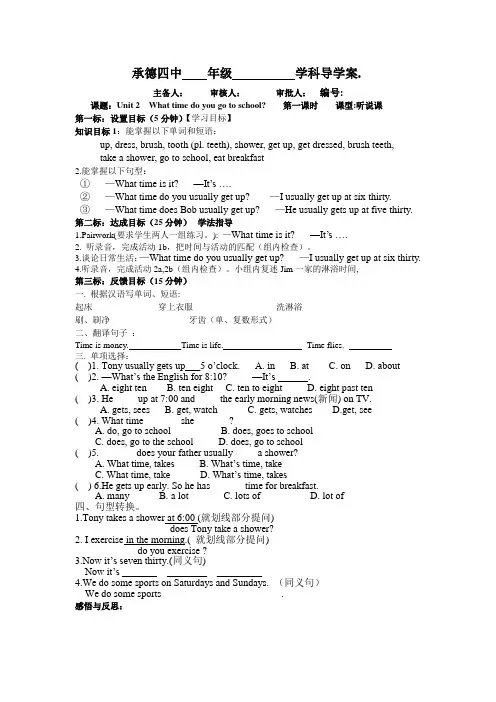
承德四中 年级 学科导学案.
主备人: 审核人: 审批人: 编号:
课题:Unit 2 What time do you go to school? 第一课时 课型:听说课
第一标:设置目标(5分钟)【学习目标】
知识目标1:能掌握以下单词和短语:
up, dress, brush, tooth (pl. teeth), shower, get up, get dressed, brush teeth,
take a shower, go to school, eat breakfast
2.能掌握以下句型:
① —What time is it? —It’s ….
② —What time do you usually get up? —I usually get up at six thirty.
③ —What time does Bob usually get up? —He usually gets up at five thirty.
第二标:达成目标(25分钟) 学法指导
1.Pairwork(要求学生两人一组练习。): —What time is it? —It’s ….
2. 听录音,完成活动1b,把时间与活动的匹配(组内检查)。
3.谈论日常生活:—What time do you usually get up? —I usually get up at six thirty.
4.听录音,完成活动2a,2b(组内检查)。小组内复述Jim一家的淋浴时间,
第三标:反馈目标(15分钟)
一. 根据汉语写单词、短语:
起床_______________穿上衣服___________________洗淋浴_________________
刷、刷净__________________牙齿(单、复数形式)________ __________
七年级下册unit2-What-time-do-you-go-to-school-知识点讲解与练习

1.What time do you get up?
释:这是一个由疑问词what time(几点)引导的特殊问句。
其结构:What time +助动词do/does +主语+动词原形,询问某人做某事的具体时间。
例如:what time do you begin class in the morning?你们早晨几点开课?
注:What’s the time=What time is it?也是用来询问时间,意为“几点了”。用it作答。
例如:What’s the time? It’s 7:30.几点了?七点半了。
2.I usually get up at five o’clock. 我通常在五点钟起床。
释:1)句中usually与often 一样都是频度副词,常用于动词be 之后,行为动词之前。
always 意思是“总是”、“永远”,表示动作重复,状态继续,中间没有间断,通常
用来修饰动词的一般时态。
例如:We always get up before six o'clock.我们总是六点前起床。
若修饰动词进行时,则有“老是”,“再三地”的意思,带有厌烦、不满、赞美等感情色彩。例如:You are always coming late.你老是迟到。(含有责备的意思)
He is always thinking of others.他总是想着别人。
usually(75%)意为“通常”,着重表示已习惯的动作。反义词为:unusually。
例如:They usually have four classes in the morning.他们上午通常上四节课。
They usually do some shopping on Sunday.他们通常星期天买东西。
often(50%)意为“时常”、“经常”,表示常常这样,但不总是这样,反义词为: seldom。
例如:She often helps her mother with her housework after school.
Unit 2 英语教案人教版新目标七年级英语下册

Unit 2 what time do you go to school?
(Section A)
教学目标:
能够听懂、会说并正确使用日常生活中的时间表达方式。
能够用英语描述自己或他人的日常作息时间。
教学重点:
时间表达方式。
熟练使用句型“What time do you...?”和“I usually... at...”。
教学难点:
用英语描述自己或他人的日常作息时间。
区分at、in、on的用法。
教学准备:
课件、多媒体设备。
钟表、日常生活用品图片等教具。
教学过程:
Step 1: Warm-up
Show some pictures of daily activities, such as getting up, having breakfast, going to school, doing
homework, watching TV, and going to bed.
Ask students to describe what they usually do at each time of day.
Step 2: Presentation
Present some common time expressions, such as "in the morning", "in the afternoon", "in the
evening", "at night", "at 6 o'clock", "at 7:30", and "on Monday".
Explain the different uses of "at", "in", and "on".
Step 3: Practice
Have students work in pairs to ask and answer questions about each other's daily routines using
七下U2.What+time+do+you+go+to+school

Unit 2 What time do you go to school?
1.what time和when都可以对时间提问,表示“什么时候”
what time用来询问具体的时间点;when既可询问时间点,也可问时间段。
Eg. What time/When do you usually get up? I uaually get up at 6:15.
What time/When do they get dressed? They always get dressed at 7:20.
When does she play the piano? She plays the piano on weekends.
注:向对方询问具体时间时,即几点几分,只用what time。
Eg. What time is it? 几点啦? It’s 3.
询问年份、月份、日期时,只用when。
Eg. When is the Father’s Day?
练习:1.--______do you usually go shopping? --_____ Sundays.
A. When;on B.where;at C. What;in D. What time;on
2.--_____does Lily have lunch at school? --At twelve o’clock.
A. What B. where C. What time D. How much
2.时间读法:①顺读法(先点后分) six fifteen ( 6:15)
②逆读法(先分后点)
分钟≤30用past :five past eight(8:05)/half past eight(8:30)/twenty past ten(10:20)
新人教 英语 七年级下册Unit2 What time do you go to school知识点详解
Unit 2 What time do you go to school?
知识点详解
单元目标总览:
单元话题 Daily routines 基本要求
重点单词 1.up 向上 2.dressed 打扮好的;穿着衣服的
3.brush 刷 4.showe淋浴;淋浴器
ually 通常 6.forty 四十
7.never永不;绝不;从不; 8.early 早
9.fifty 五十 10.job 工作;零工;任务;职位
11.o'clock(=of the clock) 点钟 12.station 电视台;车站
13.funny 奇怪的滑稽好笑的 14.exercise 锻炼;练习
15.group .组群 16.take a shower淋浴;洗澡
17.work 工作 18teeth 牙齿
19.best 最好的 20.half 一半,半数
21.past 过去,往事 22.quarter 一刻钟;四分之一
23.homework 家庭作业 24.run 跑;奔
25.walk 行走;步行 26.clean 打扫;弄干净;
27.quickly 很快的 28.either 或者;也
29.lot 大量;许多 30.taste 有…的味道;品尝
31.life 生活 1. 掌握重点词汇、短语及句型
2. 学会谈论日常的作息习惯;
3. 掌握时间的表达及询问方式;
4. 学习询问及回答对事物的看法;
人教版七年级英语下册第二单元教案
UNIT 2 What time do you go to school? Section A 第1课时(1a~1c)
自主学习方案
1. 自学生词,并记住拼读及拼写。
2. 预习课本找出重点短语及句子。(见学案自学导练内容)
3. 读记后完成自学导练内容。
课堂导学方案
Step1 情景导入
利用图片或多媒体给学生展示时间,教师问:What time is it? Can you tell me?Let’s
learn how to say time in English.教师可以自己回答一、两个时间,然后让学生回答。
—What time is it?
—It,s two (o’clock)/two twenty.
环节说明:开门见山的提出本节课的学习重点—时间表达法。
Step 2完成教材1a—1c的任务
1. 教师领读1a中的词组,学生识记并且将活动和图片中的人物匹配。(3分钟)
2. 以小组为单位说出1a图片上时钟显示的时间,练习时间表达方法。(3分钟)
3. 认真听录音,将所进行的活动和时间相匹配。完成课本1b的听力任务。(2分钟)
4. 再听一遍录音,并跟读,模仿语言语调。(2分钟)
5. 仿照1c中的对话,利用1b的听力信息和同伴练习新对话,并邀请几组同学来表演对话。(5分钟)
参考案例:
6.小结训练。(5分钟)
(1)我早上六点起床。
I get up at six in the morning.
(2)他的爸爸晚上九点洗澡。
His father takes a shower at nine in the evening.
(3)你姐姐几点刷牙?
What time does your sister brush teeth?
(4)写出下列时间。
8:00 eight (o’clock)
9:02 nine off two
11:25 eleven twenty—five
初中英语七年级下册 Unit2 what time do you go to school
人教版英语科目第二单元第二课时教学设计
Unit 2 What time do you go to school?
Section A (Grammar Focus-3c)
课题 Unit 2 What time do you go to school? 单元 第二单元 学科 英语 年级 七年级下册
学习
目标与核心素养 1. 继续学习运用when和what time引导的特殊疑问句询问时间、运用数词表达不同的时间,通过对目标语言的学习使学生学会更合理地安排自己的学习和课活动时间。
能掌握以下句型:
① —What time do you usually get up? —I usually get up at six thirty.
② —When do you go to work?
—I usually go to work at eleven o'clock. —He's never late for school.
③ —When does Rick eat breakfast? —He eats breakfast at seven o'clock.
④ —When do your friends exercise? —They usually exercise on weekends.
2.通过对该部分内容的学习,让学生们学会用频率副词谈论自己日常生活及日常作息习惯;学会更合理地安排自己的学习和课外活动时间;能够运用所学知识对某一活动进行合理安排,并培养学生良好的作息习惯和守时习惯。
重点 1) 总结归纳用频率副词谈论自己日常生活及日常作息习惯的句型。
2) 通过不同形式的练习方式来训练及熟练运用用频率副词谈论自己日常生活及日常作息习惯。
难点 1) 总结归纳用频率副词谈论自己日常生活及日常作息习惯的句型。
2) 用频率副词来造句,表达日常作息习惯。
新人教版七年级下册unit2what-time-do-you-go-to-school教案语法知识点
1 / 4 Unit2 What time do you go to school?
Section A
1a:
1. 时间的表达方式
✓ 采用数词表达时间
例如:10:30 ten thirty 11:50 eleven fifty 16: 18 four eighteen p.m.
✓ 采用介词past, to表达时间
30分钟以前的可以说成几点过几分用past
30分钟以后的可以说成差几分几点用to
1) half past + 点钟 ……点半 9:30half past nine
2) 分钟+past+点钟 几点过几分 10:05 十点过五分
3) 分钟+to+点钟 差几分几点 9:58(差两分十点) two (minutes)to ten
注意:quarter 一刻钟 a quarter past nine 9:15 a quarter to nine 8:45
2. 几种有关时间的问句
✓ What day is it today? It is + 星期
✓ What is the date today? It is + 日期
✓ What time is it?= what’s the time? 回答:it is ……
3. time 的用法总结:
in time 及时
on time 按时
at times 有时
at the same time 同时
all the time 总是 each time 每次
next time 下次
It is time for……=It is time(for sb) to do…… 到做某事的时间了
It is time for school. = It is time to go to school.
4. 本单元重点句型
What time do/does+主语+ ususlly+……?