
初中英语语法知识—动词时态的知识点复习(5)
一、选择题1.— Look after yourself on your way to Gungzhou,dear.— OK, mom.I will call you________get there.A.as soon as B.so that C.because2.Becky took a photo of her friends while they _________ computer games.A.play B.are playing C.were playing D.have played 3.—How long can I _____ the English workbook? —For two weeks.A.borrow B.to borrow C.keep D.to keep 4.—Rose, can you give me a hand?—Just a minute. I ______ the followers.A.am watering B.have wateredC.watered D.water5.We’re not sure _______ there’ll be _______ or not tomorrow.A.if; rains B.if; rainy C.whether; raining D.whether; rain 6.Boys and girls, there ________an English speech competition in two weeks.A.will have B.has C.is going to be D.are going to be 7.Dick __________ in America, but he has been ___________ Chinese food since he moved to China.A.used to live; used to eatingB.is used to live; used to eatC.is used to live; used to eatingD.used to living; used to eat8.Wang Wei often ________ TV on Sunday evenings, but now he is _______ stories. A.watches; reading B.watching; reads C.looks; reading D.watches; looking 9.Which of the following is right?A.He is used to live there.B.My main job is spreading the message about protecting the environment.C.I have borrowed the book from the library for two weeks.D.Kids under 18 are not allowed to drive.10.—I called you at three yesterday afternoon, but you weren’t in.—I ________ a meeting at that time.A.had B.was having C.have had D.would have 11.— Who ________the classroom tomorrow, Tony?— Our group.A.will clean B.cleans C.cleaned D.clean12.—How long have you________?—For 10 years, we got married in 2005.A.married B.got married C.been married D.were married13.They the English role play for the show last night.A.will practice B.practiced C.is practicing D.have practiced14.— How is your new coat?— Well, I __________ it on and it fits me well.A.try B.tried C.have tried D.had tried 15.Jack ______ a good rest as soon as he finishes the exam.A.has B.had C.is having D.will have16.Look! Dave __________ on the phone.A.talks B.are talking C.talk D.is talking 17.It’s _______today.I think it’s going to________.A.cloud,rainB.cloudy,rainingC.cloudy,rainD.cloudy,rainy18.--What age did you leave home ?--I left home at 18. I ___your city for five yearsA.have gone to B.have been to C.have been in D.have come to 19.The film Operation Red Sea_____a lot of praise since its first show months ago. A.wins B.win C.will win D.has won 20.Can you describe ________?A.what the student look like B.what does the student look like C.what does the student looks like D.what the student looks like 21.Mr. Smith ______ our school next year.A.will visit B.visits C.was visiting D.visited22.My father was reading ________ I was sleeping.A.while B.when C.before D.after 23.—Do you still play the piano?—Oh, no. I ________it since last year.A.didn’t play B.haven’t played C.don’t play24.My father is a teacher and he ___________ in this school for about twenty years. A.works B.is working C.was working D.has worked 25.Miss Smith in our school since five years ago.A.teaches B.taught C.has taught D.is teaching【参考答案】***试卷处理标记,请不要删除一、选择题1.A解析:A【解析】【分析】【详解】句意:——亲爱的,去广州照顾好自己。
——好的,妈妈。
我一到那里就会给你打电话。
考查连词。
as soon as一……就……,引导时间状语从句;so that以便,引导目的状语从句;because因为,引导原因状语从句。
根据句意,此处表示一到达广州就会给妈妈打电话,这里符合主将从现的只有选项A,故选A。
2.C解析:C【解析】试题分析:句意:Becky给她的朋友照了一张相当他们正玩电脑游戏时。
when 引导的从句表示主从句的动作同时发生,从句用进行时,或从句的动作发生在主句动作之前,主句用将来时,从句用一般现在时。
while 引导的从句表示“当……过程中”,主句动作在从句动作发生的过程中发生,从句一般用进行时。
该句强调在玩电脑的过程中照的相。
事情发生在过去,故用过去进行时态,所以选C.考点:考查动词的时态。
3.C解析:C【解析】【分析】【详解】句意:——这本英语练习册我可以借多久?——两周。
考查动词的用法句中有情态动词may,所以此空应用动词原形,how long指时间段,和时间段连用要用延续动作动词,borrow的延续动作动词是keep,所以选C。
4.A解析:A【解析】【分析】【详解】句意:——Rose,你能帮我一下吗?——等一下,我正在浇花。
考查现在进行时。
根据语境:“Rose,你能帮我一下吗?”“等一下,我______花。
”可推测是正在浇花,所以用现在进行时。
故答案为A。
5.D解析:D【解析】句意:我们不确定明天是否会下雨。
考查连词辨析和动词时态辨析。
if和whether表示“是否”可换用,但和or not连用时需用whether,可排除AB两项。
tomorrow用于一般将来时,be raining是进行时结构,可排除。
根据句意结构,可知选D。
6.C解析:C【解析】【分析】【详解】句意:同学们,两周后将有一场英语演讲比赛。
考查动词时态,根据“in two weeks两周后”可知应该用一般将来时,排除C;观察句型,这里用的是there be句型,选项A错误;又因为这里是“an English speech competition一场英语演讲比赛”那么应该用is,故选C。
【点睛】There be表示的是某地有……;have表示的是人/物拥有……要注意不能出现“there have/has”,这是错误的。
7.A解析:A【解析】【分析】【详解】句意:迪克过去住在美国,但自从搬到中国后,他就习惯了吃中国菜。
考查动词短语。
ed to do sth.:从前是,过去做某事。
2.be used to doing sth.:习惯于做某事。
结合句意可知填used to live; used to eating;选A。
8.A解析:A【解析】【分析】【详解】句意:王伟经常在星期日晚上看电视,但是现在他正在读故事。
考查动词。
看电视watch TV,固定搭配,故排除C项;根据句意可知,前句为一般现在时,主语Wang Wei是第三人称单数形式,所以行为动词watch后要加es,故排除B项;空二意为“读故事”,动词应用read,故排除D项,故选A。
初中英语的时态知识点总结

初中英语的时态知识点总结一、一般现在时一般现在时表示经常发生的动作或现在存在的状态。
它在句子中通常与通常时间状语连用,如often, usually, sometimes等。
动词在一般现在时中分为be动词和实义动词两种情况。
1. Be动词的变化- 主语为第一人称单数(I)时,用am。
- 主语为第二人称单数(you)、第三人称单数(he, she, it)或名词单数时,用is。
- 主语为第一人称复数(we)、第二人称复数(you)、第三人称复数(they)或名词复数时,用are。
例句:- I am a student.- She is a teacher.- They are friends.2. 实义动词的变化- 当主语为第三人称单数时,动词通常要加-s或-es后缀。
- 一般情况下,动词后加-s。
- 以s, x, sh, ch, o(加es的词)等结尾的动词加-es。
例句:- He plays football every day.- The buses leave at 8 a.m.二、一般过去时一般过去时表示过去某一确定时间发生的动作或存在的状态。
动词在一般过去时中要变为过去式,一般在词尾加-ed。
1. 规则变化- 动词词尾加-ed(如:played, visited)。
- 以e结尾的动词加-d(如:lived, danced)。
- 以辅音字母+y结尾的动词,变y为i再加-ed(如:studied, copied)。
2. 不规则变化不规则动词的过去式变化没有固定规则,需要特别记忆。
例如:- go去了went。
- eat吃了ate。
- begin开始began。
三、一般将来时一般将来时表示将来某一时间会发生的动作或状态。
它的构成主要有以下几种方式。
1. 将will或shall加在动词原形之前。
- I will go to school tomorrow.- He shall finish the work.2. 用“be going to + 动词原形”表示计划或打算做的事情。
石家庄市初中英语语法知识—动词时态的知识点总复习附答案解析

一、选择题1.Jack ______ a good rest as soon as he finishes the exam.A.has B.had C.is having D.will have2.My grandfather ________ live in the countryside, but now he ________ living in the city. A.used to; used to B.was used to; gets used toC.used to; is used to D.was used to; used to3.—Surprise! Cindy is singing in the concert.—But she ______.A.will refuse B.refusedC.refuses D.has refuse4.— Where can I find Jack?— He __________ to the post office.A.goes B.has gone C.has been D.will go 5.Come on, John! You are too slow! Look, the parade _________ for fifteen minutes! A.started B.has started C.has been on D.has been open 6.— Look at my new watch.—Well, it’s so cool! When and where________you buy it?A.Do B.will C.did D.Are7.It ________ heavily when I left the movie theater.A.rains B.was raining C.is raining D.will rain 8.It’s 4:00 p.m. The students _____ in the pool.A.swim B.swam C.swims D.are swimming9.Which of the following is right?A.He is used to live there.B.My main job is spreading the message about protecting the environment.C.I have borrowed the book from the library for two weeks.D.Kids under 18 are not allowed to drive.10.My mother will be very angry with me when she out where I have been.A.finds B.found C.will find D.has found 11.— Morning, Mike! Did you sleep well last night?— Yes. I went to bed at 9:30 because there ______ a math test this afternoon.A.was B.will be C.is going to have 12.Mr Hua ________ to Japan. He’ll come back in two weeks.A.goes B.went C.has gone D.will go 13.—How much is the ticket (票) to Central Park?—One ticket $40, and you can $80 for two persons.A.costs; pay B.cost; spend C.pay; spend D.spends; pay 14.— How is your new coat?— Well, I __________ it on and it fits me well.A.try B.tried C.have tried D.had tried 15.He _______ to school by bike, but now he _____ to school on foot.A.used to going, gets used to goingB.used to go, gets used to goC.used to go, gets used to going16.Look! Dave __________ on the phone.A.talks B.are talking C.talk D.is talking 17.—I can’t find Peter. Where is he?— He ______ tea in the living room.A.drinks B.drinking C.is drinking D.drink 18.While I_______ a detective story, someone_______ at the door.A.read, was knockingB.read, knockedC.was reading, knockedD.was reading, was knocking19.It’s 8 o’clock. The students _________ an English class.A.have B.having C.is having D.are having 20.—How did the accident happen?—You know, it was difficult to see the road clearly because it________.A.was raining B.has rained C.is raining D.will rain 21.— What do you use MP3 for?— I ________ it ________ to music.A.use; listen B.are listening; listeningC.use; to listen D.is listening; to listening22.The restaurant ________ many complaints because of the terrible service since last month. A.receives B.is receiving C.has received D.will receive 23.My father is a teacher and he ___________ in this school for about twenty years. A.works B.is working C.was working D.has worked 24.----Can you tell me how long you_______ the Huawei mobile phone,Mr. Zhang.----Nearly a year. It works very well.A.will buy B.have had C.have bought D.had had25.—I'm sorry. There was too much traffic on the road.—Never mind. The meeting________for only 5 minutes.A.has begun B.has stopped C.has been on【参考答案】***试卷处理标记,请不要删除1.D解析:D【解析】句意:Jack一完成他的考试就要好好的休息一下。
初中英语知识归纳总结——动词的时态
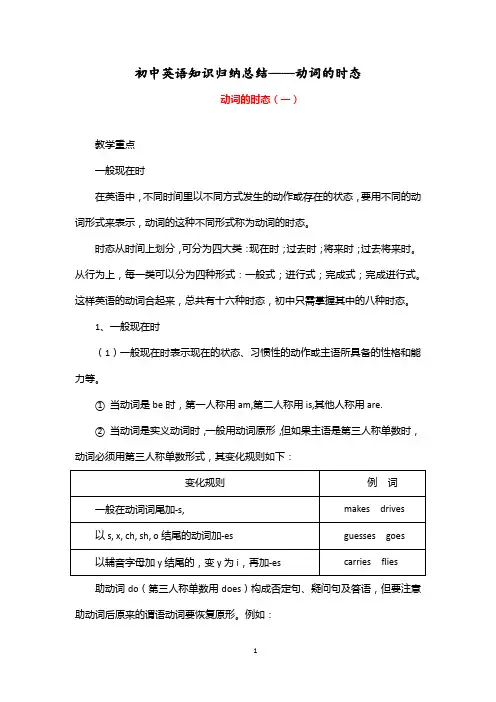
初中英语知识归纳总结——动词的时态动词的时态(一)教学重点一般现在时在英语中,不同时间里以不同方式发生的动作或存在的状态,要用不同的动词形式来表示,动词的这种不同形式称为动词的时态。
时态从时间上划分,可分为四大类:现在时;过去时;将来时;过去将来时。
从行为上,每一类可以分为四种形式:一般式;进行式;完成式;完成进行式。
这样英语的动词合起来,总共有十六种时态,初中只需掌握其中的八种时态。
1、一般现在时(1)一般现在时表示现在的状态、习惯性的动作或主语所具备的性格和能力等。
①当动词是be时,第一人称用am,第二人称用is,其他人称用are.②当动词是实义动词时,一般用动词原形,但如果主语是第三人称单数时,动词必须用第三人称单数形式,其变化规则如下:助动词do(第三人称单数用does)构成否定句、疑问句及答语,但要注意助动词后原来的谓语动词要恢复原形。
例如:I like music.I don’t like music.Do you like music?Yes, I do No, I don’t(2)一般现在时的用法①表示经常、习惯性动作,常和often, usually, every day, sometimes, always 等时间状语连用。
如:He goes to school by bus every day.They often play football②表示能力、职业、特征。
如:Miss Gao teaches English.Do you speak Japanese?③表示客观存在。
如:The earth moves round the sun.Time and tide wait for no man.④表示已经安排好或计划好的事。
如The plane takes off at 7:30.Classes begin at 8:00⑤在时间状语和条件状语从句中,主句用一般将来时,从句用一般现在时。
初中英语动词的时态

初中英语动词的时态
初中英语通常学习的动词时态包括以下几种:
1. 现在时态(Present Tense):用来描述现在正在进行的动作或状态。
例子:I play football every weekend.(我每个周末都踢足球。
)
2. 过去时态(Past Tense):用来描述已经发生过的动作或状态。
例子:She went to the store yesterday.(她昨天去了商店。
)
3. 将来时态(Future Tense):用来描述将来会发生的动作或状态。
例子:We will visit our grandparents next week.(我们下周会去看望祖父母。
)
4. 过去进行时态(Past Continuous Tense):用来描述在过去某个时间点正在进行的动作。
例子:They were playing basketball when it started raining.(下雨时他们正在打篮球。
)
5. 现在进行时态(Present Continuous Tense):用来描述现在正在进行的动作。
例子:I am reading a book right now.(我现在正在看书。
)
初中英语通常会涉及以上几种基本的动词时态,学生需要掌握它们的用法和构成形式。
初中英语语法——现在进行时知识点总结归纳
初中英语语法——现在进行时知识点总结归纳现在进行时是英语中的一种时态,表示现在正在进行或发生的动作。
在句子中,现在进行时由“be动词”(am, is, are)+动词的ing形式构成。
下面是现在进行时的一些基本知识点总结归纳。
1.现在进行时的构成:主语 + be动词(am/is/are) + 动词的ing形式2. be动词的变化:- 当主语是第一人称单数(I)时,be动词用am。
例如:I am playing soccer.- 当主语是第三人称单数(he/she/it)时,be动词用is。
例如:She is reading a book.- 当主语是第二人称单数(you)或所有人称(we/they)时,be动词用are。
例如:You are watching TV.3.现在进行时的用法:-表示现在正在进行的动作:例如:She is studying for her exam.-表示现阶段正在发生的变化或动作:例如:The weather is getting colder.-表示计划或安排的将来动作:例如:I am meeting my friends for dinner tonight.4.现在进行时的否定句和疑问句的构成:- 否定句:主语 + be动词 + not + 动词的ing形式例如:They are not playing basketball.- 疑问句:Be动词 + 主语 + 动词的ing形式?例如:Are you watching a movie?5.现在进行时与一般现在时的区别:-现在进行时强调动作的进行,往往与现在时间有关。
例如:I am studying for my exam. (强调现在正在进行的学习动作) -一般现在时表示经常性的动作或事实,不强调动作的进行。
例如:I study every day. (强调每天都进行的学习)6.现在进行时和时间状语的使用:-现在进行时常与现在连用,不需要使用时间状语。
初中英语时态归纳总结

初中英语时态归纳总结英语时态是英语学习的重点和难点,尤其在初中阶段,掌握各种时态对于提高英语水平至关重要。
本文将对初中阶段需要掌握的英语时态进行归纳总结,帮助大家更好地理解和运用。
一、一般现在时1.动词原形:He likes playing football.2.动词三单:She studies English every day.3.现在进行时:They are watching TV now.4.每日习惯:I wake up at 6 o"clock every morning.二、一般过去时1.动词过去式:He visited his grandparents last week.2.过去进行时:They were playing chess when I came in.3.过去完成时:She had finished her homework before dinner.三、一般将来时1.动词原形:I will go to the library tomorrow.2.be going to:He is going to travel to Japan next month.3.现在进行时表将来:The plane is taking off in 10 minutes.四、现在进行时1.动词现在分词:She is reading a book.2.与always, constantly等词连用,表示频繁发生:My brother is always playing video games.五、过去进行时1.动词过去分词:They were discussing the project.2.与at that time, at this moment等词连用,表示在某个时间正在进行的动作:At that time, she was sleeping.六、完成时1.现在完成时:I have finished my homework.2.过去完成时:He had left the classroom before I arrived.七、被动语态1.一般现在时:The book is written by him.2.一般过去时:The window was broken by Tom.3.一般将来时:The letter will be sent to her tomorrow.总结:初中英语时态的学习需要掌握一般现在时、一般过去时、一般将来时、现在进行时、过去进行时、完成时和被动语态等。
中考语法知识点归纳动词时态语态与非谓语动词
中考语法知识点归纳动词时态语态与非谓语动词动词时态、语态与非谓语动词是中考英语中的重要考点,掌握好这些知识,将有助于提升语法水平和英语写作能力。
本文将对中考语法知识点进行归纳总结,帮助同学们更好地理解和应用。
一、动词时态动词时态是指动词表示的动作或状态发生的时间或状态。
常见的动词时态有以下几种:1. 一般现在时:表示经常性、习惯性的动作或客观真理。
例句:He plays basketball every day.2. 一般过去时:表示过去某个时间发生的动作或状态。
例句:I watched a movie last night.3. 一般将来时:表示将来要发生的动作或状态。
例句:I will go to Beijing next week.4. 现在进行时:表示现在正在进行的动作。
例句:She is reading a book now.5. 过去进行时:表示过去某个时间正在进行的动作。
例句:I was studying when he called me.6. 现在完成时:表示过去的动作对现在造成的影响或结果。
例句:She has visited Paris three times.7. 过去完成时:表示对过去某个时间之前发生的动作进行的描述。
例句:They had already left when I arrived.二、动词语态动词语态是指动作发出的主体和动作所受的影响关系。
英语中常见的动词语态有以下几种:1. 主动语态:表示主语是动作的发出者。
例句:He fixed the car yesterday.2. 被动语态:表示主语是动作的承受者。
例句:The car was fixed by him yesterday.3. 进行时态:表示主语正在进行的动作处于进行状态。
例句:The book is being read by her.4. 完成时态:表示主语已经完成的动作处于完成状态。
例句:The book has been read by her.注意:被动语态需要根据动作的时态来变换,同时需要适当更改时态动词。
动词时态语法知识点总结
2.时间状语:ago, yesterday, the day before yesterday, last week, last(year, night, month…),in 1989,just now, at the age of 5,one day, long long ago, once upon a time, etc.
2.时间状语:yet, already ,just, never, ever, so far, by now, since +时间点,for +时间段,recently, lately, in the past few years, etc.
3.基本结构:主语+ have/has + p.p(过去分词)+其它
3否定形式:主语+ was/were + not +其他;在行为动词前加didn't,同时还原行为动词。
5.一般疑问句:was或were放于句首;用助动词do的过去式did提问,同时还原行为动词。
6.被动语态构成:was / were +及物动词的过去分词
2.基本结构:
shall/will have been doing
过去将来完成进行时:表示从过去某时看至未来某时以前会一直在进行的动作。
2.基本结构:
should/would + have + been +现在分词
3.基本结构:
主语+ shall/will + be +现在分词+其它
2.时间状语:
Soon, tomorrow, this evening,on Sunday, by this time,in two days, tomorrow evening
初中英语语法知识—动词时态的基础测试题附解析(5)
一、选择题1.Don’t turn on the TV. Grandma ________.A.sleeps B.is sleeping C.sleep D.are sleeping 2.We’re not sure _______ there’ll be _______ or not tomorrow.A.if; rains B.if; rainy C.whether; raining D.whether; rain 3.— How about going for a drive, Mike?— One moment, please! I __________ cleaning our room soon.A.will finish B.have finished C.finish D.finishes 4.My mother _____ dinner when I got home yesterday.A.has cooked B.was cooking C.will cook D.cooks 5.—Where are you going, Bob?—To go hiking. Eric____________ for me at the school gate!A.was waiting B.waitsC.waited D.is waiting6.—How much is the ticket (票) to Central Park?—One ticket $40, and you can $80 for two persons.A.costs; pay B.cost; spend C.pay; spend D.spends; pay 7.— Who ________the classroom tomorrow, Tony?— Our group.A.will clean B.cleans C.cleaned D.clean8.They the English role play for the show last night.A.will practice B.practiced C.is practicing D.have practiced9.— Could you please tell me yesterday?— In the bookshop nearby.A.Where you bought the book B.Where you buy the book C.Where did you buy the book D.Where do you buy the book 10.Jack ______ a good rest as soon as he finishes the exam.A.has B.had C.is having D.will have11.—Did you see a man in black pass by just now?—No, sir. I a newspaper.A.read B.was reading C.would read D.am reading 12.—Look, Tom's parents look so sad.—Maybe they what's happened.A.knew B.have known C.has known D.will know 13.— How ________ your trip to Australia?—Great. I’ll go there again next year.A.was B.is C.are D.were 14.— Have you ever been anywhere for a trip?— A trip? I ________ away from my hometown even once.A.went B.have gone C.have been D.have never been 15.It’s 8 o’clock. The students _________ an English class.A.have B.having C.is having D.are having 16.Can you describe ________?A.what the student look like B.what does the student look likeC.what does the student looks like D.what the student looks like17.—A nice shirt. A present ?—Yes, it is . My mum________it for me last birthday .A.buys B.bought C.buy D.is buying 18.— Mum, where is Dad?— He _________ flowers in the garden now.A.planted B.plants C.will plant D.is planting 19.—Did you hear t he strange noise next door around 9 o’clock last night?— No, I ________my favourite film in my bedroom.A.watch B.watched C.am watching D.was watching 20.Could you please turn down your music? I________.A.work B.works C.am working D.worked21.It often __________ in the north of China in winter, and the weather is very cold. A.snowing B.snows C.snowy22.The restaurant ________ many complaints because of the terrible service since last month. A.receives B.is receiving C.has received D.will receive 23.My father was reading ________ I was sleeping.A.while B.when C.before D.after24.Look! All my classmates ___________ on the playground.A.are running B.ran C.were running D.run 25.—Remember the first time we met, Jim?—Of course I do. You ________ in the library.A.were reading B.have read C.will read D.read【参考答案】***试卷处理标记,请不要删除一、选择题1.B解析:B【解析】【分析】句意:别开电视,奶奶正在睡觉。
英语中考归纳复习专题:动词的时态
英语中考归纳复习专题:动词的时态【动词的时态】初中阶段学习的时态有以下八种:一般现在时、一般过去时、一般将来时、现在进行时、过去进行时、现在完成时、过去完成时、过去将来时.前六种为常考时态,要掌握各时态的构成、用法以及标志性时间状语.【一般现在时】【考点训练1】1.My father is a teacher and he _________ (teach) in a middle school.2.Yesterday the teacher told us the earth _______ (go) around the sun.3.—When shall we begin our meeting?—We’ll begin it when Helen ___ . ()esB.cameC.will comee4.—How do you usually go to school?—I usually ___ to school on foot. ()A.goB.wentC.was goingD.will go答案:teaches goes A A【一般过去时】要点提醒:“used to+动词原形”表示过去的习惯或状态.如:Mum used to tell us stories.妈妈过去常给我们讲故事.【考点训练2】1.Mike ________ (not go) to bed until 12 o’clock last night.2.He asked if I _____ (be) a student.3.Will you please say it again?I ___ quite ___ you.()A.don’t;hearB.didn’t;hearC.don’t;heardD.didn’t;heard4.He _____ go out with his parents,but now he ____ staying at home alone. ()ed to;is used toB.is used to;used toe to;is used toed to;used to答案:didn’t go was B A【一般将来时】要点提醒:be going to与will的区别1.be going to 指已计划好的事或思考过的意图、打算,will表示未事先思考或未计划而临时做出的决定.如:I’m going to see him tomorrow.我打算明天去看他.(事先经过思考)I’ll answer the door.我去开门.(未经事先考虑)2.be going to可表示客观迹象表明马上要发生的事,而will则表明说话者的主观意愿.如:Look at the clouds.There is going to be a storm.看看这些云,暴风雨就要来了.(客观迹象表明要发生)I hope it will be warm tomorrow.我希望明天会暖和起来.(主观意愿)3.在含有条件状语从句的复合句的主句中,一般用will,不用be going to. 如:I will come if it doesn’t rain.如果不下雨的话,我就来.【考点训练3】1.____ a concert in our school next Saturday. ()A.There isB.There areC.There will beD.There will have2.If they can arrive by 9:00 am,we ___ a meeting.()A.haveB.will haveC.hadD.would have3.He ___ her a beautiful hat on her next birthday.()A.givesB.gaveC.will givingD.is going to give答案:C B D 【现在进行时】【考点训练4】1.They ____________ (have) a math test in the classroom now.2.Look! He ___________ (lie) on the beach.3.—Pass the raincoat to me.It ___ hard now.—Here you are. ()A.rainB.is rainingC.rainedD.will rain4.—Cathy,can you answer the door?I ___ the room.—I’m coming,Mum. ()A.CleanB.cleanedC.have cleanedD.am cleaning答案:are having is lying B D【过去进行时】He was forever com plaining about something.他老是怨这怨那.要点提醒:1.在含有时间状语从句的复合句中,延续时间较长的动作常用过去进行时,另一个短暂性动作用一般过去时.如:When the UFO landed,I was shopping at the clothes store.当UFO落地时,我正在服装店买衣服.2.表示两个延续性动作在过去某一时刻同时进行,不考虑动作的先后顺序,主句和从句的谓语动词都用过去进行时,连词常用while.如:Tom was doing his homework while I was reading a newspaper.我在看报纸时,汤姆在做作业.【考点训练5】1.Mike and I ___________ (play) basketball at that time yesterday afternoon.2.While Mr.Johnson _______________ (work) in the office,the phone rang.3.The girl ___ for the bus when the rainstorm came.()A.waitedB.have waitedC.is waitingD.was waiting4.—Jenny,I called you at nine last night,but you didn’t pick up.—Oh,I ____ a popular program called Go Fighting!.()A.watchB.watchedC.was watchingD.am watching答案:were playing was working D C【现在完成时】要点提醒:1.have/has been to,have/has gone to与have/has been in(考点讲解详见P74考点1)2.延续性动词与非延续性动词英语中的动词按动作发生的方式、发生过程的长短可分为延续性动词和非延续性动词两种,非延续性动词也可称为短暂性动词或瞬间动词.在现在完成时态中,有时要将非延续性动词转换为延续性动词,这样才能和时间段连用.转换方法如下:(1)将短暂性动词转换为“be+形容词或副词”.请看下表:如:这间商店开门6小时了.The shop has opened for 6 hours.( ×)The shop has been open for 6 hours.( √)(2)有的短暂性动词可以转换为意思相同的延续性动词.请看下表:如:这本书我借了一个月了.I have borrowed the book for one month.( ×)I have kept the book for one month.( √)3.现在完成时与一般过去时的区别现在完成时强调某一动作或状态对现在造成的影响或结果,不能和表示过去的时间状语连用;一般过去时只表示过去的事实,不表示和现在的关系,可以和表示过去的时间状语连用.如I bought a ticket yesterday.我昨天买了一张票.(强调我昨天做的一件事是买票)I have already bought a ticket.我已经买了一张票.(强调我已经有票了,无须再惦记票的事了)4.现在完成时的其他句型【考点训练6】1.—you _____ your homework yet?—Yes.I ______ it a moment ago. ()A.Did;do;finishedB.Have;done;finishedC.Have;done;have finishedD.Will;do;finish2.His father ___ the Party since 1978. ()A.joinedB.has joinedC.was inD.has been in3.Miss Green isn’t in the office.She to the library. ()A.has goneB.wentC.will goD.has been 答案:B D A【过去完成时】had + 过去分词表示在过去的过去发生的动作或存在的状态.I had had three pieces of cake when you arrived.你来的时候我已经吃了三块蛋糕了.表示过去某一动作或状态持续到过去另一时间.The old man had lived in Shanghai for ten years beforeTom came here.汤姆来这儿之前,这个老人已经住在上海十年了.时间标志by the time...,before,when等构成的短语或引导的从句【考点训练7】1.在我们到达电影院之前,电影已经开始了.The film __________ before we _______ to the cinema.2.警察赶到时,小偷已经逃跑了.When the police __________,the thief____________________ .答案:had begun got arrived had run away 【过去将来时】【考点训练8】1.李明说如果布莱恩下个月来中国,他将会很高兴.Li Ming said he ___________ happy if Brian came to China the next month.2.蒂娜说她下周三打算来参加我的生日派对.Tina said she ________________ my birthday party the next Wednesday.答案:would be was going to【中考示例】(2017·广西)If he _____ Guilin,he’ll probably go to Yangshuo. ( )A.visitsB.is visitingC.will visitD.has visited【解析】考查动词的时态.句意:如果他游览桂林,他有可能会去阳朔.if引导条件状语从句时,时态遵循“主将从现”原则,从句中用一般现在时表示将来.【考题热身】1.(2017·甘肃)I promise I ________ (send) you an email to explain all of these tomorrow.2.(2017·甘肃)Be quiet! The patients ______________(sleep).3.(2017·鄂州)Sandy’s grandparents__________________ (marry) for 50 years.4.(2017·台州改编)A true friend always ____________(support) you whenever youare in trouble.5.(2017·宿迁)I ______________(wash) the dishes while my sister was sweeping the floor.6.(2017·云南)—What do you think of your hometown, Kate?—It a lot.It’s more beautiful than before. ()A.has changedB.changesC.will changeD.change7.(2017·武汉)—Linda is not coming for the party tonight.—But she ______!()A.promisesB.promisedC.will promiseD.had promised8.(2017·毕节)It’s nice to see you again.We ___ each other since 2016. ()A.won’t seeB.haven’t seenC.don’t seeD.didn’t see9.(2017·黔东南)If it doesn’t rain this weekend,we ___ a picnic in the Jinquan Park. ()A.haveB.will haveC.have hadD.had10.(2017·上海)Some exchange students ___ with their host families this time yesterday. ()A.are chattingB.will chatC.were chattingD.have chatted11.(2017·重庆B卷)—Where is your uncle?I haven’t seen him for a long time. —He _____ Beijing for about half a year.He moved there in January. ()A.has gone to B.has been toC.has arrived inD.has been in12.(2017·重庆B卷)John and I ___ to visit his grandparents last Sunday afternoon. ()A.goB.wentC.will goD.have gone13.(2017·重庆A卷)In the past few years,many schools ____ the ways of doing morning exercises. ()A.changeB.changesC.will changeD.have changed14.(2017·重庆A卷)As soon as the rain _____ ,they will go out to pick apples. ()A.stopsB.stoppedC.will stopD.is stopping15.(2017·河北)Don’t take the dictionary away.I ___ it. ()eedC.am usingD.have used答案:will send are sleeping have been married supports A B BBCDBDAC。