
2019-2020学年新教材高中英语unit1 cultural heritage sectionⅠlisteningandspeaking教学案版本
Unit 1 Cultural heritage2017年联合国教科文组织公布了《非物质文化遗产名录更新》,意大利那不勒斯的传统披萨饼榜上有名,想知道它的故事吗,一起来听听吧……Pizza is favored by lots of people. It's great to share it with friends, to bring it to a party,or just to enjoy it by yourself. Recently, pizza twirling① has even received recognition from UNESCO asa cultural heritage.Pizza has been a part of Italian culture for centuries. In the 1700s and the 1800s, the city of Naples (那不勒斯) in Italy was an independent kingdom, known for its large working class. Pizza began as a poor man's food—as a way to feed people in poverty② quickly and at a low cost③. Flatbread with different kinds of toppings such as cheese, tomatoes, anchovies, oil, and garlic was considered street food and looked down upon by wealthy Italians.In 1889, King Umberto Ⅰand Queen Margherita visited Naples, which had by then come under a unified Italy. On their visit, the royal couple enjoyed pizza from a local eatery. The queen's favorite turned out to be pizza topped with cheese, tomato, and basil—it is no surprise that it came to be known as Pizza Margherita!The designation of pizza spinning④as a cultural heritage recognizes the hundreds of years of culinary⑤history behind the popular food that has now taken hold all over the world.【注】 ①twirl v. (使)旋转,转动 ②poverty n. 贫困;贫穷 ③at a low cost 以较低的成本 ④spin v. 使旋转 ⑤culinary adj. 烹饪的,烹饪用的【立德树人】 民族的就是世界的(What's unique for a nation is also precious for the world.)。
爱自己的民族,爱自己的国家,爱本民族的文化,从生活中最接地气的饮食文化(culinary culture)开始。
Section Ⅰ Listening and Speaking基础知识预习自检Ⅰ.重点词汇1.creative adj. 创造性的;有创意的→creatively adv. 创造性地;有创意地→create v. 创作;创造→creativity n. 创造力2.preserve vt. 保护;保存→preservationist n. 文物保护者;环境保护者→nature_preserve 自然保护区3.promote vt. 促进;提升;推销;晋级→promotion n. 晋升;促销;推广4.application n. 申请(表)→apply vi. 申请→apply_for 申请(得到)5.take_part_in 参与(某事);参加(某活动)→join vt. 参加(某组织、团体)→join_in 参加(到某活动中)→attend 参加;出席(会议等)Ⅱ.教材原句1.Students from different countries are working ________ (创造性地) to protect a ________ (庙) in China.答案:creatively; temple2.Youths from seven countries are working together to protect ______________ (文物) on ______________ (泰山).答案:cultural relics; Mount Tai3.The palace ____________ (被摧毁) years ago.答案:was destroyed4.The word means the ________ (相反) of a word I know.答案:opposite5.The speaker gives ____________ (一个例子) of the word.答案:an example6.The students are ________________ (制作一个应用程序) about Mount Tai.答案:making an app7.The volunteers also visit middle schools in the area ____________ (为了) talk to local teenagers.答案:in order to8.Would you like to ________________ (参加) a project like this?答案:take part in9.The dragon followed __________ (它的尾巴).答案:its tail10.The trains were ____________ (深绿色).答案:dark green重点知识合作探究1creatively adv. 创造性地;有创意地(教材P2)归纳拓展creative adj. 创造性的;有创造力的;有创意的creativity n. 创造力;创造性①She solved the problem creatively.她创造性地解决了那个问题。
②She's very creative—she writes poetry and paints.她极富创造力,既赋诗又作画。
③American art reached a peak of creativity in the 1950s and 1960s.美国艺术在二十世纪五六十年代达到了一次创作顶峰。
(1)单句语法填空①(2019·江苏高考)A city is the product of the human hand and mind, reflecting man's intelligence and ________ (creative).②Genet teaches you to think ________ (creative).答案:①creativity ②creatively(2)单句写作像许多富于创造力的人一样,他从不满足。
Like so many ______________ he was never satisfied.答案:creative people2preserve vt. 保存;保护;维持 n. 保护区(教材P3)归纳拓展(1)preserve sb./sth. (from sth.) 保护……免遭伤害preserve sth. for 为……而保存/保留某物be well preserved 保存得很好(2)keep sth. in preserve=put sth. on preserve 保存/保留某物(3)preservationist n. 文物保护者;环境保护者①The government preserves the rights of the individual person.政府保护个人的权利不受侵犯。
②It is one of the duties of the police to preserve public order.警察的职责之一是维持公共秩序。
③Pantanal is one of the world's greatest wildlife preserves.潘塔纳尔是世界上最大的野生动物保护区之一。
④People should preserve/protect children from being hurt.人们应该保护儿童免于受伤害。
⑤The house fell into disrepair but a group of preservationists have reconstructed the roofs.这座房子年久失修,但一群古建筑保护者已翻盖了房顶。
[易混辨析:preserve, reserve](1)单句语法填空①They were determined to preserve their students ________ harm.②“Cultural relics should not be used as props”,________ (preserve) Xie Chensheng complained in the Beijing Youth Daily last month.③He suggested the old temple should be kept ________ preserve.答案:①from ②preservationist ③in(2)单句写作我们应该保护民族遗产。
We should ________ our national ________.答案:preserve; heritage3promote vt. 促进;提升;推销;晋级(教材P3)归纳拓展(1)get/be promoted to ... 被提升到……职位(2)promotion n. 晋升get a promotion 得到提升①The band has gone on tour to promote their new album.这个乐队已开始巡回宣传他们的新唱片。
2019-2020学年新教材高中英语unit1 cultural heritage 单元重点知识回顾教学案版本:人教版必修第二
Unit 1 Cultural heritageⅠ.重点词汇1.creatively adv. 创造性地;有创意地→creative adj. 创造性的;有创造力的;有创意的→creativity n. 创造力;创造性2.preserve vt. 保存;保护;维持 n. 保护区→preservationist n. 文物保护者;环境保护者→nature preserve自然保护区preserve sb./sth. (from sth.) 保护……免遭伤害preserve sth. for 为……而保存/保留某物be well preserved 保存的很好keep sth. in preserve=put sth. on preserve 保存/保留某物3.promote vt. 促进;提升;推销;晋级→promotion n. 晋升get/be promoted to ... 被提升到……职位get a promotion 得到提升4.application n. 申请(表);用途;运用;应用(程序)→applicant n. 申请人→apply vi. 适用,适合;申请,请求 vt. 应用,使用make an application (to sb.) for sth. (向某人)申请……apply to 适用于apply (to ... ) for ... (向……)申请……apply ... to ... 把……应用于……apply oneself to sth./to doing sth. 专心从事;致力于5.have a/an ... part/role in 在……中起……作用,在……中扮演……角色play the part/role of ... 演……的角色for my part 就我而言for the_most part 通常,多半6.give way to 让步;屈服give up 放弃give sth. up_to 把某物让给(献给)……give away 泄露(机密);暴露;分发(奖品等);捐赠give in_(to) (向……)屈服,(向……)让步give off 发出(光等)give out 分发;用尽7.lead to 导致lead sb. to ... 带领某人通往……;引导某人去……lead sb. to_do sth. 使得某人做某事lead a ... life 过着……的生活lead the_way 带路lead sb. by the nose 牵着某人的鼻子走in the lead 领先;处于领先地位take the lead 带头;领先8.likely adj. 可能的 adv. 可能地be likely to_do sth. 可能做某事It is likely that ... 有可能……9.prevent v. 阻止;妨碍;阻挠prevent+宾语+(from) doing 阻止……干某事stop+宾语+(from) doing 阻止……干某事keep+宾语+from doing 阻止……干某事protect ... from/against ... 保护……不受……侵袭10.loss n. 丧失;损失→lost adj. 迷路的;丢失的suffer great/heavy/huge losses 遭受巨大的损失at a loss 困惑,不知所措be lost in thought 陷入沉思11.contribution n. 捐款;贡献;捐赠→contribute vi.& vt. 捐献;捐助;(为报纸、杂志、电台或电视节目)撰稿make a contribution (contributions) to ... 为……作出贡献contribute ... to ... 捐献;捐助contribute to ... 有助于;导致12.donate vt. (尤指向慈善机构)捐赠;赠送;献(血)→donator n. 捐赠者;赠送者→ donation n. 捐赠;捐赠物;赠送donate ... to ... 向……捐赠……give/make/present a donation to ... 捐赠给……13.attempt n.& vt. 企图;试图;尝试make an attempt to_do sth.=make an attempt at_(doing) sth. 试图做某事at the/one' s first attempt 第一次尝试14.worthwhile adj. 值得做的;值得花时间的→worth adj. 值得……的 n. 价值→worthy adj. 有价值的;可尊敬的;值得的;配得上的15.entrance n. 入口;进入→exit n. 出口;通道entrance to ……的入口/门口(表示“对象”“方向”)entrance of ……的入口/门口(表示“所属”)gain entrance to 获得进入……的许可an entrance fee 入场费entrance examinations 入学考试16.forgive vt.& vi. (forgave; forgiven) 原谅;宽恕 vt. 对不起;请原谅→forgiveness n. 原谅;宽恕;宽宏大量forgive sb./yourself (for sth./for doing sth.) 原谅某人/你自己forgive sb. for doing sth. 原谅某人做了某事17.tradition n. 传统;传统的信仰或风格→traditional adj.传统的→traditionally adv. 传统地by tradition 按照传统in the tradition of 具有……的传统/风格18.historic adj. 历史上著名(或重要)的;有史时期的→history n. 历史;历史学→historically adv. 历史上地;从历史观点上说sth. will go_down in history 某事将被载入史册19.contrast n. 对比;对照 vt. 对比;对照in contrast to 与……截然不同;与……对比鲜明;相比之下by contrast 相比之下contrast A and/with B对比;对照20.take part_in 参与(某事);参加(某活动)21.make sure 确保;设法保证22.all over_the_world 在世界各地Ⅱ.教材原句1.Finding and keeping the right balance between progress and the_protection_of__cultural_sites can be a big challenge.(教材P4)在历史进步和文化遗产保护之间找到并且保持良好的平衡会是一个重大的挑战。
19-20学年新教材高中英语unit1culturalheritagesectionⅣlisteni

阅读词汇
23.archaeologist [ ɑːki'ɒlədʒIst] n. _考__古__学__家_________________
24.pyramid ['pIrəmId] n. 25.sheet [ʃiːt] n. 26.parade [pə'reId] n. vi.
_(_古__埃__及__的__)金__字__塔__;__棱__锥__体__ _一__张__(_纸__);__床__单__;__被__单______ _游__行__;__检__阅_______________ _游__行__庆__祝__;__游__行__示__威_______
(2)enter v.
进入
①I will wait for you at the entrance to Guangzhou station. 我将在广州车站入口处等你。 ②Don’t enter the room without knocking on the door. 不敲门不要进入房间。 [链接写作]——完成句子 他通过了大学入学考试,这使他父母非常自豪。 He __p_a_ss_e_d__th_e__c_o_ll_e_g_e_e_n_t_r_a_n_c_e_e_x_a_m__in_a_t_io_n__s_,which made his parents very proud.
2.What are the researchers and scientists trying to do from China and other countries? A.Help increase knowledge and appreciation of China’s ancient cultural heritage. B.Appreciate the scenery of the Mogao Caves. C.Take photos of the Mogao Caves. D.Collect the information of the Mogao Caves.
19-20学年新教材高中英语UNIT1CULTURALHERITAGESectionⅠListeni
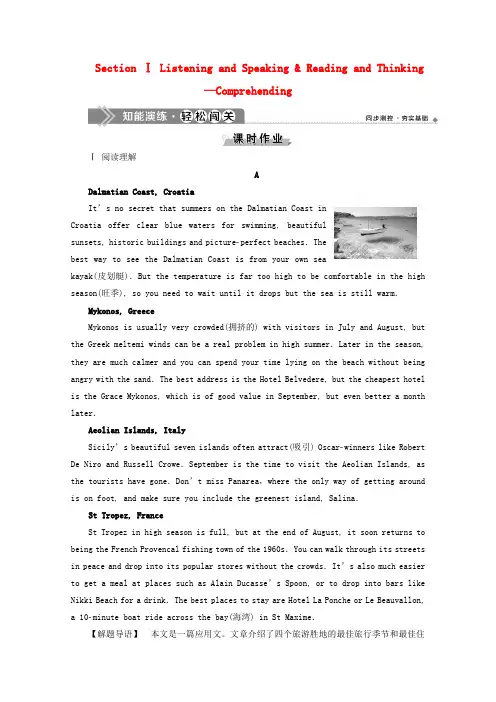
Section Ⅰ Listening and Speaking & Reading and Thinking—ComprehendingⅠ阅读理解ADalmatian Coast, CroatiaIt’s no secret that summers on the Dalmatian Coast inCroatia offer clear blue waters for swimming, beautifulsunsets, historic buildings and pictureperfect beaches.Thebest way to see the Dalmatian Coast is from your own seakayak(皮划艇).But the temperature is far too high to be comfortable in the high season(旺季), so you need to wait until it drops but the sea is still warm.Mykonos, GreeceMykonos is usually very crowded(拥挤的) with visitors in July and August, but the Greek meltemi winds can be a real problem in high summer.Later in the season, they are much calmer and you can spend your time lying on the beach without being angry with the sand.The best address is the Hotel Belvedere, but the cheapest hotel is the Grace Mykonos, which is of good value in September, but even better a month later.Aeolian Islands, ItalySicily’s beautiful seven islands often attract(吸引) Oscarwinners like Robert De Niro and Russell Crowe.September is the time to visit the Aeolian Islands, as the tourists have gone.Don’t miss Panarea,where the only way of getting around is on foot, and make sure you include the greenest island, Salina.St Tropez, FranceSt Tropez in high season is full, but at the end of August, it soon returns to being the French Provencal fishing town of the 1960s.You can walk through its streets in peace and drop into its popular stores without the crowds.It’s also much easier to get a meal at places such as Alain Ducasse’s Spoon, or to drop into bars like Nikki Beach for a drink.The best places to stay are Hotel La Ponche or Le Beauvallon, a 10minute boat ride across the bay(海湾) in St Maxime.【解题导语】本文是一篇应用文。
2019_2020学年新教材高中英语UNIT1CULTURALHERITAGESectionⅥAssessingYourProgress课件新人教版必修第二册

传统;传统的信仰或风俗
52. further adv.
更远;进一步
53.historic adj. 历史上著名(或重要)的;有史时期的
54. opinion n.
意见;想法;看法
55. quote vt.
引用
56. paraphrase n.,vi.&vt.
(用更容易理解的文字)解释
57. comparison n. 58. contrast n.
Section Ⅵ Assessing Your Progress
一、单元词汇再盘查
(一)默写单词
1._h_e_r_it_a_g_e n.
遗产(指国家或社会长期形成的历史、
传统和特色)
2._c_r_e_a_ti_v_e_ly_ adv. 创造性地;有创造力地
3._te_m__p_l_e n.
庙;寺
4._r_el_i_c n.
朝代
7.region n.
地区;区域
8.generation n. 9.significant adj. 10.harm v.&n. 11.argue v. 12.agriculture n. 13.attract v. 14.admire v. 15.destruction n.
一代人 重要的;影响深远的 伤害;损害 主张 农业 吸引;引起……的兴趣 欣赏;观赏 破坏
给……的例子 参加(某活动);参与(某事) 参考;指的是 让步;屈服 保持平衡 导致 提出建议 向……求助 限制损失到
10.investigate the issue 11.sign a document 12.take down 13. piece by piece 14. prevent ...from ... 15.donate ...to ... 16.run a program 17. world cultural heritage sites
2019_2020学年新教材高中英语Unit1CulturalHeritageSectionⅤWriting课件新人教版必修第二册
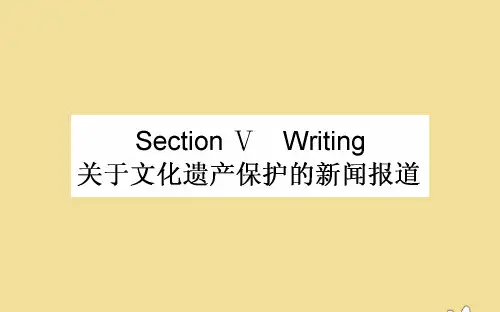
姓名:樊锦诗 身份:考古学家 出生日期:1938 年 出生地:北京 毕业学校、日期:北京大学,1963 年 专业:考古学专业
She _c_r_e_at_e_d_ digital Dunhuang, _r_ec_o_r_d_i_n_g and _co_l_l_e_ct_i_n_g digital images of cultural relics from the Mogao Caves.
(6)她对文化遗产的保护做出了巨大的贡献。 She has _m_a_d_e__a_g_r_e_a_t_c_o_n_tr_i_b_u_ti_o_n_t_o_ the protection of cultural relics. (7)在她的一生中,她获得了很多奖,其中一个是被评为“100 位新中国成立以来感动中国人物”。 In her life, she _g_o_t__m_a_n_y__h_o_n_o_u_rs_, and one of them is one hundred people moving China since the founding of The People's Republic of China.
(9)用现在分词改写(3) She graduated from Peking University in 1963, _m__a_jo_r_i_n_g_i_n__
archaeology. (10)用非限制性定语从句改写(7) In her life, she got many honours, one of __w_h_i_c_h__ is one hundred
2019-2020学年新教材高中英语unit1 cultural heritage 单元重点知识回顾课件版本:人教版必修第二册46
Ⅱ.教材原句 1 . Finding and keeping the right balance between progress and __th_e__p_ro_t_ec_t_io_n_o_f_c_u_l_tu_r_al_s_i_tes______ can be a big ____c_ha_l_le_n_g_e____.(教材 P4) 在历史进步和文化遗产保护之间找到并且保持良好的平衡会是一个重大 的挑战。 2.After listening to the scientists who had studied the problem, and citizens ____w_h_o________ lived near the dam, the government ____t_u_rn_e_d_t_o____ the United Nations ___f_o_r_h_e_lp______ in 1959.(教材 P4) 在听取了研究这一问题的科学家们的建议和堤坝附近居民们的看法后, 埃及政府在 1959 年向美国求助。
10.loss n. 丧失;损失→lost adj. 迷路的;丢失的 suffer great/heavy/huge losses 遭受巨大的损失 at a loss 困惑,不知所措 be lost in thought 陷入沉思 11.contribution n. 捐款;贡献;捐赠→contribute vi.& vt. 捐献;捐助; (为报纸、杂志、电台或电视节目)撰稿 make a contribution (contributions) to ... 为……作出贡献 contribute ... to ... 捐献;捐助 contribute to ... 有助于;导致
答案
高中英语2019新教材必修二Unit1 Cultural Heritage 课文译文
专家们经过调查研究,多次试验,提出了一 个保住那些建筑的方案。最终,(埃及政府)签 署了一份文件,于1960年开始动工。
The project brought together governements and environmentalists from around the world.temples and other cultural sites were taken down piece by piece, and then moved and put back together again in a place where they were safe from the water.
然而,巨大的挑战有时候会带来伟大的解 决方案。二十世纪五十年代,埃及政府打算在 尼罗河上新建一座大坝,可以防洪、发电,并 为该地区更多的农民供水。
But the proposal led to protests. Water from the dam would likely damage a number of temples and destroy cultural relics that were an important part of Egypt’s cultural heritage. After listening to the scientists who had studied the problem, and citizens who live near the dam, the government turned to the Unitd Nations for help in 1959.
该项目集聚了来自世界各地的政府机构和环 保人士。人们将寺庙和其他文化遗址逐块拆解, 运至一个不受河水侵袭的安全地带,再按原样 复原。
2019_2020学年新教材高中英语UNIT1CULTURALHERITAGESectionⅠListeningandSpeaking课件新人教版必修第二册
[多积词汇]
ቤተ መጻሕፍቲ ባይዱ
①unique adj. 独特的;独一无二的
②available adj. 可获得的;可利用的
③visible adj. 看得见的;明显的;
能注意到的
④disappear v. 消失
⑤charming adj. 迷人的;吸引人的
⑥heritage n. 遗产
⑦decorate v. 装饰
international youth camp at Mount Tai are creating a(n) ________ about China's most famous mountain. 一群参加泰山国际青年营的高中生正在开展一项关于中国最
著名的山峰的________。
★take part in 参与(某事);参加(某活动)
为……而保存/保留
put sth. on preserve=keep sth. in preserve 保存/保留某物
(2)preservation n.
[U]保存;保护
①We want to preserve as much open land as possible. 我们想尽可能保留更多的空旷之地。
Holloko, possibly the most charming⑤ Hungarian village in the mountains of the northeast, is also part of the world heritage⑥.
Local people as well as tourists can admire age-old wedding ceremonies of this region. The bride's trousseau is transported along the main street for the whole world to see all the brightly decorated⑦ stuff — a sign of the family's wealth. Tradition also calls for⑧ a joined community effort to make the newly weds an anticipation for many children to come.
2019-2020学年新教材高中英语unit1 cultural heritage sectionⅣreadingforwriting课件版本:
透过数码影像推广文化 2017 年 8 月 9 日,兰州。来自中国和其他国家的研究员和科学家们组成 的专项小组为进一步了解中国古代文化遗产知识一起进行研究工作。他们记 录并且收集了莫高窟文物的数字图像,而中国古代历史上莫高窟一直是丝绸 之路上必经的一站。自 1994 年该国际项目组织成立以来拍摄了将近 50 万张 高清数字图像。 莫高窟一直是不同文化的汇合点和许多国家的历史组成部分。今天,这 些洞穴和当时人们在丝绸之路上跋涉时一样国际化。来自世界各地的旅行者 来到敦煌探访洞穴,洛杉矶的盖蒂博物馆甚至复制了洞穴和画作,以便人们 欣赏。
答案
(2)单句写作 你最好把复印件与原件对比一下。 You'd better ______________ the copy ______________ the original. 答案:contrast; with
答案
学习效果 随堂演练
Ⅰ.单词拼写 1 . The advertisements are intended to improve the company's ______________ (形象). 答案:image
①__B_y__tr_a_d_it_io_n_, ___ children play tricks on 1 April. 按照传统风俗,儿童在 4 月 1 日捣乱戏弄别人。 ②He's a politician _in_t_h_e_t_ra_d_it_io_n__o_f _ (=similar in style to) Kennedy. 他是位具有肯尼迪风格的政治家。 ③It's ___tr_a_d_it_io_n_a_l ____ in America to eat turkey on Thanksgiving Day. 感恩节时吃火鸡是美国的传统。 ④Housework has ___tr_ad_i_ti_o_n_al_l_y___ been regarded as women's work. 家务劳动历来被认为是妇女的事。
2019统编人教版高中英语必修第二册unit-1《Cultural-Heritage》全单元教案教学
【2019统编版】人教版高中英语必修第二册Unit 1《Cultural Heritage》全单元备课教案教学设计Unit 1 Cultural HeritagePeriod 1 Listening and Speaking【教材分析】Listening and Speaking introduces the topic of “Take part in a youth project”.The listening text is an interview about an international youth cultural heritage protection project. More than 20 high school students from seven countries participated in the project. The reporter interviewed two participants Stephanie and Liu Bin. By listening to the text, students can understand the significance of cultural heritage protection, and teenagers can use their knowledge, combine their own interests and advantages, etc. to participate in the action of cultural heritage protection.Listening and Talking introduces the theme of “Talk about history and culture”.The listening text is a dialogue between two tourists and tour guides when they visit the Kremlin, Red Square and surrounding buildings. The dialogue focuses on the functional items of “starting a conversation”, which is used to politely and appropriately attract the attention of the others, so as to smoothly start a conversation or start a new topic. The purpose of this section is to guide students to understand the history and current situation of Chinese and foreign cultural heritage in their own tourism experiences or from other people’s tourism experiences, explore the historical and cultural values, and be able to express accurately and appropriately in oral communication.【教学目标】1. Guide students to understand the content of listening texts in terms of the whole and key details;2. Cultivate students’ ability to guess the meaning of words in listening; discuss with their peers how to participate in cultural heritage protection activities.3. Instruct students to use functional sentences of the dialogue such as “I beg your pardon, but…” “Forgive me for asking, but…” and so on to start theconversation more politely and appropriately.【教学重难点】1. Guide students to understand the content of listening texts in terms of the whole and key details;2. Cultivate students’ ability to guess the meaning of words in listening; discuss with their peers how to participate in cultural heritage protection activities.3. Enable students to use the functional items of “starting a conversation”, which is used to smoothly start a conversation or start a new topic.【教学过程】Part 1: Listening and SpeakingStep 1: Lead inThe teacher is advised to talk about the meaning of the word “Heritage”.Boys and girls, before our listening, let’s work in pairs and discuss the meaning of the word “Heritage”.What does the word “heritage” mean? Share your ideas about your understanding of it and you can use examples to illustrate your meaning.Heritage means the traditional beliefs, values, customs, etc. of a family, country or society.For example, the Great Wall is the heritage of China.Step 2: PredictionAfter their small talk, the teacher can ask students to predict what the listening text is about by looking at the pictures.The listening text is probably about how to protect a famous heritage site by some students.Step 3: Summary of the main ideaThen play the radio which is about an interview about an international youth cultural heritage protection project. And after finishing listening for the first time, the students need to solve the following tasks.1. Listen to the conversation and sum up the main idea.Youths from seven countries are working together to protect cultural relics on Mount Tai.2. Listen again and help the reporter to complete the interview notes.International youth project, 23 high school students from 7 countriesMount Tai, one of the most famous mountains in ChinaIt has been protected for more than 3,000 years.22 temples, around 1,800 stones with writing on themStep 4: Guessing the meaning of the unknown wordsListen to the conversation again and use the context to guess the meaning of the words below. Tell the reasons why you guess so.Preserve: to protectReason: the word means the same of a word I knowPromote: to help sth to happen or developReason: The word is explained by the speakerStep 5: Speaking ProjectWork in pairs or groups and role play a conversation.Suppose you are a reporter and interviewing the students who devote their time to protecting the heritage.Reporter: It is said that you are one of the volunteers to preserve the pine trees on Mount Huang. What are you guys doing?V olunteer: We are making some signs which are designed to educate people to protect the pine trees.V olunteer: Besides, we took a lot of pictures of pine trees and create an app which aims to promote people’s awareness of protecting the precious trees.Reporter: Sounds great and anything else?V olunteer: We often wear volunteer clothes and send some brochures in the park to call on more people to protect the trees.Reporter: Does your hard work pay off?V olunteer: Definitely. More and more tourists are now stopping carving names on the trees or climbing the trees.Part 2: Listening and TalkingStep1: Listen to the tape, which is about a dialogue between two tourists and a tour guide when they visit the Kremlin, Red Square and surrounding buildings for the first time, and then ask the students to solve the following tasks.1. Listen to the conversation and answer(1).Where are the speakers?On a street.(2).What are they doing?Sightseeing.2. What do you know about the Kremlin and Red Square? Listen again and complete the fact sheet.Step 2: Speaking ProjectActivity 3 on page 7.Work in groups. Choose a cultural site that you like and role-play a conversation between some tourists and their tour guide. Take turns to play the different roles.Step 3 HomeworkAccording to Activity 3, write down a conversation between the tourist and his/her guide.Unit 1 Cultural HeritagePeriod 2 Reading and Thinking【教材分析】1. This section focuses on “Understanding how a problem was solved”, which is aimed to guide students to analyze and discuss the challenges and problems faced by cultural heritage protection during the construction of Aswan Dam, as well as the solutions. On the basis of understanding, students should pay attention to the key role of international cooperation in solving problems, and attach importance to the balance and coordination between cultural heritage protection and social and economic development. Students are encouraged to face challenges actively, be good at cooperation, and make continuous efforts to find reasonable ways and means to solve problems.【教学目标】1. Enable students to understand the main information and text structure of the reading text;2. Motivate students to use the reading strategy “make a timeline” according to the appropriate text genre;3. Enable students to understand how a problem was solved;4. Enable students to understand the value of protecting cultural heritage by teamwork and global community;【教学重难点】1. Guide students to pay attention to reading strategies, such as prediction, self-questioning and scanning.2. Help students sort out the topic language about protecting cultural relics and understand the narrative characteristics of “time-event” in illustrative style3. Lead students to understand the value of protecting cultural heritage by teamwork and global community;【教学过程】1. PredictionStep 1 Predicting the main idea of the passageLook at the title and the pictures, and then predict what the passage will be about.Q: What will be talked about?Step 2: Fast reading tasksTask of the first fast reading:Read quickly and figure out the key words of each paragraph.•Paragraph 1: challenge•Paragraph 2: proposal led to protests•Paragraph 3: committee established•Paragraph 4: brought together•Paragraph 5: success•Paragraph 6: spiritTask of the second fast reading:1. Why did the Egyptian government want to build a new dam in the 1950s?2. Why did the building of the dam lead to protests?3. How did the government save the cultural relics?4. Which one can describe the project?A. Successful.B. Negative.C. Useless.D. Doubtful.5. What can be learned from the Aswan Dam project?Step 3: Careful reading tasksRead more carefully and answer the following questions.1. What do “problems” refer to and what do “solutions” refer to?2. Find out the numbers in paragraph four and explain why the author used exact numbers instead of expressions like many?3. What can you infer from “Over the next 20 years, thousands of engineers and workers rescued 22 temples and countless cultural relics”?4. What can you infer from “Fifty countries donated nearly 80 million to the project”?The project cost a lot of money.5. Before the building of the dam, what problems did the Nile River bring to theEgyptian?6. What words can you think of to describe the working process of the project?Step 4: ConsolidationDivide the passage into three parts and get the main idea of each part.Part 1 (Paragraph 1)The introduction of the topicKeeping the right balance between progress and the protection of cultural sites is a big challenge.Part 2 (Paragraphs 2-5)The process of saving cultural relics•Big challenges can sometimes lead to great solutions.•The Egyptian government wanted to build a new dam, which would damage many cultural relics.•The government turned to the UN for help.•Experts made a proposal for how to save cultural relics after a lot of efforts and the work began.•Cultural relics were taken down and moved to a safe place.•Countless cultural relics were rescued.•The project was a success.Part 3 (Paragraph 6)The summary of the textThe global community can sometimes provide a solution to a difficult problem for a single nation.Step 5: Critical thinking:1. How to deal with the construction and the protection of cultural relics?2. As students, what should we do to protect our cultural relics?Step 6: summaryStep 7 Homework:Review what we have learned and find out the key language points in the text.Unit 1 CULTURAL HERITAGEReading for Writing【教学目的与核心素养】1. Get students to have a good understanding of some features about a news report by reading the text.2. Instruct students to write a summary about a news report properly using some newly acquired writing skills in this period.3. Develop students’ writing and cooperating abilities.4. Strengthen students’ great interest in writing discourses.【教学重难点】1. Stimulate students to have a good understanding of how to a summary about a news report2. Cultivate students to write a news report properly and concisely.【教学过程】Step 1 Lead inDo you think it is necessary for us to circulate our cultural heritage to the world? Why or why not?Do we need to learn more about other countries’ cultural heritage? Why or why not?Step 2 Read to discover details concerning the main body of the news report Read the news report and then solve the questions below.1. What are the researchers and scientists trying to do?(The researchers and scientists are trying to increase knowledge and appreciation of China’s ancient cultural heritage.)2. What modern technology are they using?(They are using digital photography to record a collection of images.)3. Why are so many people interested in the Mogao Caves?(People are interested in the Mogao Caves because they have long been a meeting point for different cultures and are part of the history of many countries.)4. What do you think of the researcher’s opinion in the last paragraph?(I agree with the researcher’s opinion. Understanding our own and other cultures is a great way to understand ourselves and others.)Have the Ss discuss the questions in groups and then share their answers to the class.Step 3: Study the organization and language features1. Read the news report again and find these parts.A. Lead sentenceLanzhou, 9 August 2017. A group of researchers and scientists from China and other countries are working together ... China’s ancient cultural heritage.B. Direct quote“Appreciating one’s own cultural heritage is very important for understanding ourselves. Appreciating the cultural heritage of other countries is very important for international communication and understanding.”C. ParaphraseThey are recording and collecting digital images of cultural relics from the Mogao Caves, which were a key stop along the Silk Road throughout China’s ancient history. Nearly 500,000 high-quality digital photographs have been produced since the international project started in 1994.D. Background informationThe Mogao Caves have long been a meeting point for different cultures and are part of the history of many countries.E. Reporting verbsF. Words to show comparison and/or contrastToday, the caves are just as interactional as they were at the time when people travelled the Silk Road.2. Underline the relative clauses that the writer uses to identify the following.A. thingsThey are recording and collecting digital images of cultural relics from the Mogao Caves, which were a key stop along the Silk Road throughout China’s ancient history.B. peopleAs one researcher who is working on the project explains, “Appreciating one’s own cultural heritage is very important for understanding ourselves. Appreciating the cultural heritage of other countries is very important for international communication and understanding. ”C. timeToday, the caves are just as interactional as they were at the time when people travelled the Silk Road.Step 4 Post reading for further summary and understanding1. Why does the writer use the quote in the report?The writer uses quotes in order to make the news report more concise, authentic and persuasive.2. Explain your understanding of the sentences: “Appreciating one’s own cultural heritage is very important for understanding ourselves. Appreciating the cultural heritage of other countries is very important for international communication and understanding.”We should learn and understand our own cultures, which is vital for us to know ourselves and be proud of our profound and extensive cultural heritage. Meanwhile, we should understand and appreciate other cultures, trying to be open-minded. This way, we can deepen each other’s understanding and respect.Step 5 HomeworkWrite a news report about Li Hua who works to protect our cultural heritage using the following notes and you can add details to make the news report more concise and detailed.▪Name: Li HuaPlace: Xi’anProfession: a senior high school teacher▪wants to preserve cultural heritage:▪protect old houses▪takes photos of old buildings▪helps repair buildings▪looks for cultural relics▪ interviews old people▪ shows cultural relics to the public ▪ writes about the buildings …Section ⅤWriting关于文化遗产保护的新闻报道文体感知1.新闻报道是对最近发生的重大事件、重要人物进行简要而迅速地报道。