
人教版 英语七年级上册Unit6-SectionB2a-3b教案
Unit 6 Do you like bananas? Section B (2a-3b)
1. Teaching aims:
Knowledge aim: star, eat, well, habit, healthy, really, want, be, fat
1,. Do you like …for lunch? Do es she/he like …for lunch?
2. What do you like for breakfast? I like …, but I don’t like …
3. What does she/he like for breakfast?
She/he likes …, but she/he does n’t like …
Ability aim: Can talk about eating habits
Emotion aim: Make the students have healthy eating habits .
2. Teaching emphasis: star, eat, well, habit, healthy, really, want, be, fat.
1. Do you like …for lunch? Do es she/he like …for lunch?
2. What do you like for breakfast? I like …, but I don’t like …
3. What does she/he like for breakfast?
She/he likes …, but she/he does n’t like …
3. Teaching difficulties: talk about eating habits
4. Teaching steps:
Step1 Warm up
Greet. Then divide the class into two groups to contest. (Group1and Group2)
Play the food game.
Show the food on the PPT.Ask the students to say the name of the food. Which group is fast?
Group1: Hey hey, tomato
Group2: Yo yo, potato
Step2 Present
Let them look at the pictures and make sentences.
For example, I like …, but I don’t like …
Ask some students to show their answers.(one by one)
Show the other picture of Angelababy, teach new words: star, eat, well,
habit, healthy, really, want, be, fat, and talk about
her eating habits.Angelababy likes … but she
doesn’t like …
Next, ask students Do you want to be healthy? Discuss which food do
you think is healthy? Do 2a.
Make them share their answers.
Step3 Reading
Before reading Let the students listen the magazine articie, answer the
question:
The main idea of the article is about _______.
A. sports star
B. Cindy’s eating habits
C. sports star likes fruit
While reading Read the magazine article and circle the food words, write five sentences about Cindy’s eating habits.
Ask some students to show their answers on the blackbord, and then
correct.
After reading Play the tape, students read after it, then,
read by themselves. After a few minutes,
retell Cindy’s eating habits. Show something
to help them.
Three students are in a group. One is an interviewer,
one is Cindy, and one is a reporter. The reporter
will give me a report.
For example, Cindy likes oranges and apples for breakfast, but
she doesn’t like bananas. Sh e likes salad
for lunch.
Ask three groups to act. Then let the others talk about their eating
habits.
For breakfast, I like_________, but I don't like____________.
For lunch, I like________, but I don't like________________.
For dinner, I like _________ and I don’t like________.
Step4 Do a survey.
Finish 3a. Use Do you like …for lunch?What do you like for breakfast? Then write about what you and your partner like and don’t like for breakfast, lunch and dinner.
Ask two students to write on the blackboard, and check.
Homework
Ask:Do you love your parents?
Do you know their eating habits?
Write a passage about your parents’ eating habits.
Blackboard design
New words: Key sentences:
star 1. Do you like …for lunch? Do es she/he like …for lunch? eat Does she/he like …for lunch?
well 2. What do you like for breakfast?
habit I like …, but I don’t like …
healthy 3. What does she/he like for breakfast?
want She/He likes …, but she/he does n’t like …
really
3. What does she/he like for breakfast?
She/he likes …, but she/he does n’t like …
well
habit
healthy
really
want
-。
Unit 6 Section B (3a-3b) 教学设计 人教版初中英语七年级上册
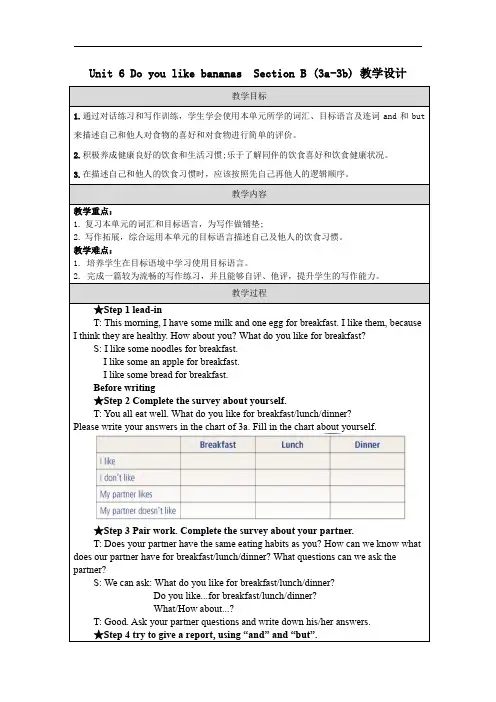
Unit 6 Do you like bananas Section B (3a-3b) 教学设计★Step 1 lead-inT: This morning, I have some milk and one egg for breakfast. I like them, because I think they are healthy. How about you? What do you like for breakfast?S: I like some noodles for breakfast.I like some an apple for breakfast.I like some bread for breakfast.Before writing★Step 2 Complete the survey about yourself.T: You all eat well. What do you like for breakfast/lunch/dinner?Please write your answers in the chart of 3a. Fill in the chart about yourself.★Step 3 Pair work. Complete the survey about your partner.T: Does your partner have the same eating habits as you? How can we know what does our partner have for breakfast/lunch/dinner? What questions can we ask the partner?S: We can ask: What do you like for breakfast/lunch/dinner?Do you like...for breakfast/lunch/dinner?What/How about...?T: Good. Ask your partner questions and write down his/her answers.★Step 4 try to give a report, using “and” and “but”.Ss judge and try to polish other students’ sentences.While writing★Step 5 make the structure betterT: Before writing, let’s look at the structure in 3b. Is it good enough? How can we make it better.S: We can add a beginning and an ending, to make the writing into three parts: beginning, body and ending.S: We can also write one or two sentences between I and my partner. The passage will be more fluent.T: So what sentences can we add in the beginning, in the middle and in the end?S: In the beginning: Hi, I am... I am a healthy boy/girl.In the middle: I have a good friend. Her/His name is...In the end: We have healthy eating habits./ We eats well.T: And don’t forget to pay attention to paragraphs.★Step 6 Writing on one’s own.After listening★Step 7 Pair work.Two students work in pairs to correct each others’ writing. Improve and polish.。
Unit 6 Section B (3a-3b) 教学设计 人教版英语七年级上册
6.为巩固所学知识,写一写家人的食物喜爱。这样,极大地满足孩子们的求知欲,熟练深入地巩固所学知识。
知识是快乐的;老师引导从孩子们平常最喜欢的话题入手,孩子们难道不感兴趣吗?只要有老师乐教的,没有孩子不乐学的。这样的其乐无穷,难道不应该保持吗?我愿陪孩子们一直快乐的成长。
2.运用句型:Do you like…?
Yes,I do, /No, I don’t.
难点:能够正确的表达出自己和同伴一日三餐的食物好恶;食物名词的可数与不可数名词的区分。
三、教学过程
1.通过一大张食物图片,复习本单元单词,区分名词可数和不可数形式。学看视频,既巩固单词理解,又强化可数和不可数形式。极大地引起学生的兴趣,由此导入本节内容学习。
Unit 6
Section B (3a-3b)
一、教学目标
1.复习并掌握与食物相关的名词;
2.能够用句型I like/don’t like, She/He likes/doesn’t like谈论对食物的喜好;
3.了解同伴饮食习惯,学会健康饮食,促进同学交往和友谊。
二、教学重点和难点
重点: 1.食物名词的复习和运用;
2.图片视频单词复习结束,又引入”Do You like…”句型重点复习,问一两个同学点一个食物如apples,问:”Do you like apples?”答:”Yes, I do/No,I don’t.”问另外一个同学:”Does he like apples?””Yes, he does/No, he doesn’t.”这样再次把本节重点句型熟悉掌握。
3.同桌互相询问对方一日三餐喜好什么食物,并回答,用上句型:”Do you like…?””Yes,I do, /No, I don’t.”此时,有一段对话展示出来,是关于3a 调查表完成而设的一段对话。同学们根据对话内容,完成表格,此为提升学生的阅读和理解能力,达到巩固和运用本单元单词和句型的目的。根据阅读,略有一点引导,轻松把3a调查表完成填空,达到3a调查任务学习。让孩子们在愉快中学习,既学到了健康饮食的知识,又学到了合作探究的本事呢。
Unit6SectionB(2a2c)精品教案 (人教版七年级上册英语)

Unit6SectionB〔2a2c〕精品教案 (人教版七年级上册英语〕Unit6 SectionB〔2a-2c〕精品教案Teaching goals:1. Learn these words and be able to say, read and write these words:star, well, habit, healthy, really, question, want, be, and fat2 . Be able to talk about and write abou t one’s eating habits by usingWhat do you like for breakfast?Do you like hamburgers for dinner?They’re not healthy.I don’t want to be fat.Cindy likes healthy food.3. Be able to understand the difficult sentences likeWhich food do you think is healthy?David asks the volleyball star, Cindy Smith, about her eating habits.情感目标:了解别人喜欢不喜欢的食物,关心他人。
学会健康饮食。
Previewing 〔读前活动〕一.Ask some of the Ss the following questions and help them to answer.Do you think hamburgers are healthy?Do you think milk is healthy?Do you think chicken is healthy?Do you think salad is healthy?二.Work on Section B -2a.Set a time limit of 3 minutes. Ask the Ss to ask and answer like the examples and check Yes, Maybe or No in the chart.2a Which food do you think is healthy? C heck (√) Yes, Maybe or No.Food Yes MaybeNofruitvegetableseggschickenhamburgersice-cream出他们的答复,为下一步操练提供示范。
2024人教版英语七年级上册 Unit 6 Section B 第2课时教学方案
8.Students read and find how to write about their days.
9.Students think and answer the questions.
学习理解之感知与注意、获取与梳理、概括与整合
教学活动
活动层次
效果评价
4.Students read the passage and answer the questions.
5.Students read the passage and fill in the blanks. Then answer the questions.
6.Students read the passages and answer the questions.
二、学情分析
学生在本单元前几个课时的学习过程中,已经学会了时刻的表达方法;了解了基本的描述日常活动的句型,能对自己和他Байду номын сангаас的学校日常活动进行描述。但是学生对于介绍自己某一天日常生活作息的语篇结构整体把握还不够准确,需要在教师的引导下树立整体语篇结构意识。
三、教学目标
通过本课时的学习,学生能够:
1.在时间轴的帮助下,回顾Timo的作息习惯,并进行问答练习及复述语篇;
12.Students write something about their days.
13.Students integrate the sentences from the previous section into a text, and they can add other details.
14.Students revise their partners’drafts according to the checklist.
七年级英语上册 Unit 6 Do you like bananas(第5课时)Section B(2a-3b)课件 (新版)人教新目标版

二、根据句意及汉语提示写单词。
6.Dale's brother _w_a_n__ts_(想要) an apple. 7.My son has good eating _h_a_b_i_t_s (习惯). 8.Fruit and vegetables are __h_e_a_lt_h_y_(健康的) food. 9.You can ask me some __q_u_e_s_ti_o_n_s_(问题). 10.The picture is __r_e_a_ll_y__(真正地) nice.
Unit 6 Do you like bananas?
第五课时 Section B(2a~3b)
1.Sports star eats well.体育明星吃得好。 (1)sports star体育明星。 (2)eats是eat的第三人称单数形式。在一般现在时中,当主语是 第三人称单数,就用动词的第三人称单数形式。 (3)well adv.好,主要用于修饰动词。 2.ask sb. about sth.向某人询问某事 3.her eating habits她的饮食习惯 此处eating作定语。eg: I have good eating habits.我有好的饮食习惯。
4.healthy 形容词,意为“健康的”,其名词形式为health,其反义词为 unhealthy。 5.I don't want to be fat.我不想长胖。 want“要,想要”,常用结构有:want sth.“想要某物”;want to do sth.“想做某事”,want sb. to do sth.“想要某人做某事”。 6.What do you like for breakfast?你早餐喜欢什么? (1)for 介词,意为“为了,给”,在句型“have…for breakfast/lunch/dinner”中表示“某人吃什么。” (2)breakfast前面不能用冠词,一日三餐前一般不加冠词。
人教版英语七年级上册Unit6SectionB3a3b优秀教学案例
(二)问题导向
问题导向是引导学生主动探索和思考的教学策略。在本节课中,我设计了一些问题,激发学生的思考和好奇心。问题导向包括以下几个方面:
1.分组讨论:将学生分成小组,让他们在小组内进行讨论和交流,共同完成任务。例如,让学生分组讨论并表演一段关于日常活动的对话,培养他们的口语表达能力和团队合作能力。
2.小组竞赛:设计一些小组竞赛活动,激发学生的团队合作精神和竞争意识。例如,进行单词接龙游戏,看哪个小组能够连续接出更多的单词。
3.小组分享:鼓励学生在小组内分享自己的观点和经验,培养良好的沟通和倾听能力。例如,让学生在小组内分享自己的一日三餐时间和日常活动安排,互相学习和借鉴。
人教版英语七年级上册Unit6SectionB3a3b优秀教学案例
一、案例背景
本案例背景以人教版英语七年级上册Unit 6 Section B 3a 3b为例。本节课主要内容是学习关于日常活动的话题,通过图片和对话的形式,让学生掌握动词短语的运用,并能够熟练进行日常交流。教学目标是让学生能够听懂、说出一日三餐的时间以及常见的日常活动,如watch TV, do homework, have a snack等。同时,培养学生正确的学习态度和良好的生活习惯。
为了实现这些目标,我将营造一个轻松愉快的学习氛围,鼓励学生积极参与和表达自己的观点。通过小组讨论和团队合作活动,培养学生的团队合作精神和良好的人际交往能力。同时,我会给予学生积极的反馈和指导,让他们感受到学习的成就感和乐趣。通过与学生的互动和沟通,引导他们树立正确的学习态度和价值观,努力提高自己的综合素质。
人教版英语七年级 上册Unit6-SectionB2a-3b教案
Unit 6 Do you like bananas?Section B (2a-3b selfcheck)教材分析:本课题选自人教版七年级英语上册第六单元Do you like bananas?Section B(2a---2c),本单元内容主要围绕“谈论对食物的喜好”以及一日三餐等语言功能项目展开的一系列任务活动。
以 like为例,进一步学习实意动词在一般现在时中的用法。
Section A 部分主要让学生使用动词like 询问他人是否喜欢某种食物,学习一般现在时各个人称的肯定句、否定句、和一般疑问句的构成及回答。
本课时要说的是Section B(2a---2c),这部分介绍了更多有关食物的词汇,听说活动、阅读活动和写作活动都围绕早餐、午餐和晚餐的话题展开,让学生进一步谈论人们对不同食物的喜好,反思不同的饮食习惯,并探讨健康饮食的问题,从而深化了本单元的话题。
2a---2c为本单元阅读板块。
2a的读前活动先让学生思考一些食物是否健康,以激活他们的知识背景。
本单元的阅读材料是记者对一位体育明星的采访对话,体育明星谈到了自己一日三餐的饮食习惯,其中融入了健康饮食的思想。
2b 的读中活动让学生关注文章中的食物名称,抓住关键信息。
2c的读后活动让学生通过造句的方式转述文中信息,不仅可以加深对文章的理解,还可以为后面的写作做准备。
学情分析:七年级的学生,年龄十二三岁,个性比较活泼,爱表现,模仿能力强,对英语表现出既好奇又有所畏惧的心态,所以教学中我会注重遵循由易到难、由简到繁循序渐进的过程,建立信心,打破恐惧,激发兴趣;本单元的主题“food”是该年龄段学生感兴趣的话题,这就提醒教者应从兴趣导入,寓枯燥的单词、语法学习于丰富多彩的情景之中,让学生很好地将学和用结合起来。
教学目标:1、本单元话题源自生活,立足这一点充分利用学生对已有的知识和经验,创造生活化的语言环境,引导学生在运用语言知识的同时学会在现实生活中注重饮食习惯的培养。
人教版英语七年级上册 Unit 6 Section B 3a-3b 教学设计
明确写作要求,给出写作内容,明确评价标准。
【设计意图】达到教—学—评一致的要求。
Step4:Post-writing
通过自评与互评的方式来进行修改与订正。
【设计意图】通过自评与互评的方式来提高学生的自学能力。
Step2:Pre-writing
1.让学生制作一份关于他们自己及同伴三餐喜欢及不喜欢的调查表,并完成3a调查表。
2.写出你和同伴一日三餐喜欢吃什么、不喜欢吃什么,完成3b.
3.给出一篇范文,引导学生分析文章结构。
【设计意图】输入语言材料,搭建语言素材;分析语篇结构,为后续写作奠定结构基础。
Step3:while-writing
2.学生分析:
K:What students already knew
学生在unit5对实义动词的相关意义有一定的了解,大部分同学能够正确使用实义动词的三人称单数的形式; 关于常见食物的词汇及其归类,包括可数与不可数,复数形式上的变化。
W:what they want to know
如何对自己及他人的饮食习惯进行得体的描述
Unit 6 Do you like bananas Section B 3a-3b 教学设计
教学目标
Atthe end of the lesson:
1.students can write their own eating habits and others’ by summarizing the structure of the passage and the linking words (but, and). (Language ability; Learning ability)
人教版七年级英语上册Unit6SectionB(2a2c)优秀教学案例
1.情境创设贴近生活:通过邀请学生上台描述自己或其他同学的外貌特征,以及展示图片和视频,让学生在真实情境中学习描述人外貌的词汇,提高学生的参与度和兴趣。
2.问题导向激发思考:在教学过程中,我提出引导性问题,如“How do you describe someone's appearance?”和“Can you give me an example of how to use 'tall' and 'short' in a sentence?”等,激发学生思考,培养学生解决问题的能力。
人教版七年级英语上册Unit6SectionB(2a2c)优秀教学案例
一、案例背景
本案例背景基于人教版七年级英语上册Unit 6 Section B (2a-2c)的教学内容。本节课的主题为“What Does She Look Like?”,主要介绍形容词来描述人的外貌特征。通过本节课的学习,学生能够掌握相关词汇,如tall、short、thin、fat等,并能够运用这些词汇描述自己和他人外貌。同时,学生还能够通过听力活动,提高听力理解能力,并能在实际情景中运用所学知识进行交流。
4.引导学生运用目标词汇进行写作练习,巩固所学知识。
(三)情感态度与价值观
1.培养学生对英语学习的兴趣,激发学生积极参与课堂活ห้องสมุดไป่ตู้。
2.培养学生自信、勇敢地表达自己观点的能力,增强学生自信心。
3.培养学生关爱他人、尊重他人外貌特征的良好品质。
4.培养学生团队合作精神,提高学生与人相处的能力。
在教学过程中,我将注重引导学生积极参与,激发他们的学习兴趣。同时,关注学生的个体差异,给予每个学生充分的关注和指导,确保他们能够在课堂上充分展示自己,提高自信心。通过设置多样化的教学活动,培养学生的观察力、表达力和听力理解能力,同时注重培养学生的团队合作精神和与人相处的能力。引导学生关注人与人之间的情感交流,培养学生关爱他人、尊重他人的价值观。
人教版英语七年级上册Unit6SectionB3a3b教学设计
3.教师提出问题:“Do you know what language people speak in different countries?”,引导学生思考并回答,为新课的学习内容做好预热。
(五)总结归纳
1.教师引导学生回顾本节课所学词汇、语法、听力等知识点,总结学习收获。
2.教师强调本节课的重点,提醒学生注意一般现在时的用法和不同国家语言的掌握。
3.教师布置课后作业,如:用英语介绍一个国家的语言和文化,要求学生充分发挥所学知识,提高学生的自主学习能力。
4.教师鼓励学生继续关注不同国家的语言和文化,培养国际视野,为下一节课的学习做好铺垫。
-通过小组合作,让学生互相交流所学词汇,提高词汇运用能力。
2.针对语法教学:
-创设情境,让学生在实际语境中感知语法结构,如通过角色扮演,模拟不同国家的人交流的场景。
-设计语法填空、改错等练习,让学生在实践中掌握语法知识。
-利用图表、思维导图等可视化工具,帮助学生梳理语法知识点,形成系统化认识。
3.针对听力教学:
4.教师及时批改作业,给予学生反馈,指导学生改进学习方法,提高学习效果。
3.培养学生良好的学习习惯,如:积极参与、主动思考、合作学习等,为学生终身学习奠定基础。
4.培养学生的爱国主义情感,让学生在学习英语的同时,关注国家的发展,为祖国的繁荣富强感到自豪。
二、学情分析
本节课的教学对象为七年级学生,经过前五个单元的学习,他们已经具备了一定的英语基础,能够运用一般现在时描述自己的日常活动,但在语言的实际运用方面仍有待提高。此外,学生对不同国家的语言和文化有一定的好奇心,但了解有限。因此,在教学过程中,应结合学生的实际情况,关注以下几点: