
英语常用语法图解一览表
英语常用语法图解 一.名词
I. 名词的种类: 专有名词 普通名词 国名地名人名,团体机构名称 可数名词 不可数名词
个体名词 集体名词 抽象名词 物质名词
II. 名词的数: 1. 规则名词的复数形式: 名词的复数形式,一般在单数形式后面加-s或-es。现将构成方法与读音规则列表如下:
规则 例词 1 一般情况在词尾加-s map-maps, sea-seas, girl-girls, day-days 2 以s, x, ch, sh结尾的名词后加-es class-classes, box-boxes, watch-watches, dish-dishes
3 以-f或-fe结尾的词
变-f和-fe为v再加-es leaf-leaves, thief-thieves, knife-knives, loaf-loaves, wife-wives
加-s belief-beliefs, chief-chiefs, proof-proofs, roof-roofs, gulf-gulfs 4 以辅音字母加y结尾的名词,变y为i加-es party-parties, family-families, story-stories, city-cities
5 以元音字母加y结尾的名词,或专有名词以y结尾的,加-s toy-toys, boy-boys, day-days, ray-rays, Henry-Henrys
6 以辅音字母加-o结尾的名词
一般加-es hero-heroes, Negro-Negroes, potato-potatoes, tomato-tomatoes
不少外来词加-s piano-pianos, photo-photos, auto-autos, kilo-kilos, solo-solos 两者皆可 zero-zeros/zeroes, volcano-volcanoes/ volcanos 7 以元音字母加-o结尾的名词加-s radio-radios, bamboo-bamboos, zoo-zoos 8 以-th结尾的名词加-s truth-truths, mouth-mouths, month-months, path-paths,
2. 不规则名词复数: 英语里有些名词的复数形式是不规则的,现归纳如下:
规则 例词 1 改变名词中的元音字母或其他形式 man-men, woman-women, foot-feet, goose-geese, mouse-mice 2 单复数相同 sheep, deer, series, means, works, fish, species li, yuan, jin,
3 只有复数形式 ashes, trousers, clothes, thanks, goods, glasses, compasses, contents 4 一些集体名词总是用作复数 people, police, cattle, staff
5 部分集体名词既可以作单数(整体)也可以作复数(成员) audience, class, family, crowd, couple, group, committee,
government, population, crew, team, public, enemy, party
6 复数形式表示特别含义 customs(海关), forces(军队), times(时代), spirits(情绪), drinks(饮料), sands(沙滩), papers(文件报纸), manners(礼貌), looks(外表), brains(头脑智力), greens(青菜), ruins(废墟)
7 表示“某国人”
加-s Americans, Australians, Germans, Greeks, Swedes, Europeans 单复数同形 Swiss, Portuguese, Chinese, Japanese 以-man或-woman结尾的改为-men,-women Englishmen, Frenchwomen
8 合成名词 将主体名词变为复数 sons-in-law, lookers-on, passers-by, story-tellers, boy friends 无主体名词时将最后一部分变为复数 grown-ups, housewives, stopwatches 将两部分变为复数 women singers, men servants
III. 名词的所有格: 名词在句中表示所有关系的语法形式叫做名词所有格。所有格分两种:一是名词词尾加’s构成,二是由介词of加名词构成。前者多表示有生命的东西,后者多表示无生命的东西。 1. ’s所有格的构成: 单数名词在末尾加’s the boy’s father, Jack’s book, her son-in-law’s photo, 复数名词 一般在末尾加’ the teachers’ room, the twins’ mother, 不规则复数名词后加’s the children’s toys, women’s rights, 以s结尾的人名所有格加’s或者’ Dickens’ novels, Charles’s job, the Smiths’ house 表示各自的所有关系时,各名词末尾均须加’s Japan’s and America’s problems, Jane’s and Mary’s bikes
表示共有的所有关系时在最后一词末加’s Japan and America’s problems, Jane and Mary’s father
表示"某人家""店铺",所有格后名词省略 the doctor’s, the barber’s, the tailor’s, my uncle’s
2. ’s所有格的用法: 1 表示时间 today’s newspaper, five weeks’ holiday 2 表示自然现象 the earth’s atmosphere, the tree’s branches 3 表示国家城市等地方的名词 the country’s plan, the world’s population, China’s industry 4 表示工作群体 the ship’s crew, majority’s view, the team’s victory 5 表示度量衡及价值 a mile’s journey, five dollars’ worth of apples
6 与人类活动有特殊关系的名词 the life’s time, the play’s plot
7 某些固定词组 a bird’s eye view, a stone’s throw, at one’s wit’s end(不知所措)
3. of所有格的用法: 用于无生命的东西:the legs of the chair, the cover of the book 用于有生命的东西,尤其是有较长定语时:the classrooms of the first-year students 用于名词化的词:the struggle of the oppressed
二.冠词 冠词分为不定冠词(a, an),定冠词(the),和零冠词。 I. 不定冠词的用法:
1 指一类人或事,相当于a kind of A plane is a machine that can fly. 2 第一次提及某人某物,非特指 A boy is waiting for you. 3 表示“每一”相当于every,one We study eight hours a day. 4 表示“相同”相当于the same We are nearly of an age.
5 用于人名前,表示不认识此人或与某名人有类似性质的人或事 A Mr. Smith came to visit you when you were out
That boy is rather a Lei Feng.
6 用于固定词组中 A couple of, a bit, once upon a time, in a hurry, have a walk, many a time
7 用于quite, rather, many, half, what, such之后 This room is rather a big one. 8 用于so(as, too, how)+形容词之后 She is as clever a girl as you can wish to meet.
II. 定冠词的用法: 1 表示某一类人或物 The horse is a useful animal. 2 用于世上独一无二的事物名词前 the universe, the moon, the Pacific Ocean 3 表示说话双方都了解的或上文提到过的人或事 Would you mind opening the door? 4 用于乐器前面 play the violin, play the guitar 5 用于形容词和分词前表示一类人 the reach, the living, the wounded 6 表示“一家人”或“夫妇” the Greens, the Wangs 7 用于序数词和形容词副词比较级最高级前 He is the taller of the two children.
8 用于国家党派等以及江河湖海,山川群岛的名词前 the United States, the Communist Party of China, the
French
英语常用语法汇总

改变词义的前缀后缀否定,反相:Anti- counter- de- dis- mis- non- un- il- im- in- ir-Auto- 自己的biography-autobiographyBio- 生物的Co- 共同operate-cooperateEn- 处于。
状态large-enlargeInter- 在。
之间Mid 中间Mini 极小的Over- 超过Post- 后,以后Pre- 在。
之前Sub 在。
下面Under 在。
之下Kilo- 千Bi- 二cycle-bicycleTri- 三uni-/momo=oneRe- 重新Super- 超级Tele- 远距离的Trans- 横贯-ful 满-less 少-ship 资格名词后缀-age -ance -ence -ancy -ency -er -or -hood -ion -tion -ation -ian -ist -ment -ness -ology -ship -ty -ity 动词后缀-en -fy -ify -ize -ise形容词后缀-able -ible -ble -al -ful -ic -ical -ish -ive -less -ous -some -y -ly副词后缀-ly -ward(s) -wiseThere be 句型be的单复数根据其后最近的词语来判断。
EG:There is a beautiful girl and 2 chairs. There are 2 chairs and a beautiful girl.五大基本句型结构(一个句子一般只有一个谓语动词,其他动词都要变换形态)主语+不及物动词I came. I saw. I conquer!主语+系动词+表语系动词:不能单独用作谓语,其后必须跟表语.be, get, become, appear, seem, look, sound, smell, taste, feel,等词表语:名词、形容词、副词、介词短语、动词的ing形式、不定式、从句主语+及物动词+宾语I want you.主语+双宾语动词+间接宾语+直接宾语双宾动词指的是该词后面可跟两个宾语一个人一个物。
英语语法50讲
英语语法50讲第一讲:英语语法概述介绍英语语法的重要性:阐述语法在准确表达、理解英语句子等方面起到的关键作用。
语法体系的基本构成:提及词法(各类词性等)和句法(句子结构等)两大部分。
第二讲:名词(一)名词的分类:如可数名词(个体名词、集体名词)、不可数名词(物质名词、抽象名词)。
可数名词的单复数变化规则:常规加“s”“es”的情况,还有特殊变化形式等。
第三讲:名词(二)名词所有格:讲解’s 所有格的构成与用法,以及of 所有格的使用场景等。
名词在句子中的作用:可作主语、宾语、表语、定语等举例说明。
第四讲:代词(一)人称代词:主格(I、you、he 等)和宾格(me、you、him 等)的用法及区别。
物主代词:形容词性物主代词(my、your、his 等)和名词性物主代词(mine、yours、his 等)的不同运用。
第五讲:代词(二)反身代词:如myself、yourself、himself 等的常见搭配与表意。
指示代词:this、that、these、those 在句中的指代和用法特点。
第六讲:代词(三)不定代词:像some、any、many、much、few、little 等的用法差异,以及在肯定句、否定句、疑问句中的运用情况。
相互代词:each other 和one another 的用法举例。
第七讲:冠词(一)不定冠词a/an 的用法:用于泛指、表示“一个”等情况,以及 a 和an 根据后续单词发音来选用的规则。
定冠词the 的基本用法:用于特指、上文提到过的事物等常见场景。
第八讲:冠词(二)零冠词(不用冠词的情况):像在某些专有名词、球类运动、三餐等前面不用冠词的举例与说明。
冠词使用的一些特殊情况和易错点总结。
第九讲:数词(一)基数词的构成与读写:从1 到100 等的基数词表达方式,以及较大数字的读写规则。
基数词在句中的作用:可用于表示数量、年龄、编号等举例。
第十讲:数词(二)序数词的构成与用法:first、second、third 等的变化规律,以及序数词用于表示顺序等情况。
小学英语语法知识 I、my、you、your、he、him、she、her、they、them、it、its各种区别用法

小学英语语法知识英语 I, my, me, mine的用法:1、I, 代词, 一般做主语, 意思是“我”;用法, 通常作为主语放在句首, 后加动词(包括Be);例: I am a good person. -- 我是一个好人2、me, 代词, 一般做宾语, 意思也是“我”;用法, 通常作为宾语放在句尾, 放在在动词后面;例: Don't hit me. -- 别打我。
3、my, I的所有格形式, 形容词性物主代词,翻译为“我的”;用法, 跟一般形容词一样, 后面加名词;例: He is my brother. -- 他是我的兄弟。
4、mine, I的所有格形式, 代词, 翻译为“我的(东西)”;用法, 可做主语,宾语等等,例: He's a friend of mine (= one of my friends) . -- 他是我的一个朋友。
英语 you、your、yours 有什么区别?1、you 指“你”。
your 指“你的,你们的”you可以直接放在句首做主语,而 your 不能单独使用,必须加上名词使用。
如:you are interesting. 你有趣。
(you直接做主语)your book is interesting. 你的书有趣。
(注意这里your book 才是主语)you可以直接做宾语,而your不可以,必须加上名词使用。
(可以和上面一条比较,只是位置不一样)如:I like you.我喜欢你。
I like your book.我喜欢你的书。
your 你的,你们的yours你的(东西),你们的(东西)your 是形容词性物主代词,后接名词yours名词性物主代词,后面不接名词,相当:your+名词据个例子你就明白了:this is my book and thatis your book.this is my book and that is yours.英语he、him、his有什么区别?首先他们都是代词,但是he是主格人称代词;him是宾格人称代词;his是形容词性的物主代词,他们运用在一个句子的不同地方。
英语语法之句子成分
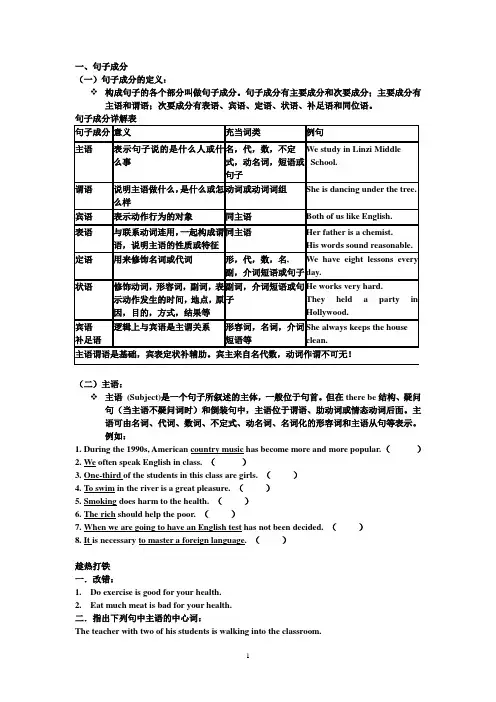
一、句子成分(一)句子成分的定义:构成句子的各个部分叫做句子成分。
句子成分有主要成分和次要成分;主要成分有主语和谓语;次要成分有表语、宾语、定语、状语、补足语和同位语。
句子成分详解表(二)主语:主语(Subject)是一个句子所叙述的主体,一般位于句首。
但在there be结构、疑问句(当主语不疑问词时)和倒装句中,主语位于谓语、助动词或情态动词后面。
主语可由名词、代词、数词、不定式、动名词、名词化的形容词和主语从句等表示。
例如:1. During the 1990s, American country music has become more and more popular. ()2. We often speak English in class. ()3. One-third of the students in this class are girls. ()4. To swim in the river is a great pleasure. ()5. Smoking does harm to the health. ()6. The rich should help the poor. ()7. When we are going to have an English test has not been decided. ()8. It is necessary to master a foreign language. ()趁热打铁一.改错:1. Do exercise is good for your health.2. Eat much meat is bad for your health.二.指出下列句中主语的中心词:The teacher with two of his students is walking into the classroom.三.找出下面句子的主语:1. It is a pleasure to talk to you.2. Cleaning the house needs a lot of time.(三)谓语谓语(Predicate) 说明主语是什么,做什么或怎么样,由动词充当。
初中英语中考 语法图解过关 专题一 冠词

专题一 冠词
中考
编写说明
语法的知识点琐碎,对初中考生来说较难掌握,如果能把这些琐碎 的点系统化、网络化,掌握起来就容易多了。基于此,确立了本部分各 专题的设计思路:
【考情】部分分析近5年中考真题,标明各考点考频考次,有助于 考生有的放矢;
中考
编写说明
【图解】部分用思维导图对知识点进行全面梳理,层次分明、线 索清晰,有助于考生整体把握;
A. the
B. an
C. a
前往
考情
图解
重难
随堂
随堂 一、选择填空
1.Everyone needs to know
sorting.
A. an
B. a
C importance of rubbish C. the
前往
考情
图解
重难
随堂
随堂 一、选择填空
2.I’m going to be A great scientist like Yuan Longping
This helps us start a day well.
A. /
B. a
C. the
前往
考情
图解
重难
随堂
随堂 一、选择填空
5.What B forget it. A. a
unusual school trip we had! I will never
B. an
C. the
前往
考情
图解
重难
随堂
11.The invention of the bicycle is a great one to the world. I like going to work by / bike.
(完整版)常用英语语法术语表_中英
常用英语语法术语表达语法 grammar句法 syntax词法 morphology结构 structure层次 rank句子 sentence从句 clause词组 phrase词类 part of speech单词 word实词 notional word虚词 structural word单纯词simple word派生词derivative复合词compound词性part of speech名词 noun专有名词 proper noun普通名词 common noun可数名词 countable noun不可数名词 uncountable noun抽象名词 abstract noun具体名词 concrete noun物质名词 material noun集体名词 collective noun个体名词 individual noun介词 preposition连词 conjunction动词 verb主动词 main verb及物动词 transitive verb不及物动词 intransitive verb系动词 link verb助动词 auxiliary verb情态动词 modal verb规则动词 regular verb不规则动词 irregular verb短语动词 phrasal verb限定动词 finite verb非限定动词 infinite verb使役动词 causative verb感官动词 verb of senses动态动词dynamic verb静态动词 state verb感叹词 exclamation形容词 adjective副词 adverb方式副词 adverb of manner程度副词 adverb of degree时间副词 adverb of time地点副词 adverb of place修饰性副词adverb of adjunct连接性副词 adverb of conjunct疑问副词 interrogative adverb关系副词 relative adverb代词 pronoun人称代词 personal pronoun物主代词 possessive pronoun反身代词 reflexive pronoun相互代词 reciprocal pronoun指示代词 demonstrative pronoun疑问代词 interrogative pronoun关系代词 relative pronoun不定代词 indefinite pronoun名词性物主代词 nominal possessive pronoun形容词性物主代词 adjectival possessive pronoun冠词 article定冠词 definite article不定冠词 indefinite article数词 numeral基数词 cardinal numeral序数词 ordinal numeral分数词 fractional numeral形式 form单数形式 singular form复数形式 plural form限定动词 finite verb form非限定动词 non-finite verb form原形 base form从句 clause从属句 subordinate clause并列句 coordinate clause名词从句 nominal clause定语从句 attributive clause状语从句 adverbial clause宾语从句 object clause主语从句 subject clause同位语从句 appositive clause时间状语从句 adverbial clause of time地点状语从句 adverbial clause of place方式状语从句 adverbial clause of manner让步状语从句 adverbial clause of concession原因状语从句 adverbial clause of cause结果状语从句 adverbial clause of result目的状语从句 adverbial clause of purpose条件状语从句 adverbial clause of condition真实条件状语从句 adverbial clause of real condition非真实条件状语从句 adverbial clause of unreal condition 含蓄条件句 adverbial clause of implied condition错综条件句 adverbial clause of mixed condition句子 sentence简单句 simple sentence并列句 compound sentence复合句 complex sentence并列复合句 compound complex sentence陈述句 declarative sentence疑问句 interrogative sentence一般疑问句 general question特殊疑问句 special question选择疑问句 alternative question附加疑问句 tag question反义疑问句 disjunctive question修辞疑问句 rhetorical question感叹疑问句 exclamatory question存在句 existential sentence肯定句 positive sentence基本句型 basic sentence patern否定句 negative sentence祈使句 imperative sentence省略句 elliptical sentence感叹句 exclamatory sentence句子成分 members of sentences主语 subject谓语 predicate宾语 object双宾语 dual object直接宾语 direct object间接宾语 indirect object复合宾语 complex object同源宾语 cognate object补语 complement主补 subject complement宾补 object complement表语 predicative定语 attribute同位语 appositive状语 adverbial句法关系 syntactic relationship 并列 coordinate从属 subordination修饰 modification前置修饰 pre-modification后置修饰 post-modification限制 restriction双重限制 double-restriction非限制 non-restriction数 number单数形式 singular form复数形式 plural form规则形式 regular form不规则形式 irregular form格 case普通格 common case所有格 possessive case主格 nominative case宾格 objective case性 gender阳性 masculine阴性 feminine通性 common中性 neuter人称 person第一人称 first person第二人称 second person第三人称 third person时态 tense过去将来时 past future tense过去将来进行时 past future continuous tense过去将来完成时 past future perfect tense一般现在时 simple present tense一般过去时 simple past tense一般将来时 simple future tense现在完成时 past perfect tense过去完成时 present perfect tense将来完成时 future perfect tense现在进行时 present continuous tense过去进行时 past continuous tense将来进行时 future continuous tense过去将来进行时 past future continuous tense现在完成进行时 present perfect continuous tense 过去完成进行时 past perfect continuous tense语态 voice主动语态 active voice被动语态 passive voice语气 mood陈述语气 indicative mood祈使语气 imperative mood虚拟语气 subjunctive mood否定 negation否定范围 scope of negation全部否定 full negation局部否定 partial negation转移否定 shift of negation语序 order自然语序 natural order倒装语序 inversion全部倒装 full inversion部分倒装 partial inversion直接引语 direct speech间接引语 indirect speech自由直接引语 free direct speech自由间接引语 free indirect speech一致 agreement主谓一致 subject-predicate agreement 语法一致 grammatical agreement概念一致 notional agreement就近原则 principle of proximity强调 emphasis重复 repetition语音 pronunciation语调 tone升调 rising tone降调 falling tone降升调 falling-rising tone文体 style正式文体 formal非正式文体 informal口语 spoken/oral English套语 formulistic expression英国英语 British English美国英语 American English用法 usage感情色彩 emotional coloring褒义 commendatory贬义 derogatory幽默 humorous讽刺 sarcastic。
史上最全的英语语法大全(精心整理)
史上最全的英语语法⼤全(精⼼整理)英语语法1、名词1、1名词复数得规则变化1、2其她名词复数得规则变化1、3名词复数得不规则变化1、4不可数名词量得表⽰1、5定语名词得复数1、6不同国家得⼈得单复数1、7名词得格2、冠词与数词2、1不定冠词得⽤法2、2定冠词得⽤法2、3零冠词得⽤法2、4冠词与形容词+名词结构2、5冠词位置2、6数词3、代词3、1⼈称代词得⽤法3、2⼈称代词之主、宾格得替换3、3代词得指代问题3、4并列⼈称代词得排列顺序3、5物主代词3、6双重所有格3、7反⾝代词3、8相互代词3、9指⽰代词3、10疑问代词3、11关系代词3、12every , no, all, both, neither, nor3、13none, few, some, any, one, ones3、14代词⽐较辩异 one,that 与it3、15one/another/the other3、16“the”得妙⽤3、17anyone/any one;no one/none;every/each3、18both, either, neither, all, any, none3、19many, much3、20few, little, a few, a little4、形容词与副词4、1形容词及其⽤法4、2以ly结尾得形容词4、3⽤形容词表⽰类别与整体4、4多个形容词修饰名词得顺序4、5副词及其基本⽤法4、6兼有两种形式得副词4、7形容词与副词得⽐较级4、8as + 形容词或副词原级 + as4、9⽐较级形容词或副词 + than4、10可修饰⽐较级得词4、12the + 最⾼级 + ⽐较范围4、13与more有关得词组5、动词5、1系动词5、2什么就是助动词5、3助动词be得⽤法5、4助动词have得⽤法5、5助动词do得⽤法5、6助动词shall与will得⽤法5、7助动词should与would得⽤法5、8短语动词5、9⾮谓语动词6、动名词6、1动名词作主语、宾语与表语6、2Worth得⽤法7动词不定式7、1不定式作宾语7、2不定式作补语7、3不定式主语7、4It's for sb、与 It's of sb、7、5不定式作表语7、6不定式作定语7、7不定式作状语7、8⽤作介词得to7、9省to 得动词不定式7、10动词不定式得否定式7、11不定式得特殊句型too…to…7、12不定式得特殊句型so as to 7、13不定式得特殊句型Why not 7、147不定式得时态与语态7、15动名词与不定式8、特殊词精讲8、1stop doing/to do8、2forget doing/to do8、3remember doing/to do8、4regret doing/to do8、5cease doing/to do8、6try doing/to do8、7go on doing/to do8、8be afraid doing/to do8、9be interested doing/to do 8、10mean to doing/to do8、11begin(start) doing/to do8、12感官动词 + doing/to do9、分词9、1分词作定语9、2分词作状语9、3连词+分词(短语)9、5分词作表语9、6分词作插⼊语9、7分词得时态9、8分词得语态10、独⽴主格10、1独⽴主格10、2With得复合结构11、动词得时态11、1⼀般现在时得⽤法11、2⼀般过去时得⽤法11、3used to / be used to 11、4⼀般将来时11、5be going to / will11、6be to与be going to11、7⼀般现在时表将来11、8⽤现在进⾏时表⽰将来11、9现在完成时11、10⽐较过去时与现在完成时11、11⽤于现在完成时得句型11、12⽐较since与for11、13since得四种⽤法11、14延续动词与瞬间动词11、15过去完成时11、16⽤⼀般过去时代替完成时11、17将来完成时11、18现在进⾏时11、19不⽤进⾏时得动词11、20过去进⾏时11、21将来进⾏时11、22⼀般现在时代替将来时11、23⼀般现在时代替过去时11、24⼀般现在时代替完成时11、25⼀般现在时代替完成时11、26⼀般现在时代替进⾏时11、27现在进⾏时代替将来时11、28时态⼀致1、29时态与时间状语12、动词得语态12、1Let得⽤法12、2短语动词得被动语态12、3表⽰"据说"或"相信" 得词组12、4不⽤被动语态得情况12、5主动形式表⽰被动意义12、6被动语态表⽰主动意义12、7need/want/require/worth13、句⼦得种类13、1句⼦得种类13、2感叹句结构13、4⽤助动词进⾏强调13、5反意疑问句14、倒装14、1倒装句之全部倒装14、2倒装句之部分倒装14、3以否定词开头作部分倒装14、4so, neither, nor作部分倒装14、5only在句⾸要倒装得情况14、6as, though 引导得倒装句14、7其她部分倒装15、主谓⼀致15、1并列结构作主语谓语⽤复数15、2主谓⼀致中得靠近原则15、3谓语动词与前⾯得主语⼀致15、4谓语需⽤单数15、5指代意义决定谓语得单复数15、6与后接名词或代词保持⼀致16、虚拟语⽓16、1真就是条件句16、2⾮真实条件句16、3混合条件句16、4虚拟条件句得倒装16、5特殊得虚拟语⽓词:should16、6wish得⽤法16、7⽐较if only与only if16、8It is (high) time that16、9need "不必做"与"本不该做"17、名词性从句17、1引导名词性从句得连接词17、2名词性that从句17、3名词性wh从句17、4if, whether引导得名词从句17、5否定转移18、定语从句18、1关系代词引导得定语从句18、2关系副词引导得定语从句18、3判断关系代词与关系副词18、4限制性与⾮限制性定语从句18、5介词+关系词18、6as, which ⾮限定性定语从句18、7先⾏词与关系词⼆合⼀18、8what/whatever;that/what; who/whoever18、9关系代词that 得⽤法19、状语从句19、1地点状语从句19、2⽅式状语从句19、3原因状语从句19、4⽬得状语从句19、6条件状语从句19、7让步状语从句19、8⽐较while, when, as19、9⽐较until与till19、10表⽰"⼀…就…"得结构20、连词20、1并列连词与并列结构20、2⽐较and与or20、3表⽰选择得并列结构20、4表⽰转折或对⽐20、5表原因关系20、6⽐较so与 such21、情态动词21、1情态动词得语法特征21、2⽐较can 与be able to21、3⽐较may与might21、4⽐较have to与must21、5⽐较have to与must21、6must表⽰推测21、7表⽰推测得⽤法21、8情态动词+ have +过去分词21、9should 与ought to21、10had better表⽰"最好"21、11would rather表⽰"宁愿"21、12will与would21、13情态动词得回答⽅式21、14带to 得情态动词21、15⽐较need与dare1、名词名词可以分为专有名词(Proper Nouns)与普通名词(mon Nouns),专有名词就是某个(些)⼈,地⽅,机构等专有得名称,如Beijing,China等。
牛津实用英语语法大全(经典完整版)
—-可编辑修改,可打印——别找了你想要的都有!精品教育资料——全册教案,,试卷,教学课件,教学设计等一站式服务——全力满足教学需求,真实规划教学环节最新全面教学资源,打造完美教学模式第一章冠词和one,a little/a few,this,that1 a/an(不定冠词)a用在以辅音字母开头,或以读做辅音的元音字母开头的单词前面:a man一个男人 a university一所大学a hat一顶帽子 a European一个欧洲人a one-way street一条单行马路an用在以元音字母(a,e,i,o,u)开头,或以不发音的h字母开头的单词前面:an apple一个苹果an island一个岛an uncle一位大叔an onion一个洋葱an egg一个鸡蛋an hour一小时an还用在发音以元音开头的单个字母前面:an L-plate一块“实习驾驶”车牌an MP一个国会议员an SOS一个呼救信号an‘x’一个x字母、X形的东西或未知数a/an没有性的变化:a man一个男人a woman一个女人an actor一个男演员an actress一个女演员a table一张桌子2 a/an的用法A 用在第一次提到而非特指某人或某物的单数可数名词前面:I need a visa.我需要签证。
They live in a flat.他们住一个套间。
He bought an ice-cream.他买了一个冰淇淋。
B 用在代表一类东西的单数可数名词前面:A car must be insured汽车必须投保。
相当于:All cars/Any car must be insured.所有汽车/任何汽车都必须投保。
A child needs love.孩子需要爱。
相当于:All children need/Any child needs love.所有孩子/任何孩子都需要爱。
C 用在作表语的名词(包括职业名称)前面:It was an earthquake.是一次地震。
英语语法(完整版)
1. 名词名词可以分为专有名词(Proper Nouns)和普通名词 (Common Nouns),专有名词是某个(些)人,地方,机构等专有的名称,如Beijing,China等。
普通名词是一类人或东西或是一个抽象概念的名词,如:book,sadness等。
普通名词又可分为下面四类:1)个体名词(Individual Nouns):表示某类人或东西中的个体,如:gun。
2)集体名词(Collective Nouns):表示若干个个体组成的集合体,如:family。
3)物质名词(Material Nouns):表示无法分为个体的实物,如:air。
4)抽象名词(Abstract Nouns):表示动作、状态、品质、感情等抽象概念,如:work。
个体名词和集体名词可以用数目来计算,称为可数名词(Countable Nouns),物质名词和抽象名词一般无法用数目计算,称为不可数名词(Uncountable Nouns)。
归纳一下,名词的分类可以下图表示:_______________________________________| |专有名词 | || 名 | | 个体名词 | || | | | 可数名词|| | | 集体名词 | || |普通名词 | | || 词 | | 物质名词 | || | | | 不可数名词|| | | 抽象名词 | |1.1 名词复数的规则变化___________________________________________________情况构成方法读音例词__________________________________________________一般情况加 -s 1.清辅音后读/s/; map-maps2.浊辅音和元音后 bag-bags读 /z/; car-cars___________________________________________________以s,sh,ch,x等结尾的词加 -es 读 /iz/ bus-buseswatch-watches___________________________________________________以ce,se,ze,(d)ge等结尾的词加 -s 读 /iz/ license-licenses___________________________________________________以辅音字母+y 变y 为i结尾的词再加es 读 /z/ baby---babies___________________________________________________1.2 其它名词复数的规则变化1) 以y结尾的专有名词,或元音字母+y 结尾的名词变复数时,直接加s变复数:如:two Marys the Henrysmonkey---monkeys holiday---holidays比较:层楼:storey ---storeys story---stories2) 以o 结尾的名词,变复数时:a. 加s,如: photo---photos piano---pianosradio---radios zoo---zoos;b. 加es,如:potato--potatoes tomato--tomatoesc. 均可,如:zero---zeros / zeroes3) 以f或fe 结尾的名词变复数时:a. 加s,如: belief---beliefs roof---roofssafe---safes gulf---gulfs;b. 去f,fe 加ves,如:half---halvesknife---knives leaf---leaves wolf---wolveswife---wives life---lives thief---thieves;c. 均可,如:handkerchief:handkerchiefs / handkerchieves1.3 名词复数的不规则变化1)child---children foot---feet tooth---teethmouse---mice man---men woman---women注意:与 man 和 woman构成的合成词,其复数形式也是 -men 和-women。
英语语法大全(279个语法点汇总)
英语语法大全共279个语法,一天背一个。
先收藏吧!(see、hear、notice、find、feel、listen to、look at(感官动词)+do Eg:I like watching monkeys jump(比较级and 比较级)表示越来越怎么样a piece of cake=easy 小菜一碟(容易)agree with sb. 赞成某人all kinds of 各种各样 a kind of 一样all over the world=the whole world 整个世界along with 同……一道,伴随……Eg:I will go along with you我将和你一起去,The students planted trees along with their teachers学生同老师们一起种树。
as soon as 一……就……as you can see 你是知道的求助;向……要……(直接接想要的东西)ask for …… ask sb. for sth.向某人要什么Eg:Ask you for my book向你要我的书ask sb. to do sth. 询问某人某事;ask sb. not to do 叫某人不要做某事at the age of 在……岁时;Eg:I am sixteen I am at the age of sixteen.的起初;……的开始at the beginning of ………at the end of +地点/+时间最后;尽头;末尾Eg:At the end of the dayat this time of year 在每年的这个时候be/feel confident of sth./that clause+从句感觉/对什么有信心,自信Eg:I am /feel confident of my spoken English I feel that I can pass the test. be+doing 表:1 现在进行时 2 将来时be able to (+v.原)=can(+v.原)能够……Eg:She is able to sing She can sing.be able to do sth.能够干什么Eg:She is able to sing.be afraid to do (of sth.恐惧,害怕……)Eg:I'm afraed to go out at night;I'm afraid of dog.be allowed to do 被允许做什么Eg:I'm allowed to watch TV 我被允许看电视I should be allowed to watch TV 我应该被允许看电视be angry with sb.生某人的气Eg:Don't be angry with me.be angry with(at)sb. for doing sth. 为什么而生某人的气be as…原级…as 和什么一样Eg:She is tall as me.她和我一样高be ashamed tobe away from 远离be away from 从……离开be bad for对什么有害Eg:Reading books in the sun is bad for your eyes.在太阳下看书对你的眼睛不好。