
文艺复兴时期的英国文学
文艺复兴时期英国文学

Part Two The English Renaissance(later 15th century - early 17th century)I. Historical background1. Politically, a centralized monarchy (the Tudor Dynasty) was established after the Hundred Years’ War (1337-1453) and the War of Roses (1455-1485).2. Economically, stimulated by the Enclosure Movement, the wool trade was rapidly growing and manufactories were developing, which paved the way for the overseas commercial expansion.3. Socially, many peasants were forced to leave the land and settled down in towns because of the enclosure movement. The two opposite classes came into being, the capitalist and the laboring class. Therefore, the 16th century in England was a period of the breaking up of feudal relations and the establishing of the foundation of capitalism.4. Religiously, the Church of England was re-established, ending the long time religious strife. The Protestant Reformation was in essence a political movement in a religious guise, a part of the long struggle of the bourgeois class for power.5. Culturally, together with the development of bourgeois relationships and formation of the English state, this period is marked by a flourishing of national culture know as Renaissance.II. Renaissance1. The Renaissance: an intellectual movement sprang first in Italy in the 14th century and gradually spread all over Europe. People had a thirsting curiosity for the classical literature. People showed the keen interest in the activities of humanity. Humanism is the essence of the Renaissance.The Renaissance, therefore, is a historical period in which the European humanist thinkers and scholar tried to get rid of those old feudalistic ideas in Medieval Europe, to introduce new ideas that express the interests of the rising bourgeoisie and to recover the purity of the early church from the corruption of the Roman catholic church.2. The English Renaissance: stretched from later 15th century to early 17th century. From the first half of the 16th century, the English Renaissance began to develop into a flowering of literature. The highest glory of the English Renaissance is drama.名词解释Humanism: Humanism emphasized the dignity and potential of individual and the worth of life in this world. Man is the measure of all things. Man has ability to perfect themselves, to develop the individual. Man should enjoy the present life.III. Literary features in this period1. Translation occupied on important place in the English Renaissance; classical works of Greek and Latin, Italian and French were translated into English.2. A large amount of books describing discoveries and adventures.3. Poetry flourished; sonnet and blank verse were introduced to England.4. The highest glory of English Renaissance is drama.IV. Major writers and worksA. Essays:1. Thomas More —Utopia (Latin: nowhere)A Utopia is an ideal society in which the social, political, and economic evils afflicting human k2. Francis Bacon —Essays (the first English essayist)B. Poetry1. Thomas Wyatt —the first to introduce the Sonnet into English literature2. Edmund Spenser —“The Fairy Queen”C. Drama1. William Shakespeare2. Christopher Marlowe —made “Blank Verse” the principle vehicle of expression in drama for the first time in history.IV. Thomas More & Francis Bacon。
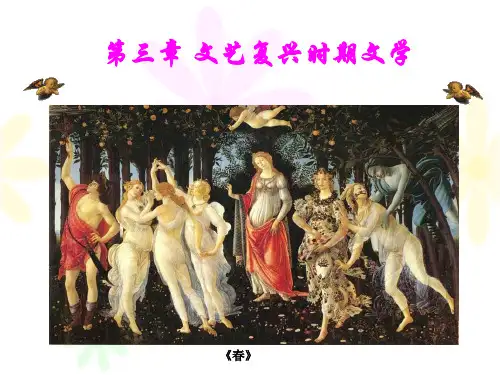
外国文学第三章 文艺复兴时期文学

法国文艺复兴运动的特点
• 文艺复兴运动部分地得到了王权的支持。
国王弗朗索瓦一世在人文主义者毕代的建议下,于 1530年建立法兰西学院,以研究希腊语、拉丁语和希 伯莱语为主,并批准印行希腊文书籍。法兰西学院与 教会控制的巴黎大学呈分庭抗礼之势。 弗朗索瓦的姐姐玛格丽特•德•那伐尔(1492-1549)支 持人文主义者和胡格诺教派。著有模仿《十日谈》的 《七日谈》。她的宫苑成了受教会迫害的人文主义者 和新教徒的避难所。
文艺复兴时期法国文学
龙沙
“法国第一位近代抒情诗人” 主题多写爱情 《致爱兰娜的十四行诗》
待你到垂暮之年
待你到垂暮之年,夜晚,烛光下, 坐在炉火旁,边纺纱边饶线, 你吟诵我的诗,发出感慨万千: 当年我多美,龙沙赞美过我啊。 那时候你不用女仆传语递话, 她干活儿累得半睡半醒之间, 听到我的名字仍然安稳睡眠, 即使用动听词句赞颂你也罢。 我将长眠地下,成为无骸幽灵, 在爱神木的树阴下歇息安定; 你则是一个蛰居家中的老妪, 怀念我的爱情,悔恨你的倨傲。
“一部完整的民间文化的百科全书”
夸张讽刺的手法;拉伯雷式的讽刺
自我意识
文艺复兴时期,西方资产 阶级肯定人的自我意识,在 《巨人传》中表现得最充分。 巨人们自觉抒发自我,表现自 我,做全面发展的理想人。
西方自我意识的发展: 古希腊: 表现人体美 中世纪: 宗教良心感
文艺复兴:歌颂理想的“人”
文艺复兴“是一个需要巨
蒙田(1533-1592)
• 16世纪下半叶法国著名的思想家、散 文家。著有《随笔集》三卷。蒙田具有怀 疑论思想。阐明了新兴资产阶级对各种事 物的看法。他主张“只有怀疑才能够判断 和论定”,不要说“我懂得”,而要说 “我懂得什么呢?” • “生活的哲理” • “我有何知” • 享受生活
The Renaissance英国文学文艺复兴时期总结

The RenaissanceThis is a greatest and most advanced revolution in the human history. This is the age the giants are needed and produced.------F. Engles<1> Brief introduction▪Renaissance in European history, refers to the period between 14th century to 17th century. It started in Italy and ended in England and Spain.▪“Renaissance” means “revival”, the revival of interest in Ancient Greek and Roman culture and getting rid of conservatism in feudalist Europe and introducing new ideas that express the interests of the rising bourgeoisie.▪Renaissance sprang first in Italy (Florence and Venice) with the flowering of paintings, sculpture and architecture, and gradually spread all over Europe;▪Renaissance originally indicated a revival of classical arts and science (ancient Greek and Roman culture) after the dark ages of medieval obscurantism.During the period of Renaissance:1. the Roman Catholic Church was shaken,2. old sciences revived and new sciences emerged,3. national languages and cultures took shape,4. art and literature flourishedBrief introduction▪There arose an interest in the manuscripts surviving from ancient Greece and Rome. Classical learning and philosophy were enthusiastically studied.▪The intellectual wisdom of ancient Greece and Rome encouraged a rebirth of human spirit,a realization of human potential for development and creation.▪Never before in human history were men and women so eager to create and discover something new.In Italy a group of artists,scientists,politicians,and writers created the most brilliant page of culture and science in Renaissance Europe.Examples:①Copernicus (哥白尼) asserted that the earth was not the center of the universe;②The passionate Petrarch produced sonnets that influenced Shakespeare and many others;③Boccaccio(卜伽邱) wrote tales of eternal charm: The Decameron;④Marco Polo (马可波罗) made journeys into the remote kingdom of China;⑤Michelangelo(米开朗琪罗),Leonardo da Vinci (达芬奇),Raphael (拉斐尔),and Titian (提香) createdpaintings and sculptures that are invaluable treasures of the world.<2>Essence and features▪Essence: It is the reflection of the rise of bourgeoisie in the sphere of cultural life.(另版本):Renaissance, in essence, is a historical period in which the European humanist thinkers and scholars made attempts to:to get rid of conservatism in Feudalist Europe;to introduce new ideas that expressed the interests of the rising bourgeoisie,to lift the restrictions in all areas placed by the Roman church authorities.Briefly it is the reflection of the rise of bourgeoisie inthe sphere of cultural life.▪Features: there are two striking features①A thirsting curiosity for the classical literature.②The keen interest in the activities of humanity.<3>Renaissance and HumanismRenaissance: the term originally indicated a revival of classical arts and science after the dark ages of medieval obscurantism. Indeed, a great number of the works of classical authors were translated into English during the 16th century.Humanism:The progressive thinkers of the humanists held their chief interest not in ecclesiastical knowledge, but in man, his environment and doings and bravely fought for the emancipation of man from the tyranny of the church and religious dogmas.Humanism is the key-note of the Renaissance. It reflected the new outlook of the rising bourgeois class;<4>HumanismHumanism is the essence of the Renaissance. It sprang from the endeavor to restore a reverence for the Greek and Roman civilization based on the conception that man is the measure of all things.Contrary to the subordination of individuals to the feudal rules and the sacrifice of earthly life for a future life in the medieval society, Renaissance humanists found in the classics a justification to exalt human nature and came to see that human beings were glorious creatures capable of individual development for perfection.By emphasizing the dignity of human beings and the importance of the present life, they voiced their beliefs that man did not only have the right to enjoy life, but had the ability to perfect himself and to perform wonders.<5>Features of humanism in RenaissanceEmphasizing the power, value and dignity of the human being and holding that human beings are glorious creatures The core of Renaissance thought is the greatness of man/giants. This is best summarized in the lines of Shakespeare’s HamletWhat a piece of work is man; how noble in reason; how infinite in faculty, in form and moving how express and admirable; in action how like and angel; in apprehension how like a god! The beauty of the world, the paragon of animals.人是一件多么了不起的杰作!多么高贵的理性!多么伟大的力量!多么优美的仪表!多么文雅的举动!在行为上多么像一个天使!在智慧上多么想一个天神!宇宙的精华!万物的灵长!▪1. Emphasizing secular happiness and individualism against the medieval ideas of asceticism;▪2.shifting man’s interest from Christianity to humanity, from religion to philoso phy, from beauty and greatness of God to the beauty of human body in all its joys and pains.▪3. Applying Aristotle’s theory, Humanist literature mainly use realistic style and take literature as the mirror or miniature of the society.<6>Influence and English RenaissanceInfluences:1.These Italians, and many others, helped to make Italy the center of the Renaissance movement in Europe.2.The movement changed the medieval Western Europe into a modern one.3.The intellectual wisdom of ancient Greece and Rome encouraged a rebirth of human spirit,a realization of human potential for development and creationEnglish Renaissance:Oxford Reformers: the Oxford reformers, scholars and humanists introduced classical literature to England. Education was revitalized and literature became more popular.This was England’s Golden Age in literature. There appeared many English literary giants such as Shakespeare, Spenser, Johnson, Sidney, Marlowe, Bacon and Donne.English RenaissanceContents●I.TheSixteenthCentury England ●II. Renaissance in England ●III. The main artistic styles●IV. William Shakespeare●V. Francis BaconI. The Sixteenth Century England1. Enclosure Movement2. The establishment of absolute monarchy3. Religious reformation4. International situation5. Cultural preparati●The background of the humanism in Europe●The introduction of printing led to an enlarged reading public and a commercial market for literature;●The great economic and political changes led to the rise of democracy;●The spirit of nationalism;●The growing of "new science” etc.Characteristics of the Elizabethan Age1. An age of comparative religious tolerance;2. An age of comparative social contentment;3. An age of dreams, of adventures, of unbounded enthusiasm;4. An age of intellectual liberty, of growing intelligence and comfort among all classes and of unbounded patriotism.II. Renaissance in England▪The time: mainly from the reign of Henry VIII, Edward, Mary and then to Queen Elizabeth and Jacobean Eraa. Beginning: the last years of the 15-th century---first half of the 16-th centuryb. Flourishing: the Elizabethan Age (1558-1603)c. Declining: the period of James I (1603-1625) early 17-th centuryThe flowering of English literatureThe second half of the 16th century, “a nest of singing birds”The early period:imitation and assimilation, translated works, poetry and poetic drama were the most outstanding literary forms. ▪Sonnet: an exact form of poetry in 14 lines of iambic pentameter intricately rhymed.▪Blank verse: iambic pentameter unrhymedThe latter period:Drama— the real mainstream of the English Renaissanceyears 1587-93. they were all of humble birth and struggled for a livelihood by writing. Through hard work, they revised old plays and wrote new ones. They made rapid progress in dramatic techniques because they has close contact with the actors and audiences. They were looked down upon by the gentlemen and suspected by the government. It was their industrious works that furnished the Elizabethan stage.Christopher MarloweWilliam ShakespeareIII. The main artistic stylesThe artistic styles as lyric poetry, narrative poetry, drama are maturized; new styles which characterized the modern literature such as sonnets, short stories and novels were produced.translation:Ovid’s Metamorphoses, Homer’s Iliad, Montaigne’s Essays▪travel books:More’s Utopia▪poetry: Edmund Spenser▪drama: “University Wits”, Marlowe, Shakespeare▪essay: Francis BaconForerunner of utopian socialism▪An imaginative travel narrative written in the form of conversation between More and Hythloday, a returned voyager describing an ideal state governed by reason.▪The subject is the search for the best possible form of government: Utopia---a community of property---a pure, pre-Marx form of communism.The Sheph erd’s Calendar 《牧人日历》: 12 pastoral poems and eclogues, one for each month, put into the mouths of speakers distinguishing themselves as shepherds, really representing Spenser and his friends.▪Amoretti《爱情小诗》:a series of 88 sonnets in honor of his lover Elizabeth. All except one was written in the Spenserian sonnet.▪Epithlamion 《婚后曲》: marriage hymns to celebrate his marriage with Elizabeth.The Faerie Queene《仙后》:▪The blending of religious and historical allegory with chivalric romance: a long poem planned 12 books. 12 knights for the qualities of the chivalric virtues--- the six completed books are holiness, temperance, chastity, friendship, justice and courtesy.Fairy Queen—Queen Elizabeth, the knights as a whole --- England, the evil figures—enemies.Themes of the poem :●nationalism( celebration of Queen Elizabeth)●humanism (strong opposition to Roman Catholicism),●Puritanism (moral teaching)Spenserian stanza:it is a nine-line stanza with the first 8 lines iambic pentameter and the ninth, iambic hexameter 六步格的诗rhyming abab,bcbc,c which is the typical verse in The Faerie Queene.For its rare beauty, this verse form was much used by many later poets, esp. imitated by the romantic poets of the 19th century.Spenser’s position in English Literature:the publica tion of “The Shepherd’s Calendar” marks the budding of Renaissance flower in the northern island of England.The language he used was modern English which has distinguished itself from the Middle English of Chaucer's day. Spenserian stanza: a model of poetic art among the Renaissance English poets.“the poet’s poet”, the first master to make the Modern English the natural music of his poetic effusion and held his position as a model of poetic art. His influence can be traced in the works of Milton, Shelley and Keats.Life: short but riotous⏹Major works:➢Tamburlaine the Great:《帖木耳》•A drama in a blank verse•About the rise and fall of Tamburlaine the Mongol conqueror on the 14th century central Asia.•A tragedy about a man who thinks he can but actually can not control his own fate.•By depicting a great hero with high ambition and sheer brutal force, the author voiced the supreme desire of the man of the Renaissance for infinite power and authority.•➢The Jew of Malta:《马耳他的犹太人》•A study of the lust for wealth, which centers around Barabas the Jew, an old money lender, whose only philosophy is the art of gaining advantage.•Suggestive of Shylock in Shakespeare’s The Merchant of Venice.•A tragic result: typically greedy of riches and gold, which is another feature shared by those in Renaissance England. •➢The History of Doctor Faustus 《浮士德博士》•Refer to compare with Goethe’s Faust•The Faust myth in 16th century Germany: the myth of men seeking great earthly power from demons at the cost of their immortal soul.•The conventional view: Dr. Faustus is a morality play that vindicates humility, faith and obedience to the law of God. •The new view: Dr. Faustus celebrates the human passion for knowledge, power and happiness, and also reveals man’s frustration in realizing the high aspiration in a hostile moral order.⏹Social significance and literary achievement1.showing the spirit of the rising bourgeoisie. Its eager curiosity for knowledge, power and gold.The praise of individuality freed from the restraints of medieval dogmas and the conviction of the boundless possibility of human efforts in conquering the universe.The heroes are mainly individualists. Their individualistic ambition often brings ruin to the world and to themselves.…soul of the Age!The applause! Delight! The wonder of our stage! Triumph, my Britain, thou hast one to show To whom all scenes of Europe homage owe. He was not of an age, but for all time!William Shakespeare1. Brief Introduction2. Shakespeare’s dramaFour periods of his literary career Categories of his drama 3. the artistic features of his plays4. Shakespeare’s place and contribution5. Shakespeare’s sonnetsWhat to be at least known about ShakespeareLife: birthplace, birth date, death date, important time in his life and career●His major works: 37 plays(10histories, 10 comedies, 10 tragedies), 2 long narrative poems, 154 sonnets.Plays to be read: great comedies & 4 great tragedies●Writing features in each of four periodsI. Brief IntroductionA dramatist “not of an age, but of all time” by Ben Jonhson, not of Engla nd, but of the world.●Not only a master of English language but also a genius of character portrayal and plot construction●A “poet of reality” for his idea that literature should reflect nature and reality.●37 plays, 154 sonnets and 2 long poems.II. Shak espeare’s dramaFour Periods of Shakespeare’s Literary careerFour major phrases represent respectively his early, mature, flourishing and late periods.1. Period of early experiment and apprenticeship (1590-1594)Background:A. it was in the middle of the highly thriving Elizabethan Age.B. The thoughts of humanism and the ideas of man’s emancipation, freedom of love was rapidly spread.C. Shakespeare was a young man full of astonishing versatility and wonderful talent and the great interest in the political questions of his time.Features:A. the writer made experiments in a number of dramatic forms: the historical plays, comedy, the revenge tragedy and the romantic tragedy.B. this period is distinctively marked by youthfulness and exuberance of imagination, by extravagance of witty language or speech, and by the final and frequent use of blank verse. In his hand, blank verse developed into a happy vehicle to express all kinds of thoughts and emotions (thus shaking off the rigidity of rimed and mechanic lines) .2. Period of maturity (1595-1600)Features:A. a period of “great comedies” and mature historical plays and sonnets.B. a sweet and joyful time when the writer portrays successfully a magnificent panorama of the manifold pursuit of people in real life.C. a great shift in characterization. A notable gallery of heroines in the comedies and vivid characters in historical plays is presented: Portia, Posalynd, Voila, Beatrice, Sir John Falstaff.3. Period of gloom and depression (1601-1607)Background:A. the aggravation of the social situation: the rising of peasants, the corruption, the tension between bourgeoisie and the feudal lands.B. the change of mood in the playwright: gloomy and indignantFeatures:A. a period of “great tragedies” and “dark comedies”B. the writer gave a scathing exposition of the somber pictures and scenes of murder, lust, treachery, ingratitude and crime.C. a higher level of crafts is reached: more intricate plotting, intense inner conflict, meticulous depiction of human mind.4. Period of calm and reconciliation (1608-1612)Background:A. the fall and collapse of absolute monarchB. the retirement of the playwright back into the tranquil countrysideFeatures:A. some serenity and optimism, instead of the beginning lightness and the middle somber violence reigned.B. romantic dramas and comedies were the main form.C. moral teaching and supernatural forces were relied on to restore the rightful honor and position. These plays all show a falling off from his previous works.Categories of his dramacomedies histories tragedies romances??Comedy is a light form of drama aiming primarily to amuse and ending happily. It often deals with people in their human state, restrained and ridiculous by their limitations, faults, bodily functions.Four Great ComdiesThe Merchant of VeniceA Midsummer Night’s DreamAs you Like itTwelfth NightComedies of the First PeriodThe keynote of his comedies:●to portray people just freed from the feudal fetters, sing of youth, love and ideas of happiness.●The heroes and heroines fight against destiny and mould their fate according to their own free will. Thus becomethe sons and daughters of Renaissance.●The victory of humanist ideal is inevitable. The general spirit of these plays is optimistic.The Merchant of Venice•The double plot: one is about the Bassanio’s winning of a bride by undergoing a test; the other is about the demanding of a pound of human flesh by Shylock.•The traditional theme is to praise the friendship between Antonio and Bassanio, to idealize Portia as a heroine of great beauty, wit and loyalty and to expose the insatiable greed and brutality of the Jew.•The new one is to regard the play as a satire of the Christian hypocrisy and their false standards of friendship and love, their cunning ways of pursuing worldliness and unreasoning prejudice against Jews.Portia: a rich heiress of Belmont in Shakespeare's comedy The Merchant of Venice.●1. Portia is a woman of Renaissance—beautiful, prudent, cultured, courteous and capable of rising to an emergency. She is one of Shakespear’s ideal women.●2. the young heroes in Shakespeare's comedies are always independent in character and take their own path of life.History plays aim to present some historical age or character, and may be either a comedy or a tragedy.●His histories include two tetralogies (四部曲)and two other plays. Characterizes two centuries of English history from Richard III to Henry VIII (1377-1547)●There is only one ideal king---Henry V who represents the aspiration for national unity under a powerful and efficient monarchy.The image of Henry V:Henry V is the symbol of Shakespear’s ideal kingship. He represents the upsurging patriotism of the time. In depicting Henry V as a prince and as a man, Shakespeare looks deep into the personality of his hero and shows a profound understanding of the politics and social life of the time.Theme: Shakespeare’s historical plays describe the decaying of the old feudal society an d the rising of the new forces. His historical plays sum up the necessity for national unity under a mighty and just sovereign. The idea is anti-feudal inIt is concerned with the harshness and injustice of life. They are often serious plays with sad endings.●Often the hero’s tragedy is due to a weakness in his or her character which brings self-destruction. A weakness such as the excessive pride of Faustus, the overweening ambition of Macbeth, or the uncontrolled jealousy of Othello.●In S hakespeare’s plays, he saw sharp contradictions between his lofty humanistic ideals and the evil social forces. Background for Shakespeare’s tragediesHe began to observe life with penetration, to expose mercilessly the contradiction of the Elizabethan society. The economical and social crisis which began at the end of the reign of Queen Elizabeth continued right up to the English Revolution.The bourgeoisie intended to break up the yoke of absolute monarchy and struggled for free development.It was in this atmosphere of general unrest that he created his great tragedies.Four Great Tragedies All analyzing the human wickedness.●Hamlet: the hero’s weakness makes him vulnerable in fighting against the outward evil.●Othello shows how an outward evil make s use of the hero’s weakness and causes his fall.●King Lear demonstrates how man’s mistake sets free the evils of treachery, hypocrisy, flattery, selfishness and distrust.●Macbeth reveals how the outward evil stirs up the wickedness in man and destroys him.Hamlet“Hamlet” is considered the summit of Shakespeare's art.Hamlet is a man of genius, highly accomplished and educated, a man of profound perception and sparkling wit. He is a scholar, soldier and statesman all combined. His image reflects the versatility of the man of Renaissance.Hamlet’s melancholy is not the negative, over-subtle and fruitless kind, it is the result of his penetrating mind. It expresses, in away, the crisis of humanism at the end of the 16th and the beginning of the 17th century.III. the artistic features of his plays1. Characterization: By using comparison and contrasts, he depicts a group of individuals with strong and distinct personalities.The melancholy of Hamlet, the wickedness of Claudius and Iago, the honesty of Othello, ambition of Macbeth and the beauty and wit of Portia.2. Psycho-analytical study: He reveals the intricate inner workings of the character’s minds through the full use of soliloquies(独白).3. Structure:⏹His plays usu. have more than one plot. Through contrast and parallel, the major and minor plots are woven intoan organic whole.⏹the device of a play within the play also plays an important part.4. Language: Shakespeare is a master of the English language, with a large vocabulary of 16000 English words. More important are the figurative speeches such as analogy and metaphor.5. style: realistic style. The reader may be impressed by the typical speech modes —the question in Hamlet, the ambiguities in Macbeth, the exclamations and very simple but also very basic questions in King Lear.IV. Shakespeare’s place and contributionOne of the founder of realism in world literature. Living in the historical period of the transition from feudalism to capitalism, he paints a panorama of the decline of the old feudal nobility and the rise of new bourgeoisie.Amazing prolificacy. In 22years, nearly 40 plays, no two of which evoke the same feeling or image among the audience, a master of every forms of drama.Skilled in many poetic forms. The songs, sonnets, couplets, esp. at home with blank verse, which became a vehicle of utterance to all the possible sentiments of his characters.A great master of English language. He has an amazing wealth of vocabulary and idiom. He is known to have used 16,000 different words. His coinage of new words and distortion of the meaning of the old ones also create striking effects on the reader.He was universally regarded are the summit of English Renaissance. His influence on later writers is immeasurable. Almost all English writers after him have been influenced by him either in artistic point view, in literary form or in language.SonnetDefinition:▪A sonnet is a fourteen-line poem in iambic pentameter with a carefully patterned rhyme scheme.Origin:▪A form of lyrical poetry was originated in Italy. “sonnet” was derived from Provencal (普罗旺斯语) “Sonet”. It was once a short popular poetry used for singing in the medieval age.▪Italian poet Petrarch was the major representatives of the poets who used this poetic form. He wrote altogether 375 sonnets, dedicated to his lover. That is the Petrarchan sonnet.▪Sonnet was introduced into England by Thomas Wyatt . It flourished in the 1590s and reach its peak of popularity with the surge of Renaissance in England.Two types of sonnetThe Italian, or Petrarchan sonnet :Petrarchan Sonnet▪The Italian form, in some ways the simpler of the two, Its fourteen lines break into an octave (八行诗)(or octet), which usually rhymes abba,abba, and a sestet (六行诗节), which may rhyme cdecde or cdcdcd, or any of the multiple variations possible using only two or three rhyme-sounds.▪It usually projects and develops a subject in the octave, then executes a turn at the beginning of the sestet, which means that the sestet must in some way release the tension built up in the octave.▪Example: see Wyatt's "Farewell Love and all thy laws for ever."Farewell, LoveSir Thomas Wyatt (1503~1542)Farwell, Love, and all thy laws forever,Thy baited hooks shall tangle me no more;Senec and Plato call me from thy lore,To perfect wealth my wit for to endeavor,In blind error then I did persever,Thy sharp repulse, that prickth aye so sore,Hath taought me to set in trifles no storeAnd’ scape forth since liberty is leverTherefore farewell, go trouble younger hearts, And in me claim no more authorityWith idle youth go use thy property,And therein spend thy many brittle darts,For hitherto though I have lost all my time,Me lusteth no longer rotten boughs to climb.别了,爱,以及你所有的法则,你上饵的钩子不再能把我缠绞,塞内克与柏拉图叫我离开你那套,并尽我才智把完美的财富获得。
英国文学作品英汉对照

Chapter 1 文艺复兴时期I. Edmund SpenserEpithalamion 贺新婚曲The Faerie Queene 仙后选文为The Faerie QueeneII.Christopher MarloweTamburlaine 铁木耳转Dr. Faustus 浮士德悲剧The Jew of Malta 马乐他岛的犹太人Edward II 爱德华二世Hero and Leander 海洛与勒安德尔选文为Dr. Faustus ; The Passionate Shepherd to His LoveIII. William ShakespeareRape of Lucrece 鲁克斯受辱记Venus and Adonis 维纳斯与安东尼斯Titus Andronicus 泰托斯安东尼The Comedy of Errors 错误的喜剧The Two Gentlemen of Veroma 维洛那二绅士The Taming of the Shrew 驯悍记Love’s Labour’s Lost爱的徒劳Richard II 理查二世King John 约翰王Henry IV, Parts I and II, Henry VSix Comedies:A Midsummer Night’s Dream 仲夏夜之梦The Merchant of Venice 威尼斯商人Much Ado About Nothing 无事无非As You Like It 皆大欢喜Twelfth Night 第十二夜The Merry Wise of Windsor 温莎的风流娘儿们Two Tragedies:Romeo and Juliet 罗米欧与朱丽叶Julius Caesar 凯撒HamletOthelloKing LearMacbethAntony and Cleopatra 安东尼与克里佩特拉Troilus and Cressida, and Coriolanus 特洛伊勒斯与克利西达All’ Well That Ends Well (comedy) 终成成眷属Measure for Measure (comedy) 一报还一报Pericles 伯里克利Cymbeline 辛白林The Winter’s Tale冬天的故事The Tempest 暴风雨Henry VIIIThe Two Noble Kinsmen两位贵族亲戚选文为Sonnet 18; The Merchant of Venice; HamletIV. Francis BaconThe Advancement of Learning 论科学的价值与发展Novum Organum 新工具Apophthagmes New and Old 新旧格言录The History of the Reign of Henry VIIThe New Atlantis 新大西岛Maxims of Law 法律原理The Learning Reading upon the Statute of Uses法令使用读书选文Of StudiesV. John DonneThe Elegies and Satires 挽歌与十四行诗The Songs and Sonnets 歌谣与十四行诗Holy Sonnets 圣十四行诗A Hymns to God the Father 给圣父的赞美诗选文The Rising Sun; Death Be Not ProudVI. John MiltonParadise Lost 失乐园Paradise Regain 复乐园Samson Agonistes力士参孙Lycidas 利西达斯Areopagitica 论出版自由Chapter 2 新古典主义时期I. John BunyanThe Pilgrim’s Progress 天路历程Grace Abounding to the Chief of Sinners 罪人头目的赫免The Life and Death of Mr. Badman 拜德门先生生死录The Holy War 圣战选文The Vanity Fair (from the The Pilgrim’s Progress)II. Alexander PopeThe Dunciad 群愚史诗An Essay on Criticism 论批评The Rape of the Lock 夺发记选文An Essay on CriticismIII. Daniel DefoeRobinson Crusoe 鲁宾逊漂流记Captain Singleton 辛立顿船长Moll Flanders 莫尔弗兰德斯Colonel Jack 杰克上校A Journal of the Plague Year 灾疫之年的日记Roxana 罗克萨那选文Robinson CrusoeIV. Jonathan SwiftA Tale of Tub 木桶传The Battle of the Books 书籍的战斗Gulliver’s Travels 格列弗游记A Modest Proposal 一个小小的建议The Drapier’s Letters 布商的书信选文Gulliver’s TravelsV. Henry FieldingThe Coffee House Politician 咖啡屋的政治家The Tragedy of the Tragedies 悲剧中的悲剧The Historical Register for the Year 1736 1736历史年鉴The History of the Adventures of Joseph Andrews and of his friend Mr. Abraham Adams, Written in Imitation of the Manner of CervantesThe History of Jonathan Wild the Great 大伟人江奈生翻乐德传The History of Tom Jones, a Foundling 汤姆琼斯The History of Amelia 阿米亚选文为Tom JonesVI. Samuel JohnsonPoems:LondonThe Vanity of Human Wishes 人生希望多空幻The History of Rasselas, Price of Abyssinia (a romance)阿比西尼亚王子的故事Irene (a tragedy) 艾琳The Ramble and The Idler 漫游者和闲散者Lives of PoetsA Dictionary of the English Language选文To the Right Honorable the Earl of ChesterfieldVII. Richard Brinsley SheridanThe Rival 情敌The School for Scandal 造谣学校St. Patrick’s Day圣特帕里克节日Scheming Lieutenant 诡计多端的中尉The Duenna 少女的监护人The Critic 批评家Pizarro 比扎罗选文The School for ScandalVIII. Thomas GrayElegy Written in a Country Churchyard 写在教堂墓地的挽歌Ode on a Spring 春之颂Ode on a Distant Prospect of Eton College 伊顿远眺Ode on the Death of a Favourite Cat 爱猫之死颂Hymn to Adversity 逆境颂选文Elegy Written in a Country ChurchyardChapter III 浪温主义时期I. William BlakePoetic Sketches 诗歌扎记The Songs of Innocence 天真之歌The Songs of Experience 经验之歌Marriage of Heaven and Hell 天堂与地狱联姻The Book of Urizen 尤里曾的书The Book of Los 洛斯的书The Four Zoas 四个成熟的个体Milton 弥尔顿选文The Chimney Sweeper (from Songs of Innocence); The TygerII. William WordsworthLyrical Ballads (抒情歌谣集)The PreludeThe ExcursionWorshipper of Nature (The Sparr,w’s Nest, To a Skylark, To the Cuckoo, To a Butterfly,I Wandered Lonely as a Cloud, An Evening Walking, My Heartn Leaps up, Tintern Abbey)选文:I Wandered Lonely as a Cloud, Composed upon Westminster Bridge, She Dwelt Among the Untrodden Ways, The Solitary ReaperIII. Samuel Taylor ColeridgeLyrical BalladsThe Rime of the Ancient Mariner (古舟子咏)Kubla Khan (忽必烈汗)This Lime Free Bower My Prison (酸橙树亭------我的监牢)Frost at Midnight 午夜霜The Nightingale 夜莺Biographia Literaria 文学传记选文Kubla KhanIV. George Grodon ByronHours of Idleness 闲散的时光Childe Harold’s Pilgrimage恰尔德哈罗德游记Oriented Tales 东方化的传奇The Prisoner of Chillon 锡庸的囚徒Manfred 曼弗雷德Don Juan 唐璜Cain 该隐The Island 岛屿The Vision of Judgment 审判的想象选文Song for the Luddites ; The Isles of Greece (from Don Juan)V. Percy Bysshe ShelleyThe Necessity of Atheism 无神论的必要性Queen Mab: A Philosophical Poem 仙后麦布Alastor, or The Spirit of Solitude 复仇者或隐居者的精神Julian and Maddalo 朱利安与麦达格The Revolt of Islam 伊斯兰的反叛The Cenci 钦契一家The Prometheus Unbound解放了的普罗米修斯Adomais 阿多尼斯Hellas 海娜斯A Defense of Poetry 诗之辩护选文A Song: Men of England; Ode to the West WindVI. John KeatsOn First Looking into Chapman’s HomerEndymionLamia, Isabella, The Eve of St. Agens, and Other Poems (Ode on Melancholy, Ode on a Grecian Urn, Ode to a Nightingale, Ode to Psyche)Lyric masterpiece (To Autumn, Hyperion)选文Ode on a Grecian UrnVII. Jane AustenSense and Sensibility 理智与情感Pride and Prejudice 傲慢与偏见Northanger Abbey 诺桑觉寺Mansfield Park 曼斯菲尔德花园Emma 埃玛Persuasion 劝导The Watsons 屈陈氏一爱Fragment of a Novel 小说的片断Plan of a Novel 小说的计划选文Pride and PrejudiceChapter IV. 维多利亚时期I. Charles DickensSketches by Boz 博兹特写集The Posthumous of the Pickwick Club 皮克威克外传Oliver Twist 雾都孤儿Nicholas Nickleby 尼古拉斯尼克尔贝The Pickwick Paper 皮克威克外传David Copperfield 大卫科波菲尔Martin Chuzzlewit 马丁朱尔述维特Dombey and Son 董贝父子A Tale of Two Cities 双城记Bleak House 荒凉山庄Little Dorrit 小杜丽Hard Times 艰难时世Great Expectations 远大前程Our Mutual Friends 我们共同的朋友The Old Curiosity Shop 老古玩店选文为Oliver TwistII. The Bronte SistersPoem by Currer, Ellis, and Acton Bell (Charlotte, Emily, Anne)The Professor (Charlotte) 教师Jane Eyre (Charlotte) 简爱Wuthering Heights (Emily) 呼啸山庄Agnes Grey (Anne) 格雷The Tenant of Wildfell Hall (Anne)野岗庄园房客选文Jane Eyre by Charlotte Bronte, Wuthering Heights by Emily BronteIII. Alfred TennysonPoems by Two Brothers 两兄弟诗集Poems, Chiefly Lyrical 诗集,主要是抒情诗Poems 诗集The Princess 公主In Memoriam 悼念Idylls of the King 国王叙事集选文Break,Break,Break, Crossing the Bar, UlyssesIV. Robert BrowningPauline 波琳 Sordello 索尔戴洛Dramatic Lyrics 戏剧抒情诗Dramatic Romances and Lyrics 戏剧罗曼史和抒情诗Bells and Pomegranates 铃铛与石榴Men and Women 男人与女人Dramatic Personae 剧中人The Ring and the Book 指环与书Dramatic Idylls 戏剧田园诗选文My Last Duchess, Meeting at Night, Parting at MorningV. George EliotScenes of Clerical Life 教区生活场景Adam Bede 亚当比德The Mill on the Floss 弗洛斯河上的磨坊Romola 罗慕拉Felix holt, the Radical 激进分子菲尼克斯霍尔特Middlemarch 米德尔马契Daniel Deronda 但尼尔狄隆达选文MiddlemarchVI. Thomas HardyTess of the D’Urbervilles苔丝Jude the Obscure 无名的裘德The Dynasts 列后The Return of the Native 还乡The Trumpet Major 号兵长The Mayor of Casterbridge 卡斯特桥市长The Woodlanders 林地居民Under the Greenwood 林间居民Far from the Madding Crowd 远离尘嚣选文Tess of the D’Urbervill esChapter 5 现代主义时期I. George Bernard ShawCashel Byron’s Profession 卡歇尔拜伦的职业Our Theaters in the Nineties 90年代的英国戏剧Widower’s Houses 鳏夫的房产 Candida 堪迪达Mrs. Warren’s Profession 沃伦夫人的职业Caesar and Cleoptra 凯撕与克利奥佩特拉 St. Joan 圣女贞德Back to Methuselah 回归玛士撒拉 Man and Superman人与超人John Bull’s Other Island 约翰布尔的另外岛屿 Pygmalion 茶花女Getting Married 结婚 Misalliance 不合适的媳妇Fanny’s First Play 范尼的第一部戏剧The Doctor’s Dilemma医生的困境Too True to be Good 难以置信选文Mrs. Warren’s ProfessionII. John GalsworthyFrom the Four Winds 来自四位吹奏者The Man of Property 财主 The Silver Box 银盒The Forsyte Saga弗尔赛特三部曲 ( The Man of Property, In Chancery 骑虎难下, To Let 出租)A Modern Comedy 现代喜剧 End of the Chapter 篇章未尾选文The Man of PropertyIII. William Butler YeatsThe Lake of Innisfree 伊尼斯岛 Sailing to Byzantium 驶向拜占庭The Countess Cathleen 女伯爵凯瑟琳 Cathleen ni Houlihan 故里痕的凯瑟琳The Land of Heart’s Desire 心里渴望的地方 The Shadowy Waters 浅水区Purgatory 炼狱选文The Lake of InnisfreeIV. T. S. EliotThe Love Song of J. Alfred Prufrock 布鲁富劳克的情歌The Waste Land 荒园 Murder in the Cathedral 教堂里的谋杀The Family Reunion 家人团聚 The Confidential Clerk 机要秘书The Statesmen 政治家 The Cocktail Party鸡尾酒会选文The Love Song of J. Alfred PrufrockV. D. H. LawrenceSons and Lovers 儿子与情人 The White Peacock白孔雀The Trespasser 过客 The Rainbow彩虹Women in Love 恋爱中的女人Aaron’s Rod亚伦神仗Kangaroo 袋鼠 The Plumed Serpent带羽毛的蛇Lady Chatterley’s Lover St. Mawr 圣摩尔The Daughter of the Vicar 主教的女儿The Horse Dealer’s Daughter贩马人的女儿The Captain’s Doll 般长的娃娃 The Prussian Officer 普鲁士军官The Virgin and the Gypsy贞女和吉普塞人Trilogy(A Collier’s Friday Night, 矿工周五的夜晚The Daughter-in-law,儿媳 The Widowing of Mrs. Holroyed 守寡的霍尔伊德夫人选文Sons and LoversVI. James JoyceDubliner 都柏林人 A Portrait of the Artist as a Young Man青年艺术家的自画像Ulysses 尤利西斯 Finnegans Wake 为芬尼根守灵选文Dubliner美国文学I. Washington IrvingA History of New York form the Beginning of the World to the End of Dutch Dynasty自古至荷兰占领为止的纽约史The Sketch Book of Geoffrey Crayon, Gent 见闻扎记Bracebridge Hall 布雷斯布里奇庄园Tales of a Travel 旅行者的故事The Legend of Sleepy Hollow 睡谷的传说选文Rip Van WinkleII. Ralph Waldo EmersonNature 论自然 Essay 散文集 The American Scholar 论美国学者Self-Reliance 论自信 The Over-Soul 论超灵选文NatureIII. Nathaniel HawthorneMosses from an Old Manse古宅青苔The Snow-Image and Other Twice-Told Tales 雪像和其他故事新编The Scarlet Letter 红字The House of Seven Gables 七个尖角阁的房子The Blithedale Romance 福谷传说 The Marble Faun 大理石雕像选文Young Goodman BrownIV. Walt WhitmanLeaves of Grass选文There Was a Child Went Forth, Cavalry Crossing a Ford, Song of MyselfV. Herman MelvilleTypee 泰比 Omoo 奥穆 Mardi 玛迪Redburn 雷德本 White Jacket 白外衣 Pierre 皮埃尔Confidence-Man 信心人 Moby-Dick 白鲸Billy Budd 比利伯德选文Moby-DickChapter 2 现实主义时期I. Mark TwainAdventures of Huckleberry FinnLife on Mississippi The Celebrated Jumping Frog of Calaveras County Innocent Abroad 傻瓜出国记 Roughing It 含莘如苦The Adventures of Tom Sawyer The Gilded Age 镀金时代A Connecticut Yankee in King Arthur’s Court 亚瑟王宫庭中的美国佬The Tragedy of Pudd’nhead Wilson傻瓜威尔逊The Man That Corrupted Hadleyburg 败坏哈德莱堡的人The Mysterious Stranger 神秘的陌生人选文Adventures of Huckleberry FinnII. Henry JamesThe American 美国人 Daisy Miller 黛西米勒 The European 欧洲人The Protrait of A Lady 贵妇人的画像 The Bostonians 波士顿人Princess Casamassima 卡撒玛西公主 The Private Life 私生活The Middle Years 中年 The Turn of the Screw 螺丝的拧紧The Beast in the Jungle 丛林猛兽 What Maisie Knows 梅西所知道的The Wings of the Dove 鸽翼 The Ambassadors 大使The Golden Bowl 金碗 The Death of a Lion 狮之死选文Daisy MillerIII. Emily DickinsonIf you were coming in the fallThere came a day Summer’s fullI cannot live with You I’m ceded-I’ve stopped being theirs选文This is my letter to the World, I heard a Fly buzz-when I diedI like to see it lap the MilesBecause I could not stop for deathIV. Theodore DreisererSister Carrie 嘉莉妹妹 Nigger Jeff 黑人杰夫Old Rogaum and His Theresa 老罗格姆和他的特里萨 Jennie Gerhardt珍妮姑娘Trilogy of Desire The Financier 金融家 The Genius 天才An American Tragedy 美国悲剧 Dreiser at Russia 德莱塞对俄罗斯的观感选文Sister CarrieChapter 3 现代主义时期I. Ezra PoundThe Cantos 诗章 Collected Early Poems of Ezra Pound 庞德的诗章Personae 人物 Cantos Hugh Selwyn Mauberley 休塞尔温莫伯利Make It New 要革新 Literary Essays 文学散文 The ABC of Reading 阅读入门Polite Essays 优雅的随笔The Translations of Ezra Pound 庞德译文集Confucius 孔子 Shih-Ching 诗集选文In a Station of the Metro, The River-Merchant’s Wife: A Letter, A PactII. Robert Lee FrostA Boy’s Will 一个男孩儿的愿望 North of Boston 波士顿以北 Mountain IntervalNew Hampshire 新罕布什尔 Snowy Evening 雪夜停马在林边 West-Running Brook 向西流去的小溪 Collected Poems 诗选 A Winter Tree选文After Apple-Picking, The Road Not Taken, Stopping by Woods on a Snowy Evening以III. Eugene O’NeillBound East for Cardiff 驶向东方的卡笛夫 Beyond the Horizon 天外边Straw Anna Christie The Emperor Jones 琼斯皇帝The Hairy Ape 毛猿All God’ s Chillun Got Wings 所有上帝的烟斗都有翅膀The Great God Brown 伟大之神布朗Long Day’s Journal Into Night 直到夜晚的漫长的一天 Desire Under the Elms 榆树下的欲望选文The Hairy ApeIV. F. Scott FitzgeraldThis Side of Paradise 天堂的这一边 Beautiful and Damned 美丽而遭骂的人The Great Gatsby Tender is the Night 夜色温柔The Last Tycoon 最后一个巨头 Flappers and Philosophers 吹捧者与哲学家Tales of the Jazz Age 爵士时代 All the Sad Young Men 所有悲惨的小伙子Taps at Reveille 拍打在起床鼓上 Babylon Revisited重返巴比伦选文The Great GatsbyV. Earnest HemingwayIn Our Time 在我们的时代 A Farewell to Arms 永别了,武器For Whom the Bell Tolls 丧钟为谁敲响 The Old Man and the Sea 老人与海Men Without Women 没有女人的男人 Death in the Afternoon 午后之死The Snows of Kilimanjaro 开利曼扎罗之雪 The Green Hills of Africa 非洲的青山选文Indian Camp (from In Our Time)VI. William FaulknerThe Marble Faun 玉石牧神 The Sound and the Fury 喧嚣与骚动As I Lay Dying 我弥留之际 Light in August 八月之光Absalom, Absalom 押沙龙!押沙龙! Wild Palms 疯狂的手掌The Hamlet 哈姆雷特 The Unvanquished 不可征服的Go Down, Moses 去吧,摩西 The Fable 寓言The Town 小镇 The Mansion 大厦Soldier’s Pay 士兵的报酬。
English literature III文艺复兴英国文学

The English Bible
❖ Ampart from its religious influence, the Authorized Version has had a great influence on English language and literature. About 93 percent of the 6,000 words used in it are the main words of native English. So with the widespread influence of the English Bible, the standard modern English had been fixed aqnd confirmed. A great number of Bible coinages and phrases have passed into daily English speech as householde words and are often used with no knowledge of their origin. So English Bible has woven its phrases and expressions into the texture of the English language, English literature and English life.
the Reformation
❖ She was shrewd and tactful to a fault. She made friends with the opposing sides of the religious conflict—Catholic Spain and Protestant France, and at home she set about uniting the divided country. She made the Church of England steer strictly the middle of the road, learning toward neither the Catholics nor the Protestants, and effectively practiced religious tolerance to the relife of the people. She encouraged learning and adventures and was a great patron of literature. As a result she was able to secure a 30-year period of peace for the country so that England slowly but steadily crawled to the zenith of wealth and power during her reign. When Francis Drake defeated the Spanish Armada in 1588, England became the first sea power in the world. This was the point at which the expansion of the British Empire began.
文艺复兴时期的文学.
后悔曾高傲的蔑视了我的爱。——听信我:生活吧, 别把明天等待,今天你就该采摘生活的花朵。
欧洲近代散文的创始人——蒙田
蒙田
蒙田故居
拉伯雷
法国文艺复兴时的“文艺巨匠”
代表作 《巨人传》作为法国早 期讽刺小说的名作。
《巨人传》1532-1564
由五部组成 三代巨人:
格朗古杰
卡冈都亚(高康大)
庞大古埃
• 长诗描写了十字军将士唐 克雷蒂与教女战士克洛琳 达的爱情幸福与悲剧
《被解放的耶路撒冷》插图
法国人文主义文学
法国的人文主义文学的显著特点是自始自终存 在着贵族与平民两种倾向。
以龙沙等七人组成的“七星诗社”,具有浓重 的贵族倾向;
蒙田是欧洲近代散文的创始人。他的《随笔集》 是法国第一部近代散文集。 拉伯雷是法国人文主义文学平民倾向的杰出代 表,其代表作是《巨人传》。
一、早期的人文主义文学
二、繁荣时期的文学
一、早期的人文主义文学
1、乔叟
1340-1400
英国诗歌之父,英国人文主义文学之父 成名作《悼念公爵夫人》 寓言叙事诗《众鸟之会》 爱情故事长诗《特罗勒斯与克丽西达》1385 代表作《坎特伯雷故事集》1387-1400
《坎特伯雷故事集》特点:
作品的思想精神和生活内容是英国社会的缩影 香客的故事体现了人文主义精神 体裁、样式丰富多样。共收入故事24篇,其中22 个诗体,2个散文体,每个故事有“ 小引”、 “ 开场白”和“ 收场语”串线组成
流浪汉的形象
《 小 癞 子 》 插 图
维加(1562—1635)
西班牙民族戏剧的代表,被 称为“ 西班牙戏剧之父” , 写过1800多部戏剧,流传下 来的完整剧本有400多部,内 容可分为袍剑剧、宗教剧、牧 歌剧、历史剧等。 代表作:《羊泉村》
约翰弥尔顿英国文艺复兴时期最伟大的诗人
约翰弥尔顿英国文艺复兴时期最伟大的诗人约翰弥尔顿(John Milton)是英国文艺复兴时期最伟大的诗人之一。
他生于1608年,逝世于1674年,一生的贡献和影响力在英国文学史上久负盛名。
弥尔顿以其杰出的作品《失乐园》(Paradise Lost)而闻名,该作品被公认为英国文学史上最伟大的叙事诗之一,也是世界文学的经典之作。
约翰弥尔顿的成就不仅仅体现在其作品的数量和质量上,还体现在他对英国文学发展的重要影响。
在他生活的时代,英国正经历文艺复兴,新的思想观念和文学形式不断涌现。
而弥尔顿正是这个时代的代表人物,他的作品和思想对后来的文学创作产生了深远的影响。
《失乐园》是约翰弥尔顿最为伟大的作品之一。
这部诗叙述了亚当和夏娃被驱逐出伊甸园的故事,同时也包含了对人类的原罪、对权力和自由的探索等深刻的哲学思考。
弥尔顿通过韵文和叙事结构的运用,展示了他卓越的语言表达能力和文学才华。
《失乐园》以其引人入胜的故事和复杂的主题深深吸引了读者,并在文学界产生了广泛的影响。
弥尔顿的作品不仅仅局限于诗歌领域,他还是一位杂文家和政治家。
他的政治观点和作品深受英国历史和社会的影响。
在他的杂文中,弥尔顿主张言论自由和思想自由,并积极参与到当时的政治讨论中。
他的政治立场和文化观点在当时是非常先进的,对英国的政治和文化发展起到了重要的推动作用。
约翰弥尔顿的诗歌风格独特,充满了对美和真理的追求。
他对诗歌的探索和创新,使他成为英国文学史上最重要的诗人之一。
他的作品通过优美的语言和深刻的思考,表达了对人类存在和命运的探索,体现了他对自由和正义的理想追求。
弥尔顿的诗歌作品一直被视为经典,对后世的诗人和文学创作都产生了深远的影响。
总结起来,约翰弥尔顿是英国文艺复兴时期最伟大的诗人之一。
他的杰出作品《失乐园》以其高超的诗歌技巧和深邃的思想充分展示了他的文学才华和创作才能。
而他的政治观点和杂文作品也对英国的政治和文化发展产生了重要影响。
弥尔顿的成就使他成为英国文学史上不可忽视的重要人物,他的作品将继续影响着后世的诗人和读者。
17世纪英国文学的主要成就及特点。
17世纪的英国文学是文艺复兴的延续和发展,我们称这个时期为传统和理性的时代。
这个时期的文学大多模仿古希腊罗马和当时法国的著作,追求理性,艺术形式的完美。
人文主义是当时的文学主流,它在思想上反对神权,封建制度,宣扬人性,赞美现世生活。
著名人物代表玛丽我司通克拉夫特就是当时的你才行政论家,作家和思想家。
她提出的女性并非天生低贱于男性,只有当她们取法足够的教育是才会显露出这一点引发了很多人的思考。
随着资本主义稳定发展,浪漫主义文学开始崛起。
这个时期的文学作品大多表达内心情感,反映普通生活。
华兹华斯的诗是这个时期文学的顶峰之作。
他认为诗必须含有强烈的情感,用平常而真实的语言写成。
接下来的维多利亚时期,散文诗逐渐退出文学界,小说紧接着成为了这个时期最受欢迎的文学类型。
弗兰肯斯坦是当时非常著名的一部小说小说不仅刻画了人类与科技进步只见存在的冲突,也揭示了人类无所顾忌,自我奋斗的丑陋行为和对社会构成的巨大危害。
最后,在现代主义时期文学中,各种文学作品和流派纷纷涌入。
有现实主义的,荒诞派的,还有意识流。
我们最熟悉的剧作就是哈利波特。
作者罗琳采用了多重写作手法是的故事更加的扑朔迷离,吸引读者的兴趣。
在第一部中,作者就塑造了很多令人反感的角色,展现了哈利与斯内普的冲突。
但是直到故事的最后才表达出斯内普对哈利的保护和爱。
这样的反差形成了鲜明的对比。
文艺复兴时期的英国
小结
文艺复兴的自由气氛给他提供了成长的土 壤,人文主义的进步思想使他能够站到时 代的高度观察和评价生活,他可以从古典 和其它国家的优秀作品中提取创作素材, 吸收艺术营养,可以直接从本国高度繁荣 的文学中得到更高的起脚点,因此他才可 能成为标志英国文艺复兴最高成就的一座 丰碑。
文艺复兴时期的英国
一、英国的文艺复兴 14世纪初到17世纪初,欧洲出现了文艺复兴运动。 新兴的资产阶级思想家打着古希腊罗马文化的旗 号,在思想文化领域里所进行的一场大规模的反 封建、反教会的思想文化运动。一些新兴的资产 阶级代表人物打出“回到希腊去”的旗号,声称 要把久被淹没的古代文化“复兴”起来,使之 “再生”。“文艺复兴”由此得名。1555年意大 利艺术史家乔治·瓦萨里首先在自己的著作中使用 了“文艺复兴”(意大利文为“再生”)这个词。
三、莎士比亚生平创作
1564年4月23日 威廉·莎士比亚生于艾汶河畔的 斯特拉福镇,一个富裕的市民家中,于此度过童 年和少年时代。七岁起在文法学校读书,十四岁 辍学。
1582年10月28日 十八岁 和安·哈瑟维结婚。
1583年5月26日 女儿苏珊娜受洗。
1585年2月2日 儿子哈姆莱特和女儿裘迪斯受洗。
马洛 是这个时期唯一可与莎士比亚在语言威力和 文字优美方面相媲美的作家 。他使无韵体作品 (素体诗)走向成熟,使它成为以后戏剧语言的 基本形式。写有《浮士德博士的悲剧》、《马耳 他岛的犹太人》。
基德 代表作是《西班牙悲剧:或赫罗尼莫又疯 了》,情节紧凑、人物鲜明,其中的复仇主题、 心理分析、戏中戏、鬼魂、独白的运用等手法都 对莎士比亚创作《哈姆雷特》起到示范和启发作 用。
英国文学7个时期 各自特点介绍
英国文学7个时期英国文学发端于中世纪,经历了古英语、中古英语、文艺复兴、17世纪、18世纪、19世纪、20 世纪文学 7 个时期,取得了举世瞩目的成就。
古英语文学英国在10世纪以前属于古英语时期,早期的凯尔特等部族及 5 世纪入侵的盎格鲁、撒克逊和朱特人,起初都没有留下书面文学。
6世纪末到7世纪末,由于肯特国王阿瑟尔伯特皈依基督教,该教僧侣开始以拉丁文著书写诗,其中以比德所著《英国人民宗教史》最有历史和文学价值。
9世纪,威塞克斯国王阿尔弗雷德为振兴文化,组织人力将各种拉丁文著作译成英语,并倡导以英语撰写《盎格鲁-撒克逊编年史》,其中包括有关盎格鲁-撒克逊和朱特人的英雄史诗《贝奥武甫》和《朱迪斯》,以及一些抒情诗、方言诗、谜语和宗教诗、宗教记述文、布道词。
中古英语文学 11世纪,随着诺曼人入侵,古英语渐渐演化为中古英语,文学上开始流行模仿法国的韵文体骑士传奇,其中以《高文骑士与绿衣骑士》最有艺术价值。
14世纪后半叶是中古英语发展的高峰,出现了似受古英语诗影响的口头韵体诗,最有名的长诗《农夫彼尔斯的幻想》,一般认为是教会人员朗兰德所写,以中世纪梦幻故事的形式探讨人间善恶,讽刺社会丑行,表达对贫苦农民的深切同情。
此时期国王查理第二当政,宫廷开始用盎格鲁-诺曼法语,王室贵族兴起赞助文人之风。
英国文学史上出现的第一位大诗人乔叟以其诗体短篇小说集《坎特伯雷故事集》和其他长短诗集成为英国文学的重要奠基人。
15世纪,有民间歌谣抄本流传至今,最有名的是关于绿林好汉罗宾汉的传说;马洛礼的散文小说《亚瑟王之死》为英国小说的雏形。
文艺复兴时期文学 16世纪中叶至17世纪初主要是伊丽莎白女王时代,英国开始文艺复兴运动。
学者纷纷翻译意大利和法国学术、文学名著并自行著述,以托马斯 ·莫尔(1477~1535)的《乌托邦》最有价值。
英国文艺复兴文学最突出的是诗歌和戏剧。
西德尼( 1554~1586 )的十四行诗、斯宾塞的《仙后》都是诗歌方面的代表作。