
高中英语牛津版模块六unit 3 Cultural differences
√ ×
√
Why?
√ √
Because yellow is the royal color for the Sultan and his family.
9.What customs do Chinese cities and Brunei have
in common?
Take off the shoes before going into someone’s house.
3.participate vi 参加 参与 (Line 39) 参加, participation n.参加 participant n.参加者 参加者 ① We want to encourage students to _____ the sports meet to be held next week . A participate B participate in C participate to D participate to
Many countries people point with their first finger.
however in Brunei They use:
thumb
2. Ifcolor go topeople wear incan wear: 8.What you can’t Brunei, you Brunei?
Review the whole text
Finding
Please spot the topics that are mentioned in this dialogue. 1. Thanksgiving 2. eye contact 3. wedding in Brunei 4. Wedding in Italy is different from one in the UK. 5. body language 6. Common people can’t wear yellow. 7. People open the present as soon as he is given it. 8. Chinese people greet each other by shaking hands. 9. Take off shoes before going inside a house. 10. Use thumb to point
(Line 15) 2.celebration n 1) 庆祝 (不可数 ) 2)庆祝活动 ( 可数 ) 3) 为了庆祝 为了庆祝… Eg:The party was __ _________ _____mother’s in celebration of silver wedding. 4)举行庆祝会 Have / hold a celebration
(Line 6) 1. all the time at a time 每次 依次 每次; at times 有时 间或 有时; ahead of time 提前
一直, 一直,始终 at no time 决不 in no time立刻 立刻 for the time being 暂且
at all times 随时 永远 at one time 一度 从前 随时; 一度;
in Brunei Yellow is the color only for the royal ____9__ family. Take off your shoes before ___10___ entering people’s house just as people do in Chinese cities.
3) 代代相传 传说 (不可数 代代相传, 不可数) 不可数
① eg: These songs have been
preserved by tradition. adj. 传统的 惯例的 traditional 传统的,惯例的 惯例的____________ 传统食物______________ 传统食物 traditional foods
celebrate/ congratulate celebrate “庆祝” ~ sth 节日庆典,生日庆贺等 庆祝” 节日庆典, congratulate “祝贺” ~ sb. on (doing) sth. 祝贺” n. celebration congratulation congratulations to sb. on sth./doing… 我们祝贺他已经通过了考试. 我们祝贺他已经通过了考试. Eg: We congratulated him on having passed the examination.
4.What are the similarities and differences in a wedding between Italy and the UK? Similarities: throwing confetti
Differences: Italy: the guests the newly weds
• 收集一些信息 accumulate some information • 体验文化差异 experience cultural differences • 一位经验丰富 an experienced old worker 的老工人 • 另外两个老师 the other two teachers • 谈到某个话题 come to the topic • 为了庆祝元旦 in celebration of (the New Year) • 在期末典礼上 at the end-of-term ceremony see one’s reaction • 看其反应 • 大办宴席庆祝 have a huge banquet to celebrate weddings 婚礼
eating and clothes
festivals Cultural differences
greeting ways
body language
wedding customs
Eating and clothes
Send flowers hug bow call
smile Short messages Wave E-mail
Cultural ___1___
differences
The British teachers didn’t know what Thanksgiving was held incelebration of ___3___ ____4__ People from the West reactdifferently ___5___ Examples from the Chinese people when given a ___2___ present. of Wedding traditions in Italy are different different ____6__ cultures from th6ose in the UK. Special People point with their __8____ thumbs traditions instead of their first fingers. ___7__
Receiving presents:
It is ______ not to open a present when rude someone gives you one in the west. Conclusion: There is difference in receiving presents in China and in the western countries.
various ways of greeting
kiss
Shake hands
Greeting ways
Wedding customs
Festivals
Body language
UK USA
Cultural Shock 文化
休克 Italy
Brune i
Cultural shock is a term used to describe a feeling when someone moves to a new place.
1.What does Thanksgiving celebrate? 2. What is the typical food at Thanksgiving?
Thanksgiving Day
Turkey
Date: on the 4th Thursday of November Definition:
Thanksgiving is a day to celebrate the first harvest after the first settlers from Europe went to live in the USA. Typical food: turkey
3.In the West, when is the polite time to open a present? Why?
In the west , it is polite to open a present when someone gives you one. Because they think it is rude not to open a present when someone gives them one. And people want to see the person’s reaction.
in time 及时 迟早 最后 once upon a time 从前 及时; 迟早,最后 on time 准时 take one’s time 慢慢来
Presents? ?
UK: the guests the newly weds
UK
Italy
guest
高中英语 m6u3 reading cultural differences教案 牛津版选修6
M6 Unit3 Cultural differences Reading教案Chuzhou Middle School Li hongxiaTeaching Analysis:This lesson is about the conversation in a chatting room and focused on the cultural differences. Three students from China, Brunei and the Uk have a discussion on theTnternet about this issue. In this section, students will gain some information aboutthe cultures of different countries and learn to communicate cross-culturally. TheReading strategy in this unit teaches students how to understand examples used intexts.Learning Aims1. Knowledge aim: Get more common sense about cultural differences2. Ability aim: 1) Try to develop students’ ability of task based reading.2)Enable the students to master Reading strategy:understanding theuse of examples.3.Emotional aim: 1) Increase students’ awareness of the importance of understandingcultural differences2) Make students proud of our own cultureImportant points1. Help students improve the cultural awareness.2. Students are to finish the related task based assignments so as to developtheir exact reading comprehension.Difficult points1. How to get students to participate the class activities actively.2. Try to help students present their ideas on the topic.Teaching Methods1. Fast reading to identify the basic information2. Task reading as a brief summary of the topic.3. Discussion for cultural differencesTeaching Aids1. The multimedia2. The blackboardTeaching ProceduresStep1: Revision.Discuss the different greeting ways in different countries.Step2: Lead-inStudents have a discussion about cultural differencesStep3:Fast readingStudentsTick out the things mentioned.wedding shoes presents pointing USA/UK cultural differencesan American celebration color of clothingStep4: Detailed readingT/F questions1.Thanksgiving is celebrated by both Americans and the British people.2. In Italy, guests are expected to give presents to the newly-weds as a souvenir to remember the big day.3. It’s good manners for Americans as well as the British to open the presents as soon as they receive them.4. In Brunei it is polite to point to someone with one’s first or index finger. Differences in wedding reception in Brunei?The man and the woman __________________.No ________.Play _______ for a long time, sometimes _______.Step5: Task reading_____1_____ differencesStep6: Reading strategy:understanding the use of examples1)_______________________________________________________2)________________________________________________________3)_______________________________________________________ Step7:Summary____________________________________________________________________ Step8: DiscussionHow to understand each other better ? (behaviour, respect...)Step9: homework1. Review what we have leant today.2. Preview the language points in this article.。
苏教牛津译林高中英语模块6_Unit3_话题背景知识:文化差异常识趣谈(全英)

话题背景知识:文化差异常识趣谈(全英)Cultural differenceIn many aspects of our life, we often divide the world into two parts: the eastern one and the western one. The former usually refers to Asia and the latter includes mainly Europe, North Africa and America. We divide like this not only because of the geographical location differences, but also due to the cultural differences to a large extent. In the following parts, you’ll see such differences, from the causes to the customs of the two sides nowadays.Part I What leads to the cultural difference?The cultures of the East and the West really distinguish each other a lot. This is because the culture systems are two separate systems on the whole.The origin of the eastern cultures is mainly from two countries: China and India. Both of the two cultures are gestated by rivers. In China, the mother river is the Yellow River while the Indian one is the Hindu River. These two cultures were developed for several thousand years and formed their own styles. Then in Dang Dynasty of China, the Chinese culture gradually went overseas to Japan, mixed into the Japanese society and shaped the Japanese culture nowadays. Though a bit different from the Chinese one, it belongs to the same system.When the two mother rivers gave birth to the eastern culture, another famous culture was brought up on the Mesopotamian Plain ---- the Mesopotamian Civilization. This civilization later on developed into the cultures of the Ancient Greece and Ancient Rome. And these two are well-known as the base of the European culture. Like the Chinese culture, the European one also crossed waters. When the colonists of England settled down in America, their culture went with them over the Atlantic Ocean. So the American culture doesn't distinguish from the European one a lot.At the same time, the difference of the language systems adds to the cultural differences. In the East, most languages belong to the pictographic language (see the picture below) while the Western languages are mostly based on the Latin system, for example, the one I’m using to write this paper.Other factors like human race difference counts as well. But what’s more, due to the fardistance and the steep areas between the East and West, the two cultures seldom communicate until recent centuries. So they grew up totally in their own ways with almost no interference from the other pictographic charactersPart II How differently do people behave in daily life?The differences are everywhere. They affect people’s ways of thinking and thei r views of the world. Even in everyday life, the cultural differences show up from the moment the eyes are opened to the minute the dreams are invited.In the following, I’ll give some typical example of the differences.Section 1: GreetingGreeting is the first step to form a culture, because people begin to communicate with others. The individuals become a community.How do we Chinese greet each other? Informally, if we meet an friend in the street, we are used to say: “Hi, have you had your meal?” or “Where are you going?”. When it is the case of two gentlemen, they tend to shake hands.However, in the western countries, the above questions are just questions, not greeting at all. They may think you’re inviting them to dinner if you ask about their meals. Usually, they’ll just give each other a smile or greet with a “Hi.”. They’ll shake hands only in some formal situations. By the way, Westerners can leave a party or meeting halls without a formal conge, nor should they shake hands with every attendee like most of us will do here.Section 2: Expressing gratitudeThink of the situations below. Your mother is busy in the kitchen. She suddenly asks you to fetch a bowl for her. You do so. What’ll your mother’s response be? Probably she’ll just continue d oing the cooking. After a while, the dinner is ready. Your mother hands you your bowl of rice. What’s your response? Probably just begin to eat.That’s what I want to say. In Chinese families, we rarely say “Thank you” to other family members for receiving help or service. Neither will we say so between good friends. It’s such an unpopular response that if you say it, the counterpart will think you are treating him as a stranger, otherwise you are lacking of intimacy.But in the West, "thank you" is one of the most frequentlyused sentences. Teachers will thank a student for answering a question; husbands will thank his wife for making a coffee.However, as an interesting phenomenon, it’s a custom to say "thank you" in Japan. No matter in family or among friends, Japanese chronically use it all the day. This is probably the aberrance of the culture.Section 3 DiningThe ways people eat, that is, the table manner, really distinguish a lot. The reason for this is probably because of the different dining tools and menus.Easterners use chopsticks, or sometimes even grasp rice straightly with hands as Indians do. The thin and long chopsticks cannot be used to cut food, so we usually use our teeth to act as knives. We hold our food, meat or vegetable, with the chopsticks, send them to the mouths, bite off a part of it and remain the other part on the chopsticks. That’s the usual way we eat. We are also used to hold up our bowls when having rice or soup. Japanese hold bowls to have miso soup without spoons. But all these habits are considered rude in the Western countries.The etiquette in the West requests that when eating, bowls and plates cannot leave the tables. Food should be cut by knives to fit into the mouths. Of course your mouth cannot touch the plates or bowls. So the regular process is like this. You cut your steak on the plate with fork and knife, send the meat cube into the mouth with fork and nothing will be returned back but the fork alone.Section 4 SymbolizingSymbolization is how people imagine or regard something. It actually reflects the way people think. Here I’ll only discuss some symbolization that frequently appears in daily life.First is about the colors. We often give each color some meanings, because we feel differently when facing different colors. So people always have preference when choosing colors of clothes, decorations, etc. In the APEC summit held in Shanghai several years ago, in the last day, the presidents from all over the world wore the traditional Chinese Dang suits and took a photo together. The colors of the suits were chosen by themselves freely. However, it’s quite interesting to find that mostEasterners chose red while most of the westerners preferred blue. To explain this, it’s easy to realize that what red means is almost opposite in the East and the West. Red means luck, fortune here. We Chinese often use this color to decorate in festivals, such as red lanterns, red Chinese nodes, red bangers. But red stands for blood, revolutions in the West. So the presidents avoided wearing this unlucky color.Another interesting discovery is about the dragons. In the East,dragons are imagined as something like snake and are flowing in the sky for most of the time. The dragon is said to have the face of the horse, the horns of the deer, the ears of the ox, the body of the snake, the claws of the eagle and squama of the fish. We regard dragon as God and say that we Chinese are the offspring of the dragon. The God of Dragons of the four seas can charge the rainfalls, so we sometimes also call them the God of the water or rain. But in the West, people think dragons as dinosaurs, which can stand on the ground with feet and fly with huge wings. They lay eggs just like dinosaurs. The dragons of the West have the ability to erupt fire, instead of water. The fire can destroy everything so the dragons are not welcomed at all. They even become the symbol of the Devil.Part III What can we do to treat the culture gap?Now we have seen that there exists such a huge gap between eastern culture and western one. Then what should we do to face this gap in the gradually globalizing world?Firstly, we cannot deny any of the cultures. Every nation has its own characteristics and it’s mainly through its culture that we first begin to know the nation an d its characteristics. So we cannot say that this culture or custom is right and that is wrong. Equal respect should be attached to every culture in the world, even to those that are not in existence any more.Next, we should get to learn how to coordinate the different cultures. We say the world is becoming smaller and smaller. More foreigners come and go everyday. When it is in the same country, the same city, the same neighborhood, the cultural collision is expected to be more serious. So we should try to avoid this happening. One important thing is to get some basic knowledge about the other cultures so as not tomisunderstand some actions or habits of the foreigners.When the above two is done, we can start to communicate. I mean we can take in some strong points from the foreign cultures. Though there doesn’t exist correctness in terms of culture, it does have the terms of more advanced or more suitable for the world nowadays. Of course, we cannot throw away our own culture and accept another one totally. Every culture is a treasure to the history of the Earth, so we should only pick out those we lack to perfect our own.Different cultures add the most colorful element to the world of 21st century. The cultural gap should not be the obstacle to the civilization of human being. It ought to be the motivation of our going farther.。
译林牛津版高中英语Module 6 Unit 3reading I---cultural differences教学课件 (共25张PPT)

Understanding the use of examples can help us understand a text.
There are cultural differences even between native English speakers. Their customs are not always alike.
Step III Discussion: What have you learned from the five examples above?
We are in a world full of cultural differences and similarities. when faced with the differences ,which of the following words indicate the right attitudes towards cultural differences?
◆ un__d__e__r_s__t_a__n__dothers better.
Step V. Post -reading
Nowadays, more and more Chinese young people celebrate Christmas Day. What do you think of the phenomenon?
eating and clothes
greeting ways
Cultural festivals differences
译林牛津高二英语模块六Unit 3 Cultural differences 全单元知识点详案
模块6Unit 3 Cultural differences重点单词1. adjust v. 适应,使适应;整理,整顿,安排;调整,调节,校正adjustment n. 调整,调节【即时演练】A: 完成下列句子1. It took several seconds for his eyes to ____________________.几秒钟以后他的眼睛才习惯了黑暗。
2. I’ve _________________________ the seating plan.我对座位表作了小小的调整。
3. You can _________________________ any child.你可以根据小孩的高度调节这张桌子。
4. The body quickly ____________________ change in temperature.身体迅速(自行)调节以适应气温的变化。
【答案】 1. adjust to the dark 2. made several minor adjustments to 3. adjust this desk to the height of 4 adjusts itself toB: 单选(湖北孝感中学2014届高三上学期期末考试)The discovery of the oil field, to the delight of the whole nation, will largely _______ the country’s dependence on imports of energy.A. adjustB. affectC. settleD. ease【解析】句意:使整个国家高兴的是,这油田的发现将很大程度上缓和对进口能源的依赖。
ease“缓和,减轻”;adjust“适应,调整”;affect“影响”;settle“定居”。
【答案】D2. celebration n. 庆祝会;庆祝;赞美celebrate v. 庆祝;颂扬◆There will be a party in celebration of Jane and Dave’s 40th anniversary.将举办一个聚会来庆祝琼和戴维结婚40周年。
译林牛津版高中英语Module 6 Unit 3 reading I---cultural differences教学课件(共60张PPT)
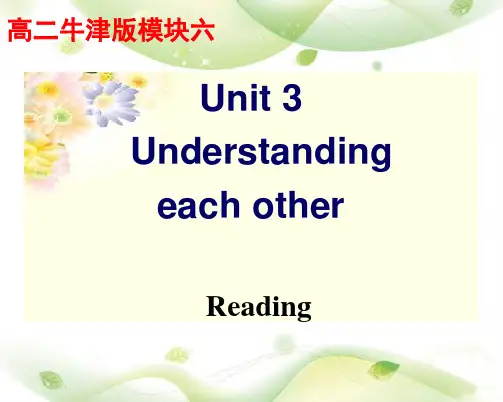
Shoes
Should take off your shoes before going into
someone’s house
Fill in the blanks
Mali has to do her homework
on_c_u_l_tu__r_a_l differences. So she goes
My savings are accumulating interest.
(2) n. accumulation accumulation of knowledge
(1)accumulate v.往往指一点一
点地连续积累 只有通过努力工作,你才能积蓄一大 笔财富。
Only by working hard may you accumulate a big fortune.
Brainstorming:
1. Do you know something about different cultures in some foreign countries?
2. Are you confused about their behavior?
3. How can we overcome these cultural obstacles?
Brunei Men and women sit in a
different area;
No alcohol is available.
About Brunei
Wedding /
Pointing Using their thumb to point to others while others use first finger Clothes Shouldn’t wear yellow
牛津高中英语M6U3 Cultural differences Welcome+Reading
Detailed reading:
Menu
4
weddings shoes
USA/UK cultural 1 differences an American 2 celebration
6
7
3 5
presents pointing
color of clothing
Thanksgiving: line 1-18
the USA
do the same
If not, rude,strange to see the receiver’s reaction
Menu
4
weddings shoes
USA/UK cultural 1 differences an American 2 celebration
6
7
3 5
presents pointing
6
color of clothing
Ø we could use examples to explain
concepts and ideas. Ø Sometimes we use examples to support arguments Ø sometimes they are used as interesting stories.
however in Brunei
line:49-51
They use:
thumb
Menu
4
weddings shoes
USA/UK cultural 1 differences an American 2 celebration
6
7
3 5
presents pointing
color of clothing
《牛津高中英语》Module 6 Unit 3 Reading 版块Cultural Differences 教学设计
66 ENGLISH TEACHERS
图4 图6 图8
English Teachers
Vol.15 No.21
图5
图7
图9
67 ENGLISH TEACHERS
2015 年 第 21 期 英语教师
图 10
设计意图: 设计三个问题,让学生快速阅读并捕捉相关 信息;限制字数,让学生学会加工整合信息。根据 本文的文体特点设计接下来的阅读摘录信息练 习,引导学生从整体上把握文章的结构,以 interviewer 所问的问题为线索,阅读 Peter 的回答以完 成表格题。之后让学生阅读 Waled 的回答,并以 小组合作的形式设计表格。这是一个大胆的尝
Wear red dress Bow
Korea
Interesting Have a rooster and a hen
设计意图:
在这个环节中,还引入了一些课文中的新单词,为
通过 Brainstorm 和 free talk,展示了不同国家 阅读做准备。
的婚礼习俗,让学生对文化差异有了初步的了解。
Step 3:Let’s read cultural differences.
English Teachers
Vol.15 No.21
教学设计与反思
《牛津高中英语》Module 6 Unit 3 Reading 版块 Cultural Differences 教学设计
赵志玲 夏 静
一、教材分析
际能力,增加英语学习的应用性。
本课的教学内容是译林版《牛津高中英语》模块
2. 能力目标
方式设计表格,进行模拟电视采访,引导学生自
作者信息:411228,湖南 湘潭,湖南省湘潭市
主合作与探究的精神,培养学生的创新精神和实
牛津版选修六Unit3 Reading-Cultural Differences课件
Topic 2: wedding ceremonies
In Korea (Line19-22)
To __d_r_iv_e__ bad spirits __aw__a_y_
To _e_n_su_r_e_ luck Considered to be very _l_u_c_k_y_
Wedding in Brunei (line23-32) TaskⅠ What is not permitted at wedding
Popularity
In Britain Yes In America No
Consolidation
Different r_e_a_c__ti_o_n_s_ to the presents
the
Different wedding _c_e_r_e_m__o_n__ie_s_
information
Cultural differences
receiving presents
festival Bonfire Night
wedding ceremonies
taking off shoes before entering a house
pointing gestures
Step 2 Detailed reading
gesture
country meaning
most countries
OK
Japan
Money
making a circle with one’s thumb and index finger
France Brazil Germany
Zero Rude
Topic 4: customs (line39-41)
牛津高中英语模块六Unit3Reading教案
根据《高中英语教学大纲》的要求,学生是课堂教学的主体,教师在教学中 起主导作用。 因此我采用任务型教学, 和小组合作探究的教学方法。 每一部分都 设有一定的任务, 引导学生自主或者合作完成。 教学过程由一张关于不同国家问 候方式的表格开始,一作复习,二做引入本课阅读文章 ----- 文化差异所用。接着 进行快速阅读, 用关键词列出文中所提及的文化差异, 并通过找搭档的互动方式 完成有关表格及填空内容, 这扩大了学生的参与度, 也加深了对文章的理解程度。 阅读活动由整体入手,由易到难,步步推进,层层深入。然后进行听力活动,并 观看相关图片, 旨在让学生对世界文化差异有一个更直观的了解, 增强他们对祖 国的自豪感。 表演及讨论部分旨在引导学生有正确的尊重他国文化的意识, 并为 写作流程图打下铺垫。在讨论的基础上进行话题写作指导便是水到渠成的事了。 整个教学活动以教材为载体, 以学生为中心。 学生参与活动贯穿始终。 学生既有 个人活动,又有小组活动和班级活动。
通过一连串的几个和学生生活紧密相关的问题,有效的提高了学生的兴趣。
学生知道美国学生在放假,而他们现在还在紧张的学习由此引出今天的话题
----
文化差异,自然,亲切。这一环节,我通过网络搜索,提炼西方节日文化特色的背景图片如圣诞节的庆祝, 通过讨论发散思维, 激发学生的想象力, 极大地
激发了学生的兴趣和好奇心,为学生全面的的课堂课堂参与作了有力铺垫。
Step two: Skimming
First, get the students to read the dialogue quickly to answer three questions. 1. How many characters are involved in this dialogue, and who are they? 2. Where do they come from? 3. What’ s Ma Li ’ s purpose?
牛津高中英语模块六第三单元Reading-Cultural-differences
全国中小学“教学中的互联网搜索”优秀教学案例评选教案设计阅读课文,连接段落大意。
从而从整体上理解课文内容。
Step4. Detailed reading 细节阅读1.Read line1-line13 and answer the following questions:1)Why does MA Li have a conversation with Waled and JacK?2)When did the British teacher open the present at the end-of –term ceremony?3)Why did he open the present at that time?2.Look at some pictures of the weddings in Korea and read line14-line22 and then fillin the blanks.Roosters are supposed to _______ _______ _________ __________ from the wedding ceremony.●Hens are thought to _______ ________ _________ for the marriage.●The fact that the hen lays an egg is considered_______ ________ during the ceremony. 【百度搜索】3.Read line23 –line40 and then do T or F statement.1)Men and women have to sit in separate areas at the wedding.2)Food ,soft drinking,tea and coffee are served,but alcohol is not permitted at the wedding.3)People in Brunei celebrate the wedding by singing and dancing throughout the night.4)People point with their first finger in Brunei.5)People will take off their shoes before entering someone’s house.4.Look at two pictures of Bonfire Night in the UK, listen to line 41-line59 and do note-making..Bonfire NightWhen to celebrate the festival It takes place on______ _______.What to do at the festival People light large ________ outside.They gather around and have a _____.There are plenty of _______.What to eat at the festival They eat _______ _______and other food that can becooked over the fire.【百度搜索】【教学设计目的】通过回答问题,填空,T or F 和表格填空等各种形式,使学生达到细读的目的。