
冀教版七年级英语下册教案
冀教版七年级英语下册教学工作计划本学期的教学重点是围绕教学大纲,努力调动学生的学习积极性,引导他们热爱学习,表现为他们自觉学习的行为,认真完成教学工作。
现将本学期担任的初一英语课教学工作计划如下:一、指导思想:在本学期的英语教学中,坚持以下理念的应用:1、要面向全体学生,关注每个学生的情感,激发他们学习英语的兴趣,帮助他们建立学习的成就感和自信心,培养创新精神;2、整体设计目标,体现灵活开放,目标设计以学生技能,语言知识,情感态度,学习策略和文化意识的发展为基础;3、突出学生主体,尊重个体差异;4、采用活动途径,倡导体验参与,即采用任务型的教学模式,让学生在老师的指导下通过感知、体验、实践、参与和合作等方式,实现任务的目标,感受成功;5、注重过程评价,促进学生发展,建立能激励学生学习兴趣和自主学习能力发展的评价体系。
总之,让学生在使用英语中学习英语,让学生成为Good User 而不仅仅是Learner。
让英语成为学生学习生活中最实用的工具而非累赘,让他们在使用和学习英语的过程中,体味到轻松和成功的快乐,而不是无尽的担忧和恐惧。
二、学生基本情况分析:本届七年级新生和以往初一学生相比在英语基础方面很薄弱,由于在小学英语课并未受到足够的重视,他们在写的技能方面基本上没有得到过训练,连音标和字母的拼读都没有掌握好。
经过上学期努力,年段学生的基础知识得到了加强,学习态度也有所好转。
但是学生整体的惰性还是很强,自觉性很差。
另外,学生在情感态度,学习策略方面还存在诸多需要进一步解决的问题。
例如:很多学生不能明确学习英语的目的,没有真正认识到学习英语的目的在于交流;有些同学在学习中缺乏小组合作意识;大多数同学没有养成良好的学习习惯,不能做好课前预习课后复习,学习没有计划性和策略性;不善于发现和总结语言规律,不注意知识的巩固和积累。
三、奋斗目标:钻研新课标,提高教学水平,真正做到教学相长,努力达到学校规定的教学指标。
四、具体措施:1、抓好英语的常规教学,加强基础知识训练:①归纳学过的词组,方便学生记忆;②用词组造句和中译英训练;③组织学生结对子,一有空就你问我答,营造学习氛围,同时加强笔头的练习,使学生能熟能生巧;④把课文分段,按学习组为单位,进行朗读比赛,对学过的课文尽量做到人人会背,有些课文还要求学生会默写。
2、抓好语法学习:①掌握形容词、副词的比较级和最高级的构成和用法。
区分单音节词和多音节词的构成,规则和不规则变化。
②学习一般过去时态,重点突破不规则动词。
③学习过去进行时与现在进行时的区别。
④学习联系词的用法。
3、培养学生综合运用知识的能力:每个单元围绕着知识点反复训练,层层渗透。
每个单元结束都进行测验,找出存在问题,及时补漏补缺。
4、抓好阅读能力培养:每周规定学生阅读三篇短文,带着问题阅读,阅读之后要回答问题。
5、培养学生写作能力:逐步创作一些简笔画要学生写出他们的动作编成故事,逐步培养他们看图写话的能力。
6、努力做好后进生转化工作,促进全体学生共同进步。
多关心后进生的思想和学习,平时要检查和督促他们的作业及时给予他们帮助7、关注学生的情感,营造宽松、民主、和谐的教学氛围。
8、实施"任务型"的教学途径,培养学生综合语言运用能力9、在教学中根据目标并结合教学内容,创造性地设计贴近学生实际的教学活动,吸引和组织他们积极参与。
学生通过思考、调查、讨论、交流和合作等方式,学习和使用英语,完成学习任务。
10、加强对学生学习策略的指导,为他们终身学习奠定基础。
五、教学进度:第一周:准备周(开学思想教育)第二周—第三周:Unit 1 A Trip to Beijing第四周—第五周:Unit 2 On the Train第六周—第七周:Unit 1—Unit 2 阶段检测Unit 3 Having Fun in Beijing第八周—第九周:Unit 4 Did You Have a Nice Trip?期中复习考试(Unit 1—Unit 4)第十一周—第十二周:Unit 5 Li Ming Goes to Canada第十三周—第十四周:Unit 6 Winter in Canada第十五周—第十六周:Unit 5—Unit 6 阶段检测Unit 7 Sports and Good Health第十七周—第十八周:Unit 8 Li Ming Goes Home第十九周—第二十周:期末复习、考试2011-3-7二单元教案Lesson 9: Getting on the TrainTeaching Aims:1. words: get, get on, very, stop, onto, ready, stand, where, see, first, man, excuse, pardon, move, problem2.sentences: Jenny and Mrs. Li are getting on the train.Don’t jump onto the train!You are in my seat.What did that man say?You have to move.Teaching Resources: audiotape, cards, picturesLanguage Points: get on, jump onto, in my seat, have toYou have to move. Teaching Procedures:Step 1: Greeting.Step 2 Revise Unit 1How far is it from China to Canada?It is about eight thousand five hundred kilometers.May I go on a trip to Beijing?Yes, you may./No, you may not.I want to go to the Great Wall.Let us take a train.Step 3 Presentationthe students to discuss the questions:Do you argue with your friends? Why?Do you have a friend who gets very excited? Who? Why?2. Play the tape and get the students to answer the question: Why is Jenny angry with Danny?3. Teach the new words and expressions:get on, jump onto, ready, beside, run onto, in the first/my seat, pardon, have to, moveWrite them on the blackboard.the language points.Step 4 Play the tape again and get the students to read after the tape.Step 5 Work in pairs. Ask the students to practice the dialogue.Step 6 present the dialogue.Step 7 Homework.1 Finish off the activity book.2. Recite the dialogue in this lesson.3. Preview Lesson 10.Lesson 10 What are they looking at ?Class opening1. Greeting.2. Duty report.3. Ask several volunteers to act out the dialogue in Lesson 9.4. Sing “The trip song.”5. Sing “I walked to zoo.”Look out of , point to.There is/are---Can you see ---?Step1: PresentationDemonstrate there be with real objects.Teacher: (holding a book) There is a book.(Holding two books) There are two books.Step2: DrillTeacher Three books.Students: There are three books.Teacher: Many people.Students: There are many people.Teacher: I see a woman with a sheep. Can you see them?Step3:Practice1. Books closed! Ask this question: What do Danny and Jenny see outside? Play the audiotape.2. Check the answers.3. Play the audiotape again as the students follow in their student books.4. Ask volunteers to read the dialogue.5. Ask volunteers to present the dialogue.Class closing1. Finish off the activity book.2. Sing the song “Who’s drawing.”3. Practice the dialogue in this lesson.4. Preview Lesson11.Lesson 11: Danny’s New FriendTeaching Aims:1.words: farm, suddenly, hear, voice, ah, scare, meet, course, of course, lot, a lot of, interest, hope, enjoy, well2.sentences: He hears a voice.There are a lot of places of interest in Beijing.I hope you will enjoy your trip.We are going on a trip to Beijing with Li Ming and his mother.Teaching Resources: audiotape, cards, picturesLanguage Points:Teaching Procedures:Step 1: Greeting.Step 2 Revise Lesson 9语法: there be 结构词汇: here and therelook out ofsomething/anythingfar awayat the top of---Step 3 Presentationthe questionDo you like to make new friends? Why or why not?Who is your newest friend? How do you meet?Explain “make friends with”and “newest”2. Play the tape and ask the students to answer the following questions:What does Danny want to buy in Beijing?Where is Wu Li from? Where does he live?Are there many places of interest in Beijing?Step 4 check the answer.Step 5 Teach the new words and Explain the language pointsfarm, suddenly, hear, voice, ah, scare, meet, course, of course, lot, a lot of, interest, hope, enjoy, wellStep 6 Play the tape again and get the students to read after the tape.Step 7 Practise the dialogue in pairs.Step 8 Present the dialogueStep 9 Homework.1 Finish off the activity book.2. Recite the dialogue in this lesson.3. Preview Lesson 12.Lesson 12: Lunch on the TrainTeaching Aims:1.words: wait, finally, cart, waitress, drink, fruit, some, grape, any, miss, snack, thirsty, bottle, nothing, own, bowl, anything, else, maybe2.sentences: It’s time for lunch.Everyone is waiting for the food to come.What would you like?I would like a bottle of tea.May I have some donuts, please?We don’t have any grapes.Anything else?Teaching Resources: audiotape, cards, picturesLanguage Points: It’s time for---be waiting for—What would you like? I would like---We don’t have any---.Anything else?Teaching Procedures:Step 1: Greeting.Step 2 Revise Lesson 11hear/listen toplaces of interestStep 3 Presentationthe questionDo you like to eat lunch on the train or bus?What do you like to eat when you travel?2. Play the tape and ask the students to answer the following questions:What do Danny, Jenny and Li Ming want to eat?Step 4 check the answer.Step 5 Teach the new words and Explain the language pointswait, finally, cart, waitress, drink, fruit, some, grape, any, miss, snack, thirsty, bottle, nothing, own, bowl, anything, else, maybeStep 6 Play the tape again and get the students to read after the tape.Step 7 Practise the dialogue in a small a menu for the the menu on a piece of paper. Practice using the menu with others.Step 8 Present the dialogueStep 9 Homework.1 Finish off the activity book.2. Recite the dialogue in this lesson.3. Preview Lesson 13.Lesson 13 What are you doing ?Class opening1. Greeting.2. Duty report.3. Play “Draw and guess”.4. Watch and Guess.The teacher does some actions (singing, talking, eating, drinking, crying ) and asks the students to guess what am I doing?Quiet , play with, joinStep1: PresentationShow a picture in which some children are playing games.Teacher: What are the children doing now?Students: They are playing games.Teacher: Who are they playing with?Students: With their friends.Teacher: Do you want to join them?Students: Yes, I do.Step2: Practice1. DrillTeacher: Can I join you?Students: Can I join you?Teacher: Do you want to join the game?Students: Do you want to join the game?2. Books closed! Ask some questions : What is Danny doing? What is the baby doing? Listen to the audiotape.3. Check the answers.4. Play the audiotape again as the students follow in their books.5. Practice the dialogue.6. Make up a similar dialogue.Class closing1. Finish off the activity book.2. Practice the dialogue in this lesson.3. Preview Lesson 14.Lesson 14 What’s happening on the train ? Class opening1. Greeting.2. Duty report.3. Act out the dialogue in Lesson 13.4. Play “Who AM I?5. Play “Whisper”.Loud, loudly.Step1: PresentationTalk about the pictures in this lesson.What is Danny doing?What is the man doing?What is the baby doing?Step2: practiceTeacher: He is very loud.Students: He is very loud.Teacher: He is snoring loudly.Students: He snoring loudly.Teacher: The salesman is too loud.Students: The salesman is too loud.2. Play the audiotape as the students follow in their books.3. Practice in groups.several groups to act out the dialogue.u a similar dialogue.Divide the class into small groups . Ask each group to make up a dialogue about buying and selling things.Class closing1. Finish off the activity book.2. Practice the dialogue in this lesson.3. Preview Lesson15.Lesson 15 Arriving in BeijingClass opening1. greetingTeacher: Hello, class. How are you doing toda y? It’s a lovely day, isn’t it? Are you ready for the class?2. Ask this question: Who’s on duty? Then listen to the student’s report. Make sure the next student for “ Who’s on duty?” Knows who he or she is for next time.From today on, you can arrange a student to give a duty report every day.3. Ask volunteers to act out the dialogue in Lesson 44. Sing a song “A plane Is Fast.”Sunday, Monday, Tuesday, Wednesday, Thursday, Friday, Saturday.Make a plan.What do you think of it?Step1: Presentation1. Pla y “What Day is it?’2. discuss: Do you like to make plans for your life?Step2: DrillT: (Holding a book) What do you think of the book?S: It’s OK.T: (Holding a pencil case) What do you think of the pencil case?S: it’s nice.T: How about the picture?Step3: Practice1. Books closed! Ask this question: What does Li Ming change in the plan? Play the audiotape.2. Check the answer.3. Play the audiotape as the students follow along in their student books.4. Students listen and repeat.5. Get the students to make up new dialogues in pairs.6. Explain “ write home”. It means write a letter to family members.Plan of our tripStep4: PresentationShow the students a calendar to review the words: Sunday, Monday, Tuesday, Wednesday, Thursday, Friday and Saturday.Step5: Practice1. Play the audiotape as the students follow along in their student books.2. Ask and answer.Students A: What do they on Monday?Student B: They leave Shijiazhuang and arrive in Beijing.Student A: What do they do on Tuesday?3. Explain that Danny and Jenny shop in Shijiazhuang means Danny and Jenny go shopping in Shjiazhuang.Class closingRead the story “Li Ming Goes to the Airport” the reader in the activity book and audiotape.Lesson16 Unit ReviewTeaching Aims:1. 复习本单元词汇、句型。
七年级英语冀教版下册全册教案
教案教案 备注备注Lesson 1 May I Go To Beijing? Teaching goals 教学目标教学目标a. 掌握词汇及短语掌握词汇及短语 may go go go shopping shopping to mom on trip the city of too and please far from kilometer okay hard great eat ask leave of so but busy only square Tian’anmen Square restaurant question sorry b. 句型句型 —May I …? —Yes, you may. /No, you may not. t oo… to… Teaching important and difficult points 教学重难点教学重难点 Teach the student to learn the following expressions: —May I…? —Yes, you may. /No, you may not. too … to … / be far from / go on a trip Teaching methods 教学方法教学方法 Listening and speaking. Teaching aids 教具准备教具准备 Audiotape. Teaching procedures & ways 教学步骤与方式教学步骤与方式教学步骤与方式 Step I Greeting and lead-in Greet the students and get them to talk about their holidays. Get some other students to talk about their holidays. And then show some places of interest and continue talking with the students to make them understand the phrase go on a trip to. T: I had a nice holiday too. I went on a trip to Beijing. Look! There are some pictures about this city. T: How about the first picture? S: It’s Tian’anmen Square. T: That’s right ! The second one? ! The second one? S: It’s Gugong. (In Chinese) T: In English It is named the Palace Museum. S: The Palace Museum. T: How about the last one? S: It’s Changcheng. T: It’s the Great Wall in English. S: The Great Wall. T: There are so many beautiful places in Beijing. And Beijing is the capital city of our country. Would you like to travel to Beijing? (To one student) S: Y es. T: Would you like to go on a trip to Beijing too? Help the student to answer. Make sure the students know the meaning of go on a trip to. S: Yes. I’d like to go on a trip to Beijing. Step II Practice Get the students to learn to talk about permission by using the phrase: to go on a trip to. The teacher can show them some pictures of places of interest to help them to discuss. T: What city would you like to go on a trip to, Beijing or Guilin? S: I’d like to go on a trip to Guilin. Ask more students the same question to let them learn the phrase go on a trip to well T: Gulin is a very beautiful place. May I go on a trip with you? Help the student to answer: Yes, you may. Or No, you may not. Explain the meaning in Chinese if necessary. S: Yes, you may. T: T: (To (To (To another another another student) student) student) I I I have have have no no no money money money to to to go go go on on on a a a trip trip trip to to to Guilin. Guilin. May I borrow some money? S: No, you may not. Step III Text learning Get the students to learn the text. Listening Get the students to listen to the tape and answer a question. And then get them to repeat after the tape. T: T: Li Li Li Ming Ming Ming wants wants wants to to to go go go on on on a a a trip trip trip to to to Beijing. Beijing. Beijing. Listen Listen Listen to to to the the the tape tape carefully. Does Li Ming’s mother go on a trip to Beijing too? S: (After listening) Yes. Paraphrasing Explain the following sentences. Notes: 1. You are too young to go, Ling Ming. It means Li Ming is too young. If he goes to Beijing, he cannot take care of himself. 2. Beijing is far from our city. It means Beijing is not near Shijiazhuang. 3. You work hard in school. It means Li Ming studies hard. Practice Get the students to read and act out the dialogue in pairs. And then ask them to work in pairs and make up their own dialogues using go on a trip to, too… to…, be far from and May I…? They can talk from the following aspects: 1.Where you want to go for a trip; 2. Why you cannot / can go there; 3.Who will go with you. Walk around to give them a hand if necessary. Sample dialogue: S1: May I go on a trip to New York, mom? S2: No, you may not. Now York is too far to go. S1: Dad? S3: No, you are too young to go. You can go to a city near our home. S1: May I go on a trip to Lasa? S3: No, you may not. It’s far from our city.S1: May I go on a trip to Beijing? S2 and S3: Yes, you may. We will go to Beijing too. Step IV Homework Finish the exercises in Activity book. Practice the dialogue in pairs. Preview Lesson 2 Lesson 2 May I Invite Danny and Jenny? Teaching goals 教学目标教学目标 a. 掌握词汇掌握词汇want come hello with who when do leave for arrive. b. 认知词汇认知词汇 invite them Mrs. call oh wonderful invitation bye hooray c. 句型句型 When do you leave for …? / When do you arrive in / at …? —May I speak with / to …? —This is … (speaking). Who’s that?Teaching important and difficult points 教学重难点教学重难点Grasp the expressions of making phone calls. Teaching methods 教学方法教学方法 Listening and speaking. Teaching aids 教具准备教具准备 Audiotape and pictures. Teaching procedures & ways 教学过程与方法教学过程与方法教学过程与方法 Step I Lead-in and speaking T: Good morning, class. S: Good morning, Miss /Mr. /Ms. … T: We know that Li Ming will go on a trip to… S: Beijing! T: Do you want to go to Beijing? Why or why not? Help Help the the the students students students to to to answer answer answer these these these questions questions questions from from from the the the following following aspects: Affirmative: 1. have fun; 2. learn a lot that can not be found in the text book; 3. make other friends … Negative: 1. Beijing is too far away; 2. too young to go; 3. … T: If you can go to Beijing, who do you want to take with you? Why? S: I may go with my parents. They can take care of me, and share the happiness together. S: I may go with my friends. We have the same interest and can have a lot of fun. S: I may go with my little brother. I can learn to take care of him and learn a lot. T: Good! Wish you a good trip to Beijing. Step II Reading Fast reading Get the students to scan the dialogue to look for the expressions about making phone calls in English. T: Li Ming wants to go to Beijng, do you know who does he want to take to Beijng? Now, look through the text and show me the answer. S: Jenny and Danny. T: That ’s it! But where are Jenny and Danny? S: They live in Canada. T: So how can Li Ming invite them? S: Make a phone call. T: Good! Please read the dialogue in Lesson 2 silently and try to find out ways to make a phone call. After the students finish reading, summarize the following patterns. —Hello. May I speak with / to …?—Yes, this is…. Who’s that?—This is …T: Great! Careful reading Get the students to learn about how to invite somebody on the phone. 1. Paraphrasing Make a dialogue to help the students understand the phrases leave for and arrive at / in. T: Hello. May I speak to Mary? S: Hello. This is Mary. Who is that? T: This is … I’m going on a trip to Beijing. Would you like to go with me? S: Y es. T: Let’s meet at the school gate at 9:00 on Friday. OK? S: OK. Draw Draw the the the school school school gate gate gate and and and Beijing Beijing Beijing West West Railway Railway Station Station Station on on on the the blackboard and let the student come to the front of the classroom to act act with with with you. you. you. The The The two two two walk walk walk from from from the the the school school school gate gate gate in in in the the the picture picture picture to to Beijing Railway Station in the picture. T: We are leaving our school. We are leaving for Beijing. Now we are arriving arriving in in in Beijing, Beijing, Beijing, arriving arriving arriving at at at Beijing Beijing Beijing West West West Railway Railway Railway Station. Station. Station. W W e usually arrive at a small place; and arrive in a big place. Got it? Write Write the the the phrases phrases phrases on on on the the the blackboard, blackboard, blackboard, explain explain explain them them them and and and lead lead lead the the students to read them. 2. Reading Get the students to read the dialogue and answer the questions given. After that ask them to listen and repeat, and then act out the dialogue. Who does Li Ming want to take to Beijing? (He wants to take Danny and Jenny to Beijing.) Can Jenny come? (Yes, she can.) When do Li Ming and his mother leave for Beijing? (They leave on February 1 in the morning.) When When do do do they they they arrive arrive arrive in in in Beijing? Beijing? Beijing? (They (They (They arrive arrive arrive in in in Beijing Beijing Beijing in in in the the afternoon on February 1.) Step III Presentation Let Let the the the students students students work work work in in in pairs pairs pairs to to to make make make up up up similar similar similar dialogues dialogues dialogues to to practice the expressions of making a phone call. They can talk from the following aspects: 1. Where you want to go for a trip; 2. Who you want to invite to have a trip; 3. When you leave. Ask some pairs to act out their dialogues. Step IV Homework Finish off the exercise in Activity book. Preview Lesson 3. Lesson 3 How Far Is Beijing? Teaching goals 教学目标教学目标 a. 掌握词汇掌握词汇 me about here him there say thousand b. 认知词汇认知词汇 dinosaur think visit Edmonton laugh worry be partner practice c. 句型句型 How far is it from … to …? It It’’s about … kilometers. Teaching important and difficult points 教学重难点教学重难点 Grasp the expressions of talking about distance. How to express numbers from one hundred to ten thousand. Teaching methods 教学方法教学方法 Listening, and speaking. Teaching aids 教具准备教具准备 Audiotape and maps. Teaching procedures & ways 教学过程与方式教学过程与方式教学过程与方式 Step I Revision Greeting T: How are you doing? S: We are fine. Revision Help the students review Lessons 1 & 2 by asking questions. Why does Li Ming want to go on a trip to Beijing? Because Beijing is the capital city of our country and it’s not far from his city, Shijiazhuang. Why does Li Ming’s mother let Li Ming go on a trip to Beijing? Because Because Li Li Li Ming Ming Ming is is is not not not too too too busy, busy, Beijing Beijing is is is not not not very very very far far far from from Shijiazhuang, Li Ming is a good student and works hard in school. What can Li Ming do in Beijing? He can go shopping, eat in restaurants and go to a hotel. Step II Lead-in Show the students the map of China and the world map to help them to talk about distance. Lead the students to read the numbers in this lesson. Step III Text learning Reading Get Get the the the students students students to to to read read read the the the text text text again again again and and and answer answer answer the the the following following questions. T: Now please read the dialogue and find out the answer to the two questions: Why is Mrs. Dinosaur worried? And can Danny go? S: Because Canada is too far from China. S: Yes, he can. T: That’s right. Listening Then get the students to listen to and repeat after the tape. Later, ask them to act out the dialogue. Step IV Get the students to talk about distance. Speaking Write How far is it from … to …? / It’s about… kilometers and some numbers on the Bb to let the students practice talking about distance. Explain the usage of hundred and thousand. Notes: Notes: hundred, hundred, hundred, thousand thousand 前面有具体数字时,不要加s; 一般情况下,百位与个位之间用and (也可以不用and )十位和个位之间可以用连字符,也可以不用。
初中英语(冀教版)七年级下册(七下)-《Lesson 24 How was Your Weekend》word教案 (1).doc
Unit 4 After-School Activities Lesson 24 How was Your Weekend Teaching Analysis1. Teaching Aims2.Knowledge Section:1.Master the following words:everybody, yummymon phrases:have a great/ good weekend, take a bus, It’s … away from…Skill SectionContinue to build up the ability in listening, speaking, reading, writing and translating, especially enable the students to make a dial ogue in English about how to .make a telephone callAffect SectionGet stu dents to know how to make a telephone call correctly.(2)Teaching FocusVoc abulary and patterns in this lesson3. Difficult pointsIt’s … away from…Teaching AidsMultimedia, radio-tapeTeaching ProceduresStep I Class Opening (5 minutes)(1) GreetingT: Good morning, class! How are you today?Ss: Good morning, Miss Gao! Fine, thank you. And you?T: I’m fine, too.(2) ReviewHave a dictation about the words and phrases in last lesson.Step II New Conce pts (24 minutes)1.Lead-inT: What did you do last weekend?S1: I played the piano.S2: I played volleyball with my friends.S3: I drew at home.S4: I read a book at the libra ry.…T: What are you going to do next weekend?S1: I’m going to stay home.S2: I’m going to watch a movie with my friends.S3: I’m going to read a book at home.S4: I’m going to p ractice English.…2. PresentationAsk the students to read the title of Lesson 24 and discuss.T: What tense is the title in? (Help the students answer this question.)Ss. It’s in the past tense.T: Very good. Now how to answer?S1: I had a good time.T: Wonderful! How is your weekend going?S2: I’m having a good time.T: That’s right.Write the statements I had a great weekend, I’m having a great weekend, I’m going to / will have a great weekend on the blackboard. Ask the students to identify the tense for every statement.T: Please look at the PPT6-8. What’s she doing?Ss: She is making donuts.T: What are they doing?Ss: They are climbing a mountainT: Loo k at the cake. Wow! It looks yummy!.2.ListeningLet’s Do It! No 1.Listen and match the pictures with the questions. Discuss theanswers as a class.4. Future study of the text1). Read the text by yourselves, please, and try to finish Let’s Do It! No 2. Ss should check and correct their answers in groups. Then discuss the answers asa class.2). Language points.PPT15-16Step III Practice (10 minutes)PPT17-19Step IV Clas s Closing (1 minute)Let’s see our homework for today.1. Finish off the exercises in Activity Book2. Preview the new words and expressions of Unit 5.3. Try to write about your activities of last weekend and your plan for the next weekend.。
最新冀教版初中英语七年级下册Unit1全单元教案
最新冀教版初中英语七年级下册Unit1全单元教案Unit 1 A Trip to the Silk RoadLesson 1 A trip to ChinaI. Learning aimsKey vocabulary: trip silk road lead note chance send news Key phrases: learn about(学习,了解);learn(…) from…(向……学习……、从……获得……知识);learn to do sth.(学习做某事)send sb. sth.= send sth. to sb.(把某物寄给某⼈)tell sb. sth.= tell sth. to sb.(告诉某⼈某事)think about(考虑、认为)Key structures: What does \do sb. think about sth.?Practice listening、speaking、reading and writing skills.II. Learning important pointsWe are learning about the Silk Road this month in school.这个⽉我们正在学校学习丝绸之路。
(1).learn about 学习、了解(2).learn(…) from…(向……学习……、从……获得……知识)(3).learn to do sth. 学习做某事learn to swim 学习游泳learn to ride a bike 学习骑⾃⾏车(4).the Silk Road2.Mum and dad, may I ask you a question?爸爸妈妈,我可以问你们⼀个问题吗?May I…? 此句式表达有礼貌地请求对⽅允许,语⽓⼗分委婉,还可以表达为:Could I \ Can I?其肯定回答常⽤:Yes.可以。
冀教版七年级英语下册Unit7全单元教案
Unit 7 Sports and Good HealthLesson37:You Are What You Eat!Ⅰ.Learning aims:1:Grasp main words:truth decide change habit usual health alful。
2:Understand important sentences.3:Know about some food are good for us and have a balanced diet.Ⅱ.Learning main points:1:Grasp words and phrases.2:Key sentences and structures:There be 句型.3:Learn about You Are What You Eat!Ⅲ。
Learning difficulties:1: Grasp words and phrases.2:There be 句型。
3: Learn about You Are What You Eat!。
Ⅳ。
导学环节:(一)self—learning:1:Talk about food they like and dislike in group of 4 ,then make a list of which food is good for us which are bad,read out food are good for us。
Then look at Lesson37.Listen to the tape and complete Let's Do It 1,read the passage again and check in group of 4。
2:小组合作互助释义:英汉互译to tell you the truth ________as uaual________have a dream______ You Are What You Eat!________________ be good for_________饮食习惯醒来谚语Complete Let’s Do It 2 then read the paassage loudly and check. (二)展示交流:小组展示:Complete Let's Do It 4讨论如何培养良好的饮食习惯,怎样关爱健康?(三)拓展提升:反馈矫正:Complete Let's Do It 3and check in group of 4.(四)课堂作业:1:朗读课文.2:复习课堂中自己掌握不够彻底的知识。
冀教英语七年级下教案Unit 1 Lesson 6 Jenny's Diary
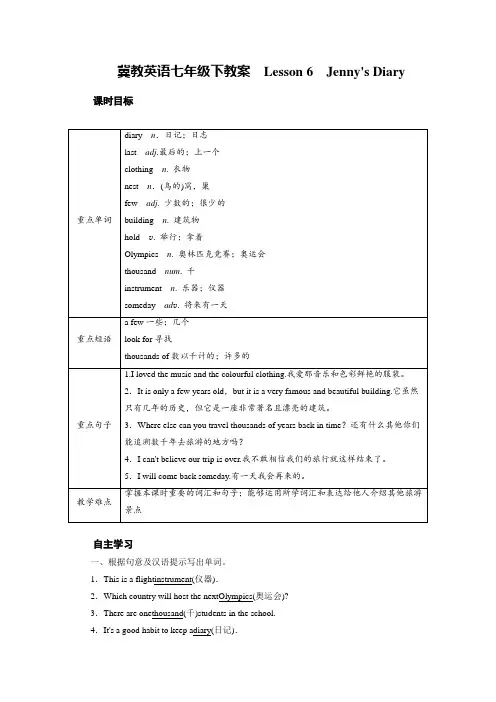
冀教英语七年级下教案Lesson 6Jenny's Diary 课时目标自主学习一、根据句意及汉语提示写出单词。
1.This is a flightinstrument(仪器).2.Which country will host the nextOlympics(奥运会)?3.There are onethousand(千)students in the school.4.It's a good habit to keep adiary(日记).5.I believe that my dream will come truesomeday(将来有一天).二、写出下列画线短语的汉语意思。
1.It is only a few years old,but it is a very famous and beautiful building.一些;几个2.Danny looked for birds there.寻找3.Where else can you travel thousands of years back in time? 数以千计的;许多的教学过程环节1新课导入T:Look at the picture.I'm sure you all know that it is the Tian'anmen Square in Beijing.Today we will follow Jenny to have a look at some Beijing's famous places.设计意图:展示与课文相关的图片,不仅可以吸引学生的注意力,还能激发学生的求知欲望,同时为接下来的学习作好铺垫。
环节2新课学习1.教师让学生快速浏览教材第12页的Jenny的日记,了解其主旨大意。
2.教师让学生仔细阅读詹妮的日记,勾画出文中的重难点短语和句子,随后教师进行一一讲解。
最新冀教版七年级下册英语教案(全册)
冀教版七年级英语下册教学计划一、学情分析:经过一学期的学习,七年级大部分学生对英语仍然保持着浓厚的兴趣,但有少数学生由于遇到困难,教学兴趣可能会开始减退。
因此,这个学期在教学中,教师应该以学生的发展为宗旨,以培养学生的创新精神和实践能力为重点,面向全体学生,在激发学生兴趣的同时,扎扎实实地从每个学生抓起。
教师在以活动为课堂教学的主要形式的同时,要充分发挥任务性教学的优化使用,设计丰富多彩的教学活动,有效的教学任务。
同时注意到学生中存在的两极分化,教学内容注意由简到难,循序渐进,在知识的复现中做好及时补差工作。
充分培养学生的听说读写能力,尤其要加强识读,拼写的能力,重视阅读能力和写作能力的同步培养,重视英语作为语言的交际功能。
结合“双减”政策的进一步落实,减少作业量,杜绝低效作业,实行分层次作业布置。
二、教材分析:本册教材分为8个单元,每单元6课,共48课。
冀教版初中英语是根据“新课程标准”中一级要求进行编写,以“话题---功能---结构---任务”相结合的原则,力求使话题、功能、结构和任务四个方面在比较真实的情景中紧密联系,融为一体;本教材提倡“任务型”的教学模式,让学生在教师的指导下,通过感知、体验、实践、参与和合作等方式,实现任务的目标,感受成功。
在教学过程中进行情感和策略调整,以形成积极的教学态度,促进语言实际运用能力的提高。
在设计教案时,不但要对培养学生的综合素质发挥积极作用,同时也要满足立德树人的要求。
三、教学目标:1.能按要求掌握所学的单词和句型。
2.能运用日常交际用语,活用句型,进行简单的交流,并做到大胆开口,发音正确,所用话语与场合符合。
3.能在图片、手势,情景等非语言提示的帮助下,听懂清晰的话语与录音。
4.培养良好的书写习惯,能做到书写规范整洁。
5.培养良好的听英语、读英语、说英语、用英语的习惯,能自觉的模仿语音、语调,逐步培养语感。
6.能在任务型教学的过程中运用相关的语言知识,完成某项任务,并促使语言能力的提高。
冀教版英语七年级下册 Lesson 1 A Trip to China教案
Lesson 1 A Trip to China 教案课题Lesson 1 A Trip to China单元Unit1 学科English年级七下学习目标知识与技能目标:(1)掌握词汇:trip, silk, road, lead, note, chance, send, news.(2)掌握短语及句型:1.语法讲解一般将来时2.plan sth.“计划某事”;plan to do sth.“计划做某事”。
3.lead sb.to do sth.“致使/导致某人做某事”。
4.be made of “由……制成”。
5.chance to do sth.”或chance“of doing sth.“有机会做某事”6.send sth to sb用send sb sth。
送给某人某物。
7.a piece of news 一则新闻。
过程与方法目标:能够在日常情境下使用相关的单词,短语知识点进行有关旅游计划的交谈。
情感态度与价值观目标:激发和培养学习英语的兴趣,用所学英语进行交际的意识和勇气。
重点掌握本课时的重点词汇、短语及句型。
难点 1.会在生活中灵活运用所学内容。
2.掌握一般将来时的用法。
导入新课Step 1:Lead-in展示相关图片。
Step 2:展示问题1. Do you know what it is?提问学生讲授新课Step 1:Learn new wordsRead and ask the students to fill in the blanks.Step 2:Listen to the tape and answer questions.Step 3Read the dialogue in the lesson and answer the questions.。
冀教版七年级英语下册教案
冀教版七年级英语下册教案一、教学目标1.语言知识目标(1)通过本节课的学习,学生能熟练掌握并正确使用以下词汇:bookstore, supermarket, library, hospital, post office, bank。
(2)能理解并正确运用以下句型:- Excuse me, where is the bookstore? It's next to the supermarket.- Excuse me, is there a library near here? Yes, it’s across from the supermarket.- Excuse me, how can I get to the hospital? Go straight and turn right.2.语言技能目标能够用英语向别人询问和指路,并理解他人给予的指引。
3.情感态度价值观目标(1)培养学生主动使用英语的兴趣和自信心。
(2)培养学生乐于助人和礼貌待人的良好品质。
(3)倡导学生尊重他人,积极与他人沟通交流的价值观念。
二、教学重难点1.教学重点(1)通过本节课的学习,学生能熟练掌握并正确使用目标词汇。
(2)能够理解并正确运用目标句型进行日常对话。
2.教学难点学生能够正确使用方向词汇和表达方式,能够正确指引和理解他人的指引。
三、教学过程1.导入新课(1)与学生进行问候和日常交流,温暖和谐的氛围中进入新课教学。
(2)通过一段简短的对话,引入本节课要学的单词和句型。
让学生根据上下文理解单词的意思,并理解句型的用法。
2.新课讲解(1)引导学生通过图片、实物等进行词汇的学习与讲解,并与学生一起朗读和记忆。
(2)通过图片展示和实际案例,向学生展示目标句型的用法和结构,并进行示范齐读和分角色朗读。
(3)引导学生分组练习并巩固句型。
进行角色扮演,让学生在实际情景中运用所学句型进行对话练习。
3.练习巩固(1)设计一些游戏和练习,巩固学生所学的词汇和句型。
冀教版英语七年级下册教案全册
教学内容
Lesson 1 : A trip to China
第几课时
1
共几
课时
1
知
识
目
标
1. New words and phrases
2. understand the meaning of text
3. Structures:May I ask.....? May I go with you ......?
思
课时教案
教学内容
Lesson 2:Meet you in Beijing
第几课时
2
共几
课时
1
知
识
目
标
1. Words and phrases:exciting,along,kilometer,special,culture,arrive,leave,How far is it from.....to.....?
This term ,what we will learn?
In unit one,we will learn the history of China and culture of China-the Silk Road.
Step 2. Lead in.
Explain the Silk Road in Chinese first,what about the Silk Road,talking about the history of China and culture of China.then we learn the new words.
教学
重点
Asking for permission:May I ask.....? May I go with you ......?
七年级英语下册 Unit 1 A Trip to the Silk Road Lesson 6 Jenny's Diary教案 (新版)冀教版
Unit 1 A Trip to the Silk Road Lesson 6 Jenny's Diary一、教材分析1. Teaching content(教学内容)(1) New words: diary, last, few, thousand, someday, nest, building, hold,Olympics, clothing, instrument(2) New phases: a few, a little, thousands of2. Teaching aims(教学目标)(1) Understand the text.(2) Remember the new words and phrases.(3) Learn to describe a place of interests you have visited.3. Key points(重点)(1) thousands of(2) someday4. Difficult points: (难点)the differences between a few and a little.二、教学准备prepare some pictures of places of interest三、教学步骤Step 1. Warming up.Greet the Ss a nd review the last le sson. Ask some questions about the famous things of China like this:T: What is China famous for?Ss: Great Wall, Beijing opera, Bird’s ne st, and so on.Step 2. Look and SayMake t he Ss say something about the following famous things and places in China. Step 3. New words.1. Give th ree minutes to Ss to pronounce t he new words.2. Pronounce the new word s following the teacher and remember the new words in three minutes.Step 4. Listening time.1. Make the Ss listen to the tape closing their books and get ready t o answer the question: Did Danny find any birds in the Bird’s Nest?2. Check the answer.Step 5. Reading time.Let the Ss read the text aloud with the foll owing questions:1. When did Jenny love about the Beijing opera?2. Where did the group go yesterday afternoon?3. What event was held at the Bird's Nest in 2020?4. What new instrument did Jenny learn about?And then make the Ss answer the above questions in pairs.Step 6. Language points:1. Make the Ss look for the language points in the text in pairs in five minutes.2. The teacher show the important language points and give some examples. Step 7.Writing time:Make the Ss write a short passage about his or her visiting to Beijing in ten minutes and show.Step 8. HomeworkWrite a diary about a place of interests in China.Step 9. Reflection:Lesson6 aims to teach the students learn how to write something about the visiting to a place of interests. It’s a little difficult for the students to master the differences between “a few” and “a little”. So, the teachers need to practice this language points as much as possible.四、板书设计Lesson 6 Jenny’s diaryBeijing:Great WallBeijing operaBird’s NestOlympic GamesXi’an: The Walled City: the Terra Cotta Warriors the yellow river五、教学反思。