
仁爱英语七年级上册unit2topic3知识总结
1
Unit2 Topic3 Whose jacket is this?
一.核心词汇
mine whose bike cat our banana their baby bag shirt jacket think new classmate
clothes find help us him
二.常用词组
help sb do sth
三.重点句子
-Is this your cap,Jane?
-No, it’s not mine.
-Whose cap is it,then?
-It’s Sally’s.
-Whose banana are these?
-They’re their bananas/theirs.
I think it’s Kangkang’s/Li Ming’s.
We look the same, but we are in different clothes.
His pants are blue and mine are white.
This man is from Canada.
四.交际用语
Guess!Who is he ?
Please help us find him.
五.语法精粹
形容词性物主代词和名词性物主代词
They are our shoes. They are ours.
‘s 表示名词的所有格 This is Li Ming’s shirt.
六.其他 学习辅音音标/ / / / / / / /
七.重点知识讲解
1-Whose bike is this? 这是谁的自行车?-It’s his bike./ It’s his.是他的(自行车)。
第一个his是形容词性物主代词,相当于形容词。置于名称之前,用来修饰,限
定名词;第二个his等于his bike,是名词性物主代词,其后不加名词。如:
Our books are new.= The new books are ours.
His bag is green.=The green bag is his.
2
Their desks are all here.= The desk here are all theirs
2 –Whose cat is that?那只猫是谁的?-It is her cat./It’s hers.是她的(猫)。
(1)whose 疑问代词,意为“谁的”,其后加名词,再加一般疑问句,或whose
加一般疑问句。如:Whose computer is that?= Whose is that computer?那是谁的电
脑?
(2)hers 为名词性物主代词,意为“她的(猫)”,其后不在加名词。
3. I think it’s Li Ming’s.我认为(想)是李明的。
(1)I think 可作为插入语,通常放在句尾或句首。如:-What’s that? 那是什么?
- A plane, I think.我想是飞机。
(2)当不能简单的用Yes 或No回答的时候,可用I think 来表达。如:-Can you
spell it? 你会拼写(它)吗?-I think so.我想我会。
(3)Li Ming’s 是名词所有格,意为“李明的”。 名词所有格一般表示所有或所
属关系,意为: “……的,在名词后加上’s.如: Maria’s book is here.玛利亚的书在
这里。
【拓展】1) 单数名词词尾加’s. 复数名词词尾没有s 的,也要加’s,表示所有格。
如:the boy’s food 男孩的食物 men’s room 男厕所
2)名词已有复数(即词尾已有s),则只加“”,表示所有格。如:a girls’ school 女
子学校 Teachers’ day
3)如果两个名词并列并且分别有’s,则表示分别拥有;如果只是最后一个名词后
有’s,则表示共有。如:John’s and Mary’s room 约翰和玛丽各自的房间。(各有
一个房间)John nd Mary’s room 约翰和玛丽共同的房间。(共有一个房间)
【链接】前面我们已经学习了加’s 的缩写形式。如:he’s, what’s, that’s 等。是所
有格还是缩写形式必须根据具体的语境来判断。如: That’s a book.那是一本书。
3
(that’s 是that is的缩写形式,意为“那是”。)
即时演练
翻译短语。1玛利亚的书___________________
2.两位女教师______________________________
3.男式服装_____________________
4.吉姆和汤姆共有的房间_____________________________________
5.我妈妈的房间__________________________________________
4.We look the same, but we are in different clothes.我们看起来很像,但我们穿着不
同的衣服。
Clothes总以复数形式出现,统称各种衣服,包括上衣、裤子、裙子、帽子和鞋
等,不指单件衣服,也不和具体数字的数词连用。它作主语时,谓语用复数。如:
My new clothes are from Guangdong. 我的新衣服产自广东。 Don’t judge a person
by the clothes he wear. 不要以貌取人。
【链接】我们已学过关于服装的名词有:dress女服,连衣裙;cap 帽子;shoes 鞋,
coat 外套,大衣;skirt 短裙; shirt(男士)衬衫; T-shirt T恤衫;pants裤子
5.This man is from Canada.这位男子来自加拿大。Man (男人)的复数形式是
men; woman(女人)的复数形式是women,注意 women 的读音是/’wimin/.
【拓展】当man, woman 作定语修饰名词时,如果名词是复数,那么man 和
woman也用复数形式。如:men teachers 男教师, women doctors 女医生
6.Please help us find him.请帮我们找到他。
(1)注意此句中动词help的句型。“帮助某人做某事”可以是help sb do sth,也
可以是help sb to do sth.或 help sb with sth. 如:She help me (to) learn English.=She
Unit+3+Topic+2+课件+河南省平顶山市2023-2024学年仁爱版七年级英语上册
a photo of, in a green T-shirt, in yellow/red/black, a big family, a doctor/teacher…, in a hospital/ in a school …
Take one of your family photos to school and describe it to your partner.
课前热身
1. The girl lives with her_g_r_a_n_d_p_a_r_e_n_t_s_(祖父母). 2. Linda and Kate are my __c_o_u_s_in_s__(表妹). 3. Tom is my uncle’s __s_o_n____(儿子). 4. Jack is Sally’s _b_r_o_t_h_e_r__(哥哥). He is a driver. 5. Zhang Lan has three apple __tr_e_e_s__(树).
(age/look/clothes/job/workplace)
用以下关键词写一篇介绍你的家庭的短文。
My name is…,come from, years old, in Class-, Grade-, a happy family, live in, My father/mother/grandparents is…, works…, love
自学指导
1.朗读课文 2.完成1b部分 3.找一找全家福中的小男孩是谁 4.找一找全家福中哪两位是小男孩的爸爸、妈妈 5.找出相应的知识点 6.小组讨论,积极参与,合作共赢
This is a photo of Kangkang's __fa_m__il_y__. The young man in a green Tshirt is his _u__n_c_le__. The young woman in yellow is his _a_u_n_t_. They have a daughter and she is in pink. She is Kangkang’s _c_o_u_s_i_n_. The young woman in red and the young man in black are his _p_a_r_e_n_t_s_. The old man and the old woman are Kangkang’s _g_r_a_n_d_p_a_re_n_t_s_ . Kangkang has a big family.
仁爱版七年级上册英语笔记Unit3Topic3-Unit4Topic1知识点总结
仁爱版七年级上册英语笔记Unit3Topic3-Unit4Topic1知识点总结U 3 T3—U4 T11.1)would like = wantwould like没有人称和数的变化I would like an egg.=I want an egg.He would like an egg.= He wants an egg.(would like不能加s)2)would like to do = want to doa. He would like to drink some water.(drink)=He wants to drink some water.b. She would like (visit) the Great Wall.=She the Great Wall.3)I would like=I’d like He would like=He’d like4)a. I’d like an egg.(一般疑问句) Would you like an egg?Yes,please./ No,thanks.b. He’d like a hamburger.he a hamburger?. / .5)Would you like some chicken?(用some 加强语气,表示强调)6)I’d like an egg.What would you like?He’d like some fish.he ?2.1)you—yourself(反身代词)2)yoursel f---yoursel ves(pl.)3.help yourself/yourselves to +n.:随便吃……a. Help yourself (you) to some chicken, Tom.b. Help yourselves (you) to some chicken, kids.4.1)可数名词[C]:有单数和复数的形式.2)不可数名词[UC]:一般没有复数的形式.3)常见的不可数名词有:milk,rice,fish(鱼肉),chicken(鸡肉),(apple/orange) juice,water,bread5.fish:1)作为“鱼” , 是可数名词.fish—fish(pl.)2)作为“鱼肉”, 是不可数名词.some fish6.chicken:1)作为“鸡” , 是可数名词.a chicken2)作为“鸡肉”, 是不可数名词.some chicken7.some + n.(pl.),some+ [UC]some eggssome fish/chicken/milk/apple juice/rice8.---Help yourselves.---Thank you.9.---Would you like…? ---Yes, please. /No, thanks.10.What/How about +sb(宾格)/sth?What about him/her/some milk?11.All right.行,好吧(表示对别人的建议表示赞同)---I’d like some rice and chicken.---All right./doc/6e6981861.html,k for me.13.Me,too.14.表示建议:---What about …? ---Good idea.15.an ideaa good ideaHomework:1.I’d like a hamburger.(一般疑问句) a hamburger?(肯否回答) ./ .2.She’d like some orange juice.she ?3. , boys and girls.(随便吃些鸡肉吧)4.She likes it very much.(否)She it .5..(我想喝些牛奶).6.他们怎么样?Unit 3 T 3 Section B—D1.1)usually:70-80%,often:50-60%2)usually,often放在be之后,行为动词之前.I usually have breakfast at home.2.have…for breakfast/lunch/supper/dinner1)He usually has an egg and some milk for breakfast.2)We usually have some rice and chicken for supper.3.一日三餐前不加a/an/the,后不加s.What do you usually have for/ breakfast?4.1)He usually has some bread for lunch.What does he usually have for lunch?2)We usually have some juice and fish for dinner. usuallyfor dinner?5.have:1)有2)吃,喝:have milk/bread6.[UC]前面不加a/an/the,后不加s.He has / milk and/ bread for breakfast.7.What/How about +sb(宾格)/sth?8.with带着/有,(表示伴随关系)have chicken/fish with vegetables9.some rice10.three meals(餐):breakfast,lunch,supper/dinner11.food:[UC],食物的总称,作主语,谓语用单数.My favorite food is (be) chicken and fish.12.Chinese /English food13.wait(v.)—waiter(指人)(男服务员)---waitress(女服务员)14.take one’s orderMay I take your order?15.something to drink/eat1)修饰词如不定式(to do) ,形容词修饰something时,放在something之后.2)something:某事(肯定句)anything:任何事(否/疑问)nothing:没有什么事(表否定意思的陈述句)3)Would you like +something?Would you likesomething to eat ?16.[UC]表示数量的表达法:1)a glass of apple juice/watera bag of rice /milk2)a glass of apple juice---two/some glasses of apple juice3) a bag of milk---five bags of milk17.wait/just a moment18.Let me see.让我想一想.I see. 我明白了.19.1)Would you like some vegetables?2)some vegetables/rice20.something to drink21.banana juice----Section C1.eat out2.eat---eating(现在分词)3.would like to doWould you like to have (have) dinner with me?4.have / breakfast/lunch/supper/dinner5.with sb(宾格)6.Would you like to have lunch with him?7.Yes, I’d like/love to.(to不能省略)8.1)May/can I help you?=What can I do for you?2)情态动词may/can/could+动原May I help (help) you?9.sir—madam(对应词)10.What would you liketo eat (eat)?11.Why not+动原? =Why don’t you +动原?Why not study (study) with me? = Why don’t you study with me?12.表示建议:1)What about…? 2)Why not…?肯定回答:Good idea.13.Here you are.14.---Would you like sth to drink?---Yes,please./No,thanks.Section D1.in+地点: in China2.many+n(pl.)many friends3.1)all,bothall指三者或三者以上“都”both指两者“都”2)all,both放在be之后,行为动词之前They are all students.We all like school.4.be kind to sbThe teacher is kind to us.5.have dinner with them6.such as +若干例子7.Sichuan food8.be glad to do sthObama is glad to visit (visit) the Great Wall.9.1)here,there是介词,前不加介词.2)be here/thereI’m glad to be (be) here.10.let sb do sthLet me (I) see (see).Homework:1.他晚饭通常吃什么?he usually2.你可以点菜了吗?3.Tom,为什么不随便吃些汉堡包呢,?,Tom?4.你想喝些什么东西吗?来两杯香蕉汁. Would you like.5.She’s glad (be) there.6.I’d like (work) with you.7.Would you like something (say)?8.Why not (tell) him about it.= him about it.9.他对我很友善.He .10.I usually have some rice for lunch. usually for lunch?1.---Do you like…?---Yes, I like …very much/a lot/a little. (No, I don’t like …at all.)Section D1.at / homeHe has a dog at home.2.it’s, its(它是)(它的)a cat. name’s Mimi.3.Tommy =T om4.Zhou Lan likes it a lot.= Zhou Lan likes it very much. (否)Zhou Lan doesn’t li ke it at all.5.some,anyShe has some pets.(否)She doesn’t have any pets.(疑问)Does she have any pets?6.1)人称代词:主格---宾格I—me,you-you,he-him,she-her,it-itwe-us,they-them2)形物代—名物代my-mine,your-yours,his-his,her-hers,its-its,our-ours,their-theirsThis is a girl. name is Lily. is twelve. We like .(Her,She,her) Unit 4 T1 Section A1.What can I do for you?=Can/May I help you?2.madam---sir(对应词)3.want to do = would like to do1)She wants to have milk and bread.=She would like to have milk and bread.2)Would you like a glass of apple juice?=Do you want a glass of apple juice?3)Would she like some vegetables?=Does she want any vegetables?4.clothes:衣服的总称,复数名词,作主语时,谓语用复数形式。
仁爱英语七年级上册Unit3topic3知识点总结

仁爱英语七年级上册Unit 3 •Topic 3知识点总结一、不可数名词英语中,不能用具体数字来表示数量的名词是不可数名词。
常见的有:water水juice果汁milk牛奶money钱food食物bread面包fish鱼肉rice米饭chicken鸡肉glass 玻璃注意:不可数名词没有复数形式,前面不能用具体的数字来表示数量,如:waters two money many breads 等,都是错误的。
不可数名词前可用下面的词或短语来表示数量。
some 一些;any一些;a lot of许多;a little一点;little几乎没有等:some water 一些水;a lot of water 许多水; a little water一点水;little water 几乎没有水也可以用一些短语来表示具体的数量。
如:a glass of 一杯……;a bag of一袋子……;a box of一盒/箱子……;a piece of 一张……a glass of water 一杯水a piece of chicken一块鸡肉a box of bread 一盒子面包a bag of rice一袋米two glasses of water 两杯水five pieces of chicken 五块鸡肉four boxes of bread四盒子面包three bags of rice三袋米二、重点短语1.help yourself ( to sth. )2.would like sth. = want sth.3.would like to do sth. = want to do sth.4.W hat about …?= How about…?5.something to eat6.something to drink7.eat out8.get sth9.on Sunday10.take + 人/物to + 地点11.go to + 地点12.a glass of water(milk)13.take sb’s order14.chicken with vegetables15.have lunch16.have sth for lunch17.why not ( + do sth) ?18.need sth.19.need to do sth.20.be kind to sb.21.be glad to do sth.22.look forward to(doing)sth1.请(你)随便(吃/喝……)2.想要某物3.想要做某事,愿意做某事4.…怎么样?5.吃的东西6.喝的东西7.下馆子,到外面吃饭8.得到某物9.(在)星期天10.把……带到……去11.去某地12.一玻璃杯水(牛奶)13.记下某人点的饭菜14.带有蔬菜的鸡肉15.吃午饭16.吃……做为午饭17.为什么不(做某事)呢?18.需要某事19.需要做某事20.对某人很友好21.很高兴(乐意)做……22.盼望(做)某事短语详解1.help yourself. 请(你)随便.help yourself to sth. 请(你)随便吃/喝……如:Help yourself to some fish. Tom. 汤姆,请随意吃些鱼肉。
仁爱版七年级上册英语-Unit1:Topic2单词汇总+知识梳理
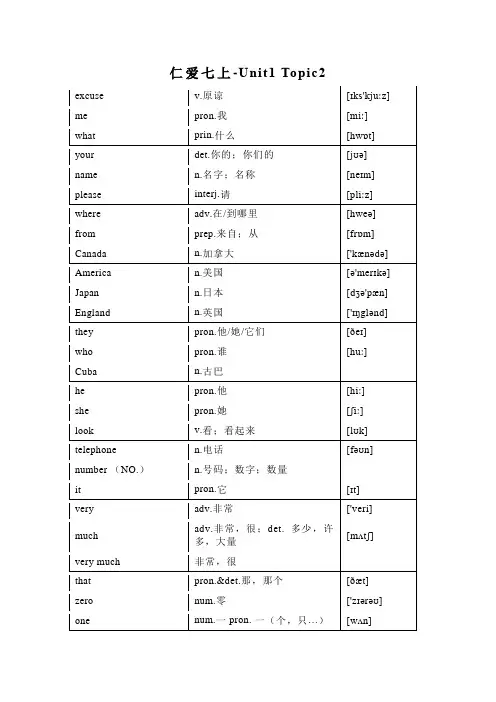
仁爱七上-Unit1 Topic2知识梳理【重点短语】1. good morning/ afternoon / evening 早上/下午/晚上好2. glad / nice to meet / see you 见到你很高兴3. welcome to + 地点欢迎来到……4. let’s + v让我们做……5. stand up 起立6. sit down 坐下7. this is... 这是……8. thanks = thank you 谢谢9. see you = see you later = goodbye 再见10. ID number 身份证号码11. be from=come from 来自12. in English 用英语【重要句型】1. ---What’s your name? ---My name is Sally.2. ---Where are you from? ---I’m from China.---Where do you come from? ---I come from China.3. ---Where is he/ she from? ---He/She is from Japan.4. ---What’s this/ that in English? --- It’s a/ an…5. ---What’re these/ those in English? ---They’re…6. ---How do you spell it? ---E-R-A-S-E-R, eraser.7. ---Can you spell it? ---Yes, M-A-P, map.8. —How old are you/ is he/ are they?—I’m/ He is/ They are eleven.9. —What’s your telephone number?—It’s 4567967.10. —What class/ grade are you in?—I’m in Class Ten, Grade Seven.(注意大小写)11. Good morning/ afternoon/ evening.12. —Hello!/Hi! —Hello!/Hi!13. —Nice/Glad to see/meet you. —Nice/Glad to see/meet you, too.14. —Welcome to China/my home. —Thanks.15. —How do you do? —How do you do?16. —How are you? —Fine, thank you. And you? —I’m OK.17. —See you then/ later. —See you.18. —Goodbye. —Bye.19. —Thank you. —You’re welcome./That’s OK./Not at all.【重点语法】1. 元音字母:Aa Ee Ii Oo Uu包含有以下元音的字母:[e] Aa Hh Jj Kk[i:] Ee Bb Cc Dd Gg Pp Tt Vv[aɪ] Ii Yy[ju:] Uu Qq Ww[e] Ff Ll Mm Nn Ss Xx Zz2. 大小写句首字母,人名,地名,称呼语,专有名词,星期的首字母要大写,引人注意。
仁爱版七年级上 Unit2Topic1 2知识梳理
U2 T2 知识梳理
Part1 单词回顾
• 颜色类单词:
红色;橙色;黄色;金黄色;绿色;灰色;黑色;粉红色;紫色;蓝色;棕 色;帽子;连衣裙;短裙;衬衣;大衣;裤子(两种);鞋子;手套
• 介词:
• of; at;like • 动词:
后面的宾格还是主格???
• 给;买;喜欢;想要 • 特殊名词(并写出复数)
6.a pair of 用法(考点;难点;易错点)
a pair of , this pair of , that pair of these pairs of , those pairs of
练习 This pair of shoes ___(be) black. That pair of shoes ___(be) black. These pairs of shoes ___(be) black. Those pairs of shoes ___(be) black. The shoes _____ (be) black. The three pairs of shoes _____(be) black.
用have,has 填1 空
1.We _____a nice house(房子). 2.Do you ____a pen? 3.Does she _____a knife? 4.You ____ beautiful looks. 5. Jim ____ two big eyes. 6. She and he_____ short hair.
1.He has small feet.(改为一般疑问句,并作出肯定回答) ______________________________________________ 2.I have a knife.(改为一般疑问句,并作出否定回答) ___________________________________________ 3.Lily has long hair.(改为一般疑问句,并作出肯定及否定回答) _________________________________________________ 4.Lily and Lucy have small ears.(改为一般疑问句,并作出肯定 及否定回答) ________________________________________________ 5.My sister has long legs,(改为一般疑问句) _____________________________________-
仁爱版英语七年级上册 Unit 1 topic3 知识归纳
Unit 1Topic 3old/How old课文原句:So, how old are you, Alan?讲解:how old问年龄。
问年龄的两种方式可以互用:How old is ...? = What's sb's age?-How old is your grandfather?-He is 60 years old.old adj. 意为“旧的,陈旧的”,其反义词为new新的。
The story is very old.这个故事十分古老。
年老的,年迈的,其反义词为young年轻的。
Everyone grows old.每个人都会变老。
相识很久的,旧交的。
Bob is an old friend of mine.Bob是我的一位老朋友。
另有常见搭配,如the old days以前,旧日的时光。
与old相关的词汇:elder adj. 前辈的,年纪较长的,常用于兄弟姐妹之间的年龄比较,在句中只用作定语,不作表语。
Did you see her elder sister yesterday?你昨天见到了她的姐姐吗?elderly adj. 年老的;渐老的(委婉用法),其后常跟名词。
2 Spell课文原句:-What's this in English?-It's a map.-Spell it, please.-M-A-P.讲解:spell,实义动词,意为“拼写”。
常用的三种句型:1. How do you spell…?2. 祈使句:Spell it, please.3. Can you spell it please?grade/class1. class n. 班级;课如:-Which class are you in this year?-Class Three.—今年你在哪个班?—三班。
I have a history class at 9 o'clock.我9点钟有历史课。
仁爱版七年级上册英语笔记 Unit3 Topic3-Unit4 Topic1知识点总结
U 3 T3—U4 T11.1)would like = wantwould like没有人称和数的变化I would like an egg.=I want an egg.He would like an egg.= He wants an egg.(would like不能加s)2)would like to do = want to doa. He would like to drink some water.(drink)=He wants to drink some water.b. She would like (visit) the Great Wall.=She the Great Wall.3)I would like=I’d like He would like=He’d like4)a. I’d like an egg.(一般疑问句) Would you like an egg?Yes,please./ No,thanks.b. He’d like a hamburger.he a hamburger?. / .5)Would you like some chicken?(用some 加强语气,表示强调)6)I’d like an egg.What would you like?He’d like some fish.he ?2.1)you—yourself(反身代词)2)yoursel f---yoursel ves(pl.)3.help yourself/yourselves to +n.:随便吃……a. Help yourself (you) to some chicken, Tom.b. Help yourselves (you) to some chicken, kids.4.1)可数名词[C]:有单数和复数的形式.2)不可数名词[UC]:一般没有复数的形式.3)常见的不可数名词有:milk,rice,fish(鱼肉),chicken(鸡肉),(apple/orange) juice,water,bread5.fish:1)作为“鱼” , 是可数名词.fish—fish(pl.)2)作为“鱼肉”, 是不可数名词.some fish6.chicken:1)作为“鸡” , 是可数名词.a chicken2)作为“鸡肉”, 是不可数名词.some chicken7.some + n.(pl.),some+ [UC]some eggssome fish/chicken/milk/apple juice/rice8.---Help yourselves.---Thank you.9.---Would you like…? ---Yes, please. /No, thanks.10.What/How about +sb(宾格)/sth?What about him/her/some milk?11.All right.行,好吧(表示对别人的建议表示赞同)---I’d like some rice and chicken.---All right.k for me.13.Me,too.14.表示建议:---What about …? ---Good idea.15.an ideaa good ideaHomework:1.I’d like a hamburger.(一般疑问句) a hamburger?(肯否回答) ./ .2.She’d like some orange juice.she ?3. , boys and girls.(随便吃些鸡肉吧)4.She likes it very much.(否)She it .5..(我想喝些牛奶).6.他们怎么样??Unit 3 T 3 Section B—D1.1)usually:70-80%,often:50-60%2)usually,often放在be之后,行为动词之前.I usually have breakfast at home.2.have…for breakfast/lunch/supper/dinner1)He usually has an egg and some milk for breakfast.2)We usually have some rice and chicken for supper.3.一日三餐前不加a/an/the,后不加s.What do you usually have for/ breakfast?4.1)He usually has some bread for lunch.What does he usually have for lunch?2)We usually have some juice and fish for dinner.usuallyfor dinner?5.have:1)有2)吃,喝:have milk/bread6.[UC]前面不加a/an/the,后不加s.He has / milk and/ bread for breakfast.7.What/How about +sb(宾格)/sth?8.with带着/有,(表示伴随关系)have chicken/fish with vegetables9.some rice10.three meals(餐):breakfast,lunch,supper/dinner11.food:[UC],食物的总称,作主语,谓语用单数.My favorite food is (be) chicken and fish.12.Chinese /English food13.wait(v.)—waiter(指人)(男服务员)---waitress(女服务员)14.take one’s orderMay I take your order?15.something to drink/eat1)修饰词如不定式(to do) ,形容词修饰something时,放在something之后.2)something:某事(肯定句)anything:任何事(否/疑问)nothing:没有什么事(表否定意思的陈述句)3)Would you like +something?Would you likesomething to eat ?16.[UC]表示数量的表达法:1)a glass of apple juice/watera bag of rice /milk2)a glass of apple juice---two/some glasses of apple juice3) a bag of milk---five bags of milk17.wait/just a moment18.Let me see.让我想一想.I see. 我明白了.19.1)Would you like some vegetables?2)some vegetables/rice20.something to drink21.banana juice----Section C1.eat out2.eat---eating(现在分词)3.would like to doWould you like to have (have) dinner with me?4.have / breakfast/lunch/supper/dinner5.with sb(宾格)6.Would you like to have lunch with him?7.Yes, I’d like/love to.(to不能省略)8.1)May/can I help you?=What can I do for you?2)情态动词may/can/could+动原May I help (help) you?9.sir—madam(对应词)10.What would you liketo eat (eat)?11.Why not+动原? =Why don’t you +动原?Why not study (study) with me? = Why don’t you study with me?12.表示建议:1)What about…? 2)Why not…?肯定回答:Good idea.13.Here you are.14.---Would you like sth to drink?---Yes,please./No,thanks.Section D1.in+地点: in China2.many+n(pl.)many friends3.1)all,bothall指三者或三者以上“都”both指两者“都”2)all,both放在be之后,行为动词之前They are all students.We all like school.4.be kind to sbThe teacher is kind to us.5.have dinner with them6.such as +若干例子7.Sichuan food8.be glad to do sthObama is glad to visit (visit) the Great Wall.9.1)here,there是介词,前不加介词.2)be here/thereI’m glad to be (be) here.10.let sb do sthLet me (I) see (see).Homework:1.他晚饭通常吃什么?he usually?2.你可以点菜了吗??3.Tom,为什么不随便吃些汉堡包呢,?,Tom?4.你想喝些什么东西吗?来两杯香蕉汁.Would you like?.5.She’s glad (be) there.6.I’d like (work) with you.7.Would you like something(say)?8.Why not (tell) him about it.= him about it.9.他对我很友善.He .10.I usually have some rice for lunch.usually for lunch?1.---Do you like…?---Yes, I like …very much/a lot/a little.(No, I don’t like …at all.)Section D1.at / homeHe has a dog at home.2.it’s, its(它是)(它的)a cat. name’s Mimi.3.Tommy =Tom4.Zhou Lan likes it a lot.= Zhou Lan likes it very much.(否)Zhou Lan doesn’t like it at all.5.some,anyShe has some pets.(否)She doesn’t have any pets.(疑问)Does she have any pets?6.1)人称代词:主格---宾格I—me,you-you,he-him,she-her,it-itwe-us,they-them2)形物代—名物代my-mine,your-yours,his-his,her-hers,its-its,our-ours,their-theirsThis is a girl. name is Lily. is twelve. We like .(Her,She,her)Unit 4 T1 Section A1.What can I do for you?=Can/May I help you?2.madam---sir(对应词)3.want to do = would like to do1)She wants to have milk and bread.=She would like to have milk and bread.2)Would you like a glass of apple juice?=Do you want a glass of apple juice?3)Would she like some vegetables?=Does she want any vegetables?4.clothes:衣服的总称,复数名词,作主语时,谓语用复数形式。
仁爱英语七年级上册Unit2topic2知识点讲解及随堂练习
仁爱英语七年级上册Unit2topic2知识点讲解及随堂练习仁爱英语七年级上册Unit2-topic2知识点讲解及随堂练习————————————————————————————————作者:————————————————————————————————⽇期:(⼀)知识点讲解1.We both have black hair and black eyes.我俩都长着⿊头发、⿊眼睛。
both pron.(与复数名词连⽤)意为“两个,两个都”。
both 放在be 动词,助动词或情态动词后⾯,实义动词的前⾯。
如:We are both from Sichuan.我俩都来⾃四川。
They both work in Toronto. 他俩都在多伦多市⼯作。
2. But you look the same.但是你们看起来⼀样。
We don’t have the same looks, but we are good friends!我们没有相同的外貌,但我们是好朋友!以上两句中出现了look the same 与 the same looks 两个短语。
虽然是由三个同样的单词组成的两个短语,但是由于它们的位置不同,意思就不⼀样。
look the same中的 look 是动词,意思是“看起来…..”,⽽the same looks 中的look 为名词,常⽤复数,意思是外表,外貌,样⼦”。
因此 look the same 意为“看起来很像”,⽽ the same looks意为“相似的外貌”【链接】look at 看…..; look like看起来像。
如:Please look at the blackboard.请看⿊板。
He looks like his father.他看起来像他的爸爸。
【拓展】look the same 的反义词组是:look different.3.Please give this letter to Maria.请把这封信给玛丽亚。
仁爱英语七年级上册Unit3-topic1复习
• 但是我只是有点喜欢。
• but I like it a little.
•
我们是好朋友,我们互相帮助。
• We are good friends and we help each other.
• she wants to visit Beijing. • She lives in England. • He works in a hospital. • She teaches in a high school. • She likes to play with Kitty.
• 了解很多关于 know a lot about
• 住在英国
live in England
词组
• 我们班的许多学生 many students in our class
• 一点点喜欢
like ... a little
• 一点也不喜欢 not like ... at all
• 不是很好
not very good
A. very
B. much
C. at all
D. little
8.I like the little cat a lot but she likes
it ____. B
A. a lot
B. a little
C. lot
D. much
9.Sally often helps me study English. And
可以这样说
My pen pel speaks English, but he knows a lot
about China.
. 10. 你想询问对方的国籍是不是美国,你可以这样问: Are you from America_? 11.当别人问你可不可以帮他做一件事情的时候 你可以这样
仁爱英语七年级上册语法精讲(一)
Unit 1-topic11. 动词be的用法动词be有三种形式:am, is, are, 它们都是“是”的意思,被称为“be动词”。
(1) am用于第一人称单数I。
其完全形式是I am ...,缩写形式是I’m ...,但I am在句末时不能缩写。
e.g. I am/I’m Li Lei. 我是李雷。
Are you Mr. Li? Yes, I am. 你是李先生吗?是的,我是。
(2) is用于第三人称单数。
e.g. My teacher is Miss Yang. 我的老师是杨小姐。
(3) are用于第二人称单数、复数或第一人称复数和第三人称复数。
e.g. You are Li Ping.你是李平。
My mom and I are at home. 妈妈和我都在家。
2. 打招呼时常用的交际用语(1)How are you?用于熟人之间,表示问候。
回答用Fine./I’m fine./I’m OK.Thanks.(2)How do you do?用于初次见面,伴随握手动作,是表示庄重、礼貌的正式问候语。
回答仍用How do you do?(3)Nice to meet you.经人介绍认识对方,礼节性地互致问候。
对方用Nice to meet you, too.来回答。
(4)Hi!和Hello!是熟悉的人之间打招呼或非正式的问候语,回答也用Hi!和Hello!意思均为“你好!”Unit 1-topic21. Where is she from?或Where’s she from?这是询问某人来自何处的一个特殊疑问句。
e.g. Where are you from?你来自哪里?I’m from China.我来自中国。
2. What is your name?或What’s your name?这是询问某人姓名时常用的一个特殊疑问句,回答时常用My name is ...或I’m ...e.g. What’s your name? 你叫什么名字?My name is Jane. 或I’m Jane. 我叫简。