
【真题】2020年广州市中考英语试题及答案(Word版)
2020年广州市初中毕业生学业考试英语本试卷共四大题,12页,满分110分。
考试时间120分钟。
注意事项:1.答卷前,考生务必在答题卡上用黑色字迹的钢笔或签字笔填写自己的考生号、姓名、考点考场号、座位号,再用2B铅笔把对应这两个号码的标号涂黑。
2.选择题每小題选出答案后,用2B铅笔把答题卡上对应题目的答案标号涂黑。
如需要改动,用橡皮擦干净后,再选涂其他答案。
不能答在试卷上。
3.非选择题必须用黑色字迹的钢笔或签字笔作答,答案必须写在答题卡各题目指定区域的相应位置上;如需要改动,先划掉原来的答案,然后再写上新的答案,改动的答案也不能超出指定的区域;不准使用铅笔、圆珠笔和涂改液。
不按以上要求作答的答案无效。
4.考生必须保持答题卡的整洁,考试结東,将本试卷和答题卡一并交回。
一、语法选择(共15小题;每小题1分,满分15分)阅读下面短文,按照句子结构的语法性和上下文连贯的要求,从1~15各题所给的A、B、C和D项中选出最佳选项,并在答题卡上将该项涂黑。
Xian Xinghai was a very famous musician in China. He wrote one of the greatest pieces of music of the 20th century. In his short life he wrote-1 300 songs and an opera.Xian was bom in Panyu, Guangdong, China in 1905. Because his father died before he was born, Xian moved from place to place with-2 mother. He began learning to play_ 3 violin when he was 20 years old. In the beginning, his violin was cheap and badly made that he_ 5 not play it well. His friends laughed at him. Xian did not stop 6 and soon showed his talent. In 1934, he was one of the first Chinese students_7 studied in a special music school in Paris. Before he 8 , Xian became the schools best student 9 won several prizes for his talents.In 1935, he returned to China and helped fight against the Japanese army. Later, he came to Yan'an 10 music at a college. 11 there were no pianos in Yan'an at that time Xian still wrote 12 of his most important music there, including The Yellow River, his most famous work.In May 1940, Xian 13 to the Soviet Union by the Chinese Communist Party towrite music for movies. In the Soviet Union, life was very 14 . Xian got sick and later died of a lung illness 15 October 30, 1945, aged only 40. Xian's music, however, lives on in the people's hearts.1. A. near B. nearly C. nearby D. nearer2. A. he B. him C. his D. he’s3. A. a B. an C. the D. this4. A. so B. such C. very D. much5. A. need B. may C. should D. could6. A. practice B. practicing C. to practice D. practised7. A. what B. which C. whom D. who8. A. leave B. leaves C. left D. was leaving9. A. and B. but C. as D. or10. A. teach B. taught C. teaching D. to teach11. A. If B. Although C. When D. Because12. A. any B. little C. few D. some13. A sent B. was sent C. has sent D. was sending14. A hard B. harder C. hardest D. the hardest15. A. at B. in C. on D. by二、完形填空(共10小题;每小题1.5分,满分15分)阅读下面短文,掌握其大意,然后从16~25各题所给的A、B、C和D项中选出最佳选项,并在答题卡上将该项涂黑。
Before graduating college, Jackie began to look for a job. She aimed at a famous company, but the 16 for such jobs was very strong. The company Jackie chose planned to employ only one person, but more than twenty people applied for the job. 17 , Jackie was one of the three people invited for the final interview. The interview was very 18_ . The interviewer asked just a few questions and it was all over in less than 10 minutes. Then the interviewer said to them, "All of you are very good. Please go home and 19 our response.”Three days later, Jackie received a message saying she would not be 20 the job. She felt deeply disappointed. That evening. however she received another 21 . This time it said that she got the job.Jackie later found out that the first message sent to her phone was part of the interview---a22 to see if she was suitable for the job. All the three people received the_ 23 _text, but only Jackie's reply 24 the company Of the three, one did not reply. The other said “goodbye” and Jackie said “thank you”. This reply showed that Jackie was a/an25 person, so the company offered her the job.16. A. exam B. work C. competition D. plan17.A. Thankfully B. Unluckily C. Hopefully D. Immediately18. A. long B. strict C. interesting D. simple19. A. pick up B. wait for C. deal with D. think of20. A. offered B. returned C. refused D. shown21. A. letter B. e-mail C. call D. message22. A guide B. conversation C. test D. lesson23. A. same B. other C. second D. whole24. A. reached B. satisfied C. helped D. surprised25. A. brave B. clever C. polite D. honest三、阅读(共两节:满分45分)第一节阅读理解(共20小题;每小题2分,满分40分)阅读下列短文,从26~45各题所给的A、B、C和D项中选出最佳选项,并在答题卡上将该项涂黑。
(A)For his eleventh birthday, Lin was given a gift that would shape his life. On that day his father took him to the Children’s Activity Centre and said he could choose any course that interested him. There was just one requirement: Lin would have to promise to study it for at least one year.To that point Lin had had many hobbies, but none kept his interest for more than a week or two. His mum once gave him a bag of stamps to encourage stamp collecting. That hobby lasted a week. Then his father got him some paints hoping that Lin's artistic side would shine through. Those paints were now under his bed, still unopened. This time Lin’s parents would let him decide.Lin's eyes moved down the noticeboard that listed all the courses on offer. He stopped at"Photography". He liked the idea of taking beautiful pictures but the notice said that each student nee ded their own camera. Although Lin's family weren't poor, they weren’t rich either, and a camera cost a lot of money. He continued looking.The next course to catch his eye was "Language Art". He didn’t even know what that meant. His father explained that it taught people how to make public speeches. Lin, a shy boy, could think of nothing worse.Then he saw it. "Cooking" sounded like something he'd like to do. It was inexpensive and convenient, it could be done alone and it was also creative.Based on Lin’s hobby history, his dad had doubts, but he agreed. Much to his parents' surprise, Lin kept his promise. He studied cooking at the Centre every Saturday, and practised at home, making delicious meals for his family. Everyone looked forward to birthdays, when they could eat his cakes. Lin got great satisfaction from the pleasure his food brought to others.The months turned to years but his hobby never changed again.Now Lin is an adult and runs a successful restaurant. When customers say they enjoy his meal, he still gets the same pleasure he did as a child, and remembers the special gift he received all those years ago.26. Why didn't Lin choose to study photography?A. It was too expensive.B. He had no interest in it.C. He was not very creative.D. It was not offered that term.27. The underlined expression "catch his eye" in Paragraph 4 means “”.A. make him excitedB. cause him surpriseC. get his attentionD. help him see clearly28. Which of the following best describes Lin's interest in cooking?A. It only lasted for a short time.B. It seemed to match his character.C. It was forced on him by his parents.D. It developed slowly over many months.29. Why did the father have doubts about Lin's choice of cooking?A. Lin wasn't good at cooking.B. Cooking wasn't very convenient.C. He didn’t think Lin would continue.D. Cooking wasn't a good hobby for a boy.30. What's the best title for the passage?A. A Strict FatherB. A Changeable BoyC. The Fun of CookingD. The Birthday Gift(B)Experts believe that there are more than 8 million restaurants in the world today. So it might surprise you to learn that restaurants, as we know them, have only existed for a few centuries. Before 1765, there were no restaurants. That is, there were no places that provided the restaurant experience. There was nowhere in which a waiter brought you food and drink that you picked from a menu. In fact, there were no menus anywhere.There were eating places travellers could go to centuries before that. The countryside was full of inns that would serve food. And there were taverns where one could get drinks. The rich could also eat special meals prepared by private cooks. But none of them could be called a “restaurant”.A man called Boulanger changed that. In 1765, he opened a place in Paris that sold soups(汤). On his sign he used the word "restaurant" to describe what he was selling. At that time, soups were considered something that could help "restore"(恢复)your health- in French the word "restore" is “restaurer”--- so he called the soups "restaurants". Soon, people started buying Boulanger's soups even when they were not ill. And over time, people began to use the word "restaurant" to refer to a place selling soup rather than the soup itself. More "restaurants" opened in France, and people began to buy soups more often.Later, restaurants in Paris began to serve other food besides soup. In the 1790s, menus started to appear. By the mid-1800s, there were many types of restaurants throughout the world. The United States offered coffee shops. Tea houses became popular throughout China. Paris createdbeautiful restaurants for the rich. The British began to copy the French, and the restaurant idea spread throughout the British Empire.Today cities are filled with all types of restaurants. Diners have millions of options from which to choose.31. What is the passage mainly about?A. How restaurants developedB. What made a good restaurant.C. Who created the first restaurantD. Why restaurants became popular.32. According to the first paragraph, what made restaurants different from earlier eating places?A. Restaurants only served foodB. Restaurants were more expensiveC. Restaurants were mainly in citiesD. Restaurants had a list of meal choices33. Who did Boulanger expect to come and eat at his restaurant?A. Rich peopleB. Sick people.C. Travellers.D. Workers.34. When it was first used. what did the word "restaurant" refer to?A. A person.B. A place.C. Illness.D. Soup.35. When did restaurants begin to grow internationally?A. In the 1600s.B. In the 1700s.C. In the 1800s.D. In the 1900s.(C)Many people know that rubbish is a big problem on planet Earth. What many people don't know is that junk(垃圾)has become a problem in outer space too.According to BBC News, there are more than 22, 000 pieces of space junk floating around the earth. And these are just the things that we can see from the surface of the earth by telescopes (望远镜). There are also millions of smaller pieces of junk that we can't see.Objects, like bits of old space rockets or satellites, move around the planet at very high speeds fast that even a very small piece can break important satellites or become dangerous to astronauts. If the tiniest piece of junk crashed into a spaceship, it could damage the vehicle.To make things worse, when two objects in space crash, they break into many smaller pieces. For example, when a U.S. satellite hit an old Russian rocket in 2009, it broke into more than 2,000 pieces, increasing the amount of space junk.To reduce additional space junk, countries have agreed that all new space tools can only stay in space for 25 years at most. Each tool must be built to fall safely into the earth's atmosphere after that time. In the upper parts of the atmosphere, it will burn up.Many scientists also suggesting different ways to clean up space junk. In England scientists are testing a metal net that can be fired into space junk. The net catches the junk and then pulls it into the earth's atmosphere to burn up. The Germans are building robots that can collect pieces of space junk and bring them back to Earth to be safely destroyed.The problem is becoming more challenging because we're sending more objects into space to help people use their mobile phones and computers,” says Marco Castronuovo, an Italian space Researcher.“The time to act is now. The longer we leave the problem, the bigger it will become,”he says.36. What does the underlined word “these” in Paragraph 2 refer to?A. Telescopes.B. Satellites.C. Pieces of space junk.D. BBC news reports.37. Why is space junk considered a problem?A. It buns up after it re-enters the atmosphereB. It often stops the view of telescopes on EarthC. It could force new space tools to travel at slower speedsD. It may crash into other space tools causing damage or deat38. Countries want future space tools to be able to fall back into the earth's atmosphere so that .A. the tools can be reused laterB. the tools don't become space junkC. the earth’s atmosphere can stay cleanD. the effects of space flight can be studied39. How do the Germans plan to deal with space junk?A. Catch it with nets.B. Use robots to collect it.C. Burn it in the earth's atmosphere.D. Send it further away from the earth.40. In which section of the newspaper would you probably read this article?A. Environment.B. Local News.C. Education.D. Fashion.(D)41. How are the books on this webpage listed?A. By price.B. By popularity.C. By reader’s age.D. By writer’ s name.42. What is true about the book Women in Science?A. It is mainly about Marie Curie's history.B. It lists all the important scientific achievements.C. It includes women scientists that aren’t famous.D. It is mostly about the development of modem science.43. How much will a Bestbooks Book Club member pay in total if he orders First Big Book of How and A Really Short History of Nearly Everything today?A. $34.B. $30.C. $26.D. $24.44. A primary school student who needs to write a science report about African elephants should choose .A. Women in scienceB. First Big Book of HowC. A Really Short History of Nearly EverythingD. National Geographic's First Big Book of the World45. What is the main purpose of this webpage?A. To sell books to young readers.B. To attract new book club members.C. To encourage students' interest in science.D. To review books young readers might like.第二节阅读填空(共5小题;每小题1分,满分5分)阅读短文及文后A~E选项,选出可以填入46~50各题空白处的最佳选项,并在答题卡上将该项涂黑。
2020广州中考英语卷

2020广州中考英语卷一、语法选择The first astronautSince the earliest times, people have looked up at the stars, the moon and the planets、 Today people use modern machines1 at the sky、 This is very different from the situation2 years ago when people could only use their eyes、 Perhaps they dreamed of3 the universe、When did humans first go into space? The story began not so very long ago,4 the first astronaut were not people – they were animals、Scientists wanted to make travelling to space as5 as possible for humans、 So they decided to experiment with animals and test6 in spaceflights、 Insects, mice, frogs, dogs and monkeys were some of the animals7 first wentinto space、 Many of them8 , but they helped to make space travel safer for humans、 For their great service, we9 forget these animals、Albert II was the first monkey to go into space in1949、 Sadly he died10 his spaceship landed back on Earth、11 the result was different for Ham the Monkey、His story ended happily when he returned to Earth12 very good health、Scientists wanted to know the answer to theimportant question: could13 animal like Ham do the same things in space as he could do on Earth? The answer came when Ham14 into space in1961、Yes, he did everything well and lived for1516 years、1、A、 lookB、 to lookC、 lookingD、 looked2、A、 thousandB、 thousandsC、 thousand ofD、 thousands of3、A、 exploreB、 to exploreC、 exploredD、 exploring4、A、 asB、 orC、 butD、 so5、A、 safeB、 saferC、 safestD、 the safest 6、A、 theyB、 themC、 theirD、 theirs7、A、 whomB、 whatC、 thatD、 whose8、A、 dieB、 diedC、 have diedD、 will die9、A、 shouldntB、 may notC、 dont have toD、 neednt10、A、 ifB、 becauseC、 afterD、 since11、A、 LuckB、 LuckyC、 LuckierD、 Luckily12、A、 atB、 onC、 inD、 for13、A、 aB、 anC、 theD、 /14、A、 sendsB、 sentC、 is sentD、 was sent15、A、 anotherB、 otherC、 othersD、 the other二、完形填空John suddenly jumped off the swingwithout even slowing down、 He called out nervously, "Mom, wheres Charlie?" He had just16 he hadnt seen his newpuppy for over an hour、John looked around the garden, behind the bushes, and under the picnic table、 No dog!His mother heard the17 in his voice as he called her a second time、 "Mom, I cant find Charlie!"She cameoutside18 、 "Lets look around the garden first、 Dontworry、 Im sure hes close by、"Both son and mother were19 now, but still no Charlie、 Their calls were not completely wasted, though、 Joe, the next-door neighbour, and his two daughters Tania and Julie, immediately agreed to help them20 the lost dog、But even with five people now searching the towns streets, they had no luck、Charlie was still21 、Tania suggested they make posters with Charlies22 、 She had done this when her own cat was lost a year earlier, she told John, and the cat was found the next day、John agreed、 When they got home, he made a poster with a photo of Charlie、 Then John heard a23 and opened his bedroom door、 It was Charlie、 John was greeted with a big wet kiss、 Charlie had been24 in the bedroom this whole time, sleeping、 John had never been so25 in his life!16、A、 decidedB、 forgottenC、 understoodD、 realized17、A、 angerC、 fearD、 warning18、A、 activelyB、 quicklyC、 carelesslyD、 annoyingly19、A、 shoutingB、 talkingC、 fightingD、 thinking20、A、 give upB、 look forC、 run afterD、 take care of2 1、A、 missingB、 asleepC、 taken22、A、 addressB、 characterC、 nameD、 picture23、A、 messageB、 noiseC、 voiceD、 song24、A、 shutB、 wokenC、 tiedD、 saved25、A、 afraidB、 sillyC、 happyD、 proud三、阅读第一节阅读理解AAn elephant and a crocodile were once standing beside a river、 They were disputing which was the better animal、"Look at my strength," said the elephant、 "I can pull up a tree, roots and all, with my trunk、""Ah! But your skin is not nearly so thick as mine," replied the crocodile、 "No knife or tooth can cut through it、"Just as they were coming to blows, a lion happened to pass、"My dear friends!" said the King of all animals, going up to them、 "Let me know the cause of your disagreement、""Will you kindly tell us which is the better animal?" cried both at once、"Certainly," said the lion, pointing across the river、 "Do you see thesoldiers metal hat on that wall?""Yes!" replied the beasts、"Well, then," continued the lion, "go and get it to me, and I shall be able then to decide between you、"Upon hearing this, off they started、 The crocodile, being used to the water, reached the opposite side of the river first, and was soon standing beside the wall、Here he waited till the elephant came up、 The elephant, seeing that the crocodile had no reaching their goal, raised his long trunk, and took down the hat quite easily、They then made their way together back againacross the river、 The elephant was trying to keep up with the fast-moving crocodile in the water and became careless、 When he was forced to turn sharply to avoid a floating tree branch, the elephant dropped the hat and it fell to the river bottom、 The crocodile noticed the accident, so down the dived, and brought it up in his huge mouth、 They then returned, and the crocodile laid the metal hat at the lions feet、 The King took it up, and turning to the elephant, said:"You, because of your size and trunk, were able to reach the hat on the wall but, having lost it, you were unable to get it back、 And you," said the lion to the crocodile, "although unable to reach the hat, were able to dive for it and save it、 You are both wise and able in your own ways、 One is nobetter than the other、26、 The underlined word "disputing" in Paragraph1 means 、A、 playingB、 quarrellingC、 complainingD、 deciding27、 What did the crocodile think was best about himself?A、 His big mouth、B、 His strong skin、C、 His swimming skill、D、 His dangerous teeth、28、 How did the lion deal with the animals disagreement?A、 He ordered them to fight、B、 He made a quick decision、C、 He suggested a competition、D、 He asked them to describe themselves、29、 What caused the elephant to drop the hat?A、 The hat got wet in the river、B、 He hit a floating tree branch、C、 He was trying to swimming too fast、D、 He wanted to fight the crocodile、30、 How were the elephant and the crocodile able to complete their task?A、 By working together、B、 By planning carefully、C、 By sharing their ideas、D、 By listening to the lion、BThey say that "travel is the best teacher" and there is no better example of this idea than the Ming dynasty travel writer and geographer Xu Xiake(1587-1641)、 His book The Travel Notes of Xu Xiake, not only encouraged a love of travelling among Chinese people but provided important scientific information about the countrys land and geography、Born into a wealthy Jiangyin family, Xu became interested in books about different places at an early age and wanted to travel、 When he was19, however, Xus father died and so, it seemed, did his travelling dreams、 He now was responsible for the family farm and taking care of his60-year-old mother as tradition required、But his mother had different ideas、Understanding her sons love of travel and valuing the knowledge he could get from such experience, this modern-thinking woman refused to keep her son at home、 She agreed that Xu could travel for three months every year, when there was less farm work、So at the age of twenty and with his mothers support, Xu set off for the first time, leaving behind not only his mother but his new wife as well、 He would repeat this goodbye each year for mostof the next30 years、 During this time, he travelled throughout the Ming kingdom, carefully studying the lands he passed through and recording his experiences and many discoveries in a diary、 This diary, which once hadover500,000 words, would eventually become The travel Notes of Xu Xiake、Although rich, Xu avoided comfortable travel, preferring to go almost everywhere on foot、 This way he could research the environment in detail and get a true picture of the natural world、 Many of his trips were to hard-to-reach mountain areas, and through wild forests where few people lived、 His willingness to face hardships came at a cost however、 Progress was slow and tiring and he was frequently sick, robbed and beaten during his journeys、Sadly Xu became seriously ill during his last and longest journey, a4-year trip through the southwest of China、 He died in1641, soon after returning to his hometown for the last time、 When his diary was finally printed years after his death, much of it had been destroyed or lost、 Although incomplete, it still made Xu a travelling legend around the world、31、What is the passage mainly about?A、 The general details of Xu Xiakes life story、B、 The difficulties Xu Xiake faced in his travels、C、 The important discoveries made by Xu Xiake、D、 They influence of Xus book The Travel Notes of Xu Xiake、32、 Which of the following best describes Xus mother?A、 Strict but interesting、B、 Kind but uneducated、C、 Helpful and hardworking、D、 Supportive and open-mind、33、 Why did Xu prefer walking during his travels?A、 It gave him the chance to meet different kinds of people、B、 It helped him to save money and travel for a long time、C、 It allowed him to see and study the environmentin detail、D、 It was the only way to reach the places he was interested、34、 What is true about Xus book The Travel Notes of Xu Xiake?A、 It was only made public after Xu died、B、 It made Xu very famous during his lifetime、C、 It was the first travel book ever written in China、D、 It was mainly about the different people of China、35、 What is the correct order for the following events from Xus life?a、 He went on his first journey、b、 His book was finally printed、c、 He returned to his hometown for the last time、d、 He developed an interest in books about other places、e、 He started managing the family farm after his father died、A、 a-e-d-c-b、B、 d-e-a-c-b、C、 d-e-a-b-c、D、 e-d-a-b-c、Cwww、youthnewshttp:// www、youthnews/your _viewShould Museum Entry Be Free?With International Museum Day coming up, today we are asking readers: Should museums be free or should people have to pay for a ticket? Let us know your view、Comments: Museum are not only there for enjoyment; they are education、This is why they must be free、 While museums need a huge amount of money to operate, let the wealthy pay for it、The idea of a person or child interested in art not being able to view it because of cost is wrong、Krista Chen(US) – Age15 Free entry does not attract people or encourage them to appreciate art、 Generally people respect things that are difficult or costly to get、Museums should require regular visitors to pay a fee, but provide free tickets as prizes for high-achieving students who can appreciate them more、Fred Smith(New Zealand)– Age14 Museums teach people about their past、 This is part of our shared culture that should be available to everyone, rich or poor、 People should never be asked to pay an entrance fee、Rob Sanchez(Australia)– Age17 There are no simple answer、 Low ticket prices could help museums stay open、 But companies and businessmen should also provide museums with more money and other support、 They have a social responsibility too、Amber White(UK)–Age16 I think museums and art galleries should all be free to the public、 I do, however, think twice a year the museums should organize money-raising events to help pay for the cost of staying open、Li Mishao(China)– Age1536、 How many readers support the idea of free museums?A、2、B、3、C、4、D、5、37、 Who suggests museums should regularly hold special events to collect money?A、 Krista Chen、B、 Fred Smith、C、 Rob Sanchez、D、 Li Mishao、38、 Why does Fred Smith believe that free tickets should be given to high-achieving students?A、 Students will then study harder、B、 Museums will attract more visitors、C、 Museums can make themselves more famous、D、 These students can better appreciate museums、39、 Which of the following does Amber White agree with?A、 Business should offer museums more help、B、 People should only pay what they can afford、C、 Free entry doesnt encourage visitors to museums、D、 Everybody should have a chance to visit museums、40、 What can we know about the website?A、 Its quite a new website、B、 It was started in Australia、C、 Its generally for young readers、D、 It mainly discuss scientific topics、DWhile the start of a new school year is always exciting, this year was even more so for some students at White Cloud Primary School、 They became the worlds first kids to be "taught" by an electronic teacher、 This electronic teacher is not a human-like robot walking around the classroom、 Instead, he is a computer-created head that appears, when needed, on students computer or phone screens、 His name isBill、Created by technology company Smart Machines, Billis able to show human-like behaviour、 He is designed to teach a special program about environment-friendly powercreated by the sun and wind、 This program, started in全文结束》》, used to be taught by human teachers、Just like human teachers, Bill is able to immediately respond to the students question and opinions about the topic、Thanks to computer cameras, he is also able to see and react to students physical actions、 For example, if a student smiles at Bill, he responds by smiling back、This two-way exchange helps get the stud。
2020年广东省中考英语试卷(含答案)
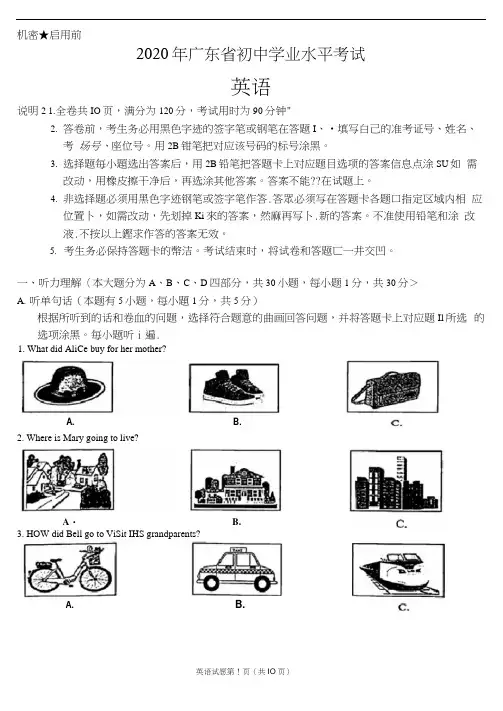
机密★启用前2020年广东省初中学业水平考试英语说明2 1.全卷共IO 页,满分为120分,考试用时为90分钟"2. 答卷前,考生务必用黑色字迹的签字笔或钢笔在答题I 、•填写白己的准考证号、姓名、考 场号、座位号。
用2B 钳笔把对应该号码的标号涂黑。
3. 选择题毎小題选出答案后,用2B 铅笔把答题卡上对应题目选项的答案信息点涂SU 如 需改动,用橡皮擦干净后,再选涂其他答案。
答案不能??在试题上。
4. 非选择题必须用黑色字迹钢笔或签字笔作答.答眾必须写在答题卡各题口指定区域内相 应位置卜,如需改动,先划掉Ki 來的答案,然麻再写卜.新的答案。
不准使用铅笔和涂 改液.不按以上鏗求作答的答案无效。
5. 考生务必保持答题卡的幣洁。
考试结束时,将试卷和答题匸一井交凹。
一、听力理解〈本大题分为A 、B 、C 、D 四部分,共30小题,每小题1分,共30分>A. 听单句话(本题有5小题,每小題1分,共5分)根据所听到的话和卷血的问题,选择符合题意的曲画回答问题,并将答题卡上对应题Il 所选 的选项涂黑。
毎小题听i 遍.3. HOW did Bell go to ViSit IHS grandparents?A.B.1. What did AliCe buy for her mother?A. B.2. Where is Mary going to live?A ・B.4. WhiCh PiCtUre is the SPeaker talking about?A. B.5. What's the highest temperature today?A・ B.B.听对话(本题有10小题,每小题1分,共10分)回答每段对话后面的问题,在毎小题所给的三个选项中选出一个最佳答案,并将答题卡上对应题目所选的选项涂黑。
每段对话听两遍。
听第一段对话,回答第6小题。
6.VVhiCh SeaSOn does Cindy Iike best?A. SPring・B. Autumn.听第二段对话,回答第7小题。
2020届广州市中考英语模拟试题(有答案)(word版)(已审阅)
广州市初中毕业生学业考试英语本试卷共四大题,12页,满分110分。
考试时间120分钟。
注意事项:1.答卷前,考生务必在答题卡上用黑色字迹的钢笔或签字笔填写自己的考生号、姓名、考点考场号、座位号,再用2B铅笔把对应这两个号码的标号涂黑。
2.选择题每小題选出答案后,用2B铅笔把答题卡上对应题目的答案标号涂黑。
如需要改动,用橡皮擦干净后,再选涂其他答案。
不能答在试卷上。
3.非选择题必须用黑色字迹的钢笔或签字笔作答,答案必须写在答题卡各题目指定区域的相应位置上;如需要改动,先划掉原来的答案,然后再写上新的答案,改动的答案也不能超出指定的区域;不准使用铅笔、圆珠笔和涂改液。
不按以上要求作答的答案无效。
4.考生必须保持答题卡的整洁,考试结東,将本试卷和答题卡一并交回。
一、语法选择(共15小题;每小题1分,满分15分)阅读下面短文,按照句子结构的语法性和上下文连贯的要求,从1~15各题所给的A、B、C和D项中选出最佳选项,并在答题卡上将该项涂黑。
Xian Xinghai was a very famous musician in China. He wrote one of the greatest pieces of music of the 20th century. In his short life he wrote-1 300 songs and an opera.Xian was bom in Panyu, Guangdong, China in 1905. Because his father died before he was born, Xian moved from place to place with-2 mother. He began learning to play_ 3 violin when he was 20 years old. In the beginning, his violin was cheap and badly made that he_ 5 not play it well. His friends laughed at him. Xian did not stop 6 and soon showed his talent. In 1934, he was one of the first Chinese students_7 studied in a special music school in Paris. Before he 8 , Xian became the schools best student 9 won several prizes for his talents.In 1935, he returned to China and helped fight against the Japanese army. Later, he came to Yan'an 10 music at a college. 11 there were no pianos in Yan'an at that time Xian still wrote 12 of his most important music there, including The Yellow River, his most famous work.In May 1940, Xian 13 to the Soviet Union by the Chinese Communist Party to write music for movies. In the Soviet Union, life was very 14 . Xian got sick and later died of a lung illness 15 October 30, 1945, aged only 40. Xian's music, however, lives on in the people's hearts.1. A. near B. nearly C. nearby D. nearer2. A. he B. him C. his D. he’s3. A. a B. an C. the D. this4. A. so B. such C. very D. much5. A. need B. may C. should D. could6. A. practice B. practicing C. to practice D. practised7. A. what B. which C. whom D. who8. A. leave B. leaves C. left D. was leaving9. A. and B. but C. as D. or10. A. teach B. taught C. teaching D. to teach11. A. If B. Although C. When D. Because12. A. any B. little C. few D. some13. A sent B. was sent C. has sent D. was sending14. A hard B. harder C. hardest D. the hardest15. A. at B. in C. on D. by二、完形填空(共10小题;每小题1.5分,满分15分)阅读下面短文,掌握其大意,然后从16~25各题所给的A、B、C和D项中选出最佳选项,并在答题卡上将该项涂黑。
2020年-广州中考英语试卷

2020年广州市初中毕业生学业考试(中考英语)一、语法选择阅读下面短文,按照句子结构的语法性和上下文连贯的要求,从1-15各题所给的A、B、C和D项中选出最佳选项,并在答题卡上将该项涂黑。
Deep in the forest lives David, who loves books. As soon as he reads one book, he brings home___1_____. Soon the house ___2_____ books. His wife, Alice, is angry. “You ____3____ do something!”David thinks hard and has____4____ idea. “I can bring my books into the faraway hills and share____5____ I have with the children.”Every week, David sets off across the countryside to faraway villages with his two donkeys. Early ___6_____ a sunny morning, David and his donkeys stop at a river____7____. Then, from deep in the shadows, a bandit(山贼) jumps out! “Please let us pass,”David says. “The children ____8____.” The bandit takes one book and shouts, “Next time I want ____9____!”They move on until at last, David sees some houses below. The children run to meet ____10____. David reads them a story first. _____11___ the story ends, it’s time for everyone to choose a book. The children hold their books close as they say good-bye and run home ___12_____. David and his donkeys head back, over and around the hills, and into the sunset.At home, Alice feeds her hungry husband and the donkeys. But then, instead of ____13____. David picks up his book, ____14____ reads deep into the night. And far away in the hills, candles and lanterns burn as the children read borrowed books deep into their night, ____15____.1.A,other B, another C, the other D, the others2.A, fills with B, filled with C, is filled with D, was filled with3.A, must B, could C, would D, may4.A, a B, an C, the D,/5.A, what B, who C, why D, how6.A, in B, on C, at D, for7.A, drink B, drinking C, drink D, to drink8.A, wait B, waited C, are waiting D, have waited9.A, some money B, any money C, some moneys D, any moneys10.A, he B, his C, him D, himself11.A, Before B,When C, If D,Because12.A, cheer B, cheerful C, cheerfully D, more cheerful13.A, sleep B, slept C, sleeps D, sleeping15.A, either B, neither C, also D, too二、完形填空阅读下面短文,掌握其大意,然后从16~25各题所给的A、B、C和D项中选出最佳选项,并在答题卡上将该项涂黑。
2020年广东省中考英语试卷附答案解析版
A. In the morning.
B. In the afternoon.
14. Which turning should the man take?
A. The first turning.
B. The second turning.
C. At 4:30. C. Through the bank. C. Yunnan. C. For three weeks. C. In the evening. C. The third turning.
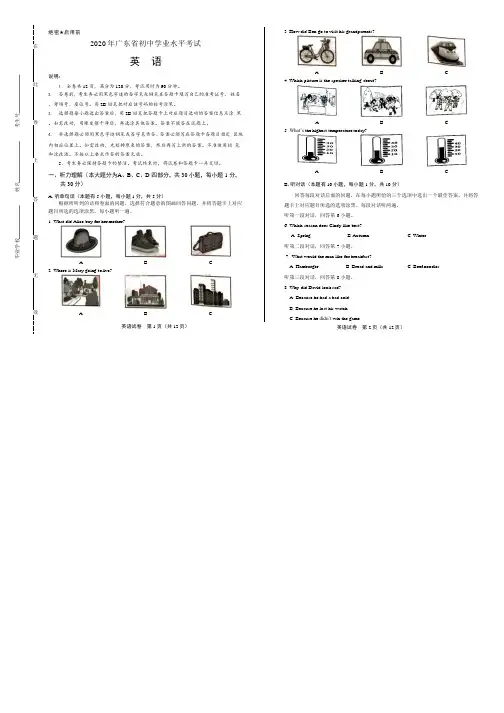
答 A.听单句话(本题有 5 小题,每小题 1 分,共 5 分) 根据所听到的话和卷面的问题,选择符合题意的图画回答问题,并将答题卡上对应
题目所选的选项涂黑。每小题听一遍。
1. What did Alice buy for her mother?
题
A
B
C
2. Where is Mary going to live? 无
18. When they sawfish swimming in the river, they felt very
A. excited
B. surprised
19. One of them suggested
in the river.
A. fishing
B. boating
20. They decided to swim in the swimming pool
21. Zhang Jiacheng is a one-armed boy from
.
A. Jiangsu
听第一段独白,回答第 16-20 小题。
16. Lin Tao went for a picnic with
2020年广州中考英语试题
2020年广州中考英语试题一、听力(共两节,满分35分)第一节听力理解(共15小题;每小题2分,满分30分)每段播放两遍。
各段后有几个小题,各段播放前每小题有5秒钟的阅读。
请根据各段播放内容及其相关小题,在5秒钟内从题中所给的A、B、C项中,选出最佳选项,并在答题卡上将该项涂黑。
听下面一段对话,回答第1~3三个小题。
1. Where does the talk take place?A. At school.B. At Kelly’s house.C. At Jason’s house2. What is the talk mainly about?A. Ways to improve the environment.B. The school project they were given.C. The reasons Jason wasn’t at school.3. What do the speakers finally decide to do?A. To clean up the river.B. To do some tree planting.C. To help the school save water.听下面一段对话,回答第4~6三个小题。
4. Who is listening to the talk?A. Teachers.B. University students.C. New workers.5. Why does the speaker think that he is very lucky?A. He works for a large company.B. He has a well-paid job.C. He does something he loves.6. What kind of person does a boss prefer?A. Someone from a famous university.B. Someone with work experience.C. Someone who likes using computers.听下面一段对话,回答第7~9三个小题。