
人教版新目标2018年八年级英语上册Unit2单元教案
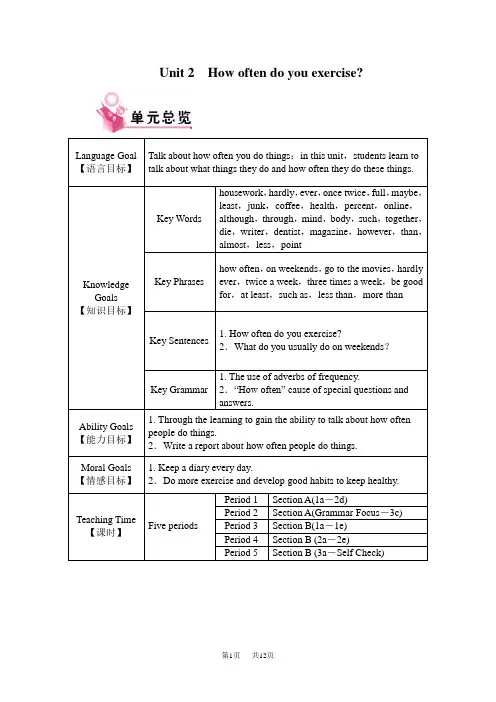
新目标2018年八年级英语上册Unit2单元教案Unit 2How often do you exercise?LanguageGoal 【语言目标】Talk about how often you do things:in this unit,students learn to talk about what things they do and how often they do these things.KnowledgeGoals 【知识目标】Key Wordshousework,hardly,ever,once twice,full,maybe,least,junk,coffee,health,percent,online,although,through,mind,body,such,together,die,writer,dentist,magazine,however,than,almost,less,pointKey Phraseshow often,on weekends,go to the movies,hardly ever,twice a week,three times aweek,be good for,at least,such as,lessthan,more than本单元的教学内容围绕“多久做一次运动”这一话题展开。
Section A是基本语言内容的收集和学习,这一部分引导学生通过本课的语言素材进行看图说话、句型演练、实际描述,通过对话表演等使学生能够正确地使用表示做什么活动的词组,多久做一次的句型,从而熟练地谈论多久做一次活动。
Section B是知识的扩展和语言的综合运用,是在Section A的基础上,锻炼学生能够自如地谈论自己的生活习惯。
这些内容都是与学生日常生活紧密相关的,学生很熟悉,也乐于去说,因此在这一课题的教学过程中,应紧密联系学生生活实际,采用多种方式,以说为主,配合听的练习,最终以对话为途径,解决本课题的中心语句。
这易于引发学生学会运用简单的英语进行交际和交流,也对提高学生的综合能力,特别是说的能力很有帮助。
学生通过对本单元的学习,可以引导他们养成良好的生活习惯和饮食习惯,从而合理安排自己的各项工作,享受丰富多彩的校园生活。
第一课时Section A(1a-2d)Teaching Goals【教学目标】Key words:housework,hardly,ever,once,twice,Internet,program,full,swingKey phrases:how often,on weekends,go to the movies,help with housework,hardly ever,go shopping,once/twice a week/a month,swing dance Key sentences:1.What do you usually do on weekends?I often go to the movies.2.How often do you watch TV?I watch TV every day.Teaching Key Points【教学重点】The vocabulary:housework,hardly,ever,once,twice,how often,on weekends,go to the movies,go shopping,help with housework,once/twice/three times a week/a monthTarget language:What do you usually do on weekends?I often go to the movies. Does he go shopping?No,he never goes shopping. How often do you have piano lessons?Twice a week,on Wednesday and Friday.Teaching Difficult Points【教学难点】1.The adverbs of frequency:always,usually,often,sometimes,hardly ever,never2.Target language above.Teaching Aids【教学工具】An English textbook,a tape recorder,CAI or courseware.Teaching Steps【教学过程】★Step 1Leading in1.Greetings:Talk about something the students did on summer vacation.2.Check the homework.★Step 2Pre-taskPage 9,1a.1.Look at the picture.2.Name each activity.T:What are they doing?S:They are shopping/reading/exercising/watching TV/helping with housework. (Help the students to answer.)3.Write the activities on the line.4.Check the answers on the board.5.Practice reading.Page 9,1c.1.Focus on the conversation in the box.2.Practice reading.3.Pair-work:What do you do on weekends?I...4.Group-work:Divide the class into groups of four or five. Make conversations. First S1 to S2:S1:What do you do on weekends?S2:I...S1:What does she/he do on weekends?S2:She/He...5.Act out their own dialogues.★Step 3While-taskPage 9,1b.1.Look at each picture above 1a.Tell what the person does on weekends. Check the Ss orally.2.Make sure what they will hear and do.3.Read these adverbs and explain.4.Play the tape twice. Write the letters on the line.Page 10,2a & 2b.1.Read the activities and the answers of “how often” first.2.Practice reading.3.In 2a we should know the activities you hear. In 2b we should know the answers of how often he does the activities.4.Play the tape for the first time. Ss only listen.5.Play the tape a second time. Ss do 2a.6.Play the tape a third time. Check the answers.7.Play the tape. Ss do 2b.8.Check the answers.In this part,we should pay attention to “how often” cause of special questions and answers.★Step 4Post-taskPage 10,2c & 2d.1.Focus on the conversation in 2c first.2.Practice reading.3.Read the activities in the left box.4.Fill in the chart.5.Pair-work:Make conversations.6.Make students scan the conversation in 2d.7.Teach and then make Ss role-play the conversation in pairs. In this part,student A will be Jack. Student B will be Claire. As they talk,move around to monitor their work. Offer language or pronunciation support as needed.8.Have a group of students present their conversation to the class.★Step 5Homework1.Practice the conversation in 2d.2.Do the exercises on Page 8 in students' book.Board Design板书设计Unit 2How often do you exercise?The first period Section A(1a-2d)1.Key vocabulary:housework,once,twice,full,how often,on weekends,go to the movies,help with housework,hardly ever,once a week,three times a month2.表示动作的频率由高到低依次是always(100%),usually(80%),often(30%~50%),sometimes(20%),hardly ever(5%),never(0%)。
第二课时Section A(GF-3c)Teaching Goals【教学目标】Key words & phrases:maybe,least,at least,once a month,stay up,twice a week,eat a healthy breakfast,go to bed,play sports,after schoolKey sentences:1.What do you usually do on weekends?I always exercise.2.Do you go shopping?No,I never go shopping.3.How often do you read English books?I read English books about twice a week.Teaching Key Points【教学重点】The vocabulary:maybe,least,at least,once a month,twice a weekTarget language:How often do you read English books?I read English books twice a week.Teaching Difficult Points【教学难点】Target language above.Teaching Aids【教学工具】An English textbook,CAI or courseware.Teaching Steps【教学过程】★Step 1Leading in1.Greetings.2.Drills:T:What do you usually do on weekends?S1:I usually play soccer.T:How often do you play soccer?S1:I play soccer twice a week.T:How often does he play soccer?The other Ss:He plays soccer twice a week.Repeat for three times.★Step 2Pre-taskPage 11,Grammar Focus.1.Review the grammar box. Ss say the questions and answers.2.Practice reading.★Step 3While-taskPage 11,3a & 3b.1.Call students' attention to 3a.Make students scan the questions and answers first,then students complete the task in 3a individually.2.Choose a student to give his or her answers. Write them on the board.3.Correct the answers.4.Practice reading.5.Pair-work:Students work in pairs to complete the task in 3b.6.Write your answers on the line.★Step 4Post-taskPage 11,3c.1.T:What can you do to improve your English?(e.g. read English books,practice reading and speaking)How often do you...?2.Think of more things you can do to improve your English and write them here.3.Ask several Ss each question.4.See:Who is the best English student in the class?★Step 5Homework1.Revise the new words.2.Do the exercises on Page 9 in students' book.Board Design板书设计Unit 2How often do you exercise?The second period Section A(GF-3c)1.Key vocabulary:maybe,at least,once a month,stay up,twice a week2.Target language:A:How often do you read English books?B:I read English books about twice a week.第三课时Section B(1a-1e)Teaching Goals【教学目标】Key words & phrases:junk,coffee,health,junk food,be good forKey sentences:How often do you drink milk,Liu Fang?I drink milk every day.Teaching Key Points【教学重点】The vocabulary:junk food,coffee,health,healthy,be good forTarget language:How often do you drink milk,Liu Fang?I drink milk every day. Do you like it?No. But my mother wants me to drink it. She says it's good for my health.Teaching Difficult Points【教学难点】“How often” cause of special questions and answers.Teaching Aids【教学工具】An English textbook,a tape recorder,CAI or courseware.Teaching Steps【教学过程】★Step 1Leading in1.Greetings & free talk.2.Practice reading the conversation on Page 10.3.Check the homework.★Step 2Pre-taskPage 12,1a.1.Point out the six words.2.Ss read after the teacher.3.Make sure the Ss understand what they mean.4.Call attention to the pictures. Say something about the pictures.5.Match the words with the pictures.6.Check the answers.7.Practice reading.★Step 3While-taskPage 12,1b.1.Pay attention to the conversation in the box on the right.2.Read it to the class.3.Explain:“be good for” means:有益于……,对……有好处。
【人教版】新目标2018年八年级英语上册:Unit 2 单元教案

【人教版】新目标2018年八年级英语上册:Unit 2 单元教案一. 教材分析人教版新目标2018年八年级英语上册Unit 2主要围绕一般现在时展开,介绍了日常生活中的动作和习惯。
本单元的主要内容包括一般现在时的构成和用法,以及如何用一般现在时描述人的特征和日常活动。
本单元旨在帮助学生掌握一般现在时的基本知识,提高他们用英语进行简单描述的能力。
二. 学情分析八年级的学生已经掌握了基本的英语语法知识,具备一定的听说读写能力。
但他们在使用一般现在时方面还存在一定的困难,如时态的运用和动词第三人称单数的变换。
因此,在教学过程中,教师需要关注学生的实际情况,有针对性地进行教学。
三. 教学目标1.知识目标:使学生掌握一般现在时的构成和用法,能够用一般现在时描述人的特征和日常活动。
2.能力目标:培养学生用英语进行简单描述的能力,提高他们的听说读写能力。
3.情感目标:激发学生学习英语的兴趣,培养他们积极向上的学习态度。
四. 教学重难点1.教学重点:一般现在时的构成和用法,以及如何用一般现在时描述人的特征和日常活动。
2.教学难点:动词第三人称单数的变换和一般现在时的运用。
五. 教学方法采用任务型教学法,通过情境创设、小组合作、角色扮演等活动,激发学生的学习兴趣,提高他们的参与度。
同时,运用语法讲解法,明确一般现在时的规则,帮助学生掌握一般现在时的用法。
六. 教学准备1.教材:人教版新目标2018年八年级英语上册。
2.课件:制作与本节课内容相关的课件,包括图片、动画、视频等。
3.练习题:准备适量的一般现在时练习题,用于巩固所学知识。
七. 教学过程1.导入(5分钟)利用图片、动画或视频展示日常生活中的动作和习惯,引导学生用英语进行描述。
例如:展示一幅图片,上有一个人在跑步,提问学生:“What is he doing? He is running.” 从而引出一般现在时。
2.呈现(10分钟)讲解一般现在时的构成和用法,举例说明如何用一般现在时描述人的特征和日常活动。
新目标八年级英语上册unit2教案

新目标八年级英语上册Unit 2 教案What’s the matter?Part 1: T eaching design (第一部分:教学设计)SECTION A Goals●To learn to use have for talking about health problems ●To learn uses of Modal should/shouldn ’t ProceduresWarming up by learning grammarTo begin with, go to page 8, and let ’s learn to use have for talking about health problems and modal verbs should/shouldn ’t. Warming up by discussing Hello, everyone!Can you name the parts of your body? How many parts of the body can you name? Let’s look at the doll and name the parts of the body.Now let’s read the words together.Keeping healthy is very important. So today we will talk about it. Let’s look at Unit 2 What’s the matter? 1A Writing the lettersNow open your books and turn to page 7. Please look at the picture and read the name of the body parts. OK. Now look at the picture of the students numbered 1 through 5. Several body parts are marked with the letters a ~ m. Write the correct letter after the name of each body part on the list. Y ou must completethe activity individually.Let’s check the answer, please.1b Listening and numberingCan you tell what part of the body doesn’t feel good? Now let’s learn the new words in the picture. Please read after me.Good. Let’s listen to the recording. There are conversations about each of these five students. Look at the picture and find the people that are being talked about. Listen to the tape and write the number next to them in the picture next to their names. The first one has been done for you.Let’s check the answers, please.And finally let’s read the tapescript to blacken all examples of have for talking about health problems andexamples of modal should/shouldn’t.1c Doing pairworkCan you express what part of the body doesn’t feel good now? Work in pairs. Makeyour own conversations out of the picture on page 7. Then present your conversations tothe whole class, using have for talking about health problems.2a Listening and matchingTaking care of your friends or family member is very important. Now please lookat page 8, 2a. Read the eight items in this activity. When you read you must callattention to the meaning of the new words.Then listen to the recording. On this recording there are four different conversations. People are talking about health problems they have and are getting advice for them. Draw lines to match the problems with the advice.The first time, you only listen. The first one has been done for you. The boy has a toothache and the advice is to see a dentist.The second time, you draw lines to match the problems and the advice.Answers:2b Listening and fillingV ery good. These conversations are illustrated by the pictures. Now listen again and fill in the blanks. Firstlook at the four pictures. Each of these pictures illustrates one of the conversations. This time, listen for the missing words. Write the missing words on the blank lines.Now read the tapescript and blacken all examples of have for talking about health problems and examples of modal should/shouldn’t.2c Doing pairworkNow let’s look at a conversation. Who wants to read it to the class? Y ou two, please.Good. Y ou are going to make a conversation in pairs using the information from activities 2a and 2b.Take turns having problems and giving advice.3a Filling the blanksHere is a picture. Look at it. A boy is sick. A teacher is talking to him. Now read the conversation on the left, please.Think of how you can complete the conversation. Write the answers in the blanks.Answers:3b Doing pairworkBefore doing the pairwork, practice the dialogue in activity 3a with your partner. (Ss act it out)Good. Now look at the picture on page 9 and ask and answer what’s the matter with the people in the picture. At last, present the conversation to the class.4 Doing group workAre you tired? Now we are going to do a game “mime an illness”.For example, hold tooth as if you have a toothache. One students stand in front of theclassroom and mime an illness. The other students guess the illness and advice. Y ou can ask and answerlike this:Then fill in the chart.Closing down by asking and answering—What’s the matter?What’s the matter?I have a toothache.I have a sore back.I have a sore throat.I have a stomachache.…SECTION BGoals●To talk about your health●To learn the habits of different countriesProceduresWarming up by asking and answeringToday we are going to learn Section B. First let’s ask and answer questions aboutillness, using have for talking about health problems and modal verbsshould/shouldn’t.1A: Matching the words you studyNow open your books at page 10. Let’s look at the words together. Pleaseread after me.V ery good. Please look at the picture and match the words with the picture.Let’s check the answers.1b MatchingLook at the pictures. The person in each picture is giving advice. What advice are the people giving? Let’s discuss the pictures.Now match each picture with one piece of advice. Write the letter of the picture in front of the sentences that give advice.2a Listening and writingGina,Tony,Julie and Alan are talking about thehealthy problems. Look at this chart. Read thenames on the left. Pay attention to the sample answer after Gina’s name.Now listen to the recording. There are four conversations. Write the problems in the blanks after eachperson’s name.Answers:Read the tapescript to underline all examples of modal should/shouldn’t.2b Listening and matchingNow I will play the recording again. This time, write what each person should and shouldn’t do for their problem.I’ll give a pause after each conversation.Please listen and write.Let’s check the answers.2c Doing pairworkAfter listening to the conversation, can you make up a conversation? Look at the conversation on the right. Y ou two, please. Read it to the class.Now use the information in activity 2a to make conversation with your partner.3a Reading and underliningWe are going to read the article on page 11. First we shall read to the tapetogether and try to blacken all the useful expressions.Next we are going to read aloud the article slowly and clearly. We will try to understand the meaning of the article.. For example, are you often weak and tired?foods, like beef. Eating Dangshenare too stressed out and angry may have tooFinally read the article again. Underline each thing you should do.3b Filling in the blanks in the articleHere is an article. It doesn’t finish. Please read it carefully, circlethe expressions and finish the activity.Let’ check the answers. Li Li, please read your answers to the class.3c.Writing an article“Do you have a cold?” Please write some advice to a person who has a cold. What shouldhe or she do? What shouldn’t he or she do?4 Doing groupworkWe can choose a problem from the list below:Write it on a piece of paper. Then go around the room and ask other students for advice about your problem. Write down the best advice. Write the name of the student, too.Closing down by asking and answeringAfter a long time learning, we are tired. Now let’s have a relaxation by asking and answering about somehealth problems.SELF CHECKGoals●To revise the vocabulary.●To revise the target language in this unit.ProceduresWarming up by having a dictationToday we are going to learn Self Check to revise the target language. Before learning, let’s have a dictation first.1 Filling in the blanksThere are five sentences in the box. First use the words given to you to fill in the blanks. Then check the answers.Next make your own sentences.2 WritingImagine that you and Sally are on a student exchange program.Read her letter, underline the useful expressions, shadow the connectives and write back to give advice.Model:Just for fun!Let’s sing a song in English.Wee Willie WinkieWee Willie Winkie runs through the town,Upstairs and downstairs in his night-gown,Tapping at the window, crying through the lock,"Are the babes in their beds,For it's now ten o'clock?"Part 2: T eaching Resources (第二部分:教学资源)I. Believe it or not, by imagination you can also lose weight.If we can gorge on fatty bacon and still lose weight, how else can we beautifyourselves and still remain lazy slobs? Here are some fitness plans for exercisehaters:"Soda Stretches," an arm-strengthening workout, in which you use soda cans as barbells. This is designed to loosen joints, increase circulation and, ultimately, inspire more vigorous activity.Toilet Training: Use bathroom fixtures as gym equipment. Hang your legs over the side of the tub and you're ready for stomach crunches. For upper body strength, do push-upswith your hands on the toilet seat and your feet put on the tub.Shop Till You Drop: Walking is the easiest way to stay in shape, and a mall is a large area that's safe and temperature-controlled.Imaginary Exercising: Psychologists in England have issued a study that could fulfill every couch potato's deepest wish: They say just thinking about exercise stimulates your muscles. The simple act of visualizing exercise makes a difference.II. American DietThese days Americans are more and more concerned with watching theirweight. Perhaps as many as 70 million Americans are on weight-reducingdiets, and weight control has become a multibillion-dollar business. Americansupermarkets sell a variety of diet foods such as diet soft drinks, diet candy,and diet salad dressings. Dieters also spend money on diet pills, exercise machines, and jogging suits. Each year dozens of new diets are popularized. They have such names as the Miracle Diet, the Nine-Day Wonder Diet, and the Easy 24-Hour Diet. There is even one called the Ice Cream Diet, which advises thedieter to eat only ice cream for lunch and dinner! For dieters who cannot lose weight on their own, there are many well-organized diet groups, which offer help and encouragement.III.Word studies (词语学习)1.mattern.1. [U]物质what everything is made of: Most matter has three states. 大多数物质具有三种状态:固态、液态和气态。
【人教】新目标八年级英语上册Unit2单元教案
Unit 2How often do you exercise?本单元的教学内容围绕“多久做一次运动”这一话题展开。
Section A是基本语言内容的收集和学习,这一部分引导学生通过本课的语言素材进行看图说话、句型演练、实际描述,通过对话表演等使学生能够正确地使用表示做什么活动的词组,多久做一次的句型,从而熟练地谈论多久做一次活动。
Section B是知识的扩展和语言的综合运用,是在Section A的基础上,锻炼学生能够自如地谈论自己的生活习惯。
这些内容都是与学生日常生活紧密相关的,学生很熟悉,也乐于去说,因此在这一课题的教学过程中,应紧密联系学生生活实际,采用多种方式,以说为主,配合听的练习,最终以对话为途径,解决本课题的中心语句。
这易于引发学生学会运用简单的英语进行交际和交流,也对提高学生的综合能力,特别是说的能力很有帮助。
学生通过对本单元的学习,可以引导他们养成良好的生活习惯和饮食习惯,从而合理安排自己的各项工作,享受丰富多彩的校园生活。
第一课时Section A(1a-2d)Teaching Goals【教学目标】Key words:housework,hardly,ever,once,twice,Internet,program,full,swingKey phrases:how often,on weekends,go to the movies,help with housework,hardly ever,go shopping,once/twice a week/a month,swing danceKey sentences:1.What do you usually do on weekends?I often go to the movies.2.How often do you watch TV?I watch TV every day.Teaching Key Points【教学重点】The vocabulary:housework,hardly,ever,once,twice,how often,on weekends,go to the movies,go shopping,help with housework,once/twice/three times a week/a month Target language:What do you usually do on weekends?I often go to the movies. Does he go shopping?No,he never goes shopping. How often do you have piano lessons?Twice a week,on Wednesday and Friday.Teaching Difficult Points【教学难点】1.The adverbs of frequency:always,usually,often,sometimes,hardly ever,never2.Target language above.Teaching Aids【教学工具】An English textbook,a tape recorder,CAI or courseware.Teaching Steps【教学过程】★Step 1Leading in1.Greetings:Talk about something the students did on summer vacation.2.Check the homework.★Step 2Pre-taskPage 9,1a.1.Look at the picture.2.Name each activity.T:What are they doing?S:They are shopping/reading/exercising/watching TV/helping with housework.(Help the students to answer.)3.Write the activities on the line.4.Check the answers on the board.5.Practice reading.Page 9,1c.1.Focus on the conversation in the box.2.Practice reading.3.Pair-work:What do you do on weekends?I...4.Group-work:Divide the class into groups of four or five. Make conversations. First S1 to S2:S1:What do you do on weekends?S2:I...S1:What does she/he do on weekends?S2:She/He...5.Act out their own dialogues.★Step 3While-taskPage 9,1b.1.Look at each picture above 1a.Tell what the person does on weekends. Check the Ss orally.2.Make sure what they will hear and do.3.Read these adverbs and explain.4.Play the tape twice. Write the letters on the line.Page 10,2a & 2b.1.Read the activities and the answers of “how often” first.2.Practice reading.3.In 2a we should know the activities you hear. In 2b we should know the answers of how often he does the activities.4.Play the tape for the first time. Ss only listen.5.Play the tape a second time. Ss do 2a.6.Play the tape a third time. Check the answers.7.Play the tape. Ss do 2b.8.Check the answers.In this part,we should pay attention to “how often” cause of special questions and answers.★Step 4Post-taskPage 10,2c & 2d.1.Focus on the conversation in 2c first.2.Practice reading.3.Read the activities in the left box.4.Fill in the chart.5.Pair-work:Make conversations.6.Make students scan the conversation in 2d.7.Teach and then make Ss role-play the conversation in pairs. In this part,student A will be Jack. Student B will be Claire. As they talk,move around to monitortheir work. Offer language or pronunciation support as needed.8.Have a group of students present their conversation to the class.★Step 5Homework1.Practice the conversation in 2d.2.Do the exercises on Page 8 in students' book.Board Design板书设计Unit 2How often do you exercise?The first period Section A(1a-2d)1.Key vocabulary:housework,once,twice,full,how often,on weekends,go to the movies,help with housework,hardly ever,once a week,three times a month 2.表示动作的频率由高到低依次是always(100%),usually(80%),often(30%~50%),sometimes(20%),hardly ever(5%),never(0%)。
人教版新目标版八年级英语上册-Unit-2-How-often-do-you-exercise教案

Unit 2 How often do you exercise?Section A 1 (1a-2d)一、教学目标:1. 语言知识目标:1) 能掌握以下单词: housework, hardly, ever, hardly ever, once, twice, Internet, program, full, swing, swing dance, maybe, least, at least能掌握以下句型:① —What does he do on weekends —He usually watches TV.② —How often do you watch TV —I watch TV every day.③ —Does he go shopping —No, he never go shopping.2) 能了解以下语法:频度副词及一般现在时简单谈论周末活动情况。
2. 情感态度价值观目标:通过本单元的学习,养成健康的饮食习惯,保证充足的睡眠时间,进行合理的运动锻炼,以保持健康的体魄。
培养学生的逻辑表述能力,激发学生的积极思维,并使学生互相了解,增进友谊,加强人际交往,以形成良好的人际关系。
二、教学重难点1. 教学重点:1) 对6个频度副词细微差异的理解及使用。
2) 弄清一般现在时在不同人称下动词形式及提问的变化。
2. 教学难点:1) 第三人称单数谓语动词在此核心句型中的运用。
2) 谈论课余时间的各项活动,以及初步认识和使用频率副词。
三、教学过程Ⅰ. Lead inTalk about your last weekend’s activities.Ⅱ. Presentation(1) 教师问:“What do you usually do on weekends ” (并且板书)让学生根据自己的实际回答I usually …… on weekends.(2) 教师出示动词卡片 watch TV,read books,exercise,swimplay football、go shopping、go to movies让学生回答。
【人教版】新目标八年级英语上册:Unit 2 单元教学设计
【人教版】新目标八年级英语上册:Unit 2 单元教学设计一. 教材分析新目标八年级英语上册Unit 2的主题是“Let’s play sports!”,主要介绍了各种体育活动。
通过本单元的学习,学生能够掌握一些关于体育活动的词汇和表达方式,同时提高他们在实际情境中运用英语进行交流的能力。
本单元包括两个部分,第一部分是关于体育活动的词汇和短语,第二部分是关于询问和描述体育活动的情境对话。
二. 学情分析八年级的学生已经掌握了一些基本的英语语法和词汇,他们具备一定的听说读写能力。
但是,学生在实际运用英语进行交流时,还存在一定的困难,特别是在口语表达和听力理解方面。
因此,在教学过程中,教师需要关注学生的个体差异,针对不同学生的学习需求进行有针对性的教学。
三. 教学目标1.知识目标:学生能够掌握本单元中出现的体育活动词汇和短语,能够正确地运用它们进行交流。
2.能力目标:学生能够听懂并能够运用本单元所学内容进行日常交流,提高他们的口语表达能力。
3.情感目标:通过本单元的学习,学生能够激发对体育活动的兴趣,增强团队合作意识。
四. 教学重难点1.重点:学生能够掌握本单元的体育活动词汇和短语,能够正确地运用它们进行交流。
2.难点:学生能够听懂并能够运用本单元所学内容进行日常交流,提高他们的口语表达能力。
五. 教学方法1.情境教学法:通过设定各种体育活动的情境,让学生在实际情境中运用英语进行交流。
2.任务型教学法:通过完成各种任务,激发学生的学习兴趣,提高他们的实践能力。
3.合作学习法:通过小组合作,培养学生的团队合作意识,提高他们的口语表达能力。
六. 教学准备1.教师准备:教师需要准备本单元的教学课件、教学素材和相关的体育活动器材。
2.学生准备:学生需要预习本单元的内容,熟悉并掌握相关的体育活动词汇和短语。
七. 教学过程1.导入(5分钟)教师通过向学生展示一些体育活动的图片,引导学生谈论他们喜欢的体育活动,激发学生的学习兴趣。
2018年秋季人教版八年级英语上册【Unit2】第二讲教学案
2018年秋季人教版八年级英语上册【Unit2】第二讲教学案2018年秋季人教版八年级英语上册第二讲Unit2How often do you exercise?学科初中英语年级初中二年级版本人教版课时2课时知识点一般现在时频度副词教学目标1.能够熟练运用一般现在时态。
2.学会使用频度副词来询问及应答日常活动和个人喜好。
教学重点一般现在时教学难点频度副词教学过程一、课堂导入通过使用频度副词来询问及应答日常活动和个人喜好来询问学生或让学生之间互相询问,复习本节课所需句型。
二、复习预习1.Mary decided_________the concert the next day.A.to listenB.listen toC.to listen toD.listening to【答案】C【解析】decide后接动词不定式,排除B、D两项;listen是不及物动词,后接宾语时要先加介词to,故选C项。
句意为“玛丽决定明天去听音乐会”。
2.You aren’t_________to drive a car.A.old enoughB.enough oldC.young enoughD.enough young【答案】A【解析】enough adv.,意为“足够地;充足地”,修饰形容词、副词或动词时,要放在被修饰词的后面。
故选A项。
句意为“你的年龄还不够大,还不能开车”。
3.---Would you like_________shopping with me?---Sorry,I feel like_________this book.A.to go;readB.to go;readingC.going;to readD.going;reading【答案】B【解析】would like后接to do sth.;句意为“你想和我一起去购物吗?”feel like后接doing sth.,句意为“对不起,我想要看这本书”,都表示想要做某事,二者一结合,B项正确。
【人教版】新目标八年级英语上册:Unit 2 单元说课稿
【人教版】新目标八年级英语上册:Unit 2 单元说课稿一. 教材分析新目标八年级英语上册Unit 2主要讲述了关于一般现在时的用法。
本单元包括两个部分:Section 1和Section 2。
Section 1主要介绍了一般现在时的基本结构和用法,通过一个关于家庭成员的对话和一个关于日常活动的,让学生理解和掌握一般现在时的构成和表示含义。
Section 2则通过一个故事和一个任务型阅读,进一步巩固一般现在时的用法,并引导学生运用一般现在时进行叙述和描述。
二. 学情分析八年级的学生已经掌握了英语学习的基本语法和词汇,具备一定的听、说、读、写能力。
但对于一般现在时的理解和运用,部分学生可能还存在一定的困难。
因此,在教学过程中,需要关注学生的个体差异,针对性地进行教学,帮助学生理解和掌握一般现在时的用法。
三. 说教学目标1.知识目标:学生能够理解一般现在时的概念、结构和用法,能够正确运用一般现在时进行叙述和描述。
2.能力目标:学生能够在日常交流中运用一般现在时,提高英语表达的能力。
3.情感目标:通过本单元的学习,学生能够培养对英语学习的兴趣,增强自信心。
四. 说教学重难点1.教学重点:一般现在时的结构、用法和意义。
2.教学难点:一般现在时的运用,特别是在具体情境中的运用。
五. 说教学方法与手段1.教学方法:采用任务型教学法、情境教学法和交际法,让学生在实际情境中理解和运用一般现在时。
2.教学手段:利用多媒体课件、图片、故事等教学资源,激发学生的学习兴趣,提高课堂参与度。
六. 说教学过程1.导入:通过一个与学生生活密切相关的场景,如询问学生家庭成员的姓名和年龄,引导学生进入一般现在时的学习。
2.新课呈现:通过一个关于家庭成员的对话和一个关于日常活动的,展示一般现在时的结构和用法。
3.实践环节:学生分组进行角色扮演,运用一般现在时进行对话,巩固所学知识。
4.任务型阅读:学生阅读一个关于故事的文章,回答相关问题,进一步理解一般现在时的用法。
人教版英语八年级上册教案:Unit2-SectionB(2a-2e)
Unit2 SectionB(2a-2e)教案【教材版本与册数】新目标人教版八年级上册【单元名称】Unit2 How often do you exercise?【课时】Section B 2a-2e (第四课时)【课型】Reading (阅读课型)2获取新知识.,{Step 3While-reading…,-—Careful- reading1. T: T asks Ss to read Para. 1 and find out the 3activities from it.Ss: Ss think it over about “What questions did the writerask?”.>2. Finish 2bT: T guides Ss to scan Para. 2 and complete the first pie.Then read Para.3 or 4, complete the pie and exchangethe information.S: Ss read the three paragraphs and finish the pie.(3.T: T asks Ss to look at the pie, and answer thequestions.Ss: Ss try to look at the pie and the article to answer thequestions.What percent of the students do not exercise at all?/训练学生阅读获取具体信息和提问能力,为后面的阅读教学活动做铺垫。
…训练学生理解并解释图表提供的信息,将文本的语言知识有效的挂靠到文本结构下的学习。
让学生学习观察和利用统计图,培养科研探究素养中必备的数据分析能力。
:通过分段细读Para. 1,学生是否能找出调查话题和调查内容。
Unit2教案人教新目标版(8上)
Unit 1
I always get up early.
I am never late for class.
I sleep nine hours every night.
always usually often hardly ever never
of course , pretty healthy/good ,unhealthy ,a healthy lifestyle, try to do sth..,
三、教学准备 图片、多媒体课件
四、教学课时
第 1 课时
1
五、教学过程
Step 1 :Greeting. 1.Welcome back: Talk about their holidays. 2.Encourage Ss to share their holidays with the whole class. Step 2 :Leading – in 1. Do you like watching TV? Yes ,I do.
How often does Cheng watch TV? He watches TV..
三、教学准备 图片、多媒体课件
四、教学课时
第 2 课时
4
五、教学过程
Step One :Greeting. Step Two :Leading – in Drills: T: What do you usually do on weekends ? S1: I usually play soccer . T: How often do you play soccer ? S1: I play soccer twice a week . T: How often does he play soccer ? The other Ss: He plays soccer twice a week . Repeat for three times . Step Three :Pre-task Review the grammar box . Step Four :While-task
【人教版】新目标八年级英语上册:Unit2单元教学设计
【人教版】新目标八年级英语上册:Unit2单元教学设计一. 教材分析人教版新目标八年级英语上册Unit 2主要围绕“How do you get to school?”这一主题展开,通过引入不同的交通工具和描述去学校的方式,让学生能够运用一般疑问句询问他人如何去某地,并能用现在时态描述自己的日常上学路线。
同时,本单元还涉及到一些日常对话的交际用语,如问候、介绍、道别等。
二. 学情分析八年级的学生已经掌握了基本的英语语法和词汇,具备一定的听、说、读、写的能力。
但是,对于一些复杂的交通方式和表达方式可能还存在困难,因此,在教学过程中需要注重对学生细节的理解和语言表达能力的培养。
三. 教学目标1.知识目标:学生能够掌握与交通方式相关的词汇和表达方式,如bus,subway, car, walk等,以及一般疑问句的构成和用法。
2.技能目标:学生能够用英语询问他人如何去某地,并能用现在时态描述自己的日常上学路线。
3.情感目标:通过小组合作,培养学生的团队协作能力和交际能力。
四. 教学重难点1.重点:学生能够正确使用一般疑问句询问他人如何去某地,并能用现在时态描述自己的日常上学路线。
2.难点:对于一些复杂的交通方式和表达方式的准确运用,以及对于不同场景下的语言交际能力的培养。
五. 教学方法采用任务型教学法,通过设定各种实际情境,让学生在完成任务的过程中运用英语,提高学生的实际运用能力。
同时,运用分组合作、讨论等教学手段,激发学生的学习兴趣,培养学生的团队协作能力和交际能力。
六. 教学准备1.准备相关的交通方式的图片、地图等教学素材。
2.设计各种任务和活动,如角色扮演、小组讨论等。
3.制作课件,包括单词卡片、对话示例等。
七. 教学过程1.导入(5分钟)利用图片和地图,引导学生谈论自己平时如何去学校,激发学生的学习兴趣。
2.呈现(10分钟)展示与本课主题相关的词汇和句型,如“How do you get to school?”和各种交通方式的词汇。