
四年级下册-译林英语知识点归纳
Unit 1 Our school subjects 知识点归纳 I、Words单词 school 学校 Art 美术(课) Chinese 语文(课) . English 英语(课)Maths 数学(课) Music 音乐(课) PE 体育(课) Science 科学(课) subject 课程、科目 playground 操场 afternoon 下午 timetable 课程表,时间表 lesson 课 see 看见,看到 Monday 星期一 fun 乐趣,快乐 II、Phrases词组
& our school subjects 我们的学校课程 back to school 回到学校
our new timetable 我们的新课程表 see you 见到你 Music and Science 音乐和科学 what subjects 什么课程 Chinese and Maths 语文和数学 like English 喜欢英语 go to the playground 去操场 go to 去…… English and Art 英语和美术 what lessons 什么课 have Music and Maths有音乐课和数学课this morning 今天早上 have PE and Science 有体育课和科学课 like PE 喜欢体育课
【 make a cake 做一个蛋糕 this afternoon 今天下午
all like English 都喜欢英语 at school 在学校 III、Sentences句型 1. Welcome back to school, class. 欢迎回到学校,同学们。 2. Nice to see you. 很高兴见到你。
3. This is our new timetable. 这是我们的新课程表。 4. What subjects do you like 你喜欢什么课程 5. I like Chinese and Maths. 我喜欢语文课和数学课。
¥ 6. Me too. 我也是。
7. It’s fun. 它很有趣。 8. It’s time for PE. 该是上体育课的时间了。 9. Let’s go to the playground. 让我们去操场吧。 10. What lessons do we have this morning今天上午我们有什么课
11. We have Music and Maths. 我们有音乐课和数学课。 12. It’s Monday. 今天是星期一。 13. But I don’t like that. 但是我不喜欢那个。
" 14. Don’t skate. 不要滑冰。
15. Come and make a cake. 过来制作一个蛋糕。 IV、Grammar语法 1. Nice to see you.和Nice to meet you. 见到你很高兴。但用法上有区别。Nice to meet you.用于初次见面时打招呼,应答也是Nice to meet you.而Nice to see you.用于两个认识的人见面打招呼,应答也是Nice to see you. 2. subject 和lesson的区别 subject 是指学科,课程。而lesson指的是具体的一节课。它们的区别还在于lesson可接在具体科目名称后面,如a Maths lesson一节数学课 an English lesson一节英语课。而subject一般不与科目名称一起出现。 3.学科类的单词第一个字母要大写,如English, Chinese, Maths, Art, PE, Music, Science等。还有一些其他的用法如:He’s an English boy. 他是一个英国男孩。We’re Chinese. 我们是中国人。I like listening to music.我喜欢听音乐。 4. It’s time for...... 到干什么的时间了。后面跟名词。
— It’s time for sth. = It’s time to do sth. 意思都是干什么的时间了,但是用
法上有区别。It’s time for +名词 = It’s time to+动词 如:It’s time for PE= It’s time to have a PE lesson. It’s time for class.=It’s time to have class. Unit 2 After school 知识点归纳 I、Words单词 Sunday 星期日 Monday 星期一 Tuesday 星期二 Wednesday 星期三 Thursday星期四 Friday 星期五 Saturday 星期六 go 去 come 来 today 今天 match 比赛 when 什么时候
! every 每个 day 天
II、Phrases词组 go and play table tennis去打乒乓 after school 放学后 a football match 一场足球比赛 on Saturday 在星期六 have a football match有一场足球比赛 all right 好的 play table tennis 打乒乓球 get up 起床 a swimming lesson 一节游泳课 every day 每天 have a skating lesson 有一节滑板课 what day 星期几
( no lessons=not any lessons 没课 make a week组成一周
at five =at five o'clock 在五点 days of the week 一周的星期 III、Sentences句型 1. Let’s go and play table tennis. 让我们去打乒乓吧。 2. What day is it today 今天星期几 3. It’s Wednesday. 是星期三。 4. I have a football match today. 今天我有一场足球比赛。 5. Come and play table tennis. 来打乒乓球。 6. 。
7. I have a swimming lesson. 我有一节游泳课。 8. What about Su Yang 苏阳怎么样
9. What about Saturday 星期六怎么样 10. She has a swimming lesson too. 她也有一节游泳课。 11. What a pity! 真遗憾! 12. We don’t have any lessons on Saturday. 星期六我们没有课。 13. Get up! 起床! 14. 13. When do you get up every day 你每天什么时候起床
< get up at five. 我五点起床!
’s my cap 我的帽子在哪里 IV、Grammar语法 1. 表示一周七天的单词完整形式和缩写形式。
西方国家把Sunday定位一周的第一天,而不是Monday 对星期几进行提问,用“What day is it today”回答:“It’s …”或是直接回答星期几。 2. 表示时间的介词的用法: (1) on表示“在具体某一天或某天的上、下午” ① 表示在星期几,如:on Sunday. on Monday. ② 表示在某天的上、下午或晚上,如: on Sunday morining
& ③ 表示节日,如:on New Year’s Day, on Children’s Day
④ 表示日期,如:on May 27th, on the 12th of March (2) at表示“在某一时刻,某一时点” ① 在几点钟介词用at ,如 at five o’clock
Sunday Monday Tuesday Wednesday 、 Thursday Friday Saturday Sun. Mon. Tue. Wed. Thur. < Fri. Sat. ② at noon在中午;at night在夜间;at Christmas在圣诞节期间; (3) in表示“在某世纪、年、季度、月、周”以及泛指的上下午、晚上 ① 在某世纪,如:in the 20th century 在20世纪; ② 在某年,如:in 2016 在2016年;
} ③ 在某月,如:in September 在九月;
④ 在某个季节,如:in winter在冬季 ⑤ 在早晨,中午,晚上, 如 in the morning, in the afternoon, in the evening. 3. have和has的用法
(1) have, has意为“有”,强调所属关系 第一、二人称和复数用have (I, You, We, They, The boys) 第三人称单数用has (He, She, It, Mike, my father) 例如: I have a football match. She has a swimming lesson.
% (2) 陈述句:以句号结尾,句中没有not。
例如:I have Chinese. He has English. 否定句:以句号结尾,句中有not或no。 例如:I don’t have Chinese. He doesn’t have English. 一般疑问句:以问号结尾,do或does在句首。 例如:Do you have Chinese Does he have English 肯定回答:Yes,I do. Yes, he does. 否定回答:No, I don’t. No, he doesn’t.
[ 特殊疑问句:以问号结尾,句首为疑问词。
例如:What lessons do you have What lessons does he have 回答:I have Chinese. He has English. (3)句型转换 肯定句变否定句: 肯定句:I have some lessons on Saturday. 否定句:I don’t have any lessons on Saturday. 肯定句:She has some lessons on Saturday.
【 否定句:She doesn’t have any lessons on Saturday.
译林版小学四年级英语下册_知识点复习总结 (1)
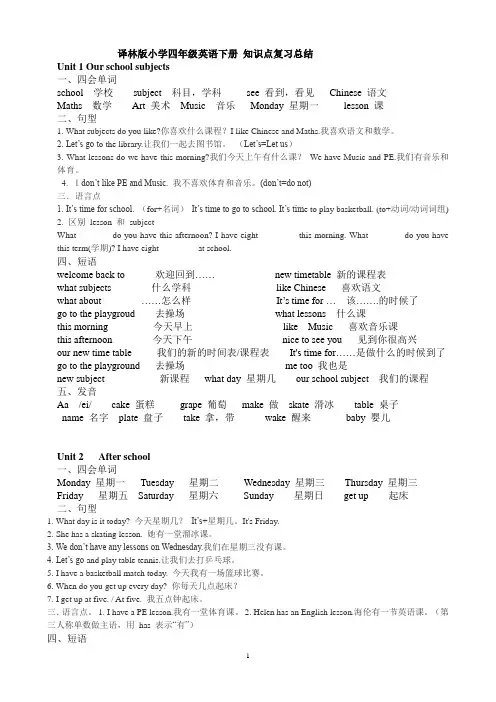
译林版小学四年级英语下册知识点复习总结Unit 1 Our school subjects一、四会单词school 学校subject 科目,学科see 看到,看见Chinese 语文Maths 数学Art 美术Music 音乐Monday 星期一lesson 课二、句型1. What subjects do you like?你喜欢什么课程?I like Chinese and Maths.我喜欢语文和数学。
2. Let’s go t o the library.让我们一起去图书馆。
(Let’s=Let us)3. What lessons do we have this morning?我们今天上午有什么课?We have Music and PE.我们有音乐和体育。
4. Idon’t like PE and Music. 我不喜欢体育和音乐。
(don’t=do not)三.语言点1. It’s time for school. (for+名词)It’s time to go to school. It’s tim e to play basketball. (to+动词/动词词组)2. 区别lesson 和subjectWhat _______ do you have this afternoon? I have eight ________ this morning. What _______ do you have this term(学期)? I have eight ________ at school.四、短语welcome back to 欢迎回到……new timetable 新的课程表what subjects 什么学科like Chinese 喜欢语文what about ……怎么样It’s time for …该…….的时候了go to the playgroud 去操场what lessons 什么课this morning 今天早上like Music 喜欢音乐课this afternoon 今天下午nice to see you 见到你很高兴our new time table 我们的新的时间表/课程表It's time for……是做什么的时候到了go to the playground 去操场me too 我也是new subject 新课程what day 星期几our school subject 我们的课程五、发音Aa /ei/ cake 蛋糕grape 葡萄make 做skate 滑冰table 桌子name 名字plate 盘子take 拿,带wake 醒来baby 婴儿Unit 2 After school一、四会单词Monday 星期一Tuesday 星期二Wednesday 星期三Thursday 星期三Friday 星期五Saturday 星期六Sunday 星期日get up 起床二、句型1. What day is it today? 今天星期几?It’s+星期几。
译林版四年级英语下册Unit 3知识点全集

四年级下册英语知识清单Unit 3重点单词ually 通常,常常2.lunch 午饭3.home 家4.homework 家庭作业5.dinner 晚饭6.watch 观看7.evening 晚上8.night 深夜重点短语1.in the morning 在上午2.in the afternoon 在下午3.in the evening 在晚上4.at night 在夜里5.go home 回家6.go to school 上学7.play football 踢足球8.have lunch 吃午饭9.have dinner 吃晚饭10.watch TV 看电视11.go to bed 睡觉12.what time 什么时候/几点13.do homework 做家庭作业14.at seven 在七点15.my day 我的一天16.over there 在那边17.have four lessons 有四节课重点句型1.I usually go to school at seven forty. 我通常七点四十去上学。
2.I have lunch at twelve. 我十二点吃午饭。
3.I have two lessons in the afternoon. 下午我有两节课。
4.I go to bed at nine every day. 我每天九点睡觉。
5.—When do you have breakfast every day? 你每天什么时候吃早饭?—At six thirty. 六点半。
6.—What time is it now? 现在几点?—It's seven o'clock. 七点。
7.—What can you see over there? 你看看那边是什么?—I can see a cake. 我能看见一个蛋糕。
8. What a big cake! 多么大的一个蛋糕啊!9. I like cakes! This cake is nice! 我喜欢蛋糕!这个蛋糕真不错!四年级下册英语知识清单Unit 1重点单词1.school 学校2.subject 课程3.see 看见,看到4.timetable 课程表;时间表5.Chinese 语文(课)6.Maths 数学(课)7.Art 美术(课) 8.PE 体育(课)9.Music 音乐(课) 10.Science 科学(课) 11.fun 乐趣,快乐12.playground 操场13.Monday 星期一14.afternoon 下午15.lesson 课重点短语1.our new timetable 我们的新课程表2.what subjects 什么学科3.go to the playground 去操场4.what lessons 什么课5.this afternoon 今天下午6.make a cake 做蛋糕7.this morning 今天上午重点句型1.—Welcome back to school, class. 欢迎回到学校,同学们。
新译林版英语四年级下册Unit3知识点归纳
新译林版英语四年级下册Unit3知识点归纳Unit 3: What's in the Schoolbag?本单元主要介绍了关于学习用具以及数词的表达等内容。
以下是对本单元知识点的归纳总结。
一、学习用具1. Pencil(铅笔)- It is used for writing and drawing. The pencil is made of wood with a graphite lead in the middle.2. Eraser(橡皮擦)- It is used to remove pencil marks or mistakes from paper.3. Ruler(尺子)- It is used to measure or draw straight lines.4. Crayons(蜡笔)- They are used for coloring.5. Glue(胶水)- It is used to stick things together.6. Scissors(剪刀)- They are used for cutting paper.7. Schoolbag(书包)- It is used to carry books and stationery to school.二、数词1. 十以内的数词十以内的数词包括1到10的数词,用于表示数量。
例如:- I have two pencils.- There are five rulers in the bag.2. 早上、晚上和钟点早上使用“in the morning”,晚上使用“in the evening”,特定时间使用钟头构成的时间表达。
例如:- I get up at 7 o'clock in the morning.- We have dinner at 6 o'clock in the evening.3. 序数词序数词是用来表示顺序或排名的词语。
语法在知识点(讲义)-译林版英语四年级下册

语法第一课名词笔记概念一.可数名词变复数变化规则。
1.一般情况,直接加。
2.以、、、和有生命的结尾的,加。
例:box → ;mango →爱吃土豆西红柿芒果)3.以辅音+y结尾的,变;如:baby →以元音字母+y结尾的,加;如:boy → ;toy →boy玩玩具toy猴子monkey +s)4.以f或fe;wife → 。
5.以man;例:man → ;woman → ;snowman → 。
6.单复数同形的词:;。
7.单词中有“oo”,变“oo”为“ ”;例:foot → ;tooth → 。
8.不规则变化:child → ;mouse → 。
9.特殊单词复数变化:Walkman → ;kangaroo → ;zoo→二.不可数名词有哪些?1.液体例:;;等2.气体例:空气3.抽象例:时间4.特殊不可数名词:小草grass ;面包;纸;钱money 。
头发;米饭;水果;食物;垃圾三.名词所有格。
1.名词所有格用法:+ 。
2.名词所有格的变法:(1)不以“s”结尾的名词,加。
例:Helen →(2)以“s”结尾的名词,加。
(3)共同拥有:在最后一个名字后+“ ’s ”。
(4)分别拥有:在各自名字后+“ ’s ”(5)无生命的名词所有格用:。
语法第二课代词概念练习一.代词的概念。
代替名词的词叫代词。
二.代词的分类。
人称代词及物主代词2. 主格的用法:主格作 ,放在句子 。
3. 所有格的用法: + 。
4. 介词后人称代词的 。
5. 名词性物主代词 = + 。
6. 反身代词用法:①主宾一致②强调语气③固定搭配:1)玩得开心2)独自3)请自便 help oneself指示代词1. 指示代词有 ; ; ; 。
其中指“近处”的词是 ;“远处”的是 。
2.①作主语 ③用于 that 表示 。
不定代词1. 概念:用于不确定的数量或范围的代词。
2. + 可名复许多: = =+ 不可数名词3. “some ”和“any ”:一些 + 可数名词 /some 用于 和 (肯定句/疑问句/否定句/希肯句)any 用于 和 (肯定句/疑问句/否定句/希肯句)Tips :not / / = no4. 都 ①两者 →②三者或三者以上 →第三课数词+形容词/副词概念练习一.数词。
新牛津译林版四年级下册英语全册知识点
Unit1 Our school subjects语法考点1. what subjects 和what lessons的区别及考点what 后面的学科和课要加s; 即what subjects和what lessons;what subjects意思是科目、学科,subjects一般和like连用;例:What subjects do you like? 你喜欢什么学科?what lessons 意思是课程, lessons一般和have连用;例:What lessons do you have? 你有什么课?特殊情况:若强调本学期有什么科目,subjects可与have连用;【易错】What subjects do you have this term(学期)? 这学期你有什么科目啊?what lessons讲的是每天要上的课,lessons一般和have连用;2.学科类名词首字母要大写; 例:Science;Chinese;3. 评价某个学科有趣用It's fun;4. 今天早上用this morning; 在早上用in the morning(√) 错误用法:in this morning(×)5.操场前面要加the; 例go to the playground;6. 多个学科并列时要用逗号隔开(不能用顿号),最后两个单词之间要用and连接;例:We have Music, Art, PE and Maths.Unit2 After school语法考点1. 星期考点①星期一到星期天分别是(拼写):星期一Monday;星期二Tuesday;星期三Wednesday;星期四Thursday;星期五Friday;星期六Saturday;星期天Sunday;②英语中,一个星期的第一天是星期天;【易错】Sunday is the first(第一) day of a week(一周).③在星期几前面的介词用on; 即on + 星期几; 在星期几的上午或下午直接在星期后加morning或afternoon; 正确用法:on Sunday morning 在星期天上午(√) 错误用法:in the morning on Sunday(×)④对星期几提问特殊疑问词用What day; 回答星期几用It's + 星期几;2. It's time for / to考点(是时候做...)It’s time for后接名词例:It's time for school. school 为名词It's time to 后接动词词组例:It’s time to go to school. go to school为动词词组例:It’s time for lunch(名词). It’s time to have(动词) lunch.3. some、any 考点①some在部分疑问句和否定句中要改为any②用于征求对方意见并且希望得到肯定答复的时候,some无须改为any;总结为以下3种情况(1)Would you like some ... ? (2)What/How about some ... ? (3)Can I have some ...?4. like考点①like后接可数名词要用复数形式; 例:like mangoes②★能力题:like后接动词时要用动词ing形式; 例:like playing basketballUnit3 My day 知识点单词、词组、句子见书上1. 时间介词in, on, at 的考点in 考点①四季前介词用in, 中间不加任何冠词。
译林版四年级下册英语知识点归纳
Unit 1 Our school subjects 知识点归纳I 、Words 单词school 学校 Art 美术(课) Chinese 语文(课)• English 英语(课)Maths 数学(课: ) Music 音乐(课)PE体育(课)Science 科学(课) subject课程、playground 操场 afternoon 下午 timetable 课程表,时间表lesson 课see 看见,看到 Monday 星期一 fun 乐趣,快乐II 、Phrases 词组our school subjects 我们的学校课程 back to school 回到学校 our new timetable 我们的新课程表 see you见到你 Music and Science 音乐和科学 what subjects 什么课程 Chinese and Maths 语文和数学 like English 喜欢英语 go to the playground 去操场 goto去...... English and Art 英语和美术what lessons什么课have Music and Maths 有音乐课和数学课this morning 今天早上 have PE and Science 有体育课和科学课like PE 喜欢体育课 make a cake做一个蛋糕this afternoon 今天下午 all like English 都喜欢英语 at school在学校III 、Sentences 句型1. Welcome back to school, class.欢送回到学校,同学们。
2. Nice to see you.3. This is our new timetable.4. What subjects do you like?5.1 like Chinese and Maths.很快乐见到你。
译林版四年级下册英语Unit1-4语法梳理复习
译林版四年级下册英语Unit1-4语法梳理复习Unit 1: Present Continuous Tense (现在进行时)The present continuous tense is used to talk about actions happening at the moment of speaking or actions that are happening around the current time.FormationThe present continuous tense is formed with the present tense of the verb "to be" (am, is, are) + present participle.Examples- I am reading a book right now.- She is eating lunch at the moment.- They are playing football in the park.Unit 2: Prepositions of Place (地点介词)Prepositions of place are used to describe the location or position of something or someone.- In: Used for enclosed spaces or larger areas (e.g., in the box, in China).- On: Used for surfaces (e.g., on the table, on the wall).- Under: Used for things that are below or beneath something (e.g., under the chair, under the bed).- Behind: Used to describe something located at the back of another object (e.g., behind the door, behind the car).- Next to: Used to describe something located beside or adjacent to another object (e.g., next to the tree, next to the supermarket).Unit 3: Plural Forms of Nouns (名词的复数形式)To form the plural of most nouns, add -s to the end of the singular noun.Examples- Cat → Cats- Dog → Dogs- Book → Books- Chair → Chairs- Toy → ToysUnit 4: Adjectives (形容词)Adjectives are words that describe or modify nouns. They provide more information about the noun in a sentence.Placement of adjectivesAdjectives are usually placed before the noun they modify.Examples- She has a beautiful dress.- He is a tall boy.- They live in a big house.。
四年级下册译林英语知识点归纳
make a cake 做一个蛋糕all like En glish 都喜欢英语III 、Sentences 句型1. Welcome back to school, class.2. Nice to see you.3. This is our new timetable.4. What subjects do you like?5. I like Chinese and Maths.6. Me too.7. It ' n.s fu8. It ' s fomPE.9. Let ' s go to the playgro und.10. What lesso nsdo11. We have Music and Maths.12. It ' s Mon day.13. But I don ' t like that.14. Don ' t skate.15. Come and make a cake. IV、Grammar 语法1. Nice to see you.区别。
Nice to meet you. you.而Nice to see you.我喜欢语文课和数学课。
我也是。
它很有趣。
该是上体育课的时间了。
让我们去操场吧。
今天上午我们有什么课?我们有音乐课和数学课。
今天是星期一。
但是我不喜欢那个。
不要滑冰。
过来制作一个蛋糕。
见到你很高兴。
但用Un it 1 Our school subjects 知识点归纳school 学校Art 美术(课)Chin ese 语文(课). En glish 英语(课)Maths 数学(课)Music 音乐(课)PE 体育(课)Scie nee 科学(课)subject 课程、科目playgro und 操场after noon 下午timetable 课程表,时间表less on 课see 看见,看到Mo nday 星期一fun 乐趣,快乐II、Phrases 词组our school subjects 我们的学校课程back to school 回至U学校our new timetable 我们的新课程表see you 见到你Music and Scie nee 音乐和科学what subjects 什么课程Chin ese and Maths 语文和数学like En glish 喜欢英语go to the playgro und 去操场go to 去……En glish and Art 英语和美术what lessons 什么课have Music and Maths 有音乐课和数学课this morning 今天早上we have this morning?和Nice to meet you.用于初次见面时打招呼,应答也是用于两个认识的人见面打招呼,应答也是喜欢体育课this after noon 今天下午at school 在学校欢迎回到学校,同学们。
【译林版】四年级英语(下册)知识点归纳及重点练习
1 四年级英语(下册)知识点归纳及重点练习 班级: 姓名: 1. 一周的星期前用介词 on,如: on Monday, on Monday morning 2. 时间点前用介词 at, 如:at ten, at ten forty-five 3. 一年四季用介词 in 如:in spring, in summer 4. 第三人称单数, 动词 have 变 has, 或在单词后 加 s, 如: ( 1) She/He/David has a fever/has lunch.
( 2) She/He/David draws some pictures in the park.
(3)My hand hurts.
5. 在 can, want to, don't 后面加 动词原形 。如: ( 1) She/He/David can have lunch at twelve.
( 2) She/He/David wants to drink some juice.
( 3) Don't swim in the river, it's very dangerous.危( 险的)
6. some一般用于 肯定句和征求别人意见的疑问句中 ,如: (1)I can sees omec akes on the table. 我在桌子上能看到一些蛋糕。 (2)Can I have some cakes? 我可以吃些蛋糕吗? (3)Would you like some cakes? 你想要些蛋糕吗? any 一般用于 疑问句 和否定句 中,如: (1)Do you have any cakes? 你有蛋糕吗? (2)Can you seea ny flowers under the tree ? 在树下你能看见花吗? (3)We don't have any lessons on Saturday.我 们在周六没有课。 7. be动词 am, is, are的用法。 am只和 I 搭配。 is和一个人或一件物品 或 it, this 搭配, are 和两个及两个人以上或两件或两件以上物品或 we, they,
(完整版)译林版英语四年级下册Unit7-8单元知识点
Unit 7 What’s the matter? 知识汇总一、语音o / əʊ/close home no nose open old so go coldGo home, Joe, and show Rose your nose!二、词汇1. have a pie 吃个派2. some water 一些水3. Here you are. 给你。
4. want to go to bed 想睡觉5. be ill 生病的,不舒服的6. drink some water 喝些水7. tired and thirsty又累又渴8. Good night. 晚安。
9. have a cake 吃块蛋糕10. a happy girl 一位快乐的女孩11. show Rose your nose给罗斯看你的鼻子12. take this pill 吃这片药13. Mrs. Mouse 老鼠夫人14. Mr. Fox 狐狸先生15. go home 回家16. want to sit on the chair想要坐在椅子上三、句型1. What’s the matter? 怎么了?2. Come and have a pie, Taotao. 过来吃个派,涛涛。
3. I’m not hungry, I’m thirsty. 我不饿,我渴。
4. Can I have some water? 我可以喝些水吗?5. Are you ill? No, but I’m tired. 你病了吗?没,但我累了。
6. I want to go to bed. 我想要睡觉。
7. Good night, dear. 晚安,亲爱的。
8. Here is some water for you. 这儿有些水给你。
9. Are you cold? 你冷吗?No, I ’m not. / Yes, I am.10. This is Mrs Fox speaking. 我是狐狸夫人。