
Pep小学英语四年级下册第二单元《What time is it》教学设计
It’s… o’clock. It’s time for…
(设计意图:以What time is it?引出新学单词,始终将时间与lunch, dinner, music class等单词融合在一起,这样既通过旧知引出了新知,也达到了在学习新知的过程中进一步巩固旧知的目的。)
Tick tock, tick tock, what’s this?(边出示,边贴在黑板上。引出clock.)
(2)学习clock
(3)What time is it?引出课题Unit Tow What time is it?
(4)学习time
(5)出示珍惜时间的名言或谚语。
2.It’s time for…
time for ____.
Step4: Exercises for improvement
1.看图完成对话(屏幕出示)
2.看时间表完成对话。
3.完成阅读
Step5 Summary
1.T: What did you learn this class?
教师和学生一起总结本课时的教学重点,起回顾学过的知识内容。最后送给学生两条关于时间的谚语。
2.Homework
板书设计
Unit 2 What time is it?
Breakfast
Lunch --- What time is it?
Dinner
Music class ---It’s 9 o’clock. It’s time for breakfast.
PE class
反思:针对《小学英语阅读教学存在问题的研究》这一课题,我设计了PEP四年级下册第二单元《What time is it ?》第一课时let’s learn部分内容。
我带小学英语已多年,深知大部分小学对学习英语很无奈。为什么要这样说呢?因为时间不允许他们对此产生更浓厚的兴趣。他们只能肤浅的说几句日常英语。对于英语阅读更的望尘莫及。为了改变这一现状,我和几位本课题组英语老师进行了深入探讨,分析、实践、研究如何解决小学英语阅读教学中存在的问题。我们小到字母的发音、读音、单词的音、形、义;再到句子的语音、语调、意群的阅读,最后到语篇的阅读质量、速度方法、技巧等的研究。本学期我们在教学实践当中,尝试着借鉴了当今最为盛行的自然拼读法,让学生尝试着运用新的拼读单词的方法来记忆、积累词汇,为句子、语篇的阅读打下坚实的基础。本课我试图让学生再回到纯真的学前时代,让他们再一次的摇头晃脑的咿咿呀呀拼读着b—a :ba m—a: ma……
呈现单词breakfast,学生跟课件反复练读breakfast.
T:What time is it?
S:It’s 7 o’clock. It’s time for breakfast.
通过师生问答,男女生问答,操练句型的同时也巩固了新词语。
(2)通过What time is it?分别引出新单词luEnglish class.
2.教师给学生准备作为奖励的小礼物。
教学过程
Step 1:warm-up
1.Greeting: Good morning!
2.Review:1)show the books and say their names.2)Let’s march.(看图连线)(分发数字奖品)
Step 2:Presentation
1.Lead-in
(1)guessing riddle:
Tick tock, tick tock ,it has a long hand ,it runs fast.
Tick tock, tick tock ,it has a short hand ,it runs slowly.
Tick tock, tick tock ,it has 12 numbers on the face.
breakfast, lunch, dinner, music class, P.E. class, English class.
(1)T:What time is it?(指钟面问)
S:It’s 7 o’clock.
T:It’s 7 o’clock. It’s time for breakfast.
Step 3: Practice
1.Let’s learn.
播放“Let’s learn”部分的媒体资源,让学生边听便跟读。
2.看图抢读。
3.Chant:
6:00a.m. it’s time for breakfast, breakfast.
9:00a.m. it’s time for English class, English class.
Pep小学英语四年级下册第二单元《What time isit?》教学设计
1.知识目标:
(1)能够听懂、会说与学习生活相关的单词:breakfast, lunch, dinner, music class, P.E. class, English class.
(2)能够听懂会说日常交际用语,并能熟练回答: What time is it? It’s …o’clock. It’s time for…
2.技能目标:
(1)学会表达时间的句子, 能在现实生活中运用。
(2)能够听懂并发出一些指令,如:Time for breakfast.Drink some milk.
3.情感目标:
(1)激发学生的英语学习兴趣,培养良好的英语学习习惯。
(2)培养时间观念,养成守时、珍惜时间的好习惯。
教学重点:
(1)句型: What time is it? It’s … o’clock. It’s time for…
12:00 , it’s time for lunch, lunch.
3:00p.m. it’s time for music class, music class.
6:00p.m. it’s time for dinner, dinner.
4.让学生将得到的奖品钟表拿出了,师生互动:___What time is it? ___It’s ___ o’clock. It’s
(2)词汇:breakfast, lunch, dinner, music class, P.E. class , English class.
教学难点 :
(1) breakfast的发音
(2)运用所学词汇及句型It’s …o’clock. It’s time for…
教学准备
1.教师准备与本课时相关图片及课件。
人教PEP版四年级下英语Unit2第4课《What time is it》教案
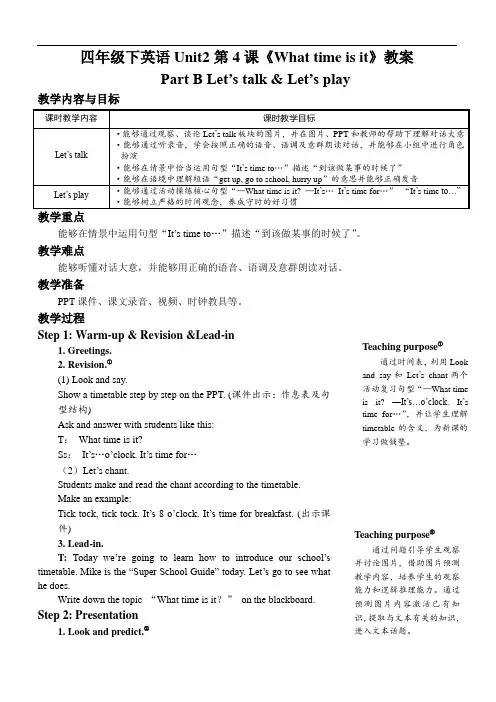
四年级下英语Unit2第4课《What time is it》教案Part B Let’s talk & Let’s play教学内容与目标教学重点能够在情景中运用句型“It’s time to…”描述“到该做某事的时候了”。
教学难点能够听懂对话大意,并能够用正确的语音、语调及意群朗读对话。
教学准备PPT课件、课文录音、视频、时钟教具等。
教学过程Step 1: Warm-up & Revision &Lead-in1. Greetings.2. Revision.①(1) Look and say.Show a timetable step by step on the PPT. (课件出示:作息表及句型结构)Ask and answer with students like this:T:What time is it?Ss:It’s…o’clock. It’s time for…(2)Let’s chant.Students make and read the chant according to the timetable.Make an example:Tick tock, tick tock. It’s 8 o’clock. It’s time for breakfast. (出示课件)3. Lead-in.T:Today we’re going to learn how to introduce our school’s timetable. Mike is the “Super School Guide” today. Let’s go to see what he does.Write down the topic “What time is it?”on the blackboard. Step 2: Presentation1.Look and predict.②Teaching purpose①通过时间表,利用Look and say和Let’s chant两个活动复习句型“—What time is it? —It’s…o’clock.It’s time for…”,并让学生理解timetable的含义,为新课的学习做铺垫。
人教版PEP英语四年级下册《Unit 2 What time is it》教学设计2
人教版PEP英语四年级下册《Unit 2 What time is it》教学设计2一. 教材分析人教版PEP英语四年级下册《Unit 2 What time is it》主要让学生掌握日常英语表达时间的基本句型和词汇。
通过本课的学习,学生能够用英语询问和回答现在的时间,描述一天的作息时间安排。
本课的主要句型为:“What time is it?”和“It’stime for…”,同时学生还需要掌握与时间相关的词汇,如:morning, afternoon, evening, morning tea, lunch, afternoon tea, supper等。
二. 学情分析四年级的学生已经具备了一定的英语基础,能够听、说、读、写一些简单的英语句子。
在学习本课之前,学生已经学习了有关日常生活的基本词汇,如:good morning, good afternoon, good evening等,为本课的学习打下了良好的基础。
但是,对于一些较复杂的时间表达,如具体的钟点时间(如:1:30, 2:45等),学生可能还比较困难,因此在教学过程中需要特别关注这一点。
三. 教学目标1.知识目标:学生能够听、说、读、写本课的主要句型“What time isit?”和“It’s time for…”,并能够运用所学词汇和句型描述现在的时间和一天的作息时间安排。
2.能力目标:通过小组合作、角色扮演等活动,提高学生的口语表达能力和交际能力。
3.情感目标:培养学生热爱生活、珍惜时间的良好习惯。
四. 教学重难点1.重点:学生能够熟练掌握并运用本课的主要句型和词汇进行日常交流。
2.难点:学生能够正确表达具体的钟点时间(如:1:30, 2:45等)。
五. 教学方法1.情境教学法:通过设定生活情境,让学生在实际语境中学习和运用英语。
2.互动教学法:引导学生参与课堂互动,提高学生的口语表达能力和交际能力。
3.任务型教学法:通过完成各种任务,让学生在实践中学习和运用英语。
PEP小学英语四年级下册Unit2Whattimeisit说课稿(精选五篇)

PEP小学英语四年级下册Unit2Whattimeisit说课稿(精选五篇)第一篇:PEP小学英语四年级下册Unit 2Whattime is it说课稿PEP小学英语四年级下册Unit 2《 Whattime is it?》说课稿一、说教学内容今天我说课的内容是PEP小学英语四年级下册Unit 2Whattime is it?的B部分第二课,主要学习Let’s talk的对话.二、说教材本单元围绕“时间”这一题材开展教学活动。
学生在前面课时学过句型What time is it? It’s nine o’clock.It’s time for English class.他们已经掌握了整点和几点几分的表达方法,比较使用It’s time for….和It’s time to….。
我相信通过这一节课的学习,有助于学生巩固和丰富表达时间的方式,并学会如何表达“到时间做某事”。
三、说教学目标《英语课程标准》明确提出了小学英语在语言技能、语言知识、情感态度、学习策略和文化意识五个方面所要达到的教学目标。
在本课时的教学中,我将重点关注三大目标:1)认知目标要求学生能听说读写get up, go to school., go home, go to bed四个动词词组;能认读、区分并灵活运用It’s time to….和It’s time for….两个句型。
2)能力目标要求学生看懂时间;能流利地问答非整点时间;能用It’s time to ….来描述自己一天的活动。
3)情感目标主要是帮助学生树立学好英语的信心。
增加学生参与意识,引导学生积极与他人合作。
共同完成学习任务并在成功中体会学习中的乐趣。
加强学生珍惜时间的意识,帮助学生养成良好的作息习惯。
四、说教学重点和难点It’s time to…和It’s time for…的用法。
五、学情分析学生在本单元已分别学习了“It’s time for…”和“It’s time to…”的用法,需在本课中感悟两者的区别。
四年级下册What time is it教学设计(优秀9篇)
四年级下册What time is it教学设计(优秀9篇)What Time Is It教案篇一教学目标:认知目标:1、能够听、说、认读本课时的主要单词和词组:music class, P.E class, English class, breakfast, lunch, dinner.2、能认读句型:What time is it? 并做出相应的回答:It’s…… It’s time for……Let’s do 部分的指示语,并按要求做出相应的动作。
3、能完成Task time 中的任务。
情感目标:在教学中激发学生学习英语的兴趣,帮助他们树立信心。
学习策略目标:1、培养学生的注意力。
2、通过小组活动,培养学生积极与他人合作、参与活动的意识。
3、在任务中,促使学生积极运用所学英语知识进行表达与交流,并能在遇到问题时主动向人请教。
教学重点:听、说、认读本课时的单词和词组。
教学难点:对新句型“What time is it? It’s ……o’clock.It’s time for …..” 的理解和运用。
课前准备:教具钟、单词卡片、教学课件学生准备自制的种表。
教学步骤:一、课前热身复习旧知1、Greeting .2、Sing a song : One Two Three Four Five.3、游戏:教师两个手指同时出示数值,看谁能最快报出两个人相加的和。
二、呈现新知1、时间的表述A. 教师出示教具钟:Look , this is a clock. (教师将钟拨到一点) What time is it?It’s one o’clock.教师强调地说one o’clock,(教师将钟拨到四点) What time is it? It’s three o’clock now.B. 教师领读o’clock,It’s three o’clock.C. 教师拨动教具钟的时针,进行提问:What time is it? 先由个人――小组――全班的方式,让学生回答。
Unit2Whattimeisit?(教学设计)-人教PEP版英语四年级下册
四下英语Unit Two What time is it?教学设计一、教材分析:本节课是人教版四年级下册的第二单元课Let’s talk,英语是从三年级为起点,学生在之前就掌握了一些关于英语的数字的表达,词汇,短语,日常生活中的打招呼用语,,学习了内容随着越高年级逐渐的加深,层层递进,联系生活实际,现在这一单元What time is it? 核心句型:What time is it now? It’s two o’clock.通过这里的句子引出It’s time to do sth.It’s time for sth.学习时间的表达,知道用英语怎么表达现在的时间点,在该时间去做某事,结合课文,以旧引新。
二、学情分析:本节课的授课对象是四年级的学生,四年级的学生有了一定的英语基础,掌握了数字的表达,有了这个基础对于时间表达更容易掌握。
《义务教育英语课程标准》四年级学生表达与交流中提出:能围绕相关主题,运用所学语言,进行简单的交流,介绍自己和身边熟悉的人或事物,表达情感和喜好等,语言达意;在书面表达中,能根据图片或语境,仿写简单的句子。
贴切日常生活,有助于学生理解识记和运用文中的单词和对话,同学之间能够进行口语交际,提升学生的听、说、读、写的能力。
三、教法:情境教学法,小组合作学习教学法。
四、教学目标:1.学生能够听懂并且会说并且回答What time is it?/ It’s…… 用It’s time to do sth.来描述即将要做的事情。
2.学生之间,教师之间互相的对话交流,加深对句式的理解与运用。
3.培养学生的时间观念,养成珍惜时间的好习惯。
五、教学重点:学生能熟练的掌握问句What time is it?和回答的It’s___o’clock.六、教学难点:能在具体情境中运用It’s time to do sth./It’s time for……七、教学过程:热身 Warmup sing the song.Good morning ,boys and girls.播放What time is it? 视频设计意图:运用视频的方式导入,调动学生的好奇心,调动学生的学习态度,有助于提升课堂氛围,集中学生的注意力,为后续教学做铺垫。
人教版PEP小学英语四年级下册第二单元-《What time is it?》教案
Unit 2 What time is it?教案Teaching Contest:人教版PEP小学英语四年级下册第二单元《What time is it?》Part B Let’s learn & Let’s playTeaching Objectives:1.能够听、说、认读短语:get up/go to school/go home/go to bed;并且能够运用核心句型:It’s time to ...描述自己的作息时间和活动安排。
2.通过游戏教学激发学生学习兴趣,通过任务教学操练句型。
3.培养学生严格的时间观念,养成守时守纪的好习惯。
Important & difficult points:1.重点:听、说、认读会上述四个短语;能在实际情景中灵活运用于句型It’s time to ...。
2.难点:区分句型“It’s time for ...”和“It’s time to ...”用法。
Teaching aids:教学课件、单词卡、相关图片Teaching procedures:Step 1 Warm up通过“I Spy”游戏复习上课时所学的单词和短语。
在游戏中,激发学生学习的兴趣。
(3min)Step 2 Presentation1.呈现新知:在游戏“I Spy”最后,引出bed、school、home等单词的图片,在学生认读之后,逐一教学短语:get up/go to school /go home/go to bed。
教师在教学过程中,采取齐读、个读等形式让学生反复练习,同时教师注意纠正get up的读音(可以连读)。
(5min)2.播放Let’s learn的录音,学生跟读单词,并引出句型“It's time to ____.”学生提出疑问。
3.教师通过上课时的句型“What time is it?It’s ...It’s time for ...”与学生展开对话。
Unit 2 What time is it- 教案(优秀5篇)-最新
Unit 2 What time is it? 教案(优秀5篇)Unit 2 What time is it? 教案篇一a read and write c good to knowaims:1. master the writing of the words: 1-10, and “what time is it? it’s two o’clock.2. know “read and write”3. at the same time understanding of the countries in the time to express the difference. analysis of the teachingimportant points:master the writing of the words: 1-10, and “what time is it? it’s two o’clock.difficult points:at the same time understanding of the countries in the time to express the difference. knowledge points:write the four skill wordsanalysis of the students:the students can read the words before, so it will be easy for them to write the words. but they don’t know the sentences,so write the sentences are very difficult.teaching aids1.the pictures of the words.2.a map of the world.3.a tape recorder, a tape.step one warm-up1. review the part of let’s do and sing and do it2. listen and draw.1.the teacher says the time and the students draw.3. the daily talk and the free-talk.t: good morning. how do you do?s: how do you do?t: what time is it now?s: it’s nine o’clock. it’s time for english class.(teaching intention: firstly ,the ss can be interested in english by singing and set up a good english atmosphere. secondly, ss can be confident in english studying.)step two presentation1. what time is it? it’s … o’clock.a. t: look at the map of the world. what time is it in beijing?s: it’s two o’clock.teacher shows a map of the world so that students observe beijing and other cities the time to answer questions. and put the sentences on the blackboard.b. guide the students to remember the spelling of sentence.2. write the words: 1—10a. t: it’s two o’clock in beijing, which one is two?s: that one is two.t: who can e here and write down the word?s: i can.in the same way, teach the other words.b. then look at the map. then tell me, what time is it in london\ new york\ sydney?s: it’s six \ one\ four.c. listen, read and point.d. spelling the words.step three practice1. after the listening of the tape, the ss will practice the four-skilled words:pay attention to the good habits of the handwriting.(teaching intention:firstly: make the students grasp the new lesson.secondly: revise the old knowledge. )2. gameswhen the ss master the words, the teacher can use some games to practice the four-skilled words. such as: read the words quickly. pass over the words. listen and then find the words. guess the words. make a choice.(teaching intention: make the students use the new lesson . secondly: foster the students’ ability to study on their own. assess them fairly.)step four consolidation and extension1. do the wb of this part: a read and write2. know “good to know”simple on the question of the time difference, through observation of students in four different cities map at the same time as the time difference, figure out the four cities of the time difference betweendifferent cities.3. read and write cross. ( 根据实际情况,填写。
人教版pep小学英语四年级下册《What time is it》教案及教学反思(共6个课时)
人教版pep小学英语四年级下册《What time is it》教案及教学反思(共6个课时)一. 教材分析《What time is it》是人教版PEP小学英语四年级下册的一篇课文,主要讲述了一天中不同时间所做的事情。
本课旨在让学生掌握一般现在时态的疑问句和回答,以及时间表达法。
通过本课的学习,学生能够用英语询问和回答时间,并进行简单的日常交流。
二. 学情分析四年级的学生已经掌握了基本的英语语法和词汇,具备一定的听、说、读、写能力。
他们对新鲜事物充满好奇,善于模仿和探究。
但同时,学生的英语水平参差不齐,部分学生对时间的表达和理解还有待提高。
三. 教学目标1.知识目标:学生能够听懂、会说、会读关于时间的单词和短语,如:hour, minute, clock, What time is it?等。
2.能力目标:学生能够用英语询问和回答时间,进行简单的日常交流。
3.情感目标:培养学生热爱生活、珍惜时间的意识。
四. 教学重难点1.重点:学生能够正确地运用一般现在时态询问和回答时间。
2.难点:学生能够熟练地运用时间词汇进行日常交流。
五. 教学方法1.情境教学法:通过设置具体的时间情境,让学生在实际环境中运用英语。
2.任务型教学法:通过完成小组任务,激发学生的学习兴趣和合作精神。
3.游戏教学法:通过趣味游戏,巩固所学知识,提高学生的积极性。
六. 教学准备1.准备时间相关的图片、道具等教学资源。
2.制作课件,展示课文内容。
3.准备录音机、磁带等播放设备。
七. 教学过程1.导入(5分钟)利用图片和道具,引导学生谈论一天中的时间,为新课的学习营造氛围。
2.呈现(10分钟)展示课文图片,让学生看图说话,引出时间词汇。
接着,播放课文录音,让学生跟读。
3.操练(15分钟)采用游戏、小组活动等形式,让学生反复练习时间词汇和句子。
如:时间接龙、角色扮演等。
4.巩固(10分钟)设计任务型活动,让学生在实际情境中运用英语。
如:制作时间表格、编写小故事等。
四年级下册What time is it教学设计优秀5篇
四年级下册What time is it教学设计优秀5篇四年级下册What time is it教学设计篇一教学要求:思想品德要求:学习格言警句,知道该如何做人、如何处事,要热爱祖国;懂得在邀请别人时要诚心诚意。
知识要求:会读、会背格言警句,理解其意思;学习短文《三顾茅庐》,理解短文内容。
把自己最想告诉别人的事、快乐、梦想、美景写成作文,要把意思写具体,写清楚。
能力要求:培养背诵格言警句的能力;能用自己的话说说“三顾茅庐”这个词语的意思;向别人推荐好书,提高口头表达能力;培养独立选择作文材料的能力。
重点难点:读、背格言警句,理解意思;理解短文内容,明白故事说明的道理;能选择一本好书,具体说出书好在哪儿,清楚明白地向同学介绍;作文不出题,选好材料要动脑筋,把作文写具体,写清楚,需要下功夫。
教具准备:常规教学时间:三课时第一课时一、学习格言警句1、读一读,读准字音卑、炬2、理解意思(小组讨论,全班交流)寸寸河山寸寸金:河山像金子一样宝贵,寸土寸金,不容侵犯。
位卑未敢忘忧国:地位虽然地下是普通百姓,但不能忘了为国分忧,因为都是国家的主人,有为国分忧的责任。
天下兴亡,匹夫有责:天下的兴盛、灭亡,人人都有责任,都应为国家的发展出力。
春蚕到死丝方尽,蜡炬成灰泪始干:春蚕的丝直到死才吐尽,蜡炬的泪直到燃尽才能流干。
借指爱情的忠贞不渝,也指鞠躬尽瘁的献身精神。
干大事而惜身,见小利而忘命,非英雄也:做大事情的时候不肯出力,怜惜自己;而见到很小的好处就去拼命,这不是英雄好汉,告诉人们要正确对待事业与私利。
人故有一死,或有重于泰山,或轻于鸿毛:人都会死,有的人死得有意义,比泰山还重;有的人死得毫无意义,比鸿毛还轻。
3、采用多种形式练习背诵二、阅读短文1、自己读短文,提出不懂的问题,同桌互相讨论。
三顾茅庐:顾,看望;茅庐,草房。
三国鼎立:指三国的势力对立(像鼎的三条腿)2、细读课文,找出描写刘备语言、动作、神态的词句,从中你能体会到什么?在书上批注。
四年级下册What time is it教学设计(优秀9篇)
四年级下册What time is it教学设计(优秀9篇)“Whattimeisit?”教学反思篇一“Whattimeisit?”教学反思合理设计课堂活动点燃学生学习热情----“What time is it?”教学反思蓝田县工业园区小学刘宁在Unit2 let's learn一课中,学生学习的主要目标是能运用“get up,go to school,go home, go to bed”及句型“ What time is it? ”、“ It’s …”、“It’s time to…”进行问答进而激发学生学习英语的兴趣,帮助学生树立学好英语的信心,增强学生参加意识,引导学生主动与他人合作。
在Practice环节,我设计了学生合作学习的故事情境:看课本Let’s play 图片,运用“What time is it?”、“It’s…”、“ It’s time to ...”进行对话,小组练习。
尽管老师、学生进行了示范,打算学生仍感到操作难度大,兴趣不高。
我想,原因如下:1. 学生刚开始学习、接触句型、单词,不熟悉,没有信心。
2. 接近课程尾,学生很疲劳。
3. 有些学生比较害羞。
但是,我觉得主要是难度太大,不适合我班学生特点。
于是,我调整了这个活动,改为抽卡片,三人对话,大家判断是否合理。
这样难度降低了,再加上反复示范,还有一些不合理的事件,引发了学生参与的热情,学生能够积极投入小组合作学习,反复练习,乐此不疲,达到了预期效果。
从孩子们的`精彩表现中,我看到了学生们真正享遭到了运用语言正在语言交流中获得学习的乐趣,经验小结:1.故事情境的设计要符合学生特点,不能太难,教学还是要根据学生的实际,从学生的水平入手,设计符合他们水平的活动,这样才能达到最好的效果,不能好高骛远。
2.故事情境要有趣,激发学生的参与热情。
3.注重示范的作用。
4.吃透教材,分析好重难点,这样才能有的放矢,要不然纵然有再好的点子也不能点亮整个课堂。