
人教版新目标英语八年级下册《Unit 4 Why don't you talk to your parents?》单元主题写作课件
新目标八年级下册英语Unit4 why don39;t you talk to your parents重点知识讲解

Unit 4 Why don’t you talk to your parents?Language points1)allow v.允许;准许allow doing sth 允许做某事e.g. We don’t allow smoking in our house. 我们不允许在家里抽烟。
allow sb. (not)to do sth. (不)允许某人做某事(在中考单选中常考)e.g. My parents don’t allow me to stay up late. 我父母不允许我熬夜。
Mr. Smith allowed Mike to drive there. 史密斯先生允许迈克开车去那里。
2) big deal, dealbig deal表示“重要的事情或状况”,多用于非正式交流。
作否定时,常说It’s not a big deal或It’s no big deal.没有什么了不起。
e.g. There's a soccer game on TV this evening but I don’t have to watch it. It’sno big deal. 今天晚上电视上有一场足球赛,但我不一定要看。
It’s a big deal, David, bigger than you know.这事挺重要的,戴维,比你所知道的要重要。
What's the big deal? It’s only a birthday, not the end of the world.有什么了不起的?这不过是个生日,又不是世界某日。
3) work outwork out 解决(问题);算出e.g. Mike worked out the difficult problem by himself.迈克自己算出了那道难题。
Is it possible to work out the problem? 有可能解决这个问题吗?work for 为……做事,为……尽力,被……雇佣者work out 可以解决,设计出,算出,计算出,消耗完挤出去4)argue v.争吵;争论e.g. The couple began to argue about the child’s education.argue for 为……辩护The lawyer argues for the poor man.argue sb with/over sth 与……争论Do what you are told and don't argue with me! argue against争辩……He argued fiercely against the plan of tax cute.5). proper adj.正确的;恰当的e.g. It’s not proper to visit a friend too late in the evening.太晚了,去看朋友不合适。
人教新目标2014春八年级下册unit4-Why-don't-you-talk-to-your-parents课文重难点讲解(打印)
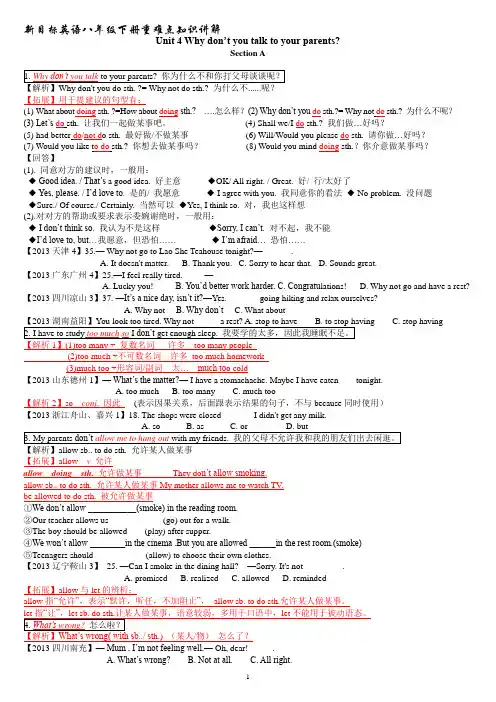
新目标英语八年级下册重难点知识讲解Unit 4 Why don’t you talk to your parents?Section A【拓展】用于提建议的句型有:(1) What about doing sth. ?=How about doing sth.? ….怎么样?(2) Why don’t you do sth.?= Why not do sth.? 为什么不呢?(3) Let’s do sth. 让我们一起做某事吧。
(4) Shall we/I do sth.? 我们做…好吗?(5) had better do/not d o sth. 最好做/不做某事(6) Will/Would you please do sth. 请你做…好吗?(7) Would you like t o do sth.? 你想去做某事吗?(8) Would you mind doing sth.?你介意做某事吗?【回答】(1). 同意对方的建议时,一般用:◆ Good idea. / That’s a good idea. 好主意◆OK/ All right. / Great. 好/ 行/太好了◆ Yes, please. / I’d love to. 是的/ 我愿意◆ I agree with you. 我同意你的看法◆ No problem. 没问题◆Sure./ Of course./ Certainly. 当然可以◆Yes, I think so. 对,我也这样想(2).对对方的帮助或要求表示委婉谢绝时,一般用:◆ I don’t think so. 我认为不是这样◆Sorry, I can’t. 对不起,我不能◆I’d love to, but…我愿意,但恐怕……◆ I’m afraid… 恐怕……【2013天津4】35.— Why not go to Lao She Teahouse tonight?— ______.A. It doesn't matter.B. Thank you.C. Sorry to hear that.D. Sounds great.【2013广东广州4】25.—I feel really tired. —______A. Lucky you!B. You’d better work harder.C. Congratu lations!D. Why not go and have a rest? 【2013四川凉山3】37. —It’s a nice day, isn’t it?—Yes. ______ going hiking and relax ourselves?A. Why notB. Why don’tC. What aboutC. stop having【解析1】(1)too many + 复数名词许多too many people(2)too much +不可数名词许多too much homework(3)much too +形容词/副词太… much to o cold【2013山东德州1】—What’s the matter?— I have a stomachache. Maybe I have eaten ___ tonight.A. too muchB. too manyC. much too【解析2】so conj. 因此(表示因果关系,后面跟表示结果的句子,不与because同时使用)【2013浙江舟山、嘉兴1】18. The shops were closed_______ I didn't get any milk.【拓展】allow v 允许allow doing sth.允许做某事They do n’t allow smoking.allow sb.. to do sth. 允许某人做某事My mother allows me to watch TV.be allowed to do sth. 被允许做某事①We don’t allow ___________(smoke) in the reading room.②Our teacher allows us ____________(go) out for a walk.③The boy should be allowed____(play) after supper.④We won’t allow ________in the cinema .But you are allowed ______in the rest room.(smoke)⑤Teenagers should ___________ (allow) to choose their own clothes.【2013辽宁鞍山3】25. —Can I smoke in the dining hall? —Sorry. It's not_________.A. promisedB. realizedC. allowedD. reminded【拓展】allow与let的辨析:allow指“允许”,表示“默许,听任,不加阻止”,allow sb. to do sth.允许某人做某事。
人教新目标英语八年级下册:Unit 4 Why don't you talk to your par

Name Group ClassTitle:Unit 4 Why don’t you talk to your parents? Period 6 RevisionTopic: Interpersonal communication【Get ready before class】知识梳理1.掌握提出问题的方法,What’s wrong?What’s the matter? with sb.What’s the problem/the trouble?并能讨论所给出的建议。
情态动词should,shouldn’t“(不)应该”,常用来提出请求和建议。
Could“可以”也可用来给出建议。
2、表建议的句型:You should/could +v. Why don’t you + v?Why not + v? Could you please + v?You’d better (not) + v. Would you mind doing…?What about/How about + n/doing…?单元词汇、句型分课时过关Section A (1a-2d)单词:1.允许2.有毛病3.猜测4.协议词组:1.快速查看2.成功的发展3. 和睦相处4.学的太多5.得到充足的睡眠6.和我的朋友闲逛7.早一点睡觉8.给他写信9.进入一所好的高中10.等那么久11.对某人生气句子:1. 我学得太多了因此我的睡眠不足。
2. 我有太多的作业因此我没有闲暇做我自己爱做的事。
3. 我上太多的课后辅导班。
4. 我和我最好的朋友吵架了。
5. 我不擅长写信。
6. 虽然是她错了,但这也不是什么大事。
7. 希望事情能解决。
Section A (3a-3c)单词:1.关系2.交流(n.) (v.)3.沟通4.争吵5.云朵6.年级较长的7.代替8.任何9.焦虑的10.主动提出11.正确的12.第二13.解释14.清楚易懂的15.抄袭16.归还17.再也(不)词组:1.和睦相处2.我和父母之间的关系3.拒绝让我看我喜欢的电视节目4.感觉孤独5.和你的兄弟交流句子:1.我的问题是我和我的家人相处不好。
教学设计 Unit 4 Why don’t you talk to your parents
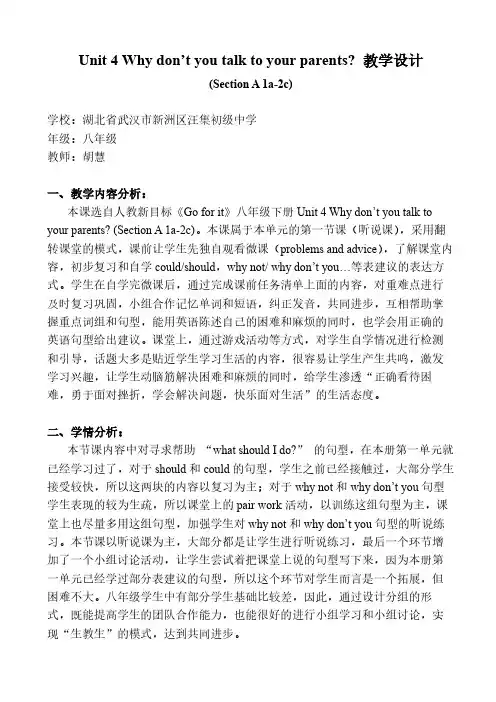
Unit 4 Why don’t you talk to your parents? 教学设计(Section A 1a-2c)学校:湖北省武汉市新洲区汪集初级中学年级:八年级教师:胡慧一、教学内容分析:本课选自人教新目标《Go for it》八年级下册Unit 4 Why don’t you talk to your parents? (Section A 1a-2c)。
本课属于本单元的第一节课(听说课),采用翻转课堂的模式,课前让学生先独自观看微课(problems and advice),了解课堂内容,初步复习和自学could/should,why not/ why don’t you…等表建议的表达方式。
学生在自学完微课后,通过完成课前任务清单上面的内容,对重难点进行及时复习巩固,小组合作记忆单词和短语,纠正发音,共同进步,互相帮助掌握重点词组和句型,能用英语陈述自己的困难和麻烦的同时,也学会用正确的英语句型给出建议。
课堂上,通过游戏活动等方式,对学生自学情况进行检测和引导,话题大多是贴近学生学习生活的内容,很容易让学生产生共鸣,激发学习兴趣,让学生动脑筋解决困难和麻烦的同时,给学生渗透“正确看待困难,勇于面对挫折,学会解决问题,快乐面对生活”的生活态度。
二、学情分析:本节课内容中对寻求帮助“what should I do?”的句型,在本册第一单元就已经学习过了,对于should和could的句型,学生之前已经接触过,大部分学生接受较快,所以这两块的内容以复习为主;对于why not和why don’t you句型学生表现的较为生疏,所以课堂上的pair work活动,以训练这组句型为主,课堂上也尽量多用这组句型,加强学生对why not和why don’t you句型的听说练习。
本节课以听说课为主,大部分都是让学生进行听说练习,最后一个环节增加了一个小组讨论活动,让学生尝试着把课堂上说的句型写下来,因为本册第一单元已经学过部分表建议的句型,所以这个环节对学生而言是一个拓展,但困难不大。
人教新目标版初中英语八年级下册Unit4Whydon’tyoutalktoyourparents单元测试题(含答案)

Unit 4 Why don’t you talk to your parents单元过关与检测(时间:120分钟,满分:120分)一、听力部分(20分)Ⅰ.听句子,选择正确的图片(其中有两项多余)。
句子读两遍。
(5分)Ⅱ.听小对话,选择最佳答案。
对话读两遍。
(5分)( )6.What’s the matter with Lisa?A.She argued with her mother.B.She was ill.C.She was stressed out.( )7.What should the man do?A.He should borrow money from others.B.He should get a part-time job.C.He can ask his parents for some money.( )8.What’s happening to the woman?A.She is asking the policeman for help.B.She gets lost.C.She is giving directions to the man.( )9.Why is the man angry?A.He can’t listen to his CDs.B.His sister plays her CDs too loud.C.He has a fight with his sister.( )10.What will the man do?A.He will write Eve a letter.B.He will go to Eve’s home.C.He will talk with Eve on the phone.Ⅲ.听长对话,选择最佳答案。
对话读两遍。
(5分)听第一段对话,完成第11—12小题。
( )11.Who got the worst grade in English?A.Jane.B.Jim.C.Frank.( )12.What does Jane advise Jim to do?A.Jim shouldn’t call up his best friend.B.Jim should study harder.C.Jim should write to his best friend.听第二段对话,完成第13—15小题。
人教新目标版英语八下Unit4《Whydon’tyoutalktoyourparents》说课稿

人教新目标版英语八下Unit 4《Why don’t you talk to your parents》说课稿一. 教材分析人教新目标版英语八下Unit 4主要讨论了如何与父母沟通的问题,通过本节课的学习,学生能够掌握一定的沟通技巧,提高与父母交流的能力。
本单元的主题贴近学生的生活,有利于激发学生的学习兴趣和积极性。
二. 学情分析根据我对学生的了解,他们在学习过程中已经掌握了基本的英语语法和词汇,具备一定的听说读写能力。
但部分学生在与父母沟通方面存在一定的困扰,可能因为害羞、害怕被批评等原因而不愿意与父母交流。
因此,本节课的教学目标在于帮助学生克服这些障碍,提高他们的沟通能力。
三. 说教学目标1.知识目标:学生能够掌握本节课的重点词汇和句型,如“Why don’tyou…?”,“Because…”等,并能够运用这些词汇和句型进行简单的交流。
2.能力目标:学生能够通过听力、口语、阅读和写作等多种方式,提高自己的英语应用能力。
3.情感目标:学生能够认识到与父母沟通的重要性,学会尊重和理解父母,提高与父母相处的质量。
四. 说教学重难点1.重点:本节课的重点是让学生掌握并运用句型“Why don’t you…?”和“Because…”进行交流。
2.难点:如何帮助学生克服害羞、害怕被批评等心理障碍,提高他们与父母沟通的勇气和信心。
五. 说教学方法与手段1.任务型教学法:通过设计各种真实的任务,让学生在完成任务的过程中运用所学知识,提高英语实际应用能力。
2.情境教学法:创设各种与父母沟通的情境,让学生在模拟实践中学会如何与父母交流。
3.小组合作学习:通过小组讨论、分享等方式,促进学生之间的互动,提高他们的合作能力和沟通能力。
六. 说教学过程1.导入:通过一个关于父子间沟通的小故事,引发学生对与父母沟通的思考,激发他们的学习兴趣。
2.呈现:介绍本节课的主题,展示相关的词汇和句型,让学生初步感知和学习。
3.实践:设计各种与父母沟通的情境,让学生在模拟实践中运用所学知识。
初中英语_Unit4 Why don’t you talk to your parents?教学设计学情分析教材分析课后反思
Step 5:Listening活动一、出示听力图片引导学生猜测“Is she happy? What ’s wrong with the girl?” 播放录音 并根据学生完成听力情况调整听力次数 看图片做听力猜测,读1a 句子做好听力准备,核对答案。
活动二、fill in the blanks再次听力,补全朋友给出的建议。
重视听力策略的训练 活动二的设计一方面是根据学生的水平对听力材料难度进行的调整,另一方面也是为了让学生继续感知问题与建议这一话题。
Step 6:Group work If your classmates have some troubles, can you giv e them some advice? Try to give advice in groups. 并进行总结给出建议的几种方式。
小组合作讨论问题并给出恰当的建议,利用小组的作用,调动学生的积极性。
Step 7 :pair work T : There is something wrong with me . can you give me advice?T: Now it ’s your turn. Work in pairs to makea new conversation从师生对话过渡到生生对话,进行目标语言的操练。
Step8: ListeningShow the picture lead in the listening 2a 、2b Look at the picture and guess “What ’s the matter with Peter?”Read the advice that Peter ’s friend gives himand the reason why Peter doesn ’t like theadviceDo listening and Check the answers.通过导入听前活动,做好听力准备,进行听力训练。
新目标英语八年级下册Unit4-Why-don't-you-talk-to-your-parents
Unit4 Why don't you talk to your parents?单元练习一、听力(听力)(共20小题;共20分)一、听句子,选择与所听内容相符的图片。
每个句子读一遍。
1。
A。
B。
C. 2。
A. B。
C.3. A。
B. C。
4。
A。
B. C.5. A. B. C.二、听下面五段对话,选择正确答案.每段对话读一遍。
6. What does the woman think of John?A. Honest。
B. Generous。
C。
Friendly.7。
How does the woman think of the dress?A。
It's of high quality. B。
It’s cheap and nice. C. It's too expensive.8. Who is the tallest student in the woman's class?A. Jerry。
B。
Jane. C。
Jason.9. What is Rose doing now?A. Playing with her sisters.B. Watching a movie.C。
Doing her homework.10. Why is the woman asking for more hot water?A。
She is thirsty. B。
She hurt her feet. C。
It’s cold today.三、听下面两段对话,选择正确答案。
每段对话读两遍。
听第11段对话,回答第11至第12题。
11. What’s the matter with Lucy?A。
She speaks too much。
B。
She has a sore throat。
C. She drinks too much water.12. What should not Lucy have to do?A. Not to speak too much。
新目标人教版八年级下册英语《Unit 4 Why don’t you talk to your parents》Section A 1 (1a-2c)教学设计
Unit 4 Why don’t you talk to your parents ? Section A 1 (1a-2c) 一、教学目标: 1. 语言知识目标: 1) 能掌握以下单词: allow ,allow to 能掌握以下句型: ① —What’s wrong ? /What’s the problem ? ② —I’m really tired because I studied until midnight last night . 2) 能掌握语法:学习情态动词和建议的表达法,学会用不同句式提出建议。 3) 能运用所学的建议,引导学生学习更多表达建议的句式,培养自我放松、帮助他人提出合理化的建议的意识。 2. 情感态度价值观目标: 通过对本单元的学习活动,能培养培养学生学习英语的强烈兴趣,善于发现生活中存在或发生的事情,积极思考,乐于助人,乐于参加各种活动的积极情感,培养学生在日常生活中善于发现问题并有针对性的提出合理的建议。 二、教学重难点 1. 教学重点: 1) 词汇、词组搭配和情态动词的用法。 能用表示建议的短语或句式,给父母、同学朋友、家人的合理建议。 2) 能熟练掌握并运用本部分的重点句式: What’s wrong ? I’m really tired because I studied until midnight last night. Why don’t you talk to him about it ? 2. 教学难点: 情态动词在表达建议时的用法。 3. 教学突破 1)在教学过程中,注重分层教学,尊重差异,让不同层次的学生都能参与,获得成就感。 2)使学生在做中练,任务明确,活动面广,使学生在交际中真实运用所学知识。 三、教学过程 StepⅠ. Warming-up and Lead in (导入) 师生问候后就学生日常生活或学习中常见的问题开始让学生考虑与家人或他人的沟通问题,学习与建议有关的词汇,导入新课。 StepⅡ. Presentation (新授) 1. Show some pictures on the big screen. Discuss with the Ss with all the children. 2. Ss watch and say the new actions by some expressions. 3. (Show some pictures on the screen and ask some students to perform the actions.) e.g. T: What’s wrong ?/ What’s the problem ? S: I have too much homework. T: What’s wrong ?/ What’s the problem ? Ss: He /she has to study too much so he didn’t get enough sleep. Teach: have too much homework ,have/has to study too much ,get into a fight 4. Work on 1a. Ss read the problems and think them over if they’re serious. 5. Check the talk about the problems with their partners. Ⅲ. Listening Practice (听力练习) 1. T: What’s wrong with the girl ? Now let’s listen to the tape, find out the problems they hear from 1a. 2. Play the recording for the Ss twice if necessary. 3. Ss listen to the recording and write the numbers from 1a. Keys:1,4 4. Listen and repeat. 5. 对话展示:根据听力以及幻灯片中的问题引出本节课重点句型: -- What’s wrong ?/ What’s the problem ? --I’m really tired because I studied until midnight last night. --Why don’t you go to sleep earlier this evening ? --I have too much homework. 然后再要求学生根据刚才的例子自己编写对话,再与自己的伙伴一起进行对话表演。 Ⅳ. Pair work ( 合作与运用 ) 1. Ask the students to choose one of the pictures in 1a and make a conversation with their partners. eg. --What’s wrong ,Peter ? --I had a fight with my best friend .What should I do ? --Well,you should call him so that you can say you’re sorry . 2. Then ask some pairs to come to the front and perform it. 3.Show the Ss two more pictures ,My dirty room and An argument . Let them think over and write down some sentences ,then share their advice together. Ⅴ. Listening (听力练习) 1. Work on 2a; T: Introduce Activity 2a ,get the Ss go through it quickly so that they understand know what to do next . Listen to the conversations and fill in the blanks with should or could . 2.Check the answers. 3.Read them together. 4. Work on 2b. Let Ss read the advice and the reasons in 2b first. Then play the recording for the Ss . We’d better play twice . The first time Ss only listen and write down the letters in the blanks. Then check the answers. At last play the recording again, Ss read some sentences after the recording (pay attention to the pronunciation and intonation. ) 5.Check the answers with all of them together . Ⅵ. Pair work (合作) Activity 2c Boys and girls ask and answer together. Ⅶ. Writing(写作) 1. Let Ss make up new conversations according to 2a&2b and role play in groups. 2. Write it down.(ask two students to come to the blackboard and write it.) 3. Discuss with the Ss. Homework: Talk to your parents or your friends , ask them if they meet problems ,wok out the best resolutions about their problems and their advice using the Modal Verbs. 板书设计: Unit4 Section A1 (1a-2c) Drills:
新目标人教版八年级下册《Unit 4 Why don’t you talk to your parents》教案
Unit 4 Why don’t you talk to your parents? Section A (3a-3c) 教案
学习目标: 知识目标 I.掌握以下句式: 1. My problem is that I can’t get on with my family. 2. Why don’t you talk about these feelings with your family? 3. Maybe you could do more jobs around the house so that they have more time for proper communication. 4. I don’t know if I should say anything to them about this. II.会用下列词汇来表达自己的感受和提出建议。 relation ,communication .argue,cloud,elder,instead,whatever,nervous,offter,proper,secondly,communicate,explain,clear, 了解短语 get on with ,all the time 技能目标 1. 能读懂描述他人问题的文章并提出合理建议。 2. 能就其他人的建议表达看法。 3. 学习一些阅读技巧和单词学习策略。 情感态度 学生能就自己的问题与别人谈论并寻求帮助,学会与别人沟通交往,关爱家人与父母,以积极的心态去面对生活。 教学过程 Before reading 1.看视频:Which word can you hear very often? When you feel lonely ,who will you ask for help? 复习怎样给别人提出建议 While reading 1 Skimming 读第一封信,回答问题 What’s his problem? 2.Scanning 跳读填写表格 3. Careful reading 1). Find the best title for the first letter. 2). How are the relations between his parents? 3). Can his elder brother watch his favorite TV show? 4.完成Sad and Thirteen’s 烦恼表 5. 读第二封信,完成思维导图,找出知心姐姐的建议。 6. 再读第二封信,找出提建议的句子。 7. 你还有其他建议吗.?请在我的空间留言板留言。 After reading 1. Question time. 同学讨论解决疑难问题,深入理解课文。 2. 学以致用 找出文中同义词及近义词,帮助学生理解单词及记忆单词。 3. Groupwork :挑选漂流瓶,谈论解决烦恼的办法并汇报。 4. Summary. 5 .Homework. 1.) Set up a QQ group after class, discuss your problems in the group to get help. 2. )To be a Caring Sister or Brother: choose one of the problems to write an email to him or her.