
高中英语(牛津译林版)必修一学案 Unit1 School life 定语从句(新)
定语从句(一)1.定义:定语从句由关系代词或关系副词引导的从句,用来修饰某个名词的从句。
定语从句的位置一般紧跟在它所修饰的词后面。
2.用法:1)被修饰的人与物在定语从句中做主语。
① The girl who/that sits next to me is from No. 27 Middle School. 坐在我旁边的女生来自27中。
② The tree which/that stands on top of the hill is 100 years old now. 矗立在山顶上的那棵树现在有100年了。
③ Do you know the boy who/that sits next to you? 你认识坐在你旁边的那个男孩吗?④ I bought a pen which/that writes very well. 我买了一支笔很好写。
练一练,好不好?①去年教我们英语的老师是个中年男人。
(中年男人:a middle-aged man)The teacher is a middle-aged man.②在你的左边有一扇能够自动打开的门。
(能自动打开:can open by itself)On your left is a .2)被修饰的人与物在定语从句中作宾语。
① The boy (whom/that/who)you met in the street is my friend.你在街上遇到的男孩是我朋友。
② The pen (which/that) I bought writes very well.我买的钢笔很好写。
③ Who is the boy (that) you met yesterda y? 你昨天遇到的男孩是谁?④ Let me see the book (which/that) you bought yesterday. 让我看看你昨天买的书吧。
<比较>:I bought a pen which/that writes very well. 我买了一支笔很好写。
(被修饰的名词pen在定语从句中作)The pen (which/that) I bought writes very well.我买的钢笔很好写。
(被修饰的名词pen在定语从句中作)练一练,好不好?①潘劲松老师教的学生经常受到校长的表扬。
(受表扬:be praised by...;校长:the principal)The students by Mr. Pan are often .②去年建造的校健身房已经投入使用了。
The school gym last year has been put into use.3)被修饰的人与物在定语从句中作定语:① I sat next to a girl whose name was Diane. 我坐在了名叫Diane的女孩旁。
② I like the book whose cover is red. = I like the book of which the cover is red.=I like the book, the cover of which is red.我喜欢那封面为红色的书。
③ He sat by the window whose glass was broken.= He sat by the window of which t he glass was broken=He sat by the window, the window of which i s broken.再练一练,好吗?①你是怎么认识那个爸爸做医生的男孩的?How the boy a doctor?②所有其墙壁都涂上了红色的房子都要被拆除。
All the houses red will be demolished.4)被修饰的名词在定语从句中作时间状语,引导词用when。
① I’ll never forget the days when we studied together. 我永远也忘不了我们在一起学习的那些日子。
② Dad, do you still remember the day when you and mom got married? 爸爸,你还记得你跟妈妈结婚的那一天吗?=Dad, do you still remember the day on which you and mom got married?<比较>:① I’ll never forget the days when we studied together.② I’ll never forget the days that we spend together.练一练:①你还记得你第一天来学校的日子吗?Do you remember to the school?②我忘不了跟你们大家度过的那些岁月。
I’ll never forget you guys.5)被修饰的名词在定语从句中作地点状语,引导词用where。
① This is the house where I was born. 这就是我出生的房子。
② The school where I’ve worked for 17 years is a key high school in Wuhu. 我工作了17年的学校是芜湖的一所重点中学。
<比较>:① This is the house where (in which) I was born.② This is the house that I bought last year.6)被修饰的名词在定语从句中作原因状语,引导词用why。
① The reason why he failed the test is hard to understand.=The reason for which he failed the test is hard to understand.练习:1.用定语从句两句并一句:1) A plane is a machine. The machine can fly.A plane .2) The man is a famous doctor. He lives in the next door.The man doctor.3) The person is our new English teacher. I spoke to the person.The person our new English teacher.4) The restaurant sells fast food. It is called MacDonald’s.The restaurant MacDonald’s. 5) This is the shoe factory. We visited the factory last week.This last week.6) This is the shoe factory. I worked in the factory for 2 years.This is .7) This is the hotel. I stayed in the hotel last month.This last month.7) These students like the school very much. Their parents have come to China for business.The noodles .9) I’ve lost the book. Several pages of the book are missing(缺失了).I’ve missing.10) I went to see my friends the Smiths. I used to look after their children when they were small.I went to see my friends the Smiths .11) I will never forget the time. We worked on the farm together during the time.I will never forget the time .12) It is reported that two schools will open next year. Both of the two schools are being built in my hometown.It is reported that two schools will open next year, .13) Last week only two people came to look at the house. Neither of them wanted to buy it.14) I recently went to the town. I was born in that town.I recently .定语从句(二)1.限制性和非限制性定语从句1) 定义:限制性定语从句是先行词不可缺少的部分,去掉它主句意思往往不明确;非限制性定语从句是先行词的附加说明,去掉了也不会影响主句的意思,它与主句之间通常用逗号分开。
① This is the house which we bought last month. 这是我们上个月买的那幢房子。
(限制性定语从句)② The house, which we bought last month, is very nice. 这幢房子很漂亮,是我们上个月买的。
(非限制性)2) 用法:专有名词或物主代词和指示代词被从句所修饰时,其后面的定语从句通常是非限制性的。
① Charles Smith, who was my former teacher, retired last year. 查理•史密斯去年退休了,他曾经是我的老师。
② My house, which I bought last year, has got a lovely garden.我去年买的的那幢房子带有一个漂亮的花园。
③ This novel, which I have read three times, is very touching. 这本小说很动人,我已经读了三遍。
非限制性定语从句还能将整个主句作为先行词, 对其进行修饰, 这时从句谓语动词要用第三人称单数。
① He seems not to have grasped what I meant, which greatly upsets me. 他似乎没抓住我的意思,这使我心烦。
高中英语 unit1 school life reading第1课时学案牛津译林版必修1
高中英语 unit1 school life reading第1课时学案牛津译林版必修1School life in the UKLearning objectives1、To read a magazine article about school life in the UK;2、 To learn to apply two basic reading skills: skimming and scanning;3、 To learn some expressions about school life;4、 To get some information about what school life in the UK is really like、 Emphasis:1、Enable the students improve their reading ability and understand the passage 、2、 Learn more about school life in the UK and the differences between school life in the UK and in ChinaTeaching methodsCooperative learning method, audio-lingual methodTeaching Procedures:Step1、Check preview and lead-in Activity1: Let’s preview the words that will be used in the article, translate into Chinese、1、enjoyable2、 experience3、 headmaster4、 earn5、 respect6、 devote7、 literature8、 average9、 struggle10、challenging11、encouragement12、cooking13、 extra14、fond15、Spanish16、sculpture17、 dessert18、satisfaction19、academic20、exchangeMake a match2 1、for free 负责,掌管22、 be fond of 喜欢,喜爱23、 look back (on)利用24、 make use of免费25、 opening hours开放时间26、 in charge of回忆,回顾Activity2: Can you describe the school life in China after viewing these pictures?(teachers, classmates, homework/assignments, subjects, grades, timetable, activities, hobbies、、、)Activity3:More and more young people begin to study abroad、What’s their school life like? Today we’ll learn an article from a school magazine, written by Wei Hua, who studied in the UK for one year、 First, listen to the tape with books closed and answer three questions、 Q1: What did Wei Hua think of her life in the UK?Q2:What subjects did Wei Hua study in the pastyear?Q3:Which British city did Wei Hua go to?Step2、 Reading strategyActivity1:Reading strategies--skimming and scanningWe skim a text when we want to get a general idea of what it is about、 We look at the and , the and sentences of paragraphs and the first and last as well as and charts to guess what the text is about、When we want to find 某些 information in a text quickly, we scan the text for and phrases, dates, numbers, etc、 Wedo not need to read the whole text word by word、Activity2:Skimming for general ideas1、What’s the main idea of the text?school life in the UK2、 Match the main idea of each paragraph as soon as possible、Para、1 lucky to experience the lifePara、2school hoursPara、3attending assemblyPara、4subjectsPara、5lunch timePara、6homeworkPara、7teachers and classPara、8improving English andcookingActivity3:Scanning for specific information1、Identify the sentences true or false, and correct the false、1)、Wei Hua’s favourite teacher was Mr Heywood、2)、 Most British classes have fewer than thirty students、3)、 Wei Hua had more homework in her school in China、4)、 It was very expensive for Wei Hua to communicate with her parents、5)、 In the UK, students can choose to stop studying any subject、6)、 The cake made by Wei Hua did not taste good、2、 Watch the video again and answer questions(First go through the questions so as to know what to find out、 You may discuss with their partners if you want、)1)、According to the headmaster, what should the students spend much time on?They should devote themselves to study、2)、 Why did Wei Hua find her homework difficult at first?Because there were different students in some classes3)、 Who gave Wei Hua a lot of support in her studies?Because all the homework was in English、4)、 How did Wei Hua manage to improve her English?The teachers gave her much encouragement、5)、What do the British like eating at the end of dinner? DessertActivity4:Read together and tell whether the following aspects of school life arementioned in the article?teachers, classmates, friends, homework/assignments, subjects, grades, timetable, activities, hobbies, customs, traditions, festivals, food, school facilitiesStep3、 ConsolidationActivity1:[Task-basedreading]AspectsDetailsGeneral impressionIt was adifferent but exciting and enjoyable1、__experience__AssemblyStudents should attend it on the first day and the2、 _headmaster_____ will tell the rules of theschool during that period、ClassOur class is of the3、average___size; we would never study in a fixed classroom、SubjectsEnglishI practiced it every day, so it got4、 _improved__ a lot、FrenchI had an5、extra ___ French class on Tuesday evenings、CookingI learned a lot and could make delicious cakes、Selective onesStudents can6、__stop_____ studying some subjects if they don’t like them、7、Homework__It was not heavy but a bit8、 ________challenging______Spare timeI played football with others,9、 relaxed____ under a tree and went to the Computer Club where I could send e-mails to my family and friends10、 free___ of charge、--Hello, this is Wei Hua speaking、How’s your day, WXY?--Quite good, how about you? What did you do?--School starts around9 am、 And ends about3、30 pm、 So I did n’t get up until8、30、Unexpectedly, i made friend with a girl called Diana、 We went to the lessons together、 Today I had6 courses- History, English, PE, Maths, Science andCooking、 Among them, English is my favorite、 During the lunch break, I sent e-mails to my family for free、Is there anything else that you want to know?--Did you do any outdoor activities today?--Ah- yes、 Playing football on the school field was quite an interesting experience、I’d like to play tomorrow、-- Sounds interesting、Let’s keep i n touch,shall we?--OK、Activity2:Time for reflection1、What’s the school life like in the UK?(such as teachers, classmates, homework,subjects, outdoor activities…)In the UK, school starts around9 am、 And ends about3、30 pm、 Teachers treat students as equals and give them much encouragement、 The average size for British schools is not more than30 students, but students have to move to different classrooms for different classes, so it’s a struggle to remember all their names、 As for the homework, it is not as heavy as what we used to get in China、 But they are a bit challenging because all the homework is in English、 Students have to study Maths, English and Science, but can also stop studying some subjects if they don’t like them、 They can choose othersubjects、 Students are encouraged to take part in different outdoor activities during the spare time, such as playing football or go to the computer club、 Field trips are organized by schools to visit places which have something to do with education、2、Think about the meanings and usage、 If you have any problems, mark them for further discussion、earn, challenging, encouragement, look back (on), for free, a bit/little、、、(Write down the new words the students have just listed、)3、 Can you tell the differences between skimming and scanning?(purpose,methods)StrategiesPurposeMethodsskimmingto get a general idea the titles(标题)the first and last sentences of paragraphs the first and last paragraphs pictures &charts(图表)scanningto find certain(某些)information quicklykey words, phrases(短语)dates, numbers …Step4、 Assignment发挥想象,连词成文(100字)enjoyable, headmaster, experience, earn, respect, average, encouragement, literature, struggle, challenging, extra。
牛津译林版高中英语必修一Unit 1《School Life》(Word power)教案
To strengthen tection, we can give the students more practice.
Ask the students to take out the maps they prepared before class. Let them discuss the map and put their maps into English first.
*Walk towards / past…, and then wa lk between…and…. You will find…at the end of the road.
Step 2.Read a map
After the warming up exercises, we will come to the topic of this period.
进行口语练习,在练习中掌握词汇
板书设计
(用案人完成)
当堂作业
完成口语任务和单词识记
课外作业
预习语法,并且完成课后作业
教学札记
Module 1 Unit 1 School life Word power
课题
M1U1 Word power
课型
新授课
教学目标
Enable the students to learn the words and expressions about school facilities.
Help t he students learn how to master the words and expressions about school facilities and equipment in the gym
译林牛津版高一英语必修一Unit 1 School life教案
Unit 1 School lifeTeaching aims of the whole unit:1.Develop students’ ability of reading comprehension by reading an article about school life in the UK and two other articles about school clubs.2.Develop students’ ability of listening comprehension by listening to two talks about school activities.3.Develop students’ speaking ability by discussing daily school life and reporting school activities.4.Develop students’ writing ability by writing a notice about school activities.5.Develop students’ integrated skills of using English by making a poster for a school club.6.Enlarge students’ vocabulary about school facilities.7 Help students understand what an attributive clause is and what relative words function as in attributive clauses; teach students how to use relative pronouns that, which, who, whom and whose.Period arrangement:The whole unit: 12 periodsWelcome to the unit: 1 periodReading: 2 periodsWord power: 1 periodGrammar and usage: 2 periodsTask: 2 periodsProject: 2 periodsSelf-assessment: 1 periodRevision and exercises: 1 periodPeriod 1 Welcome to the unitI. Teaching aims:1 Get students to know the different high school loves between the UK and China.2 Develop students’ English speaking skills.II. Teaching Procedures:Step 1. Warming upLet some students make a self-introduction.1. Introduce themselves.2. Say something about their junior high school life.3. Pair work: brain storm:When we are talking about our school life, what will we probably think of?What words or phrases will we use to describe our school life? Step 2 Presentation1.Say the following to students:It’s the beginni ng of the new term. You’ve just finished your junior high and are about to enter a new period in your studies. I am happy to give your lessons and I hope we can be friends.I can see that some of your are eager to know what studying at senior high will be like. Will it be differ4ent from junior high? Well, there are certainly many differences between junior high and senior high, but there are also some things that are the same in every school in China. What about schools in other countries? Do you have different experiences? Are schools all over the world the same? This is the subject of our first unit.2. Ask students to read the instruction and tell them:Here are three pictures that show some aspects of school life in the UK. Please read the instructions, look at the pictures: what's the difference between schools in China and the UK?Step 3 Discussion1 Ask students the following questions to talk about the words in the four pictures:Huge campus and low-rise buildingsWhat does huge mean?What does low-rise mean?What about campus and school buildings in China?(Schools in China usually have a large enough campus to make sure students have enough space to study and play. But most school buildings have at least 3 storeys.)Lockers for every studentDo you know what a locker is?(There are rows of lockers by the classrooms for students to put their bookd, exercise-books and other belongings.)What do you think about locker for students?Do you think that we should have such locker in our school? Why or Why not?Fewer students in each classHow many students are there in our class?Do you know the number of students in a class in the UK?At ease with our teacherWhat can we know from this picture?What does the word ease mean? What do you think the phrase at ease mean?Were you getting on well with the teacher when you were in junior high?What relationship do you want to have with your teachers in senior high?2 Ask students to work in groups to talk about the four pictures and the differences between schools in the UK and China. Then ask several students to report their discussion to the whole class.3. Ask students to discuss the three questions in pairs, and them ask some of them to report their answers to the questions to the whole class.What is your dream school life like?What kind of school activities do you enjoy?What do you think of your life here in the new school?Step 4 Summary and HomeworkTo day we’ve mainly talked about the differences between the high school lives in the UK and in China. After class you should:1) Recall all the new words and expressions that we learn in this lesson.2) Find more about any other differences between the high school lives in the UK and in China, either by surf the Internet or by reading some articles in newspapers or magazines.3) Preview the following part: reading (page 2 to page 4).Period 2 Reading (1) School life in the UKTeaching aims:1. Get students to know what school life is like in a high school in the UK.2. D evelop students’ ability of reading comprehension through:1)skimming and scanning.2)Guessing the meanings of some new words from the context3. To learn some expressions about school life.Teaching procedures:Step 1 Lead-in and PresentationSay the following to the students:Yesterday we’ve talked about the differences between the high school lives in the UK and in China. We know well about the high school lives in China, because we are Chinese. But we know a little about the highschool lives in the UK. Yeah? Today we are going to read a magazine article which is written by an exchanging student. She has been studying in the UK for one year. Now she gives a clear brief introduction about her school life there.(Bb: School life in the UK) Before we read the article, we are going to learn the reading strategy: skimming and scanning.Please look at page 3: Reading strategy. (Bb the following while learning the reading strategy. ) Skimming: to get a general idea of the article, without studying it in detail.Focus on the titles, headings, the first and last sentences or paragraphs, charts and pictures …scanning: to find certain information in an article quickly.Look for key words and phrases, dates and numbers, etc.Step 2. Reading1. Skimming:Question: How does Wei Hua feel about her life in the UK?2. Scanning:1)Ask students to go through the three questions in part A and makesure that each of them know the meaning of each question.(AWoodwork class is a class in which students make somethingfrom wood.)Ask students to read the passage as quickly as possible and try to find answers to the three questions. Remind students only tofocus on and identify the most important information.2)Ask student to reread the passage and complete Part C1individually. Then ask some of them to give the answers to thequestions in Part C13)Ask students to finish Part C2 individually. Then get somestudents to share their answers with the whole class. Ask them to say the true sentences to correct the false ones.3 GuessingAsk students to finish Part D individually. Tell them not to look up the meanings of the words from the wordlists in the textbook. Let them guess the meanings from the context. Then check the answers with the whole class.Step 3 New Words in this UnitStudy the new words appears from page2 to page 5 (from attend to immediately) at page 68.Step 4. Homework.1. Complete part E on page 5.2. Read the two articles in reading on pages 82 and 83 in wb and answers the questions below them.3. Learn all the new words we learned today by heart.Period 3 Reading (2) School life in the UKTeaching aims:1 Help students become more familiar with the article.2 Develop s tudents’ ability of reading comprehension by finding out what topics are covered in the article.3 Develop students’ ability of speaking by discussing the subjects they like in school.Teaching Procedures:Step 1. Revision:Check the homework:1)Have a dictation to go over the words learned last period.2)Check the answers in reading on pages 82 and 83 in wb.3)Ask some students to read the article in Part E to check whetherthey have used the suitable word in each blank.Step 2 Reading1) Ask some students to read the article aloud paragraph by paragraph. Ask other students to find out what topics are covered in it.School hoursSchool assemblyTeachersClass sizeDifferent classes in different classroomsHomeworkSubjects and favourite subjectsWhat to do at lunchtimeBritish food3)Ask students to point out the different high school lives in the UKand in China in these topics.Step 3 DiscussionLet students look at Part F together and discuss the questions in Part F in Pairs. Then get some pairs to act out their discussion in class.Step 4 Language focus1 Ask students to find out the following words, phrases and sentences in the article. Then give some explanations.Words:a)as (since, because, for)b)attend (join, join in, take part in)c)prepared)experiencee)respectf)exciting, excitedg)dropPhrases:a)for freeb)be happy withc)used to do sth.; be/get used to do sth.; be/get used to doing sth.d)the way to do; the way of doing; the way + Attributive Clausee)at the end of; in the end; by the end off)as … asSentences:a)Going to a British school for one year has been a very enjoyableand exciting experience for me.b)I do like eating.c)We also had different students in some class, so it was difficult toremember all the faces and names.2 Ask students to put the following sentences into English in their exercise-books.1) Jim 加入了我们的讨论之列。
牛津译林版高中英语必修1Unit 1School Life—reading 教案译林版必修1
牛津高中英语模块一(第二讲)主讲教师:邵磊主审孙德霖【教学内容与教学要求】一、教学内容:牛津高中英语模块一Unit 1 (下)二、教学要求:1.掌握和学校活动有关的常用单词、词组与句型。
2.学会用英语写通知和海报。
3.语法:定语从句(二)【知识重点与学习难点】一、重要单词:contest, replace, possession, complete, include, programme, present(v), event, item, venue, timetable, compare, issue, order, dynasty, professor, unnecessary, attractive, underline, approve, , generation, require, scary, design, draft, wording, previous, finalize, poem, poet, confident, run(manage,operate), host, hostess, advertise,vote.二、重点词组:refer to 指, function as当作…使用, 具有….的功能, leave out省略, relate to 和…相关, pay attention to注意, in short form用宿略的形式, take place发生, make decision作决定, make comparison作比较, take turns轮流, follow the outline按照纲要, be responsible for对…负责, consist of包含,由…构成, come up with想出, base on根据, have it approved by…征得…..的同意, inform sb of sth告知, sign up签名参加.【难点讲解】1. I have to do my home work in a place that has desks and chairs.我必须在一个有课桌椅的地方做家庭作业。
牛津译林版高中英语必修1Unit 1school lifeTask学案2译林版必修1
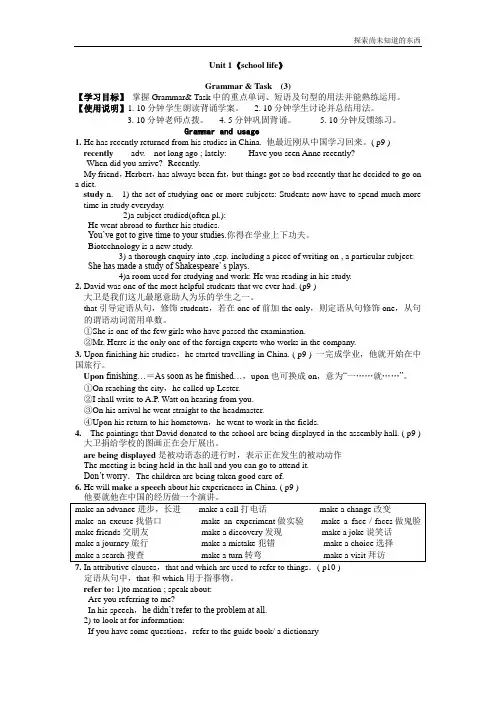
Unit 1《school life》Grammar & Task (3)【学习目标】掌握Grammar& Task中的重点单词、短语及句型的用法并能熟练运用。
【使用说明】1. 10分钟学生朗读背诵学案。
2. 10分钟学生讨论并总结用法。
3. 10分钟老师点拨。
4. 5分钟巩固背诵。
5. 10分钟反馈练习。
Grammar and usage1. He has recently returned from his studies in China. 他最近刚从中国学习回来。
( p9 ) recently adv. not long ago ; lately: Have you seen Anne recently?-When did you arrive? -Recently.My friend,Herbert,has always been fat,but things got so bad recently that he decided to go on a diet.study n. 1) the act of studying one or more subjects: Students now have to spend much more time in study everyday.2)a subject studied(often pl.):He went abroad to further his studies.You’ve got to give time to your studies.你得在学业上下功夫。
Biotechnology is a new study.3) a thorough enquiry into ,esp. including a piece of writing on , a particular subject:She has made a study of Shakespeare’ s plays.4)a room used for studying and work: He was reading in his study.2. David was one of the most helpful students that we ever had. (p9 )大卫是我们这儿最愿意助人为乐的学生之一。
牛津译林版高中英语必修一Unit1SchoollifeSectionⅡ
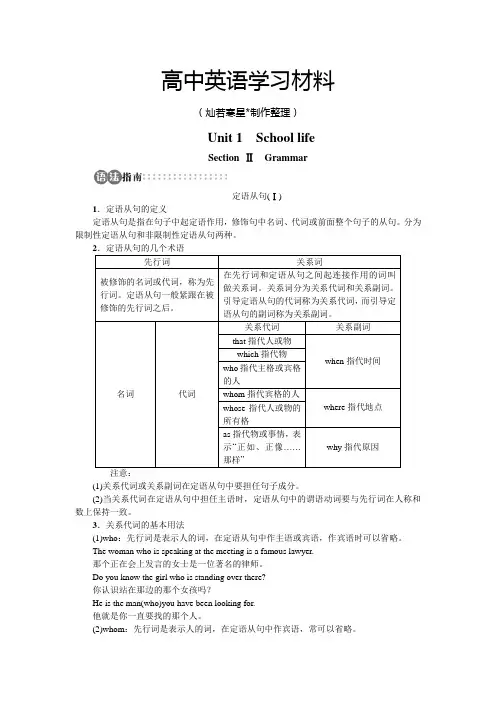
高中英语学习材料(灿若寒星*制作整理)Unit 1School lifeSection ⅡGrammar定语从句(Ⅰ)1.定语从句的定义定语从句是指在句子中起定语作用,修饰句中名词、代词或前面整个句子的从句。
分为限制性定语从句和非限制性定语从句两种。
2.定语从句的几个术语先行词关系词被修饰的名词或代词,称为先行词。
定语从句一般紧跟在被修饰的先行词之后。
在先行词和定语从句之间起连接作用的词叫做关系词。
关系词分为关系代词和关系副词。
引导定语从句的代词称为关系代词,而引导定语从句的副词称为关系副词。
名词代词关系代词关系副词that指代人或物when指代时间which指代物who指代主格或宾格的人whom指代宾格的人where指代地点whose指代人或物的所有格as指代物或事情,表示“正如、正像……那样”why指代原因注意:(1)关系代词或关系副词在定语从句中要担任句子成分。
(2)当关系代词在定语从句中担任主语时,定语从句中的谓语动词要与先行词在人称和数上保持一致。
3.关系代词的基本用法(1)who:先行词是表示人的词,在定语从句中作主语或宾语,作宾语时可以省略。
The woman who is speaking at the meeting is a famous lawyer.那个正在会上发言的女士是一位著名的律师。
Do you know the girl who is standing over there?你认识站在那边的那个女孩吗?He is the man(who)you have been looking for.他就是你一直要找的那个人。
(2)whom:先行词是表示人的词,在定语从句中作宾语,常可以省略。
Do you know the girl(whom)I spoke to just now?刚才和我说话的女孩你认识吗?(3)whose:先行词既可以是表示人的词也可以是表示物的词,意思是“……的”,在定语从句中作定语。
牛津译林版必修一Unit1《SchoolLife》word教案(2)
英语:Unit1《School Life》教案(2)(译林牛津版必修1)一. 教学内容:Unit 1 School life二. 教学目标:掌握Unit 1语法定语从句三. 教学重难点:掌握定语从句(一)the handsomethe tallthe strong boythe cleverthe naughtyThe boy is Tom.将两部分内容连接起来The boy who is handsome is Tom.The boy who is tall is Tom.The boy who is strong is Tom.The boy who is clever is Tom.The boy who is naughty is Tom.1. 概念:在复合句中,修饰某一名词或代词的从句叫定语从句。
The girl who is standing there is Mary.先行词关系词2. 先行词:被定语从句所修饰的词。
3. 关系词:引导定语从句的词。
关系词:在句子中充当成分例:不到长城非好汉。
He who hasn’t been to the Great Wall is not a true man.谁笑在最后,谁笑得最好。
He who laughs last laughs best .天助自助者。
God helps those who help themselves.Who is Tom?The boy is Tom. The boy is smiling.The boy who is smiling is Tom.The boy is Tom. The boy has a round face.The boy who has a round face is Tom.The boy is Tom. The boy sits in front of me.The boy who sits in front of me is Tom.将下面两个句子连成一个句子,形成定语从句。
高中英语(牛津译林版)必修一学案 Unit1school life《Welcome to the unit》学案1
III. Reading (1) Fill the following blanks (the main idea part is given)
Teachers and classmates/ Attending assembly/ School hours/ British food and her activities / Homework and subjects / Intention Para. Main idea Detailed information a) Was she happy with the school hours? _______ 1 b) School in Britain __________around 9 am and _______ about 3:30 pm a) Who was the girl sitting next to her on the first day? ______________ 2 b) The headmaster told them about ________________ during assembly. a) Who was her favorite teacher? _________________ 3 b) Was it easy for her to remember all the students’ faces and names? Why? ______________________ 4 a) The homework was not heavy, but why was it a bit challenging for her? _____________________________ a) 5 b) 6 a) Do students have to learn all the subjects even if they don’t like them? ____________________________ Why did her English improve a lot? ______________ Did she enjoy cooking? How do you know? ________________________________________
XX高一英语Unit1SchoolLife学案牛津译林版必修1
XX高一英语 Unit1 Shl Life学案(牛津译林版必修1)XX高一英语Unit1ShlLife学案(牛津译林版必修1)一单词应用依照单词的首字母或汉语意思填写正确单词,注意形式转变。
NbdnshenthepretillbepletedSenehasti_________thebssf theprgressfther2Allstudentsarer____________tattendshlasseblnndarning s3----hatisTbusdingtnight?----Heisaingp______________frtrr’sexainatin4Thereisnstudentthatdesn’tantsta___________highgradesAsaungb,hehadte________alivingbeausehisfailasverpr6heneeet,efirsts_________pesthatelve,andthenreadtheu tlud7Hei____________hiselftusHisnaeashnSith8Heassgenerusthathed_________altfnetthefldedarea 9Britishpepleeatltsfd__________aftertheiraineal0Inhina,DavidHlesd____________aninterestinteahingEngl ishthinesestudents1NextnthDavidillaeas___________abuthisexperienesinhi na2Pleaseparea___________tspellingnexttie3I__________ntfinishingheresterda4Du______________fhatIhavedne? urteaher____________aapnthetable6Isuggestheleave________________7The_______________ageinurlassis178ainghasearned_____________fralltherld 二.词形转换、ahievevt_____________6preparatinn___________二、Gerann_____________7requirevt______________3、iediateladv__________8sarad_______________4、develpvt_____________9naturen_______________、infrvt______________0pleasev_______________三补全佳句__________________________________(到英国的高中上学)frneearasaverenableandexperienedfre2我以为爱惜环境的最正确方式是多种树。
高中英语 unit1 School life导学案牛津译林版必修1
高中英语 unit1 School life导学案牛津译林版必修1life 重点解析1、attend vt、出席,参加;上(学);到场;照料,护理归纳拓展(1)Recently,I flew to Las Vegas to attend a meeting、(xx四川,完形填空)最近,我飞往拉斯维加斯参加了一个会议。
attend,join,join in,take part in(1)attend表示出席或参加会议、仪式、典礼;也可表示上课、上学、听报告等。
(2)join表示加入某一组织,并成为其中的一员,如:加入党派、组织、社团、俱乐部等。
其宾语也可以是人。
(3)join in表示参加正在进行的活动,也可用于join sb、 in (doing) sth、表示加入某人一起做某事。
(4)take part in表示参加活动,侧重说明主语参加并发挥一定的作用,part前若有修饰语,要用不定冠词。
活学活用(1)用attend,join(in),take part in的适当形式填空He has ①attended all the lectures and ②joined the other members in ③taking_part_in all the activities given by the organization since he ④joined it、(2)When I got there,he was________a wedding party、A、attendingB、joiningC、attending toD、joining in (3)I always have so many things to________ when I come back to the company after a trip abroad、A、add toB、contribute toC、attend toD、appeal to2、regret vt、遗憾;惋惜;n、遗憾;懊悔归纳拓展I have always regretted not having studied harder at school、我一直后悔在校期间没能努力学习。