
小学英语沪教牛津版六年级下册Module 1 Unit 3 (第2课时)教学PPT
Module3Unit8ReadingsignsPeriod1(教学设计)-牛津上海版英语六年级下册
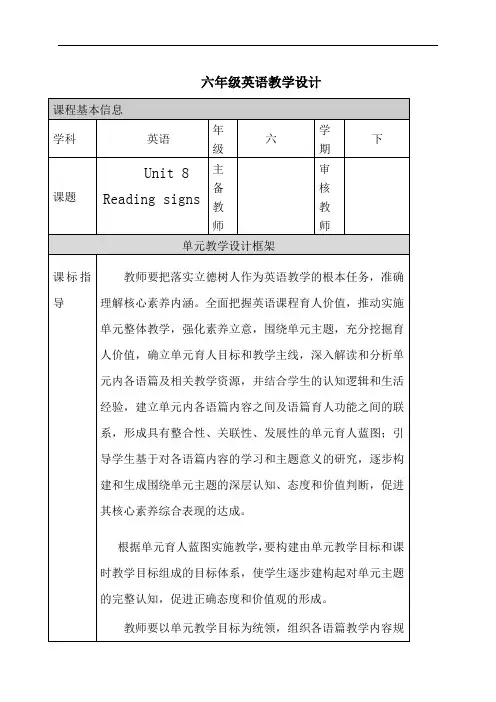
六年级英语教学设计
课程基本信息
学科 英语 年级 六 学期 下
课题 Unit 8
Reading signs
主备教师 审核教师
单元教学设计框架
课标指导 教师要把落实立德树人作为英语教学的根本任务,准确理解核心素养内涵。全面把握英语课程育人价值,推动实施单元整体教学,强化素养立意,围绕单元主题,充分挖掘育人价值,确立单元育人目标和教学主线,深入解读和分析单元内各语篇及相关教学资源,并结合学生的认知逻辑和生活经验,建立单元内各语篇内容之间及语篇育人功能之间的联系,形成具有整合性、关联性、发展性的单元育人蓝图;引导学生基于对各语篇内容的学习和主题意义的研究,逐步构建和生成围绕单元主题的深层认知、态度和价值判断,促进其核心素养综合表现的达成。
根据单元育人蓝图实施教学,要构建由单元教学目标和课时教学目标组成的目标体系,使学生逐步建构起对单元主题的完整认知,促进正确态度和价值观的形成。
教师要以单元教学目标为统领,组织各语篇教学内容规
划系列教学活动,实施单元持续性评价,引导学生在学习过程中逐步建构对单元主题的认知、发展能力,形成素养。
教材分析 本单元是沪教版小学英语6B第三模块的第2单元。第三模块Things we do介绍的关于日常生活中的三个话题帮助他人,识别公共场所的标识和旧物利用,本单元的话题是“Reading signs”,要求学生识别公共场所公共场所的标识并描述其含义,以及通过识别标识判断哪些事情可以做,哪些事情不可以做。。我们结合课文主题和学生语言基础,将知识进行整合,对文本进行挖掘和拓展,让学生在层层深入的语言知识的学习下,能用can must和should说说可以做和禁止做的事情,能用恰当的句子问路和指路,本单元以“差异和共性”为主线,深入认识人与人之间的差异,理解和尊重来自不同文化背景的人。
学情分析 小学六年级学生普遍拥有较好的英语听、说、读、写能力,正在进入青春期的他们既关注自己成长的变化,也对外部世界充满了兴趣,拥有探索的欲望,善于思考,也乐于实践。与此同时,进入高年段的他们对于学习的热情不如低年段学生,对于学习内容的趣味性与深度有更高的要求,这就需要教师在进行教学设计时要注重内容的整合与深度的挖掘,并增加趣味性,为学生提供更高质量的学习输入。
六年级下册英语一课一练- Module1 Unit1 You and me 牛津上海版(三起)(w
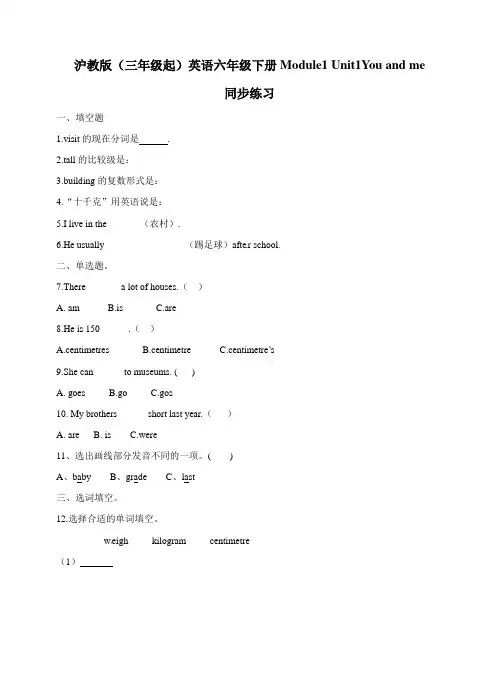
沪教版(三年级起)英语六年级下册Module1 Unit1You and me
同步练习
一、填空题
1.visit的现在分词是
.
2.tall的比较级是:________
3.building的复数形式是:________
4.“十千克”用英语说是:________
5.I live in the_______(农村).
6.He usually_______ ________(踢足球)after school.
二、单选题。
7.There _______a lot of houses.( )
A. am B.is C.are
8.He is 150______.( )
A.centimetres B.centimetre C.centimetre’s
9.She can______ to museums. ( )
A. goes B.go C.gos
10. My brothers ______short last year.( )
A. are B. is C.were
11、选出画线部分发音不同的一项。( )
A、baby B、grade C、last
三、选词填空。
12.选择合适的单词填空。
weigh kilogram centimetre
(1)
(2)
(3)
四、连词成句。
13.连词成句。
(1) near no there’s home river my
.
(2)do lot of a do you exercise
?
五、补全对话。
14.根据题意,补全对话。
—Do you live in the city? — .(做肯定回答)
牛津版英语六年级下册教案 6B Module1 Unit3(2)

…………………………………………………………………………
~小学英语精品资源~ Module 1 Unit 3 Period 2
Teaching Aims:
Using adverbs to express degree
Using the modal verb ‘need’ to express needs
Using the simple past tense to talk about past events
Using the impersonal ‘it’ to express facts
Using adverbs to indicate the sequence of an event.
Key Points: Mr.Hu and Class 6B went to East point Beach for a trip.
First, they went for a swim.
Difficult Points: I need a drink of water.
Teaching Aids: tape、 radio 、word cards.
Procedures Contents Methods Purpose
Warming
up
Pre-task
preparation
1.Sing songs
2.Daily talk:
1. Review the poem.
2. Read Which do you like better, blue
or purple?
Where does air pollution
come from?
Who made the first
aeroplane?
Where can you see water?
Read and recite.
1 Ask students if they have
小学六年级英语下册教学要点
小学六年级英语下册教学要点
内容:
本册一共有五个模块和一个复习模块,分别是:Module 1
changes (第一模块) , Module 2 Diaries (第二模块) ,Module 3
Famous Peoples (第三模块) ,Moudle 4 Stories and Fables (第四模块) ,Module 5 Hopes and Fantasies (第五模块) ,Module 6 Revision
(复习) 。
第一部分:全册教学目标、重难点
教学目标、重难点
1、 能听懂本册书话题的语段和简短的故事;能就所学的话题(如变化与对比、日记、名人、故事寓言、希望与幻想等)与教师或同学交换简单的信息;能读懂与本册书知识水平相当的小故事及其他文体的阅读材料;能按话题或看图写出意思连贯、语法结构比较准确的5个以上的句子;能进行简单的交际性活动,形成有效的学习方法,克服学习中遇到的困难。
2、 能熟练识记与运用各单元的四会单词、短语、习惯用语和固定搭配;能运用所学词汇描述事物、行为和特征;能熟练理解各话题的对话与课文的内容;
3、 熟练掌握名词的单复数形式;正确使用主要人称代词;正确使用所学的各种时态;掌握常用的时间、地点和位置的介词;掌握英语简单句的基本形式和表意功能;基本理解和掌握比较人、物体及事物的表达形式;
4、 能读懂简单的对话、故事和短文并理解大意,能较准确地按要求做任务;
5、 能掌握规范的句子书写;能模仿范例写出或回复简单的问候卡和邀请卡等文体;
6、 能根据提示词和所给图片编写简单的对话或小短文,语法结构比较准确的5个以上的句子并且句式有所变化;
7、 能按日记的基本格式写简单的日记。
第二部分:
模块教学目标、重难点
第一模块:本模块主要要求学生能谈论关于变化,尤其是家庭及家庭成员的变化话题。语言的知识和技能与上两个学期所学习的重点语法知识:形容词、副词的比较级和一般过去时有所联系和发展。
牛津上海版(三起)英语六年级下册Module 1 Unit 2 单元测试卷 (含答案)
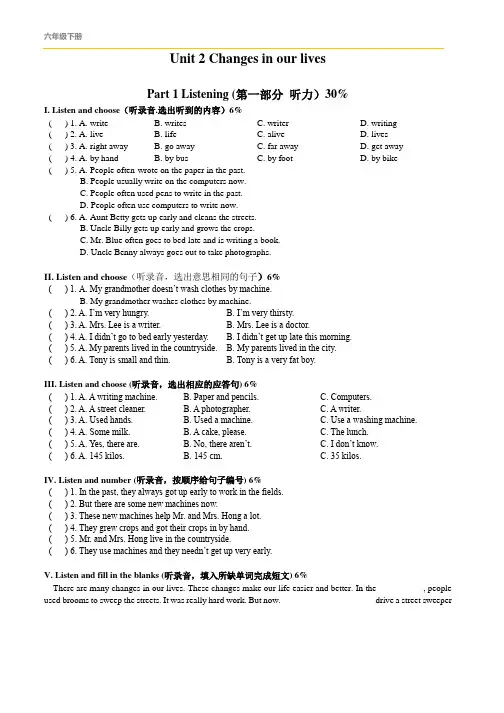
六年级下册
Unit 2 Changes in our lives
Part 1 Listening (第一部分 听力)30%
I. Listen and choose(听录音.选出听到的内容)6%
( ) 1. A. write B. writes C. writer D. writing
( ) 2. A. live B. life C. alive D. lives
( ) 3. A. right away B. go away C. far away D. get away
( ) 4. A. by hand B. by bus C. by foot D. by bike
( ) 5. A. People often wrote on the paper in the past.
B. People usually write on the computers now.
C. People often used pens to write in the past.
D. People often use computers to write now.
( ) 6. A. Aunt Betty gets up early and cleans the streets.
B. Uncle Billy gets up early and grows the crops.
C. Mr. Blue often goes to bed late and is writing a book.
D. Uncle Benny always goes out to take photographs.
II. Listen and choose(听录音,选出意思相同的句子)6%
( ) 1. A. My grandmother doesn’t wash clothes by machine.
Module3Unit1第2课时教案

Module3 Unit1 第2课时教案
一、教学内容
外研版小学英语六年级上册第三模块第一单元第二课时: Unit 1 3. Listen
and say. 4. Practice. &- Unit 2 5. Listen and say. Then Chant.
二、教学目标
1. 大多数学生能够听、说、读、写单词或短语:collect, stamp, letter,hobby,
collect stamps,toy,any,another。
2. 大多数学生能够听懂并运用句型:These are stamps from Canada. This
stamp is from China. They have got famous people on them.
3.能够运用所学的语言知识与同伴进行交流。
三、教学重难点
重点:
1.听、说、读、写单词和短语:collect,stamp, letter,hobby, collect stamps,
toy, any, another。
2.学习句型:Have you got any stamps from China? These are stamps
from Canada. This stamp is from China. They have got famous people on
them.
难点:
1.用句型:“Have you got any...?”询问某人是不是拥有某物。
2.“have/has got+名词”表示拥有什么东西。
四、教学准备
1. 同步课文动画、课文录音(可在优教平台打开“Module3 Unit1 活动3课文动画” “Module3 Unit2 活动5课文动画”直接利用)。
2. 单词卡片.
3. 第2课时教学课件。
五、教学设计
Step 1 Warm-up
1. Shooting balloons game.
小学英语沪教版六年级上册Module 1 Unit 3 Healthy or unhealthy 教案
1 小学英语沪教版六年级上册
Module 1 Getting to know each other
Unit 3 Healthy or unhealthy? 教案
一、教学目标
1. 认知目标:学习掌握新词汇:healthy,unhealthy,hamburger,yesterday,fruit,pie,pizza,sandwich,vegetable,chicken,chocolate,掌握句型:What did you have for breakfast this morning?
以及回答:I had some …
2. 能力目标:能运用所学句型描述自己的早餐吃了什么。
3. 情感目标:让学生通过对课文内容的学习掌握,增强学习的信心,调动学生的学习兴趣。
二、教学重难点
1. 重点
能运用所学句型描述自己的早餐吃了什么。
2. 难点
句型:What did you have for breakfast this morning? 以及回答:I had some …的理解掌握。
三、教学用具
照片、多媒体教学设备、单词卡片。
四、教学设计
Step 1 warming
1. 师生互相问好,教师询问大家今天早上吃早餐了吗?早餐吃了些什么呢?自己喜欢的食物有哪些呢?这些是否是健康食物呢?
2. 教师向学生们说说自己的早餐吃了些什么,自己喜欢的食物。
Step 2 Revision and Presentation
1. 教师告诉学生我们这节课就要学学如何用英语交流自己的早餐吃了些什么,是否健康。
2. 教师请学生谈谈自己的早餐及喜欢的食物。
3. 教师出示单词卡片进行新单词教学,带读并配合肢体动作让同学们印象深刻。
4. 教师播放课文内容录音,请同学们认真听一遍,争取做到理解内容。
Step 3 New Lesson
2 活动Let’s do a survey
教师制作一张表格,请同学们分别填上自己三餐所吃的食物,并在表格完成后请一位同学向其他同学介绍任意一位同学的三餐吃了什么,并评价是否健康。介绍完之后再邀请其他同学进行介绍……介绍的好的同学会得到奖励。
牛津英语上海版六年级第一学期 6A Unit 3教案(4课时,含教后感)
Module 1 Family and friends
Unit 3 Spending a day out together
Period 1
Teaching aims:
1. Talking about places to visit
2. Talking about leisure activities and frequency
Language focus:
Asking wh-questions to find out specific information
Teaching procedures:
I. Pre-task preparation
1.Look and learn
Let students study the map of Green Island:
Happy Town, North Bay, Sandy Bay, North Bay, Dragon Bay, Star Town, Moon
Town, South Bay, Sunny Town, Blue Bay, Spring Bay
2. Listen and guess
Play the video. Ask students to guess the place.
(录音文字1)It is in the north of Green Island. It is near Sandy Bay. It’s quite near
North Bay. But it’s far away from Spring Bay. Which place is it?
(录音文字2)It is in the east of Green Island. It is near Blue Bay, but far away
from South Bay. Which place is it?
(录音文字3)It is in the southwest of Green Island. It’s near Moon Town. It’s not
牛津沪教版六年级下 Module 1 Unit 2语法及拓展(无答案)
第1页 学 科 英语 课题名称 6B M1 Unit2 At the airport..语法及拓展
教学目标 掌握本单元的重点语法
重点难点 介词in,for;现在完成时
Unit2 At the airport. 语法及拓展
一、课前回顾
单词默写:
名词 noun 形容词 adj.
1. 机场 18. 几个
2. 洛杉矶
3. 手提箱 副词 adv.
4. 丝绸 19. 以前
5. T恤衫 20. 然而
6. 航班
7. 乘客 动词 v.
8. 离开;出发 21. 装(箱)
9. 伦敦 22. 担心
10. 注释;提醒 23. 带... 到某处
11. 手推车 24. 不得不
12. 护照
13. 登机牌
14. 姓名牌
第2页 15. 美元
16. 地址
17. 清单
二、新课导入
读以下课文,完成下面表格:
Mr Wang: What time does your plane leave for Los Angeles tomorrow?
Grandma: At three o’clock in the afternoon.
小学英语沪教牛津版六年级下册全册知识点整理2
小学英语沪教牛津版六年级下册全册知识点整理2
Module Changes and Differences
In this module。we will learn about XXX。We will also
learn some new vocabulary words and phrases.
Core Vocabulary:
1.Nouns:
Kilogram: a unit of measurement for weight (abbreviated as
kg)
XXX (abbreviated as cm)
Fan: XXX who is a big admirer of something。like a XXX
XXX: a place where plays and other performances are held
Life: the state of being alive
Writer: XXX。stories。or articles
XXX: a desire or hope for something Mountain: a large natural n of the earth's surface
Space: the area beyond the XXX
2.XXX:
XXX: to find out how heavy something is
Drive: to operate a XXX
Carry: to hold or support something while moving it
3.Other:
Poor: having little money or resources
Even: used to XXX
4.Phrases:
Street cleaner: a person who cleans the streets
Go fishing: to fish as a hobby or sport