
仁爱版七年级英语上册Unit4知识点总结
Unit 4-topic1基本句型1.What can I do for you,madam?=May/Can I help you?2.-May/Can I help you? Yes,please.I like the red coat.3.Can I try it on?Try on 试穿,试戴;代词必须放在动词和副词之间。
如:try it/them on;但如果宾语为名词时,它可以放在短语之间,也可以放在短语之后。
These shoes are good.You can try them on.Try on these shoes.=try these shoes on4.It looks nice on you.5.How much is it? It`s seventy yuan,madam.问价格还可以用what`s the price of...?How much 与how many的区别(1)对物品价格进行提问How much is the cap?(2)后接不可数名词,用于提问不可数名词的数量。
How much milk do yo u drinkevery day?How many 后接可数名词复数,用于提问可数名词的数量。
how many apples do you have?6.We`ll take it.Take sb.(sth.)to...把某人(某物)带到某地7.I`m just looking,thanks.8.How do you like the trousers?\9.Jane,what do you think fo this yellow skirt? Oh,I don`t like it at all.What do you think of=how do you like..?你觉得。
怎么样?10.How about the blue one?11.Are you kidding?12.Thank you all the same.=Thank you anyway仍然谢谢你13.Could you help me do some shopping,Ben? Sure.14.I want to buy some clothes for my daughter.Buy sth.for sb.=buy sb. Sth.My mom buys a a schoolbag for me.=My mom buys me a schoolbag.15.Oh,we don`t have any milk.Some 与any 的区别Any意为“一些”,一般用于否定句和疑问句中,通常也修饰不可数名词和可数名词的复数。
如:I don`t want any milk.Do you have any friends here?some一般用于肯定句中,用于修饰不可数名词和可数名词的复数。
有时也用于疑问句中,但一般表示征求对方意见并希望得到肯定回答。
如:I have some milk in the glass.Why not have some milk?16.Here it is.给你在表示“给别人东西”时,here it is是把侧重点放在东西上,here you are是强调要给的人不可数名词的量的表达(1)用“数词+表量的名词+of+不可数名词”如:a piece of paper two glasses of tea(2)用much,little,a little以及a lot of,lots of,some,any等来表示多少①In winter there`s a lot of snow.②We don`t have much tea or coffee.③I can speak a little French.④I want some water.1. May/Can I help you?/ What can I do for you?这些表达是常用的习惯用语,根据语境不同,它们的含义也不同。
e.g. 在餐馆:你要吃什么?在商店:你要买什么?在图书馆:你要借什么?肯定答语用Yes, please./I’d like...,否定回答则用No, thanks.2. How much is /are ...? ……多少钱?这是购物时询问价钱的一个句型,同义的还有:What’s the price of ...?/How much does/ do ... cost?另外,how much 也可用于对不可数名词数量多少的提问。
e.g. How much bread is there? 有多少面包?How much milk do you want? 你想要多少牛奶?3. some和any既可修饰可数名词,也可修饰不可数名词,表示“一些”。
some一般用在肯定句中,或者用在希望得到对方肯定回答的疑问句和用情态动词提出疑问的句子中,表示建议和请求。
e.g. He has some water. 他有一些水。
Would you like some water? 你想要些水吗?any用在否定句和疑问句中,还可译作“任何”。
e.g. They don’t have any food.他们没有任何食物了。
There isn’t any water in the bottle.瓶子里一点水都没有了。
Does she have any eggs? I’m hungry.她有一些鸡蛋吗?我饿了。
Unit 4-topic2句型1.Are you free this Sunday?Yes,what`s up?(1)Free 形容词,意为”有空的,空闲的“,常与be动词连用。
如:I`m free this afternoon. free还有免费的,自由的”之意,如:The ticket is free.The bird is free in the sky.(2)What`up?意为“怎么啦?什么事?2.Would you like to go to the West Hill for a picnic?Oh,I`d love to.3.Please tell Maria about it.Tell sb.about sth.告诉某人关于某事You have to tell her mother about it.4.See yo then.5.I have to cook.Have to 表示一种客观的需要,意为不得不,主语韦第三人称单数时记得变为has to. Jim`s shoes are old,so he has to buy new noes.(否定形式)6.Michael,how about flying a kite with me? I`d like that,but I`m sorry I have no time. How about=what about,后面常跟名词/代词或动词的-ing形式。
常用于以下场合:(1)向对方提出建议或者请求。
How about going out for a walk?(2)征询对方的看法或者意见。
What about the TV play?(3)寒暄时用作承接上下文的转折语。
I am from Beijing.What about you?I have no time=I don`t have any time.我没有时间。
其中no为形容词,修饰不可数名词,相当于not any+不可数名词。
We have no bread=We don`t have any bread.no修饰可数名词时,相当于“not a(n)+单数名词”或“not any+复数名词”。
Jack has no pet=Jack doesn`t have a pet.no还可以用作副词,常对一般疑问句作答。
Is this your watch? No ,it isn`t.7.Jane wants Kangkang to sing some songs with her.8.May I speak to Maria?Speak to sb.对(和)某人说话Let`s speak to Jane,OK?9.Who`s this ,please? This is Sally.10.Maria isn`t in now.Be not in=be out=be not at home不在家11.Could yo ask her to call me back this evening?(1)Ask sb.to do sth.让某人去做某事/tell sb.to do sth.告诉某人去做某事/wouldlike/want sb.to do sth.想要某人做某事.(2)Call sb.back.给某人回电话12.That would be very nice.1.打电话英语电话用语有别于汉语表达习惯。
通常要说Could /May /Can I speak to..., please?意为“请找/让……接电话”或“我可以同……通话吗?”;如果接电话的人正好就是要找的人,就说Speaking或This is...speaking(我就是……);如果找的人不在眼前,就说Hold on/One moment或Wait a minute/while;如果不在家就说He/She is notin /here /at home.或He/She is out/away。
如果说“我是……”则用“This is...speaking.”“你是……吗?”则用“Isthat/It...speaking?”“你是谁?”则用“Who is this/it speaking?”注意: speaking可以省略。
2.邀请常用句式:(1) Would you like to...? 你愿意……吗?Will you come to...? 请你来……好吗?(2) 答语有:①Yes, I’d love/like to.是的,我很乐意。
②Yes, it’s very kind / nice of you.是的,你真是太好了。
③I’d love/like to, but...我很乐意,不过……较熟悉的朋友、同事或邻居可用How / What about going to the movie with me?(和我一起去看电影怎么样?)之类的句型发出邀请。
答语可用I’d love/like to.谢绝邀请时一般要找出合适的理由向对方说明。
e.g. I’d love/like to, but I’mafraid ... / Sorr y, I can’t. /Thank you very much, but...3.习惯用语Could you ask her to call me back this evening?请你让她晚上给我回电话好吗?ask sb. to do sth.请/要求某人做某事,其否定形式为ask sb. not to do sth.请/要求某人别做某事。
仁爱英语七年级上册第四单元知识点归纳
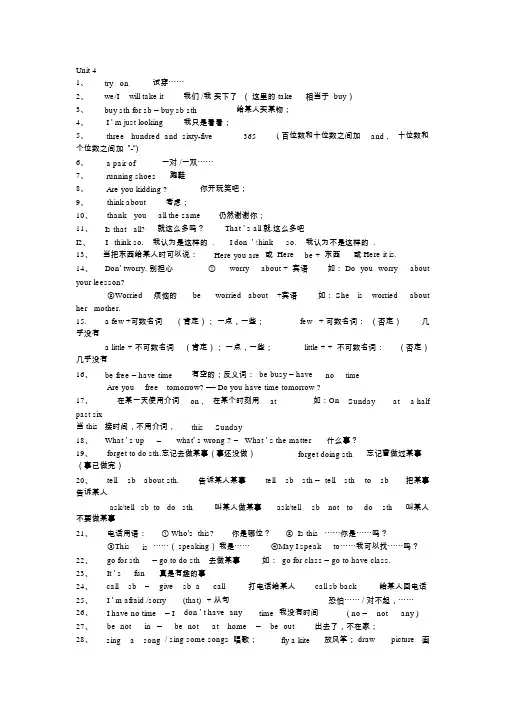
Unit 41、try on试穿⋯⋯2、we/I will take it我们 /我买下了(这里的 take相当于 buy)3、buy sth for sb = buy sb sth给某人买某物;4、I ’ m just looking我只是看看;5、three hundred and sixty-five365( 百位数和十位数之间加and ,十位数和个位数之间加”-“)6、 a pair of一对 /一双⋯⋯7、running shoes跑鞋8、Are you kidding ?你开玩笑吧;9、think about考虑;10、thank you all the same仍然谢谢你;11、Is that all?就这么多吗?That ’ s all就.这么多吧I2、I think so.我认为是这样的 .I don ’t hink so.我认为不是这样的 .13、当把东西给某人时可以说:Here you are或 Here be +东西或 Here it is.14、Don’ tworry. 别担心①worry about + 宾语如: Do you worry aboutyour leesson?②Worried烦恼的be worried about+宾语如: She is worried about her mother.15. a few +可数名词(肯定);一点,一些;few + 可数名词:(否定)几乎没有a little + 不可数名词(肯定);一点,一些;little + + 不可数名词:(否定)几乎没有16、be free = have time有空的;反义词: be busy = have no timeAre you free tomorrow? == Do you have time tomorrow ?17、在某一天使用介词on ,在某个时刻用at如:On Sunday at a half past six当 this接时间,不用介词,this Sunday18、What ’ s up=what’ s wrong ? = What ’ s the matter什么事?19、forget to do sth.忘记去做某事(事还没做)forget doing sth忘记曾做过某事(事已做完)20、tell sb about sth.告诉某人某事tell sb sth =tell sth to sb把某事告诉某人ask/tell sb to do sth叫某人做某事ask/tell sb not to do sth叫某人不要做某事21、电话用语:① Who’s this?你是哪位?② Is this⋯⋯你是⋯⋯吗?③This is⋯⋯( speaking)我是⋯⋯④May I speak to⋯⋯我可以找⋯⋯吗?22、go for sth= go to do sth去做某事如: go for class = go to have class.23、It ’ s fun真是有趣的事24、call sb=give sb a call打电话给某人call sb back给某人回电话25、I ’ m afraid /sorry(that)+ 从句恐怕⋯⋯ / 对不起,⋯⋯26、I have no time= I don ’ t have any time我没有时间( no =not any )27、be not in =be not at home=be out出去了,不在家;28、sing a song/ sing some songs 唱歌;fly a kite放风筝; draw picture 画画play sports做运动;watch TV看电视read books看书 read newspaper 看报纸29、let sb do sth(后接动词原形)让某人做某事30、时间读法有顺读法和逆读法:顺读法( eleven thirty-six表示 11:36)逆读法 (分钟数小于等于30 分用 past ,分钟数大于 30 分用 to,如 five past ten表示 10:05;five to ten 表示9:55,half past six表示 6:30 , a querter to six 表示5:45)31、show sth to sb = show sb sth把⋯⋯拿给某人看;作为名词表示演出,表演32、祈使句的否定句,直接在句首加上Don't就可以了33、have to ⋯⋯(后接动词原形)不得不⋯⋯48.It ’ s time for sth/ doing sth It’ s time to do sth 该到做⋯⋯的时候了?It ’ s time for sb to do sth是某人做某事的时候了33、next time下一次next week下个星期the next day第二天;34、next to ⋯⋯ = near⋯⋯在⋯⋯旁边35、get up起床go to bed上床睡觉;get sb up 叫某人起床36、do one’ s homework做作业;37、have a picnic野餐; have class上课 have a meeting开会have a party 举办聚会have dinner/ breakfast /lunch/supper吃正 /早/午/晚餐have +东西吃 /喝⋯⋯have a good time =enjoy oneself玩得很愉快have sb to do sth 让某人做某事have to do sth不得不⋯⋯38、on the weekday在周末;39、lot of = lots of = many =much许多的,大量的40、in the sun在阳光下;41、sb like ---best = sb ’s favorite + 种类is / are⋯⋯谁最喜欢⋯⋯42、on one ’ s way to ----在某人去⋯⋯的路上;on one ’ s way home在某人回家的路上43、Here we are. 我们到了44、It ’ s very kind of you 你真是太好了;45、thanks / thank you for + n /v-ing为⋯⋯而感谢你;46、 .in the tree在树上(外物附着)on the tree在树上(树上本身长出的东西)In the wall在墙里(如 window )on the wall 在墙上句型:1、 What do you think of ----?= How do you like ----?你认为⋯⋯怎么样?例: What do you think of your English teacher ?==How do you like your Englishteacher ?2、 How much be+ 主语?(回答: It’ s They/ ’ re + 价钱 .)How much is your English book ?问价格还可以用what ’s the price of ⋯⋯3、 Why not ⋯⋯(后接动词原形)= Why don ’ t you⋯⋯(后接动词原形)为什么不做某事呢?回答: Good idea好主意;4、 What time is it ? == What is the time?(回答: It ’时s+间 )。
仁爱英语七年级上册U4T3知识点

仁爱英语七年级上册U4T3知识点在仁爱英语七年级上册的第四单元第三课,我们学习了一些重要的知识点。
这些知识点是我们学好英语的基础,所以我们要认真学习和掌握。
下面是这些知识点的详细介绍。
1. 动词的时态
在英语中,动词的时态分为三种:现在时、过去时和将来时。
现在时表示现在正在进行或经常发生的事情;过去时表示过去已经发生过的事情;将来时则表示将来将要发生的事情。
我们要学会根据句子的语境和时态去使用正确的动词时态。
2. 数词的用法
数词在英语中有两种,分别是基数词和序数词。
基数词用于表示数量,而序数词则用于表示顺序。
我们要根据具体情况正确地使用这两种数词。
3. 形容词的比较级和最高级
形容词的比较级和最高级分别用于表示两个或多个事物之间的比较和最高程度。
比较级通常使用“-er”或“more”来构成,而最高级则使用“-est”或“most”来构成。
4. 祈使句的用法
祈使句用于表示请求、命令等,这种句子的语气比较强硬。
我们要熟练掌握祈使句的用法,根据具体情况正确地使用祈使句。
5. 代词的用法
代词是用来代替名词的,常见的代词有人称代词、指示代词和不定代词等。
我们要认真学习代词的用法,熟练掌握它们的用法和区别。
6. 物主代词的用法
物主代词是用来表示所属关系的,常见的物主代词有“my”、“your”、“his”、“her”等。
我们要认真学习物主代词的用法,熟练掌握它们的用法和区别。
以上就是本课的重点知识点,我们要认真学习和掌握。
只有强化基础,才能在英语学习的道路上越走越远。
仁爱版七年级英语上册Unit4知识点总结
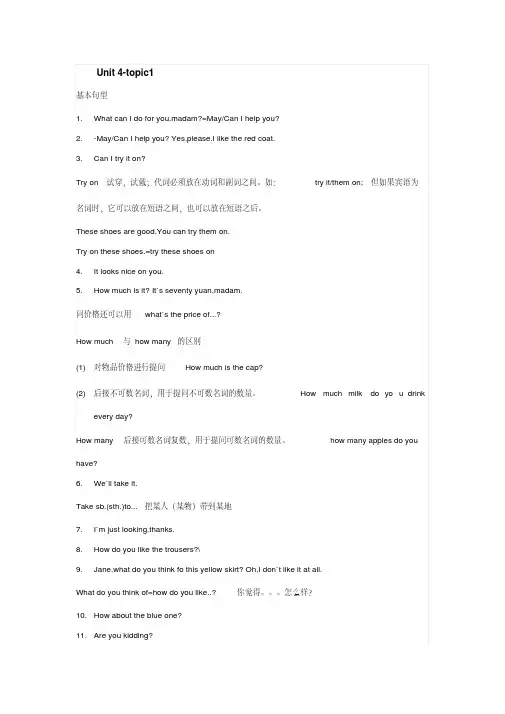
Unit 4-topic1基本句型1.What can I do for you,madam?=May/Can I help you?2.-May/Can I help you? Yes,please.I like the red coat.3.Can I try it on?Try on 试穿,试戴;代词必须放在动词和副词之间。
如:try it/them on;但如果宾语为名词时,它可以放在短语之间,也可以放在短语之后。
These shoes are good.You can try them on.Try on these shoes.=try these shoes on4.It looks nice on you.5.How much is it? It`s seventy yuan,madam.问价格还可以用what`s the price of...?How much 与how many的区别(1)对物品价格进行提问How much is the cap?(2)后接不可数名词,用于提问不可数名词的数量。
How much milk do yo u drinkevery day?How many 后接可数名词复数,用于提问可数名词的数量。
how many apples do you have?6.We`ll take it.Take sb.(sth.)to...把某人(某物)带到某地7.I`m just looking,thanks.8.How do you like the trousers?\9.Jane,what do you think fo this yellow skirt? Oh,I don`t like it at all.What do you think of=how do you like..?你觉得。
怎么样?10.How about the blue one?11.Are you kidding?12.Thank you all the same.=Thank you anyway仍然谢谢你13.Could you help me do some shopping,Ben? Sure.14.I want to buy some clothes for my daughter.Buy sth.for sb.=buy sb. Sth.My mom buys a a schoolbag for me.=My mom buys me a schoolbag.15.Oh,we don`t have any milk.Some 与any 的区别Any意为“一些”,一般用于否定句和疑问句中,通常也修饰不可数名词和可数名词的复数。
仁爱英语七年级上册Unit4,topic2知识点讲解及随堂练习
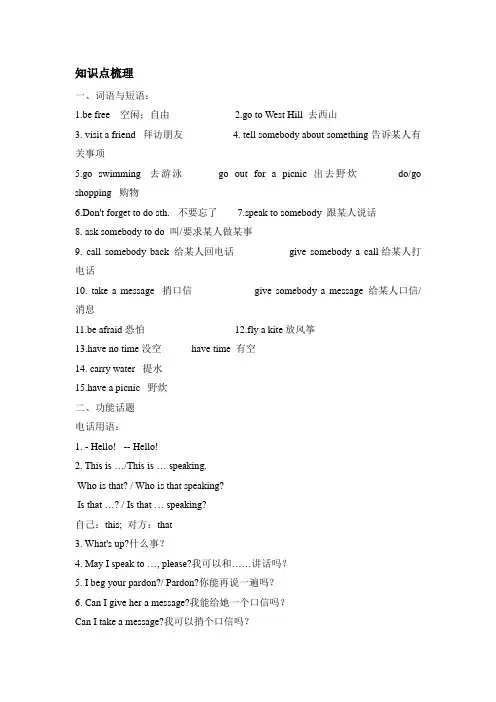
知识点梳理一、词语与短语:1.be free 空闲;自由2.go to West Hill 去西山3. visit a friend 拜访朋友4. tell somebody about something 告诉某人有关事项5.go swimming 去游泳 go out for a picnic 出去野炊do/go shopping 购物6.Don't forget to do sth. 不要忘了7.speak to somebody 跟某人说话8. ask somebody to do 叫/要求某人做某事9. call somebody back 给某人回电话give somebody a call 给某人打电话10. take a message 捎口信 give somebody a message 给某人口信/消息11.be afraid恐怕12.fly a kite放风筝13.have no time没空have time 有空14. carry water 提水15.have a picnic 野炊二、功能话题电话用语:1. - Hello! -- Hello!2. This is …/This is … speaking.Who is that? / Who is that speaking?Is that …? / Is that … speaking?自己:this; 对方:that3. What's up?什么事?4. May I speak to …, please?我可以和……讲话吗?5. I beg your pardon?/ Pardon?你能再说一遍吗?6. Can I give her a message?我能给她一个口信吗?Can I take a message?我可以捎个口信吗?7. Could you ask her to call me back?请你转告她给我回个电话好吗?三、重点句型:1. Are you free this Saturday?2. Would you like to have a picnic with somebody?3. I have something to tell Matthew.4. How happy they are!同义句:1. Let's make a plan for the picnic. = Let's make a picnic plan.2. Let's discuss. = Let's have a discuss.3. I'll call her right away. = I'll make a telephone call to her right away. = I'll give hera call.4. She isn't in now. = She isn't here now.5. Can I give him a message? = Can I give a message to him?四、语法:1. must与have to的区别:must受主观条件限制,表"必须";have to受客观条件限制,表"不得不"e.g. We must study hard. I have to look after my mother at home. She is ill.题讲解一、词汇A. 根据句意及首字母提示完成下列单词1. What will they do on S_______ morning?2. I am f_______ tomorrow evening.3. Can you t_______ him about it?4. Don’t f_______ to buy some vege tables.5. Would you like to go for a p_______?B. 用所给单词的适当形式填空6. Please give me some _______ (knife).7. What about go _______ (swim) with us?8. We need two _______ (guitar). What about you?9. How many _______ (bowl) of water do you need?10. Look at _______ (Mary) plan.二、单项选择11. _______ you like to go shopping with me?A. CanB. AreC. Would12. This is my friend. _______ name is Mike.A. ItsB. HisC. Her13. I have a book. She _______, too.A. have oneB. has itC. has one14. We have no classes _______ Sunday.A. onB. atC. in15. —Could I have some tea, please? —Certainly. _______.A. Thank youB. Here is itC. Here you are三、完成句子16. 我的电话号码是45890126。
七年级上册仁爱英语教材讲解Unit4知识点击

Unit 4 Topic 1 Section ANew wordsNew phrasesUseful expressions知识点击1.What can I do for you, madam?女士,要买点什么吗?(1)"What can I do for you?"是服务行业的用语,在不同场合表示不同含义,是商店售货员常用的表达方式。
在英语国家里,售货员通常向顾客问"May/Can I help you?"或"What can I do for you?",顾客如需购物可以回答"Yes, please.",然后说出自己所需物品。
如果仅想逛商店,可回答:"I'm just looking, thanks."或"No, thanks.Just have a look."。
如:——Can I help you?/ What can I do for you?要买点什么吗?——I'd like to buy a new pair of shoes.我想买双新鞋。
——May I help you?要买点什么吗?——I'm just looking, thanks.谢谢,我只是随便看看。
(2)madam意为"夫人,女士" ,用于对女长辈、女上司或不相识的女性的尊称,男士则称为sir.2.I want to buy some clothes for my daughter.我想给我女儿买些衣服。
buy为动词,意为"买,购买" 。
buy sth. for sb.=buy sb. sth.意为"为某人买某物" 。
如: Jack wants to buy a.new coat for me.= Jack wants to buy me a new coat.杰克想要为我买一件新外套。
仁爱英语七年级上册u4知识点

仁爱英语七年级上册u4知识点Unit 4: Let's Celebrate!在本单元中,我们将学习关于节日的词汇、单词拼写、听力和阅读技能,以及如何用英语谈论我们喜欢的节日和庆祝活动。
接下来,让我们详细了解下本单元的知识点。
一、新词汇1. celebrate (v.) 庆祝2. ceremony (n.) 典礼3. tradition (n.) 传统4. custom (n.) 风俗5. parade (n.) 游行6. national (adj.) 国家的7. feast (n.) 宴会8. decoration (n.) 装饰品9. costume (n.) 服装10. mask (n.) 面具二、拼写在本单元中,我们将学习一些常用的描述节日活动和庆祝活动的单词。
你需要掌握这些单词的正确拼写。
1. celebrate2. tradition3. parade4. national5. feast6. decoration7. costume三、听力技能在学习英语中,听力技能非常重要。
下面是本单元中的一些听力技能:1. 聆听并理解描述庆祝活动和节日活动的句子。
2. 能够听懂人们在讲述他们喜欢的节日或庆祝活动。
四、阅读技能阅读是英语学习中非常重要的一部分。
本单元中,学生将通过阅读文章和句子来加强他们的英语阅读技能。
1. 阅读与庆祝活动和节日相关的文章,并理解文章中的句子。
2. 理解人物在阐述他们喜欢的节日或庆祝活动时所使用的词汇。
五、谈论节日在学习完本单元的内容后,你将能够用英语描述你喜欢的节日并谈论庆祝活动。
下面是一个简单的范例:I like Christmas. It is my favorite holiday. Every year, my family and I decorate our house with lights and ornaments. We also have a big feast with turkey, ham, and lots of other delicious food. On Christmasmorning, we open presents and sing carols. It is a very special time of year for me.感谢您阅读本文,希望这些知识点能够帮助您更好地学习仁爱英语七年级上册的Unit 4。
Unit 4 Topic 1 重难点知识归纳总结2021-2022学年仁爱版英语七年级上册
Unit 4 Having Fun Topic 1 What can I do for you?【重点单词】1.shop [ʃɔp] n. 商店v. 购物2.madam [ˈmædəm] n. 夫人;女士3.seventy [ˈsevənti:] num. 七十4.thirty [ˈθɜ:ti:] num. 三十5.forty [ˈfɔ:ti:] num. 四十6.fifty [ˈfɪfti:] num. 五十7.sixty [ˈsɪksti:] num. 六十8.eighty [ˈeɪti:] num. 八十9.ninety [ˈnaɪnti:] num. 九十10.hundred ['hʌndrəd] num. 百11.just [dʒʌst] adv. 仅仅;只是12.anything [ˈeniθɪŋ] pron. 任何东西(事物)13.mean [miːn] v. 意思是14.kilo ['kilo] =kilogram [ˈkiləuɡræm] n. 千克15.bag [bæɡ] n. 袋子16.loaf [loʊf] n. 一条(面包)17.bar [bɑːr] n. (长方形)条,块;酒吧18.bottle [ˈbɔtl] n. 一瓶(的量);瓶子19.tin [tɪn] n. 听,罐20.save [seɪv] v. 节省;攒钱;挽救21.chocolate [ˈtʃɑkələt] n. 巧克力22.Coke [kəʊk] n. 可乐23.any [ˈeni] det. 任何的,任一的pron. 任一,任何一些24.heavy [ˈhevi] adj. 重的【重点短语】1.try on 试穿2.how much 多少3.think of 认为;想起4.How about...? ……怎么样?5.think about 考虑6.shopping list 购物清单7.do some shopping 购物8.how many 多少9.go shopping 去购物【重点句型】1.—What can I do for you, Madam? 我能为你做些什么吗,夫人?—I want to buy some clothes for my daughter. 我想给我的女儿买一些衣服。
仁爱版七年级英语上册unit4知识点
仁爱版七年级英语上册unit4知识点Unit 4主要内容为“Where’s my backpack?”。
以下是该单元的知识点:一、单词和词组1. backpack:背包2. pencil:铅笔3. book:书4. eraser:橡皮5. ruler:尺子6. pencil case:铅笔盒7. classroom:教室8. library:图书馆9. playground:操场10. canteen:食堂11. office:办公室12. restroom:卫生间13. go straight:直走14. turn left/right:向左/右拐15. on the left/right:在左/右边二、句型和语法1. Where’s my backpack?:我的背包在哪里?2. It’s in the classroom.:它在教室里。
3. Where’s my pencil case?:我的铅笔盒在哪里?4. It’s on the desk.:它在桌子上。
5. Where’s the restroom?:卫生间在哪里?6. It’s next to the library.:它在图书馆旁边。
7. Excuse me, where’s the canteen?:请问,食堂在哪里?8. Go straight and turn left.:直走然后向左拐。
9. Where’s the office?:办公室在哪里?10. It’s across from the restroom.:它在卫生间对面。
三、重点词汇解析1. classroom:教室- class:课程,班级- room:房间2. library:图书馆- libr:图书- -ary:表“地方”的后缀3. playground:操场- play:玩,游戏- ground:地面,场地4. canteen:食堂- can:罐头- teen:叫号后缀四、话题练习根据上述知识点,练习以下话题:A. 对话练习1. A: Excuse me, where’s the restroom? B: It’s next to the library.2. A: Where’s my backpack?B: It’s in the classroom.3. A: Where’s the office?B: It’s across from the restroom.4. A: Excuse me, where’s the canteen? B: Go straight and turn left.B. 句型转换1. I am next to the library.: Where am I?2. It’s in the pencil case.: Where’s the eraser?3. He’s in the classroom.: Where’s she?4. They’re on the playground.: Where are we?5. Go straight and turn right.: How can I get to the office?C. 阅读练习My ClassroomHi, my name is Lily. This is my classroom. The backpack is on the desk. The pencil case is under the chair. The book is on the shelf. The eraser is in the pencil case. The ruler is on the desk. I love my classroom.1. Who is talking about the classroom?2. Where is the backpack?3. Where’s the pencil case?4. Where’s the book?5. Is the eraser on the desk?总结:仁爱版七年级英语上册unit4知识点主要涉及单词和词组、句型和语法、重点词汇解析等方面。
初中英语新仁爱版七年级上册Unit 4 Fun in the sun语法和写作(2024秋)
七年级英语上册Unit 4语法和写作一、语法(一)现在进行时1.现在进行时用法(1) 表示此时此刻正在进行的动作。
Eg:Lily is reading a book now.丽丽现在正在读一本书。
(2) 表示现阶段正在进行的动作或持续的状态。
Eg:They are studying hard this term.他们这学期正在努力学习。
(1)go, come,leave, arrive, start等动词用现在进行时表示将来。
Eg:The bus is coming.公共汽车来了。
2.现在进行时结构肯定式:主语 + am/is/are + 动词现在分词 + 其他否定式:主语 + am/is/are + not + 动词现在分词 + 其他一般疑问式:Am/Is/Are + 主语 + 动词现在分词 + 其他特殊疑问式:特殊疑问词 + 一般疑问句Eg:肯定式:I am doing my homework now.我现在正在做作业。
否定式:I am not doing my homework now.我现在不在做作业。
一般疑问式:Are you doing your homework now?你现在正在做作业吗?特殊疑问式:What are you doing now?你现在正在干什么?3.动词现在分词变化规则(1)直接加-ing; Eg:go -- going;see -- seeing(2)将不发音e去掉,再加-ingEg:take -- taking;live -- living(3)在重读闭音节中(单词中只有一个元音,元音后只有一个辅音),双写结尾字母加-ingEg:shop -- shopping;run -- running4.现在进行时时间标志词当句子中有以下时间标志词是,句子通常用现在进行时。
这类词有:now, right now, at present, at the moment, these days, when, while, Look!; Listen!等Eg:Look! This boy is playing football.看!这个男孩正在踢足球。
仁爱英语七年级上册unit4topic2知识总结
Unit4.Topic2.Would you like to go for a picnic?一.核心词汇 free Sunday up go picnic love call forget bring guitar tomorrow sing song fun fly kite afraid time carry ask back二.常用词组be free West Hill go for a picnic forget to bring something (to eat) go fishing have to fly a kite speak to ask sb to do sth call….back have a picnic go shopping三.重点句子Please tell Maria about it. Don’t forget to bring your guitar. …I’m afraid I have no time. Could you ask her to call me back this evening?四.交际用语Hello! Hello, Jane! This is Kangkang. Are you free this Sunday? Yes. What’s up? Would you like to go to West Hill for a picnic? All right. See you then. Would you like to cook with us? It’s fun. I’d like that,….. May I speak to Maria? Who’s this,please? He/She isn’t in now. That would be very nice.五.语法精粹表示请求、建议、征求对方意见的表达法Would you like to sing some songs with me ? What about having a picnic with old McDonald?七.金点剖析1 Are you free this Sunday?这个周日你有空吗?free adj意为―有空的‖,常与be动词连用,动词be 在句中随人称变化而变化。