
外研版一年级起点二年级上册英语教案全册
Module 1 Unit 1 I like the ABC song. Module 1 Unit 2 What do you like? Module 2 Unit 1 He likes this T-shirt. Module 2 Unit 2 He doesn’t like this shirt. Module 3 Unit 1 We have English in the morning. Module 3 Unit 2 I like PE. Module 4 Unit 1 It’s 2 o’clock. Module 4 Unit 2 What’s the time? Module 5 Unit 1 I get up at 7 o’clock in the morning. Module 5 Unit 2 It’s half pat 7. Module 6 Unit 1 She watches TV. Module 6 Unit 2 Does he play the flute? Module 7 Unit 1 What do you do at the weekend? Module 7 Unit 2 Where do you live? Module 8 Unit 1 How do you go to school? Module 8 Unit 2 I go by train. Module 9 Unit 1 It’s winter. Module 9 Unit 2 It’s warm. Module 10 Unit 1 Happy New Year! Module 10 Unit 2 We have Christmas. Module 1 Unit 1 题目 I like the ABC song. 题材 (主要) 内容 Daming 向大家介绍了自己最喜欢的歌曲,并唱给大家听。
教学目标 语言 知识 目标 功能 了解字母表的顺序并初步认识26个字母。
语法 (结构、 句子) I like the ABC song. It’s my favourite song.
词汇 听 能够在听录音的过程中辨别出单词:song, favourite 说 能够在卡片的帮助下说出单词:song 读 能够在卡片的帮助下正确认读单词:song 写 语言 技能 目标 听 能听懂26个字母。 说 能按顺序说出26个字母并会唱ABC song。 读 能背诵出字母表。 写 学习策略 在游戏中感知26个字母及其相应的顺序。 文化意识 情感态度 从字母表起培养学生们对英语的学习兴趣。 任务 1. Chain Game:可以在师生或学生小组间进行“字母接龙”的游戏; 2. Letter Family:把字母卡(大小写共52张)打乱顺序分发到学生手中,让他们按大小写找到自己的搭档; 3. 在字母歌的帮助下,让他们按顺序列队; 4. 齐唱ABC song,复习、巩固26个字母。 Module 1 Unit 2 题目 What do you like? 题材 (主要) 内容 Panpan 和Baby panda在商店里购买玩具,并谈论各自最喜爱的玩具。
教学目标 语言 知识 目标 功能 谈论个人的喜好。 语法 (结构、 句子) Do you like dolls/…? Yes, I do. / No, I don’t. What do you like? I like jigsaws/…
词汇 听 能够在听对话录音的过程中辨别出单词:jigsaw, toy, bike 说 能够看图说出单词:jigsaw, toy, bike 读 能够看图跟录音正确朗读单词:jigsaw, bike 写 语言 技能 目标 听 能够听懂Panpan与Baby panda间关于自己最喜爱玩具的谈论。如:Do you like dolls? No, I don’t. What do you like? I like jigsaws.等。
说 在图片或实物的帮助下,会用What do you like? I like…的句型询问和表述喜好; 会说唱课文儿歌。
读 会认读对话中What do you like? I like jigsaws/pandas…等询问及表述喜好的句子。 写 学习策略 在调查活动及创编儿歌中,增强运用、实践英语的自信心。 文化意识 了解中西方孩子喜闻乐见的玩具。 情感态度 在创编活动中敢于发表自己的见解,乐于合作,勇于创新。 任务 1. What’s missing:可选用实物或卡片,复习、巩固有关toy的词汇; 2. Do a survey:在小组中调查同学们最喜欢的玩具; 3. 创编儿歌。 Module 2 Unit 1 题目 He likes this T-shirt. 题材 (主要) 内容 Smart 一家人到商店里购物,爸爸妈妈分别为Sam和Amy挑选了各自喜爱的 T恤衫和连衣裙,Sam十分开心,但爸爸为Amy 挑选的裙子太小了。 教学目标 语言 知识 目标 功能 谈论他人的喜好。 语法 (结构、 句子) Sam likes T-shirts. He likes this T-shirt. Amy likes dresses. She likes this dress.
词汇 听 能够在听对话录音的过程中辨别出单词:T-shirt, dress, small, mum, dad, too 说 能够在图片、实物的帮助下说出单词:T-shirt, dress, small, mum, dad 读 能够在图片、实物的帮助下正确朗读单词:T-shirt, dress 写 语言 技能 目标 听 能够听懂Smart 一家在商店中选购衣服的过程:Here’s a T-shirt/… for you. Sam/… likes T-shirts/… 说 能够在图片或实物的帮助下,陈述他人喜爱的服装:He likes this blue T-shirt/… 读 能够认读课文中运用likes表达他人喜好的句子:Sam likes T-shirts. Amy likes dresses. 写 学习策略 在游戏及介绍活动中学会归纳一些语言变化的规律,如like如何变为likes。 文化意识 英美国家人的一些衣着喜好及穿着习惯。 情感态度 进一步增强学生们“在生活中运用英语”的积极态度和兴趣。 任务 1. Listen and match:教师在课前准备人物头像及服装的图片各一套。 T: Sam likes the blue T-shirt. S1 (Choose the blue T-shirt and match it to Sam.) 2. 在任务1的基础上,进行Look and say的说话训练; 3. 在四人小组中介绍好友或家人的着装喜好。 Module 2 Unit 2 题目 He doesn’t like this shirt. 题材 (主要) 内容 Sam 参加了一个party,由于他不喜欢自己穿的衬衫、裤子、鞋子等衣物,所以很不开心; 学唱儿歌:A is for apple. 教学目标 语言 知识 目标 功能 谈论他人的喜好。 语法 (结构、 句子)
He doesn’t like these clothes. He doesn’t like this shirt.
词汇 听 能够在听对话录音的过程中辨别出单词:shirt, clothes, trousers, shoes, party 说 能够指着实物或图片说出单词:shirt, clothes, trousers, shoes
读 能够在实物或图片的帮助下正确朗读单词:shirt, trousers, shoes 写 字母:Aa, Bb, Cc 语言 技能 目标 听 能够听懂Sam不喜欢party的理由:He doesn’t like these clothes/this shirt/… 说 会用He/She doesn’t like…谈论他人不喜欢的衣物及物品; 能说唱儿歌:A is for apple. 读 能够认读文中表达他人对物品不喜欢的句子:He doesn’t like these clothes. He doesn’t like this shirt. 写 能够抄写字母:Aa, Bb, Cc 学习策略 能够在游戏及设计中灵活运用所学知识。 文化意识 英美国家人们参加party时的着装习惯。 情感态度 在谈论衣物的活动中,培养学生们勤俭节约,不挑吃穿的精神。
任务 1. 说“反义句”:在师生、学生之间进行如T: She likes this shirt. S1: She doesn’t like this shirt.的活动; 2. 根据学生用书活动2的图片,进行point and say的活动; 3. 我是小小设计师:请学生们帮Sam 设计一套服装,并模仿课文活动1 改编介绍词,比一比谁为Sam设计的服装最棒,介绍得最好。 Module 3 Unit 1 题目 We have English in the morning. 题材 (主要) 内容 Ms Smart的班上来了一位新同学Fangfang,大家热情地为 Fangfang介绍班级的课程安排,最后 Fangfang还为大家演奏了笛子。
教学目标 语言 知识 目标 功能 介绍学校里的科目。 语法 (结构、 句子) We have English in the morning. We have Maths in the afternoon.
词汇 听 能够在听对话录音的过程中辨别出单词:we, English, Maths, Music, play, new, please, have 说 能够在卡片、课程表或科目标志的帮助下说出单词:we, English, Maths, Music, have 读 能够根据课程表或科目标志正确朗读单词:English, Maths, Music 写
语言 技能 目标 听 能够听懂大家为Fangfang介绍课程安排的过程:We have English/… in the morning/… This is our English/… book. 说 会用We have English/… in the morning/…及Do you have Music/…?等句型介绍、询问学校里的课程安排。 读 会认读文中用We have English/… in the morning/…介绍课程的句子。 写
学习策略 能够在联系生活实际、制作课表的活动中,真实运用所学知识,体现学有所用。 文化意识 了解英美国家小学的基本课程安排。 情感态度 通过制作课表及介绍活动,培养孩子们乐于交友的精神。
外研版小学英语(一年级起点)二年级上册Module 1 Unit 2教学设计

Module 1 Unit 2
I like football.
本课内容为外语教学与研究出版社Module 1 Unit 2 I like football.。
本课重点围绕学生对几种体育运动是否喜爱这个题材开展多种教学活动,通过学习句型I like …\I don't like …,让学生能够用英语表达出自己的思想和感受。
(1)能听、说、认读单词:football, basketball, table tennis, like
(2)能听懂会说并熟练在情景中运用“I like.....”句型谈论自己的喜好。
2. 能力目标:培养学生说英语,正确运用英语进行表述的能力
3. 情感目标:
1)培养学生运用英语表达自己的情感,积极参加课堂交流活动,激发学生学习英语的兴趣;2)教育学生做事要有恒心,坚持到底才能胜利。
重点:能够运用句型“I like…” 和“I don’t like…..” 谈论自己喜欢和不喜欢的运动项目。
难点:将本课的知识运用到真实的情境中。
课件ppt、投影、歌曲音频文件。
外研版一年级起点小学二年级英语上册教案Unit 1 I like the ABC song.
Module 1 Unit 1 It's the ABC Song【第一课时】【教学目标】1.情感目标:培养学生的自信心和合作精神以及用英语交流沟通的能力。
2.知识目标:学会字母歌及26个英文字母的读音。
3.能力目标(1)发音准确,能听懂录音。
(2)会运用句式What’s your favorite …?询问。
(3)提高英语表达能力。
【教学重难点】1.基本能够听懂,会说,会读词汇:Song, favorite2.学会用What’s your favorite…?的语言结构。
3.注意favorite的读音。
【教学过程】Step 1 Warming up:Greetings.(师生激情打招呼)Step 2 Presentation:T: Do you like orange/apple?T: Do you like cat /elephant / dog?T: Ok! You all like some animals? I like animals too. Guess!T: Dog is my favorite animal.出示“favorite”单词卡,教授“favorite”单词。
T: I like singing the English song!What’s your favorite song?出示“song”单词卡,教授“song”单词。
What’s your favorite song?It’s the ABC Song.采用不同的方式巩固新单词:开火车猜口型你大我小等,让学生读的准,说的准。
教师及时给予公正的评价,同时注意学生的发音,及时纠正错误。
巩固练习:T: What’s your favorite song?S1:It’s the ABC Song.S2:It’s the…Song.T: What’s your favorite color?设计意图:教师创设情境和句型,学生在教师的引领下学习语言。
外研版英语一年级起点二年级上册教案 Module 1 Module 2
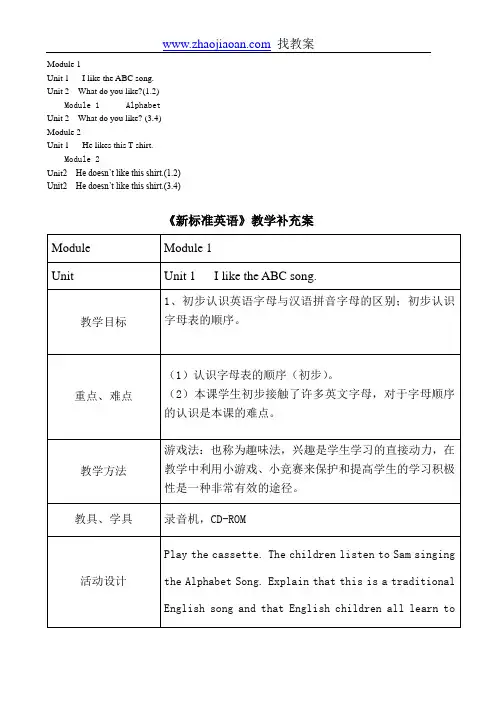
扩展有关玩具的单词:yo-yo, puppet, top ...
文化介绍
教学反思
对教材的改进意见
《新标准英语》教学补充案
教学目标
(1)通过学习Chant练习重点句型What do you like?
(2)通过字母游戏巩固学生对26个字母的认读。
重点、难点
学生对26个字母的认读。
教学方法
游戏法:也称为趣味法,兴趣是学生学习的直接动力,在教学中利用小游戏、小竞赛来保护和提高学生的学习积极性是一种非常有效的途径。
教具、学具
多媒体课件
活动设计
The game is played in pairs. Ensure that each child has a counter, stone or screwed-up piece of paper to mark his/her position. Each pair will also need a dice. Partner A throws the dice and moves his/her counter to the letters of squares.
游戏法:也称为趣味法,兴趣是学生学习的直接动力,在教学中利用小游戏、小竞赛来保护和提高学生的学习积极性是一种非常有效的途径。
教具、学具
CD-Rom
活动设计
Get two students to stand up. The first student holds up an object and frown or smiles. The class makes a statement about that object.Then the second student points to the first student’s object, looks at the class and makes a statement.
外研版英语小学二年级上册全册教案
外研版英语小学二年级上册全册教案Unit 1: HelloLesson 1: GreetingsObjectives:- Students will learn to greet and respond to greetings.- Students will practice simple dialogues using greetings.Materials:- Greeting flashcards- Song: "Hello, hello"Procedure:1. Introduce the topic: Greetings.2. Show flashcards with different greetings and elicit the meaning from students.3. Model and drill the greetings with the students.4. Play the song "Hello, hello" and have the students sing along.5. Pair the students and have them practice the dialogues using greetings.6. Conduct a whole-class activity where students greet each other randomly.7. Wrap up the lesson by reviewing the greetings and singing the song again.Unit 2: My FamilyLesson 1: Family MembersObjectives:- Students will learn basic vocabulary for family members.- Students will practice using possessive pronouns.Materials:- Flashcards of family members- Picture cards of family members- Worksheet: Fill in the blanksProcedure:1. Introduce the topic: Family members.2. Show flashcards of family members and elicit the vocabulary from students.3. Model and drill the pronunciation of the family members' names.4. Show picture cards of family members and have the students identify and name them.5. Introduce possessive pronouns (my, your, his/her) and explain their usage.6. Give out the worksheet and ask students to fill in the blanks with the correct possessive pronouns.7. Check the answers as a class and provide feedback.8. Wrap up the lesson by reviewing the vocabulary and practicing the pronunciation.Unit 3: My SchoolLesson 1: School ObjectsObjectives:- Students will learn vocabulary for school objects.- Students will practice using basic prepositions of place.Materials:- Flashcards of school objects- Picture cards of school objects- Whiteboard or blackboardProcedure:1. Introduce the topic: School objects.2. Show flashcards of school objects and elicit the vocabulary from students.3. Model and drill the pronunciation of the school objects' names.4. Show picture cards of school objects and ask students to point to the objects as you name them.5. Introduce basic prepositions of place (on, in, under, beside) and explain their usage.6. Use the whiteboard or blackboard to draw a classroom scene and demonstrate the prepositions with the school objects.7. Pair the students and have them take turns giving directions using the prepositions and school objects.8. Wrap up the lesson by reviewing the vocabulary and practicing the pronunciation.*(Continue the format above for the remaining units and lessons)*。
外研版一年级起点小学二年级英语上册教案Unit 1 Happy New Year!

Module 10 Unit 1 Happy New Year【教材分析】本课的内容是运用核心句子介绍自己国家的节日。
通过本课的活动让学生感知中西方文化差异,节日特点,风俗习惯。
使学生更加喜爱中国的传统节日。
【学生分析】二年级的孩子活泼可爱,求知欲强,但也存在着稳定性较差,注意力不易长时间集中等特点。
大多数学生对图画都感兴趣,尤其通过课件展示,更增加了学生对本课知识的趣味性。
【教学目标】知识目标1.Learn to say and understand the words: New Year, Chinese New Year, eat, dumpling.2.Learn to say the key sentences: Happy New Year! We eat dumplings at Chinese New Year. We have firecrackers.能力目标1.能用英语谈论节日;2.Try to talk about Chinese New Year and what do we do at Chinese New Year? At the same ti me, raise the students’ language abilities.情感态度目标通过学习新年的英语句子,让学生更加喜爱中国的传统节日。
【教学重点】1.Help students grasp the 4-skill words: New Year eat hair.2.Talk about the customs of our Chinese New Year using the phrases: eat dumplings, have firecrackers.【教学难点】How to use the new words and the drills to Talk about the customs of our Chinese New Year. 【教学方法】任务法采用任务型教学模式,让学生在有任务的情形理解课文。
二年级英语上册教案Module 10 Unit 1 外研版一起
Module 10 Unit 1 Happy new year.教材分析本模块的话题是谈论中国的春节和西方的圣诞节。
本单元的课文情景是春节到了,Sam 一家人来Daming家做客,Daming穿着喜庆的大红新衣服欢迎大家。
Daming问客人们介绍在中国过春节要吃饺子。
Amy没有见过鞭炮,错以为是装饰头发的。
Daming的爸爸告诉她这是鞭炮。
随后大家一起放鞭炮庆祝春节。
课文中Daming一家通过介绍有特色的食物、活动,让Sam一家了解了春节,这种形式适合任何节日活动的介绍。
教学目标【知识目标】1.学生能够认读、运用year, Happy new year! Come in, present, dumpling, eat, Chinese, hair, firecrackers2.能听懂、会说、会读、运用以下句子:Happy new year! We eat dumplings at Chinese New Year. 【能力目标】1.学生的听说能力能够得到提升。
2.学生能够运用所学内容介绍中国的春节。
【情感目标】学生能够初步感知中西方节日文化的异同。
教学重难点【教学重点】1.学生能够认读、运用year, Happy new year! Come in, present, dumpling, eat, Chinese, hair, firecrackers2.能听懂、会说、会读、运用以下句子:Happy new year! We eat dumplings at Chinese New Year. 【教学难点】词汇较多,掌握起来会比较困难。
课前准备多媒体设备挂图教学过程Step 1 热身导入1. 师生互致问候。
2. 教师告诉学生:快放寒假了,春节也快到了,我们一起来学唱一首表达春节祝福的英文歌曲吧。
1.请学生看活动1的动画。
2.播放动画或录音,教师组织全班跟唱、小组跟唱、个人跟唱,直到学生都能演唱这首歌曲。
外研版(一起)二年级英语上册教案Module10Unit1(2)
外研版(一起)二年级英语上册教案Module 10模块分析:本模块重在让学生感知中西方文化差异,节日特点,风俗习惯。
在Unit 1学习完后,安排课本剧表演能极大的丰富课堂教学内容,活化学习模式,加深理解。
Unit 2,结合西方文化背景,列举出几个典型的民俗节日,对比不同国家的节日特色,加深对学生文化意识的培养。
再通过演唱歌曲的形式,歌唱表演,渲染节日气氛,提高学生的综合语言技能。
Unit1 Happy New Year!教学目的:1.学会运用Happy New Year! 表示节日祝贺。
会说句子:We eat dumplings at Chinese New Year.2.会制作新年贺卡3.在节日时给家人朋友送上自己的祝福和问候,更新享受节日的氛围。
教学步骤:(一)热身复习1.学生表演唱英文歌曲2.男女生比赛看图片的某个部分来猜测。
最后一个图片是dumplings,这样可以为新课做好充分的准备。
(二)任务呈现教师一边指着带来的物品(如sweets peanuts, fish图片...)呈现本节课的学习任务:Do you know why I take so many things? It's because New Year is coming. And our old friend Sam, Amy will come here. Would you like to learn how to introduce Chinese New Year to them? 本节课的学习任务就是如何介绍中国新年的相关活动。
(三)任务准备1.课文导入Daming 正在向Sam介绍中国新年的有关活动,让我们一起去听一听吧!2.课文学习:1)听音说出听到的信息。
引出firecracker/eat/hair等生词,并采取领读、点读、齐读、快速指读等方式进行进一步练习。
2)听音回答问题:What do you say at Chinese New Year?What do we eat at Chinese New Year?学生回答后教师板书并引导学生练习。
外研版小学英语(一年级起点)二年级上册Module 2 Unit 1教学设计
Module 2 Unit 1I don’t like meat.本课内容为外语教学与研究出版社二年级上册Module 2 Unit 1 I don’t like meat.,本课是和学生们一起讨论食物,这个主题非常贴近我们的日常生活,有助于提高学生的学习兴趣,锻炼口语能力。
本课的句型都是基于“I like…/I don’t like…”,使得学生学习“你喜欢的东西…”这个内容相对容易。
1.Knowledge objects(1) To learn and master five new words: meat, rice,, noodles, sweets.(2) To enable the students to understand and speak “I like…/I don’t like…”Make sure that students can use in real situations.2.Ability objectsThe creative spirit is very important to the students. So I’ll pay much attention to train it in my class. Otherwise I’ll try to train the students learning and speaking abilities. Mainly improve their communicative abilities and encourage them to speak more English.3.Emotion objects(1)To arouse the students’ interests of learning English.(2)Make the students have successful feeling and achievement.(3)let students know don’t be choosy with their food.重点句型:“I don’t like……”,meat ,sweet单词:rice,noodles课件;点读机Step 1 Warm upT: Boys and girls, do you like English song?S: Yes.T: OK! Let’s sing the ABC song!Step 2 Lead inT: What’s your favorite animal /sport?S: ...T: What’s your favorite food? Now let's learn something about food.板书Module 2 Unit 1 I don't like meat .Look,(课件出示food的图片)结合图片教授新单词rice, noodles, meat, sweets每学一个单词都分组读一次,然后请再叫一列或两列同学接火车读。
外研版小学英语二年级上册全册优秀教案1
外研版小学英语二年级上册全册优秀教案
1
教学目标
1. 培养学生的英语听说能力,提高他们的语言表达能力。
2. 研究并掌握本单元的核心词汇和句型。
3. 培养学生的合作意识和团队合作能力。
教学准备
1. 外研版小学英语二年级上册教材。
2. 多媒体设备和投影仪。
3. 单词卡片和图片。
教学过程
第一课时
1. 导入新课内容,给学生展示单词卡片或图片,让学生猜测单词的意思。
2. 通过多媒体展示和播放音频,教授新单词,帮助学生正确发音。
3. 分组让学生进行口语练,使用新学的单词进行对话练。
第二课时
1. 复上节课学的单词,检查学生掌握情况。
2. 配对练,让学生根据图片和提示词组成正确的句子。
3. 带领学生进行问答练,培养他们的问答能力。
第三课时
1. 回顾上两节课学的句型和单词。
2. 引入新的对话内容,通过多媒体展示和音频播放,让学生听
懂并模仿对话。
3. 小组活动,让学生分角色进行对话练,培养他们的合作意识。
第四课时
1. 复上节课学的对话内容,检查学生掌握情况。
2. 练对话,学生可以分角色进行口语表演。
教学评估
1. 通过课堂练和口语表演来评估学生是否掌握了本单元的核心
词汇和句型。
2. 观察学生在小组活动中的合作情况,评估他们的团队合作能力。
参考资料
外研版小学英语二年级上册教材。
外研版(一起点)二年级英语上册Module9_Unit1 公开课教案
教材版本:外研社版新标准英语一年级起点年级:二年级课题:Module 9 Unit 1 It’s winter.一、教材分析《Module 9 Unit 1 It’s winter.》是外研社版小学新标准英语一年级起始第二册第九模块第一单元。
按照教材设计意图和阅读教学的建议,本课主要是学习有关季节的短文,在正确朗读、回答问题、理解短文的基础上培养学生的阅读能力和初步的仿说、仿写能力。
二、学情分析二年级的学生有一定的听说读写的能力。
对具体知识技能的掌握少,知识的应用转化能力较差。
小学生有好奇,好动,善于模仿,好表演的特点,学生在以前已经学过、并能够说出有关季节的知识,本节课学生会在创设的情境中通过一系列的课堂活动以及谈论自己能做的事情,轻松愉快的感受语言,表达语言,理解语言,从而习得语言。
抒发对大自然的赞美和热爱之情。
三、教学目标1. 知识与技能(1) 学生能够听、说、读、写单词spring, summer, autumn, winter, season,能够认读、表达和运用重点句My favourite season is... It’s... I can...(2) 能够运用所学词汇、句子表达或描写出自己喜欢的季节及原因。
能够正确朗读语篇、获取语篇的信息,在阅读的基础上进行仿写。
2. 过程与方法(1) 通过多媒体课件的演示,学生小组合作探究,对知识进行学习巩固。
初步培养学生的阅读能力,谈论喜欢的季节及原因,提高学生的语言运用能力及写作。
(2) 以任务型,情境型活动来完成教学内容。
采用情景法、直观演示法,全身反映法等教学方法,创设语言氛围,激发学生的学习兴趣。
使学生在参与活动中,掌握知识,提高能力。
3. 情感、态度与价值观学生品读短文,感受四季之美,热爱生活,热爱大自然,积极乐观学习生活。
四、教学重点、难点教学重点:1. 进一步巩固有关季节的单词和句型spring, summer, autumn, winter, season.My favourite season is...I love... it’s... I can wear...2. 指导学生在理解的基础上有感情的朗读课文。