
动词词组辨析
学习必备 欢迎下载 第一版本:易混动词短语辨析 die off= die away消失(离远去) die down 声音逐渐变弱,变小
2.go out 1)出去;2)出去参加社交活动;3)灯熄灭(go out = be out) set out 1)出发;2)开始 come out 1)得出;2)开花、发芽;3)出版 work out 1)计算出;做出;制定出;2)出去锻炼;
take up 开始从事职业、职务 take over接管 take on 1)呈现(色彩,面貌);2)雇佣;3)承担 take off 1)脱下,取下;2)事业起步,飞机起飞
4.Pick up 1)偶然学到;2)开车去接;3)局面好转 Pick out 辨认出
hand out=give out=share out=distribute 分发 result in=lead to=bring about导致
cut off 1)切断(水,电)的供应;2)断绝关系、联系 cut up 1)切成小块,砍碎;2)连根拔起 cut down 1)切成块;2)减少
7.Run smooth 进展顺利(不用smoothly) Go smoothly
8.come off =fall=drop花凋落 Keep off 远离,不靠近 Leave off= stop停止 Set off 1)放烟花;2)使爆炸
9.make up 补足;化妆;编造 Make up for弥补
10.put up with=come to terms of忍受 Keep up with=catch up with跟上;赶上 in terms of就….而言,关于…..;涉及….. 学习必备 欢迎下载 11.go through 1)=live through经历,渡过; 2)=look through仔细检查; 3)通过 get through 1)接通get through to sb; 2)完成,读完书,写完东西 3)通过
12.set up树立;创立 Put up挂起;张贴 Send up使上升
13.put away收好、放好 Take away脱下、放下外在的东西
14.bring back使想起 bring about产生 Vt bring up 1)培养;2)吐出 come about产生 Vi
15.call on 1)访问;2)号召 Call for 1)需要;2)号召
16.send up 1)发射(satellite, rocket, signal ) 2)把…..关入监狱 send sb up=send sb into prison Sign up for报名参加,注册 Try out for参加
17. call up 1)召唤;2)使想起=bring back 3)调动(人员、力量);4)提出(议案)=come up 4)给….打电话
18.at ease 平静、宁静 With ease轻松地 do sth with ease ease v.缓解 unease焦躁,不安的 学习必备 欢迎下载 19.go about开始做、着手于 get about=get around到处走动
20.do away with=call off=cancel=abolish取消,废除(规定、制度) Break away from脱离
21.give out 1)发出尖叫;2)耗尽、用完;=run out;3)分发、分配 give off发出烟、气味smell/smoke let out 1)让…出去;2)泄露 put up 1)张贴 put up the notice;2)举起 break into 1)破门而入;2)大的变小
22. by the way顺便说 In the way挡住….的去路 on the way在去…的路上
23. provide for sb=support sb供养 provide for sth为可能发生的事情做好准备
24.at a time一次、每次 at no time= in no way= by no means= on no account绝不 in no time= at once= in a moment = right away 立刻、马上 at a time一度、曾经
25. call for 1)要求、需求;2)约某人、去叫某人;3)号召 call on 1)拜访 call on sb; call at sp;2)号召 call in调集 call in the police,call in the army
26.for the moment当时、在那个时候 for a moment一会儿 at a moment当时、这时(at present) in a moment= right away= in no time立刻,马上 right now= just now刚才
27.put off=delay推迟 put up 1)举起;2)张贴;3)忍受put up with put away 1)收起、收好;2)存钱
28.go away走开、离开;拿走、带走 学习必备 欢迎下载 go off出发;爆炸;铃响;go off to Japan go out出去;灯熄灭 run out (物品、钱)用完 give out(力气、耐心)用完、耗尽
29. refer to= deal with= cover涉及 set down= put down=write down写下 shut down= cut off关闭;与外界隔离
30. give sb a ride= give sb a lift给某人搭顺风车 take hold of抓住 give away= donate 捐赠
31. hold back阻止 hold on 1)别挂断;2)别松开、别松手;3)拥有、占有、保存有 hold up 1)被(雨、交通)困住;be held up= be stuck with 2)举起、支撑起、顶起
32. go about 1)=set about开始做、着手于; 2)=deal with处理 3)wander about四处走动
33.get there=make it成功 get across传达、让….清楚;明白 get along进展,和….相处 get in 1)收割 get in the crops;2)插话 get into 1)进入…里面 get into trouble; 2)上车 get into the car/ get out of the car get off 下车 get off the bus/ get on the bus get through 1)接通;2)完成;3)穿过 get up 1)站起来;2)起床
34.give away 1)捐赠,赠送;2)泄露、透露(无意)=let out (有意或无意) give back归还 give in to sth屈服,让一步 give out 1)分发=hand out= distribute 2)(体力、精力)耗完,耗光 give up放弃 学习必备 欢迎下载 35.stick out突出、伸出 36.call up 1)唤起;2)给…打电话 call for 1)要求= require;2)约某人、哈某人 call on 1)看望、拜访;2)掉军队;3)号召 call in 调军队、叫警察 call off 取消
37. bring in 引进;带来 bring up 1)抚养 be brought up; 2)呕吐 bring out 1)将….拿出来;2)将….阐述清楚 bring about 1)使产生、使出现;2)造就 bring about the best charater of sb 38. put forward提出 Put on 1)穿上;2)表演 Put up with=bear= stand忍受
39.think over仔细考虑 Think of/ about想起 Think up想起、提出
40.be close to= get close to 1)接近、靠近;2)快要、将要 be/get close to sb 41.use up用完、用光Vt Give out=run out Vi
42.hand over将….交给某人 43.add to增加 add up to总共是
44. go over复习、预习、过一遍 go through浏览、仔细地看
45.come around出来;到来 come along走上来 come out出版;生产;扑灭;关掉 give rise to= bring about= result in= lead to带来;产生;导致
46.pay off 1)得到回报(Vi,不及物,没有被动语态)
动词和动词词组
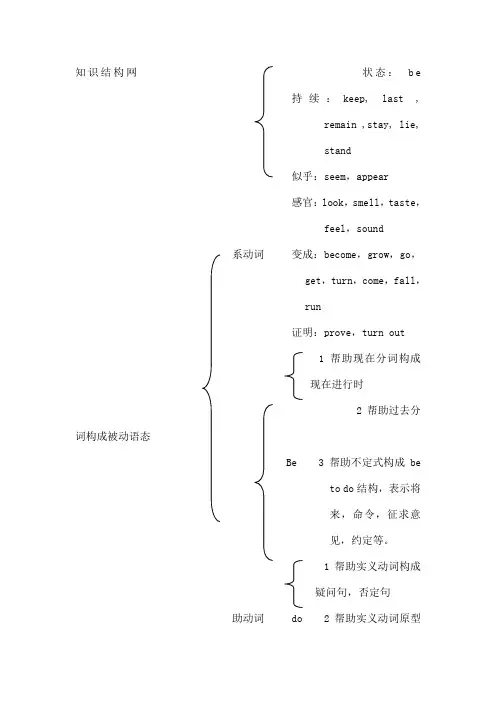
知识结构网状态:b e持续:keep, last ,remain ,stay, lie,stand似乎:seem,appear感官:look,smell,taste,feel,sound系动词变成:become,grow,go,get,turn,come,fall,run证明:prove,turn out1帮助现在分词构成现在进行时2帮助过去分词构成被动语态Be 3帮助不定式构成beto do结构,表示将来,命令,征求意见,约定等。
1帮助实义动词构成疑问句,否定句助动词 do 2帮助实义动词原型构成强调式3用来代替动词按用法 have帮助过去分词构成完成时态分shall/will/would/should帮助谓语动词构成将来时态宾语及物动词双宾语复合宾语实义动词不及物动词动词情态动词延续性动词:last;keep按意义分动词和非延续性动词:die,leave,come动词词组动词+介词:look at; take on动词+副词:find out ,turn up动词词组动词+副词+介词:come up with, go in for动词+名词+介词:take part in ,take care ofBe+形容词+介词:be ready for ,be devoted to 考点一:动词及动词辨析1,achieve,gain,win,earn(1),achieve,vt. 强调通过极大努力获得或达到某事物,实现弯沉,常与一些抽象名词连用,如:success,goal(2),gain vt 指获得,赢得(尤指想要的或所需的事物)。
此外,gain 还有增加的意思 I gained the impression that the matter had been settled The plane rapidly gained height. Gain weight= put on weight(3),win vt 表示在较强的竞争中取得胜利,它通常跟的宾语有game,war ,prize, fame, battle(4),earn vt. 表示挣钱,赚工资,因自己成就行为等,得到应得的事物,博得,earn one’s living 谋生2,adapt, adjust, adopt(1),adapt 使适合,使适应 adapt (oneself)to …使自己适应。
易混淆动词辨析

拿(无方向性)
6.三个“到达”
词 意
区 别
1. get
Get to + sp. *到家 get home
2. arrive
arrive+ in (大地点) / at (小地点) +sp.Arrive home
3. reach
reach+ sp.
7.三个“借”
词 意
区 别
1. borrow
+对手(人)
12. 两个“发现/发明”
词 意
区 别
1. invent
发明(创新,以前没有的) invention(发明物)
2. discover
发现(原已存在,现在找到)
13. 两个“忘”
词 意
区 别
1. forget
Forget to do 忘记要做某事
Forget doing 忘记做过…
2. leave
Speak+语言, 电话用语:speak to sb.
4. 四个“看”
词意
区 别
1. look at
(动作) 看
2. see
(结果)看见
3. watch
连续性,运动性的画面
4.
读书/ 板报/ 杂志
5.四个“拿”
词意
区 别
1. get
去拿 去+拿<方向性>
2. bring
带来
3. take
拿走
借入 用主语做判断
2. lend
借出
3. keep
延续性动词与段时间连用
8.三个“听”
词 意
区 别
1. listen
知识点-die out与die away, die off, die down等辨析

die out与die away, die off, die down等辨析 【三、die away, die off, die down等辨析
】
3、die down 主要指火等渐熄 ;草木等枯萎、凋谢。 (gradually become less strong, loud, etc,侧重于减弱的过程,有 一个变化过程,是一个动态的动词词组)
】
2、die off 指的是相继死亡,就是一个个死掉;也可指草木一 一枯死(个体死亡或部分灭绝但并不一定不复存)。
As he grew older, his relatives all died off. 随着他年龄的增长,他的亲人都一个一个地死去了。
If the snowstorm does not blow over, the cattle will die off. 如果暴风雪不停息,很多牲畜就要死掉了。
【四、相关连接-----die of 、die from、 die for 】
3、die for 为某种目的而献身、牺牲 Lots of them died for the cause of liberation. 他们中许多人为解 放事业而献身 die for one’s country 为国捐躯 拓展: be dying for something /to do something 迫切想要(做)某事。 He is dying for something to eat. 他极想弄点东西吃。 He is dying to know where he has gone. 他迫切想知道他到哪里 去了。
die的名词形式是death,意为“死亡”。例如: His mother's death was a great blow to him. 他母亲的去世对他是 一个巨大的打击。
中考动词最全讲解-共21页。包括常见短语动词辨析,重点动词用法
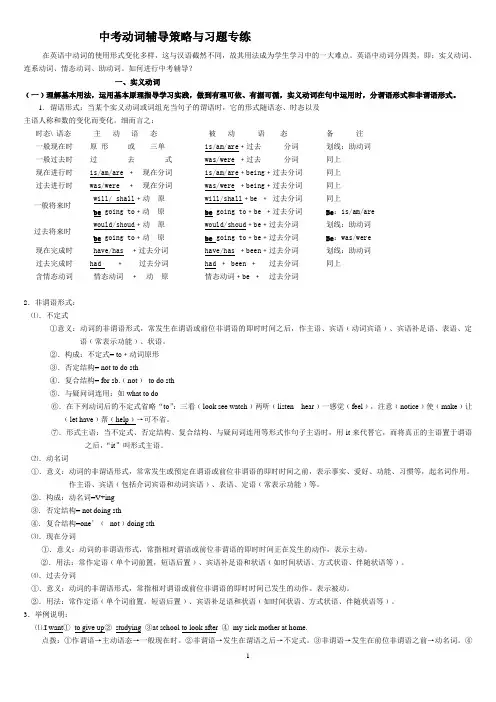
中考动词辅导策略与习题专练在英语中动词的使用形式变化多样,这与汉语截然不同,故其用法成为学生学习中的一大难点。
英语中动词分四类,即:实义动词、连系动词、情态动词、助动词。
如何进行中考辅导?一、实义动词﹙一﹚理解基本用法,运用基本原理指导学习实践,做到有理可依、有据可循,实义动词在句中运用时,分谓语形式和非谓语形式。
1.谓语形式:当某个实义动词或词组充当句子的谓语时,它的形式随语态、时态以及主语人称和数的变化而变化。
细而言之:2.非谓语形式:⑴.不定式①意义:动词的非谓语形式,常发生在谓语或前位非谓语的即时时间之后,作主语、宾语﹙动词宾语﹚、宾语补足语、表语、定语﹙常表示功能﹚、状语。
②.构成:不定式= t o ﹢动词原形③.否定结构= not to do sth④.复合结构= for sb.﹙not ﹚ to do sth⑤.与疑问词连用:如what to do⑥.在下列动词后的不定式省略“to ”:三看﹙look see watch ﹚两听﹙listen hear ﹚一感觉﹙feel ﹚,注意﹙notice ﹚使﹙make ﹚让﹙let have ﹚帮﹙help ﹚→可不省。
⑦.形式主语:当不定式、否定结构、复合结构、与疑问词连用等形式作句子主语时,用it 来代替它,而将真正的主语置于谓语之后,“it ”叫形式主语。
⑵.动名词①.意义:动词的非谓语形式,常常发生或预定在谓语或前位非谓语的即时时间之前,表示事实、爱好、功能、习惯等,起名词作用。
作主语、宾语﹙包括介词宾语和动词宾语﹚、表语、定语﹙常表示功能﹚等。
②.构成:动名词=V+ing③. 否定结构= not doing sth④. 复合结构=one ’﹙ not ﹚doing sth⑶.现在分词①.意义:动词的非谓语形式,常指相对谓语或前位非谓语的即时时间正在发生的动作,表示主动。
②.用法:常作定语﹙单个词前置,短语后置﹚、宾语补足语和状语﹙如时间状语、方式状语、伴随状语等﹚。
动词词义辨析及练习
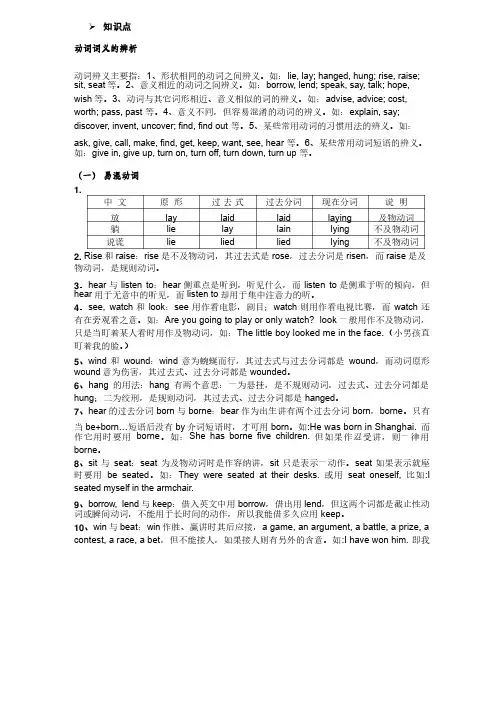
Ø 知识点动词词义的辨析动词辨义主要指:1、形状相同的动词之间辨义。
如:lie, lay; hanged, hung; rise, raise; sit, seat 等。
2、意义相近的动词之间辨义。
如:borrow, lend; speak, say, talk; hope, wish 等。
3、动词与其它词形相近、意义相似的词的辨义。
如:advise, advice; cost, worth; pass, past 等。
4、意义不同,但容易混淆的动词的辨义。
如:explain, say; discover, invent, uncover; find, find out 等。
5、某些常用动词的习惯用法的辨义。
如:ask, give, call, make, find, get, keep, want, see, hear 等。
6、某些常用动词短语的辨义。
如:give in, give up, turn on, turn off, turn down, turn up 等。
等。
(一) 易混动词1.中 文 原 形 过 去 式 过去分词过去分词 现在分词现在分词 说 明放 lay laid laid laying 及物动词及物动词躺 lie lay lain lying 不及物动词不及物动词说谎说谎 lie lied lied lying 不及物动词不及物动词2. Rise 和raise :rise 是不及物动词,其过去式是rose ,过去分词是risen ,而raise 是及物动词,是规则动词。
物动词,是规则动词。
3.hear 与listen to :hear 侧重点是听到,听见什么,而listen to 是侧重于听的倾向,但hear 用于无意中的听见,而listen to 却用于集中注意力的听。
却用于集中注意力的听。
4.see, watch 和look :see 用作看电影,剧目;watch 则用作看电视比赛,而watch 还有在旁观看之意。
人教版高中英语语法八——动词词义辨析

语法复习九:动词词义辨析动词是是各类考试的重点,高考试题中,单项填空、完形填空和改错等三项题型中,动词辨义的比重较大,并逐年增加。
动词辨义主要指:1、形状相同的动词之间辨义。
如:lie, lay; hanged, hung; rise, raise; sit, seat等。
2、意义相近的动词之间辨义。
如:borrow, lend; speak, say, talk; hope, wish等。
3、动词与其它词形相近、意义相似的词的辨义。
如:advise, advice; cost, worth; pass, past 等。
4、意义不同,但容易混淆的动词的辨义。
如:explain, say; discover, invent, uncover; find, find out等。
5、某些常用动词的习惯用法的辨义。
如:ask, give, call, make, find, get, keep, want, see, hear等。
6、某些常用动词短语的辨义。
如:give in, give up, turn on, turn off, turn down, turn up等。
(一)易混动词中文原形过去式过去分词现在分词说明放lay laid laid laying 及物动词躺lie lay lain lying 不及物动词说谎lie lied lied lying 不及物动词1、lay(放), lie(躺)与lie(说谎):这三个易混动词构成见下表:2、rise和raise:rise是不及物动词,其过去式是rose,过去分词是risen,而raise是及物动词,是规则动词。
3、hear与listen to:hear侧重点是听到,听见什么,而listen to是侧重于听的倾向,但hear用于无意中的听见,而listen to却用于集中注意力的听。
4、see, watch和look:see用作看电影,剧目;watch则用作看电视比赛,而watch还有在旁观看之意。
第07讲 动词(情态动词、非谓语动词、系动词、使役动词、动词辨析)
第7讲动词考向1 情态动词高频考点:情态动词肯否答用法速记口诀:肯否一致最容易,谁问谁答没问题;may/could表请求,肯否can回答,绝对禁止mustn't;must/need表必须,肯用必须(must),否俩不必(needn't/don't have to).口诀使用范例-May I smoke here?-I'm afraid you .It's not allowed(允许)。
A.canB.can'tC.mayD.may not问句以can/could/may/must/need等情态动词提问,考查肯定或否定回答时,用此口诀解题。
答案解析:根据题干中的“May I smoke here?”可知,may提问表请求,结合大招“may/could表请求,肯否can回答”,故选B.解题坑点1.could提问表请求时,用can回答;但表过去的能力时,用could回答。
2.mustn't表明令禁止,不用于回答must的提问。
母题1(2023·江苏宿迁·统考中考真题)According to the traffic rules, people ________ ride e-bikes without wearing helmets.A.mustn’t B.needn’t C.may not D.might not【答案】A【详解】句意:根据交通规则,人们禁止骑电动车不戴头盔。
考查情态动词。
mustn’t禁止;needn’t不必;may not可能不;might not可能不。
根据“According to the traffic rules”可知是规则,结合常识可知禁止骑电动车不戴头盔。
故选A。
考向2 非谓语动词高频考点1:to do作宾语用法速记口诀:我想要决定未来,敢于承担失败(want/would like, decide/determine, afford, fail);我选择拒绝诱惑,需要学习解惑(choose,refuse,need,learn);我自愿承诺努力,希望计划给力(volunteer,promise,hope/wish/expect,plan);时间不能耽误,想要就要to do.口诀使用范例-What are you going to do this weekend,Alice?-I plan the Great Wall with my cousin.A.visitingB.visitC.to visitD.visited当选项为同一个动词的to do,doing和do及变形且作宾语时,参考此口诀解题。
高中英语语法过关辅导课件-动词和动词词组
She went through the book before buying it. She went over the lessons for three times. He had to go without food. The ship is heading for the nearest port. He is looking up a new word in the dictionary. The boy looked through the picture book. She put up a picture on the wall. The match is put off owing to the rain. The bus ran over his legs. His illness results from overeating. Overeating results in his illness.
You will answer for what you’ve done. The boy asked for more food. He doesn’t care for playing football. I came across an old friend in the street.
call up打电话
到进一步发展,不能与名词purpose搭配使用。obtain“获得,得
到”,多指获得信息、知识、忠告、许可等,不能与purpose搭配。 reach“达到,达成”,在此最具迷惑性,但reach多与conclusion,
decision, agreement, destination等名词搭配,不能与purpose搭配。
sth.“因某事而控告某人”。blame“责备,责怪”,常与介词for
【中考英语、英语语法】【人教版】中考英语动词及动词短语考点剖析
中考英语:动词及动词短语考点一常见易混动词辨析1.spend/pay/cost/take表示“花费”spend主语是人,指花费时间和金钱。
spend... on...; spend... (in) doing sth.pay主语是人,指花费金钱。
pay... for...=spend... oncost主语是物或某种活动,指花费金钱或其他代价。
sth. cost(s) (sb.)...多用it作形式主语,指花费时间。
It takes sb. ... to do sth.=Sb. spend(s)... (in) doin takesth.Mom never spends any money on herself.妈妈从来都不在自己身上花钱。
May I borrow 12 yuan from you? I’ll pay it back next week.你能借给我12块钱吗?我下周还你。
It won’t cost you a penny for the first six months.开始的六个月你不用花一分钱。
It took them three years to build this road.他们用三年时间修完了这条路。
2.look/watch/see/read 表示“看”look看(动作);可单独成句;look at...watch看(电视、比赛);注视see看见(结果);看望;理解(I see.)read看(书、报);读;读懂别人的内心★look可以表示“看上去”,是感官系动词,后接形容词。
★看病(看医生)用see a doctor表示。
3.speak/say/talk/tell表示“说”speak发言;说(某种语言)say说(内容);写有talk谈论;talk about sth.; talk to/with sb.tell告诉;讲述;tell sb. (not) to do sth.4.感官动词look/taste/sound/feel/smelllook看起来(视觉)taste尝起来(味觉)sound听起来(听觉)feel摸起来(触觉)smell闻起来(嗅觉)5.borrow/lend/keep表示“借”borrow借用;borrow sth. from sb.lend借给;lend sth. to sb.keep借用若干时间;keep... for 2 days6.hope/wish/expecthope希望;hope to to sth.; hope+that 从句wish但愿、希望;wish to do sth.; wish sb. to do sth.; wish+that 从句expect期待、期望; expect to do sth.; expect sb. to do sth.7.forget/leaveforget表示“忘记”时,forget通常不能与表示地点的副词或短语连用leave在表示“遗忘”时,通常要与表示地点的状语连用8.hear/listen/soundhear听见;hear+名词(强调听的结果)listen听;listen to+名词(强调听的过程)sound听起来; sound+形容词(强调听的效果)9.wear/put on/dress/be inwear“穿着;戴着”,强调状态,wear后可接穿戴的东西,包括眼镜、首饰等put on“穿上;戴上”,指“穿”的动作,反义词为“take off”“穿衣”,是及物动词,后接人作宾语,意为“给某人穿衣服”;dress onself“打扮;给自己穿dress衣服”be in表示状态,后接衣服,也可接表颜色的词10.reach/get/arrivereach“到达”,是及物动词(比get更正式),其后可直接接地点名词作宾语(不能用介词)get“到达”,不及物动词,之后通常接介词 toarrive“到达”,不及物动词,之后通常接介词 at (一般用于较小的地方)或 in (一般用于较大的地方)1.(2018·山东菏泽单县常青学校模拟三)—I meeting Jack today because I am still angry with him.—Come on, Mary. You are good friends.A.avoid B.expect C.enjoy2.(2018·广东普宁模拟改编)I don’t know the restaurant, but it’s to be quite a good one.A.said B.told C.spoken3.(2018·广西贵港港南二模改编)—How much money did he you yesterday?—500 yuan. I told him I would return it to him in three weeks.A.give B.borrow C.lend4.(2018·甘肃定西中考改编)—I can’t find my English textbook.—Is it possible that you it at home?A.lost B.forgot C.left5.(2018·四川泸州中考改编)It about eight minutes for the light to travel from the sun to the earth.A.costs B.spends C.takes考点二动词短语辨析常考的动词短语辨析有三种:第一种是同一动词的不同搭配;第二种是同一副词或介词与不同动词的搭配;第三种是完全不同的动词短语。
高考高考英语语法复习精品学案之动词词义辨析篇
2012届高考英语二轮语法复习学案(动词词义辨析)动词是是各类考试的重点,高考试题中,单项填空、完形填空和改错等三项题型中,动词辨义的比重较大,并逐年增加。
动词辨义主要指:1、形状相同的动词之间辨义。
如:lie, lay; hanged, hung; rise, raise; sit, seat等。
2、意义相近的动词之间辨义。
如:borrow, lend; speak, say, talk; hope, wish等。
3、动词与其它词形相近、意义相似的词的辨义。
如:advise, advice; cost, worth; pass, past 等。
4、意义不同,但容易混淆的动词的辨义。
如:ex plain, say; d iscover, invent, uncover; find, find out等。
5、某些常用动词的习惯用法的辨义。
如:ask, give, call, make, find, get, keep, want, see, hear等。
6、某些常用动词短语的辨义。
如:give in, give up, turn on, turn off, turn down, turn up等。
(一)易混动词1、lay(放), lie(躺)与lie(说谎):这三个易混动词构成见下表:2、rise和raise:rise是不及物动词,其过去式是rose,过去分词是risen,而raise是及物动词,是规则动词。
3、hear与listen to:hear侧重点是听到,听见什么,而listen to是侧重于听的倾向,但hear用于无意中的听见,而listen to却用于集中注意力的听。
4、see, watch和look:see用作看电影,剧目;watch则用作看电视比赛,而watch还有在旁观看之意。
如:Are you going to play or only watch?;look一般用作不及物动词,只是当盯着某人看时用作及物动词,如:The little boy looked me in the face.(小男孩直盯着我的脸。