
新目标英语八年级下册Unit1复习学案
八年级下英语Unit 1 Will people have robots?复习学案
主备:贾华荣 教师寄语:Everything is possible if you set your mind to do it! 学习目标:1、熟练掌握本单元的重点词并能对易混词的用法进行辨析。 2、归纳并熟练运用本单元的常用表达法、句型结构及重点语法。 I、自主学习,归纳总结 常用表达法: 1、太空站 2、爱上 3、去滑冰 4、有能力做某事 5、世界杯 6、(希望等)实现,达到 7、未来,将来 8、大量,许多 9、十年后 10、和„相同 11、醒来,唤醒 12、尽力做某事 13、反复地 14、让某人做某事 15、一些„,另一些„ 16、帮助(某人)做某事 17、最„的„之一 18、寻找 重要句型: 1、将会有„ 2、对于某人来说做某事是„ 3、有„在做某事。 4、好像,似乎„ 5、做某事花费某人多长时间。 重点语法: 1、一般将来时由“助动词 + ”构成。“ ”和“ ” 也可以表示将要发生的动作或安排。“in +一段时间”表示“ ”,用于一般将来时,提问时用“ ”,意为“多久以后”。 2、will用于 人称,在名词或代词后常缩略为 ,will not常缩略为 。在疑问句和书面语中,主语为第一人称时,常用助动词 。在疑问句中will用于第二人称时,表示询问对方的 ,或向对方提出 。 3、There be的一般将来时为 或 。 词汇辨析: 1、less, fewer In the future, there will be water and trees. 2、maybe,probably, may/might I'll fly to the moon one day. I'll live on the space station and I travel to other planets by rockets. 3、alone,lonely
The old man lives in the mountain village and he feels very .
4、sound,voice, noise
I can't stand the from the airport.
Light travels much faster than .
Song Zuying has a sweet .Her songs beautiful.
5、dress, wear, put on
Ms brown often a .
The mother her clothes, her baby and then went to hospital.
6、such, so
I've never seen a moving movie.
It's impossible for a little girl to finish much work.
7、bored,boring
Doing the laundry is so and it makes me .
8、can, be able to
He play basketball at the age of five.
If I become a doctor, I'll help more people.
II、合作探究,点拨提升
小组合作,解决疑难。出示答案,点拨讲解。加深理解,强化记忆。
III、当堂检测,及时反馈
小组互查,重点查出错的内容,人人过关。
附加题:
1、 He (好像) angry. =He angry. = he is angry.
2、 (take) a walk after supper is good for health.
3、Everything (begin)to grow in spring.
4、My mom makes me (drink) milk every morning.
5、There are over five (hundreed) students in this middle school.
6、Five years ago, Sally (play) soccer. Today, she the guitar. In five years, she
Tennis.
7、杨利伟是中国最著名的宇航员之一。
8、我需要参加工作面试时显得精神些。
9、将来污染会更少吗?不,不会。
10、对于机器人来说像人一样做同样的事情很难。
11、你认为一百年后你的生活会是什么样的?
新目标英语八年级(下)Unit 1知识要点归纳
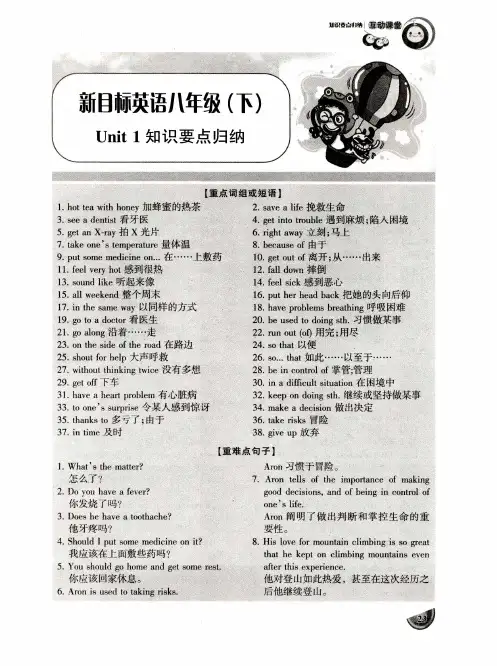
A r o n阐 明 了 做 出判 断 和 掌 控 生 命 的重 要性 。
8 . Hi s l o v e f o r mo u n t a i n c l i mb i n g i s S O g r e a t t h a t h e k e p t o n c l i mb i n g mo u n t a i n s e v e n a f t e r t h i s e x p e r i e n c e .
8 . b e c a u s e o f 由于
1 1 . f e e l v e r y h o t 感 到很热 1 3 . s o u n d l i k e听起来像 l 5 . a . 】 1 w e e k e n d整个 周末 l 7 . i n t h e s a m e w a y以同样 的方式 l 9 . g o t o a d o c t o r 看 医 生 2 1 . g o Mo n g沿着 … …走 2 3 . o n t h e s i d e o f t h e r o a d在 路边 2 5 . s h o u t f o r h e l p大声 呼救 2 7 . w i t h o u t t h i n k i n g t w i c e没 有多想 2 9 . g e t o f下 车 3 1 . h a v e a l 1 e a r t p r o b l e m 有 心脏病 3 3 . t o o n e ’ s s u r p r i s e令某人 感 到惊讶 3 5 . t h a n k s t o多亏 了 ; 由于
5 . g e t a n X - r a y拍 X光 片
6 . r i g h t a w a y 立刻
2020-2021学年人教版新目标英语八年级下 unit1-2复习(单词填空、变形专项)(含答案)1
人教版新目标英语八年级下unit1-2复习一、单词填空1.The sick children are well taken care of by the doctors and n_______.2.He is in _______(麻烦).Let's do something to help him out.3.They found a wallet on the way to school and waited to find its __________(物主).4.The box is heavy. Can you help me to c_________it?5.-What’s the m_______? -I have a stomachache.6.Words can hardly describe how ___________(激动的)we feel about the news.7.Take some _______(药)and you'll feel better soon.8.He fell off the bike and cut his _______(膝盖)yesterday.9.My mother asked us to stop walking to _______(休息)for a while.10.The baby has had a bad _______(咳嗽)for a few days. Her mother is worried about her.11.Our school is ready to ____________ (募集) money for the old people in the poor mountainous area.12.Lisa had a sore _______(喉咙)and she needed to drink much water.13.Between classes, the students usually take a b_______ on the playground.14.The boy is c_________and he can work out the difficult problem easily.15.The bus driver asked one of the p _______to help him move the old man onto the bus.16.Don't work too late, or you'll fall s_______17.You shouldn't laugh at the_________(有残疾的)at any time.18.My mother helped me move the heavy box _______(向)the desk.19.A c_______is someone who climbs rocks or mountains as a sport or a hobby.20.—What's the _______(温度)in Qingdao now? -It is 32℃ now.二、用所给单词的适当形式适当形式填空1.-Could you please take the dog for a walk?-OK, but I want _____(watch) one show ___(one).2.The air here isn’t clean so people have problems_______(breath) .3.You make a big___________(different) to my life.4.Bill agreed _______(help) me to look for my lost bike.5.Some teenagers are afraid of_______( take ) risks which is not good for their future.6.The blind girl lost _______(she ) in the beautiful music.7.There are some _______(knife) in the kitchen.8.The teacher asked me _________ (answer) the question in English.9.David___________(fix) up these broken television by himself.10.He used_______( take ) a walk after dinner.11.Would you like to be a volunteer to help those___________(home) people? They really need help now.12.Lily shows great _______(interest ) in the stories.13.I don't mind _______(drive) if you are tired.14._______(be ) healthy, we should eat more vegetables and fruits.15.The old man dad problems breathing. What should we do_______( help ) him?16.Everyone was_______( surprise ) at the bad news.17.He promised me that he would finish the work _______(quick).18._______( clean) up your bedroom, please. It’s dirty19.Where there is a ______________ (difficulty) there is a way out.20.How many _______(foot) does a horse have?21.They felt___________about the___________ program Sing! China.( excite )22.I find it_______(difficulty)to plan things for myself.23.He _______(hurt) his right leg when he played soccer in the playground yesterday.24.I ___________( give) away some of my clothes to the poor children yesterday.25._______( make ) good decisions is extremely important when we are in danger.答案一、单词填空1.nurses2.trouble3.owner4.carry5.matter6.excited7.medicine8.knee9.rest 10.cough11.raise 12.throat 13.break 14.clever 15.passengers16.sick 17.disabled 18.onto 19.climber 20.temperature二、用所给单词的适当形式适当形式填空1.to watch first2.breathing3.difference4.to help5.taking6.herself7.knives8.to answer9.fixed 10.to take11.homeless 12.interests 13.driving 14.Be 15.to help 16.surprised 17.quickly 18.Clean 19.difficulty 20.feet 21.excited exciting 22.difficult 23.hurt 24.gave 25.Making。
人教版新目标英语八年级下 unit1-2复习(单词填空、变形专项)(含答案)
人教版新目标英语八年级下unit1-2复习一、单词填空1.He fell down and hurt his _______(膝盖)。
2.Kate’s hairstyle is ____________ (相似的) to Anna’s.3.He is the_______(主人) of the new house. He is going to have a housewarming party.4.You spoke so fast that I couldn't_________(理解)what you meant.5.We must learn to regard ___________(困难)as challenges(挑战).6.My sister is old enough to look after _______(她自己).7.The man tried to _______(管理)the whole company.8.We sat around the fire to keep o_______warm.9.Don't work too late, or you'll fall s_______10.I wrote that song just to c__________myself up.11.S__________days later, Grace came to the library to borrow some books.12.Words can hardly describe how ___________(激动的)we feel about the news.13.Don’t go to work with an empty s_______in the morning, you must eat something.14.The _______(意志)of these climbers shows us that we should never give up trying to achieve(实现)our dreams.15.Stephen Hawking is a ___________(残疾的)but clever scientist.16.-How do you usually keep in touch with your friends?-I used to write l_________.But now I often use WeChat.17.Do you realize the i_______of protecting the earth?18.Tom had a _______(头痛),so he didn't go to school.19.I'm able to get enough money for the poor children because of your_________(善良)。
15-16新目标[英语周报]八年级下册Unit1SectionA3(Grammarfocus–4c)教案
![15-16新目标[英语周报]八年级下册Unit1SectionA3(Grammarfocus–4c)教案](https://360docs-1393072327.cos.ap-beijing.myqcloud.com/8d88d67a0912a21615792935.webp)
Section A 3 (Grammar focus – 4c)Step 1 Revision (Guessing game)Look at the pictures, guess what has happened and revise the important points the students have learned.What’s the matter with her?Does she have a fever?Does she have a toothache?What should she do?What’s the matter with him?Does he have a fever?Does he have a toothache?Does he have a sore throat?Does he have a backache?What should he do?What’s t he matter with him?Does he have a fever?Does he have a toothache?Does he have a sore throat?Does he have a stomachache?What should he do?Step 2 Grammar Focus根据所给汉语意思把句子补充完整。
________________? 怎么了?I have a ____________. 我胃疼。
You _________ eat so much next time. 你下次不该吃那么多。
What’s the matter with Ben?本怎么了?He hurt himself. He _____________.他伤了自己。
他背疼。
He should _______________.他应该躺下休息。
Do you ____________? 你发烧了吗?Yes, I do. / No, I don’t. / I don’t know. 是的。
人教新目标八年级英语下册Unit1知识点归纳练习汇总

人教新目标八年级英语下册Unit1知识点归纳练习汇总Unit1 what’s the matter?1.words about body:2.words about health problems and accidents:你哪里不舒服?/3.量体温:躺下看牙医可能的可能地休息破坏,打碎4.翻译:我在想是我同一个姿势坐太久没动了。
5.翻译:我的腿受伤了。
6.拯救了一位老人存钱节约用水7. 沿着…走在马路一边毫不犹豫8.下车上车赶快行动take sb. to sp 期盼做某事等待某人/某物令某人感到吃惊的是9.(不)同意(v.)(n.) (不)同意做某事(不)同意某人10.多亏于11.翻译:因为不想惹麻烦,许多人不愿帮助别人,这是令人寒心的。
这个司机没有想到自己,他所想的就是救人一命。
12.P5.句子讲解13.失去(v.)过去式失去生命迷路丢了钥匙14.翻译:他是一个对打篮球感兴趣的小男孩。
15.作为学生因为事故车祸16.用尽/ : My money ran out./I ran out of my money .17.切断切碎砍到18.做好决定的重要性19.翻译:他如此热爱登山以至于在这次经历后还在继续登山。
他反复举手。
一直走,知道你看到了书店。
20.做决定give up give in21.拓展用法:with的用法①. Mandy likes playing ball games with Mike.②.She wrote a letter with a pen.③.Do you know what’s the matter with Cindy? (关于,对于)④.They often sleep with the lights on.。
八年级英语下册 Unit 1 What’s the matter教案 (新版)人教新目标版
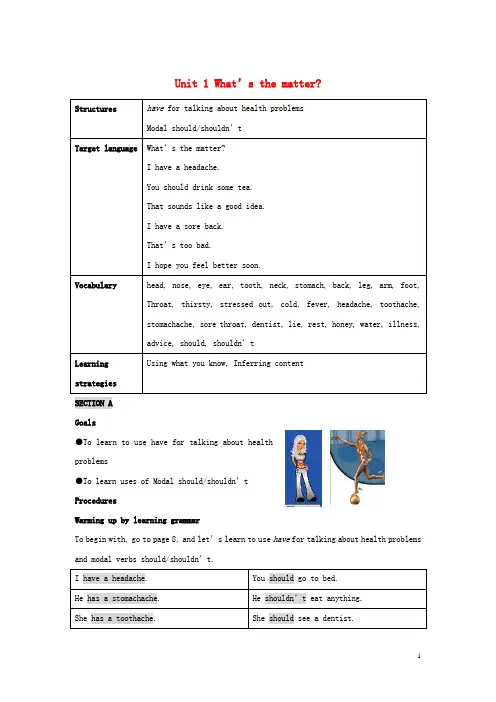
Unit 1 What’s the matter?SECTION A Goals●To learn to use have for talking about health problems●To learn uses of Modal should/shouldn’t ProceduresWarming up by learning grammarTo begin with, go to page 8, and l et’s learn to use have for talking about health problems and modal verbs should/shouldn’t.Warming up by discussingHello, everyone!Can you name the parts of your body? How many parts of the body can you name? Let’s look at the doll and name the parts of the body.Now le t’s read the words together.Keeping healthy is very important. So today we will talk about it. Let’s look at Unit 1 What’s the matter?1A Writing the lettersNow open your books and turn to page 7. Please look at the picture and read the name of the body parts.OK. Now look at the picture of the students numbered 1 through 5. Several body parts are marked with the letters a ~ m. Write the correct letter after the name of each body parton the list. You must complete the activity individually.Let’s check the answer, please.1b Listening and numberingCan you tell what part of the body doesn’t feel good? Now let’s learn the new words in the picture. Please read after me.Good. Let’s listen to the recording. There are conversations about each of thes e five students. Look at the picture and find the people that are being talked about. Listen to the tape and write the number next to them in the picture next to their names. The first one has been done for you.: What's the matter, David ?Let’s check the answers, please.And finally let’s read the tapescript to blacken all examples of have for talking abouthealth problems and examples of modal should/shouldn’t.1c Doing pairworkCan you express what part of the body doesn’t feel good now? Work in pairs.Make your own conversations out of the picture on page 7. Then present yourconversations to the whole class, using have for talking about health problems.2a Listening and matchingTaking care of your friends or family member is very important. Nowplease look at page 8, 2a. Read the eight items in this activity. Whenyou read you must call attention to the meaning of the new words.Then listen to the recording. On this recording there are four different conversations. People are talking about health problems they have and are getting advice for them. Draw lines to match the problems with the advice.The first time, you only listen. The first one has been done for you. The boy has a toothache and the advice is to see a dentist.The second time, you draw lines to match the problems and the advice.Answers:2b Listening and fillingVery good. These conversations are illustrated by the pictures. Now listen again and fill in the blanks. First look at the four pictures. Each of these pictures illustrates one of the conversations. This time, listen for the missing words. Write the missing words on the blank lines.Now read the tapescript and blacken all examples of have for talking about health problems and examples of modal should/shouldn’t.2c Doing pairworkNow let’s look at a conversation. Who wants to read it to the class? You two, please.Good. You are going to make a conversation in pairs using the information from activities 2a and 2b.Take turns having problems and giving advice.3a Filling the blanksHere is a picture. Look at it. A boy is sick. A teacher is talking to him. Now read the conversation on the left, please.Think of how you can complete the conversation. Write the answers in the blanks. Answers:3b Doing pairworkBefore doing the pairwork, practice the dialogue in activity 3a with your partner. (Ss act it out)Good. Now look at the picture on page 9 and ask and answer what’s the matte r with the people in the picture. At last, present the conversation to the class.4 Doing group workAre you tired? Now we are goin g to do a game “mime an illness”.For example, hold tooth as if you have a toothache. One students stand infront of the classroom and mime an illness. The other students guess the illness and advice. You can ask and answer like this:Then fill in the chart.Closing down by asking and answering—What’s the matter?What’s the matter?I have a toothache.I have a sore back.I have a sore throat.I have a stomachache.…SECTION BGoals●To talk about your health●To learn the habits of different countriesProceduresWarming up by asking and answeringToday we are going to learn Section B. First let’s ask and answerquestions about illness, using have for talking about healthproblems and modal verbs should/shouldn’t.1A: Matching the words you studyNow open your books at page 10. Let’s look at the words together.Please read after me.Very good. Please look at the picture and match the words withthe picture.Let’s check the answers.1b MatchingLook at the pictures. The person in each picture is giving advice. What advice are the people giving? Let’s discuss the pictures.Now match each picture with one piece of advice. Write the letter of the picture in front of the sentences that give advice.2a Listening and writingGina, Tony, Julie and Alan are talkingabout the healthy problems. Look at thischart. Read the names on the left. Pay attention to the sample answer after Gina’s name.Now listen to the recording. There are four conversations. Write the problems in the blanks after each person’s name.Answers:Read the tapescript to underline all examples of modal should/shouldn’t. 2b Listening and matchingNow I will play the recording again. This time, write what each person should and shouldn’t do for their problem. I’ll give a pause after each conversation. Please listen and write. Let’s check the answers.2c Doing pairworkAfter listening to the conversation, can you make up a conversation? Look at the conversation on the right. You two, please. Read it to the class.Now use the information in activity 2a to make conversation with your partner.3a Reading and underliningWe are going to read the article on page 11. First we shall readto the tape together and try to blacken all the usefulexpressions.Next we are going to read aloud the article slowly and clearly. We will try to understand the meaning of the article.need a balance of yin and yang to be healthy. For example, are you. You should eat hot yang foods, likeis also good for this. But people who are tooChinese doctors believe that they shouldFinally read the article again. Underline each thing you should do.3b Filling in the blanks in the articleHere is an article. It doesn’t finish. Please read it carefully, circlethe expressions and finish the activity.Let’ check the answers. Li Li, please read your answers to the class.tired,bed3c.Writing an article“Do you have a cold?” Please write some advice to a pe rson who has a cold.What should he or she do? What shouldn’t he or she do?4 Doing groupworkWe can choose a problem from the list below:Write it on a piece of paper. Then go around the room and ask other students for advice about your problem. Write down the best advice. Write the name of the student, too.Closing down by asking and answeringAfter a long time learning, we are tired. Now let’s have a relaxation by asking and answering about some health problems.SELF CHECKGoals●To revise the vocabulary.●To revise the target language in this unit.ProceduresWarming up by having a dictationToday we are going to learn Self Check to revise the target language. Before learning, let’s have a dictation first.1 Filling in the blanksThere are five sentences in the box. First use the words given to you to fill in the blanks. Then check the answers.Next make your own sentences.2 WritingImagine that you and Sally are on a student exchange program.Read her letter, underline the useful expressions, shadow the connectives and write back to give advice.Model:Just for fun!Let’s sing a song in English.Wee Willie WinkieWee Willie Winkie runs through the town,Upstairs and downstairs in his night-gown,Tapping at the window, crying through the lock,"Are the babes in their beds,For it's now ten o'clock?"Part 2: Teaching Resources (第二部分:教学资源)I. Believe it or not, by imagination you can also lose weight.If we can gorge on fatty bacon and still lose weight, how else canwe beautify ourselves and still remain lazy slobs? Here are somefitness plans for exercise haters:"Soda Stretches," an arm-strengthening workout, in which you use soda cans as barbells. This is designed to loosen joints, increase circulation and, ultimately, inspire more vigorous activity.Toilet Training: Use bathroom fixtures as gym equipment. Hang your legs over the side of the tub and you're ready for stomach crunches. For upper body strength, do push-ups with your hands on the toilet seat and your feet put on the tub.Shop Till You Drop: Walking is the easiest way to stay in shape, and a mall is a large area that's safe and temperature-controlled.Imaginary Exercising: Psychologists in England have issued a study that could fulfill every couch potato's deepest wish: They say just thinking about exercise stimulates your muscles. The simple act of visualizing exercise makes a difference.II. American DietThese days Americans are more and more concerned with watching their weight. Perhaps as many as 70 million Americans are on weight-reducing diets, and weight control has become a multibillion-dollar business. American supermarkets sell a variety of diet foods such as diet soft drinks, diet candy, and diet salad dressings. Dieters also spend money on diet pills, exercise machines, and jogging suits. Each year dozens of new diets are popularized. They have such names as the Miracle Diet, the Nine-Day Wonder Diet, and the Easy 24-Hour Diet. There is even one called the Ice Cream Diet, which advises the dieter to eat only ice cream for lunch and dinner! For dieters who cannot lose weight on their own, there are many well-organized diet groups, which offer help and encouragement. III. Word studies (词语学习)1.mattern.1. [U]物质what everything is made of: Most matter has three states. 大多数物质具有三种状态:固态、液态和气态。
新版新目标英语八年级下册Unit 1知识点总结
新版新目标英语八年级下册Unit 1知识点总结新版新目标英语八年级下册 Unit 1 知识点总结一、词汇1. 与学校有关的词汇- classroom:教室- library:图书馆- playground:操场- canteen:食堂- laboratory:实验室- office:办公室- gymnasium:体育馆- bathroom:洗手间2. 与科目有关的词汇- math:数学- English:英语- science:科学- history:历史- geography:地理- art:美术- music:音乐- PE (Physical Education):体育3. 与研究活动有关的词汇- study:研究- homework:家庭作业- test:考试- exam:考试- project:课题- report:报告- presentation:演讲二、句型1. 询问状况的句型- How are you doing?:最近怎么样?- How's everything going?:一切都好吗?- How's it going?:怎么样?- What's up?:有什么新鲜事吗?2. 表达喜欢的句型- I like...:我喜欢...- I love...:我喜爱...- I enjoy...:我喜欢...- My favorite subject is...:我最喜欢的科目是...3. 描述课程安排的句型- We have... on (day):我们在(星期几)有... - I have... at (time):我在(时间)有...- Our class starts at...:我们的课程从...开始- Our class ends at...:我们的课程到...结束三、语法1. 现在进行时现在进行时表示现在(说话时)正在进行的动作。
用法:主语 + am/is/are + 动词-ing- I am studying English now.:我现在正在研究英语。
人教版(新目标)初中英语八年级下册Unit 1
人教版(新目标)初中英语八年级下册Unit1Unit1 Whats the matter?Unit1 知识梳理【重点单词】matter [?m?t?] v. 重要,要紧,有关系Whats the matter? 怎么了?出什么事了?sore [s?:(r)] adj. 疼痛的,酸痛的have a cold 感冒stomach [st?m?k] n. 胃,腹部stomachache [st?m?ke?k] n. 胃痛,腹痛have a stomachache 胃痛foot(复数feet) [fu:t] n. 脚neck [nek] n. 颈,脖子throat [rt] n. 喉咙fever [fi:v?] n. 发烧,发热lie [la?] v. 躺,平躺lie down 躺下rest [rest] n. 剩余部分,其余;放松,休息cough [k?f] n. v. 咳嗽X-ray [eksre?] n. X光,X射线toothache [?tu:e?k] n. 牙痛take ones temperature 量体温headache [?hede?k] n. 头痛have a fever 发烧break [bre?k] n. v. 休息,暂停;打破take breaks (take a break)休息hurt [h?:t] v. 伤害,损害,使受伤passenger [p?s?nd] n. 乘客,旅客off [?f] adv. prep. 离开(某处);从去掉get off 下车to ones surprise 使惊讶,出乎意料onto [nt?] prep. 向,朝trouble [?tr?bl] n. 麻烦,烦扰,问题hit [hit] n. v. 碰撞,打,打击right away 立即,马上get into 陷入,参与herself [h?:?self] pron. 她自己,她本身(she的反身代词)bandage [b?nd?d?] n. v. 绷带;用绷带包扎sick [s?k] adj. 患病的,不适的knee [ni:] n. 膝盖nosebleed [?nzbli:d] n. 鼻出血breathe [bri:e] v. 呼吸sunburned [?s?nb?:nd] adj. 晒伤的ourselves [ɑ:?selvz] pron. 我们自己(we的反身代词)climber [?kla?m?(r)] n. 登山者be used to 习惯于适应于risk [r?sk] n. v. 风险,危险;冒险take risks (take a risk) 冒险accident [ksid?nt] n. 意外事件;事故situation [?sitju?ein] n. 状况,形式,情况kg=kilogram [?k?l?gr?m] n. 公斤,千克rock [r?k] n. 岩石run out (of) 用尽,耗尽knife [naif] n. 刀,餐刀cut off 切除blood [bl?d] n. 血mean [mi:n] v. 意味着,意思是,意欲get out of 离开,从出来importance [?m?p?:tns] n. 重要性decision [d?sn] n. 决心,决定,抉择control [k?ntrl] v. 控制,支配,操纵be in control of 掌管,管理spirit [sp?r?t] n. 勇气,意志death [de] n. 死亡give up 放弃nurse [n?:s] n. 护士【重点短语】1.have a fever 发烧2.have a cough 咳嗽3.have a toothache 牙疼4.talk too much 说得太多5.drink enough water 喝足够的水6.have a cold 受凉;感冒7.have a stomachache 胃疼8.have a sore back 背疼9.have a sore throat 喉咙痛10. take risks 冒险11.hot tea with honey 加蜂蜜的热茶12.see a dentist 看牙医13.get an X-ray 拍X 光片14.take one s temperature 量体温15.put some medicine on sth. 在上面敷药16. give up 放弃17. sound like 听起来像18. all weekend 整个周末19. in the same way 以同样的方式20. go to a doctor 看医生21. go along 沿着走22. on the side of the road 在马路边23. shout for help 大声呼救24. without thinking twice 没有多想25. get off 下车26. have a heart problem 有心脏病27. to one s surprise 另某人惊讶的是28. thanks to 多亏了;由于29. in time 及时30. make a decision 做出决定31. get into trouble 造成麻烦32. right away 立刻;马上33. because of 由于34. get out of 离开;从出来35. keep on doing sth. 继续或坚持做某事36. put a bandage on sth. 用绷带包扎37. fall down 摔倒38. feel sick 感到恶心39. have a nosebleed 流鼻血40. cut his knee 割伤他的膝盖41. put her head back 把她的头向后仰42. have problems breathing 呼吸困难43. mountain climbing 登山运动44. be used to doing sth. 习惯做某事45. run out (of) 用完;用尽46. so that 以便47. so...that... 如此以至于...48. be in control of 掌管;管理49. in a difficult situation 在闲境中【重点句型】1. Whats the matter with you?= Whatthe trouble with you?= Whats wrong with you? 你怎么了?2. What should she do? 她该怎么办呢?3.Should I take my temperature? 我应该量一下体温吗?4.You should lie down and rest. 你应该躺下休息一会儿。
人教新目标八年级英语下册Unit1知识点归纳练习
人教新目标八年级英语下册Unit1知识点归纳练习Section A1) What’s the matter with sb.?=what’s with sb.?=what’s the / with sb.?=what’s one’s ?=what to you?=Is there with you?2) matter ①名词,“问题,事情,当前状况”e.g. We have important (matter) to discuss. 我们有些重要的问题要讨论。
②as a matter of fact=in fact 事实上,其实e.g. / , it's quite easy. 事实上,这很简单。
③no matter作“无论”、“不管”解,用以引导表示让步的状语从句,句型中的no matter what (who/when etc.)...分别表示“无论何事”、“无论何人”、“无论何时”等,这个从句可以置主句之前,也可以置主句之后。
No matter what you do(=Whatever you do), you must be very careful.不管做什么事,你都必须非常细心。
No matter who you are (=Whoever you are), I’ll never let you in.无论你是谁,我绝不让你进去。
No matter which you choose(=Whichever you choose), you will be satisfied.不论你选择哪一个,你都会满意的。
No matter where I go (=Wherever I go), I will be thinking of you.无论我到哪里,我都会想着你。
I’ll discuss it with you no matter when you like(=whenever like).你什么时候高兴,我愿意同你讨论这件事。
八年级下册英语人教版期末单元基础知识点复习unit 1
英语新目标八年级下Unit 1 what’s the matter? 单元基础知识复习一、根据汉语提示,写出相应的单词1.问题;事情________2. 胃痛;腹痛________________3.咽喉;喉咙________4. 发烧________5.躺;平躺________6. 放松;休息________7.咳嗽____________8. 刀________9.牙痛___________10. 头痛___________11.间歇;休息________12.(使)疼痛;受伤________13.乘客;旅客______________14.问题;苦恼________15.击;打________16.她自己___________17.生病的;有病的________18.我们自己___________19.登山者;攀登者___________20.危险;风险;冒险________21.情况;状况___________22.血________23.意思是;打算;意欲________24.重要性;重要______________25.决定;抉择___________26.限制;约束;管理___________27.勇气;意志________28.死;死亡________二、单元语法情态动词shouldshould属情态动词, 后接动词原形, 没有人称和数的变化。
用于提出建议劝告别人。
should的否定形式为should not, 通常缩写为shouldn’t。
1. — Tom, I have a toothache. 汤姆, 我牙痛。
— You should see a dentist. 你应当去看牙医。
2. — I’m not feeling well these days. I have bad cough. 这些天我身体不适, 老是咳嗽。
— You shouldn’t smoke so much, I think. 我认为你不该抽这么多烟。