
牛津上海版六年级下册U3教案
学科教师辅导教案
讲义编号:组长审核:
Lose 失去 lose memory 失忆 lose one’s way 迷路 lose one’s eyesight失去视力 lose one’s job 失业
danger n.危险 be in danger 处于危险中 dangerous adj.危险的 ---反义词 safe Remember v. 记得 memory n.记忆力 remember to do sth 记得去做某事(未做)Remember doing sth 记得做过某事(已做) forget to do sth 忘记去做某事(未做)Forget doing sth 忘记做过某事(已做)
Would rather do sth than do sth 宁愿做某事不愿做...
Send sth to sb =send sb sth 寄给某人某物
2.讲解课文
P14-P17 would like to do sth =want to do sth 想要做....
Thousand 千表示具体数量不加s two thousand 表示成千上万加s thousands of One’s job is to do sth 某人的工作是去做.... listen to sb 听某人的话
The fifth day of the fifth lunar month of that year 农历五月初五
Rice dumplings with meat 肉粽 rice dumplings without meat 不加肉的粽子
Ones 一些 one 一个 a piece of 一片
作文:Spring festival 传统节日:春节
The Spring Festival is coming. I will help my mother clean the windows and wash the clothes. I will put on duilian on the door and chuanghua on the window.
People usually go home to spend the festival with their family. They have a big family get together. The Chinese people have big meals and watch TV during the Spring Festival. They also visit their friends and relatives.
The underlined part means “________”.
A. About
B. Less than
C. Over
D.little
( ) 7. Ben’s mother is not at home. He _________ look after his younger sister.
A. has to
B. have to
C. need to
D. must to ( ) 8. I don’t like coffee ____________ sugar. It’s too sweet.
A. with
B. without
C. has
D. /
( ) 9. --Where is your brother? -- He __________ to the library.
A. has gone
B. has been
C. goes
D. went
( ) 10. Bangkok is _________ of Shanghai.
A. south-west
B. to the west-south
C. west-south
D. in the south west ( ) 11. I spent____________ making this model plane.
A. a half and an hour
B. one and a half hours
C. one and a half hour
D. an and half hours
( ) 12. My father’s job is ___________ sick people better.
A. make
B. making
C. to make
D. makes
( ) 13. It’s too hot outside. I’d rather not _______ out!
A. go
B. going
C. to go
D. goes
( ) 14. There are many skirts in the shop. Do you like this red ________?
A. one
B. ones
C. one’s
D. once
( ) 15. --Would you like ______ orange juice? -- _______________.
A. any … No, thanks
B. some … Of course
C. some … Yes, please
D. an … No, thanks。
六年级下英语教案-Module 3 Unit 3 Forests and land_牛津版(上海)
六年级下英语教案-Module 3 Unit 3 Forests and land_牛津版(上海)Module 3 The natural worldUnit 3 Forests and land教学目标:1.学习用动词词组get…from…表示“从……得到……”。
2.学习用动词词组use…to make…表示:“用……做”。
3.学习描述材料的词,例如:wooden,plastic.4.学习用动词词组be made of…表示“由……制成”。
教具准备:small blackboard radio课时安排:五课时第一课时教学过程:Step 1: Show the subject and the aims.1. Greetings.2. Show the subject and the aims.T: Boys and girls, today we’re going to learn Module 3 The natural world Unit 2 Sea water and rain water (板书)Here are our aims, they are…(利用小黑板出示学习目标)Learn aims:1.学习本课的单词。
Step2:第一次先学后教先学:Show the learn guide one:请同学们自己先根据单词后面的音标进行拼读单词。
I will give you about five minutes,thent hey are…(利用小黑板出示学习目标)Learn aims:能够熟练的读通课44页Look and read中的内容。
Step2:第一次先学后教先学:Show the learn guide one :请同学们自己学习“Look and read”这部分中的第一段,找出自己不认识的单词或不理解的句子。
I will give you about two minutes, then we’ll check up.后教:1、让学生们说出自己不会的单词和不理解的句子,先让其他同学帮助解决,必要时教师再作指导。
新人教版PEP上海牛津3起点英语六年级下册Unit 3 PARTA 教案
新人教版 PEP 英语 【3 起点】
Unit 3 Where did you go ? partA 教学目标
知识与能
●能够听、说、读、写句型:Where did you go ? Did you… ? Yes, we did . No, we didn’t. How did you go there ?
(6).根据文本内容引出句型并帮助学生理解句型。 教师提问:Let’s have a look at John’s Labour Day hlokday gaain. Where did
he go over his holiday ? What did he do ? 引导学生回答:He went to … He… 根据思维导图中的句子解释 Where did he go…? What 单词教学
教学目标
● 能听、说、读、写以下动词短语: rode a horse, rode a bike, went camping, hurt my foot, went fishing.
● 能运用一般过去时来询问别人在假日里去了哪里、干了什么并作答。 ● 培养学生热爱大自然的美好情感。 ● 教育学生要锻炼身体,多参加户外活动。
seashells on the beach.
Step 2. Presentation
Let’s talk
(从呈现完整对话到处理局部语言) 1. 整体感知对话并回答问题。
(1)通过提问要求学生猜测:Did you go to John’s home ? What happened to John? What did they talk about later? 请学生带着问题观看动画或阅读文本,了 解 John 脚受伤的原因:He fell of his bike,利用图片帮助学生理解并教授 fell.
【沪教牛津版(三起)】六年级下册英语教案Unit3Our-school-in-the-future
【沪教牛津版(三起)】六年级下册英语教案Unit3Our-school-in-the-futureU3 Our school in the future教学内容与目标教学内容功能描述●描述对将来的愿景。
语言知识核心句型和日常用语● What changes would you like to see in our school?● Studengts will have a picnic every month.词汇Carry,mountain,even, space, a piece of, have a picnic,better and better语音m, n, ng,n(k),n(g)语言技能听●听懂谈论关于未来学校变化的对话。
说●用一般将来时说说未来学校可能会有怎么样的变化。
读●读懂郭老师和孩子们之间关于未来学校变化的对话。
●读懂关于未来学校的短文。
写●能结合语境写出正确的句子,并简单描述未来学校的变化。
教学目标●能在语境中正确运用本单元的核心词汇,复习已学相关核心词汇。
●对未来充满美好的期待。
●能用一般将来时对未来学校进行描述。
●根据字母m, n, ng,n(k),n(g) 的发音规律,能拼读简单的单词。
教学重点:●词汇:Carry,mountain,even, space, a piece of, have a picnic,better and better ●句型:What changes would you like to see in our school?Studengts will have a picnic every month.●根据字母m, n, ng,n(k),n(g) 的发音规律,能拼读简单的单词。
教学难点:● will be 和 will do 的用法区别。
M1 Changes and differencesU3 Our school in the futurePeriod1教学目标[知识目标]1.通过Look and learn 复习动词词组2.通过Listen and say的学习,学习词汇和词组,复习使用一般将来时,谈论对未来学校的憧憬。
牛津上海版英语六年级下册Unit3DragonBoatFestival单元分析以及教学设计

3.教师讲解课文,分析文章结构和语言特点,帮助学生理解课文内容,并关注端午节的文化内涵。
(三)学生小组讨论
1.教师将学生分成小组,让他们讨论以下问题:“What do you know about the Dragon Boat Festival? Can you describe the customs and activities of this festival?”
4.写作任务:按照题目要求,撰写一篇关于端午节的英文短文。
5.课后实践:用英语记录端午节活动的精彩瞬间,字数不限。
6.作业反馈:学生之间相互评价,教师对作业进行批改,给予指导意见。
牛津上海版英语六年级下册Unit3DragonBoatFestival单元分析以及教学设计
一、教学目标
(一)知识与技能
在本章节中,我们将围绕“牛津上海版英语六年级下册Unit 3 Dragon Boat Festival”展开学习。通过本单元的学习,学生应掌握以下知识与技能:
1.词汇:学生能够掌握并运用与端午节相关的词汇,如:dragon boat, race, rice dumpling, traditional, celebrate, festival, teamwork等。
三、教学重难点和教学设想
(一)教学重难点
1.词汇:本章节的词汇涉及端午节的相关内容,如dragon boat、rice dumpling等,对于学生来说,这些词汇较为专业,需要在实际语境中进行反复练习,以达到熟练运用的程度。
2.语法:一般现在时态在本章节中的应用是教学难点,学生需要学会在具体情境中正确运用该时态描述端午节的活动和习俗。
5.情感教育,培养综合素质:在教学过程中,注重学生的情感教育,培养他们的团队协作精神、民族自豪感等。
牛津上海版英语六下Module1Unit3《Ourschoolinthefuture》word教案1
牛津上海版英语六下Module1Unit3《Ourschoolinthefuture》word教案1Unit 3 Our school in the future教案1教学目标:(1)知识目标:能够听、说、认读写单词carry mountain, even, space.能够将单词与平常生活相运用。
(2)能力目标:能够在认识单词的基础上,熟练将单词运用于句子之中,能够准确的用英文各种生活事物,可不能将单词记错。
(3)情感目标:在通过各种生单词的学习,激发学生学习爱好。
教学重点:能够听、说、认读单词carry mountain, even, space在问答题目练习中能够及时反应,运用单词组成句子回答问题。
在众多物体中准确辨认单词。
教学难点:单词与句子的结合运用较为难,新识得单词较多,不利于运用。
教学预备:ppt课件,教案,大布袋及模具。
教学设计:Step1. PreparationLead-in.T:大伙儿来猜猜我们今天要来上什么?S1:….(老师开场提问学生问题)(设计意图:通过提出问题让学生独立摸索发觉问题答案。
培养学生的想象力,提高学生的注意力。
)Step2. PresentationLet’s get to learn some new words.教师展现新学单词的照片(carry mountain, even, space.),同时配上单词及意思,让同学跟随老师大声学读单词,同时将图片与相对应单词相熟悉对应。
(设计意图:通过简单直截了当的图片展现能够让同学们更好的了解事物,了解单词的意思,现在学生在脑中有一个直观的映像,对新单词有一个更加直截了当明了明白得,能够让同学们能够在明白得的基础上经历,重复朗读单词能够练习学生的发音,幸免哑巴英语教学。
)Step3. Practice1.做一个关于所学单词的游戏。
道具:一只大布袋,或一个一面有洞的大箱子,一些carry mountain, even, space单词的卡片等。
Module1Unit3Ourschoolinthefuture(教学设计)牛津上海版英语六年级下册
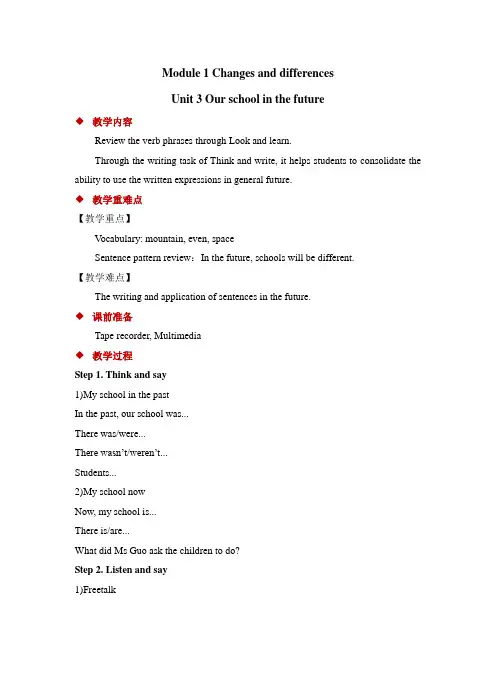
Module 1 Changes and differencesUnit 3 Our school in the future◆教学内容Review the verb phrases through Look and learn.Through the writing task of Think and write, it helps students to consolidate the ability to use the written expressions in general future.◆教学重难点【教学重点】V ocabulary: mountain, even, spaceSentence pattern review:In the future, schools will be different.【教学难点】The writing and application of sentences in the future.◆课前准备Tape recorder, Multimedia◆教学过程Step 1. Think and say1)My school in the pastIn the past, our school was...There was/were...There wasn’t/weren’t...Students...2)My school nowNow, my school is...There is/are...What did Ms Guo ask the children to do?Step 2. Listen and say1)FreetalkWhat’s a t ime box?What would you like to put into a time box?2) let’s make some wishes about changes in our school. Then put them into the time box. And then read the wishes in front of the class.➢Where will you go for a picnic? And How often?➢Will you be able to grow plants in a garden?➢Will you take books with you?➢Where will be your school ?➢How will you study in school?➢What will you be in the future?3) Read the talk between Ms Gao and students in Listen and say carefully.Then work in groups and fill in the blanks in the following exercise in Page 15.4) Read aloud again and try to retell.Students will have a picnic every month.Students will study online at home.Students will grow a lot of plants in the garden.Students will not carry any books.All their books will be on a small puter.I will be the head teacher.Step 3. Look and learnHave a picnic grow a plantStep 4. Look and readSchools of the future.1) free talk: make a prediction about the future of schools according to the pictures. Where will be schools?2) Ask and answer the questions:They will be under the sea, on high mountains and even in space.How do you find books now?How will you find books in the future?Robots will help us find books in the library.3)Make a dialogue in P17 using the key words, phrases and sentence structures. Step 5. Learn the sounds1)Show the flashcards of words in this part and lead students read aloud.2)Find out the rules of pronunciations.Step6. Think and writeWrite down wishes about changes in your school.T hen exchange them to your partner. Make a presentation about your partner’s wish. Step 7. Do a surveyWork in teams. Interview your partners and make a report.Step 17. HomeworkTell your parents about what changes will be like in schools in the future.。
沪教牛津6下教案 Module 3 Unit 7 Helping others
Module 3 Things we doUnit 7 Helping others◆教材分析Understand the ideographic functions of different tenses through the situational dialogue of Listen and say. Talk about how to help others.◆教学目标【知识目标】Through the teaching activities of Look and learn, read new words and review the same words in front of them.【能力目标】Help students practice different tenses through the activities of Ask and answer 【情感目标】Guide students to realize that helping others is also the source of their own happiness.◆教学重难点【教学重点】Sentence:How can you help others? I can...【教学难点】Help students to practice different tenses.◆课前准备Tape recorder, Multimedia◆教学过程Step 1. Listen and enjoyLead students enjoy and sing along with the tape and know the topic of this Unit. Step 2. Think and discuss1)Did you ever help other people?Did anyone help you before?How do you feel when you help other people?Why do people help each other?Step 3. Ask and answer◆Talk about how to help others in your daily life.help the blind cross the streetpick up rubbish (sweep the floor)read the newspaper to old peoplegive seats to those in need (old people/ the disabled/pregnantwomen/the sick)help tourists find their way◆Make a short dialogueStep 4. Listen and say1) Look and predict: What’s happening in the picture?2) read and answer1. Where are they?2. Why is the boy crying?3. What does the lost dog look like? (explain the new words in Look and learn)4. how did they help the boy?3) Read and fill in the table.Sally and peter cannot find the dog? Please complete the notice about a lost dog.4) read aloud and act it out.Step 5. Read a story1)Read and guess◆I am an insect. I am small and yellow. I fly among flowers.I have a sting on my tail. What am I?◆I am an insect. I am small and black.I live in a nest under the ground.Do you know me?2) Read and answer the questions in page 45.3) Think and answer◆Why do people like the bee instead of the ant?Because the bee works for flowers and people while the ant only works for himself and his queen.◆What do you think of the ant and the bee?◆Do you have any suggestions for the ant?Don’t be selfish.Work for people and plants.Do good things for others.4)Talk and shareWhat do you learn from the story?A selfish person cannot earn people’s respect.Helping other people makes you popular.A kind heart is better than a smart mind.Step 6. Learn the sounds1)Show the flashcards of words in this part and lead students read aloud.2)Find out the rules of pronunciations.Step 7. HomeworkRead the dialogue in Listen and say. Retell the story in Read a story.。
牛津沪教六年级下册module 1《unit 3 water》优秀教案(重点资料).doc
Contents
Methods
Purpose
Warming
up
Pre-task preparation
1.Sing songs
2.Daily talk:
Review the story.
new words
3. Read a poem.
How are you?
Which do you like better, blue or purple?
在学习单词时也讨论有水的地方,及水的特征,为小诗学习作准备。
While-task procedure
Post-task activity
Assignment
1.Do exercises on Photocopiable Page 17
Exercises
Read and write.
4. Ask the students questions to check for comprehension, such as: Where is water? To elicit: It’s in the waterfall. It’s everywhere around us.
The pump, the tap, the well.
Key Points: Water has no taste at all
The pump, the tap, the well.
Difficult Points: Water has no taste at all
Teaching Aids:tape、radio、word cards.
5 Distribute Photocopiable page 16 to the students. Give them time to unscamble the words. Ask: Where can we find water? And elicit the answers.
新人教版PEP上海牛津3起点英语六年级下册Unit 3 Where did you go 教案
Where did he go ? 引导学生通过观察推测故事的大意。 3.读一读,完成匹配活动。教师要求学生通过观察图片,寻找对应的对话,学生通过图
板书设计:
Unit 3 Where did you go ?
Here comes a spaceship. It’s time to go. There is the rabbit.
本课时的教学重点是故事教学。故事教学重在让学生理解故事, 理清故事情节,并能自己表演故事。所以老师在教学过程中要把握 中心,不能过于纠结于词、句的教学。本课时采用分层教学的方 教学反思 法,通过设置有层次的问题,一步步引导学生掌握故事情节,分散 难点,学生更容易接受,也能更好地融入课堂。最后教师将故事中 的重点词、句挑出,对本单元的重点知识重新梳理,使学生对本单 元的知识框架记忆得更牢固更全面。
1.教师和一位英语基础较好的学生示范表演故事,然后同桌之间戴上准备好的头饰进行 故事表演,将故事表演完整。
2.教师从故事中挑出本单元重点句型和短语,师生一起大声朗读,并做替换练习。如: How did you go there ? By plane. / By train.
Step 4 : Condolidation and extension 1.学生朗读 Story time,并读给家长听。 2.做同步精练的相关练习。
教学目标
● 培养学生综合运用知识的能力和表演能力 ● 培养学生团结互助的合作精神
教学重点 能理解 Story time 中的故事
牛津沪教六下Module 3《Unit 1 What job do you want to do》word教案
复习巩固,为新授做准备。
由生活经验引出新授内容,学生能很快进入状态。
While-task procedure
Post-task activities
Assignment
1. Look and learn
2. Look, point and match.
What does your father do?
What is your mother?
Are you a doctor?
Quick response.
Guessing games.
Grammar Practice Book 6B page 31,32
1. Look and say.
2 .Copy the new words.
1.Revision:
Plan a trip
2. names of jobs
What do you usually do at weekends?
Is your home near school?
Is your school far away from No. 1 Yaohan?
1 Talk about planning a trip to somewhere in the city.
Module 3 Unit 1 what job do you want to do?
Period 1
Teaching Aims:
Using nouns to identify people
e.g. a businesswoman, a secretary
Key Points:a businesswoman, a secretary